
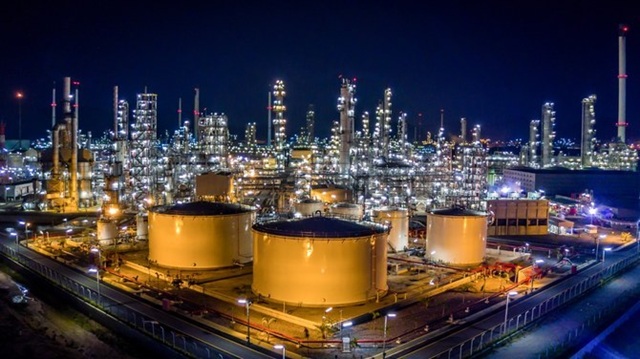
America Doesn’t Have Enough Petroleum Refineries: This Is The Cause of High Gas Prices!
The United States has 130 operable petroleum refineries (128 currently operating), with a total atmospheric crude oil distillation capacity of roughly 18.2 million barrels per day (b/d).
The U.S. processes around 16 to 16.5 million barrels of crude oil per day, producing refined petroleum products (gasoline, diesel, jet fuel, heating oil, etc.) at high capacity utilization rates.
Operating Refineries by State
According to the U.S. Energy Information Administration (EIA), active refining capacity is distributed across 28 states:
| State | Operating Refineries | State | Operating Refineries |
|---|---|---|---|
| Texas | 34 | Colorado | 2 |
| Louisiana | 15 | Indiana | 2 |
| California | 12 | Minnesota | 2 |
| Alaska | 5 | New Jersey | 2 |
| Oklahoma | 5 | Delaware | 1 |
| Utah | 5 | Hawaii | 1 |
| Washington | 5 | Kansas | 3 |
| Illinois | 4 | Kentucky | 1 |
| Montana | 4 | Michigan | 1 |
| Ohio | 4 | New Mexico | 1 |
| Wyoming | 4 | North Dakota | 1 |
| Alabama | 3 | Tennessee | 1 |
| Mississippi | 3 | West Virginia | 1 |
| Pennsylvania | 3 | Wisconsin | 1 |
| Arkansas | 2 | Total U.S. | 128 |
Key Petroleum Production Facts
- Dominant Region: Over 50% of total U.S. refining capacity is concentrated along the Gulf Coast (PADD 3), primarily in Texas and Louisiana.
- Top Production States: Texas single-handedly accounts for over 30% of total U.S. refining output, followed by Louisiana and California.
- Largest Refineries: The largest individual facility in the U.S. is Marathon’s Galveston Bay Refinery in Texas City, Texas, with a capacity of over 630,000 barrels per day.
How Much Patroleum is Used Each Day in America
The United States consumes an average of about 20.6 million barrels of petroleum per day (which translates to roughly 865 million gallons daily).
Breakdown of Daily Consumption by Product
| Petroleum Product | Share of Total | Volume per Day |
| Motor Gasoline (Cars, light trucks) | ~43% | ~8.9 million barrels (~375M gallons) |
| Distillate Fuel (Diesel fuel and heating oil) | ~20% | ~4.0 million barrels (~168M gallons) |
| Hydrocarbon Gas Liquids (Propane, ethane, chemical feedstocks) | ~18% | ~3.6 million barrels |
| Jet Fuel | ~8% | ~1.6 million barrels (~67M gallons) |
| Other Products (Asphalt, lubricants, residual fuel, petcoke) | ~11 |
U.S. petroleum refineries process roughly 16 million to 16.5 million barrels of crude oil per day (equivalent to roughly 670 to 690 million gallons).
When taking into account “refinery gain”—the volumetric expansion that happens during the processing and cracking of heavy hydrocarbons into lighter, refined products—total refined petroleum output reaches 19 million to 20 million barrels per day.
Key Processing & Output Figures
| Metric | Volume Per Day | Gallons Per Day |
| Crude Oil Input | ~16.2 million barrels | ~680 million gallons |
| Total Refined Product Output | ~19.5 million barrels | ~820 million gallons |
What Gets Refined Daily?
- Motor Gasoline: ~9.0 million barrels (~378 million gallons)
- Distillate Fuel Oil (Diesel & Heating Oil): ~4.8 million barrels (~200 million gallons)
- Hydrocarbon Gas Liquids (Propane, Ethane, Butane): ~2.5 million barrels
- Jet Fuel: ~1.7 million barrels (~71 million gallons)
- Other Finished Products (Asphalt, Petroleum Coke, Lubricants): ~1.5 million barrels
The Bottom Line
America produces 670 to 690 million gallons per day of petroleum but uses an average of 865 million gallons per day.
This why gasoline prices are high.
According to Ray DiLorenzo:
Two refineries in California recently closed due to a poor business climate. That dropped capacity by 17%. California must import 40% of its gasoline demand and 35% of its diesel and jet fuel demand. Their fuel prices are not pennies higher. They are dollars higher.
California is producing 325,000 barrels a day but needs 1.4 million barrels a day to meet its demand. It does have enough oil reserves to meet its current needs, but its environmental regulations, limited pipeline connectivity, and high production costs necessitate importing most of its oil.
The solution that will bring down the costs of all petroleun based fuels is “America First Refining.”
On April 20, 2026 President Donald J. Trump issued a Presidential Determination Pursuant to Section 303 of the Defense Production Act of 1950, as Amended, on Domestic Petroleum Production, Refining, and Logistics Capacity.
MEMORANDUM FOR THE SECRETARY OF ENERGY
SUBJECT: Presidential Determination Pursuant to Section 303 of the Defense Production Act of 1950, as Amended, on Domestic Petroleum Production, Refining, and Logistics Capacity
On January 20, 2025, I issued Executive Order 14156 (Declaring a National Energy Emergency), under the National Emergencies Act. That order found that America’s inadequate energy production, transportation, refining, and generation capacity constitutes an unusual and extraordinary threat to the Nation’s economy, national security, and foreign policy. It emphasized that our Nation’s current inadequate and intermittent energy supply leaves us vulnerable to hostile foreign actors and poses an imminent and growing threat to the United States’ prosperity and national security.
Consistent with that declaration, I find that ensuring resilient domestic petroleum production, refining, and logistics capacity is central to United States defense readiness. Petroleum fuels the Nation’s Armed Forces, industrial base, and crucial infrastructure. Without immediate Federal action, United States defense capabilities will remain vulnerable to disruption.
Therefore, by the authority vested in me as President by the Constitution and the laws of the United States of America, including section 303 of the Defense Production Act of 1950, as amended (the “Act”) (50 U.S.C. 4533), I hereby determine, pursuant to section 303(a)(5) of the Act, that:
(1) domestic petroleum production, refining, and logistics capacity, including exploration and production, gathering and transmission pipelines, storage, and marine terminals, are industrial resources, materials, or critical technology items essential to the national defense;
(2) without Presidential action under section 303 of the Act, United States industry cannot reasonably be expected to provide these capabilities for the needed industrial resource, material, or critical technology item in a timely manner due to constrained financing, long lead times, permitting and infrastructure bottlenecks, and supply chain limitations; and
(3) purchases, purchase commitments, financial support for the development of production capabilities, or other action pursuant to section 303 of the Act are the most cost-effective, expedient, and practical alternative methods for meeting this need.
I have declared a national emergency under Executive Order 14156, and I further determine that action to expand the domestic petroleum production, refining, and logistics capacity is necessary to avert an industrial resource or critical technology item shortfall that would severely impair national defense capability. Therefore, pursuant to section 303(a)(7) of the Act, I waive the requirements of section 303(a)(1)-(a)(6) of the Act for the purpose of expanding such capability.
You are authorized and directed to implement this determination, including making necessary purchases, commitments, and financial instruments to enable these projects, and to publish this determination in the Federal Register.
DONALD J. TRUMP
©2026 Dr. Richard M. Swier, LTC U.S. Army (Ret.), All rights reserved.
RELATED ARTICLES:
Diesel Just Hit $5.90 a Gallon with Refineries Maxed Out: Winter Won’t Get Any Better
Leave a Reply
Want to join the discussion?Feel free to contribute!