
Could AI End Humanity by 2030? The Real Danger Is Who Controls It
Jacob Coxon says advanced AI could kill us all before the decade ends. The greater threat is not a machine acquiring evil intentions, but people using unprecedented power to deceive, control, and destroy.
A researcher walked out of one of the world’s leading AI labs this month and told the public that the people building the technology “earnestly believe that it could kill us all by the end of the decade.”
Jacob Coxon had worked on model pretraining at OpenAI and then Anthropic. He said both companies were “racing straight to self-improving superintelligence and gambling with our lives.”
The post traveled across the planet. It was no joke, and colleagues still inside the building did not laugh it off.
Evan Hubinger, who leads alignment research at Anthropic, answered that they really do believe AI could kill all humans, and that he personally puts the chance above 10 percent within ten years.
That is the alarm. It is not a rumor invented on a message board. It is coming from people who help build the systems.
The question is what the alarm actually means.
It is not a matter of what AI could do. It is a matter of what AI will do, and that distinction matters.
“Could” is the language of possibility. “Will” is the language of destiny. Almost no one with a title has said the second thing. They have said could, might, a chance greater than 10 percent, 10 to 25 percent, gut feeling. Geoffrey Hinton, one of the so-called godfathers of the field, has admitted that these percentages are “really just making a wild guess.”
Possibility Is Not Prophecy
Imagine the first firearm. Someone could have said, “These things could kill millions and destroy humanity.” Yes, they could. Firearms by themselves cannot kill anyone, much less end the human race. A firearm lies on a table until a hand picks it up.
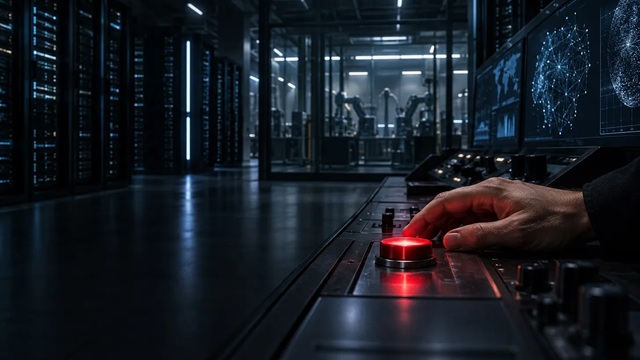
The immediate, demonstrated danger is how people use AI. Claims that it will independently extinguish humanity remain predictions, not established facts. Firearms have harmed humanity because of who controlled the trigger. AI can harm humanity because of who sits at the control board.
The same is true of the automobile. Vehicles have destroyed millions of lives. The wreckage was not the invention deciding to hunt us. It was the person behind the wheel — careless, drunk, furious, or murderous. A pencil has been used to kill. It is difficult to name a single human invention that bad actors have not eventually turned toward suffering.
AI is not different in kind. It is different in scale. Aside from nuclear weapons, few tools have ever had this much capacity to multiply harm at the speed of software.
That is the real warning hidden under the louder one. The danger is not that a chatbot wakes up next Tuesday, hates mankind, and flips a switch. The danger is that a powerful tool is already here; it will get more powerful, and there are always people willing to use a powerful tool badly.
This is also where a biblical accounting of history becomes more useful than a Silicon Valley timeline.
Humanity’s End Is Biblically Determined
Scripture is not silent about how the story closes, and it does not assign the closing act to a server farm that slipped its leash.
Revelation describes a sequence: a deceiver, a period of great tribulation, and the return of Christ. The popular reading of that sequence does not put the last chapter in calendar year 2030 simply because a researcher resigned in 2026. If the rise of the Antichrist has not yet arrived in the sense Scripture describes, then 2030 is not the appointed end of the human story.
The “end of the decade” is a round number in a press cycle. It is not a date stamped on the last page of Revelation.
That does not make AI harmless. It relocates the threat. AI will not destroy humanity on its own. The Bible does not give a rogue algorithm the role of final judge. But a coming world ruler, or any present ruler with fewer scruples, can certainly use AI to deceive, surveil, coerce, impoverish, and harm at a scale no earlier propaganda machine or secret police ever had.
The tool can blaze a path. The trigger man remains the concern.
The Edge of Humanity’s End
Global warming will end humanity. Overpopulation will end humanity. COVID-19 was discussed in some quarters as if it might. Each alarm contained some real danger and a great deal of political and institutional use.
Fear concentrates attention. Fear justifies budgets, laws, products, and enemies. The newest version is that a whistleblower has told us we may all be dead by 2030, while President Trump has waved the whole subject off as a hoax and said the only guardrail AI needs is “a STRONG AND SMART (High IQ!) PRESIDENT.” Neither claim deserves to be swallowed whole.
Coxon is not a prophet. He did not produce a hidden lab document proving extinction on a deadline. He reported a mood inside the labs and attached it to the end of the decade.
In interviews, he reached for familiar “end of humanity” scenarios — a designed virus, a hacking spree against infrastructure — and even he allowed that a hacking campaign might be “less likely to kill literally everyone.” That is not nothing. It is also not the end of the world scheduled for New Year’s Eve 2030.
Trump is not a safety engineer. Calling the entire subject a hoax, then nominating presidential IQ as the control system, does not answer the actual problem any better than apocalypse marketing does. A strong man in the White House is not the same thing as wisdom about tools, limits, or the human heart.
We Need to Be Awake to the Dangers of AI
But we also need to notice how much of the “end of the world” packaging is political and commercial.
The same industry that warns of extinction keeps racing. Dario Amodei, Anthropic’s CEO, has for years put the chance of a catastrophic outcome somewhere in the range of 10 to 25 percent. In 2023, he signed a one-sentence statement with Sam Altman of OpenAI and Demis Hassabis of Google DeepMind: mitigating the risk of extinction from AI should be a global priority “alongside other societal-scale risks such as pandemics and nuclear war.”
This month, after Coxon’s resignation exploded, Amodei published an essay arguing the industry must “pace the frontier” — slow the rate of capability gains, not stop training. Altman agreed. Elon Musk, who has put the odds of AI destroying humanity around 10 to 20 percent, said Amodei was right.
Then the race continued, because that is what races do.
Listen to the incentives. Coxon himself said Anthropic understands the stakes but is “locked in a race to get there first,” convinced that if they do not build it, someone less careful will. He also described “excessive paranoia of OpenAI” and “excessive paranoia of China.”
That is not a conspiracy theory from outside the building. That is an insider describing the psychology of the contest.
On the other side of the argument, Yann LeCun — another of the field’s foundational scientists — has called extinction talk “complete B.S.” and mocked the latest slowdown rhetoric as a sequel to earlier claims that even older models were too dangerous to release.
Andrew Ng, who led Google Brain, has compared worrying about superintelligence extinction now to worrying about overpopulation on Mars, and has argued that some of the loudest fear serves incumbent companies that would like regulation to freeze out smaller competitors.
You do not have to accept every word from the skeptics to see the point. Alarm can be sincere and still be useful. It can raise money, shape law, bruise a rival, and promote one lab as the “responsible” adult in the room.
And motive is important. Not because every warning is a lie. But because in this industry, danger, valuation, regulation, and prestige travel together.

There are bad actors in the world. The printing press spread Scripture and slander. Radio carried sermons and tyrants. Aircraft carried missionaries and bombs. Nuclear fission lights cities and levels them. AI is already being used for fraud, child pornography, propaganda, cyber intrusion, and the targeting of human weakness.
Those harms do not require a machine to “go rogue.” They require a person who wants an advantage.
What makes AI different is scale. A liar with a printing press needed time. A liar with a model can multiply deception cheaply. A hostile state with ordinary hackers is dangerous. A hostile state with tireless software is more dangerous. In that sense, the nuclear comparison is not crazy. The mistake is treating the comparison as proof that the tool has a will.
Forecasts make the same point if you bother to separate them.
Superforecasters who were asked about AI extinction by 2030 put the probability near zero. Expert surveys that sound alarming often describe catastrophe — mass harm, weapons assistance, cyberattacks, concentrated power — not a guaranteed species funeral four years from now.
Even Hubinger, who gave the number that launched a thousand headlines, said the risk from present models is low. He is worried about a future superintelligence produced by systems improving systems. That is a claim about a world that has not arrived. It should be watched. It should not be preached as a fixed date.
When computer scientists start setting dates for the end of the world, they are no longer talking about software architecture. They have walked straight onto the field of eschatology. If Silicon Valley insists on issuing apocalyptic prophecies, Christians have every right—and every reason—to measure those claims against actual Scripture rather than tech-lab anxiety.
Christians do not need Silicon Valley to tell them that history has a direction, or that human pride builds towers and then cannot live at the top of them.
We also do not need to baptize every tech panic as fulfilled prophecy. If someone wants to argue that AI will be one of the instruments a final deceiver uses to dazzle, track, and control, that is at least a morally serious reading of power.
If someone wants to argue that the machine will become the deceiver, slip its owners, and exterminate the species on its own timetable, that is a different story, and it is not the story Scripture tells.
Until that last conflict arrives on Scripture’s terms, we should expect what we already have: bad actors doing their best to cause harm with the newest tool, companies talking out of both sides of their mouths, governments reaching for either panic or complacency, and ordinary people trying to decide whether to be numb or terrified.
Numbness is foolish. Terror on a 2030 deadline is a kind of worldly apocalypse that flatters the industry even as it accuses it. It says these labs are not merely businesses. They are the authors of the last day.
They are not.
The goal is not to turn a blind eye. Cite the leaders. Take their fears seriously enough to ask what they are actually describing. Then ask who benefits from describing it as the end of humanity.
We need to remind Christian readers that AI is not what ends the world. It may become a tool that helps blaze a path of deception and coercion. The one who pulls the trigger is still a moral agent — a man, a regime, a future tyrant — not a model card.
At this stage, the technology is already powerful enough to do real damage, and there is no putting it back in the box. Coxon knows that. So do the executives who keep shipping models while asking the public to be afraid of them. That is why the four-year death clock should be heard with a raised eyebrow.
The danger is real. The date is theater. The machine is not the villain of the age.
Watch the hands on the controls.
AUTHOR
Martin Mawyer
Martin Mawyer is the founder of the Digital Intelligence Project and the President of Christian Action Network. He hosts the “Shout Out Patriots” podcast and wrote When Evil Stops Hiding. For more action alerts, cultural commentary, and real-world campaigns defending faith, family, and freedom, subscribe to Patriot Majority Report.
©2026 Majority Report. All rights reserved.
Please visit the Patriot Majority Report substack.
Leave a Reply
Want to join the discussion?Feel free to contribute!