That is what the Niskanen Center, a Washington think tank whose immigration program receives Soros-foundation backing, wants policymakers to do. The instruction appears in its November 2025 immigration blueprint.
Two weeks later, Niskanen published a county-by-county migration index, identifying hundreds of American communities as potential destinations for newcomers. Its proposed applications include planning where refugees and asylum seekers could settle.
The complete published community list appears at the end of this article, organized by state. Check whether your county is on it.
The agenda reaches straight into the question of who gets to shape your town: which places should receive newcomers, which private actors should help sponsor them, and how arrivals could be encouraged to stay.
The Soros money behind the immigration program
Niskanen’s own funding disclosure lists $300,000 from Open Society Foundation for immigration work, covering September 1, 2024, through February 27, 2026. That period includes the release of both proposals.
George Soros founded Open Society. The same Niskanen disclosure lists another $400,000 from Carnegie Corporation of New York and $100,000 from Migration Policy Institute for immigration work, with grant terms also spanning the publications.
Its model screens unemployment, job openings, rental vacancies, affordability and age. Older residents and available apartments become indicators that a community could accommodate more migration.
“aging, stagnant, or insufficient native labor supply”
Its model screens unemployment, job openings, rental vacancies, affordability and age. Older residents and available apartments become indicators that a community could accommodate more migration.
The authors explicitly discuss using updated data to plan resettlement following:
“an influx of asylum seekers at the border”
Niskanen also contemplates applications to a future refugee-admissions system. It acknowledges that local receptivity and migrants’ own choices matter.
Yet an economic score cannot answer the political question underneath it: who authorized someone else’s vision for the community?
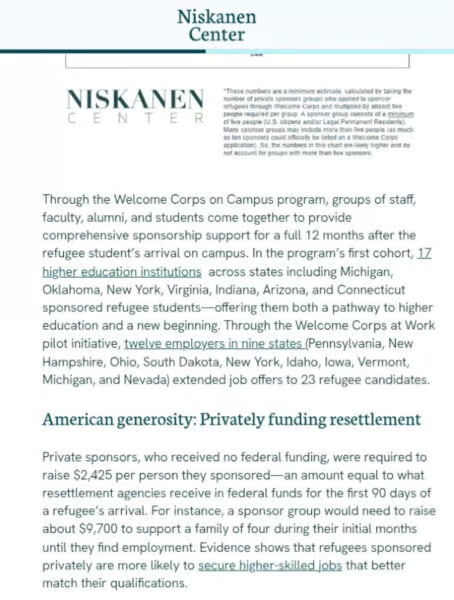
An employer’s job offer—and a refugee’s destination
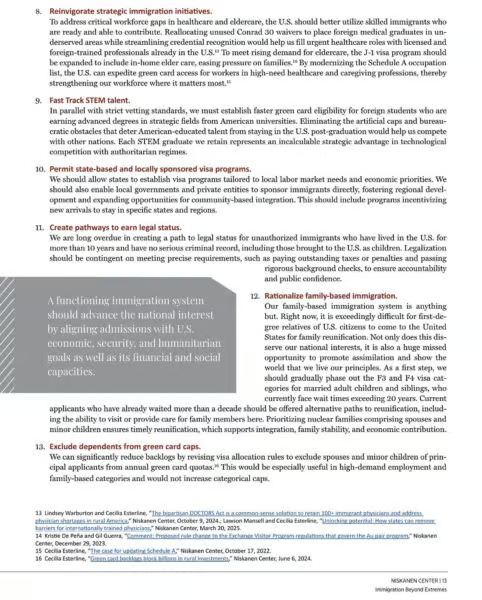
The separate immigration blueprint proposes state visa programs tailored to local labor needs, direct sponsorship by local governments and private entities, and:
“incentivizing new arrivals to stay in specific states and regions.”
That would give regional economic interests more influence over where immigration takes place. The document also supports stronger employment verification and immigration enforcement; its local-sponsorship proposal sits alongside those measures.


Leave a Reply
Want to join the discussion?Feel free to contribute!