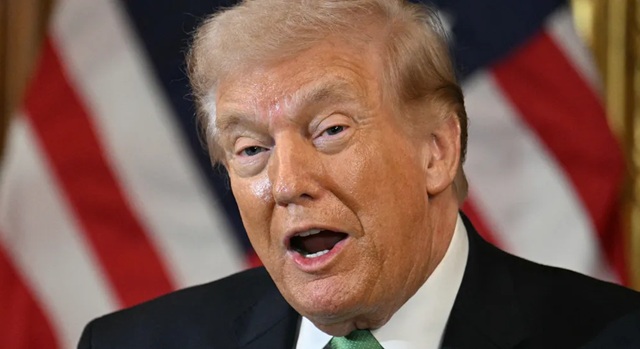
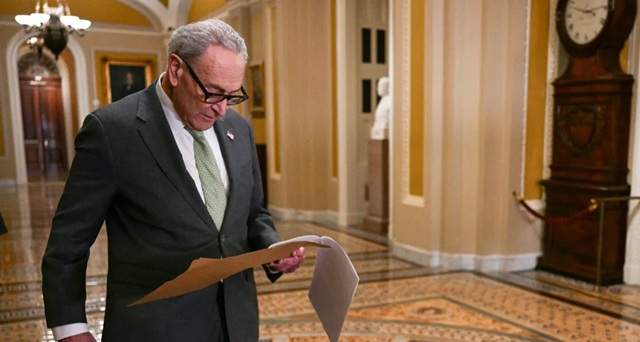
Trump, GOP Sens Lash Out at Thune for Placing Six-Week Recess Over SAVE America Act

Several prominent Senate Republicans have joined President Donald Trump in pressuring Senate Majority Leader John Thune to cancel the Senate’s August recess to pass the SAVE America Act, the voter-integrity legislation championed by the president.

The legislation aims to prevent noncitizens from voting.

As of Monday morning, Sens. Ashley Moody, R-Fla., Rick Scott, R-Fla., Mike Lee, R-Utah, Jim Banks, R-Ind., John Kennedy, R-La., and Ron Johnson, R-Wis., have come out in favor of passing the legislation before recess.

Banks stated that after New Jersey Gov. Mikie Sherrill announced that more than 6,600 noncitizens had been accidentally registered to vote, there has been a new push among Republicans to enact the legislation.

Last week, Sherrill blamed a “software error” in her state’s Motor Vehicle Commission computer system for noncitizens being added to the voter rolls. However, the company that handles the software denied the error, claiming the state government was responsible for voter registration.

Banks’ colleagues echoed his remarks, calling on Thune to cancel the August recess.

“I hereby object to any effort to put the Senate into recess in August—at least until such time as the Senate has passed the SAVE America Act—and hereby request a roll call vote,” Lee wrote on Sunday.

“Do not assume you have my consent,” Lee added, referring to a possible effort to adjourn the Senate for the month of August. “You do not.”

“The Senate doesn’t need a summer vacation as much as the country needs the SAVE America Act,” Lee wrote on X on Sunday. “Let’s cancel recess.”

Scott responded to his colleague’s remarks and wrote that “the American people expect us to deliver. They deserve secure elections.”

Over the weekend, Kennedy also took aim at Thune during an appearance on CBS, calling on the majority leader to delay the August recess.

“Take a few extra days [before recess]! I mean no disrespect to John Thune… but I think he’s just being too cautious! He wants to spend the rest of our time talking with [Chuck] Schumer about shutting down the government,” Kennedy said. “The Graham Platner wing of his party is not going to let Schumer agree with us.”

On Monday, President Donald Trump demanded on Truth Social that Thune not allow the Senate to go on break until the legislation is passed.

“John Thune should not allow the Senate to ‘leave town’ until it passes the SAVE America Act, or, far better, TERMINATE THE FILIBUSTER, where Republicans can quickly pass everything they’ve ever dreamed of, including a full and deep-throated SAVE America Act, the budget, the ever-looming debt-ceiling disaster 1929!,” the president wrote.

In the lower chamber, conservative members of Congress are furious over the leader’s inability to pass the voter-integrity legislation.

Over the weekend, Rep. Andy Ogles, R-Tenn., put out a poll on social media that asked if Thune should resign as majority leader if he doesn’t pass the legislation before the August recess.

Ninety-seven-point-six percent of respondents voted yes.

His fellow Freedom Caucus colleague, Rep. Randy Fine, R-Fla., blamed Senate leadership for “not even trying” to pass the bill.

“We’ve now passed the SAVE America Act five times,” Fine wrote on X on Friday. “The Senate has passed it zero times. If they were fighting for it, fine. But they’re not even trying.”

“That’s the problem,” he concluded.

As of now, the Senate will begin its recess after Aug. 7 and return in September.

AUTHOR

Pedro Rodriguez

Pedro Boccalato Rodriguez-Aparicio is a journalism fellow at the Daily Signal.

RELATED ARTICLES:

Trump Slaps Down Reporter’s ‘Stupid Question’ About Senate Recess

100 Days From Election Day, New Ad ‘Holds the Line’ Against Socialism

John Thune Responds To Trump’s Demand He Keep Senate Open To Pass SAVE America Act

EXCLUSIVE: GOP Leaders Circulate Talking Points To Quash SAVE America Act Revolt

EDITORS NOTE: This Daily Signal column is republished with permission. ©All rights reserved.

House Racks Up Dramatic Wins before Recess while Senate Works to Catch Up

It wasn’t easy, but Speaker Mike Johnson (R-La.) managed to go three-for-three on some of the heaviest lifts the House GOP has faced this year: the National Defense Authorization Act (NDAA), the framework for reconciliation 3.0, and a short-term government funding bill. In just 48 hours, the Louisianan ran the table on bills that the media had written off as impossible. But, as Rep. Dusty Johnson (R-S.D.) pointed out, “House Republicans, we almost always get our work done,” even, he added, if it isn’t always a “pretty journey.”

The trio of proposals adds to the mountain of business piling up in Majority Leader John Thune’s (R-S.D.) Senate, where he’s trying to game out which pieces of the House’s legislation he’ll actually pursue and which he’ll either punt or switch out for his own chamber’s version. All the while, the president sits impatiently, wondering whether his agenda items will actually make it out of Congress alive. “It’s like the Senate is a place that you send things when you want them to die,” Donald Trump told reporters.

While the House and Senate leaders seem to have a good working relationship, there’s no mistaking the tension over the two chambers’ gameplans. Right now, most observers point out, “Johnson and Thune seem to be on completely different planets.” And while the Senate is in session a week longer than the House, it still might not be enough to tie up what are turning out to be very critical loose ends.

Stopping a Government Shutdown

To foil the Democrats’ plans to shut down the government before the elections, Johnson managed to muscle through a continuing resolution that would keep the agencies funded through December 4 — well after the midterms. Six Democrats and Rep. Kevin Kiley (I-Calif.) joined the GOP in pushing the bill across the finish line (220-205). “This clean, short-term [CR] simply keeps the government open, protects the progress we’ve made, and preserves the path to full-year appropriations,” Chairman Tom Cole (R-Okla.) explained on the floor.

His budget counterpart in the Senate, Ron Johnson (R-Wis.) — the successor to the late Lindsey Graham — has no illusions about the lengths the Democrats will go to score political points. “They’ve completely blown up the appropriations process,” he told Family Research Council President Tony Perkins on “Washington Watch” this week. “I think by and large, most of them are spoiling for a shutdown, thinking that would give them an advantage in the election.” But he’s also heard that there might be enough support from Minority Leader Chuck Schumer’s (D-N.Y.) caucus to pass a relatively clean CR in the hopes that Democrats take over the House and can press for big spending.

Regardless, he shook his head, “I definitely question their motives. It’s certainly not to be helpful, certainly not to be for the benefit of the American public. It’s for their own personal political power and for growing government. But it’s just possible we might get a CR because of those motivations.”

Whose CR is the better question. On Tuesday, Thune seemed to ignore the House version, opting instead to try to strike his own deal with Democrats, since he’ll need at least seven to reach the 60-vote threshold. “That is something I intend to bring to the floor for a vote before the August break,” he vowed.

The speaker seemed to give his partner latitude, telling reporters Wednesday, “I think Leader Thune believes he’ll have some reasonable Democrats in the Senate that will assist. I certainly hope that’s true and hopefully that’ll spark some in the House as well. So I think we’ll get it done.” If not, Thune has threatened to use budget reconciliation to force the government’s funding extension through on a simple majority vote.

At the end of the day, Senator Johnson wanted people to know, “Democrats are all about power. And to the extent that they can create chaos, [they will].”

Moving on Reconciliation 3.0

Speaking of reconciliation, despite a lot of hemming and hawing, House Republicans ultimately bowed to Trump’s wishes and agreed to unlock the process to a third reconciliation bill Wednesday — overcoming a lot of conservatives’ objections in the process. The budget resolution, which was an iffy prospect at best last week, squeaked through with two votes to spare after a group of hardline GOPers flipped to “yes” at the last minute.

The House’s latest gambit partially fulfills Trump’s wishes for more defense funding to fight Iran, agreeing to another $73 billion for the Pentagon, $12 billion in farm aid, and $10 billion to implement parts of the SAVE America Act. To help secure elections, Johnson’s plan would create a pot of money for states that agree to mandate voter ID and proof of citizenship at the polls.

Reflecting on the dim prospects for reconciliation earlier in the week, Rep. Ralph Norman (R-S.C.) admitted that “part of what happens with these legislative journeys is at the beginning, everybody is comparing the proposal to perfect, what they want. As the week moves on, people generally understand that they need to be comparing the proposal with some other realistic option, and that perfect is never going to happen around here,” he said. “As that happens, people across the spectrum in the House understand that what’s been proposed isn’t that bad. That’s why we’ve generally won votes Wednesday, Thursday, Friday that looked pretty bleak on a Monday or a Tuesday.”

But the journey is far from over. The Senate GOP isn’t exactly chomping at the bit to launch the fraught process. Thune has already managed expectations, insisting that he won’t move the House’s blueprint until the government funding problem is solved. “That means reconciliation won’t move in the Senate anytime soon — and passing a bipartisan stopgap spending bill could still take weeks or months of additional work,” Punchbowl News cautioned.

“I think [Thune’s] looking at all contingencies,” the speaker agreed. “…[W]e’ll coordinate on strategy, but I think there’s a lot of game to be played between now and then, so we’ll see what happens.”

Part of the hesitation on the Senate’s part has to be the terrifying prospect of a vote-a-rama right before the midterm elections. As part of reconciliation, Democrats can force an unlimited number of amendment votes on any issue they want — forcing vulnerable Republicans to take positions on a number of politically dicey issues like the Iran war, for example. And, Punchbowl adds, with the narrow margins, “it’s naïve to believe that Senate GOP leaders would be able to defeat all of them.”

Look, Ron Johnson acknowledged to Perkins, “It’s never an easy task, reconciliation. I think this one will be made easier because President Trump and the White House are really taking a leading role here. It’s a more modest; it’s a skinnier version of what a lot of people want. … Everybody’s got their own ideas in terms of what they want to do in a third reconciliation package. So this one’s going to be focused on military spending. What can we do to help farmers? And what can we do to restore integrity to our elections? Those are things that most Republicans agree on,” he noted.

Yet, they’re also, Senator John Kennedy (R-La.) observed, not exactly Schumer’s priorities. “Money for the military, and money for the farmers, and a fair chance of passing the SAVE Act — you’re not going to get it in regular order,” he argued. “And if you think otherwise, you’re entitled to your opinion, but I’ve got rocks in my driveway that are smarter.”

Another reason why Thune might hold his fire on reconciliation is that he could very well end up needing that tool to keep the government’s lights on. “I hope that’s not necessary,” he said. “We’ve had conversations, productive conversations, on both sides of the aisle on a funding resolution that would carry us past the November election.” But if not, having another reconciliation bill in his back pocket may be the only way to get the agencies the dollars they need.

Defunding Planned Parenthood

One of the major grudges pro-lifers continue to hold against Congress is its refusal to carry over the defunding of America’s biggest abortion business into a second year. After Republicans accomplished that long-awaited dream in Trump’s One Big Beautiful Bill, stripping more than $800 million from Planned Parenthood in 2024, some corners of the party have abruptly walked away from that fight in the second and third reconciliation bills — to the dismay of grassroots conservatives. Making that sting even more, the floodgates reopened July 4, the same day America celebrated its 250th birthday.

The speaker hasn’t abandoned the idea, though, telling pro-life groups that a fourth reconciliation bill might be in play to rectify this wrong. Majority Leader Steve Scalise (R-La.) echoed that thought, insisting that reconciliation 4.0 can “do the things that are left out of this one.” Budget Chair Jodey Arrington (R-Texas) agreed.

The fact that it’s not a part of the current budget framework is “concerning,” Rep. Mark Harris (R-N.C.) told Perkins earlier this week. “And we’re certainly continuing to add our voice to the fact that we’ve got to do something here. I was in a meeting with the speaker just yesterday, and I do believe that he is working with a number of pro-life groups [on] that and really moving strategically as we get into the fall,” he noted. There are also things on the table “that we possibly can do that would almost change the landscape of the way Planned Parenthood is viewed,” the former pastor said without revealing details.

In the meantime, Harris stressed, “This has got to happen. The fact that we passed out of the House a one-year ban in the One Big Beautiful Bill, it got to the Senate, they cut it back to one year, and that just expired on July 4th” should mean Congress can do it again, he said. “It is at the top of our list. We’re continuing to push toward that.”

AUTHOR

Suzanne Bowdey

Suzanne Bowdey serves as editorial director and senior writer at The Washington Stand.

EDITORS NOTE: This Washington Stand column is republished with permission. All rights reserved. ©2026 Family Research Council.


The Washington Stand is Family Research Council’s outlet for news and commentary from a biblical worldview. The Washington Stand is based in Washington, D.C. and is published by FRC, whose mission is to advance faith, family, and freedom in public policy and the culture from a biblical worldview. We invite you to stand with us by partnering with FRC.

After 76 Days, GOP House Votes to End Democrat Government Shutdown — DHS NOW FUNDED

President Donald Trump has signed a bill to restore funding to the Department of Homeland Security, ending a record-setting 75-day lapse in funding for the critical agency tasked with protecting U.S. soil.

Trump signed the bill Thursday after the House of Representatives reached a bipartisan agreement to fund DHS. The House approved the Senate-passed spending measure by voice vote, covering most of the department’s appropriations through September.

Notably, however, U.S. Immigration and Customs Enforcement (ICE) and U.S. Customs and Border Protection (CBP) will remain unfunded under the current legislation.

Mullin: Perhaps no one is as pleased as Markwayne Mullin, our nation’s new DHS Secretary, who was sworn in on March 24th to lead a department without a fully-funded budget. Mullin on Thursday afternoon: After 76 days, the longest government shutdown in history is over. @DHSgov is back open, @ICEgov and @CBP will be funded through reconciliation (with NO Democrat votes) so liberals can’t play games with federal law enforcement funding. To be clear, this Democrat shutdown NEVER should have happened.

Fox News: The DHS secretary Mentioned funding ICE and CBP (Customs and Border Patrol) through reconciliation. A first hurdle was passed on that as well on Thursday: House Republicans just cleared a key first hurdle to move ICE and Border Patrol funding forward without Democratic votes. The chamber passed a budget framework 215-211 along party lines, setting up the reconciliation process for a later bill that aims to provide about $70 billion for the agencies.

RedState: Although these maneuvers won’t solve everything immediately, they would stave off a looming issue: the White House had warned that the government would not be able to pay hundreds of thousands of federal employees beginning in May as funds were drying up due to the partial shutdown.

AUTHOR


RELATED ARTICLES:

SENATE SHOCKER: Mills Bails – Nazi-Tattooed Platner Poised to Take Democratic Nomination

TRUMP RIPS IRAN: ‘Get It Together, Sign a Nonnuclear Deal’ — War Hits 2 Months, Still No Agreement

RELATED VIDEO: Trump Assassination Attempt, Kimmel’s WHCD Joke, Comey & Fauci Indictments, and the UK Visit | VDH

EDITORS NOTE: This Geller Report is republished with permission. ©All rights reserved.
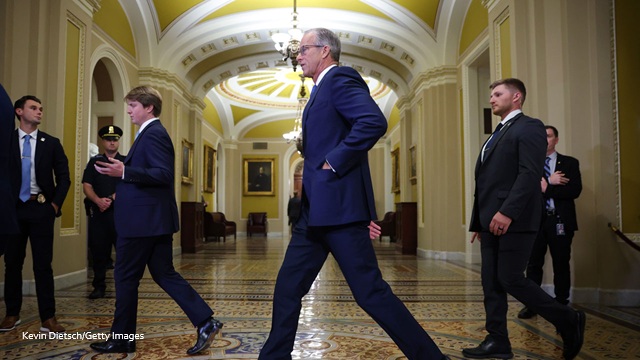
Outcry Erupts over Dems’ Refusal to Fund Secret Service, DHS after Mass Assassination Attempt

While America tries to process what happened at Saturday night’s White House Correspondents’ Dinner, the chaotic images of what could have been a mass casualty event will be impossible to forget. The horror-stricken faces of men and women huddling under tables, Speaker Mike Johnson (R-La.) sprinting down the hallway with his security detail, the sound of trays clattering to the ground as SWAT teams leapt over tables and drew their rifles are etched on all of our minds. But as grateful as everyone is that a massacre of some of the country’s highest-ranking leaders was thwarted, incredibly serious questions remain — not the least of which is how we got here in the first place.

To everyone’s relief, the 31-year-old gunman who raced through the magnetometers was tackled and subdued before he could kill anyone. Still, the harsh reality remains: this is the third serious attempt on the president’s life in less than two years. We are officially, as National Review’s editors warn, in the grip of a deadly insanity as a nation. “The feverish opposition to Trump — who is another Hitler, according to the left, and might be the Antichrist … provides a permission slip for sundry fanatics and losers to resort to political violence.”

Meanwhile, throwaway posts about lowering the temperature and “ending the hostility” abound from Democrats, who have yet to acknowledge the lethal environment their government shutdown created. Instead, House Minority Leader Hakeem Jeffries (D-N.Y.) took to Fox News to try to paint the violence as a bipartisan problem. “Listen,” Jeffries told Shannon Bream Sunday, “I think that here in America we can have strong disagreements, but it’s important for us to agree to strongly disagree without being disagreeable with each other. And it is certainly the case that violence is never the answer, whether it’s targeted at the Right, the Left, or the center.”

It’s a convenient soundbite for the leader of a party who’s decided to roll the dice with American security for the last 70 days. As RNC Chairman Joe Gruters fired back, “Democrats can issue all the hollow calls for ‘unity’ they want, but their actions tell the truth — they’ve repeatedly blocked funding for DHS and the very law enforcement agencies tasked with protecting Americans. You cannot inflame division, undermine public safety, and then pretend to stand for peace. Until Democrats fully fund our security, their words are worthless.”

Thanks to Jeffries and Senate Minority Leader Chuck Schumer (D-N.Y.), the very Secret Service agents who stopped Saturday’s bloodbath are working without paychecks. “It’s really important that law enforcement did their job,” former Acting Homeland Security Secretary Chad Wolf agreed before adding, pointedly, “And I’ll just reiterate, Secret Service is part of the Department of Homeland Security, which remains unfunded at this day and time. And so, these agents and officers are doing their job despite the Democrats in Congress refusing to fund them.”

“It’s outrageous,” Scott Jennings argued on CNN Sunday. “We’re not paying these guys. The [Democrats] who’ve got [Homeland Security] shut down need to think long and hard about last night … [and] what that means to [an officer] who has to show up and take a bullet. Every American ought to be outraged by it.”

Fury continued to pour in from GOP leaders, who’ve tried for weeks — and failed — to reopen the agency tasked with U.S. security. Now, Republicans can’t help but wonder if a shortage of resources might have led to the opening that madman Cole Allen exploited. “Democrats have caused THE LONGEST GOVERNMENT SHUTDOWN IN HISTORY,” the speaker fumed. “Democrats REFUSE to pay law enforcement for over TWO MONTHS because they want to reopen the border for criminal illegal aliens. Democrats’ shutdown is not just DISTURBING — it’s DANGEROUS. Protect American citizens. Fully fund DHS.”

To all the “anti-American Democrats,” Senator Tommy Tuberville (R-Ala.) declared, “it’s time to get your head out of you’re a** and fund our national law enforcement. ALL Americans deserve to live in safety and without fearing for their lives.”

One thing that should come of this nightmare, Acting Attorney General Todd Blanche stressed, is the Democrats’ cooperation in reopening the department. “I hope this is a wake-up call to Congress,” he emphasized on Fox News Sunday. “I hope this is a wake-up call that the games that they’ve been playing, really with the lives of the men and women protecting them, should end.”

Even the president, reflecting on the heroism of the night before, could only shake his head at the situation Schumer’s party has created. “The Secret Service and all law enforcement was … outstanding. … They stopped him cold. … And you just look at them. They were these strong, solid people who’ve got to get paid. You know, this is a group that is not being paid. If you think about it, you know, the Democrats are holding up their pay.”

After Saturday’s incredibly close call, Schumer’s party may be forced to the negotiating table on optics alone. Tired of waiting, Republicans had teed up a reconciliation bill to muscle the funding through on their own two days before the attack at the Washington Hilton happened. It was a last-ditch effort to break through the wall Democrats had built to protest ICE, despite how vulnerable it made the country.

Johnson had expressed optimism on Saturday’s “This Week on Capitol Hill” that his caucus was “finally on the path to get [it] done.” But frankly, he argued, “it’s rather shocking that we’re in this situation. … “The Department of Homeland Security is the third largest department of the federal government — with 10 agencies beneath it. And all of them are tasked with keeping America safe. It’s gone unfunded because the Democrats are playing political games. So we’re going to have to do this on our own. It’s shameful … but that’s where we are.”

Almost prophetically, the speaker pointed out what a “scary and dangerous” situation the country was in. “And the Democrats want to play political games. I just don’t know what else to say about it.”

Now, unfortunately, there’s plenty.

AUTHOR

Suzanne Bowdey

Suzanne Bowdey serves as editorial director and senior writer at The Washington Stand.

RELATED ARTICLES:

Trump Puts Ambitious White House Ballroom Project Back Into National Spotlight Following Third Assassination Attempt

DOJ Investigating Alleged Leftist Ties to White House Correspondents’ Dinner Suspect

‘You’re A Disgrace’: Trump Snaps At ’60 Minutes’ Reporter After She Reads From Would-Be-Assassin’s Manifesto

Alleged Shooter’s Manifesto Included DEI Self-Audit Before Attack On Trump Officials

Ex-US Gymnast Jennifer Sey Reacts After ‘Terrifying’ Shooting At White House Correspondents’ Dinner

Would-Be Trump Assassin Wasn’t Only One Encountering ‘Insane’ Security Arrangement At Glitzy Dinner

TERROR ATTACK: Would Be Assassin At White House Correspondents’ Dinner Was ‘TEACHER OF THE YEAR IN LOS ANGELES COUNTY”

RELATED VIDEO: Hakeem Jeffries doubles down after shooting at correspondence dinner again calls for ‘maximum warfare’ on Republicans

EDITORS NOTE: This Washington Stand column is republished with permission. All rights reserved. ©2026 Family Research Council.


The Washington Stand is Family Research Council’s outlet for news and commentary from a biblical worldview. The Washington Stand is based in Washington, D.C. and is published by FRC, whose mission is to advance faith, family, and freedom in public policy and the culture from a biblical worldview. We invite you to stand with us by partnering with FRC.

Johnson, Thune Hatch Plan to End DHS Shutdown and Launch Second Reconciliation Push

As the almost 50-day partial shutdown drags on, travelers have definitely found some creative coping mechanisms for their long waits at U.S. airports. In Houston, one man went viral for walking up and down the security line with a vodka bottle, pouring shots for annoyed adults. Atlanta’s Hartsfield-Jackson brought in live entertainment, a violinist who was supposed to ease some of the tension. “[A] violin playing like on the deck of the Titanic. Is it that bad?” one passenger joked. And in Baltimore, volunteers passed out “pick-me-up snacks.” Now that TSA workers are finally getting paid, Americans’ aggravation is starting to subside — just not where Congress is concerned.

What was a four-hour checkpoint in Houston had dwindled to just 10 minutes on Monday, PBS reported — a world of difference from the endless nightmare passengers were experiencing just 48 hours earlier. After weeks of maddening scenes across the country, there are signs that things may slowly be returning to normal. On Capitol Hill, though, there’s been no reprieve from the biggest standstill: Homeland Security funding. But that’s about to change.

While the president found a workaround for TSA agents, the two chambers have been logging long phone calls in search of a solution to turn the lights on across DHS. As Politico points out, “While about 50,000 airport security officers are now getting paid under Trump’s executive action, thousands more workers remain furloughed or working without pay. Those include more than 2,000 employees of the premier federal cybersecurity agency, more than 4,000 FEMA workers as well as more than 1,000 Coast Guard civilians.”

On Wednesday afternoon, the situation took a dramatic turn when the two GOP leaders — who were at odds on strategy before the Easter recess — released a joint statement agreeing to compromise on their differences. In it, House Speaker Mike Johnson (R-La.) and Senate Majority Leader John Thune (R-S.D.) both agreed to swallow pieces of the other chamber’s proposal in an effort to get all of Homeland Security funded.

“In the coming days, Republicans in the Senate and House will be following through on the President’s directive by fully funding the entire Department of Homeland Security on two parallel tracks: through the appropriations process and through the reconciliation process,” they explained. “We appreciate,” they continued, “that Senator [Lindsey] Graham (R-S.C.) and the Senate Budget Committee have already initiated the process of developing a budget resolution that will ensure border security and immigration enforcement will be funded for the balance of the Trump Administration and insulated from future attempts by the Democrats to defund those agencies.”

Translation: House Republicans will be pressured to accept the Senate’s proposal to partially fund Homeland Security in exchange for Thune’s help in passing another reconciliation bill (which would presumably finance ICE and Customs and Border Patrol). Of course, the advantage of reconciliation, that tricky budgetary process the GOP used to move the One Big Beautiful Bill, is that it lets conservatives bypass the Senate’s 60-vote threshold and get legislation over the finish line with a simple majority — an absolute necessity in the era of absurd Democratic obstruction.

Last Friday, House Minority Leader Hakeem Jeffries (D-N.Y.) pushed hard to bring the Senate-passed proposal to the floor — to no avail. Wednesday afternoon, he reiterated that position, posting that it was “time to pay TSA agents, end the airport chaos and fully fund every part of the Department of Homeland Security that does not relate to Donald Trump’s violent mass deportation scheme.”

Assuming that position holds, the Democrats’ help will be crucial in getting the Senate bill over the hump in Johnson’s chamber, where some conservatives were already grumbling about the new, two-track plan. But even they must recognize the quandary leadership is in when Minority Leader Chuck Schumer’s (D-N.Y.) party is determined to put political messaging above American safety.

“We operated under a belief that while our country is in the midst of an international armed conflict, Democrats might finally come to their senses and understand that defunding our homeland security agencies is beyond reckless and very dangerous,” the two leaders pointed out. “[But] it is now abundantly clear that Democrats place allegiance to their radical left-wing base above all else — including their own power of the purse — which means open borders and protecting criminal illegal aliens. That is not acceptable to Republicans in Congress, nor is it to the American people. We cannot allow Democrats to any longer put the safety of the American public at risk through their open border policies, so we are taking that off the table.”

By early Thursday morning, the new plan was already moving. In its pro-forma session, the Senate sent its partial funding bill back to the House, where action will likely be taken early next week. Meanwhile, conservatives are bracing for the wild race toward reconciliation.

The challenge, most people agree, will be political discipline. There’s always a temptation for the party chasing reconciliation to throw every possible thing at the wall and see if it sticks. But this cannot be a catch-all, conservatives warn. “I would keep it as simple as possible so it could pass,” Johnson reiterated. While some Republicans will want to slip in Iran funding, pieces of the SAVE America Act, or other logjammed bills, an injection of too many priorities could “kill the whole thing,” one senator acknowledged anonymously.

“If you want to keep all of our members tight,” outgoing Senator Thom Tillis (R-N.C.) insisted, “… we need to agree to parameters and not allow scope creep.” The majority leader echoed the sentiment. “We’re just trying to make sure we keep our expectations realistic,” Thune said.

One advantage of the idea is that Republicans could fund all of DHS for multiple years — sparing them (and the country) this headache every time Homeland Security appropriations comes up. On that, both chambers agree. “We’re going to send [the House something] that actually funds DHS for the next three years. We’re not going through this again with the Dems, okay?” Senator John Hoeven (R-N.D.) emphasized.

Rep. Kevin Hern (R-Okla.) wonders if the House can find a sweet spot on reconciliation the second time around. “The reality is, we will be fine in the Senate,” he explained, recognizing that Thune can still lose three Republicans on reconciliation and still pass the bill. “The House is where we’re going to have the problem,” he cautioned on Tuesday’s “Washington Watch.” But we’re going to have people in swing districts [who] are going to have a real problem with it. The speaker knows that. We all know that, and we’re working hard to try to figure out a way forward.”

Singling out the perpetual thorn in Johnson’s side, Rep. Thomas Massie (R-Ky.), Hern acknowledged, “… There are a lot of reasons why we don’t have the full vote margins that we need. … And we know that we have one member [who’s] going to vote against everything that we do going forward. So we can’t lose any[one]. And that’s a very difficult situation when you’re trying to pass something as monumental as a second reconciliation bill.” Especially when the president throws down this timeline: “I am asking that the Bill be on my desk NO LATER than June 1st,” he posted Wednesday.

But the current situation isn’t just unsustainable, it’s historic. “Listen, not every single Democrat is against funding the security of our border and ICE,” Hern wanted people to know, “but the stranglehold by the Democrat[ic] leadership is making it such [that] if you vote to do the right thing for America, you’re a bad person. [And] I do think that it’s unprecedented.”

AUTHOR

Suzanne Bowdey

Suzanne Bowdey serves as editorial director and senior writer at The Washington Stand.

EDITORS NOTE: This Washington Stand column is republished with permission. All rights reserved. ©2026 Family Research Council.


The Washington Stand is Family Research Council’s outlet for news and commentary from a biblical worldview. The Washington Stand is based in Washington, D.C. and is published by FRC, whose mission is to advance faith, family, and freedom in public policy and the culture from a biblical worldview. We invite you to stand with us by partnering with FRC.

DHS Funding Drama Pits House against Senate

The Senate and the House of Representatives are still sparring over funding for a critical federal agency, even as air travel is crippled and the threat of terrorist acts looms large. In the earliest hours of Friday morning, while much of America still slept, Senate Republicans attempted to end the impasse they had reached against their Democratic counterparts and end the longest Department of Homeland Security (DHS) shutdown in U.S. history.

The deal was met with outrage by House Republicans, however, as the bill provided funding for the Transportation Security Administration (TSA), Federal Emergency Management Agency (FEMA), Coast Guard, and other DHS components, but deliberately excluding funding for Immigration and Customs Enforcement (ICE) and Customs and Border Protection (CBP), the two DHS agencies responsible for immigration enforcement and border security, labeled problematic by Democrats.

Senate Minority Leader Chuck Schumer (D-N.Y.) touted the bill’s passage as a win for Democrats, charging that Senate Republicans “caved to our demands to fund DHS without a blank check for ICE and CBP.” He added, “Democrats held firm in our opposition that [President] Donald Trump’s rogue and deadly militia should not get more funding without serious reforms, and we will continue to fight for those reforms.”

House Speaker Mike Johnson (R-La.) lambasted the funding bill as a late-night “gambit” and a “joke,” suggesting that Senate Majority Leader John Thune (R-S.D.) and other Senate Republicans likely hadn’t even read the text of the bill they approved. “I’m quite convinced that it can’t be that every Senate Republican read the language of this bill,” Johnson quipped. “It’s pretty alarming.” He cited a portion of the bill clarifying that there will be no funding provided to ICE and CBP, commenting, “We’re not doing that.”

Rep. Chip Roy (R-Texas) spoke forcefully against Senate Republicans for passing the bill and then immediately leaving Washington, D.C. for the Easter recess period. “It is absolutely offensive to the people that we represent that the Senate would send over a bill that doesn’t fund Border Patrol and the core components of ICE,” he told reporters Friday. “It’s absurd. And the fact that they would expect us to take that up and pass it today, as they leave town — I mean, could the Senate be any more lazy than to send to us a bill that doesn’t do the job and then leave town? We’re going to stand up and say no to that. We’re going to send back a bill that’s responsible to the American people.”

Accordingly, House Republicans passed their own funding bill to ensure that the entirety of DHS receives federal funding, faulting Democrats for allowing the agency to be shut down for nearly 50 days now, even as war with Iran heightens national security concerns. “Is our border secure? Are our airports safe? Will hardworking personnel receive their paychecks? Can Secret Service plan for the security of upcoming national events? Do Americans have confidence that their government is doing its job to protect the country? This bill answers those questions with certainty,” said House Appropriations Committee Chairman Tom Cole (R-Okla.) in a statement. “It ends the Democrat shutdown, restores full funding for the Department of Homeland Security, and ensures the men and women on the front lines of safeguarding our nation are paid, supported, and able to carry out their duties without continued disruption. It brings stability back to DHS now — and makes clear where the House stands: with our citizens.”

The House bill is a stopgap measure intended to fund DHS fully for a 60-day period while lawmakers continue battling over long-term funding. Congressional Democrats originally refused to fund DHS starting February 14, in an effort to halt ICE and CBP operations, maligning the immigration agencies as lawless and aggressive following controversial operations in Minnesota earlier. Since then, travelers have been waiting longer and longer periods of time in line at airports as unpaid TSA staff either quit or refuse to show up for work. Late Friday, 209 House Republicans were joined by three House Democrats and one Independent to pass the funding measure, while 203 Democrats voted against it. Eight Republicans and eight Democrats did not vote.

Schumer pledged that Senate Democrats would shut down the House bill, just as they have killed previous House efforts to fully fund DHS, describing the new bill as “dead on arrival.”

In a “Washington Watch” interview Friday night, Senator Ron Johnson (R-Wis.) suggested that the House bill will likely fail in the Senate, instead recommending that DHS be funded through the budget reconciliation process, a theory floated previously by Thune. “The good news is ICE and CBP were funded by the One, Big, Beautiful Bill for a period of time. So we have a way to cure this. What we need to do is get this behind us, get on the same page,” he said. Through the reconciliation process, Johnson suggested, Republicans can pass “a very focused and very rapidly-passed reconciliation bill. My suggestion is let’s pass all of DHS for the Trump term and beyond.” He continued, “Again, it’s going to be a big price tag, but it’s going to be in lieu of appropriations, so Democrats can never use DHS and the men and women of DHS as pawns in their political games.”

Johnson shared that he was “disappointed” that the House rejected the Senate funding package, noting that friendly mainstream media coverage largely protects congressional Democrats from being held accountable by voters. “We can’t force Democrats to do certain things when you have no accountability, no pressure by the mainstream media. So that’s the pickle we’re in as Republicans. It’s not a fair fight. It’s not a level playing field,” he said. “I mean, if we could have passed something we would have done that. We would have done that days ago, weeks ago. But it’s not going to pass. So it’ll be right back in this House’s lap.”

Also on “Washington Watch” Friday, Rep. Glenn Grothman (R-Wis.) addressed many of the points raised by Johnson. Grothman said that Republican senators who backed the funding bill isolating ICE and CBP “would tell you … we have enough money available right now that we can do a reconciliation package and get the money to fund these two vital organizations before they run out of money.” He continued, “The problem is we have a very slim majority in the House of Representatives, and there is no guarantee that we can put together any package that will only cause us to lose two votes and could easily be one vote.” The congressman added, “Therefore we feel it would be reckless not to pass a bill that is fully funding both ICE and Border Patrol right now.”

In response to the funding crisis, the president issued an executive order demanding that DHS use funding already available to it in order to pay TSA agents. “As the Democrat-caused shutdown of the Department of Homeland Security (DHS) continues well into its sixth week, America’s air travel system has reached its breaking point. This is an unprecedented emergency situation,” the president wrote. He added that the approximately 50,000 TSA agents who have gone unpaid for weeks have been denied funds by “Democrats’ reckless decision to prioritize criminal illegal aliens over American citizens and shut down DHS until their demand to prohibit enforcement of Federal immigration law is met.”

“If Democrats in the Congress will not act to honor the service of our TSA officers, who are now performing their critical public safety responsibilities without knowing whether they will be able to buy food for their families or pay their rent, then my Administration will take action,” the president announced. “As President of the United States, I have determined that these circumstances constitute an emergency situation compromising the Nation’s security.”

Grothman commented, “Donald Trump solved the biggest problem by … announc[ing] that he is going to fund the people at the airports. And I think that of all the things that Homeland Security does, that’s the one thing that has to get done and the people care about.” He suggested that without the public pressure resulting from the lapse in TSA funding, congressional Republicans may be more likely to fight Democrats to fund ICE and CBP. “So since he has just announced he is going to fund that, I think the other parts of the law, well, hopefully we’ll be able to come to a compromise on them.”

Some Senate Republicans have voiced that they would like to fight Democrats on the issue. Senator Mike Lee (R-Utah), for example, said in a Sunday night social media post, “Waiting for a deal to materialize with Chuck Schumer applies no pressure on Senate Democrats to fund DHS. Interrupting their recess and forcing them to debate DHS funding on the Senate floor *would* apply pressure. We can’t reward unprecedented obstruction with two-week recesses.” He further suggested that the president could exercise his constitutional authority to convene an “extraordinary” Senate meeting in order to force debate and a vote.

AUTHOR

S.A. McCarthy

S.A. McCarthy serves as a news writer at The Washington Stand.

EDITORS NOTE: This Washington Stand column is republished with permission. All rights reserved. ©2026 Family Research Council.


The Washington Stand is Family Research Council’s outlet for news and commentary from a biblical worldview. The Washington Stand is based in Washington, D.C. and is published by FRC, whose mission is to advance faith, family, and freedom in public policy and the culture from a biblical worldview. We invite you to stand with us by partnering with FRC.

Thune Has Got to Go

GOP House rep urges ouster of John Thune from leadership

“We should call on Thune to step aside,” Rep. John Rose said

By  Natalia Mittelstadt, Just The News, March 27, 2026 2:03pm

Tennessee Republican Rep. John Rose called for the removal of Senate Majority Leader John Thune from leadership on Friday.

“We should call on Thune to step aside,” Rose told Newsmax host Todd Starnes, the TV anchor posted on X.

“We now have a sitting member of Congress officially calling on Majority Leader John Thune to be removed from power,” Starnes wrote.

Earlier on Friday, Rose called out the Senate’s passage of a spending bill that would partially fund the Department of Homeland Security, except for U.S. Immigration and Customs Enforcement and U.S. Customs and Border Protection.

“And just like that, while Americans were asleep, Senate Republicans were wide awake tossing the radical Democrats a political lifeline to end the government shutdown without funding ICE and our brave Border Patrol,” Rose posted on X. “Now they’re off to take their recess — getting off the hook from having to vote on the SAVE America Act and fully funding ICE.”

“I’m glad TSA agents will finally get their paycheck. They should NEVER be used as political pawns again. But let me be clear: this shutdown was squarely on the Democrats. They put illegal aliens before Americans, and some Senate Republicans just ran cover for them,” he added.

Rose posted on X on Wednesday, calling out Thune directly, saying, “President Trump is right. @LeaderJohnThune & Senate Republicans should weld the SAVE America Act to must-pass DHS funding. Protect our elections. Secure our homeland. We should do both, not just because Americans overwhelmingly support it, but because it’s the right thing to do. Full stop.”

Thune has not just failed us, he has served our enemies.

Time and time again, Thune delivers for the Democrats. His funding (or lack of) bill that omitted border security and ICE was a gift to Schuer and the party of treason.

John Thune left DC without going on a full recess to block President Trump from making recess appointments…

While the Senate is on vacation.

President Trump is the only President in history blocked from making recess appointments by “his own” party.

AUTHOR

RELATED ARTICLES:

‘WE’RE NOT ACCEPTING THAT GARBAGE FROM THE SENATE”: House Passes Spending Bill That Funds All of DHS, with ICE and CBP Included

PRIME MINISTER ORBÁN DROPS BOMBSHELL: Billions in Ukraine Aid Were Used for the Democrats Elections in the States

Muslim Woman in U.S. Military Says She Won’t Fight Muslims

Iran Promotes Trump Assassination Bounty, $25 Million Pledged

Senate Confirms New DHS Secretary Markwayne Mullin As Democrats Continue Funding Blockade

RELATED VIDEO: Democrat Party has Fallen: Liberals are now waving Communist Flags in New York City.

EDITORS NOTE: This Geller Report is republished with permission. ©All rights reserved.
Senior Democrat Senator: “The People We Care About Most, The Undocumented Migrants”

Senator Chris Murphy: “The people we care about most, the undocumented migrants”

They are telling you.

This is why Sheridan Gorman (and so many others) is dead. This is why DHS is shut down right now — the second extended shutdown over illegal immigration in recent months.

Reverend Jordan Wells: Senator Chris Murphy just said the quiet part out loud:

“The people we care about most, the undocumented migrants.”

He admitted Democrats’ 30+ year strategy has been to deliver citizenship for them — not American citizens, not veterans, not working families.

Reverend Jordan Wells: Senator Chris Murphy just said the quiet part out loud:

“The people we care about most, the undocumented migrants.”

He admitted Democrats’ 30+ year strategy has been to deliver citizenship for them — not American citizens, not veterans, not working families.

This is exactly why DHS is shut down right now — the SECOND extended shutdown over illegal immigration in recent months.

Democrats are blocking funding unless they get major restrictions on immigration enforcement. Result?

  • Tens of thousands of TSA workers forced to work without pay (again).
  • Hundreds have already quit.
  • Hours-long security lines at airports, ruining spring break travel for Americans.
  • Essential DHS operations crippled while the standoff drags on.

Priorities revealed: Illegal migrants over the safety, paychecks, and convenience of U.S. citizens and frontline workers.

Senator’s resurfaced comment on who Democrats care about the ‘most’ sparks online outrage: ‘He really said it’

Murphy’s 2024 comment was blasted by Bernie Moreno, Elon Musk and a White House official

By Andrew Mark Miller, Fox News, March 24, 2026:

Undocumented Americans are people we care about the most in U.S., Democratic Sen. Chris Murphy says

Sen. Chris Murphy told MSNBCs Chris Hayes in 2024 that “undocumented Americans” were the people they care about the most.

A resurfaced post by Democratic Sen. Chris Murphy discussing the people Democrats “care about most” is sparking social media outrage from conservatives, making the case it points to their priorities in the current fight on Department of Homeland Security funding.

In the clip, posted on Monday night by the conservative influencer account End Wokeness, MSNBC host Chris Hayes asked Murphy in 2024 about negotiations between Democrats and Republicans happening at the time about a border security bill. Hayes pressed Murphy on why Democrats were pushing to get funding for Ukraine instead of pushing for a path to citizenship for illegal immigrants, as the party had done in the past.

“Well, I mean, Chris, that’s been a failed play for 20 years,” Murphy replied. “So you are right that that has been the Democratic strategy for 30 years, maybe, and it has failed to deliver for the people we care about most, the undocumented Americans that are in this country.”

Conservatives quickly picked up on the clip and argued it’s emblematic of why Democrats haven’t been motivated to end the DHS shutdown that they voted for in February in opposition to ICE, even as concerns about national security during the war with Iran linger.

“This has absolutely proven to be true and never more than this week,” Sen. Bernie Moreno, R-Ohio, posted on X. “Senate Democrats have allowed 260,000 American workers to be used as political pawns so that they could protect criminal aliens that invaded our nation. Sick stuff.”

“Treachery,” Tesla and Space X CEO Elon Musk posted on X.

Continue reading.

AUTHOR

RELATED ARTICLES:

Republicans Rebrand Trump’s Big Beautiful Bill Ahead Of Midterms

Israeli Businesses Generate 20+K jobs in California, Report Reveals – Despite Gov. Gavin Newsom’s Slanderous Antisemitic Remarks

RELATED VIDEO: Victor Davis Hanson: The New Democratic Party

POSTS ON X:

EDITORS NOTE: This Geller Report is republished with permission. ©All rights reserved.

Trump Deploys ICE to Airports to Ease Endless Hours Long TSA Lines

4D Chess? Trump just flipped the board.

Democrats freeze DHS funding, Americans pay the price—hours-long lines, unpaid TSA agents, airport chaos. Democrats hate you.

Trump responds by deploying ICE, keeping the system moving while exposing the political sabotage behind it.

resident Trump has just announced that ICE will be deployed to airports on Monday to assist TSA with security amid the Democrat shutdown, stating they will arrest any illegals found during operations, with a “heavy emphasis on those from Somalia.”

Trump deploying ICE to airports on Monday to ease crowded TSA lines — as NYC travelers face security line hell

By: Victor Nava, NY Post, March 22, 2026:

The video player is currently playing an ad. You can skip the ad in 5 sec with a mouse or keyboard
ICE officers will be deployed to airports to help clear the horrendous security lines for the TSA, which ran out of funding more than a month ago because of a Democrat shutdown, President Trump announced Sunday.

The move is meant to speed up security lines, which have stretched up to three hours at some airports as TSA agents walk off the job or call out sick because they haven’t been paid in weeks.

“On Monday, ICE will be going to airports to help our wonderful TSA Agents who have stayed on the job despite the fact that the Radical Left Democrats, who are only focused on protecting hard line criminals who have entered our Country illegally, are endangering the USA by holding back the money that was long ago agreed to with signed and sealed contracts, and all,” Trump wrote on Truth Social.The president predicted his decision to send the federal immigration agents to airports nationwide would be met with criticism from the left.

“But watch, no matter how great a job ICE does, the Lunatics leading the incompetent Dems will be highly critical of their work,” Trump said, asserting, “THEY WILL DO A FANTASTIC JOB.”

Homan said during an interview on CNN’s “State of the Union” Sunday that he doesn’t envision ICE agents doing the jobs of TSA screeners, but rather handling other aspects of airport security.

“I don’t see an ICE agent looking at an x-ray machine – because you’re not trained in that – [but] there are certain parts of security that TSA is doing that we can move them off those jobs and put them in the specialized jobs to help move those lines,” he explained.

“We’ll put together a plan today, and we’ll execute tomorrow,” Homan said.

The border czar indicated discussions are ongoing about how many ICE agents will be deployed to airports.

“We’re going to do what we can to help TSA move people through the line,” he added.

Travelers have been facing security line hell this past weekend, with wait times on Sunday hitting nearly three hours at Atlanta’s Hartsfield-Jackson International Airport, two hours at Houston’s George Bush International Airport, and more than an hour at JFK in New York.

Even before dawn, the TSA precheck line at JFK appeared to be at a standstill and stretched longer than the regular security checkpoint line.

In New Jersey, wait times at Newark Liberty International Airport ranged from 5 minutes to longer than 30 minutes in some terminals.

At Philadelphia International Airport, the 6 a.m. security lines were backed up to the Marriott hotel on the premises.

“I have never seen a line this long in Philly,” Reuters reporter Jarrett Renshaw wrote on X.

Widespread TSA absenteeism amid a partial government shutdown prompted Trump to start mobilizing ICE agents for use at airports on Saturday, as he called on Democrats to end the stonewalling that has cut off funding and paychecks for TSA screeners.

Roughly 50,000 TSA agents have been working without pay amid the shutdown, which is entering its 36th day.

“I think you’re going to see more TSA agents, as we come to Thursday, Friday, Saturday of next week, they’re going to quit or they’re not going to show up,” Transportation Secretary Sean Duffy said during an interview on ABC’s “This Week,” noting that TSA workers are set to miss paychecks on Friday.

“So I do think it’s going to get much worse,” Duffy said of the situation at airports.

ICE, unlike TSA, was funded through last summer’s One Big Beautiful Bill Act.

House Minority Leader Hakeem Jeffries (D-NY) slammed the plan.

“It’s unfortunate that Republicans have decided that they would rather force TSA agents to work without pay, inconvenience millions of Americans all across the country and now potentially expose them to untrained ICE agents and create chaos at airports throughout the land, rather than get ICE agents under control,” Jeffries argued.

Democrats have demanded that the Department of Homeland Security implement several immigration enforcement reforms as a condition for federal funding.

The White House last week signaled it would support expanding the use of body-worn cameras for ICE agents; limiting immigration enforcement operations around certain locations, like schools and hospitals; increasing oversight of ICE detention facilities; and requiring officers to wear ID badges.

Democrats, however, appear to be holding out for more, including a ban on agents wearing masks and face coverings and requiring ICE to obtain judicial warrants before entering private property.

AUTHOR

RELATED ARTICLES:

Trump’s Approval Rating Sets New Record

The Democratic Party Operates Like a Criminal Organization

In Wake Of Democrat Airport Shutdown, Airplane Crash at La Guardia, Two Pilots Dead, 41 People Hospitalized After Air Canada Plane Hits Fire Truck

POSTS ON X:

EDITORS NOTE: This Geller Report is republished with permission. ©All rights reserved.

Trumps Says He Will Deploy ICE Agents To Airports If Democrats Don’t Agree To Fund DHS

President Donald Trump threatened Saturday to station ICE agents at airports across the country if Democrats refuse to reach a deal on Department of Homeland Security (DHS) funding.

“I will move our brilliant and patriotic ICE Agents to the Airports where they will do Security like no one has ever seen before, including the immediate arrest of all Illegal Immigrants who have come into our Country, with heavy emphasis on those from Somalia,” Trump wrote on Truth Social.

Trump also claimed Somali immigrants “have totally destroyed” Minnesota with the backing of the state’s governor, attorney general and Rep. Ilhan Omar. The White House reposted the statement on X, amplifying the threat as an official administration message.

Fox News correspondent Bill Melugin said he contacted several ICE agents for their take on the proposal. Their responses ranged from “Love it” and “Genius” to “Lots of illegals at airports,” he posted on X.

Trump’s post landed hours after the Senate failed for a fifth time to advance a DHS funding bill, according to the Associated Press. Democrats again refused to provide the votes needed to move the measure forward. Senate Minority Leader Chuck Schumer announced a Saturday vote on a narrower proposal to fund only the Transportation Security Administration (TSA), though that effort was also expected to fall short.

The Friday vote collapsed 47-37, well below the 60-vote threshold required to proceed, The Hill reported. Sen. John Fetterman of Pennsylvania was the sole Democrat to side with Republicans. Sixteen senators from both parties skipped the vote entirely. Democrats have repeatedly tried to carve out funding for TSA, FEMA and the Coast Guard while leaving ICE out of any deal. Republicans have rejected that approach, demanding a complete DHS funding package.

The airport crisis, meanwhile, continues to worsen. More than 360 TSA officers have left the agency since the shutdown began in mid-February, and callout rates surged past 50% at Houston’s main airport, The Hill reported. Deputy TSA Administrator Adam Stahl warned that smaller airports may have to temporarily shut down operations if staffing losses continue.

Earlier Saturday, Elon Musk offered to personally cover TSA salaries, though whether a private citizen can legally fund federal workers remains an open question.

AUTHOR

Mark Tanos

Contributor

RELATED ARTICLES:

‘Isn’t Really A Policy Issue’: Tom Homan Tells CNN Why Democrats Really Want to Keep DHS Shut Down

Surprise Democrat Defection Helps Markwayne Mullin’s Nomination To Be DHS Secretary Advance To Finish Line

Lawmakers Fail To End Second Longest Shutdown In History

Trump Ridicules Schumer For Accidentally Demanding Funding For ICE

EDITORS NOTE: This Daily Caller column is republished with permission. ©All rights reserved.
Elon Musk Offers To Pay TSA Salaries During Democrat Shutdown

Democrats have shut down the Department of Homeland Security and are inflicting incalculable pain on the American people.

Across the country, travelers are being trapped in hours-long security lines, sometimes in bitter cold and driving rain, while TSA officers—essential workers charged with protecting the flying public—are forced to work without pay. More than 50,000 TSA employees have gone weeks without checks, absenteeism has surged, and hundreds have already quit, deepening the chaos at airports nationwide.

Into that disgraceful vacuum stepped Elon Musk, offering to cover TSA salaries during the funding impasse—a stark reminder of what real patriotism looks like when Washington fails. When an American steps up to defend working people and shield the public from the consequences of partisan sabotage, he exposes the Democrats for what they are: a party willing to punish the country to advance its own political aims.

Elon Musk on X, “I would like to offer to pay the salaries of TSA personnel during this funding impasse that is negatively affecting the lives of so many Americans at airports throughout the country.”

WATCH: UNBELIEVABLE: Bernie Sanders attacks Elon Musk for paying the salaries of TSA agents

AUTHOR

RELATED ARTICLES:

Elon Musk Offers To Pay Salaries Of TSA Agents Working Through Government Shutdown

EDITORS NOTE: This Geller Report is republished with permission. ©All rights reserved.

John Fetterman Puts Trump’s DHS Nominee On Fast Track To Confirmation

Democratic Pennsylvania Sen. John Fetterman helped fast-track the nomination of Republican Oklahoma Sen. Markwayne Mullin as the next Secretary of Homeland Security (DHS) on Thursday morning.

The Oklahoman’s nomination passed the Homeland Security and Government Affairs committee vote 8 to 7, with Republican Kentucky Sen. Rand Paul voting down President Trump’s nominee and Fetterman voting in support. The vote comes on the department’s 34th day of a partial shutdown as airports across the nation slow amid a lack of funding for the Transportation Security Agency.

“In January, I called on the president to fire Noem—and he did. I truly approached the confirmation of my colleague and friend, Senator Mullin, with an open-mind,” Fetterman posted to social media following the vote. “We need a leader at DHS. We must reopen DHS. My AYE is rooted in a strong committed, constructive working relationship with Senator Mullin for our nation’s security.”

The committee hearing and vote are the most expedited in history for a DHS nominee, as Paul remained committed to giving Mullin a quick path to receive approval from his colleagues. Still, Paul slammed Mullin on Wednesday over his refusal to apologize for his comments about an attack Paul faced from his neighbor in 2017 that left him severely injured.

“We’re in the midst I think of a crisis where there needs to be more direction from the top and a guy who brawls, a guy who can’t even say he’s sorry about wishing violence on me, really applauding the attack on me,” Paul told reporters Wednesday, “I don’t know how he could from my point of view be a leader of ICE or border patrol.”

Mullin’s nomination now moves to the Senate, where he could face a confirmation vote as soon as next week. The ongoing debate on the Senate floor over the SAVE America Act will be paused to allow lawmakers to vote on advancing Mullin.

The senator will be walking headfirst into a struggling DHS if confirmed. Democrats have withheld their votes to fund the department for weeks as they continually demand sweeping reforms to Immigration and Customs Enforcement (ICE) and Customs and Border Patrol (CBP).

The nominee gave support for one of the Democrats’ key asks on Wednesday, saying he would enforce the law to require DHS to use judicial warrants to enter private property unless they are in an active chase and someone enters a home.

Mullin also said if he were to front the Department, he would not have federal law enforcement agents near sensitive locations, such as polling sites, unless there was an active threat.

AUTHOR

Andi Shae Napier

Congressional Reporter

RELATED ARTICLES:

Rand Paul Lays Into Markwayne Mullin Over Alleged Anger Issues During Fiery Opening Statement

Blue State Democrats Block Debate On Bill To Notify ICE Of Illegal Immigrants Arrested For Violent Crimes

Kathy Hochul Begs Rich People Who Fled New York For Florida To Return And Foot Bill For ‘Generous Social Programs’

EDITORS NOTE: This Daily Caller column is republished with permission. ©All rights reserved.

CEOs of Nation’s Leading Airlines Publish Open Letter Pressing Democrats to Open Government

The pain the Democrats are inflicting on the American people — out of pure spite — is largely being ignored by the Democrat media complex. While Americans stand for hours in snaking TSA lines, the media runs cover.

ABC News did a segment on the 4+ hours travelers are forced to wait on security lines without ever mentioning that the reason for these delays is the Democrat government shutdown.

Airlines: On Friday, our TSA workers got a $0 paycheck. From the letter signed by 10 CEOs: There are very few issues upon which 9 out of 10 Americans agree. However, in recent polling, 93 percent of your constituents across the country supported paying federal aviation workers during government shutdowns. Furthermore, 88 percent of Americans said long lines and extended wait times at airport security checkpoints are likely to be repeated if TSA officers continue to work without pay during future shutdowns…. It’s past time for the government to make sure that TSA officers, U.S. Customs clearance officers at airports and air traffic controllers are paid for the job they do.

Wall Street Journal: The Editorial Board of the Wall Street Journal: As the lines at airport security get worse, frustrated travelers should know who’s to blame: Sen. Chuck Schumer. Democrats have refused to fund the Department of Homeland Security, producing a shutdown that now has dragged on for a month. TSA airport screeners are calling out of work, since they aren’t getting paid. The Transportation Security Administration’s nationwide absence rate on March 6 was 8%, according to agency figures obtained last week by CBS, but in some places it has been much higher. “At Houston’s Hobby Airport,” the network reported, “53% of officers called out on March 8, with 47% calling out the following day.” The wait hit three hours. Other TSA workers are outright quitting, and it’s hard to blame them. They received a partial paycheck last month. Then on payday last week they got nothing. This financial hardship arrives only months after last fall’s shutdown, when Mr. Schumer didn’t reopen the government for a record 43 days. Do Democrats think TSA staff should simply put up with this treatment?.

Britt: Alabama Senator Katie Britt (R): TSA officers have gone 74 days without a paycheck in FY26 because of Democrats’ two shutdowns. This is absolutely unacceptable. Democrats need to end their political posturing, stop using our TSA agents as political pawns, and fully fund DHS.

Shutdown Tracker: Government shutdown is now in its 32nd day.

AUTHOR

POST ON X:

EDITORS NOTE: This Geller Report is republished with permission. ©All rights reserved.

TSA Calls To End Now 25 Day ‘Democrat Shutdown’ With Airport Lines Out The Door, Terror Threats Abounding

The partial government shutdown has entered its 25th day as over 50,000 airport employees manage the spring break travel season without pay while the conflict in Iran escalates.

The Transportation Security Administration (TSA) is calling on lawmakers to end what it calls the “Democrat shutdown” of the Department of Homeland Security (DHS) as airport security lines spill outside into parking lots and terrorism threats to the U.S. increase. President Donald Trump slammed Democrats Monday night for not funding DHS — of which the TSA is an agency — and accused them of “deliberately sabotaging our national security,” following reports that Iran activated terrorist sleeper cells in the United States.

“This chaos is a direct result of Democrats and their refusal to fund DHS. Stop holding our national security and everyday Americans hostage!” TSA’s X account posted Monday.

“Enough is enough,” TSA posted to X on Sunday. “The Democrat shutdown of DHS must end!”

The partial shutdown marks the third time TSA agents are working without pay in nearly six months, according to the White House. Airports from Houston to Tampa to New Orleans are facing security checkpoint lines with waiting times as long as three hours.

DHS funding lapsed Feb. 13 after lawmakers in the upper chamber failed to reach a deal on sweeping immigration reforms. Despite Democrats’ efforts to implement reforms, Immigration and Customs Enforcement (ICE) is still fully funded through Trump’s signature legislative accomplishment, the One Big, Beautiful Bill Act (OBBBA).

Republican Alabama Sen. Katie Britt, who is overseeing negotiations with the White House and Senate Democrats on behalf of Senate Republicans, highlighted the financial stress the shutdowns place on vital workers.

“So you have people like a TSA officer who went without pay for 43 days in the previous Democrat-led shutdown, and here they go once again. The financial insecurity that comes from that is tremendous,” she said in early March. “We heard reports of officers sleeping in their cars at airports to save money on gas, selling their blood and plasma and taking on a second job to make ends meet. Some are just recovering from the financial impact of the 43-day shutdown and many are still reeling from it.”

Also in the third week of the partial shutdown, U.S. intelligence reportedly intercepted Iranian communications to activate sleeper cells, sparking outrage among Republicans on Capitol Hill. Democrats threaten to extend their funding halt of the department unless Trump ceases military operations in the Middle East.

In addition to impacts TSA, the partial shutdown cut off resources from the Federal Emergency Management Association (FEMA), federal law enforcement officers and the U.S. Coast Guard, bringing the tally of unpaid workers to over 100,000.

Just one-third of Cybersecurity and Infrastructure Security Agency (CISA) staff are on the job amid the shutdown, according to CISA Acting Director Madhu Gottumukkala. The employee shortage significantly impairs “cyber security response, security assessments, stakeholder engagements, training exercises and event planning.”

Gottumukkala told House appropriators in February the Iranian regime also uses cyberattacks and has previously targeted American water treatment facilities, energy infrastructure and hospital networks.

The U.S. is also preparing to host both the FIFA World Cup in Los Angeles this June and the America 250 celebration in Washington D.C. as FEMA grants face further delays for host cities.

“The FIFA World Cup designated Special Event Assessment Rating (SEAR) 1 and 2 events will take place across multiple cities in just a few months. Finally, critical preparations are already underway for the 2028 Olympic and Paralympic Games,” DHS Deputy Director Matthew Quinn said in February. “This critical work will continue during a shutdown, in many cases, on the backs of our greatest resource – the men and women of the Secret Service.”

All content created by the Daily Caller News Foundation, an independent and nonpartisan newswire service, is available without charge to any legitimate news publisher that can provide a large audience. All republished articles must include our logo, our reporter’s byline and their DCNF affiliation. For any questions about our guidelines or partnering with us, please contact licensing@dailycallernewsfoundation.org.

AUTHOR

Andi Shae Napier

Congressional Reporter

RELATED ARTICLES:

Trump Aims To End Iran’s War On America — On His Terms

DEMOCRAT GOVERNMENT SHUTDOWN CHAOS Trigger Massive Airport Security Lines Nationwide

Trump Addresses When He Expects Iran Conflict Will End

Republican Wins Upset In Deep-Blue Seat After Muslim Democrat Busted For Racist Tweets

Marjorie Taylor Greene All But Set To Be Replaced By Trump-Backed Republican

RELATED VIDEO: Putting an end to Iran’s threat once and for all

EDITORS NOTE: This Daily Caller column is republished with permission. ©All rights reserved.

The ‘fever model’ of revolution: recognize the symptoms that are right before your eyes

Have we entered another time of revolution and insurgency? Mastery of the ideological drivers answers only part of the question. Taking a functional approach to the structure and mechanics of revolution is equally if not more important. 

Have we entered another time of revolution and insurgency? Mastery of the ideological drivers answers only part of the question. Taking a functional approach to the structure and mechanics of revolution is equally if not more important.

This means recognizing the underlying preconditions for such a violent state of affairs to burst forward.

Revolutions, of course, occurred well before Marx, yet we tend to view them through a Marxist lens, be it Marxist or counter-Marxist. In misperceiving the origins of revolution, we handicap ourselves in trying to prevent or counter them.

Few revolutions are led by the poor and oppressed. Violent revolutions are generally orchestrated and led by educated, privileged, upwardly mobile, intellectual activists and organizers. The leaders tend to be from professional- and merchant middle class backgrounds, with wealthy patrons or allies.

Just as people have anatomies, so do revolutions. Anatomy has no relation to ideology. Every part of anatomy has a particular function, working in concert with the other parts.

To study anatomy is to understand how all the parts work together. In studying the parts and functions, we can recognize revolutions’ strengths and weaknesses, and treat them accordingly.

The Anatomy of Revolution

The late Crane Brinton makes a comparative study of these functional aspects in The Anatomy of Revolution, a classic in the field that he first wrote in 1938, with a last revision in 1965. His work is free of the economic determinism and class oppression that the Marx-influenced worldview of revolution normally takes.

Brinton was Harvard student during World War I and the Bolshevik Revolution. He became a scholar of the 17th century English Civil War that overthrew the monarchy, executed the king, and saw Oliver Cromwell take power. During World War II, Brinton became chief of research at the Office of Strategic Services (OSS) station in London.

In The Anatomy of Revolution, Brinton argued that revolutions arise not from the misery of what Marx called the toiling masses, but from unfulfilled expectations of the privileged and their sense of injustice when progress stalls.

Revolutions, Brinton said, are like a fever in the body politic, a disease with its own life-cycle. Under Brinton’s “fever model,” they begin with “prodromal” symptoms, burst into an acute crisis, then enter a state of delirium and internal shock. They end in a stage of eventual convalescence that often seems like hospice.

Brinton dissected revolution in four cases: The English Civil War or revolution of the 1640s, the American Revolution of the 1770s, the French Revolution of 1789-1799, and the Russian Revolution(s) of 1917.

He argued that these different revolutions share what he called uniformities in their causes, their processes, and their outcomes.

Revolutionary preconditions

If we think of revolutionary situations in Marxist terms, we search for absolute misery by a large segment of the population that is victim of “oppression.” This is the core of Marxism, Marxism-Leninism, Trotskyism, Maoism, and the critical theorists their adherents spawned.

Brinton took a different approach, a functional one in which he compared revolution to disease. Although the disease is already consuming the body, its symptoms go unseen or misdiagnosed, and the revolutionary precursors go untreated.

Revolutions, he argued, come not from abject misery and hopelessness, but from growing discontent among educated or privileged groups that sense or nurse an injustice of some sort, either against themselves or others. Expectations rise. When those exceptions to unfulfilled or dashed, the revolution begins.

This is where those with education, economic means, social and political standing, and privilege become the real agents of revolution. Elite campaigns against “injustice” can spawn a broader movement of revolutionaries.

Brinton identified typical pre-revolutionary signs, broken down below. They include the financial breakdown of the state or society, government systems and leaders seen as corrupt or ineffective, rising class or social tensions, intellectuals turning (or being bred) against the system, and elites losing confidence and even defecting against the social, economic, and governing structures that gave them their privileged positions.

These pre-revolutionary conditions are what Brinton called “symptoms of the fever.” They begin not in poor, oppressed areas, but in generally prosperous ones in which certain conditions fertilize elements of society for the sowing of discontent.

Stages of revolution

Brinton suggested that revolutions pass through recurring stages in a life-cycle:

  1. Old Regime / Pre revolutionary phase. This stage shows the “symptoms of the fever,” the sickness of the status quo, before a revolution breaks out. “Regime” refers not only to the government and related institutions, but to the status quo at large. Fever symptoms can be prodromal, or warning signs of a disease yet to break out. While most are aware of the points below, few identify them as symptoms of a mortal sickness and misinterpret their importance entirely.
    1. Economic weakness: Chronic deficits, fiscal strain, uncontrolled government spending, heavy or resented taxation, lack of hard currency and credit.
    2. Political weakness. Ineffective government; bloated bureaucracy; inability of government to enforce its policies; crisis of the political, legal, or moral legitimacy of government; perceived corruption or incompetence of authority.
    3. Transfer of allegiance of the intellectuals. Educated elites and opinion-makers shift loyalties from defending the government to deserting it and challenging its very basis of existence. These elites represent culture, politics, economics and commerce, law and justice, religion and morals, and society at large. That transfer of allegiance often marks the tipping point to the revolution itself.
    4. Civil antagonism. Growing or deepening conflict between traditional ruling groups and new social or economic forces whose expectations rise faster than the regime can accommodate, leading to polarization.
  2. Rule of the Moderates. A legal and moderate government emerges – “moderate” being a very relative term. The moderates attempt reforms under provisional governments or new constitutional frameworks, while struggling with crises, fragmentation, and inability to satisfy public expectations or radicals’ intensifying demands.
    1. Intensification of protests. The moderates cannot control or suppress manufactured and genuine expressions of strong public discontent. Limited reforms cannot satisfy intensified demands. The system becomes unstable.
    2. Direct action creates rallying points. Symbolic actions and dramatic events, from toppling symbols of the old order, mass petitions, large-scale or vivid street clashes, and storming prisons become rallying points against the Old Regime and the successor moderates.
    3. Breakdown of the economy. Economic and financial breakdown continue with deficits, indebtedness, fiscal crises, currency devaluation, and related hardships.
    4. Polarization of judiciary, police, armed forces. The instruments of force – judiciary, law enforcement, secret services, military – become increasingly divided and unreliable. This limits the moderates’ ability to enforce their policies against the radicals.
    5. Political power shifts hard. Being too cautious and compromise-minded in the public eye, moderates lose support as disciplined radicals gain prestige and generate hope for change by offering decisive solutions. As support for the moderates collapses, the instruments of force split or shift their loyalty, and the radical vanguard gains ground.
  3. Crisis: Accession of the radicals, or Reign of Terror. This is where the full symptoms of the fever burst forth. More extreme factions, better organized and more fanatical, oust the moderates, centralize power, set out to remake society (“heaven on earth,” “workers’ paradise,” “just and equitable”), and often rule through deprivation of rights, repression and mass arrests, emergency measures, purges, executions, and terror. Accession of the radicals can also result in civil war, exportation of revolution, and invitation or incitement of foreign wars.
  4. Thermidorian Reaction, or “convalescence.” Exhaustion and backlash lead to the fall of the radicals. The fever breaks. Moderates, relatively speaking, often return under a dictatorial strongman. (Brinton considers Napoleon and Stalin to have been relative “moderates” in comparison to Robespierre in France, and the revolutionary Bolsheviks, of which Stalin had been one. Stalin was an anomaly in that he had no higher education.) This period sees, at some point, a relaxation of terror or at least of its intensity (Stalin formalized, “legalized,” and provided some order to the terror as he consolidated control), restoration of some pre-revolutionary norms, a rise in nationalism, and a focus on stability and institution-building.

The exception to the rule is the American Revolution. It approached neither a terror phase nor the reaction coming from such a phase.

Revolutionaries seldom deliver

Revolutionaries, Brinton found, tend to be idealistic, skilled at theory and mobilization, but poor at governance. They promise sweeping change but usually deliver modest results far from promised utopian ideals. Some inefficiencies and inequalities are cleared, but human nature recovers much of the battle-scarred landscape as society reverts to many old habits, if under new guises or names.

In short, according to Brinton, revolutions are temporary fevers that ultimately restore health (or at least stability) to the social body politic, but seldom alter the body’s inherited structure.

Wider patterns and methods

Brinton listed “uniformities” or common patterns among revolutions. These uniformities include impossible demands placed on the old government, failed repression, initial unity among revolutionaries followed by bitter infighting, progressive radicalization until a small extremist minority dominates, and then the emergence of a single strong leader.

Again, the American Revolution is the outlier, without the extremism. Washington, who could have been dictator or king with wide popular acclaim, chose the route of Cincinatus to return to his farm. Who knows what reaction could have occurred over time, had Washington followed the European tradition of chiefs-of-state-for-life?

Revolutions, Brinton argued, tend to develop more self conscious “techniques” over time – organization, propaganda, terror – that later revolutionaries studied and imitated.

American revolutionaries, particularly the Puritan New Englanders who sparked most of it, studied Cromwell. Many French revolutionaries studied the Americans. Marx and his followers – and among the Bolsheviks, Lenin and Trotsky – extensively studied the French and chose the route of Robespierre and the Jacobins in what they imagined as a proletarian, as opposed to France’s bourgeous, revolution.

Outcomes

In the long run, Brinton concluded, revolutions change institutions and clear away some inefficiencies, but they usually do not completely transform social structures as much as their rhetoric implies. Much of the old culture and class patterning persists beneath new political forms.

As an exercise, the reader can apply Brinton’s political fever symptoms to our own society today. What would be the diagnosis?

Read The Anatomy of Revolution

Crane Brinton’s The Anatomy of Revolution has been out of print for years. Downloadable copies in the public domain are here as PDFs:

AUTHOR

J. Michael Waller

J. Michael Waller is Senior Analyst for Strategy at the Center for Security Policy.

His academic and professional areas of concentration are foreign propaganda, political warfare, psychological warfare, and subversion.

He is the former Walter and Leonore Annenberg Professor of International Communication at the Institute of World Politics, a graduate school in Washington, DC.

He has been an instructor with the Naval Postgraduate School in Monterey, California, and at the John F. Kennedy Special Warfare Center and School at Fort Bragg. He has guest lectured at the FBI Academy, George C. Marshall Center, Marine Corps University, National Defense University, National Intelligence University, and other military schools and combatant commands.

Dr. Waller holds a Ph.D. in international security affairs from the University Professors Program at Boston University. His award-winning doctoral dissertation, written in 1993 and published as Secret Empire: The KGB In Russia Today (Westview, 1994), foresaw the rise of a KGB officer to seize political control of Russia. He received his military training as an insurgent with the Nicaraguan contras.

He is author or editor of books relating to intelligence, political warfare, public diplomacy, terrorism, subversion, and strategy. See his page on Academia.edu. His latest book is Big Intel: How the CIA and FBI Went from Cold War Heroes to Deep State Villains (Regnery, 2024).

He has written for American Greatness, the American Mind, the Daily Beast, Daily Caller, The Federalist, Forbes, Insight, Investor’s Business Daily, Kyiv Post, the Los Angeles Times, the New York Post, New York Times, Reader’s Digest, Real Clear Politics, USA Today, the Washington Examiner, the Washington Times, and the Wall Street Journal. See his page on Authory.

Dr. Waller is on Twitter/X at @JMichaelWaller.

RELATED ARTICLE: States Push Back Against Organized Mob Rule and ‘Civil Terrorism’

EDITORS NOTE: This Center for Security Policy column is republished with permission. ©All rights reserved.