On June 7, 1981, Israel Israel launched “Operation Opera” (Hebrew: אופרה) and destroyed Saddam Hussain’s nuclear bomb capability. Operation Opera prevented Saddam Hussein from developing and using nuclear weapons to destroy the state of Israel.
On June 7, 1981 Israel launched “Operation Opera” (Hebrew: אופרה) attacking Baghdad.
Reread that sentence because the globally condemned actions of Israel in Iraq have proven to be the right decision, at the right time and those countries which condemned, soon after, praised Israel for their bold, daring, very dangerous attack, that has kept the world safe from a madman’s apocalyptic delusions.
Did I say, “a madman’s apocalyptic delusions?”
Clearly, that description causes your brain to see the insane, satanic leaders of Iran, specifically, the Ayatollah Khamenei.
Seyyed Ali Hosseini Khamenei is an Iranian Twelver Shia and politician who has been the second supreme leader of Iran since 1989
Ayatollah Khamenei wants to destroy all of Israel because Allah told him to do that and he can’t go against Allah & Mohammad.
Give this Saddamesque madman a big bomb and the World is in a helluva mess.
So, here are a few questions to ponder as Muslims worldwide, energized by Iran, continue destructive demonstrations against Jews and Israel, especially here in America.
QUESTIONS:
Will the Shia leaders of Iran find “Jesus” and change their ways?
Will the Shia leaders of Iran realize that their apocalyptic dreams are the delusions of madmen?
Once the Mullahs get their nukes, will they finally realize it would be a mistake to bomb and destroy Israel?
Are there any countries that have the guts to unilaterally attack Iran and destroy their nuclear capability thus protecting the entire world?
If you answered “NO” to these questions, then shut your mouth!
When the 7.5 million Israeli’s, once again, risking their blood and treasure, attack and destroy Iran’s nukes, which should really be done by a coalition of the billions of citizens in the free countries, too afraid to fight unadulterated evil.
WATCH BONUS 2.00 MINUTE VIDEO!
In 2015, The United West tried to STOP, President Obama’s “deal” with Iran, designed to slow down their nuclear bomb program but in fact, did the opposite. Instead of a bogus deal, the West (and several Arab countries) should have bombed Iran’s nuclear facilities. If that was done in 2015, The World would NOT have the problem of Iran as the number one global terrorist threat.
http://drrich.wpengine.com/wp-content/uploads/logo_264x69.png00Defend The Borderhttp://drrich.wpengine.com/wp-content/uploads/logo_264x69.pngDefend The Border2024-04-21 12:17:512024-04-21 12:35:16VIDEO: On June 7, 1981 Israel attacked Baghdad here’s IAF General David Ivry’s Story about ‘Operation Opera’ with Tom Trento
Fiamma Nirenstein in her “Barbarians at the Gates of Israel” takes the reader into the mindset of both the terrorists who committed the October 7th atrocities, and into the mindset of the victims, their families and the people of Israel.
It was the morning of October 7, 2023. The sun shone gloriously on the yellow sand, the grass of the kibbutzim, the swing chairs beneath the veranda, the lopsided sculptures, the children’s bicycles, the’ grandparents’ electric cars, the shells threaded onto string swinging in the wind and tinkling in front of the houses. The sea nearby. Everyone was sleeping. It was six o’clock on Shabbat morning. Not far away, a crowd of thousands of young people was dancing to pounding rave music at a festival called Nova, lightheaded with youth and peace until collapsing into sleep.
In the kibbutzim of southern Israel, among the Israeli families, this was the beginning of a holiday; nobody knew of the reality of roaring white pickup trucks breaking through the mesh fences and walls to invade. The inhabitants of Be’eri or Kfar Aza had wanted to create in the south one of the most utopian pictures of the homeland of the Jewish people, in the style of the early twenty-first century: a little socialist, very loving, ecological, and pacifist as well as technological, even holding a daily dialogue with the inhabitants of Gaza, neighbors across the yellow space, with gifts to the children, cookies, and health care.
At six-thirty, the legion of children, about three per family, princes, and princesses, masters of all, were sleeping before a new royal awakening of kisses and cookies. The grandparents
had left the Friday-night tables half laid, with the traces of the large families who had eaten the foods of their Polish or Moroccan past. They would sleep a little longer, as would the longhaired post-army youngsters, with the guitars propped in the corner, the cell phones already buzzing with all the TikToks trying vainly to warn them: “Wake up, something’s going on!” But it was already too late. In the houses overflowing with books and flowers, the many peace ideals would be incinerated with the special thermobaric RPG grenades, large black spindles (we saw dozens of unexploded ones) that explode at 2000 degrees and carbonize everything, leaving the victims and the houses, objects, and people, unrecognizable and unidentifiable. This is precisely what happened. I have seen photographs of the carbonized victims, like the victims of Pompeii.
As missiles began to rain everywhere, much more than the usual barrage of the southern communities constantly shelled by Hamas, I received a call from my shocked friend Ruthie: “Do you maybe know why they’re shooting so much and everywhere?” I didn’t know, nobody knew, nobody was expecting it. As in 1973, when the Yom Kippur War took a toll of about 2,700 Israeli soldiers, Israel had believed that its moral and technological superiority, its mythical powers of survival against all and everything, nullified any warning, any forecast. Instead, everything would soon be ashes and blood. In the 1920s and 1930s, in Europe, Gershom Scholem, Franz Rosenzweig, Walter Benjamin, and others relied on the refinement of advanced German thought without an inkling that anything was brewing in the country. They did not know, precisely because of their sophistication and hope in life joined with materialization, that a monster was lurking in the shadows, planning how to kill all the Jews, one by one, and bury them under the ruins of Europe.
[ … ]
The genuine wish for peace is only that which understands patience, namely long and difficult support for a painful but necessary war against Hamas. This was the case with Al Qaeda and ISIS. Moreover, it should be understood that, just as to achieve peace, it was necessary to fight the Nazi menace until its eradication, including Hitler, his officials, and governing infrastructure, so today this must be repeated because it has been demonstrated again that cruelty can go beyond the bounds of the most demonic imagination.
Therefore, let us hope for a victory over evil, a triumph of what we love and believe in. Let us hope for democracy and common sense, not for a premature ceasefire, but only when evil is stamped out. Peace will be achieved only with the patience and courage of today’s soldiers on the battlefield…
Dr. Fiamma Nirenstein was a member of the Italian Parliament (2008-2013) where she served as Vice President of the Committee on Foreign Affairs in the Chamber of Deputies, served in the Council of Europe in Strasbourg, and established and chaired the Committee for the Inquiry into Anti-Semitism. A founding member of the international Friends of Israel Initiative, she is the author of 13 books, including Israel Is Us (2009). She is a Fellow at the Jerusalem Center for Public Affairs.
http://drrich.wpengine.com/wp-content/uploads/logo_264x69.png00Harold Rhodehttp://drrich.wpengine.com/wp-content/uploads/logo_264x69.pngHarold Rhode2024-04-21 11:30:512024-04-21 11:33:13‘Barbarians at the Gates of Israel’ by Fiamma Nirenstein
The Biden regime is expected to announce sanctions against IDF unit for human rights abuses. This is a punishing break with our most devoted and stalwart ally, all while continuing to fund Iran, the world’s largest state sponsor of terror and it’s vicious jihad proxies in Gaza (Hamas), Syria and Lebanon (Hezb’allah) and Judea, Samaria (‘Palestinian’ jihad) in their genocidal jihad against the tiny Jewish nation.
It beggars belief, too gruesome to contemplate. The United States of America is rewarding savage jihad terrorists unimaginable bounty for the most unspeakable massacre and monstrous atrocities against the Jewish people since the Holocaust.
The message the Biden regime is sending to jihad terrorists is clear. We will break with and punish our allies and you will reap untold wealth and legitimacy for the most monstrous brutality and obscene savagery against the Jewish people.
The US is expected to announce sanctions against IDF unit for human rights abuses
The IDF unit operates in the West Bank and is mainly composed of haredi men and extremist youth who hold-far right views, and were not included in other combat units in the IDF.
By Baral Rabid, Jerusalem Post, April 20, 2024:
US Secretary of State Antony Blinken is expected to announce sanctions against the IDF’s Netzah Yehuda Battalion in the next few days, according to three American sources.
The sanctions are a result of human rights violations against Palestinians in the West Bank.
This will be the first time that the United States government has imposed sanctions on an Israeli military unit for its activities in the West Bank.
The sources stated that the American sanctions will prohibit the transfer of US military aid to the Netzah Yehuda Battalion, will prevent its soldiers and officers from taking part in training with the United States military, and will prevent the soldiers from this unit from participating in activities that receive American funding.
The sanctions are based on a 1997 law by former Democratic Senator Patrick Leahy, which prohibits the United States from providing military aid or training to security forces, the military, or the police when there is reliable information about human rights abuses.
A senior US administration official told Walla! that Blinken’s decision is based on incidents that occurred before October 7 and occurred only in the West Bank.
This was the only unit Blinken decided to sanction
One of the sources stated that Blinken decided not to impose sanctions on several additional units in the IDF and the Israel Police that were also under investigation because they had corrected their conduct.
On Thursday, the American investigative website ProPublica reported that a special committee of the American State Department, which investigated allegations of human rights violations in the West Bank, forwarded recommendations a few months ago to Blinken to impose sanctions on several units of the IDF and the Israel Police and to prevent them from receiving American funding.
At a press conference in Italy on Friday, Blinken was asked about these recommendations, and claimed that he had made a decision on the matter and that an announcement about it would be made in the coming days.
Israeli officials condemn sanctions
Prime Minister Benjamin Netanyahu expressed outrage at the reported intention to sanction the unit, writing on X that “sanctions must not be imposed on the IDF!”
Netanyahu added that in recent weeks he’s been working against the imposition of sanctions on Israeli citizens.
“At a time when our soldiers are fighting the monsters of terror, the intention to impose a sanction on a unit in the IDF is the height of absurdity and a moral low,” wrote Netanyahu. “The government headed by me will act by all means against these moves.”
The Netzah Yehuda Battalion was originally established as a special military unit for haredim (ultra-orthodox), in which all of the soldiers and officers were men.
אסור להטיל סנקציות על צבא ההגנה לישראל! ** אני פועל בשבועות האחרונים נגד הטלת סנקציות על אזרחים ישראלים, כולל בשיחות שלי עם בכירי הממשל האמריקני.
בשעה שחיילינו נלחמים במפלצות הטרור, הכוונה להטיל סנקציה על יחידה בצה״ל זה שיא האבסורד ושפל ערכי.
הממשלה בראשותי תפעל בכל האמצעים…
— Benjamin Netanyahu – בנימין נתניהו (@netanyahu) April 20, 2024
A US move to sanction Netzah Yehuda will be a move to sanction the IDF. It will be an open breach of relations with Israel and Israel should respond in kind. If the unit is sanctioned, Israel should -Ban all US embassy personnel from entering Judea and Samaria. -Ban the… https://t.co/P9XNI4b6ru
US plans 1st sanctions for an IDF unit “Netzah Yehuda” Battalion for West Bank human rights violations that occurred before the escalation of the Palestinian-Israeli conflict in October 2023.
The unit and its members will be banned from receiving American military assistance and… pic.twitter.com/7kfoMBkE5k
— 🇮🇱(Igal Shneiurson) יגאל שניאורסון🇮🇱 (@shneiurson) April 21, 2024
Israeli daily Maariv, quoting the Commander of the Netzah Yehuda Battalion in response to anticipated US sanctions: "The ethics of our army are higher than those of the American army." pic.twitter.com/pajNlDrERR
The reported sanctions against the IDF’s Netzah Yehuda Battalion by the @StateDept is the result of a coordinated campaign by DAWN and other extreme political NGOs. DAWN has an extensive list of targets and won’t stop after an IDF unit or few individuals. > https://t.co/JFBwm4wFknpic.twitter.com/nF2OaSoFv8
http://drrich.wpengine.com/wp-content/uploads/logo_264x69.png00The Geller Reporthttp://drrich.wpengine.com/wp-content/uploads/logo_264x69.pngThe Geller Report2024-04-21 06:38:312024-04-21 07:17:35Biden Regime To Announce Sanctions Against IDF Unit
Sen. Josh Hawley, R-Mo., lambasted Homeland Security Secretary Alejandro Mayorkas in a Senate hearing Thursday, highlighting Americans killed as a direct result of the administration’s open borders policies.
Hawley began by pressing Mayorkas about the case of Jose Ibarra, who was arrested in February and charged with felonies related to the murder of Laken Hope Riley.
“You know what he did?” Hawley asked.
“I know what he’s accused of doing,” the secretary responded.
“And that wasn’t the first crime that he committed in this country, was it?” Hawley questioned.
Mayorkas cited the ongoing criminal investigation related to Ibarra’s alleged crime as his reason not to comment. Hawley went on to ask Mayorkas whether the Homeland Security secretary had read Ibarra’s parole file.
“I do not want to speak to the particulars of the case,” Mayorkas said.
“It looks like to me, you just don’t want to answer the question,” Hawley replied. The Missouri senator brought up the secretary’s answers to the same question asked in a House hearing earlier this week. “You were asked the same question,” Hawley said. “‘Jose Ibarra, why was he paroled?’ You said, ‘I don’t know!’” After recounting the DHS chief’s previous non-answers to lawmakers regarding the Ibarra case, Hawley outlined details from the suspect’s parole file.
“Now we do have the parole file, and now we all know that the reason he was paroled into this country was because lack of detention capacity, which, as you and I both know, is not a valid reason under the statute,” Hawley said. “And now that we know that for sure … you don’t want to talk about it. This is extraordinary. It’s also a pattern with you.”
Hawley accused Mayorkas of lying to Sen. Katie Britt, R-Ala., and Rep. Dan Bishop, R-N.C., in earlier testimony this month when lawmakers asked why Ibarra was given parole. Mayorkas told Britt there was no “derogatory information” known to federal law enforcement to warrant detention and claimed this week in a House hearing that parole was applied legally. Hawley clarified the circumstances surrounding Ibarra’s case with the Homeland Security secretary Thursday, however, emphasizing that Ibarra was paroled into the country because of lack of detention space, despite having a criminal arrest record.
On Sept. 8, Hawley said, “[Ibarra] was encountered by United States Border Patrol in El Paso, Texas, and was paroled into the United States due to lack of detention capacity. … You and I both know you know this. You knew it when you were talking to Congressman Bishop. You knew it when you were testifying to Sen. Britt.”
Now the Democrat party of treason wants to kill Trump. Just to be clear, all living former presidents (and their spouses) after receive lifetime Secret Service protection.
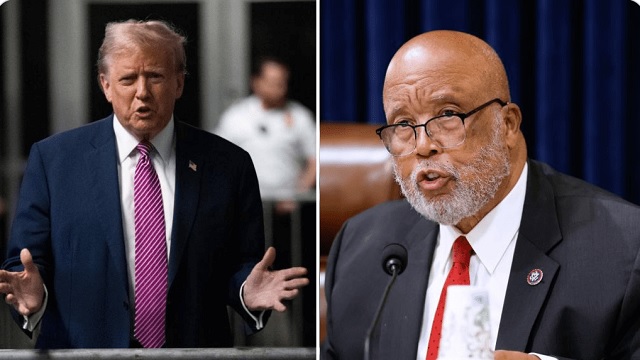
Democrat Rep. Bennie Thompson on Friday introduced legislation that would strip Secret Service protection from ‘convicted felons’ sentenced to prison, a bill clearly aimed at President Donald Trump.
House Democrats on Friday moved to strip President Trump of his Secret Service protection if he is convicted.
Democrat Rep. Bennie Thompson introduced a resolution that would terminate Trump’s Secret Service protection. The legislation dubbed the “Denying Infinite Security and Government Resources Allocated toward Convicted and Extremely Dishonorable (DISGRACED) Former Protectees Act would apply to all Secret Service Protectees convicted and sentenced under felony charges.
“The DISGRACED Former Protectees Act would terminate Secret Service protection for individuals who otherwise qualify for it upon sentencing following conviction for a Federal or State felony,” the announcement said.
Critical Medications Every American Can Have On Hand (Including Ivermectin) – And How To Get Them Prescribed
“It is regrettable that it has come to this, but this previously unthought-of scenario could become our reality. Therefore, it is necessary for us to be prepared and update the law so the American people can be assured that protective status does not translate into special treatment —and that those who are sentenced to prison will indeed serve the time required of them,” Democrat Rep. Bennie Thompson said according to the Washington Times.
“Obvious subtext here is that removing USSS would make it easier for someone to kill Trump, which is arguably the goal of Thompson’s bill, H.R. 8081,” Byron York said.
Democratic Rep. Bennie Thompson ran the January 6 committee, which mixed elements of show trial and reality series. Focused solely on Trump, of course. Now, Thompson wants to take away Trump's Secret Service protection if Trump is convicted on any of the 88 felony charges…
The swamp is hellbent on keeping Trump out of office. First they sued him. Then they prosecuted him. Then they tried to take him off the ballot. None of it worked & now they’re trying to strip his Secret Service protection. I wonder what they’re rooting for? pic.twitter.com/3fdnM7eXUi
http://drrich.wpengine.com/wp-content/uploads/logo_264x69.png00The Geller Reporthttp://drrich.wpengine.com/wp-content/uploads/logo_264x69.pngThe Geller Report2024-04-21 05:41:182024-04-22 07:33:00Democrats Move to Strip Trump of Secret Service Protection
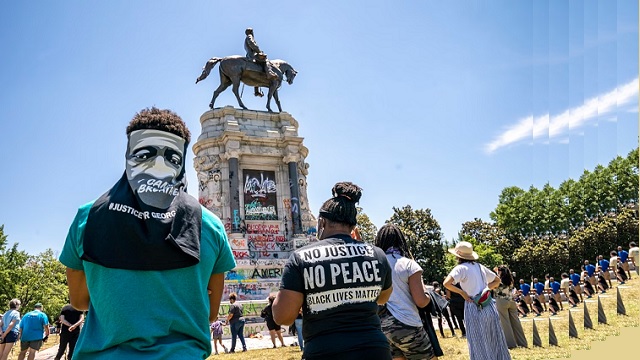
Many arguments have arisen for the removal of the Confederate Flag and other articles associated with the American Civil War/War between the States. A consistent and glaring theme that few discuss is the eradication of American history in all its’ glory and ugliness. America is not a perfect nation, but Americans from both the north and south, east and west have always striven to be free from tyrants and a government that forgets that it was established to serve the people, and not the other way around.
Our founders stated for all to read for all time and eternity that the average man and woman, all people from every background and life experience have rights, and government has only the powers the sovereign people have delegated to it.
This founding principle is also being erased by politicians in BOTH political parties.
Americans are not perfect, but Americans are a forgiving people and when wrong is exposed Americans want to right the wrong, institute correction so as not to have a repeat of the wrong, and to embrace all who adopt our American values, creeds, and ideals formulated by our Forefathers who created this unique nation. There are, however, those who clearly despise America and they are working to transform this nation into something it was never, ever intended. In attempting to accomplish their diabolical goal, they work at erasing all elements of our country’s history in the process.
These diabolically motivated Cretins care less about America’s history and care even less about embracing our history and learning from the same.
America’s principles helped create a country like none other, an exceptional nation that many in elected office today resent and are working diligently to transform into merely a country within the global sphere of countries. These folks with dark hearts cannot comprehend why Americans defend their country with every drop of blood within them.
Those with diabolical schemes coursing through their veins cannot comprehend why Americans look fondly to this nation’s origins, vigilantly assert their political rights and civic responsibilities, and hold in their hearts the special meaning that is America with our role, and yes, our responsibility to the world.
Transform America. Eradicate all signs and wonders of America’s exceptional creation and development. Forever remove all history so a population has no reference point, no foundation, no appreciation much less understanding of all the costs to simply bring us to this point in time. Transform America into something far from the ideals and vision our Forefathers intended and gave their sacred honor to embrace.
Erase every monument and article of this Nation’s history to redirect the citizens of America into a New-World Order that is not exceptional at all except for its’ tyrannical rule and removal of individual rights and freedoms, including the celebrating of individual gifts and strengths.
The men of Kentucky would not have stood for this; neither would the men of Pennsylvania. NO…the brave and dedicated men who faced off against one another in the War Between the States would have linked arms and faced off against the evil change and eradication now attempting to sweep across the land.
http://drrich.wpengine.com/wp-content/uploads/logo_264x69.png00Lyle J. Rapacki, Ph.D.http://drrich.wpengine.com/wp-content/uploads/logo_264x69.pngLyle J. Rapacki, Ph.D.2024-04-21 05:28:512024-04-21 05:30:43Removing Monuments — Eradicating America
“Search the Constitution and you will find no power granted to the legislative branch to make laws governing agriculture, housing, medicine, energy, private ownership or weapons, and a great deal more.” – John F. McManus
“Communism is the corruption of a dream of justice.” — Adlai E. Stevenson, Democrat politician and former UN Ambassador from 1961-1965
“Communism has never come to power in a country that was not disrupted by war or corruption, or both.” — John F. Kennedy
“We are opposed around the world by a monolithic and ruthless conspiracy that relies primarily on covert means for expanding its sphere of influence — on infiltration instead of invasion, on subversion instead of elections, on intimidation instead of free choice, on guerrillas by night instead of armies by day.” — John F. Kennedy
There isn’t a day that some horrible news doesn’t come into our home via newspapers, magazines or email. Today is no different. Yesterday’s headline was that the Republican held House reauthorized a two-year government surveillance power in the FISA bill, and Speaker Mike Johnson cast the winning vote.
Today’s news was just as horrifying. The unelected elitists in the World Economic Forum are strongly promoting digital IDs to enforce vaccination compliance.
There is a network of power-seekers operating in the US and throughout the world to destroy nations and rule the planet. They hate freedom and liberty.
Community organizer Saul Alinsky stated, “True revolutionaries do not flaunt their radicalism. They cut their hair, put on suits and infiltrate the system from within.”
And they infiltrate…everything.
Italian Marxist Antonio Gramsci gave us the blueprint for what has happened to America, “Socialism is precisely the religion that must overwhelm Judeo-Christianity. … In the new order, Socialism will triumph by first capturing the culture via infiltration of schools, universities, churches and the media by transforming the consciousness of society.”
Infiltration and Extirpation
Back in 2009, when the Tea Parties started up, I remember watching Glenn Beck on Fox News. He had Tea Party representatives from all over the country in studio. I was astonished at their lack of knowledge, but they knew something was very wrong and wanted to fix it. Judge Napolitano came out at the end and stated that all could be fixed with a constitutional convention, and it wasn’t long before Beck was touting one as well. Opening our fabulous constitution to destruction is the goal of the infiltrators.
A controlled opposition is a protest movement that is actually being led by government agents. Nearly all governments in history have employed this technique to trick and subdue their adversaries. Vladimir Lenin said, “The best way to control the opposition is to lead it ourselves.”
As for Newt, in 1996, Speaker Gingrich signed the Republican-led “gun free school zones act,” creating criminal safe zones like Virginia Tech, where the only person armed was a murderous criminal. Senator Herb Kohl of Wisconsin introduced the bill that was incorporated into the Crime Control Act of 1990 and signed into law by George H.W. Bush.
If you check on the voting list of those who voted “yea” on Public Law 101-216 in 1989 (an update to the General and Complete Disarmament Law, Public Law 87-297) you will find that Newt Gingrich voted in favor of section 2 of this disarmament bill which reads: “(2) as defined in this Act, the terms ‘arms control’ and ‘disarmament’ mean ‘the identification, verification, inspection, limitation, control, reduction, or elimination, of armed forces and armaments of all kinds under international agreement to establish an effective system of international control’.”
As for those Tea Parties, within six to eight weeks, the majority were infiltrated and became nothing more than garden clubs effecting no change.
In Manning Johnson’s 1958 book, Color, Communism and Common Sense, Johnson exposed the communist infiltration of black churches using the age old adage of divide and conquer by stirring up racial hatred. Johnson wrote that communists plotted to use the US Courts to aid communism, to subvert the black churches and to use their members to stir up race conflict. Many white churches have been infiltrated with Black Lives Matter, gay rights, and even Antifa. All of this was exposed in R. M. Whitney’s 1926 book, Reds in America.
This brings me to the core of this article and what I have seen taking place in the John Birch Society’s New American Magazine, an organization and magazine that I love and am concerned about.
John F. McManus
Many years ago, I had written an article where I quoted someone who had lied about the John Birch Society (JBS). Shortly thereafter, John (Jack) F. McManus, President of JBS called me and we spoke for over an hour. I joined the Society.
Years later, Jack was to speak in Memphis, so a girlfriend and I drove across state and heard Jack express his distaste for Rockefeller’s United Nations and how it needed to be defunded and abolished. Two JBS life members were with us and we enjoyed a wonderful evening. You can still watch Jack’s magnificent expose of the UN.
Interestingly enough, it was Buckley’s National Review that brought Jack to the Birch Society. He had been an antagonist regarding the JBS and read an article in National Review he agreed with regarding Robert Welch’s organization. Watch this two-minute video where Jack tells what happened.
I cannot begin to list all that Jack McManus accomplished in his lifetime. I had hoped that an entire issue of JBS’ New American Magazine (NAM) would be devoted to his memory since he passed away on March 4th of this year. I wanted to see the photo from the cover of this book on the front of an issue devoted to this wonderful man. It is Jack speaking with Robert Welch.
In February of this year, I wrote a letter to the publisher of the NAM with copies to editors and directors of the magazine as well as the CEO, president emeritus and others.
I was extremely concerned with changes I had seen. So often, the direction changes and weakens, in these wonderful liberty and freedom organizations, when the old guard passes away.
Many of the JBS employees are allegedly not even members of the Society, and as I recall, CEO Bill Hahn, wasn’t a member before he was made CEO. How can that be? Where is the allegiance to the organization if you aren’t even a paying member?
The NAM’s logo had always been “That Freedom Shall Not Perish.” It was recently changed to “Know More, Do More,” which sounds like an advertisement for Home Depot or Lowes.
I was horrified that the freedom logo had been replaced. And asked in my letter:
Isn’t freedom the entire goal of the John Birch Society?
Aren’t we to be educated and equipped warriors against the evils of Marxism and fascism?
Aren’t we all waging a war to stop the juggernaut of communist evil from overtaking our beloved country?
Wasn’t it freedom that JBS founder, Robert Welch, spent his life fighting for?
That word “Freedom” means as much today as it did when our founders adopted the Declaration of Independence on July 4, 1776, the actual signing occurred on August 2, of 1776. Following the signing, were seven years of America’s War for Independence from Great Britain that didn’t end until September of 1783.
Freedom, that cry of all people, needs to be the everlasting banner of the New American Magazine, especially today, when our freedom is in great peril of perishing.
Another problem popped up last year. In all the years I had been a member, I was able to find the NAM articles on the web that had appeared in the magazine and forward them widely to friends. I knew that many of those who received the articles were impressed and ended up ordering the magazine.
All of a sudden, they were unavailable.
The magazine had adopted the business model of charging to read their articles, but for months, state leaders could not even access the articles to forward them. Under Biden’s economy, feeding the family and paying the bills comes first. Incomes are stretched to the limit and few can afford extras.
This problem is now fixed after many months, and we can once again forward articles, but only members can access the articles.
There are some amazing investigative journalists who are editors of the magazine. Alex Newman, Rebecca Terrell and R. Cort Kirkwood are my favorites. I have sent hundreds of NAM articles through email, but there were two that were extremely important; Rebecca Terrell’s Covid Hospital Rescue and Alex Newman’s BlackRock: Masters of the Universe.
Another change has been the use of AI for magazine cover art. I was shocked at the visage of Klaus Schwab on one cover as it didn’t even look like that despicable snake.
These minor changes along with others I haven’t mentioned, have me concerned. We need this organization to be operating with the same focus they had at their inception.
My letter was directed to the publisher, but I never received a response. Instead, JBS CEO, Bill Hahn, who was sent a copy of the letter, responded via email. Rather than alleviating my fears by telling me he’d look into everything I mentioned, he sent a “defense” letter. That certainly wasn’t the way to win friends and influence people and it didn’t assuage my fears.
The Communist Onslaught
America was long ago infiltrated with communists. As I’ve written in past articles, the first communist arrived here in 1824. His name was Robert Owen and he started a socialist school in Harmony, Indiana where he had purchased 20,000 acres. The school failed.
His son, Robert Dale Owen, also a socialist, became a US Congressman and founded the Smithsonian Institute, understood completely where New Harmony went wrong.
“All cooperative schemes which provide equal remuneration to the skilled and industrious and the ignorant and idle must work their own downfall,” he wrote of his father’s utopia. “For by this unjust plan they must of necessity eliminate the valuable members and retain only the improvident, unskilled and vicious.”
In 1848, a huge number of communists immigrated to the United States after their socialist efforts had failed in Germany. Thirteen high ranking soldiers in the Union Army were Marxists and corresponded with Marx. President Lincoln received letters from Karl Marx and they are in the Smithsonian.
By the 1930s, our government schools were being infiltrated with Marxists as told by former Congressman Paul W. Shafer and John Howland Snow in their book, The Turning of the Tides.
In the 1950s, Hollywood and our government were being infiltrated with communists and Senator Joseph McCarthy knew they had to be exposed. Blacklisted By History authored by M. Stanton Evans, tells the full story of the struggles of Joe McCarthy to expose what was happening to our beloved nation. It is a revealing expose of the forces that distorted our national policy in the cold war conflict and our understanding of its history since. It is an incredibly detailed work of scholarship and investigative journalism.
Conclusion
Infiltration is the key. We must not allow it to happen to the only group known for exposing and fighting communism. The United Nations, The World Economic Forum and The World Health Organization all represent Marxist control.
Today, the Leftists who appear to be full-blown Stalinists, are in control of far too many facets of American society and culture. This is why we need a vibrant and strong John Birch Society with the same fire in the belly to save our beloved country.
The education must go on with new leaders like Jack McManus, a man whose heart was always for God, Family and Country.
http://drrich.wpengine.com/wp-content/uploads/logo_264x69.png00Kelleigh Nelsonhttp://drrich.wpengine.com/wp-content/uploads/logo_264x69.pngKelleigh Nelson2024-04-21 05:14:082024-04-21 07:21:03With the Old Guard Gone, will Birchers still fight the Commie Menace?
Three New York offshore wind projects were canceled Friday in the latest sign of trouble for the stumbling industry and President Joe Biden’s green energy agenda, according to Politico.
The New York State Energy Research and Development Authority (NYSERDA), the agency that handles offshore wind contracts, disclosed Friday that it could not finalize power purchase agreements with three developers that received conditional awards from the state in October 2023, according to Politico. The announcement amounts to a cancellation of the projects, which deals a blow to New York’s goal to reach 70% green energy generation by 2030 and Biden’s goal to install enough offshore wind capacity nationwide to provide enough electricity to power 10 million U.S. homes by 2030.
New York announced awards for the three projects canceled Friday after the state’s Public Service Commission (PSC) shot down a push by other developers to charge more for the power their projects would produce to offset rising costs, according to Politico. Several other projects were canceled following the PSC’s rejection, with similar dynamics playing out in other blue states like New Jersey and Maryland in recent months as well.
Biden’s Climate Bill Boosted An Offshore Wind Giant, But His Economy Brought It To The Brink https://t.co/AF7SPT2FNu
“Despite notable progress, the U.S. offshore wind industry is still in its infancy. As [with] any new sector, challenges are expected & require resolve from [federal], state & private sector to overcome,” Doreen Harris, NYSERDA’s president and CEO, wrote in a Friday post to X. “[NYSERDA] will take proactive measures to address these issues head-on. Next steps soon.”
The offshore wind industry is stumbling despite the availability of generous tax credits contained in the Inflation Reduction Act (IRA), Biden’s signature climate bill. Inflation, higher borrowing costs and logistical problems are gumming up projects and contracts that appeared lucrative and viable around the time that Biden signed the IRA into law.
Biden’s 2030 target continues to fall further out of reach with Friday’s cancellation, as Reuters reported in November 2023 that the goal already appeared to be unattainable given headwinds in the industry.
The White House, the office of Democratic New York Gov. Kathy Hochul and NYSERDA did not respond immediately to requests for comment.
All content created by the Daily Caller News Foundation, an independent and nonpartisan newswire service, is available without charge to any legitimate news publisher that can provide a large audience. All republished articles must include our logo, our reporter’s byline and their DCNF affiliation. For any questions about our guidelines or partnering with us, please contact licensing@dailycallernewsfoundation.org.
http://drrich.wpengine.com/wp-content/uploads/logo_264x69.png00The Daily Callerhttp://drrich.wpengine.com/wp-content/uploads/logo_264x69.pngThe Daily Caller2024-04-20 15:33:002024-04-20 15:34:093 Blue State Offshore Wind Projects Scrapped In Blow To Biden’s Green Agenda
“All the ‘experts’ fear an Iranian attack on Israel, but Iran fears how Israel will respond much more. Netanyahu is projecting strength, not fear.” — Newsrael.
“We are prepared to meet all of the security needs of the State of Israel, both defensively and offensively,” said the Israeli premier.
Israeli Prime Minister Benjamin Netanyahu said on Thursday that the Jewish state would respond in kind to any attack.
Speaking during a visit to the Tel Nof Air Base, he said, “We are in challenging times. We are in the midst of the war in Gaza, which is continuing at full force, even as we are continuing our relentless efforts to return our hostages.”
However, he continued, “We are also prepared for scenarios involving challenges in other sectors. We have determined a simple rule: Whoever harms us, we will harm them. We are prepared to meet all of the security needs of the State of Israel, both defensively and offensively.”
Washington and its allies believe a major attack on Israel by Iran is imminent and may be launched in the coming days.
The Islamic Republic’s response to the killing of an Iranian general in Syria on April 1, which Tehran has blamed on the Jewish state, could involve high-precision missiles being launched at Israel.
The U.S. military commander in charge of the Middle East arrived in Israel on Thursday to coordinate with the Israel Defense Forces regarding a possible attack by Iran and its proxies.
Gen. Erik Kurilla, commander of the U.S. Central Command (CENTCOM), will reportedly meet with Israeli Defense Minister Yoav Gallant and senior military officials.
The Israel Defense Forces has been placed on high alert, resulting in combat soldiers’ weekend leaves being canceled and the military calling up additional reserve soldiers to the IDF Aerial Defense Array.
On Wednesday, U.S. President Joe Biden sent a public warning to Iran, saying: “As I told Prime Minister [Benjamin] Netanyahu, our commitment to Israel’s security against these threats from Iran and its proxies is ironclad.”
Israeli Foreign Minister Israel Katz warned on Tuesday that Israel will respond in kind should Iran launch a direct attack against it.
“If Iran attacks from its territory—Israel will respond and attack in Iran,” tweeted Katz. The minister tagged Iran’s Supreme Leader Ali Khamenei in the X post.
NEWSRAEL: While the West still panders to the Iranian Ayatollahs even though it terribly oppresses its own people, Israel is the only country willing to attacks the Iranians head on!
They waited for his family to be out and no one else around when they sent the senior Hezbollah terrorist on his journey. Ynet pic.twitter.com/Cwf9ZtgkTn
http://drrich.wpengine.com/wp-content/uploads/logo_264x69.png00NEWSRAEL Telling the Israeli Storyhttp://drrich.wpengine.com/wp-content/uploads/logo_264x69.pngNEWSRAEL Telling the Israeli Story2024-04-20 15:00:552024-04-22 07:11:34Netanyahu: ‘Whoever harms us, we will harm them’
The Florida Republican addressed Agudath Israel of America‘s leadership mission to Washington on Wednesday.
JNS – Jewish News Syndicate:
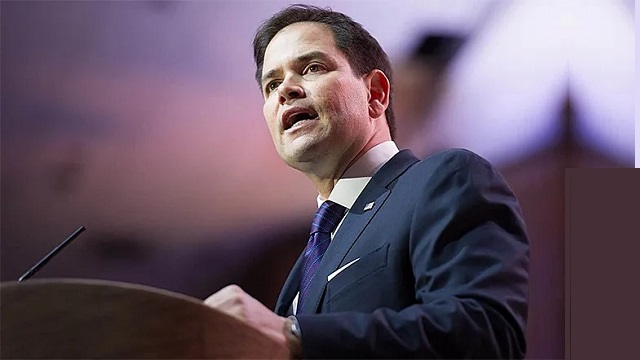
“God forbid,” Sen. Marco Rubio (R-Fla.) told Agudath Israel of America on Wednesday, but Israel could face “a multi-pronged attack, not just by Iran, but by their agents in Syria and in Iraq, by the Houthis, by Hezbollah, all at once, perhaps in retribution for a recent strike, perhaps in a future conflict.”
“Iran is closer to coordinating that, because they believe that they can do it, and that the U.S., because of our internal friction with regards to the U.S.-Israeli relationship, will not respond,” the Florida Republican added, addressing Agudah’s leadership mission to Washington.
“That’s a very real threat, and I hope I’m wrong,” Rubio said. “But we may not see the end of next week without something like that happening. If it does, you will remember that that deterrence was lost and undermined by this desire to appease this radical element of a voting base.”
U.S. leaders who created that friction between Jerusalem and Washington “in order to appease some radical, left-wing, pro-Hamas element” are “undermining the deterrence of Israel’s enemies,” Rubio added.
Per photos that Agudah posted on social media, its members met with members of Congress from Connecticut, Louisiana Maryland, New Jersey, New York, North Carolina, Oklahoma Pennsylvania and Wyoming, as well as members of the Biden administration.
Agudath Israel of America, founded in 1922 to serve as Orthodox Jewry’s umbrella organization, is the arm and voice of American Orthodox Jewry. With national and DC offices, and regional branches serving the entire country, Agudath Israel – also called Agudas Yisroel or the Agudah – advocates for its constituents at federal, state, and local levels. The Agudah and its many divisions provide social, educational, and youth services to its constituents, continuing a century-long tradition of championing the evolving needs of Orthodox Jewish life in America.
Since its inception, Agudath Israel of America has operated under the guidance and ongoing involvement of the Moetzes Gedolei HaTorah of America, the Council of Torah Sages. Agudath Israel of America is keenly attuned to the American Jewish community’s challenges and triumphs, and has helped our communities grow, thrive, and advance through changing times.
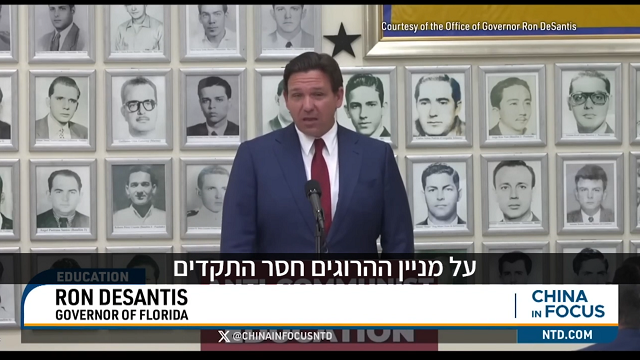
“Communist tyranny has already resulted in 100,000,000 victims.” — Governor Ron DeSantis
Ron DeSantis, the governor of Florida, signed a law this week that will require Florida public schools to educate students about the history and dangers of communism, both in the U.S. and in other countries, and about the growing threat of communism in the U.S. now.
“We are going to tell the truth about the unprecedented death toll of the 20th century at the hands of communist tyranny – 100 million people killed by communist regimes, which spread to China, the Soviet Union, Cuba…” said Ron DeSantis.
VIDEO:Orthodox Christian Receives Two-tier Policing — An Orthodox Christian man in Great Britain wrote on his Facebook “Christians must stand up” after an Islamist stabbed a bishop during mass in Australia. The British authorities responded by sending the police and a psychologist to his home for a checkup. Two-tier policing!
POST ON X:
We need *two* sets of mass deportations.
First, deport millions of illegals out of our country.
Second, deport millions of federal bureaucrats out of Washington, D.C.
http://drrich.wpengine.com/wp-content/uploads/logo_264x69.png00NEWSRAEL Telling the Israeli Storyhttp://drrich.wpengine.com/wp-content/uploads/logo_264x69.pngNEWSRAEL Telling the Israeli Story2024-04-20 14:13:472024-04-20 14:23:20In Florida Public School Students Will Learn About the Dangers of Communism
This perceptive article by Michael Oren, among other things, describes the kind of mental gymnastics combined with a deliberate misrepresentation of the historical facts mobilized by Jew-haters of all stripes to portray Israel as a determined aggressor in her relationship to her Arab Palestinian citizens in particular and the Arab Palestinians in general.
There is no grievance real or imagined that could possibly justify the horrific genocidal attack on Israel by Hamas on October 7th. This is an absolute statement that admits to no moral relativism and cannot be applied on a sliding scale which is why Israel must utterly destroy every last vestige of the Hamas regime and bring its leaders to justice one way or another.
Along with destroying Hamas and reestablishing our security, the great unspoken objective of Israel in Gaza is restoring our self-proclaimed role as the keeper of the six million’s memory and the guarantor of “never again.” At stake is not only Israel’s future but, in a very real sense, our past. And yet, even as Israelis have frequently referenced it, the war has posed the ultimate challenge yet to our right to speak in the name of, and have recourse to, the Holocaust.
When, in July 2018, the Israeli government held a reception for Hungarian Prime Minister Viktor Orbán, I declined to attend. As Deputy Minister in the Prime Minister’s Office dealing with diplomacy, it was only fitting that I be among those receiving him, yet I wouldn’t. The reason had nothing to do with Orbán’s support for Israel, which was ironclad, or his willingness to oppose the European Union’s ceaseless hounding of the Jewish state. Prime Minister Benjamin Netanyahu’s campaign to whittle away the 28-nation consensus that the EU needed to condemn us certainly made strategic sense. And while the Hungarian strongman’s efforts to dismantle parts of his country’s democracy discomforted me, far more draconian measures by Russian, Arab, and Chinese leaders had not moved me to boycott them. My problem, rather, lay with Orbán’s relationship to the Holocaust—he and his neo-fascist party had praised Hungarian collaborators with the Nazis—and the danger that posed to Israel’s security.
Along with the IDF, the Mossad, and the Shin Bet, the Holocaust is an essential component in Israel’s defense. Very few countries in history ever confronted genuine existential threats—Japan and Germany in World War II set out to defeat, not destroy, the United States—but Israel has faced several, simultaneously and daily, since its creation. Conversely, while the U.S. determined to defeat the Nazis and the Imperial Japanese, it did not seek to wipe Germany and Japan off the map but to restore their peaceful place in world affairs. Egypt, Syria, and Jordan, by contrast, once strove to annihilate Israel entirely, and Iran and its proxies—Hamas, Hezbollah, and the Houthis—still do today. And when Israel acts to protect itself from these existential threats, the Holocaust joins its F-35 jets and Merkava tanks as a major defensive asset. “As a people which has suffered and survived an attempted genocide,” we declare, “Israel has the right to use extraordinary means to prevent its recurrence.” By providing a moral tailwind the Holocaust provides time and space for those jets and tanks to act.
The Holocaust is hardwired into our nuclear facility in Dimona.
Preserving the memory of the Holocaust is, therefore, a strategic national interest for Israel, one that we would be tragically negligent to harm. Establishing warm relations with Orbán’s Hungary or with Austria’s ultra-rightist Former Chancellor Sebastian Kurz or with the Polish government that denied its country’s complicity in the mass murder of Jews may have short-term diplomatic benefits but at an irretrievable strategic cost. By selling our Holocaust birthright expediently, we risk forfeiting our past and jeopardizing our future.
We also chip away at the nation’s roots. Israel’s Declaration of Independence cited the Holocaust as a basic justification of the state, and Israel thereafter arrogated the role as the prime repository of the Holocaust’s legacy: “The Nazi holocaust which engulfed millions of Jews in Europe proved anew the urgency of the re-establishment of the Jewish state, which would solve the problem of Jewish homelessness by opening the gate to all Jews and lifting the Jewish people to equality in the family of nations.” This claim enabled Israel, in 1952, to accept hundreds of millions of dollars in German reparations to the Jewish people and, nine years later, to try and execute Nazi mass murderer Adolf Eichmann. Yad Vashem, Israel’s World Holocaust Remembrance Center, became first stop of every foreign dignitary’s visit to Jerusalem. The message was clear: “This is what can happen without an independent, defendable, Jewish state.”
Israel’s claim to exclusivity didn’t last long, though. By the 1970s, Holocaust memorials, many with a universalist message, were inaugurated in Washington, DC and other capitals, and Holocaust Studies programs sprouted on American campuses. Hollywood seized on this interest by producing blockbuster movies and television series—so many, in fact, that conventional wisdom held that a Holocaust theme was a surefire path to an Oscar. As Israel’s ambassador to the United States, the most important speech I gave annually was to the leaders of Congress and the administration assembled in the Capitol building for Holocaust Remembrance Day.
But along with the rising challenges to Israel’s claim to the Holocaust legacy came assaults on the Holocaust itself, and not just from the David Irving-esque deniers. Scholars such as Yale historian Timothy Snyder and journalist Isabell Wilkerson sought to contextualize the Holocaust by linking it to other Eastern European massacres or comparing it with other racially based injustices. Young American Jews, raised in a victimhood-equals-virtue environment, became increasingly reluctant to cite the Holocaust’s uniqueness, and to challenge the Palestinians’ attempts to liken it to the 1948 Nakba.
The Palestinians, meanwhile, keenly aware of its contributions to the creation and protection of Israel, assailed the Holocaust in multiple ways. Many echoed the longstanding Arab claim—first presented to President Roosevelt by King ibn Saud in 1945—that Palestine was simply the place where Europe dumped those Jews it failed to kill in the camps. Palestinian Authority President Mahmoud Abbas went from downplaying the Holocaust (one million dead, not six) in his Soviet university doctoral thesis of 1982, to, last year, both minimalizing the Holocaust and insisting that the Jews brought it on themselves. “When Hitler perpetrated the Holocaust, he had obvious reasons,” Fatah Official Yasser Aby Sido, echoing Abbas, recently explained. “They were plotting to take over Germany.”
For a great number of Palestinians, acknowledging the Holocaust was tantamount to recognizing Israel’s legitimacy and negating the importance of the Nakba. Accordingly, in 2009, PA officials shut down a Palestinian youth orchestra after it performed for Holocaust survivors. In 2014, al-Quds University forced the resignation of American Studies professor Mohammed Dajani after he led a delegation of West Bank Palestinians to Auschwitz.
In general, the Palestinians and their supporters have focused less on denying or even justifying the Holocaust and more on painting Israel as the new Nazi Germany and the Palestinians as the new Jews. The Palestinians, in the words of Edward Said, were “the victims of the victims.” Other Palestinians adopted the pledge “Never Again,” and turned it against Israel. “This…desperate cry…is pointed to the descendants of those Jewish victims of Nazi terror who now inflict on the indigenous people of Palestine a crime equally horrendous,” proclaimed the introduction to the book The Plight of the Palestinians, published in 2010. It accused Israel of emulating the Nazis in perpetrating “a prolonged, merciless attempt to erase a people from their land by whatever force is needed.”
The equation Israel=Nazis, Palestinians=Jews, which might be abhorrent to neo-Nazis, gained increasing traction among Israel’s critics, among them a growing number of Jews. Princeton professor Richard Falk, musician Gilad Atzmon, Holocaust survivor Hedy Epstein—all have compared Zionism to Nazism. Jewish writers Primo Levi and Jean Améry both expressed the fear that, by citing the Holocaust to justify its brutal military operations, Israel was in danger of resembling Nazi Germany—a fear that Israeli theologian Yeshayahu Leibowitz upgraded into a condemnation of Israel’s “Nazification.” Political scientist Norman Finklestein began his lifelong assault on Israel protesting the 1982 siege of Beirut with a sign demanding, “Israeli Nazis – Stop the Holocaust in Lebanon!”
Still, none of these developments had the least impact on Israel. From the sabras who, in the 1950s, disdained those who “went like sheep to the slaughter” and labeled those who survived “sabonim”—soaps—Israelis came to embrace the legacy of the Holocaust. “The alternative to fighting is Treblinka, and we have resolved that there would be no Treblinkas”—so Prime Minister Menachem Begin justified Israel’s invasion of Lebanon in 1982. For high schoolers, a pilgrimage to Auschwitz, draped in the Israeli flag, became a pre-army ritual, while the dwindling number and plight of survivors regularly made national news. Every government office, including my own in Washington, boasted the photo of the three Star of David-emblazoned F-15’s flyover of Auschwitz in 2003. Israel, quipped New York Times columnist Thomas Friedman, was in danger of becoming “Yad Vashem with an air force.”
Friedman failed to understand the depth of Zionism’s victory over victimhood, though the enlistment of the Holocaust in Israel’s defense, once implicit, had grown increasingly manifest. Defying the mounting attempts to impugn Israel’s right to harness the Holocaust in its battle against existential threats, Israeli leaders now adamantly asserted it. “The Jewish people have learned the lessons of the Holocaust,” Prime Minister Netanyahu declared on Holocaust Remembrance Day in 2020, “always to take seriously the threats of those who seek our destruction [and] always to have the power to defend ourselves by ourselves. We have learned that Israel must always remain the master of its fate.”
Those very lessons were lost a mere four years later, on the morning of October 7. Seen through the prism of the Holocaust, the trauma of the Hamas onslaught was excruciatingly magnified. An avowedly genocidal organization enamored of Hitler had perpetrated the greatest single slaughter of Jews since World War II. Not surprisingly, Netanyahu compared the massacre at the Nova Festival to that of Babi Yar and the kibbutz children who hid for their lives to Anne Frank. Gilad Erdan, Israel’s ambassador to the UN, pinned a yellow “Jude” star to his lapel. Former Israeli Prime Minister Naftali Bennett declared, “we are facing a Nazi conception.”
Billboard in Tel Aviv (@the_civil_front on X/Twitter)
“We stand here as men who refute their Jewishness and the Holocaust being hijacked by an occupation which has led to conflict for so many innocent people,” announced filmmaker Jonathan Glazer upon winning an academy award for “Zone of Interest,” a biopic about Auschwitz commander Rudolf Höss. The import of the maker of a Holocaust movie stripping Israel of the power to wield the Holocaust in its defense was not lost on the Oscar audience, which avidly applauded Glazer’s statement.
Writing in The New Yorker, Masha Gessen put a finer point on Glazer’s accusation, likening Gaza to the Warsaw Ghetto. “The term “ghetto” would have …given us the language to describe what is happening in Gaza now. The ghetto is being liquidated.” Like Glazer, a Jew, Gessen notes how the Nazis built the ghettos to protect non-Jews from “Jewish diseases,” much as Israel created the Gaza ghetto to protect Jews from Palestinian threats. “Both claims,” she concludes, “propose that an occupying authority can…isolate, immiserate—and, now, mortally endanger—an entire population…the name of protecting its own.”
Gessen’s comparison of Gaza with the Warsaw Ghetto was echoed by Colombian President Gustavo Petro while Vladamir Putin equated Israel’s offensive to the Nazi siege of Leningrad. “In the past they were massacring the Jewish people in the gas chambers,” railed Turkish President Erdoğan. “A similar mentality is being shown [by Israel] in Gaza today.” The social media were rife with posts drawing parallels between Israel and the Third Reich and accusations that the Jews are emulating the Nazis in perpetrating genocide in Gaza.
Yet these themes were hardly confined to the Web. In a lengthy essay published in the prestigious London Review of Books, Indian writer Pankaj Mishra argues that the war in Gaza is, in fact, a struggle over the Holocaust. Its memory, though sullied by Israel, is upheld by the millions of pro-Palestinian protesters demonstrating “against savagery.” Their actions will eventually overcome Israeli propaganda, Mishra predicts, and “go some way towards redeeming the memory of the Shoah.”
Mishra’s voice is hardly lone. Podcaster and wrestler Joe Rogan recently claimed that Israel’s actions in Gaza amounted to Israel “saying that genocide is okay as long as we’re doing it.” Brazilian President Luiz Inacio Lula said Israel’s war in Gaza was unparalleled in history except when “Hitler decided to kill the Jews.” Chris Williamson, of the British Labour Party, called Gaza a “concentration camp” and characterized Israel as “worse than the Nazis.”
Call it Holocaust decoupling or Holocaust severance, but a global movement is now mounting to cut the ties between the Jewish State and the Final Solution and deny the former the ability to adduce the latter in its defense. Europeans, in particular, are welcoming this trend as an opportunity to at last escape the Holocaust’s burden, and even Germany is purportedly reexamining its initial support for Israel’s policies in Gaza. The slogan, “Never again,” is being appropriated from Israel and, according to Mishra, replaced by the universal, “Never Again for Anyone.”
As soon as this war is concluded, once Israel succeeds in defeating Hamas and begins the process of demilitarizing, deradicalizing, and reconstructing Gaza, we must embark on a quest to reclaim the Holocaust from those who seek to detach us from it and even use it against us. While parts of the world may now contest that ownership, we must nevertheless uphold and preserve it if for ourselves and generations of Israelis to come. We must think twice before squandering our legacy—selling our birthright—for potentially short-term benefits. Girded once more in our past, we can fight more effectively, more morally, for our future.
http://drrich.wpengine.com/wp-content/uploads/logo_264x69.png00The Geller Reporthttp://drrich.wpengine.com/wp-content/uploads/logo_264x69.pngThe Geller Report2024-04-20 08:31:242024-04-20 08:34:38‘The Final Battle for the Holocaust. In Gaza, Israel is not only fighting for our future, but also for our past.’ by Michael Oren
While messed up kids can go from any background, when you’re the child of whatever weird incestuous, adulterous Islamist-Socialist grift, Rep. Ilhan Omar has going on, the odds are against you.
So whether it’s nature or nurture, Isra Hirsi, Omar’s daughter, has a sickle and hammer in her profile and evil in her heart.
Yes, that’s what she was doing on Oct 7.
Now, Isra Hirsi was suspended as part of the pro-Hamas events at Columbia University as an organizer with the SJP hate group.
The media and the Left are full of claims that “peaceful students” were arrested in a peaceful protest. Here’s what some of those peaceful students looked like.
“Al-Qassam, you make us proud, kill another soldier now.” Unsanctioned mob of Hamas supporters riot at Columbia university while the university president testifies in Congress about the schools appalling failure to reign in Jew hatred
the New York Times, the Washington Post, CNN, Brad Lander and every media outlet and politician carrying water for these aspiring mass murderers at Columbia U refuse to report what their genocidal movement stands for https://t.co/Mpe4LcuIeF
— Daniel Greenfield – "Hang Together or Separately" (@Sultanknish) April 20, 2024
Hirsi is playing the victim and so is Rep. Ilhan Omar and Squaddies who keep claiming falsely that Columbia suspended Omar’s daughter because of something the pro-terrorist antisemitic congresswoman asked the university’s president.
But playing the victim while celebrating murder is all that they know.
http://drrich.wpengine.com/wp-content/uploads/logo_264x69.png00Jihad Watchhttp://drrich.wpengine.com/wp-content/uploads/logo_264x69.pngJihad Watch2024-04-20 07:49:222024-04-21 07:12:53Rep. Ilhan Omar’s Communist Daughter, Who Cheered Oct 7, Suspended
Major medical associations have remained silent after the results of a four-year review commissioned by the National Health Service (NHS) England undermined their recommendations for giving puberty blockers to children with gender dysphoria
The Cass report, conducted by former Royal College of Pediatrics and Child Health Dr. Hilary Cass and released April 10, found that there is “weak evidence” for offering puberty blockers to children. It concluded that its findings “raise questions about the quality of currently available guidelines” offered by associations like the World Professional Association for Transgender Health (WPATH) and the Endocrine Society, yet neither organization has committed to reviewing their guidelines.
The review references a letter recommending against treating children with puberty blockers outside of a research setting. It also urged “extreme caution” for providing cross-sex hormones to minors under 18 and stressed the need for a “clear clinical rationale.”
The review further suggested a “full programme of research be established” to “look at the characteristics, interventions and outcomes of every young person presenting to the NHS gender services.”
“Although a diagnosis of gender dysphoria has been seen as necessary for initiating medical treatment, it is not reliably predictive of whether that young person will have longstanding gender incongruence in the future, or whether medical intervention will be the best option for them,” the report noted.
The American Medical Association, WPATH, American Academy of Pediatrics, American Academy of Child & Adolescent Psychiatry (AACAP) and Endocrine Society did not respond to multiple inquiries over the past week from the Daily Caller News Foundation asking whether they had concerns with the report’s findings or intended to conduct their own review. Aside from WPATH, these organizations have largely failed to even address the report publicly.
WPATH wrote in a statement that it “supports policies that increase access to high-quality ethical care for transgender youth,” claiming that the report’s foundation is rooted in a “false premise.”
The organization’s standards of care 8th version states that waiting several years to start a young adolescent on puberty blockers “is not always practical nor necessary given the premise of the treatment as a means to buy time while avoiding distress from irreversible pubertal changes,” though it acknowledges that establishing a “sustained experience of gender incongruence” can be important before starting.
“The foundation of the Cass report is rooted in the false premise that non-medical alternatives to care will result in less adolescent distress for most adolescents and is based on a lack of knowledge of and experience working with this patient population,” the organization said in a press release. “It is harmful to perpetuate this notion and does not acknowledge the very real fact that medical pathways are an important treatment option for many young people.”
🚨 The American Academy of Child and Adolescent Psychiatry (@AACAP) is refusing to inform its members about the publication of the Cass Review, the biggest news in the field of pediatrics since COVID, and arguably in the 21st century.
The Endocrine Society characterizes puberty blockers as a “reversible pause to puberty” and “a first step in treatment to allow the adolescent to explore their gender identity and/or to provide relief from distress.” WPATH’s guidelines likewise recommend putting adolescents on “puberty suppressing hormones” to “alleviate gender dysphoria.”
WPATH physicians acknowledged puberty blockers can cause irreversible consequences in minors like infertility, bone loss and disruption of brain development in educational sessions from September 2022 previously obtained by the Daily Caller News Foundation.
Both the AMA and AACAP recommend WPATH’s guidance for handling gender dysphoria in children. The AMA often advocates against red state laws that ban sex-change procedures for minors, including puberty blockers.
The Cass report notes “there is no evidence that puberty blockers buy time to think, and some concern that they may change the trajectory of psychosexual and gender identity development.”
The Cass report also questioned WPATH and the Endocrine Society on the “circularity” of their citations, which make support for their positions appear stronger than they are.
Early versions of the two organization’s guidelines influenced “nearly all” guidelines set by other organizations, the report notes. The two organization’s guidelines are also “closely interlinked” because WPATH provided input on the Endocrine Society recommendations, according to the report.
“The circularity of this approach may explain why there has been an apparent consensus on key areas of practice despite the evidence being poor,” the report stated.
All content created by the Daily Caller News Foundation, an independent and nonpartisan newswire service, is available without charge to any legitimate news publisher that can provide a large audience. All republished articles must include our logo, our reporter’s byline and their DCNF affiliation. For any questions about our guidelines or partnering with us, please contact licensing@dailycallernewsfoundation.org.
http://drrich.wpengine.com/wp-content/uploads/logo_264x69.png00The Daily Callerhttp://drrich.wpengine.com/wp-content/uploads/logo_264x69.pngThe Daily Caller2024-04-20 07:31:162024-04-20 07:33:45Medical Associations Silent After Review Finds ‘Weak Evidence’ For Giving Puberty Blockers To Kids
I’m a proud product of Catholic education. I had Sisters of St Joseph for grammar school, Xavarian Brothers for high school, and Jesuits for college (Boston College). I went off the reservation for graduate school (Syracuse), but the die had been set.
I attribute my skills and interest in Critical Thinking to the fine teachers I had.
Attentive readers of my commentaries are well aware that I have been extensively involved with the K-12 education business, for both public and private schools. IMO both need to be preserved, which means that both need fixing.
The main (of several) threat to the public school system is that anti-American Left-wing ideology is taking over the curriculum in almost every subject area, but especially in Science and History.
The fix for this starts with Conservative organizations (e.g., Heritage & AEI) paying a LOT more attention to the curricula. Although they typically say that education is a top priority, curricula have been largely ignored. Not surprisingly, the Left is aggressively taking full advantage of this shameful neglect.
Additionally, State Education Superintendents (and State Boards of Education) also need to give the curricula a lot more attention. This business of giving deference to education administrators who oversee curricula, is toxic nonsense — as many of those people are a major part of the problem. This deference has led to multiple bad outcomes, like the purposefully deceptive Social Emotional Learning (SEL) scam.
This is just a bit of background, as this commentary is about Catholic Schools.
K-12 Catholic schools used to be successful as many parents strongly wanted to have their children taught Judeo-Christian standards, and were willing to pay for this. However, times have changed (in many ways) — but most Catholic schools are still relying on this archaic model.
Another outdated part of the Old Model is that the default solution to every financial challenge is to have another fund-raiser (rather than do things differently to prevent the financial problem).
Just one example of how times have changed is that the number of Catholics attending weekly Mass has dropped precipitously over the last few decades. It stands to reason that when parents are less attached to Judeo-Christian standards, their interest in having their kids be taught Judeo-Christian standards will also decrease.
Considering that the cost of K-12 Catholic schools can be substantial, the question is: will these parents be willing to pay a premium cost for what is (in effect) a public school plus a religion class? The answer for many parents is NO.
The good news here is that COVID has provided the solution!
For the first time, parents had the opportunity to look over the shoulders of their children to see what they were being taught. Two problems quickly became apparent:
their children are being told WHAT to think rather than HOW to think, and
the WHAT part is largely Left-Wing, atheistic, and anti-American.
However, very few parents want to home-school their children, as (to do it right) this requires an enormous amount of time, effort, and competence on their part. Further, their child would largely miss out on the positive social benefits of interacting with other classmates, as well as lose out on extra-curricular activities. (E.g., I was the editor of my high school’s weekly Newspaper which was a fabulous experience.)
The light bulb should go on at Catholic (and other private) schools: that this new set of needs should be the basis for a New Model. They should be loudly telling parents:
their children will be taught HOW to think (i.e., Critical Thinking skills), and
their children will be given a Judeo-Christian, pro-American, classic education.
As a refresher, here are some of the MANY benefits of being a Critical Thinker… If you can’t intuitively see the merits of this New Model, then look at how a real-world example has been a resounding success — at a relatively low cost besides!
The Bottom Line here is that (since times have changed rather radically) Catholic Schools need to be aware that they must adopt the New Model. The slow learners will suffer the fate of those who laboriously put all their memories on VHS tapes.
Media Balance Newsletter: a free, twice-a-month newsletter that covers what the mainstream media does not do, on issues from COVID to climate, elections to education, renewables to religion, etc. Here are the Newsletter’s 2023 Archives. Please send me an email to get your free copy. When emailing me, please make sure to include your full name and the state where you live. (Of course, you can cancel the Media Balance Newsletter at any time – but why would you?
http://drrich.wpengine.com/wp-content/uploads/logo_264x69.png00John Droz, Jr.http://drrich.wpengine.com/wp-content/uploads/logo_264x69.pngJohn Droz, Jr.2024-04-20 07:13:302024-04-20 07:36:24Saving K-12 Private Schools — What seems daunting is actually rather simple!