Tag Archive for: CBO

EXCLUSIVE: Watchdog Says Congressional Budget Office’s Calculations Have More Holes Than Swiss Cheese

A report from a government watchdog organization released Thursday highlights inaccurate projections from the Congressional Budget Office (CBO).

The report released by Open the Books spotlights decades of CBO projections and finds that while routine estimates were normally reliable, projections tied to larger legislation missed the mark. According to the report, the CBO’s scoring is generally accurate, although projections for major legislation frequently are missed by wide margins, with revenue estimates showing larger deviations over time.

The report notes that CBO’s miscalculations have continued to grow over the years. From 1983 to 2024, the average error in CBO projections was 6%, according to the report.

In February 2009, the CBO projected that a $25 weekly unemployment insurance bonus would cost taxpayers $39.2 billion over a ten-year period. After six years, the CBO issued a revised estimate showing it would actually cost $64 billion, a 63% increase over initial projections.

Notably, the Affordable Care Act, passed under the Obama administration, became one of the largest federal expenditures and was more expensive than the initial CBO cost estimate in 2010, which projected $788 billion. When the CBO conducted another estimate two years later, it ballooned to $1.76 trillion, a 123% jump.

Michael Solon, senior fellow at the Hudson Institute, told the Daily Caller News Foundation that the issue may extend beyond legislative scoring alone, arguing that broader economic forces often outweigh policy changes.

“The economic factors are far more important than the legislative factors,” Solon said, noting that shifts in economic growth can have a significantly larger impact on federal revenues than individual pieces of legislation.

Solon noted that legislative estimates draw the most attention, but they represent only a small slice of what drives budget outcomes.

“Scoring is not forecasting.” Douglas Holtz-Eakin, former director of the CBO, told the DCNF. Holtz-Eakin argued that the process guarantees to make the CBO marginally inaccurate.

When asked about the large miscalculation with the ACA, Holtz-Eakin noted, “The baseline they were scoring off was more than a year and a half old. Of course it was going to be wrong.”

“The ACA looks different in 2012 than it did when it was first passed,” Holtz-Eakin said “There’s no way CBO can anticipate that,” he further stated.

The CBO didn’t immediately respond to questions from the DCNF about the report.

The report also noted that the CBO plays a significant role in shaping legislation, as the office works directly with legislators during the bill-writing process.

The costs for running the CBO ballooned to $75.8 billion in fiscal year 2026, an 8.2% jump from the previous year. The CBO is also exempt from complying with the Freedom of Information Act; information such as salaries remain hidden from the public according to the report.

The CBO’s primary focus on budgetary projections has shifted slightly since the early 2000s, as it has become involved in climate-related policy. Over the years the budget has become inflated with climate-related funds, and currently nears $1 trillion.

The report highlights the CBO’s flaws in analyzing climate data. In 2021, the CBO released “Budgetary Effects of Climate Change and of Potential Legislative Responses to It.” In the report, the CBO flagged climate change as a risk to budget deficits, adding that mitigation or adaptation could reduce climate change costs, but that the “benefits of successful investments would generally accrue gradually over many years and might be only partially reflected in future savings to the federal budget.”

As the rising national debt approaches $40 trillion, unfunded liabilities including Social Security and Medicare will increase as baby boomers continue to retire, further straining the federal budget. These mandatory spending programs account for approximately 60% of federal spending.

A decline in the U.S. Labor force participation rate is expected to further strain the already bloated federal budget, with the rate dropping to its lowest level since 1977, The Wall Street Journal reported. 

The report calls for greater transparency, higher accuracy and reduced reliance on the CBO as the sole authority for budgetary and economic information in Congress.

Republican Kentucky Rep. Andy Barr introduced legislation in 2025 to strengthen budget accountability, requiring the CBO to publish supplemental analyses of major legislation before major legislation receives a vote. “Washington’s budget process is broken, and part of the problem is that there’s no accountability when reality doesn’t match the promises made to get legislation passed,” Barr said in a statement.

AUTHOR

Nick Naulty

Contributor

RELATED ARTICLE: Blue States Turbocharging Their Own Collapses With New Tax Gambits

EDITORS NOTE: This Daily Caller column is republished with permission. ©All rights reserved.


All content created by the Daily Caller News Foundation, an independent and nonpartisan newswire service, is available without charge to any legitimate news publisher that can provide a large audience. All republished articles must include our logo, our reporter’s byline and their DCNF affiliation. For any questions about our guidelines or partnering with us, please contact licensing@dailycallernewsfoundation.org.
The Concorde Coalition says it’s the Budget Stupid!

WASHINGTON, D.C. /PRNewswire-USNewswire/ — Sobering 30-year projections that the Congressional Budget Office (CBO) released today underscore the need for the 2016 presidential and congressional candidates to provide voters with credible plans to put the federal budget on a more responsible course, according to The Concord Coalition.

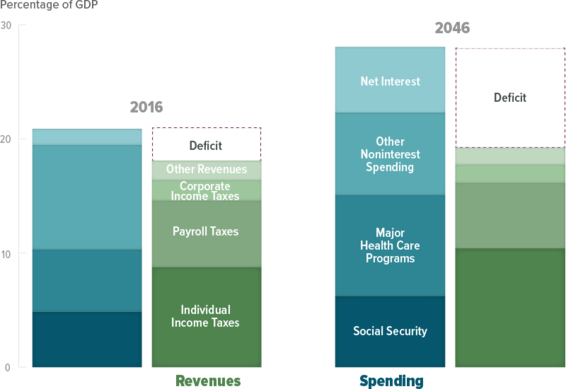
cbo long term spending revenues

“If current laws remained generally unchanged, the United States would face steadily increasing federal budget deficits and debt over the next 30 years—reaching the highest level of debt relative to GDP ever experienced in this country” – Congressional Budget Office.

“Americans like to think we put a high priority on strengthening the country and looking out for the next generation, but the CBO’s latest long-term projections show once again that we are falling far short on both counts,” said Robert L. Bixby, Concord’s executive director. “Those who aspire to national leadership should take a good look at these projections and explain to the public how they intend to avoid the intense budget pressures and grave economic consequences toward which current policies are leading us.”

Bixby added:

“If candidates for federal office over the next few months ignore the CBO’s warnings of severe trouble ahead, whoever wins in November will not have a clear mandate for the reform measures needed to rein in the federal debt, strengthen the economy and protect our children’s future.”

The federal deficit has been dropping in recent years, creating a sense of complacency in Washington about the need for such reforms. Yet under current law the deficit is rising again this year and the debt will continually grow more quickly than the economy — a trend that is ultimately unsustainable.

Today’s CBO report looks out over the next three decades and projects even greater government debt and fiscal pressures after 2026.

The federal debt held by the public, which was only 39 percent of GDP at the end of Fiscal 2008, has climbed to 75 percent. That is already high by historical standards. The budget office projects that under current law, that debt would rise to 86 percent of GDP in 2026 and to 141 percent in 2046 — far exceeding the historical peak of 106 percent shortly after World War II.

As the CBO points out, such high levels of public debt would reduce national savings and income, increase interest costs that would put more pressure on the rest of the budget, limit the nation’s ability to respond to unforeseen problems and increase the likelihood of a fiscal crisis in which investors would demand extremely high interest rates on further loans to the government.

“The changes needed to bring about a sustainable fiscal policy are substantial and the costs of delay are profound, yet so far the 2016 presidential candidates have said nothing that comes close to addressing the challenges identified in CBO’s report,” Bixby said.

According to CBO, simply keeping the debt-to-GDP ratio from rising above its current level, would require spending cuts and/or tax increases totaling 1.7 percent of GDP in every year through 2046. That would amount to $330 billion in 2017.

Waiting until 2022 would require annual changes totaling 2.1 percent of GDP, and procrastinating until 2027 would require annual changes totaling 2.7 percent of GDP.

The choice about when to make policy decisions also has different generational impacts. As CBO says: “Reducing deficits sooner would probably require today’s older workers and retirees to sacrifice more and would benefit today’s younger workers and future generations. By contrast, reducing deficits later would require smaller sacrifices by older people and greater sacrifices by younger workers and future generations.”

An aging population and rising health care costs are key factors in the government’s growing financial problems. As more people retire, the government must spend more just to maintain current levels of service. Health care costs rise as more treatments become available and demand for them increases.

CBO says federal spending on Social Security, the government’s major health problems and other “mandatory” programs would rise from 13.2 percent of GDP today to nearly 16.9 percent in the decade starting in 2037.

The budget office also warns that interest payments on the federal debt are expected to rise rapidly as government borrowing continues and low interest rates return to normal levels. Net interest costs now amount to only 1.4 percent of GDP but that figure is expected to rise to 5.1 percent after 2037.

The CBO report shows other areas in the federal budget — even those that may prove critical to the nation’s future — being squeezed harder and harder in the coming years. CBO projects that over the next 30 years spending on national defense, infrastructure, research and development,  and everything else other than health care, Social Security and interest payments would drop to 5.2 percent of GDP, down from 6.5 percent today.

In addition to more thoughtful spending decisions in Washington, reasonable reforms in the federal tax system could help boost the economy and reduce federal borrowing.

“As in past years, CBO’s long-term projections are a valuable reminder that the federal budget is not on a sustainable course,” Bixby said. “Interest payments and a few spending programs, no matter how important, cannot be allowed to squeeze other national priorities out of existence. Voters this year would do well to look for candidates who understand this and are prepared to do something about it.”

ABOUT THE CONCORD COALITION

The Concord Coalition is a nationwide, non-partisan, grassroots organization advocating generationally responsible fiscal policy. The Concord Coalition was founded in 1992 by the late former Senator Paul Tsongas (D-Mass.), late former Senator Warren Rudman (R-N.H.), and former U.S. Secretary of Commerce Peter Peterson. Former Senator Sam Nunn (D-GA) serves as co-chair of the Concord Coalition.

RELATED ARTICLE: The 15th Obamacare Co-Op Has Collapsed. Here’s How Much Each Failed Co-Op Got in Taxpayer-Funded Loans.

Report: As Many as 165,000 Jobs Lost Because of Obamacare’s Medical Device Tax

Health and Human Services Secretary Kathleen Sebelius may want to take back her claim that there is “absolutely no evidence” that Obamacare has caused any job losses. If the Congressional Budget Office report earlier this month wasn’t enough, the medical device industry delivered some troubling news about the effects of the health care law’s medical device tax.  The Daily Caller reports:

Obamacare’s medical device tax has already created a job loss of 33,000 in the medical device industry and 132,00 more job losses are expected, according to a new report from the industry trade group the Advanced Medical Technology Association (AdvaMed), obtained by the Daily Caller.

The AdvaMed survey breaks down the job losses from the first year that the medical device tax has been in place along with its broader job effects:

The tax has resulted in employment reductions of approximately 14,000 industry workers and forgone hiring of 19,000 workers. The total job impact of the tax on industry employment was approximately 33,000.

Independent estimates of the relationship between direct employment in the industry and indirect employment among suppliers and in the general economy found a ratio of four indirect jobs for each direct job.

Applying this ratio to jobs lost or foregone suggests that the impact of the tax on indirect employment would be approximately 132,000 jobs, for a total job loss due to the tax of as many as 165,000 jobs.

Apparently for Secretary Sebelius, job losses in the medical device industry don’t count.

The survey also finds that because of the tax:

  • 75% deferred, cancelled, or reduced investments and employee compensation.
  • Over 30% said they cut research and development.
  • Nearly 10% said they moved or expanded manufacturing outside the United States.

If it remains on the books, device makers say the medical device tax will continue hurting employees and innovation:

58% of respondents said they would consider reducing employment if the device tax were not repealed.

50% said they would consider reducing R&D investment if the device tax were not repealed.

A Gallup poll finds that jobs are the most-important issue for Americans. We must help put people back to work by lifting the barriers to hiring and investment. Repealing the harmful medical device tax would be a good step.

[youtube]http://youtu.be/TBu_dmoqzSU[/youtube]

EDITORS NOTE: Featured image courtesy of the Chemical Heritage Foundation. This image is licensed under the Creative Commons Attribution-Share Alike 3.0 Unported.