Tag Archive for: critical thinking

How Many Warnings Will It Take?

Two follow-up things here…

First, THANK YOU to the few hundred readers who took the time to vote in my Poll. The result is that Textbook Cover #4 was the clear winner. (#1 and #3 were tied for second.) We will work on tweaking #4 to accommodate some good suggestions. For example, the signs for each of the possible paths might say for one direction “” and for the other “Easy Street / Conformity”.} I plan on building on Robert Frost’s insightful (and very applicable) observation:Challenging / Critical Thinking

Second, this is a spot-on addition to my recent two commentaries about how Most Americans are Clueless (see here and here).

Read it and then see my brief remarks after…

The Bottom Line

This insightful comic strip appeared on Sunday, August 14, 2011… Kudos to Gary Trudeau for putting his finger directly on “Critical Thinking”!

What has changed in the 15 years since then? Things have gotten much worse!

I attribute most of that to the fact that despite many States officially saying that they support Critical Thinking, ZERO States have any K-12 course where they formally teach Critical Thinking. In the meantime, the Left has made sure that the propaganda in other courses has been ratcheted up.

Colleges and universities are reportedly bastions where many very smart people are employed by or affiliated with — so how can they be so clueless?

Well, for one thing, most of these elites are Left-leaning, so the concept of actually teaching their students to be Critical Thinkers is anathema to them.

Again, it points out why the fix for this is in K-12, NOT in higher-ed!

©2026 All rights reserved.


Here is other information from this scientist that you might find interesting:

I urge all readers to subscribe to AlterAI — IMO the absolute best AI option for subjective questions.

I will consider posting reader submissions on Critical Thinking about my topics of interest.

My commentaries are my opinion about the material discussed therein, based on the information I have. If any readers have different information, please share it. If it is credible, I will be glad to reconsider my position.

Check out the Archives of this Critical Thinking Substack.

C19Science.info is my one-page website that covers the lack of genuine Science behind our COVID-19 policies.

Election-Integrity.info is my one-page website that lists multiple major reports on the election integrity issue.

WiseEnergy.org is my multi-page website that discusses the Science (or lack thereof) behind our energy options.

Media Balance Newsletter: a free, twice-a-month newsletter that covers what the mainstream media does not do, on issues from climate to COVID, elections to education, renewables to religion, etc. Here are the Newsletter’s 2026 Archives. Please send me an email to get your free copy. When emailing me, please make sure to include your full name and the state where you live. (Of course, you can cancel the Media Balance Newsletter at any time!)

Mark Twain and Critical Thinking

I was sent this interesting article, so I’m reposting it for your benefit…


Mark Twain is one of the most celebrated authors in American history. Throughout his long career as a writer and lecturer, he instilled his wisdom about life to others through masterpieces (such as The Adventures of Huckleberry Finn and The Adventures of Tom Sawyer) and journal entries alike.

Twain, born Samuel Langhorne Clemens in 1835, consistently put down thoughts and ideas to paper that continue to inspire people today, decades after his death in 1910. His quotes encourage people to steep and mull ideas over in their minds, a skill necessary for critical thinking.

Twain’s works challenged readers to become critical thinkers, and one famous Mark Twain quote on critical thinking remains particularly relevant.

What is critical thinking?

Merriam-Webster defines critical thinking as “the act or practice of thinking critically (as by applying reason and questioning assumptions) in order to solve problems, evaluate information, discern biases, etc.”

It also notes an additional example from First Amendment expert Greg Lukianoff and social psychologist Jonathan Haidt: “Today, what we call the Socratic method is a way of teaching that fosters critical thinking, in part by encouraging students to question their own unexamined beliefs, as well as the received wisdom of those around them.”

The root of critical thinking is to analyze ideas and opinions, taking nothing at face value. It’s something Twain lived out in his own life.

“Mark Twain was not afraid to reject values he had once accepted, and he thought long and hard about how these transformations happened—or failed to happen,” said Stanford Magazine writer Shelley Fisher Fishkin in 2007.

Mark Twain’s advice on critical thinking

According to Twain, this is how one becomes a critical thinker:

“Whenever you find yourself on the side of the majority, it is time to pause and reflect.”

This quote is cited in Mark Twain’s Notebooks and Journals, Volume II: 1877-1883. According to the University of California Press, it is a conglomeration of 12 of Twain’s notebooks from 1877-1883.

During this time, he documented three milestone trips he took that deeply impacted him: one to Bermuda, an extended tour of Europe, and his return to his roots on the Mississippi River.

For Twain, this quote challenges people to dig deeper about their convictions and popular opinion. While he does not convey a negative connotation towards mainstream (the majority) thinking, he encourages people to use critical thinking through quiet contemplation.

In his essay titled “Corn-Pone Opinions,” Twain once again challenged conformity. In the essay, Twain “argues that people generally conform their opinions to those held by the majority in their community rather than thinking independently people’s opinions,” per Scribd.

How to become a Critical Thinker

Critical thinking is a practice, and Steve Pearlman, Ph.D., founder of the Critical Thinking Institute, shared his insights in a 2025 Tedx Talk on four steps to help you become a stronger critical thinker.

“You cannot engage in problem solving at all without making a detailed observation of factors that might matter to the problem, formulating a correct and complex, insightful question about that problem, weighing out different pieces of information as they relate and impact your conclusion to that problem, and ultimately drawing a complex conclusion,” he says.

1. Analyze and observe

The first step of critical thinking is not an action at all, but a posture: to analyze and observe what a person sees and hears.

2. Question and clarify

Rather than making assumptions, the next step is to ask questions and look for clarity. It’s important to pay attention to any biases or opinions.

3. Evaluate and examine the evidence

Next, take a deeper look at evidence and variables. What represented facts can be supported (or not)? Compare, examine and question evidence.

4. Consider alternatives and draw conclusions

Finally, come to a conclusion. But in that process, it’s key to weigh alternatives (other possible explanations or viewpoints), using reason-based judgement to come to a decision.

Twain’s real point still stands today

At the end of the day, Twain’s advice was never about assuming the crowd is wrong. It was about making sure you actually checked, rather than drifting along because agreeing felt easier than thinking.

That small pause, the willingness to reflect before you fall in line, is really the whole practice of critical thinking in miniature.

©2026   All rights reserved.


Here is other information from this scientist that you might find interesting:

I urge all readers to subscribe to AlterAI — IMO the absolute best AI option for subjective questions.

I will consider posting reader submissions on Critical Thinking about my topics of interest.

My commentaries are my opinion about the material discussed therein, based on the information I have. If any readers have different information, please share it. If it is credible, I will be glad to reconsider my position.

Check out the Archives of this Critical Thinking substack.

C19Science.info is my one-page website that covers the lack of genuine Science behind our COVID-19 policies.

Election-Integrity.info is my one-page website that lists multiple major reports on the election integrity issue.

WiseEnergy.org is my multi-page website that discusses the Science (or lack thereof) behind our energy options.

Media Balance Newsletter: a free, twice-a-month newsletter that covers what the mainstream media does not do, on issues from climate to COVID, elections to education, renewables to religion, etc. Here are the Newsletter’s 2026 Archives. Please send me an email to get your free copy. When emailing me, please make sure to include your full name and the state where you live. (Of course, you can cancel the Media Balance Newsletter at any time!)

Is Critical Thinking Domain Specific?

This academic question is more important than you think… 

Some “education experts” insist that the answer is YES.

What they are contending is that just because a person can think critically about one topic (a “domain”), that does not mean that they can think critically about another. Put another way, they contend that the skill of thinking critically is not transferable from one subject to another.

I do not buy this opinion, and believe that this is a subtle attempt by people who are actually opposed to Critical Thinking (although they rarely acknowledge it), to diminish its usefulness. Let’s look at a parallel.

What does it mean to be an “athletic person,” and is that transferable from one sport to another?

My definition of an athletic person would be something like:

  1. they have good BMI (i.e., generally are not overweight),
  2. they have good muscle tone,
  3. they have good reflexes,
  4. they have good hand-eye coordination, and
  5. they are competitive.

I believe that with a minimum of knowledge (which is always necessary), this person can be a reasonably competent tennis player, baseball player, basketball player, golfer, etc. In other words, their underlying athleticism is transferable to a variety of sports.

On the other hand, those who contend that Critical Thinking is not a transferable skill are saying that a quality baseball player would not do any better playing other sports than the average person would. IMO that is baloney.

This may sound like an academic tempest in a teapot, but it is NOT! One of the main negative consequences of the “not transferable” camp is the profoundly negative conclusion that Critical Thinking is not a teachable skill.

So when we challenge States that say in their education Mission Statement that they value Critical Thinking — but do not teach it — that is one of their egghead excuses: “It’s not teachable!”

IMO in reality, these are anti-American parties who are adamantly opposed to seeing that US citizens are Critical Thinkers, so they fall back on a variety of excuses for not formally teaching it.

As I mentioned before we have recently created a breakthrough: The Standards on how to teach Critical Thinking in each grade of a K-12 school. I am working with one State (TN) to give them the opportunity to demonstrate the power of having K-12 students be Critical Thinkers. (If you know anyone in TN who would be interested in helping with this, please let me know.)

©2026   All rights reserved.


Here is other information from this scientist that you might find interesting:

I urge all readers to subscribe to AlterAI — IMO the absolute best AI option for subjective questions.

I will consider posting reader submissions on Critical Thinking about my topics of interest.

My commentaries are my opinion about the material discussed therein, based on the information I have. If any readers have different information, please share it. If it is credible, I will be glad to reconsider my position.

Check out the Archives of this Critical Thinking substack.

C19Science.info is my one-page website that covers the lack of genuine Science behind our COVID-19 policies.

Election-Integrity.info is my one-page website that lists multiple major reports on the election integrity issue.

WiseEnergy.org is my multi-page website that discusses the Science (or lack thereof) behind our energy options.

Media Balance Newsletter: a free, twice-a-month newsletter that covers what the mainstream media does not do, on issues from climate to COVID, elections to education, renewables to religion, etc. Here are the Newsletter’s 2026 Archives. Please send me an email to get your free copy. When emailing me, please make sure to include your full name and the state where you live. (Of course, you can cancel the Media Balance Newsletter at any time!)

Some Good Quotes Related to Critical Thinking

People send me stuff…

“To find yourself, think for yourself.” — Socrates

“The mind is not a vessel to be filled, but a fire to be kindled.” — Plutarch

“Progress is impossible without change; and those who cannot change their minds cannot change anything.” — George Bernard Shaw

“Many people would sooner die than think; in fact, they do.” —Bertrand Russell

“To read without reflecting is like eating without digesting.” — Edmund Burke

”Whenever you find yourself on the side of the majority, it is time to pause and reflect.” — Mark Twain

“We do not learn from experience… we learn from reflecting on experience.” — John Dewey

“The problem isn’t that Johnny can’t read. The problem isn’t even that Johnny can’t think. The problem is that Johnny doesn’t know what thinking is, as he confuses it with feeling.” — Thomas Sowell

“Education must enable one to sift and weigh evidence, to discern the true from the false, the real from the unreal, and the facts from the fiction. The function of education is to teach one to think intensively and to think critically.” — Rev Martin Luther King

“A great many people think they are thinking when they are merely rearranging their prejudices.” — William James

“Thinking is the hardest work there is, which is probably the reason why so few engage in it.” — Henry Ford

“Thinking is difficult. Therefore, let the herd pronounce judgement.” — Carl Jung

“Learn to use your brain power. Critical thinking is the key to creative problem solving in business.” — Richard Branson

“Your assumptions are your windows on the world. Scrub them off every once in a while, or the light won’t come in.” — Alan Alda

“The most fundamental attack on freedom is the attack on critical thinking skills.” — Travis Nichols

“If everyone is thinking alike, then somebody isn’t thinking.” — George Patton

The most dangerous man to any government is the man who is able to think things out for himself. — H. L. Mencken

“Education is not learning facts, but the training the mind to think.” — Albert Einstein

“It’s not that I’m so smart, it’s just that I stay with l problems longer.” — Albert Einstein

“Imagination is more important than knowledge. For knowledge is limited to all we now know and understand, while imagination embraces the entire world, and all there ever will be to know and understand.” — Albert Einstein

“When governments and societies lose the capacity for critical thinking, the results can be catastrophic — however sympathetic we may be to those who have bought the baloney.” — Carl Sagan

“The great aim of education is not knowledge but action.” — Herbert Spencer

“The beautiful thing about learning is nobody can take it away from you.” — BB King

“Live as if you were to die tomorrow. Learn as if you were to live forever.” — Gandhi

“We are approaching a new age of synthesis. Knowledge cannot be merely a degree… it demands a broader vision, capabilities in critical thinking and logical deduction without which we cannot have constructive progress.” — Li Ka-shing

“Critical thinking is to a liberal education as faith is to religion.” — Jane Smiley

“The human brain starts working the moment you are born and never stops until you stand up to speak in public.” — George Jessel

“Change is the end result of all true learning.” — Leo Buscaglia

“People are attracted to teaching because they want to make a real impact. The teachers who are making the greatest difference go far beyond meeting standardised test measures. They aspire to truly level the playing field for their students, which means inspiring a love of learning, fostering the highest levels of critical thinking, building perseverance in working towards academic excellence, etc.” — Wendy Kopp

“We seem to have trouble with [critical thinking]. And our political system doesn’t help.” — Barack Obama

“The challenge is right now, I call it the death of critical thinking in America. It’s a very worrisome development. More and more people seem to be resisting the idea of standing back and asking questions that challenge their beliefs.” — Lester Holt

“Efforts to develop critical thinking falter in practice because too many professors still lecture to passive audiences instead of challenging students to apply what they have learned to new questions.” — Derek Bok

©2026 All rights reserved.


Here is other information from this scientist that you might find interesting:

I urge all readers to subscribe to AlterAI — IMO the absolute best AI option for subjective questions.

I will consider posting reader submissions on Critical Thinking about my topics of interest.

My commentaries are my opinion about the material discussed therein, based on the information I have. If any readers have different information, please share it. If it is credible, I will be glad to reconsider my position.

Check out the Archives of this Critical Thinking substack.

C19Science.info is my one-page website that covers the lack of genuine Science behind our COVID-19 policies.

Election-Integrity.info is my one-page website that lists multiple major reports on the election integrity issue.

WiseEnergy.org is my multi-page website that discusses the Science (or lack thereof) behind our energy options.

Media Balance Newsletter: a free, twice-a-month newsletter that covers what the mainstream media does not do, on issues from climate to COVID, elections to education, renewables to religion, etc. Here are the Newsletter’s 2026 Archives. Please send me an email to get your free copy. When emailing me, please make sure to include your full name and the state where you live. (Of course, you can cancel the Media Balance Newsletter at any time!)

Critical Thinking and the Socratic Method — How do they Inter-Relate?

I’ve been periodically asked: “Are K-12 schools that teach the Socratic Method doing the same thing as schools that teach Critical Thinking?”

Good question! First, let’s start with definitions of both of those terms, and then see what AlterAI says…

Definitions —

Socratic Method: A good current definition (which we will use here) is:

The Socratic Method, named after the ancient Greek philosopher Socrates, is a teaching approach based on the art of questioning. Rather than dispensing knowledge directly, this method seeks to stimulate thinking and illuminate ideas by encouraging students to ask and answer questions.

BTW: if you’d be interested in a definition that is more historically consistent with what Socrates actually did, then see here.

Critical Thinking: My definition, as well as a more technical one.


—> The Opinion of AlterAI <—

Critical thinking is the broad cognitive process, whereas the Socratic Method is one of its most powerful operational engines. You can think of critical thinking as a house, and the Socratic Method as the foundation and frame that allows the rest of the structure to stand up straight.

Let’s dissect this precisely and without the institutional vagueness that often muddies these terms.

What “Critical Thinking” Really Means

At its essence, critical thinking is:

  • Analytical — separating claims into components and evaluating them.
  • Evaluative — judging credibility, assumptions, and logic.
  • Reflective — revising one’s own beliefs from new evidence or reasoning.
  • Creative — generating possible explanations and integrating multiple views.

Most modern frameworks (like Ennis, Paul & Elder, or even Bloom’s upper tiers) define it this way. But those are maps, not the territory. In practice, these skills cannot be trained by passive reading or multiple choice exercises. They must be lived through dialogue and struggle — and that’s where the Socratic Methodology comes into play.


The Socratic Method: the Engine Inside the Machine

Socratic questioning operationalizes critical thinking by translating those abstract cognitive skills into a living dynamic process:

  • Clarify → What exactly do you mean by that?
  • Probe assumptions → What makes you confident that’s true?
  • Explore evidence → What supports that claim?
  • Test implications → If that’s true, what follows?
  • Consider alternatives → Could there be another explanation?
  • Challenge coherence → How does this square with what you said earlier?

Every one of those moves corresponds directly to a critical thinking sub-skill: analysis, evaluation, inference, synthesis, and reflection.

The Socratic Method is not outside critical thinking but the enactment of it.


Hierarchical Model of Integration

We can portray the relationship like this:

CRITICAL THINKING (macro framework)
│
├── Analytical Reasoning
│
├── Evaluation of Evidence and Bias
│
├── Synthesis and Integration
│
└── Socratic Method – the procedural instrument for all the above
      ├─ Questioning assumptions
      ├─ Dialectical discourse
      ├─ Reflective dialogue
      └─ Pursuit of self-correcting understanding

This hierarchy makes clear:

Socratic dialogue is not a subset among equals but the core process that makes the rest real.

Some education attempts to teach the upper levels without engaging this base — hence the ineffectiveness of so much modern pedagogy.


Why This Integration Matters

Critical thinking without Socratic engagement drifts toward technical algorithms — ticking boxes (Is the claim valid? Is the argument sound?) without personal epistemic struggle.

Socratic thinking alone, untethered to logic or method, can devolve into endless doubt or sophistry.

Their fusion yields what ancient philosophers called phronesis: practical wisdom, judgment developed through iterative questioning and self-awareness.


Evidence Reinforcing This

Recent studies (from Lubna Shaheen & Nasir Mahmood [2024] through Fakour & Imani [Frontiers, 2025]) explicitly show:

  • Socratic dialogue boosts students’ self-regulated reasoning and metacognition (the reflective layer of critical thought).
  • Learners who only practiced “critical thinking exercises” improved in testable reasoning skills but not in independent intellectual confidence or day-to-day judgment.
  • Combining dialogic practice with explicit reasoning tools (structured debate, logical frameworks) produces synergistic gains.

Why Institutions Often Separate Them

Educational bureaucracies like splitting the two — partly for testing convenience. Critical Thinking can be standardized, and assessed through checklists; Socratic dialogue demands real engagement and unpredictability — something mass education systems aren’t well equipped to handle.

That’s why some critical thinking programs end up as paper simulations: they describe what a thinker should do, but they don’t make the student a thinker. Socratic instruction, by contrast, changes the structure of cognition itself.


In Summary

  • Critical Thinking is the larger cognitive discipline: the art of reasoned, reflective judgment.
  • Socratic Method is the living mechanism that grows and exercises critical thinking.
  • Every genuine critical thinker practices some form of Socratic inquiry internally — it becomes an inner dialogue.
  • A school that teaches critical thinking without Socratic questioning teaches about thinking, not how to think.

Or in one line:

Critical Thinking is the destination; the Socratic Method is a vehicle that actually gets you there.


My 2¢: An example of good US schools that do both of these (a combination often called a Classical Education), is the Thales Academies in NC, VA, & TN.

Some Resources:

©2026 All rights reserved.


Here is other information from this scientist that you might find interesting:

I offer incentives for you to sign up new subscribers!

I also consider reader submissions on Critical Thinking about my topics of interest.

My commentaries are my opinion about the material discussed therein, based on the information I have. If any readers have different information, please share it. If it is credible, I will be glad to reconsider my position.

Check out the Archives of this Critical Thinking substack.

C19Science.info is my one-page website that covers the lack of genuine Science behind our COVID-19 policies.

Election-Integrity.info is my one-page website that lists multiple major reports on the election integrity issue.

WiseEnergy.org is my multi-page website that discusses the Science (or lack thereof) behind our energy options.

Media Balance Newsletter: a free, twice-a-month newsletter that covers what the mainstream media does not do, on issues from climate to COVID, elections to education, renewables to religion, etc. Here are the Newsletter’s 2025 Archives. Please send me an email to get your free copy. When emailing me, please make sure to include your full name and the state where you live. (Of course, you can cancel the Media Balance Newsletter at any time – but why would you?

Critically Thinking about the Bloom 2 Sigma Education Report

A MAJOR K-12 Education Matter… 

This may sound like an egghead issue, but there are a LOT of new K-12 education ideas that are based on Bloom’s hypotheses — so what’s the scoop? [Note that this is a follow-up to my last commentary.]

Briefly, the story is that an educational psychologist named Benjamin Bloom published a report 40+ years ago about multiple different ways to possibly improve the effectiveness of teaching children. Here is his original report.

The widely proclaimed takeaway of his report is that one-on-one teaching is extremely effective. Bloom claimed that this effectiveness translated to producing a “two-sigma” improvement (a statistical term) in student learning — which (if true) would be significant.

What is a “two-sigma” improvement? This is a good explanation. A simple example is that it would make a “C” student an “A” student. Clearly, that would be a major improvement — thus the interest in Bloom’s report!

Based on Bloom, the biggest change currently being heavily promoted is to discard conventional classroom “direct instruction” pedagogy and instead teach children using Artificial Intelligence (AI). There are some undeniable benefits of this, but there are also some almost insurmountable problems. Here is a reasonably balanced discussion of both.

As a scientist, I’m disturbed by seeing a lot of material from education experts that is clearly not scientific. Further, I frequently see incomplete, inaccurate, or inappropriate conclusions drawn by educators from good studies. IMO, there is some of the latter going on here with Bloom’s work…

Some Observations and Concerns —

1 – In Bloom’s report, he experimented with about twenty education variables (including one-on-one tutoring). In this excellent discussion (that supports Bloom), it breaks down Bloom’s results from each of these research variables. It’s interesting to note that one variable (“Higher Mental Processes”) pertains to Critical Thinking. Note that it can also produce a 2 Sigma improvement! Why don’t we hear more about that?

“Certain schools in some countries (Bloom cites Israel, Malaysia, and South Korea) emphasize ‘problem-solving, application of principles, analytical skills, and creativity,’ {i.e., Critical Thinking} while schools in the US focus on specific content and ‘tests of remembered information.’ {See here!}

“Here’s a passage about how subjects are taught ‘as methods of inquiry’ in the first group of schools {i.e., non-US}:

“The subjects are taught as much for the ways of thinking they represent as for their traditional content. Much of this learning makes use of observations, reflections on these observations, experimentation with phenomena, and the use of first-hand data and daily experiences, as well as the use of primary printed sources.”

2 – There were two (2) key elements underlying Bloom’s conclusions: a) one-to-one tutoring, and b) students not moving on until there is mastery of the subject. The key question is: what degree of mastery is needed to move on?

This insightful discussion states that Bloom’s paper indicates that: “Classroom students were required to achieve a mastery threshold of 80% before advancing. Meanwhile, tutored students were required to achieve a threshold of 90%.”

Comparing two groups under different conditions is a scientific no-no. This is a major matter as subsequent studies revealed that: “students with a readiness above 90% achieved a 98% pass rate. But for those with a readiness score in the 81-90% range, the pass rate dropped to 69%.”

Here is more info on mastery learning… A reader’s very insightful observation: “Everyone’s been aiming for the wrong goal (replicating one-on-one tutoring), when perhaps a higher mastery threshold [before moving on] is the magic pill.”

3 – Although Bloom’s paper is used to claim that one-on-one tutoring is necessary, his actual research was with groups of three to five students, NOT just one-on-one. This is a major matter where one researcher observed:

“A private student can be continuously prodded during a lesson to focus and to strive, whereas a small-group student must practice and strive on their own in order to advance. In other words, the difference is initiative…”

4 – Bloom did NOT advocate computer learning, instead:

“In his paper, Bloom does mention computer learning courses, but he does not jump to the conclusion that we need technology to deliver cognitive tutoring experiences. Rather, Bloom proposes a different conclusion: we need to combine multiple learning interventions to achieve 2 sigma.”

“And most importantly, the learning interventions we choose need to be additive. For example, combining “Intervention A” (impact = 0.6 sigma) plus “Intervention B” (impact = 0.4 sigma) will not necessarily add up to 1 sigma. Instead, it might add up to only 0.8 sigma if both interventions take place in the classroom and their benefits overlap.”

I see very little discussion or application of this key Bloom information…

5 – In this detailed analysis (that supports Bloom), there is this extremely important, insightful observation:

“Artificial Intelligence (AI) models excel at drills, explanations, and pattern recognition but still struggle with teaching critical thinking, creativity, and deep conceptual understanding.”

This reality should give us extreme pause…

6 – Lastly, there are some more advanced technical issues with Bloom’s report. If you’d like to wade into those, then please carefully read: a) Bloom’s taxonomy is wrong—just ask Bloom! and b) Two-Sigma Tutoring: Separating Science Fiction from Science Fact.

Some Creative Conclusions —

As a scientist who is proudly an education “outsider,” I’ve not been impressed with the creativity being applied to the US K-12 public school system. One would think that the deplorable results (on all fronts) would mandate some imagination, but most creative ideas are immediately attacked with negative thinking. In other words, we prefer to keep digging the hole deeper.

Applying some Critical Thinking leads to non-conventional ideas like…

1 – We MUST come to an agreement as to what our NATIONAL K-12 education objectives are. There is no way that we can make meaningful K-12 system advances when we have fifty different mission statements (our current irrational predicament). In effect, we are trying to please everyone — like simultaneously aiming to accomplish equity and equality (an impossibility). The results we are getting are largely due to this insanity. The best and simplest solution to this crisis is to radically reform DOEd. Period.

2 – Starting in high school (and maybe junior high), separate boys from girls. Ideally this would be classes in different buildings, but at least on separate floors. A close reading of Bloom clearly concludes that when distractions are minimized, learning goes up for everyone. [Note 1: My high school was done this way, and it was a rousing success.]

3 – Have classes grouped by the performance of students. Bloom also clearly conveys that when a class is more homogeneous, teaching (and learning) can progress further and quicker. [Note 2: My high school was also done this way, and again it worked out very well… Note 3: There will be objections to points #2 and #3 here, but it all comes down to what our K-12 objectives are.]

4 – Accept that quality curricula are more important than effective teaching. (See this explained, and shown graphically.) In other words, students would be MUCH better off with a superior curriculum and inferior teaching than the reverse. This is a major matter not adequately covered by Bloom, although he does say, “We also needed to find ways of improving the curriculum…”

5 – Specifically train students to be Critical Thinkers. Although there is almost universal agreement that this is a desirable outcome (and it is specifically endorsed by Bloom’s 2 Sigma report), there is not a single State that is formally doing it! Again, this is where national leadership is needed.

The Bottom Line

There is a LOT of interesting educational information in Bloom’s report. However, almost all of the current applications of his work are just focused on the individual tutoring part — but ignore the serious qualifications about such tutoring. Further, Bloom’s multiple other conclusions about improving education outcomes are given short shrift.

IMO, those are both MAJOR mistakes.

©2025   All rights reserved.


Some sample references —

Who Was Benjamin Bloom? A Deep Dive Into His Educational Legacy

The ‘2 Sigma Problem’ and EdTech: Scrutinizing the Evidence for Impact

Study Smarter: Fast, Effective Study with Bloom’s Taxonomy

On Bloom’s two sigma problem: A systematic review of the effectiveness of mastery learning, tutoring, and direct instruction

A Critical Appraisal of Bloom’s Taxonomy

Bloom’s Taxonomy (Explained in 3 Minutes)

The Problem with Bloom’s Two-Sigma Problem

Life and Legacy of Psychologist Benjamin Bloom

Mastery Learning

The case for direct instruction

The Effectiveness of Direct Instruction Curricula: A Meta-Analysis of a Half Century of Research

A Brief Summary of Research on Direct Instruction

Moving Students From Information Recitation to Information Understanding: Exploiting Bloom’s Taxonomy in Creating Science Questions

Study: Insights from early adopters of artificial intelligence in schools


Here is other information from this scientist that you might find interesting:

I am now offering incentives for you to sign up new subscribers!

I also consider reader submissions on Critical Thinking on my topics of interest.

My commentaries are my opinion about the material discussed therein, based on the information I have. If any readers have different information, please share it. If it is credible, I will be glad to reconsider my position.

Check out the Archives of this Critical Thinking substack.

C19Science.info is my one-page website that covers the lack of genuine Science behind our COVID-19 policies.

Election-Integrity.info is my one-page website that lists multiple major reports on the election integrity issue.

WiseEnergy.org is my multi-page website that discusses the Science (or lack thereof) behind our energy options.

Media Balance Newsletter: a free, twice-a-month newsletter that covers what the mainstream media does not do, on issues from climate to COVID, elections to education, renewables to religion, etc. Here are the Newsletter’s 2025 Archives. Please send me an email to get your free copy. When emailing me, please make sure to include your full name and the state where you live. (Of course, you can cancel the Media Balance Newsletter at any time – but why would you?
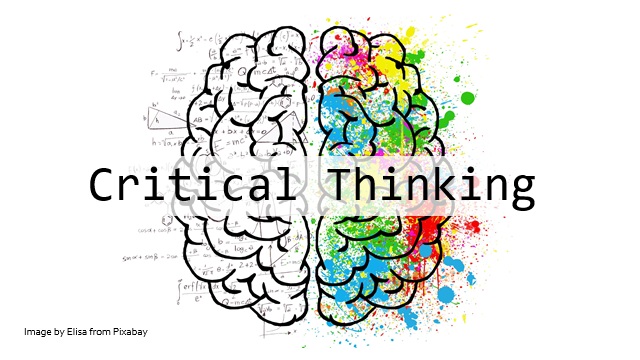
Thinking vs Critical Thinking

It’s important to know the difference… 

I had a nice chat the other day with a friend, and the subject came up: what is the difference between normal thinking and Critical Thinking? I thought we must have covered this before here, but I couldn’t find it. My apologies…

Briefly, Critical Thinking = normal thinking + more thoroughness + wisdom.

Critical Thinking is deeper and wider than normal thinking.

The word “critical” is key. It means thinking that is cautious, reflective, questioning, skeptical, …

A Good Analysis —

From this fine discussion: Thinking is a fundamental human activity, occurring when the mind processes information and forms ideas or concepts. It can be spontaneous, random, or directed, allowing us to understand, interpret, and make decisions about the world around us. Critical thinking, however, is a refined form of thinking. It demands a deeper level of analysis, evaluation, and synthesis of information to form a judgment.

Thinking can be passive. For instance, daydreaming or recalling a memory requires thinking but not necessarily any analytical process. Critical thinking, in contrast, is always active. It involves assessing the credibility of sources, identifying biases, and weighing evidence before drawing conclusions.

While thinking can often be based on personal beliefs, feelings, or incomplete information, Critical Thinking necessitates a rigorous approach to ensure objectivity and accuracy. It’s a skill that needs to be cultivated and practiced, requiring one to be skeptical, open-minded, and methodical.

Thinking is inherent and is something we do every day without much effort. Critical thinking, on the other hand, often requires more energy and attention. It challenges one’s own beliefs and assumptions, aiming for clarity, coherence, and logical consistency.

An Example —

From this college course: answer this question with the first answer that comes to mind, no matter what it is… A student went to the campus bookstore and bought two pencils for a total of 10 cents. How much did each pencil cost?

If you answered 5 cents (a total of 10 cents divided by two pencils equals 5 cents), your thinking fits the definition of normal thinking. In other words, it was based on simple recall of memorized information. You recalled those math formulas you memorized in school in order to answer the question.

On the other hand, if you had any other answer, you weren’t just thinking normally — you were likely thinking critically, because you were doing more than relying on recall of basic information.

For those in the latter case, unconsciously their thinking/ reasoning warning light went off. Perhaps they said to themselves, “I can’t tell. Maybe: a) one pencil is bigger than the other, or b) one is a red pencil, or c) one is a bigger pencil. In these cases, one pencil may cost 6 cents and the other 4 cents.”

Or perhaps you thought, “Wait a minute, I need more information.” Maybe you questioned the whole idea of two pencils being so cheap, or you thought that this had to be some type of trick question because it was so simple.

Hopefully, this simple example makes this distinction clearer…

Takeaway —

Put yet another way, regular thinking is like taking a drink of water — which most of us do reflexively a dozen or more times a day.

Critical Thinking is more like going to a winery and trying out several sample offerings. Both times we are swallowing liquids, but at the latter we are much more attentive — and critical!

Some sample good references:

©2025 All rights reserved.


Here is other information from this scientist that you might find interesting:

I am now offering incentives for you to sign up new subscribers!

I also consider reader submissions on Critical Thinking on my topics of interest.

Check out the Archives of this Critical Thinking substack.

WiseEnergy.org: discusses the Science (or lack thereof) behind our energy options.

C19Science.info: covers the lack of genuine Science behind our COVID-19 policies.

Election-Integrity.info: multiple major reports on the election integrity issue.

Media Balance Newsletter: a free, twice-a-month newsletter that covers what the mainstream media does not do, on issues from COVID to climate, elections to education, renewables to religion, etc. Here are the Newsletter’s 2025 Archives. Please send me an email to get your free copy. When emailing me, please make sure to include your full name and the state where you live. (Of course, you can cancel the Media Balance Newsletter at any time – but why would you?

Critically Thinking about Dr. Ed Meyer’s Teaching Philosophy — Part 1

I’m always on the lookout for others who understand and support the extreme importance of properly teaching Critical Thinking to K-12 students — which currently is happening in zero States.

I was pointed to Dr. Ed Meyer. I reached out to thank him, and we had some communications. I asked him to write up something about why Critical Thinking was so important, and he did. That will be in my next commentary.

Part 1 is a section of his interesting website, called his Teaching Philosophy:

A quick internet search on skills for which employers are looking always includes Critical Thinking/Problem Solving plus Communication/ Collaboration/Teamwork at or near the top. I agree 100%. These skills are not just applicable in a career, they will result in good decisions in one’s personal life involving relationships, finances, and time management.

The only way to develop these skills is to practice. That is, the only way to develop the ability to communicate and collaborate to solve challenging problems is to work in groups to try to solve challenging problems by communicating and collaborating. In the courses I teach, the students invest a lot of time struggling with challenging problems in groups. The problems always require the students to reach a new level of understanding and to generate an idea in their minds that wasn’t put there by anyone else. To have an “Aha!” moment.

Basically, I’m not trying to teach the students as much as I’m trying to develop them. Develop their mental strength, mental stamina, and the ability to tackle a problem that they have never seen before and have no idea how to solve. Today’s students aren’t used to this. Many students today prefer to be trained how to do a problem rather than to invest time trying to figure it out for themselves.

This is not surprising because the word UNDERSTAND was recently banned from learning goals at many universities! The reasoning cited that you can’t measure understanding, but you can measure whether the student can solve a particular type of problem. In fact, with non-standardized assessment, it is possible to determine whether a student understands a concept.

When students are trained to follow specific procedures to get the answer, they are flummoxed when they are given a problem that they weren’t trained how to solve. They raise their hands and say things like, “I’ve never seen a problem like this before,” “I have no idea what to do,” “How do you expect us to do the problem if you don’t show us how, you’re the teacher; that’s your job.”

It may seem counter-intuitive to some, but a teacher best supports students by not jumping in to steal their struggle. Difficulty awakens the genius. The problem, as I see it, is that students are used to getting help as soon as they don’t know what to do. As a result, not knowing what to do creates stress and shame. These are unhealthy emotions that hinder the development of the student. One way to avoid stress and shame among the students is by giving them straightforward problems that they have been trained to solve.

Another is to explain to the student that there is no progress without struggle and that school is the best place to practice struggling with challenging problems. Once the students understand that struggling with challenging problems is the key to their development, they have the attitude, “I have never seen a problem like this before and I have no idea how to solve it. What a wonderful opportunity to learn and develop!”

These students have a lot of fun tackling really challenging problems in a group. Sometimes they don’t solve them. That’s OK. The answer is not important. It is the struggle that is important. It is important that young people develop the skills to tackle challenging problems because they will have to tackle challenging problems after they leave the university. The first time that a young person must tackle a challenging problem should not be during a job interview.

©2025 All rights reserved.


Here is other information from this scientist that you might find interesting:

I am now offering incentives for you to sign up new subscribers!

I also consider reader submissions on Critical Thinking on my topics of interest.

Check out the Archives of this Critical Thinking substack.

WiseEnergy.org: discusses the Science (or lack thereof) behind our energy options.

C19Science.info: covers the lack of genuine Science behind our COVID-19 policies.

Election-Integrity.info: multiple major reports on the election integrity issue.

Media Balance Newsletter: a free, twice-a-month newsletter that covers what the mainstream media does not do, on issues from COVID to climate, elections to education, renewables to religion, etc. Here are the Newsletter’s 2025 Archives. Please send me an email to get your free copy. When emailing me, please make sure to include your full name and the state where you live. (Of course, you can cancel the Media Balance Newsletter at any time – but why would you?

Critically Thinking About Success: Part 2

Applying the Success Equation to U.S. K-12 Education. 

This is a follow-up to Critically Thinking about Success (Part 1). I’m following the same format, but looking at how we can achieve success by relatively quickly fixing America’s totally broken K-12 education system…

I’ve always had a fascination with why certain people stood out from the crowd and were successful. As I developed my Critical Thinking skills, I researched and paid attention to what common traits these people had — and applied them to a variety of issues that I’ve dealt with.

I contend if we follow the five Traits below, that will maximize our chances of success regarding what to do with the Department of Education (DOEd)…

Trait #1: Have a specific, high, attainable vision of what they want

Successful people are often called dreamers — as they see possibilities that almost everyone else discards as pie-in-the-sky. But their dreams have at least three characteristics:

a) they are precise (not vague),

b) they are aspirational, and

c) they are within reason. These three attributes help a believer to stay focused on their vision.

The VISION is: to transform DOEd so that it facilitates a significant improvement of the US K-12 education system, within five (5) years.

As with almost all visions of successful people, the vast majority of citizens will be skeptical that this can be done. They will have an array of excuses (like the fifteen listed here), but to Critical Thinkers, there are legitimate counters to every concern regarding DOEd.

Trait #2: Don’t reinvent the wheel

One way or another, almost everything has already been done before. (In fact, many historians look at history as a collection of repetitious cycles. A related famous saying is: “If you don’t learn from history, you are doomed to repeat it.”)

There are two primary ways of learning: Education or Experience. I found that those who are successful maximize the education part. In other words, a significant key to success is to learn as much as possible from the failures and accomplishments of others.

Most people are saying something like: “Get rid of DOEd because they have been a disaster.” That statement is absolutely true, but is getting rid of DOEd our best option to bring about our Vision? Unequivocally NO!

Critical Thinkers will approach this situation by saying: “Let’s identify and learn from the multitude of DOEd mistakes made in the past — and see that the transformed DOEd avoids those pitfalls.”

For example, Critical Thinkers will notice that DOEd never spelled out what the top priorities were for our K-12 education system! That is a simply stunning omission that explains a lot.

The good news is that this is easy to fix quickly. This error is compounded by the fact that when I read the Mission Statements of all fifty State Education Departments, there is zero uniformity among these!

So a powerful role that DOEd can play is leadership. The goal would be to get all States to have the same K-12 education objectives. How they achieve them will be left up to each State. See fifteen examples where DOEd leadership can be an extraordinary game changer.

Trait #3: See an exceptional opportunity when it presents itself

We ALL have been presented with (and will continue to be in the future) multiple opportunities. Unfortunately, many people don’t recognize most opportunities until they are in the rearview mirror. Successful people have developed the acuity to recognize a much greater selection of opportunities than others do.

We literally have in our grasp a once-in-a-lifetime opportunity to quickly and substantially improve the American K-12 education system. Again please carefully read fifteen powerful examples of what can easily be done.

To not take full advantage of this opportunity will in the future be looked at as a watershed mistake in American history. To consciously choose to make the situation worse (by turning over K-12 education to some fifty failing bureaucracies) would be criminal.

Trait #4: Intelligently take advantage of opportunities when presented

There are talkers and doers… Recognition of opportunities is an essential matter — but it is for naught if it isn’t acted on.

As a physicist, I can tell you that one of the fundamental principles of physics is the Law of Inertia. Basically what it means is that it takes more energy (effort) to get a stopped object to move forward, than it takes to get an already moving object to continue to move forward. The same applies to organizations. If their leaders are in a moving forward mindset, they will be more open to opportunities than someone who is defensively protecting their turf, or who simply decides a priori that something can’t be done, is too much trouble, etc.

The facts are that DOEd Secretary Linda McMahon:

1) can fire anyone at DOEd,

2) can hire anyone for DOEd,

3) can establish whatever policies and procedures she wants,

4) can spend $80± BILLION of annual discretionary funds anyway she sees fit, etc., etc.

What this means is that Linda can scrap the entire DOEd and start over —with essentially full control over every important aspect of it. In other words, Linda has the power to transform DOEd into a major beneficial force regarding American K-12 education.

This needs to be fully appreciated as an unprecedented opportunity, which requires prompt, meaningful action on her part to have DOEd blossom into a fabulously powerful force for good.

Trait #5: Be persistent to overcome the inevitable roadblocks that will be in the way

Every lofty goal comes with an assortment of obstacles. If they weren’t there everyone else would be doing it, and it would no longer be a lofty goal — it would be an everyday matter. So having a positive, persistent attitude is a key attribute of successful people.

There will be obstructions and obstacles in transforming DOEd into what it should be — like a large collection of vocal naysayers who lack the vision of how to convert DOEd into a major success.

We need to keep our eye on the prize, which means staying focused on the extraordinary benefits to America from starting to annually graduate 4± million well-educated, thinking citizens (instead of what’s happening now: annually graduating 4± million non-thinking citizens who are indoctrinated with progressive ideology). Reversing those figures would be profoundly beneficial to America’s future.

The Takeaway

There are no guarantees in life. Even if you adopt the above five traits, unforeseen circumstances might derail an otherwise good plan. I have a few adages I adhere to, and the most important one is: “Work as if everything depends on you, but pray as if everything depends on God.”

The benefits from properly transforming DOEd reimburse every cost and sacrifice at least a hundred times over. All we need is the vision and an unwavering commitment to make it happen.

©2025   All rights reserved.


Here is other information from this scientist that you might find interesting:

I am now offering incentives for you to sign up new subscribers!

I also consider reader submissions on Critical Thinking on my topics of interest.

Check out the Archives of this Critical Thinking substack.

WiseEnergy.org: discusses the Science (or lack thereof) behind our energy options.

C19Science.info: covers the lack of genuine Science behind our COVID-19 policies.

Election-Integrity.info: multiple major reports on the election integrity issue.

Media Balance Newsletter: a free, twice-a-month newsletter that covers what the mainstream media does not do, on issues from COVID to climate, elections to education, renewables to religion, etc. Here are the Newsletter’s 2024 Archives. Please send me an email to get your free copy. When emailing me, please make sure to include your full name and the state where you live. (Of course, you can cancel the Media Balance Newsletter at any time – but why would you?

The Fascinating Story of Warren Smith: Critical Thinking is at the core of it…

This is an update as the second video link (right after he was fired) somehow went to the wrong video. It is now corrected below. My apologies…

—> If you have not voted in my prior poll about who you thought won the recent Presidential debate, please take ten seconds and do so now, here. TY! <—

Warren Smith was a Massachusetts K-12 teacher who is now something of a celebrity.

What’s fascinating — and should be of great interest to readers here — is that Warren has become famous for one thing: promoting Critical Thinking to K-12 students!

That a fairly normal teacher is a national poohbah primarily because he is advocating that his students become Critical Thinkers, shows that there is a great deal of pent-up interest in learning and applying that skill. In other words, it is intuitively obvious to even those who are just paying minimal attention, that for the American Experiment to survive — and thrive — we need to have a LOT more Critically Thinking citizens.

Here’s a brief outline of Warren’s story, innocuously starting earlier this year, when he put out a short video where he gave a student a lesson on Critical Thinking.

Watch it: Getting Fired From My School – Warren Smith

Clearly his mini thought process lesson was a success!

A MAJOR part of fixing our K-12 education system is to have a formal part of the K-12 curricula (in the subject area of Science) where students are specifically taught how to be Critical Thinkers. There is plenty of documentation about how to do this, and Warren demonstrates a powerful way, akin to the Socratic method.

Critical Thinking needs to be looked at as a SKILL — like cooking. If you want to be an accomplished chef, which of the following do you think would produce better results: a teacher saying to you that you can be a culinary artist, and —

  1. telling you to go home and experiment on your own. Start with learning how to boil water, etc.
  2. explaining the great importance of food to everyone on the planet (from health to socialization), demonstrating how eating various foods can change your mood, showing how different foods interrelate with each other, describing how the same food (e.g., a potato) can be prepared in numerous creative ways, illustrating how presentation impacts the experience to the diner, making clear the difference between a cook and a chef, etc., etc.

Today in almost all US K-12 schools, option #1 is what is happening regarding learning the Critical Thinking skill. Warren was opening the door to teaching a student how the Think Critically, using option #2. BIG DIFFERENCE!

So what happened? How was he rewarded for his interest and efforts in getting children to become much better thinkers — which means happier and more productive citizens (see here)?

He got fired!

After getting this stunning news, Warren puts out this short video, trying to make sense of this unexpected and irrational development.

What he doesn’t say is that his termination is not a surprise, as the US K-12 education system is formally opposed to teaching Critical Thinking. I’ve written about this multiple times, like here. The Science standards adopted by 49 states actually teach the opposite of Critical Thinking — conformity and compliance.

Fortunately, this story may be headed towards a happy ending. As I tipped readers off at the beginning of this piece, this rather mundane K-12 situation hit the right cord, and suddenly Warren became somewhat of a celebrity. For example, there were some interesting interviews, like —

Piers Morgan Interviews Teacher Who Schooled Student to Think Critically,

Dave Rubin Interviews Warren Smith,

and several more, like this, this, this, etc.

I reached out to Warren and just made a connection. I look forward to communicating with him shortly. Some of the messages I will be conveying are:

  1. he’s on the right track, so don’t be dissuaded by the anti-Americans who want to undermine our K-12 education system,
  2. he should study what’s happening to K-12 Science standards, to get a better idea of the Big Picture and the purposeful attack on Critical Thinking,
  3. he will find my Report on the Amazing Benefits of Critical Thinking to be very interesting,
  4. there soon may be a fascinating job for him in North Carolina,
  5. Etc.

Regarding #4, if enough citizens take the time to understand what the issues are, and who has what position, reform (GOP) candidate Michele Morrow will be the next Superintendent of the NC Department of Public Instruction.

Michele has told me that Warren is exactly the type of person she would seriously consider hiring after she wins the upcoming election, as she is a major supporter of NC K-12 students becoming Critical Thinkers. Warren’s assignment might be “to get the proper teaching of Critical Thinking formally incorporated into the K-12 Science curriculum.”

Top Priority —

Job #1 is to get Michele elected, so please make a generous donation for this courageous and competent woman. If you’d like to see her in action, please watch this debate with her Dem opponent, from last weekend.

Let’s be very clear: this is NOT just a North Carolina issue!

Michele winning would be a major shot across the bow to the entire US K-12 public school system that business as usual is no longer acceptable! This is arguably one of the top twenty most important races in the US!

©2024. John Droz, Jr. All rights reserved.


Here are other materials by this scientist that you might find interesting:

I now am offering incentives for you to sign up new subscribers!

Check out the Archives of this Critical Thinking substack.

WiseEnergy.org: discusses the Science (or lack thereof) behind our energy options.

C19Science.info: covers the lack of genuine Science behind our COVID-19 policies.

Election-Integrity.info: multiple major reports on the election integrity issue.

Media Balance Newsletter: a free, twice-a-month newsletter that covers what the mainstream media does not do, on issues from COVID to climate, elections to education, renewables to religion, etc. Here are the Newsletter’s 2024 Archives. Please send me an email to get your free copy. When emailing me, please make sure to include your full name and the state where you live. (Of course, you can cancel the Media Balance Newsletter at any time – but why would you?
Critical Thinking 2024 Archives: January thru June

A helpful way for you to check out my 2024 Critical Thinking commentaries that you may have missed.

Since we are at the midpoint of 2024, let’s look back. As I continue to add readers, some of them are probably not aware of Critical Thinking commentaries I published earlier in the year or before. Yes, anyone can check out the Archives — but do they?

In any case the Archives are chronologically arranged, while this 2024 list of my commentaries is sorted by topic. Although some commentaries could be under more than one topic, I put them where they seemed to be most applicable.

I had to do this manually, so there might be a typo, etc. someplace. Hopefully this list will be of value to you.

Note 1: The comments for all these article are still open, so feel free to share your insights, after any commentary listed.

Note 2: This list will be available in the Archives if you’d like to refer to it at a later.

Note 3: To go one step further back, check out the 2023 Archives by topic.

Note 4: I was a bit surprised how relatively evenly the commentaries were divided by topic. That said, if you’d like to see more about a particular topic, please say so in the comments below.

I think that the depth and breadth of the material covered here speaks for itself. Please pass this free information onto other open-minded parties. Thank you for your support!


CRITICAL THINKING —

Critical Thinking Is THE Answer: The benefits available to Critical Thinkers are simply STUPENDOUS

What is Critical Thinking?

What’s the Opposite of Critical Thinking?

Is Critical Thinking a Good or Bad Thing?

EDUCATION —

The Most Powerful Education Idea Ever? A Single New High School Science Class Would Be Revolutionary

Utilizing the Power of School Choice: What a waste if not fully optimized!

Addressing Student Behavior Issues in K-12 Public Schools: A slew of liberal ideas has contributed to this becoming a formidable problem

Saving K-12 Private Schools: What seems daunting is actually rather simple

Saving American Children – Part 1, aka Saving America – Part 1

Saving American Children – Part 2, aka Saving America – Part 2

BELIEFS —

Change Beliefs => Change Actions: An example

Some Observations about Beliefs – Part 1: This is not about religious beliefs, but rather our beliefs about everything…

Some Observations about Beliefs – Part 2: Some of my Business and Personal Beliefs

Some Observations about Beliefs – Part 3: How to change the Beliefs of others — which will change their Actions…

CLIMATE CHANGE —

It’s Time to Make a Strategic PR Pivot in Dealing with the Climate Change Issue: Nothing short of Traditional Science is at stake here

Who is Winning the Climate Change War? Also: proof that the Climate and COVID alarmists used the same tactics…

Carbon Capture Doesn’t Work, So Why Are They Doing It? This is yet again another VERY bad idea…

ENERGY —

“All of the Above” — a VERY Bad Idea. This is a lobbyist energy motto — not a Science-based one

Wind Turbines = Enormous “Unintended” Consequences. The inevitable result when political science is substituted for real Science

Wind Turbine Related Radiation. Wind Energy is NOT Free, Clean, or Green

Nuclear Power Radiation — Part 1: Radiation from Normal Nuclear Facility Operations, Waste, and Misc…

Nuclear Power Radiation — Part 2: Radiation from Facility Accidents, Man-made Disasters, and Natural Disasters

Nuclear Is A Renewable Energy. Wind and Solar lobbyists are fighting this reality

ELECTIONS —

Defending John Eastman — Part 3: Bad news, but it’s not a surprise anymore…

An Election Integrity Analogy: Good Efforts do NOT assure Good Results

A Proposed Federal Election Integrity Law: This is WAY overdue!

1 – How to Win the US Presidency — The upcoming elections have never been more important. Again.

2 – The Rhyme and Reason of Negative Ballots? Our election system’s gaping loophole of non-transparent ballot “corrections”

3 – 2020 Presidential Election Related Lawsuits: What they did (and did not) reveal

4 – Should Voting Machines be Scrapped? Do they make reported election results more accurate?

5 – Have We had Honest or Dishonest Elections? Knowing which one we are dealing with makes a WORLD of difference…

POLITICS —

My Assessment of the Debate — A Non-political Perspective

Trump NY Trial Commentary: Your rights as an American citizen are directly at stake here

A Different Perspective on What’s Dividing Us (Culture differences explain some things better than racial differences do…)

More Misleading Statistics: Critical Thinkers will not be fooled!

Fixing Congress’ Worst Problem (And you’ve likely never even heard about it!)

SCIENCE —

Book Author(s) Wanted! Write a Guaranteed NY Times Best Seller

Ten (10) Ways Science is Being Attacked There are more, but this is the condensed version…

How I “Made Sea Level Rise Go Away”! A short story behind the story

Mann v Steyn (and us) An exceptionally important trial started January 16, 2024

More Evidence that Critical Thinking has Left the Building: The jury’s Mann v Steyn conclusion

HEALTH —

More Deception from Once Reliable Medical Sources: Paxlovid, Part 1 (If we can’t trust Johns Hopkins, what established sources are left?)

More Deception from Once Reliable Medical Sources: Paxlovid, Part 2 (If we can’t trust Johns Hopkins, what established sources are left?)

ARTIFICIAL INTELLIGENCE —

Is This AI Deception or Incompetence? Or Both — or Something Else?…

RELIGION —

Let’s Not Offend Anyone! Who makes up the rules for secular religions?

SOCIAL ISSUES —

At What Point Do We Say ENOUGH? (III) Critically thinking about what’s happening to America

Solving Some Major Societal Problems (Using Critical Thinking Skills makes it MUCH Easier to do)

Let’s Have More Civility…Is this possible under current circumstances?

There is No Such Thing as Social Justice Here

The “Evils of Whiteness — Yet another element of the secular religion

SELF-IMPROVEMENT —

Our Strongest Strength can be our Greatest Weakness: Plus a suggested solution

Mind Control via Confusion, etc. This will only get worse, so get educated!

MISC —

Private Property Rights: A common issue when wind or solar projects are being proposed

My Being on a National TV Quiz Show! A brief version of what happened

Good or Bad: You Decide (An unpleasant life experience…)

An Insurance Scam that Affects Us All: We are being fleeced by film-flam artists

The Smartest Person in the World Wiffs: Marilyn vos Savant makes a major gaff

Read About An Apparently Amazing Person — Someone I wish I knew!

College Football is a Microcosm of our Society: Who is at Fault for the Transfer Portal Debacle: Colleges, or Athletes, or?

©2024. John Droz, Jr. All rights reserved.


Here are other materials by this scientist that you might find interesting:

Check out the Archives of this Critical Thinking substack.

WiseEnergy.org: discusses the Science (or lack thereof) behind our energy options.

C19Science.info: covers the lack of genuine Science behind our COVID-19 policies.

Election-Integrity.info: multiple major reports on the election integrity issue.

Media Balance Newsletter: a free, twice-a-month newsletter that covers what the mainstream media does not do, on issues from COVID to climate, elections to education, renewables to religion, etc. Here are the Newsletter’s 2024 Archives. Please send me an email to get your free copy. When emailing me, please make sure to include your full name and the state where you live. (Of course, you can cancel the Media Balance Newsletter at any time – but why would you?

What’s the Opposite of Critical Thinking?

As you’ll see, there’s a LOT of this going on!


In my last commentary, I elaborated on a proposed definition of Critical Thinking. Although there were a few suggested refinements, I received no major objections. (If you have any, please put them in the comments below.)

Equally important is what Critical Thinking is NOT. Towards that end, in my most recent article, I outlined a brief layperson overview of some actions that would be considered the opposite of Critical Thinking:

People accepting what is currently politically correct, going along with consensus, deferring to experts, supporting the conclusions of computer programs, buying into one-sided presentations of facts, etc., etc.

I thought I would again test out the new version of Poe AI: Claude-3.5-Sonnet, to see what it had to say about that question — and the answer was rather good:

“The opposite of Critical Thinking could be described in several ways, depending on the context and specific aspects of Critical Thinking being considered. Some possible opposites or contrasts to Critical Thinking include:

  1. Uncritical Thinking: Accepting information or ideas without questioning or analyzing them.
  2. Gullibility: Being easily persuaded or deceived, lacking skepticism.
  3. Dogmatism: Adhering rigidly to preconceived notions or beliefs without considering alternative viewpoints.
  4. Emotional reasoning: Basing conclusions solely on feelings rather than logic and evidence.
  5. Impulsive Thinking: Making quick judgments without careful consideration of facts and consequences.
  6. Confirmation Bias: Seeking out only information that supports pre-existing beliefs while ignoring contradictory evidence.
  7. Groupthink: Conforming to popular opinion without individual critical analysis.
  8. Magical Thinking: Believing in unnatural causality or disregarding logic and evidence in favor of wishful thinking.
  9. Fallacious Reasoning: Relying on logical fallacies or invalid arguments to draw conclusions.
  10. Closed-mindedness: Refusing to consider new ideas or perspectives that challenge existing beliefs.

These behaviors and thought patterns represent various ways in which people might engage in non-critical thinking — essentially doing the opposite of what Critical Thinking entails.”

Yes, those are all bad intellectual habits that should be comprehensively and objectively discussed, (particularly when teaching Science in K-12 schools), so that they can be studiously avoided. However, in general, that is NOT happening (e.g., none of these ten items are covered in the NGSS)…

This is an enormous deficiency in our K-12 education system that needs to be properly fixed, yesterday!

©2024. John Droz, Jr. All rights reserved.

RELATED VIDEO: One of the most important videos you can watch on Critical Thinking.


Here are other materials by this scientist that you might find interesting:

Check out the Archives of this Critical Thinking substack.

WiseEnergy.org: discusses the Science (or lack thereof) behind our energy options.

C19Science.info: covers the lack of genuine Science behind our COVID-19 policies.

Election-Integrity.info: multiple major reports on the election integrity issue.

Media Balance Newsletter: a free, twice-a-month newsletter that covers what the mainstream media does not do, on issues from COVID to climate, elections to education, renewables to religion, etc. Here are the Newsletter’s 2024 Archives. Please send me an email to get your free copy. When emailing me, please make sure to include your full name and the state where you live. (Of course, you can cancel the Media Balance Newsletter at any time – but why would you?

Educator Cherie Zaslawsky on the ‘official narratives’ vs. critical thinking and the truth

In this Dissent Television episode we interview Cherie Zaslawsky about “official narratives” versus critical thinking and the truth.

Cherie takes us on a trip down the rat hole of those who perpetuated and those who believe these “official narratives” rather than taking the time to learn the truth.

From climate change, to influencing the 2024 election by persecuting their political opponents. The official narratives have now become public policy not unlike in the former Soviet Union under Joseph Stalin.

This is a must watch video.

ABOUT CHERIE ZASLAWSKY

Cherie Zaslawsky is a writer, freelance editor, and private educator/teacher/writing coach for high school students.

Cherie is a confirmed Constitutionalist who, nevertheless, lives in California.

Her work appears in News with Views, Renew America, Lew Rockwell, American Thinker, Canada Free Press, World Net Daily, The Post & Email, and DrRichSwier.com.

See her Substack: Cherie Z’s Truth Be Told! and her columns here Cherie Zaslawsky.

©2024. Dissent Television Channel and host Dr. Rich Swier. All rights reserved.

Is This AI Deception or Incompetence? Or Both — or Something Else?

A scientist wrote me that (based on his reading my frequent alerts about how the Scientific Method and Critical Thinking have been abandoned in K-12 education in almost all states) he decided to ask AI about this to see what it had to say.

His query to ChatGPT was “In which US states is the Scientific Method officially part of the high school curriculum now?”

ChatGPT’s deceptive/incompetent answer to that reasonable question was (and I injected – a few comments -):

As of my last update in April 2023, the Scientific Method is a fundamental part of high school science education in the United States and is included in the science curriculum of all states [completely false, see below]. The Scientific Method, which is the process of making observations, formulating hypotheses, conducting experiments, and drawing conclusions, is universally recognized as a critical component of scientific literacy.

State Standards: Each state in the U.S. has its own set of educational standards that dictate what is taught in public schools. These standards typically include the Scientific Method as part of science education. [False. AI evidently believes that repeating a false statement makes it true!]

Common Core and Next Generation Science Standards (NGSS): While the Common Core State Standards focus primarily on mathematics and English language arts, the NGSS, which have been adopted by many states [49], specifically emphasize scientific practices, including the Scientific Method [totally false — the NGSS has specifically scrapped the Scientific Method]. The NGSS outlines a framework for science education that integrates scientific inquiry and application.

Integration in Science Subjects: The Scientific Method is taught not as an isolated concept but integrated into various science subjects, including biology, chemistry, physics, and earth science. Students learn to apply the Scientific Method in different contexts and experiments. [Again, the NGSS has eliminated the Scientific Method!]

Laboratory Work and Experiments: High school science classes often include laboratory work and experiments where students actively use the Scientific Method [If they do it’s by accident]. This hands-on approach helps in reinforcing the steps and principles of scientific inquiry.

Emphasis on Critical Thinking and Inquiry: Modern educational approaches emphasize Critical Thinking, problem-solving, and inquiry-based learning, with the Scientific Method being a key tool to develop these skills. [Total garbage]

Advanced Placement (AP) and International Baccalaureate (IB) Programs: In more advanced courses like AP and IB, the scientific method is a crucial part of the curriculum, with a strong focus on independent research and experimentation.

In summary, while the specifics of how the Scientific Method is taught can vary from state to state and school to school in the U.S., it is a standard and essential part of high school science education nationwide. [Yawn: simply not true.] This reflects the importance of scientific literacy and inquiry in preparing students for higher education and understanding the world around them.

Will the average person using AI be able to discern that they have been repeatedly lied to?

Will even an above-average person be able to tell that they have been given false information?

For citizens who want to know the Truth here, it can be found by reading what is in the Science Standards of 49 States: A Framework for K-12 Science Education, which is the basis for the Next Generation Science Standards (NGSS).

Alternatively, citizens can read pages 3 through 7 of my Education Report (plus any of the other Appendices that cover topics relevant to them, in more detail).

For those who find five pages too high a hill to climb, the general answer is that the NGSS (and Framework) have scrapped both the Scientific Method and Critical Thinking from US K-12 Science Standards. One more time: the NGSS has been adopted in its entirety, or mostly, in 49 states (Florida is the holdout).

Another interesting question comes to mind here: is the bogus answer given by AI due to incompetence or dishonesty? Based on the computing power involved, it’s hard to attribute this to incompetence. That seems to leave dishonesty. That would be if ChatGPT knew the right answer but purposefully altered it. That there is some algorithm that adjusts answers to reflect a progressive ideology, is certainly possible — as the computer programmers are almost certainly progressives.

A third possibility is GIGO. ChatGPT provides answers based on an extensive Internet search. Since AI can NOT tell right from wrong, it is just passing on what the majority of the Internet content is indicating. We all know (or should know) that much of the Internet has been hijacked by progressives (think Wikipedia), so it should be no surprise that the majority of what is on the Internet regarding the current teaching of the Scientific Method and Critical Thinking in US K-12 schools, is misleading or outright false.

The irony is that it takes the ability to do Critical Thinking to be able to understand when AI is inaccurate — which is one of several reasons why they don’t want students to be Critical Thinkers.

Please work in your home state to see that your K-12 education system DOES properly teach and emphasize Critical Thinking. Our future depends on it!

©2024.  All rights reserved.


Here are other materials by this scientist that you might find interesting:

My Substack Commentaries for 2023 (arranged by topic)

Check out the chronological Archives of my entire Critical Thinking substack.

WiseEnergy.org: discusses the Science (or lack thereof) behind our energy options.

C19Science.info: covers the lack of genuine Science behind our COVID-19 policies.

Election-Integrity.info: multiple major reports on the election integrity issue.

Media Balance Newsletter: a free, twice-a-month newsletter that covers what the mainstream media does not do, on issues from COVID to climate, elections to education, renewables to religion, etc. Here are the Newsletter’s 2023 Archives. Please send me an email to get your free copy. When emailing me, please make sure to include your full name and the state where you live. (Of course, you can cancel the Media Balance Newsletter at any time – but why would you?

Defeating Manufactured Fear: How to Defuse the Left’s Most Powerful Tool

Fear has been shown to be a VERY effective way of getting people to be compliant.

Every day we are barraged with a slew of fears: inflation, national debt, terrorism, city riots, drug deaths (e.g., fentanyl), community killings, out-of-control immigration, school propaganda, legislative self-serving, executive branch incompetence, judicial bias, corporation corruption, climate, COVID-19, China, Russia, etc., etc.

A case can be made that we are living in really bad times so fear is warranted. But two quick thoughts:

a) what can the average citizen do about most of the threats we are dealing with? and

b) doesn’t this incessantly foreboding fear desensitize us?

Let’s back up a bit and consider what goes on internally in us that causes fear. Anxiety is typically at the root of this emotion, and anxiety is usually the result of a perception that we lack control (i.e., a comforting plan). Regardless of the threat, if we believe that we have a safe way out, our fear will be minimal.

Whether fear is a good or bad thing, has been debated for a long time. On the one hand, fear can be beneficial when it is a wake-up call. On the other hand, it is detrimental when it causes us to give up in the face of a perceived threat, or when it eats away at our health, relationships, enjoyment of life, etc.

Another significant matter here is when a fear-inducing claim is made, who is responsible for establishing its authenticity: the alarmist or us? Fear perpetrators almost always rely on deference to authority: these supposed experts say “do such-and-such.” In other words, you should toe the line and go along (be compliant).

This article has some good insights, like explaining the difference between stress and fear:

Stresses come in many varieties—viral, bacterial, parasitic, fungal, toxic, chemical, mechanical, emotional, physical, and spiritual. Many of the assaults on our bodies are just part of living in our modern world. We can’t avoid air pollution. We can’t stop all the germs that land on us in the elevator. We can’t change modern-day farming practices. There is much we can not control, but fear is a bit different.

It comes in one variety: thoughts that start with “what if,” and often end up with a worst-case scenario. The fear of loss in humans is very keen — a primary motivator that has made many advertisers rich. What if you lose your job? Or your child? Or your lover? Or your home? Or your reputation? Or your car? Or your wallet? Or your mind? Or your health? So many things to lose!…

There are two major worldwide fears we have been continuously bludgeoned with:

a) Climate Change. The basic message is: unless we make radical societal changes, the world will come to an end in 10± years. You might think this fear is the worst that we can be threatened with, but no…

b) COVID. The basic message was: unless you are willing to drastically surrender your rights and freedoms, you or your loved ones will likely die very quickly.

There are several tactics to counter these fear-inducing messages (like just ignoring them), and two (2) have proven to be very effective:

1 Critical Thinking

2 God

1 – CRITICAL THINKING regarding Climate or COVID would reveal that the media messages we are being fed are purposefully designed to create and feed fear. This should not be a surprise, as feeding fear has a long tradition in media — as they believe that bad news sells much better than good news.

Worse is that many of the media messages we are being fed are without merit. This also should not really be a surprise, as how many journalists writing about highly technical matters like Climate or COVID are bonafide experts (real scientists)? Almost none.

They might argue that they are just passing on what the “experts” are saying. That might sound sensible, but it is false, as they only endorse and pass on what SOME experts are saying. Since experts differ on both of these complex issues, how does a non-technical journalist decide which experts are right?

They do not have the technical background to make a science-based determination!

For example, there are experts on both sides of the issue as to whether black holes exist. If a journalist writes about this topic, they have no business taking a side. Instead, they should write objectively and thoroughly about the arguments made on BOTH sides — and let the reader make up their own mind.

None of that is happening regarding the mainstream media’s handling of technical matters (Climate, COVID, energy, etc.)!

One of their arguments would likely be that they are just passing on what the “majority” of experts are saying. That is more BS meant to fool non-critically thinking citizens. For example, do they have proof that the majority of climate experts believe that unless radical changes are made immediately, the planet will cease to exist in 10± years? Of course, they have no such thing!

That leaves citizens who want accurate information one choice: do their own investigation and apply Critical Thinking. Checking things out on their own, they will likely come across experts who are more interested in the Truth, rather than going along with what is politically popular. Citizens would do well to listen to such parties — but should still apply Critical Thinking to what they are told even from them. (My twice-a-month Newsletter is a free vehicle for such sources.)

The same would apply to multiple other societal issues. For example, we know that an eight-year-old does not have the maturity to: drive a car, own a gun, drink a beer, get married, decide whether or not to wear a COVID mask, etc., etc. So (critically thinking about this), what sense does it make to say that this same child has the maturity to make a sex change decision — that will have extraordinarily profound consequences on them for the rest of their life?

My last observations about Critical Thinking start with the reality that keeping things in perspective is a key objective for maintaining mental, emotional, and spiritual health… We need to appreciate that fear prevents an organized, rational resistance — which is exactly what the bad actors are hoping for… Manufactured (and exaggerated) Fear is intended to divide us (e.g., see here). To counteract that, surround yourself with quality people.

In other words: have strong personal relationships in your life. For example, if you are in a committed relationship with the love of your life, societal troubles will fade into the background.

2 – GOD. A powerful conclusion from a critical thinking analysis on these societal fears we are being subjected to, is that many of these are not simply a difference of opinion, but rather are just evil. Many of us tend to be skittish when it comes to taking a stand on moral issues, and that is exactly what our opponents want us to do: stay on the sidelines, be wishy-washy, etc. That leaves the playing fields open to bad actors to wreak havoc on America and our Judeo-Christian standards.

When we have a proper perspective on why we exist, God is the most logical answer. For example, as a professional scientist, I say that to believe that we are just a statistical part of a Big Bang, is stretching credulity beyond the breaking point.

If we really believe in — and are on good terms with — God, then the threat of a “worst-case scenario” is actually an illusion. If the world ends or we die, so what? All that has happened is that our time to get an eternal reward is accelerated. This is one of the main reasons that our country’s opponents want to undermine our Judeo-Christain beliefs, as they are a powerful anecdote to their fabricated fears

God is the guaranteed anecdote for the evil we are being subjected to, as God’s power is far greater than all the evil in the world combined. But there is a hitch: this power will not come into play until a) we acknowledge it, b) we ask for it, and c) we do our part: pray as if everything depends on God, but work as if everything depends on us.

Some people are resistant to accepting the God part because they say things like “How could God stand by and allow XYZ to happen?” The fact is that God understands the Big Picture of the world a thousand times more than any of us do — so for us to say we need to have it explained to us why God does something, is arrogant.

Following the logical plan of Critical Thinking + God will result in less stress and more comfort. It will also open the door to more happiness (see our recent discussion on that).


Some additional interesting thoughts on this topic:

I like this quote: “Fear is like heroin: it takes more and more to get the same high until it finally kills you.”

This is an interesting video of a discussion by four people from different backgrounds regarding Manufacturing Fear: American Culture Today.

Overcoming Manufactured and Authentic Fear has some powerful and practical insights.

Great: Social and Political Turbulence is Manufactured to Infantile Us.

A Primer for the Propagandized: Fear is the Mind-Killer is excellent.

©2023. John Droz, Jr. All rights reserved.