Tag Archive for: Cuba

The Trump Administration Is Punishing Fraudulent Refugees and Assisting the Truly Persecuted

Watching FIFA World Cup referees darting back and forth across the pitch these days, I was reminded that some professions are thankless. Theirs is one such job: a single blunder triggers an avalanche of criticism, while getting it right goes unnoticed. Yet, it is not the only one. The role of the politician in charge is another — and one judged even more harshly, I would argue.

A few weeks ago, I wrote an article arguing that the real and sustained misuse of terms like “refugee” or “asylum” should not lead to extremes, given that there are, in fact, people who genuinely fit these categories. In that piece, I called on the Trump administration to punish fraudsters — yes — but also to assist the truly persecuted.

Today, I must highlight a couple of cases that illustrate how the White House is embracing this sound practice.

Just weeks after sanctions were imposed on the Cuban Institute of Friendship with the Peoples (ICAP) — described by Secretary of State Marco Rubio as “a vehicle for radical leftist extremism and subversive foreign influence in the U.S. and throughout our hemisphere” — Carlos Antonio Lloga Domínguez was expelled from the country. He was a former Castro-regime official linked to that organization.

In an official statement, Rubio detailed that despite residing in the U.S., Lloga Domínguez “maintains ties to the organization” as well as “links to the transnational network of communist subversion.” Consequently, he, his wife, and his son “are now in federal custody awaiting removal from the United States.”

Rubio reaffirmed that the country “will never become a home for foreign communists who peddle propaganda, direct subversive influence operations, or support radical anti-American movements.” He further warned that anyone dealing with ICAP would face sanctions, prosecution, or deportation.

Like Rubio, I agree that ICAP is an influence and intelligence group controlled by Havana, possessing an extensive global network that fosters espionage, promotes anti-Western propaganda, coordinates foreign influence operations, and organizes leftist revolutionary movements worldwide.

In recent weeks, [there have been interactions] with former prison system officials, daughters of high-ranking Castro-era military officers, former Communist Youth leaders, and former Ministry of the Interior officers.

On another front, the winds are shifting toward extending a hand to those fighting against socialism.

In early July, an immigration judge dismissed the deportation proceedings facing Cuban journalist Yosmany Mayeta. Originally from Santiago de Cuba, he is a well-known reporter who exposes the brutality of the Castro regime and the hardships of daily life on the island; he also frequently participates in demonstrations calling for the release of political prisoners outside the Cuban embassy in Washington, D.C.

He arrived in the United States in 2019 on a student visa linked to his work as an independent journalist. As he detailed on social media, he began the process of regularizing his immigration status, but the case was stalled by the lack of a resolution regarding an immigration waiver that was never processed by the relevant authorities.

Last month, Mayeta explained on social media that he lacked the financial resources to hire specialized legal counsel after his application for permanent residency was denied.

The immigration authorities’ decision ended months of uncertainty for Mayeta, who can now continue his work denouncing an anti-American tyranny without the threat of deportation back to the island.

The journalist told the press that he knew that hearing could change his life.

“Before going in, I said a prayer and surrendered everything to God, like someone letting go of a burden they can no longer carry alone,” he commented. “I feared deportation, but my greatest fear was losing the chance to keep living in a country where I have been able to work and practice journalism freely — something that, in Cuba, cost me beatings, threats, and persecution.” Upon learning of the judge’s decision, the first thing she did was give thanks. “The first thing I did was thank God, with my eyes closed and my heart racing. Then I thought of my family, my lawyers, and all the people — including my followers — who prayed for me and stood by me throughout this process,” he said.

The “Yes” for Mayeta and the “No” for the socialists are good news, a blend of hope and justice that I trust will prove enduring.

AUTHOR

Yoe Suarez

Yoe Suárez is The Washington Stand’s international affairs correspondent. He is an exiled journalist, writer, and producer who investigated in Havana about torture, political police, gangs, government black lists, and cybersurveillance. A graduate of Universitat Autònoma de Barcelona, he was a CBN correspondent, and has written for outlets like The Hill and Newsweek. He has appeared on Vox, Univision, and Deutsche Welle as an analyst on Cuba, security, and U.S. foreign policy.

RELATED ARTICLE: The Spanish Socialist Workers’ Party Triggered the Invasion of Ceuta

EDITORS NOTE: This Washington Stand column is republished with permission. All rights reserved. ©2026 Family Research Council.


The Washington Stand is Family Research Council’s outlet for news and commentary from a biblical worldview. The Washington Stand is based in Washington, D.C. and is published by FRC, whose mission is to advance faith, family, and freedom in public policy and the culture from a biblical worldview. We invite you to stand with us by partnering with FRC.

The Lost Ties between the United States and Cuba (Part 1)

If you were to ask any 21st-century American about Cuba, most of the stories that would come to mind would be those of the Missile Crisis, the world on the brink of nuclear collapse, and the repression of freedoms against the island’s inhabitants by a socialist tyranny. And they are right.

But the rich connections between the island and the United States are not limited to the last 70 tumultuous years. There is a whole current of prior ties, in which solidarity and alliance between regional neighbors prevailed.

We discussed these with Cuban-American historian Octavio de la Suarée, who for years was a professor and head of the Department of Language, Literature, and Culture at William Paterson University in New Jersey, and who presides over the Cuban Academy of History in Exile. Here is part of that long conversation on the 250th anniversary of the United States.

In what ways did Cubans contribute to the American Revolutionary War?

The contribution of Cubans to the American Revolutionary War between 1775 and 1783 was very important, although often underappreciated. As a Spanish colony, and given its proximity to the United States, Cuba supported the Thirteen Colonies through Spain, which officially entered the war against Great Britain in 1779.

Their contributions are highlighted in various ways, but perhaps the most poetic of all was the famous collection by the ladies of Havana, whose donations helped finance the military campaign that culminated in the Battle of Yorktown in 1781, considered decisive for the American victory. Several sources refer to the large quantity of personal jewelry that, when sold, helped reach the sums required to finance that battle.

Another substantial economic foundation was the large sums of money that were collected from all over Havana to help finance the independence army.

Likewise, another significant military reinforcement was the fact that Cuba served as a strategic base for operations against the British in the Caribbean and the Gulf of Mexico. Cuban troops, militias, and resources participated in campaign actions such as the capture of Pensacola, which weakened the British.

And among the logistical support was the location of Cuban ports on the island, from where weapons, gunpowder, food, and medicine were sent to the American rebels. Similarly, Havana was a key naval supply center for the Allied Forces against England.

There were figures who stood out at that historical moment, right?

Yes. I’m only going to mention two key Hispanic figures in the American Revolutionary War against the British.

Bernardo Gálvez, for example, was an essential figure in the independence of the United States, although he is little known in this country. This Spanish politician and military leader was born in Macharaviana, Spain, near Málaga, in 1746, and distinguished himself as a military strategist during the war between Spain and Great Britain. He was governor of Spanish Louisiana during the conflict and fought against the British on many occasions. Gálvez decisively aided the Thirteen Colonies, without openly declaring it at the beginning, by sending arms, gunpowder, money, and supplies to the rebels, which he received from Havana.

Later, he participated in and led important military campaigns against the British, including those of Baton Rouge, Mobile, and Pensacola in 1781. In the latter, he led a very risky naval attack, and it was there that he acquired his motto, “Yo solo” (I alone), because he sailed his ship where other military personnel thought it was impossible. These victories not only expelled the English from the region but also prevented the rebels from being attacked from the south. Gálvez ended his brilliant career as Viceroy of New Spain (present-day Mexico).

In 2014, the United States Congress named him an Honorary Citizen of the United States (a very rare honor). There is a statue of Bernardo de Gálvez in Washington, D.C., near the State Department.

The other important figure was Juan Mirallés, an 18th-century Spanish merchant and diplomat, known for his role during the American Revolutionary War. In short, he was the main informal liaison between Spain and the American revolutionaries.

Mirallés was born in Spain and later settled in Havana, which at that time was a key center of Spanish trade. He quickly became a wealthy merchant with extensive networks in the Caribbean and North America.

He was a personal friend of George Washington and lived for a time very close to the headquarters of the Continental Army. From there, he discreetly helped channel financial support, supplies, and weapons to the rebels. At the same time, he served as an observer and political advisor for Spain, reporting on the war’s progress.

Juan de Mirallés died in 1780, during the war. George Washington attended his funeral, a very significant gesture that shows the respect he had for him. Although not very well known today, Mirallés was a substantial figure in the secret diplomacy that helped make American independence successful and a reality.

In short, although Cuba did not participate directly as an independent nation, its economic, military, and logistical support was crucial to the triumph of the American colonies.

Without these resources, especially in the final stage of the conflict, the independence of the United States would have been much more difficult to achieve.

Now, let’s change direction. In the Cuban wars of independence in the 19th century, several North American names stand out. But perhaps the most well-known is Henry Reeve, also known as “the little Englishman.” What is his story?

Many Americans participated in the Cuban Wars of Independence, and among the most prominent names are Thomas Jordan, a general of the Confederate States, who served as Chief of Staff of the Mambí Army in 1869; Colonel Federico Fernández Cavada of the Union Army, who was commander-in-chief of the Mambí Army for a time; his brother Adolfo, who was a colonel; and W.A.C. Ryan, executed in Santiago de Cuba, among others.

We also have Henry Mike Reeve Carroll — who was a brigadier general in the Liberating Army during the Ten Years’ War (1868-1878), the First War of Independence of Cuba — proclaimed against Spanish colonialism by the Father of the Nation, Carlos Manuel de Céspedes, with the Grito de Yara (Cry of Yara) at his La Demajagua estate on October 10, 1868. He is also known as the first president of the Republic of Cuba in Arms.

Henry Reeve, for his part, was born in Brooklyn, New York, on April 4, 1850, and participated as a drummer boy for the Union Army from a very young age in the American Civil War (1861-1865), where he developed a strong opposition to slavery. Three years later, upon learning of the revolution in Cuba against Spain, he felt compelled to join the Mambí Army.

Is it true that he didn’t speak Spanish?

Yes. Although he didn’t speak a word of Spanish, Reeve boarded the steamship “Perrit” in 1869 under the alias Henry Earl and arrived on the Cuban coast at the port of Nipe, eight months after the war began. The next day, he engaged the enemy in combat, where he was captured along with several other expedition members, and they were taken to be executed.

Reeve was shot four times, the bullets piercing his body, but fortunately, none of them hit a vital organ. He regained consciousness later and managed to escape his captors at night. He wandered aimlessly for two days until he found the Mambí detachment of General Luis Figueredo at El Mejías camp, where he received medical attention.

The following month, the American received the rank of Second Sergeant in the Mambí Army, and in October of the same year, he was appointed aide-de-camp to General Thomas Jourdan. Jourdan, however, resigned shortly afterward, and the young man joined the 1st Cavalry Squadron of the Northern Brigade of Camagüey under the command of Brigadier General Cristóbal Acosta. Throughout that year, he participated in several encounters with the enemy, including the battles of Tana, Imías, and Jagua, where he was wounded again.

Reeve fought on the island under the command of the legendary lawyer who fought in some 100 battles, Ignacio Agramonte, correct?

In March 1871, Reeve was transferred to Ignacio Agramonte’s cavalry unit with the rank of captain. He fought in the battles of Estrada and Mulato before taking part in the rescue of Brigadier General Manuel Sanguily on October 8, 1871, leading a machete charge of Agramonte’s cavalry against superior Spanish forces. Agramonte had selected a small group of 35 horsemen, led by Commander Reeve, to carry out the daring rescue, which resulted in a resounding success.

Later, the young commander participated in the battles of Plátano, La Redonda, San Ramón de Pacheco, Santa Deo, La Matilde, and Sitio Potrero, and, in November 1871, he was wounded again. The following year, on November 29, 1872, he received an abdominal wound during the Battle of Le Carmen, an injury that would cause him problems for the rest of his life.

In 1873, Reeve participated in the battles that took place in Ciego de Najasa, Soledad de Pacheco, and Cocal del Olimpo. His daring and valor in the Battle of Jimaguayú on May 11, 1873, in which Ignacio Agramonte died, earned him even more distinctions. During this battle, Reeve briefly assumed command of Agramonte’s division, later handing it over to General Julio Sanguily. When Agramonte died in Jimaguayú, Reeve already held the rank of colonel.

After the death of Ignacio Agramonte, Reeve was reassigned to the command of Major General Máximo Gómez and was appointed Chief of Cavalry for the First Division on July 27, 1873. Gómez described Reeve as an exceptional officer, highlighting “his proven courage, his tireless dedication, and his strict military discipline.”

AUTHOR

Yoe Suarez

Yoe Suárez is The Washington Stand’s international affairs correspondent. He is an exiled journalist, writer, and producer who investigated in Havana about torture, political police, gangs, government black lists, and cybersurveillance. A graduate of Universitat Autònoma de Barcelona, he was a CBN correspondent, and has written for outlets like The Hill and Newsweek. He has appeared on Vox, Univision, and Deutsche Welle as an analyst on Cuba, security, and U.S. foreign policy.

EDITORS NOTE: This Washington Stand column is republished with permission. All rights reserved. ©2026 Family Research Council.


The Washington Stand is Family Research Council’s outlet for news and commentary from a biblical worldview. The Washington Stand is based in Washington, D.C. and is published by FRC, whose mission is to advance faith, family, and freedom in public policy and the culture from a biblical worldview. We invite you to stand with us by partnering with FRC.

Rubio Sanctions Cuba’s Oil Machine

Secretary of State Marco Rubio on Thursday announced multiple sanctions against the Cuban communist regime, this time targeting the regime’s cash cow.

“Today, I am sanctioning Cuba’s state-owned energy company, Unión Cuba-Petróleo (CUPET), under President [Donald] Trump’s EO 14404,” Rubio wrote on X. “Cuba’s Communist elites have weaponized energy as a tool of social control and kleptocratic profit.”

“For decades, the regime has stolen and hoarded available fuel—using it for the Castros’ private jet, the security services forces used to repress the Cuban people, to keep empty tourist hotels lit up, and to bus people in for fake protests and political stunts—all while the Cuban people have suffered blackouts and waited weeks to fill their cars,” he added.

Cuba’s communist regime has been designated as a state sponsor of terrorism by the United States since 2021. The regime has also been accused by numerous human rights organizations of severe violations, including forced starvation of its people, severe political imprisonment and executions, and censoring the information provided to its people.

The petroleum company sanctioned by the secretary serves as a leading contributor of wealth for the regime’s military arm, known as GAESA.

GAESA currently has over $10 billion in reserves, Cuban American lawmaker Rep. Carlos Gimenez, R-Fla., told the Daily Signal at a press conference earlier this month.

Rubio added that the sanctions are not the last action Trump’s administration will take against the Cuban regime.

“President Trump wants a new future for the Cuban people with greater economic and political freedom and opportunity. Until then, we will continue to target the Communist regime’s ability to leverage its energy trade,” the secretary said.

In May, the Department of Justice also announced criminal charges against Cuba’s former communist dictator, Raul Castro, and his family members, for the downing of a humanitarian rescue flight that took place over Cuba in the 1990s.

AUTHOR

Pedro Rodriguez

Pedro Boccalato Rodriguez-Aparicio is a journalism fellow at the Daily Signal. Follow on X pedrobrodrigue7.

RELATED ARTICLE: SHOT TO THE HEART OF DEI: How the Trump Admin Is Dismantling the Legal Basis for Government-Endorsed Discrimination

EDITORS NOTE: This Daily Signal column is republished with permission. ©All rights reserved.

Finally! Consequences for a Castroist Influence Network in the U.S.

As I wrote in November 2025, the Cuban regime has been trying to influence the new generations in America for years. The audacity with which some of their sympathizers operate on U.S. soil is reckless. What is most outrageous to a Cuban fleeing socialism is seeing a horde of so-called intellectuals marching against capitalism while wearing a T-shirt featuring the assassin known as Che Guevara.

Fortunately, however, the Trump administration has begun doing what no other has done before: confronting these propagandists with the full force of the law. Currently in the crosshairs are the influential Marxist commentator Hasan Piker and CodePink Co-Founder Susan Benjamin.

Both — having been issued citations by the Office of Foreign Assets Control — visited Havana in March on an “ideological safari,” aiming to echo the Castro regime’s narrative regarding the extent to which the U.S. “blockade” impacts the daily lives of ordinary Cubans. In a capital city shrouded in darkness, they stayed at the only place with electricity: a luxury hotel owned by the regime.

In doing so, both Piker and Benjamin allegedly violated U.S. law, which prohibits citizens from staying in state-owned facilities, based on the rationale that such funds would not end up in the hands of the Cuban people. Anticipating this, several American commentators who have traveled to the island to document its reality have chosen to stay in “casas particulares” — hostels run by ordinary Cubans.

The citations issued to Piker and Benjamin are not an isolated incident. Rather, it stems from a broader investigation seeking to determine whether organizations and U.S. citizens violated U.S. laws and sanctions by supporting a socialist tyranny.

Officials from the Departments of the Treasury, State, and Justice are reportedly coordinating efforts to curb malicious foreign influence operations within the country — particularly those activities related to supporting political violence, extremist movements, or acts of terrorism.

At the center of the investigation lies a single name: that of the leftist American tech magnate Neville Roy Singham, a key figure in the financing of a network of nonprofit organizations. According to Piker himself, these are dedicated to the “defense of political causes” and to “many political movements.”

However, this support comes not only from international capital but also from the “accompaniment” of Castroist diplomacy in the United States — regarded by analysts as a perennial source of espionage.

Federal authorities are investigating David Ramírez Álvarez, Second Secretary of the Embassy of Cuba in Washington, D.C., for allegedly coordinating a malign foreign influence campaign on U.S. soil.

Fox News recently published a video in which Ramírez Álvarez participated in a meeting of left-wing radicals. But that is nothing new. This influence over potential community organizations and leaders dates back decades — to when the current mayor of Los Angeles, Karen Bass, traveled to the island as part of the Venceremos Brigade, or when Cuban American socialist Danny Valdes was part of Zorhan Mamdani’s campaign.

As former Chavista general Hugo Carvajal confessed last year, Havana has been among the operators with spies infiltrated in American institutions, who have laundered money in Miami, New York, and Texas and who coordinate operations to influence strategic decisions in Washington.

How? One way we have known about for some time is through activists or proxy groups that it trains and that its diplomats support, such as Calla Walsh, co-founder of Unity of Fields, formerly known as Palestine Action US, the Armed Queers of Salt Lake City, or the Democratic Socialists of America.

These organizations always find a way to interconnect their agendas and actions in tributes to Fidel Castro alongside Ernesto Soberon Guzman, Permanent Representative of Cuba to the United Nations. Cuba had trained organizers behind the anti-Israel protests on university campuses, including the leader of The People’s Forum, Manolo De Los Santos, an avowed admirer of the Cuban Revolution, who posted in 2023 that he spent 10 days in Cuba “learning with its people & President Miguel Diaz-Canel.”

As a Cuban exile, I thank U.S. authorities for working to ensure the national security of their citizens and of those of us who have found refuge in this beautiful nation. The most positive effect, I hope, is that other bad actors will think twice before violating the law in support of a tyranny like the Castro regime — at least during this administration.

AUTHOR

Yoe Suarez

Yoe Suárez is The Washington Stand’s international affairs correspondent. He is an exiled journalist, writer, and producer who investigated in Havana about torture, political police, gangs, government black lists, and cybersurveillance. A graduate of Universitat Autònoma de Barcelona, he was a CBN correspondent, and has written for outlets like The Hill and Newsweek. He has appeared on Vox, Univision, and Deutsche Welle as an analyst on Cuba, security, and U.S. foreign policy.

EDITORS NOTE: This Washington Stand column is republished with permission. All rights reserved. ©2026 Family Research Council.


The Washington Stand is Family Research Council’s outlet for news and commentary from a biblical worldview. The Washington Stand is based in Washington, D.C. and is published by FRC, whose mission is to advance faith, family, and freedom in public policy and the culture from a biblical worldview. We invite you to stand with us by partnering with FRC.

How Christians in Cuba Are Engaged in Civic Resistance under The Current Regime

In his seminal work “The Politics of Nonviolent Action,” political scientist Gene Sharp cataloged 198 methods of nonviolent action. Wherever tyranny existed, the American scholar found a hopeful and creative form of civic resistance emerging from diverse populations. Through sit-ins, musical performances, and countless other forms of expression, men and women across the globe voiced their dissent against specific policies or systems.

Among these methods, Sharp included the “protest or support assembly.” He classified it as a method of “protest and persuasion,” aimed at making public support — or opposition — to a specific cause visible, while seeking to mobilize citizens and exert pressure on opponents without resorting to violence.

In Cuba, the long history of resistance against totalitarianism has involved recourse to both violence and peaceful demonstrations. And within this civic landscape, the protest or support assembly has carved out a space — one that is currently being championed by young Christians.

There are precedents. In April 2021, evangelical leader Marcos Antonio Perdomo was interrogated by the National Revolutionary Police (PNR) in Santiago de Cuba. He was reprimanded for continuing to hold worship services, thereby defying the Castro regime’s COVID-19 lockdown orders.

In solidarity with Perdomo, a group of some twenty believers gathered outside the Micro 9 Police Station and remained there until he emerged from the building.

Recently, there has been a surge in such displays of solidarity; their primary inspiration is a movement of young evangelical and libertarian influencers in Cuba that first emerged in late 2025.

The Christian content creators — Anna Bensi, Ernesto Ricardo Medina (of El4tico), Iván Daniel Calás, and David Espinosa — and, on the other side, the four members of the widely followed program Fuera de la Caja (Outside the Box), did not initially know one another. However, the thematic overlap in the issues they address eventually led them to collaborate, both on-camera and behind the scenes. The discourse of the Cristario axis — a blend of “Christian” and “libertarian” — is anti-socialist and pro-free market; it champions Cuba’s Christian heritage and envisions a future free from the leftist propaganda that has dominated the country for nearly seven decades. They represent a sort of crystallization of the “New Right” concept articulated by political scientist Agustín Laje: sovereigntists, patriots, conservatives, and libertarians united against totalitarian ideologies.

Since late 2025, this group has engaged in public education through videos disseminated via Facebook profiles and YouTube channels, covering topics such as the separation of powers, public service, totalitarianism, and religious and financial freedom; they have also dispelled myths surrounding the much-maligned concept of capitalism. This activity has placed them squarely under the regime’s microscope.

In an unfortunately familiar cycle — one seemingly lifted straight from the socialist political police’s playbook — repression begins in concentric circles radiating outward from the targeted individual.

First, the victim is “interviewed” and warned to abandon their dissident discourse; next, an attempt is made to recruit them as an informant for the intelligence apparatus; should they refuse to compromise, threats inevitably follow. The next circle to be targeted consists of friends and family members, who receive summonses and threats, pressured to “counsel” their loved one.

Thus, in April, the political police summoned Yusleidy Bosques — mother of Karel Daniel Hernández, a member of the group Fuera de la Caja (Outside the Box) — to the National Revolutionary Police (PNR) station located at Infanta and Manglar in Havana.

Caridad Silvente and Elmis Rivero (a U.S. citizen) — the mother and sister, respectively, of Anna Bensi — were also summoned and subjected to intimidation regarding the repercussions Bensi would face if she continued posting criticisms of the socialist system. Subsequently, both Silvente and Bensi were held under house arrest for a month and placed on the blacklist of “regulated” individuals — those barred from leaving the country.

However, alongside this subsequent wave of repression came a surge of solidarity. By my count, five solidarity gatherings took place within a span of seven weeks (from March 11 to April 25, 2026). On each occasion — during a summons issued to a member of the Eje Cristario or a family member — each woman gathered friends, followers, and leaders or brethren in the faith outside the police stations where the interrogations were taking place, remaining there until the interrogated individual emerged.

The solidarity assemblies held during this period were characterized by public prayers offered on behalf of the summoned individual, performed in circles formed directly in front of the police stations — all of which were located in Havana. Furthermore, each gathering was documented through selfies and photographs, which were uploaded immediately to social media; this revealed a shift in attitude regarding resistance to the totalitarian state — no longer marked by cautious apprehension, but rather by an openly displayed courage.

Another noteworthy element is that, from the very first assembly on March 11 (when Silvente went to the PNR Station in Alamar) to the one held on April 25 (the Bosques gathering at Infanta and Manglar), the number of participants steadily increased. While images from the first event show nine people gathered, the final assembly drew 19 attendees — an event that even featured a sort of bicycle caravan carrying a portion of the participants as they made their way to the police station.

Could these assemblies grow to become events involving dozens or even hundreds of citizens?

The regime shifted its strategy regarding summonses to police stations in May. Early that month, Castroist henchmen interrogated Amílcar Andrés Bravo — father of Abel and Bety, the young members of the Fuera de la Caja (Outside the Box) collective — but this time, the interrogation took place at his workplace: the Cuban Sports Research Center. Had the military authorities changed the location of the interrogation to prevent another solidarity assembly — one that might have been even larger than previous ones?

Alfredo G. Fominaya Roig, a student at the Pentecostal Theological University of Cuba, has participated in three of the recent solidarity assemblies held in Havana. Having himself become a influential figure — particularly through his Facebook profile — he has faced threats due to the videos he posts criticizing the regime.

The first solidarity assembly he attended was held in support of Anna Bensi, even though he knew her only through social media.

Alfredo recalls how the regime attempted to sabotage an assembly organized in support of the young woman. He was unable to attend another of the content creator’s summonses (on April 12) because the political police had — in a move described as “simultaneous and malicious” — issued a summons to David Espinosa; consequently, many people were already en route to support him in a different part of Havana.

Reflecting on the solidarity assemblies he has attended, he notes that while each offered a distinct experience, they shared certain common nuances. “The one constant is that we pray before the person who was summoned goes inside,” he says. “Then, during the wait, conversations spring up — along with mutual understandings, shared affinities, and friendships that grow increasingly solid with each passing time.”

Alfredo believes that “the dictatorship, in its attempt to sever that connection, has only succeeded in making us more united and stronger.”

These gatherings conclude only when the summoned individual emerges from the police station, where they are greeted “with joy and a keen curiosity to hear about their latest encounter with those Orwellian dogs,” recounts the young man affiliated with the Assemblies of God. In his case, he attended for the first time because he had asked a friend to let him know when the next solidarity assembly took place. He had seen photos of people gathered at a previous one and told himself that he was one of them. “In hard times, I couldn’t help but be where those who thought the same way I did were.”

The example of others who had come before him — spread through an open channel like social media — combined with ideological alignment and, most importantly, shared faith as a unifying bond, drew Alfredo to more than one of these acts of resistance. It remains to be seen whether the courage of others proves contagious and activates the civic responsibility of other Cubans during this decisive hour for the island.

AUTHOR

Yoe Suarez

Yoe Suárez is The Washington Stand’s international affairs correspondent. He is an exiled journalist, writer, and producer who investigated in Havana about torture, political police, gangs, government black lists, and cybersurveillance. A graduate of Universitat Autònoma de Barcelona, he was a CBN correspondent, and has written for outlets like The Hill and Newsweek. He has appeared on Vox, Univision, and Deutsche Welle as an analyst on Cuba, security, and U.S. foreign policy.

RELATED ARTICLE:

EDITORS NOTE: This Washington Stand column is republished with permission. All rights reserved. ©2026 Family Research Council.


The Washington Stand is Family Research Council’s outlet for news and commentary from a biblical worldview. The Washington Stand is based in Washington, D.C. and is published by FRC, whose mission is to advance faith, family, and freedom in public policy and the culture from a biblical worldview. We invite you to stand with us by partnering with FRC.

Supreme Court Weighs in 8-1 on Cuba-Tied Lawsuit

The Supreme Court determined that a U.S.-based company—Havana Docks—can recover damages from four major cruise lines that used its docks previously confiscated by the Cuban government.

Havana Docks, a U.S. company, built docks in Havana’s port before the Cuban Revolution. The Castro regime revoked the company’s legal right to the docks, and the company later sued cruise lines that used the docks, claiming they were liable for trafficking in confiscated property. The cruise lines argued that the company’s legal right to the docks would have expired by then, regardless of confiscation.

In an 8-1 ruling issued on Thursday, Justice Clarence Thomas found that Havana Docks “did not have to prove that the cruise lines interfered with a property interest that would have existed in the counterfactual scenario in which the Cuban government did not confiscate it.”

“The cruise lines’ use of the docks is sufficient to establish that they used ‘property which was confiscated by the Cuban Government,’” Thomas wrote.

Justice Elena Kagan dissented.

In 2019, the docks company sued four cruise companies that used the confiscated docks from 2016 through 2019. The companies were Royal Caribbean, Carnival, Norwegian Cruise Line, and MSC Cruises.

The companies argued they followed the U.S. government’s lead on reopening travel to Cuba as part of the Obama administration’s overtures to the island nation.

Thursday’s ruling reverses an 11th U.S. Circuit Court of Appeals decision that determined the company could not recover damages. Before that, a lower court found the cruise companies liable for $440 million.

The question before the court was whether a plaintiff must establish a present-day property interest if the assets in question were not monetized.

AUTHOR

Fred Lucas 

Fred Lucas is senior investigative reporter for the Daily Signal. He is the author of “The Myth of Voter Suppression: The Left’s Assault on Clean Elections.” Follow on X FredLucasWH.

EDITORS NOTE: This Daily Signal column is republished with permission. ©All rights reserved.
U.S. Indicts Cuba’s Castro for Massacre of American Citizens

It has happened. The memory and pain of several Cuban-American families in Florida may finally find justice starting this Wednesday, May 20. On that very day — when Cubans celebrate the founding of the Republic that preceded the socialist Revolution — a federal grand jury filed formal charges against Raúl Castro for a massacre that took place 30 years ago.

For years, the anti-Castro exile organization Brothers to the Rescue (HAR) flew small planes over the Florida Straits, searching for Cubans fleeing in small boats or homemade rafts, crafted from almost any floating material, and alerting the U.S. Coast Guard to rescue them.

However, on February 24, 1996, four of the eight HAR activists took off in three planes on a routine mission from Florida, unaware that two Soviet-built MiG fighter jets were taking off from the island with orders to massacre them.

In international airspace, air-to-air missiles tore apart two HAR Cessna 337s and four of their crew members — three of whom were U.S. citizens.

‘Many Unanswered Questions,’ Says a Survivor

Now, Armando Iglesias, one of the survivors of that day, applauds the filing of charges against Castro. In statements provided for this article, he expressed his belief that “many questions still remain unanswered.”

For him, “after 30 years, any effort aimed at establishing accountability for the downing of the HAR planes constitutes an important step in the search for truth and justice for the families of Carlos Costa (29), Mario de la Peña (24), Pablo Morales (29), and Armando Alejandre Jr. (45).”

The third plane — the only one to escape the massacre — was locked in the crosshairs of the MiG piloted by Castro regime pilot Luis Raúl González-Pardo. Iglesias, José Basulto, Sylvia Iriondo, and her husband Andrés were on board. Hidden among the few clouds that day, it entered U.S. airspace and landed at Opa-Locka.

During the administration of Democratic President Joe Biden, one of the Castro-era pilots who participated in the operation that day — Lieutenant Colonel González-Pardo — entered the United States.

For Iriondo, this is “a slap in the face to the memory of the victims of the February 24 massacre and their families.” Furthermore, as a member of the Cuban-American community “who has experienced firsthand the criminal nature of the Castro tyranny, I am deeply concerned by the deficient vetting process that allowed González-Pardo to enter this country.”

In November 2025, the FBI arrested the former pilot. The U.S. Attorney’s Office for the Southern District of Florida charged him with “fraud and misuse of visas, permits, and other documents,” as well as making a false statement to a federal agency. These charges could carry a prison sentence of up to 15 years.

Then-Attorney General Pam Bondi stated regarding the case: “This man’s past as a longtime military pilot in the service of the evil Castro regime — which has caused untold suffering to the Cuban people — should have taken center stage and featured prominently in his immigration file.”

A Key Piece: González-Pardo

Now, González-Pardo could become a key piece for the U.S. Attorney’s Office for the Southern District of Florida in the trial against the younger Castro brother. In fact, he is one of five co-defendants alongside the dictator, according to court documents made public.

González-Pardo’s testimony would be particularly useful for reconstructing how the military chain of command functioned, the orders in place regarding HAR, and for verifying the level of control Castro — then Cuba’s Minister of Defense when the massacre occurred — exercised over the Air Force.

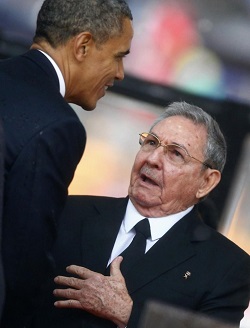
Listed as co-defendants alongside these two are the Castro-era military officers Lorenzo Alberto Pérez-Pérez, Emilio José Palacio Blanco, José Fidel Gual Barzaga, and Raúl Simanca Cárdenas. Castro II, 94, became the “president” of Cuba in 2008 following the illness of his brother, Fidel Castro, who passed away in 2016. Around that time, President Barack Obama offered him a failed “thaw” in diplomatic relations. Today, however, Trump is bringing his name before the courts.

With him, America will initiate the same process it undertook with Nicolás Maduro: a judicial proceeding designed to exert further pressure on Havana — at a time when negotiations for political change appear to be making little headway — while the Castro regime pins its hopes on simply holding out until November and the midterm elections.

Will the Department of Justice “Madurará” (ripen, en español) judicially Raúl Castro through to the very end, just as it did with the Venezuelan socialist dictator?

In Florida this Wednesday, Acting U.S. Attorney General Todd Blanche stated regarding the indictment: “President Trump is committed to restoring a very simple yet important principle: if you kill Americans, we will pursue you — no matter who you are, no matter what title you hold, and, in this case, no matter how much time has passed.”

With the filing of charges against the Antillean tyrant, the America First agenda has proven that it looks not only toward the future but also toward the injustices of the past.

AUTHOR

Yoe Suarez

Yoe Suárez is The Washington Stand’s international affairs correspondent. He is an exiled journalist, writer, and producer who investigated in Havana about torture, political police, gangs, government black lists, and cybersurveillance. A graduate of Universitat Autònoma de Barcelona, he was a CBN correspondent, and has written for outlets like The Hill and Newsweek. He has appeared on Vox, Univision, and Deutsche Welle as an analyst on Cuba, security, and U.S. foreign policy.

EDITORS NOTE: This Washington Stand column is republished with permission. All rights reserved. ©2026 Family Research Council.


The Washington Stand is Family Research Council’s outlet for news and commentary from a biblical worldview. The Washington Stand is based in Washington, D.C. and is published by FRC, whose mission is to advance faith, family, and freedom in public policy and the culture from a biblical worldview. We invite you to stand with us by partnering with FRC.

The Cuban Government’s Miraculous Ability to Survive May Be Coming to an End

I first heard the term “estática milagrosa” (“miraculous stasis”) from a friend of my wife. The young woman — an architect — had worked for an urban heritage conservation office in Cuba, and she marveled at how the mansions, buildings, cinemas, and theaters of the once-Parisian Havana refused to collapse.

Humidity might burst the dowels within their columns; saltpeter might bloat the cement on their facades; a hurricane might rip away their doors and windows — yet the structures remained standing, defying the terror of skittish passersby.

The Revolution turned Havana into a Pompeii of Salt. Ruins without a volcano. The volcano — red as the most vivid lava — was socialism. The city’s miraculous stasis is mirrored in the very malady that has caused its impoverishment. Cuban socialism has misgoverned the country — and squandered its sugar and tourism industries — to such an extent that, although it should have collapsed years ago, its capacity to cling to power remains astonishing.

Events between Cuba and the United States have taken a series of highly symbolic turns this May.

On the 5th, Secretary of State Marco Rubio visited SOUTHCOM headquarters during a national security conference in Miami, where he posed for a photograph in front of a map of the island while shaking hands with General Francis L. Donovan.

On the 12th, he smiled for the camera once again. This time, aboard Air Force One, he wore a gray Nike tracksuit — remarkably similar to the one Nicolás Maduro was wearing when he was extracted during the operation on January 3rd. Was he sending a warning to Raúl Castro regarding what would befall him should he refuse to negotiate a change in Cuba?

Two days later, John Ratcliffe, the Director of the CIA, arrived in Havana for an unprecedented official visit. After years of accusing independent journalists like myself of being “mercenaries paid by the CIA,” the U.S. delegation was received by Interior Minister Lázaro Alberto Álvarez Casa and Intelligence Chief Ramón Romero Curbelo.

Furthermore, Ratcliffe reportedly held talks with Raúl Guillermo Rodríguez, head of security and factotum to his 94-year-old grandfather, Raúl Castro, who holds the reins of the island.

It appears that things did not go entirely smoothly during the talks, or perhaps Rubio simply wants no further delays from Havana. That very night, an administration official leaked to major media outlets that the United States is moving toward indicting Castro in connection with the 1996 massacre of activists from Hermanos al Rescate (Brothers to the Rescue).

Amidst all this, earlier in the month, widely circulated reports emerged regarding an increase in U.S. spy flights near Havana and Santiago de Cuba, the country’s second-largest city. Since February, P-8A Poseidon and RC-135V Rivet Joint aircraft, as well as MQ-4C Triton drones, have reportedly conducted at least 25 intelligence-gathering flights.

Meanwhile, economic pressure continues to mount. The Canadian mining firm Sherritt, which had been operating in the eastern part of the island, is set to dissolve its Cuban subsidiary due to sanctions imposed by Washington.

According to both the secretary of Interior and the U.S. Geological Survey, Cuba possesses one of the world’s largest nickel reserves; moreover, in 2023, Cuba ranked as the world’s seventh-largest producer of cobalt — a mineral critical for battery manufacturing. The geopolitical significance of these critical minerals provides yet another compelling reason why a free Cuba serves the national interest of the United States.

On the domestic front, the diplomatic efforts of Ambassador Mike Hammer continue to exert a positive influence on the public opinion of the average Cuban regarding the role of the United States in the current crisis, as well as the White House’s support for those on the island who risk their safety to raise their voices in support of a new Cuba.

If there is one issue that unites the entire spectrum of political opinion within the Cuban dissident movement, it is the liberation of political prisoners — a group that currently numbers well over a thousand. And the Trump administration is pressuring the Castro regime to carry out further prisoner releases.

The departure of activist Sissi Abascal — escorted directly from prison to a flight that took her to the United States on a humanitarian visa — is the most recent example. It occurred shortly after USA Today published audio recordings of the high-profile political prisoners Maykel Osorbo and Luis Manuel Otero Alcántara, in which they describe receiving an ultimatum from the regime: leave Cuba or remain in prison.

Meanwhile, the protests continue unabated — an extension of that “Spring of Fire” which began in March and has filled neighborhoods across the country with the din of banging pots and pans. People are protesting with cacerolazos against power outages, medicine shortages, repression, and food scarcity.

Will all of this momentum finally translate into the end of the “miraculous stasis” (what Cubans view as a “cursed stasis”) that sustains the longest-running tyranny in the hemisphere? The Donroe Doctrine must take root in the heart of the Caribbean to affirm its hegemony — and to realign the destinies of millions on the island with the cause of freedom.

AUTHOR

Yoe Suarez

Yoe Suárez is The Washington Stand’s international affairs correspondent. He is an exiled journalist, writer, and producer who investigated in Havana about torture, political police, gangs, government black lists, and cybersurveillance. A graduate of Universitat Autònoma de Barcelona, he was a CBN correspondent, and has written for outlets like The Hill and Newsweek. He has appeared on Vox, Univision, and Deutsche Welle as an analyst on Cuba, security, and U.S. foreign policy.

RELATED ARTICLE: From Hitler To Adenauer, From Tojo To Yoshida, From Mussolini To De Gasperi

EDITORS NOTE: This Washington Stand column is republished with permission. All rights reserved. ©2026 Family Research Council.


The Washington Stand is Family Research Council’s outlet for news and commentary from a biblical worldview. The Washington Stand is based in Washington, D.C. and is published by FRC, whose mission is to advance faith, family, and freedom in public policy and the culture from a biblical worldview. We invite you to stand with us by partnering with FRC.

Marcel Villa: The Hazardous and Rewarding Work of Practicing Independent Journalism in Cuba (Part 1)

Marcel Villa does not come from academia; he holds no formal degree certifying him as a journalist or photographer. Perhaps that is precisely why he is, today, one of the most intriguing communicators on the island — someone who does not take for granted the postmodernist dogmas prevalent in state-run higher education or in courses designed for the independent press. And that stance has come at a cost.

He recalls his teenage years as those of an undisciplined youth, “without much sense of future direction.” At age 21, he sat for the entrance exams and enrolled in law school through a special program for working students. He admits he chose the major “more out of family influence than any true vocation.”

In 2018, while in his third year of studies, his older brother — who has lived in Spain for the past 20 years — gifted him a camera. Almost simultaneously, he discovered the small world of the non-state press in a Havana that was experiencing the ultimately fruitless apertura (opening) initiated by Barack Obama.

The profession he chose is not an easy one. Practicing independent journalism in Cuba remains a pursuit subject to a level of persecution rarely seen elsewhere in the hemisphere. The Cuban Institute for Freedom of Expression reported that in the month of March alone, there was a surge in internet outages, arbitrary detentions, incarcerations, attacks, threats, and both psychological and physical assaults.

On the island — currently a focal point of international attention due to the potential for political change under pressure from the Trump administration — Villa uses video interviews, travel chronicles, and photojournalism to document a fractured nation that continues to survive despite socialism.

Here is Part 1 of my interview with Marcel.


How did you get your start in the world of the independent press?

It was in 2018, when I submitted a feature story to Play-Off Magazine — an independent Cuban sports publication. The piece was about a Dominican priest living in Havana who was using soccer as a tool for social change.

At the time — alongside my studies — I was working as a pizza maker at a cafeteria in Alamar; I would spend 12 or 13 hours there, working non-stop, for $10 a day. It was exhausting. I was just at the café when I received the news that Play-Off Magazine had accepted my feature story and that I would be able to contribute to them on a regular basis. Immediately afterward, I feigned a stomachache, hung up my apron, and walked out — never to return. That day, Play-Off became my job.

I wasn’t a photographer yet, nor did I aspire to be one; I was barely just learning how to use a camera.

My intention was to become a journalist, so I focused on writing the text, treating photography more as a supplement. Lacking formal professional training, I had gaps in my theoretical knowledge and errors in my writing — flaws I gradually corrected as I studied journalism manuals and my editors provided feedback. In that sense, Play-Off served as a school for me.

And when — and why — did you shift your focus to photography?

In 2019, I watched the film “The Pirates of Somalia,” and it sparked the idea for me to travel to the Isle of Pines. I thought: This will be my Somalia. Once there, I sought out stories that I could later turn into feature articles, chronicles, or even — I considered — an investigative piece. I laugh about it now, looking back, because the whole trip was incredibly ill-prepared. I hadn’t even arranged a place to stay.

I arrived on the island and knocked on the door of the very first house I saw that was renting out a room. I spent a week in the city of Nueva Gerona, burning through my savings; as a consequence of my journalistic wanderings around the city, I ended up being interrogated by State Security (SE — the political police) just hours before my scheduled departure.

The day after I returned to Havana, State Security contacted me again — but this time, they tried to recruit me as an informant within Play-Off. I refused, and for months afterward, I lived in fear that they would retaliate against me.

During that period, the era of openness in Cuba — sparked by the “thaw” under the Obama administration — was drawing to a close, and with it, the boom in independent media. Some magazines went on hiatus; many others simply didn’t survive. My trip to the Isle of Pines had been a complete fiasco. I was never able to land any actual journalistic assignments during my time there. Photography — both as an art form and a craft — was captivating me more and more.

All of this, combined with the apprehension left over from my run-in with State Security, led me to dedicate myself to photography full-time. Although I became a professional photographer and focused on more commercial genres, I continued to collaborate occasionally with Play-Off.

I dropped out of law school, knowing it was a profession I would never actually practice, and devoted myself full-time to studying and honing my skills with my camera. I completed a basic course at an excellent private institution called the Havana School of Creative Photography; everything else I learned on my own — through books, articles, and videos.

From that time until 2023, I shot Quinceañera celebrations, music videos, still photography, theater productions, fashion shoots, special events, nightlife scenes, and more. To make a living as a photographer in Cuba, you have to be extremely versatile, as the market is quite limited.

But then you returned to independent media — and not merely as a contributor, but by founding a publication of your own.

Yes. In 2022, together with three friends, I founded POB Magazine, an independent photography journal. We kept it running for a year using our own resources. Its editorial line was largely inspired by Play-Off; we used photography — along with the testimonies of photographers — as a window onto the reality of life in Cuba.

A series of cyberattacks on our website — occurring just days before our one-year anniversary — forced us to cease publication. We decided to put the project on hold until we could secure the necessary funding. While it was active, the magazine was very well received within the Cuban photography community; being its co-founder and director gave me significant visibility within the independent media landscape.

In that same year — the year POB Magazine went on hiatus — I returned full-time to the world of journalism, this time working as both a photographer and a video producer. I gradually began to move away from the more commercial genres of photography and video, shifting my focus instead toward photojournalism and documentary photography.

Since then, I have collaborated with most of the independent Cuban magazines and newspapers currently in existence — almost always anonymously. I also contribute regularly to El País, and on a couple of occasions, I have worked with El Confidencial — both based in Spain.

(Read Part 2)

AUTHOR

Yoe Suarez

Yoe Suárez is The Washington Stand’s international affairs correspondent. He is an exiled journalist, writer, and producer who investigated in Havana about torture, political police, gangs, government black lists, and cybersurveillance. A graduate of Universitat Autònoma de Barcelona, he was a CBN correspondent, and has written for outlets like The Hill and Newsweek. He has appeared on Vox, Univision, and Deutsche Welle as an analyst on Cuba, security, and U.S. foreign policy.

EDITORS NOTE: This Washington Stand column is republished with permission. All rights reserved. ©2026 Family Research Council.


The Washington Stand is Family Research Council’s outlet for news and commentary from a biblical worldview. The Washington Stand is based in Washington, D.C. and is published by FRC, whose mission is to advance faith, family, and freedom in public policy and the culture from a biblical worldview. We invite you to stand with us by partnering with FRC.

The Most Important Debate in Cuba Happening Today: Christians and Politics (Part 3)

(Read Part 1 and Part 2)

The Catholic intellectual Dagoberto Valdés has spoken of that essential embrace between the exiles and those remaining within the country — those two “lungs” of the nation. Millions of Cubans are scattered across the globe, kept apart by politics and the draconian laws of a totalitarian regime. From the prohibitions and surveillance surrounding the receipt of letters from abroad, to the deep-seated mistrust directed at the men and women who departed the island — all these wounds must be healed.

“Not everyone will discern this right away,” Methodist Pastor Darlon Bermúdez cautioned. “It happened in the days of Nehemiah, and it will happen again now. But when the hand of God rests upon a people, He Himself undergirds the entire process. Cuba has not been forgotten by God. These ruins do not mark the end of the story. God continues to raise up, to restore, and to establish — and He often accomplishes this by bringing back those who were once compelled to leave, yet who never ceased to belong.”

Zeal Tempered by Love; Prudence Guided by Truth

For his part, religious leader Carlos López Valdés drew another historical parallel — though in this instance, he focused on two distinct groups that coexisted during the days of Jesus. The pastor of the Evangelical League of Cuba recalled that, at that time, Israel was living under immense socio-political pressure.

“Amidst that reality, the Zealots emerged: men deeply passionate about God and about the freedom of their nation. They believed — rightly so — that only God should reign over His people, and that oppression was not God’s design for Israel,” said López Valdés. In his view, their contribution was significant: they kept the people’s identity alive, defended God’s sovereignty, and refused to resign themselves to an unjust reality.

To the pastor, some of them chose the wrong paths — “not in their yearning for change, but in the methods they employed to achieve it.”

Then there were the Pharisees. “Men sincere in their desire to honor the Law, committed to the spiritual life of the people. Many of them sought to preserve the faith amidst a complex context,” he said. “Their concern to avoid conflict with Rome also stemmed, in part, from a desire to shield the nation from graver consequences.”

Yet in that attempt to preserve, he underscored, “there was sometimes a risk of adapting too readily to the system and of viewing with suspicion those who raised a dissenting voice.”

López Valdés noted that Jesus did not align Himself with the violence of some Zealots, yet neither did He ignore the need for transformation. He did not reject the Pharisees as individuals, though He did confront — with love and authority — attitudes that hardened the heart.

The controversy surrounding political engagement within the Cuban church reminded the pastor of that historical scenario. Regarding believers who, moved by their faith, voiced their anguish in the face of injustice, he stated that they did so not out of hatred or violence, “but out of a deep conviction that human dignity must be honored.”

He acknowledged that, at the same time, other brethren feel concern regarding the tone, the potential repercussions, or the risk that the church might lose its spiritual focus. “Their desire, often, is to safeguard unity, avoid divisions, and protect their witness,” he said. In his reflection, López Valdés took issue with the epithets hurled during the controversy. “Calling a brother a ‘zealot’ can end up being a label that oversimplifies something far more complex. For not everyone who raises their voice seeks violent confrontation. And not everyone who remains silent does so out of a lack of conviction,” he wrote.

For him, the challenge amidst the controversy was not “labeling one another,” but rather discerning hearts and fruits. “There is a zeal that needs to be guided by love. And there is also a prudence that needs to be accompanied by truth. The church is called to uphold both: a passion for justice, and wisdom in its approach.”

In an invitation to unity, López Valdés urged everyone to listen to one another with humility. “Behind every stance lie distinct stories, fears, convictions, and burdens. And all of us, in some way, are striving to remain faithful to God amidst complex realities,” he remarked. “Instead of discrediting one another, we are called to walk alongside each other. Instead of labeling one another, we are called to understand one another.”

Zeal is not the problem, nor is prudence. “The true challenge is ensuring that both are surrendered to Christ. For ultimately, the Kingdom of God advances neither through imposition nor through silence, but through transformed hearts that know how to love the Truth and live it out with grace.”

I believe that a mature and realistic perspective on the church’s mission involves viewing it — yes — as an institution, but also as the sum of its members. We are one body; I have been called to be a voice, while others serve as hands or feet. No one is superior to another. We are all part of the Redeemer’s plan.

At the same time, I never forget that whenever members of the political police detained or summoned me regarding my work as a journalist, they would invariably sneer the phrase: “Christians don’t get involved in politics.” Of course! That is precisely what they desire: that those who know the Light should hide it away. Yet, it fills me with hope to know that within the Cuban church, many simply do not know how to hide their lamp under the bed.

AUTHOR

Yoe Suarez

Yoe Suárez is an exiled journalist, writer, and producer who investigated in Havana about torture, political police, gangs, government black lists, and cybersurveillance. A graduate of Universitat Autònoma de Barcelona, he was a CBN correspondent, and has written for outlets like The Hill and Newsweek. He has appeared on Vox, Univision, and Deutsche Welle as an analyst on Cuba, security, and U.S. foreign policy.

EDITORS NOTE: This Washington Stand column is republished with permission. All rights reserved. ©2026 Family Research Council.


The Washington Stand is Family Research Council’s outlet for news and commentary from a biblical worldview. The Washington Stand is based in Washington, D.C. and is published by FRC, whose mission is to advance faith, family, and freedom in public policy and the culture from a biblical worldview. We invite you to stand with us by partnering with FRC.

Firm Steps for the Cuban Transition

John Suárez — the son of Cuban exiles who spends part of his year living in Miami — has experienced firsthand the hopes held by the exile community and their families. He has witnessed their dreams of returning home and the dinner-table conversations envisioning a prosperous, free future for the island.

Now, as executive director of the Center for a Free Cuba (CFC) — a non-partisan, D.C.-based NGO focused on monitoring human rights violations — he has published a significant analytical paper titled “Cuba at a Crossroads: Options for Supporting Democratic Transition Amidst Economic Collapse and National Security Challenges.”

The report calls upon the Trump administration to focus on immediate, shared objectives, such as demanding the unconditional release of all political prisoners (currently numbering over 1,200) and a full amnesty. This is perhaps the point where his views most concretely align with those of activists in exile and Cubans on the island who seek a change of regime.

Furthermore, the CFC demands that the International Committee of the Red Cross be granted access to Cuban prisons. The last such visit authorized by Havana took place in 1989.

Suárez deems it crucial to “secure verified humanitarian assistance through independent channels — bypassing entities controlled by the regime — in a manner consistent with a spirit of reconciliation.” This is something the administration has already been facilitating through the Catholic Church, but which it could also pursue in future aid shipments through evangelical groups — a growing presence now spread across the entire island.

U.S. Ambassador to Havana, Mike Hammer, recently held meetings with representatives of these groups.

The CFC calls for preparations for what it terms the “Liberation Phase.” How? By documenting acts of repression, training citizens in non-violent resistance and transitional governance, and preserving evidence for future truth and justice commissions. Of that entire list, in my opinion, the most critical element is that the regime must set a date for holding free and fair elections. There must be a date!

As I explained in an interview with Univision a few days ago, the regime is an expert at buying time. Havana has proven its ability to evade the deadlines of history. And John Suárez is well aware of this, too. In a previous conversation with me, he acknowledged that Washington should not underestimate the Castro regime.

Furthermore, the CFC document includes several policy recommendations to be followed.

First, it urges the United Nations to send an independent delegation to conduct an on-the-ground assessment of the current food and medicine crisis in Cuba. As a second step, donor nations must “channel assistance exclusively through independent mechanisms of proven effectiveness” or insist that Havana legalize genuine non-governmental organizations. In this effort, diplomats must maintain constant oversight.

The Castro regime is weak, but not finished. For this reason, the CFC recommends maintaining and expanding targeted sanctions against its repressive agents, and rejecting bills such as the United States-Cuba Trade Act — which would prematurely dismantle the sanctions against the regime — “precisely at a moment when Havana has been exposed for supporting Putin’s war in Ukraine and maintaining hidden military assets in Venezuela.”

Introduced by Democrats James P. McGovern (term ends February 12, 2026) and Ron Wyden (term ends January 16, 2025) — and codified as H.R. 7521 in the House and S. 136 in the Senate — the bill seeks to lift the main restrictions of the embargo, as well as to prohibit limits on remittances and other transactions.

Instead, the CFC argues, the United States should tighten sanctions, apply Magnitsky-style measures against individual repressors, and condition any future relief upon concrete actions. Some of these include: withdrawing all Cuban military and intelligence personnel from Venezuela, Ukraine, and Nicaragua; closing Chinese radar facilities directed against the United States; surrendering terrorists and fugitives from justice; and, on the domestic front, legalizing political parties.

Running counter to Barack Obama’s policy, the CFC maintains that genuine democratic political change will drive economic liberalization — not the other way around. “Decades of European economic engagement — intensified under the 2016 Political Dialogue and Cooperation Agreement — failed to yield democratic reforms, while simultaneously enabling the regime to capture foreign capital through mandatory joint ventures with the military conglomerate GAESA,” the document underscored.

Notwithstanding all external support, however, the real change that will steer Cuba away from its socialist nightmare will come from within. It is a cultural shift that has already crystallized among a number of young evangelicals — currently the most far-reaching independent political voices on the island.

The CFC considers it essential to establish greater unity among Cubans who support democracy. To this end, it recommends forming “informal yet effective working groups (operating through secure channels) that connect internal opposition networks with exile organizations,” in order to “coordinate non-violent civic actions within Cuba with international advocacy, the delivery of humanitarian aid, and legal pressure abroad.” In the realm of non-violent civic actions and the overall internal strategy, the voices of domestic actors will carry the greatest weight.

Along this path — I am certain — the growing Cuban evangelical church will play a significant role. The church in both its senses: as a community of believers, and as an institution. The former to rebuild and administer justice; the latter to foster reconciliation. Both to point toward the ultimate Truth and to reconstitute the philosophical and moral fabric that will restore Cuba to the orbit of the West, and heal the nation of the snares of resentment and envy that socialism has sown for decades.

AUTHOR

Yoe Suarez

Yoe Suárez is an exiled journalist, writer, and producer who investigated in Havana about torture, political police, gangs, government black lists, and cybersurveillance. A graduate of Universitat Autònoma de Barcelona, he was a CBN correspondent, and has written for outlets like The Hill and Newsweek. He has appeared on Vox, Univision, and Deutsche Welle as an analyst on Cuba, security, and U.S. foreign policy.

EDITORS NOTE: This Washington Stand column is republished with permission. ©All rights reserved. ©2026 Family Research Council.


The Washington Stand is Family Research Council’s outlet for news and commentary from a biblical worldview. The Washington Stand is based in Washington, D.C. and is published by FRC, whose mission is to advance faith, family, and freedom in public policy and the culture from a biblical worldview. We invite you to stand with us by partnering with FRC.

A Gourmet Leftist Flotilla for the Cuban Socialist Tyranny

Last February, I warned that an international brigade intended to save Cuba. Was that why Cuba’s Deputy Foreign Minister, Carlos Fernández de Cossío, told NBC that the Castroist army was preparing for an attack?

Nothing of the sort. It was merely a contingent from the international Left — one that was simply going to pat dictator Miguel Díaz-Canel on the back. It comprised figures who once floated in the upper echelons of European politics — such as Britain’s Jeremy Corbyn and former Spanish Vice President Pablo Iglesias — down to “Champagne Socialists” like influencer Hasan Piker and the Irish rap group Kneecap. Also accompanying the group were well-known pro-Castro opinion leaders from the United States — such as Danny Valdés, co-founder of Cuban Americans for Cuba — according to leftist media outlets.

The group members arrived on a comfortable charter flight and toured Havana in electric cars, guided by government officials. They strolled through hospitals and schools — where they failed to ask a single doctor or child they encountered whether they had food at home — and ended up at a concert in the middle of the El Vedado neighborhood, jumping and singing, while not far away, more than a thousand political prisoners remained incarcerated.

In less than a week, the island has experienced two nationwide blackouts. This is something the “friends of the proletariat” likely didn’t even notice, since the Aston and Meliá Habana hotels — where they were staying — were, at one point, the only spots in the capital with electricity, as reported by commentator Agustín Antonetti.

Outside, to ensure they wouldn’t be disturbed by the noise of the nightly protests — during which Cubans demand freedom — the political police maintained a heavy security presence.

In this adult theme park into which the global Left has transformed Cuba — walking right over the bones and hunger of millions of Cubans spanning generations — the “Nuestra América” flotilla has become an object of scorn and mockery.

At another point during their “ideological tourism” itinerary, participants in the flotilla marched down Havana’s bustling San Lázaro Street, shouting revolutionary slogans — a street now dutifully and surgically illuminated so that the visitors could engage in their anti-imperialist cosplay. The Castro regime — facing a populace now utterly disillusioned — brings in foreign legions to march on its behalf.

In addition to providing a facelift for the regime, members of the flotilla were filmed asking children to dance in exchange for sweet cookies on a street in the capital. Let no one forget how, amidst repression and destitution, a contingent of the international Left went there to mock our children and to applaud the very tyrant who starves them!

Indignant reactions from Cubans on social media were swift and immediate. Two of these responses encapsulate my own sentiments as a Cuban who endured the rigors of socialism — and who remains in exile today precisely because of the tyranny that this “gourmet Left” now applauds.

Writer Zoe Valdés, an exile living in Paris, criticized the contingent’s “solidarity” theater in a poignant post. “They were paid for first-class tickets; they were provided with aircraft reserved exclusively for them. They utilized air and ground transportation that consumes gasoline, while Cubans survive amidst blackouts, cooking with firewood and charcoal,” she wrote. “They were lodged in five-star hotels, while infants and the elderly die in hospitals shrouded in darkness. The blame lies solely with the blockade imposed by that 67-year-old tyranny — a regime that imprisons and executes its own people. They were fed well; they were invited on a safari where poor, starving Cubans serve as their sideshow curiosities.”

For Valdés, the members of the flotilla ought to feel ashamed, “for they will not remain to offer any real assistance; instead, they will return — bloated with ‘social-communism’ — to the comfortable capitalism that enables them to be so hypocritical and inconsistent.”

Meanwhile, Yoaxis Marcheco, an evangelical journalist exiled in the United States, highlighted the stark contrast: while the Cuban people “sink into the darkness of night, into hopelessness, into swarms of mosquitoes, into a Cuba where only garbage abounds,” and where “there is no fuel to light homes, nor for hospitals, nor for transportation,” resources are available for propaganda — “for the farce of hosting a gaggle of leftist foreigners and putting on a spectacle of lights, transport, and food.”

For Marcheco, “it is imperative that a miracle put an end to this senile tyranny — that it wipe it from the face of the earth. Light must reach the Cuban people with urgency; once that miracle occurs, we must keep this plague of stale leftism at bay, wherever it may come from. We must drive it away forever, for our agony has lasted far too long.”

AUTHOR

Yoe Suarez

Yoe Suárez is an exiled journalist, writer, and producer who investigated in Havana about torture, political police, gangs, government black lists, and cybersurveillance. A graduate of Universitat Autònoma de Barcelona, he was a CBN correspondent, and has written for outlets like The Hill and Newsweek. He has appeared on Vox, Univision, and Deutsche Welle as an analyst on Cuba, security, and U.S. foreign policy.

EDITORS NOTE: This Washington Stand column is republished with permission. All rights reserved. ©2026 Family Research Council.


The Washington Stand is Family Research Council’s outlet for news and commentary from a biblical worldview. The Washington Stand is based in Washington, D.C. and is published by FRC, whose mission is to advance faith, family, and freedom in public policy and the culture from a biblical worldview. We invite you to stand with us by partnering with FRC.

Cuba’s Power Grid Collapses As Trump Pressures Communist Regime

Cuba’s entire electrical grid failed Monday, leaving roughly 11 million people without power on the communist-ruled island as authorities began restoration efforts.

The country’s Ministry of Energy and Mines confirmed a total shutdown of the national power system in a post on X. The ministry later claimed microsystems were coming back online “in various territories” as officials worked to restore power.

Cuban President Miguel Díaz-Canel said Friday that the island had gone three months without a single oil delivery, The Associated Press (AP) reported. He added that the power grid was using solar energy, natural gas and thermoelectric plants and that government has also put tens of thousands of surgical procedures on hold.

The collapse came a week after another massive failure knocked out electricity across Cuba’s western provinces and left millions in the dark, the AP reported. (

Cubans have grown increasingly vocal in their frustration. Footage online showed residents across Havana and other cities taking to banging pots and pans in recent days in a form of protest known as a “cacerolazo,” CBS News reported. Power failures have also served as a catalyst for anti-government unrest on the island, with protests erupting in 2021, 2022 and 2024.

President Donald Trump’s administration has tightened its grip on Havana’s energy lifeline. Trump signed an executive order on Jan. 29 declaring a national emergency over Cuba and calling its government “an unusual and extraordinary threat” to U.S. national security, according to the White House. The order initially authorized tariffs against products from any nation supplying the island with oil. The Supreme Court later invalidated that tariff authority under IEEPA, forcing the administration to roll back the tariffs, but the national emergency designation remains in force, CiberCuba reported.

Venezuela, once Cuba’s primary oil supplier, stopped all shipments after U.S. forces arrested then-President Nicolás Maduro in early January, the AP reported. Cuba generates roughly 40% of its own petroleum but falls far short of meeting domestic demand while facing a degrading electricity grid.

Díaz-Canel confirmed Friday that Havana had opened talks with Washington. Earlier in 2026, a U.S. official told CBS News that Washington is not trying to topple Cuba’s government but instead wants its leadership to move away from one-party communist rule.

AUTHOR

Mark Tanos

Contributor

RELATED ARTICLE: Cuba Begs For American Exile Money As Communist Regime Faces Crisis

EDITORS NOTE: This Daily Caller column is republished with permission. ©All rights reserved.
2 Cuban Exiles Who Were Central to the ‘Cola Wars’

Few brands in the history of global commerce have generated such a fierce rivalry as that of PepsiCo and Coca-Cola. This rivalry has permeated popular culture and even inspired Hollywood stars like Steven Spielberg, who will produce Sony’s film “Cola Wars,” currently in development.

And perhaps the lesser-known story is that, behind the scenes, Cuban-American businessmen were making key decisions that elevated these two brands to the status of epitomes of good marketing, aggressiveness, and market savvy. The two men we will analyze here helped shape the American imagination and popular culture in recent decades.

Néstor T. Carbonell was born in 1936 in Cuba. His paternal grandfather had already lived in the United States as an exile during the island’s war of independence; upon his return to Cuba, he served as ambassador of the new Republic to Mexico and president of its National Academy of Arts and Letters.

He never imagined that his descendants, because of another revolution, even more radical and violent, would have to spend most of their lives in the country that welcomed him with open arms in the 19th century.

Carbonell recounts that it was on his maternal grandfather’s hacienda (confiscated by Fidel Castro’s socialist regime) where, on October 15, 1962, a U.S. U-2 reconnaissance plane photographed the first Soviet offensive missile base, triggering the crisis that brought the world to the brink of World War III.

But, as has happened so often with Cubans fleeing communism with almost nothing, he carved out a place for himself in the new American society. After participating in various initiatives to reclaim the island (from joining Brigade 2506 to diplomatic efforts to isolate the Castro regime) and following the Kennedy administration’s agreement with the Soviet Union that prohibited attacks on Cuba, he began his 40-year professional career at PepsiCo in New York in 1967.

Carbonell spent approximately 40 years there. He rose from being a lawyer to holding positions related to international relations within the corporation. Along with his wife and family, he traveled and lived in Mexico, Venezuela, the United Kingdom, the Bahamas, and the United States. “I was fortunate to meet and establish personal relationships with many prominent figures, including the three pillars of the free world during the Cold War: Ronald Reagan, Margaret Thatcher, and Pope John Paul II,” he recounted in an interview.

As part of the PepsiCo team, Carbonell saw its net sales increase from $665,345,000 in 1967 to $43.25 billion in 2008.

That year, the Cuban-American ended his tenure at the mega-corporation as vice president in charge of international public and government relations, a position he had held since 1995.

But during his time at PepsiCo, Carbonell had a formidable rival: Coca-Cola. And within Coca-Cola, another Cuban-American was driving the company forward. I’m referring to Roberto Goizueta.

Goizueta was born in Havana, Cuba, in 1931, “with a natural curiosity and a great love of learning,” according to the website of the foundation that bears his name. He studied at prestigious institutions in Cuba and the United States, such as the Jesuit Belén School, Cheshire Academy, and Yale University, where he majored in chemical engineering. In 1953, he married Olga Casteleiro, his high school sweetheart.

On July 4, 1954, Goizueta began working as a chemist at The Coca-Cola Company’s Havana branch after responding to a job offer; however, he didn’t stay there long. A year after Castro took power, he nationalized Coca-Cola’s Cuban operations. In 1961, Goizueta fled with his wife and three children to the United States.

They arrived with little more than $40 and 100 shares of Coca-Cola stock. At the company’s headquarters in Atlanta, his leadership potential was recognized by others, including Robert W. Woodruff, former president and CEO and later a member of The Coca-Cola Company’s board of directors.

“Two years after moving to Atlanta, at the age of 35, Mr. Goizueta was elected vice president, at the time the youngest vice president in the history of The Coca-Cola Company,” according to the Goizueta Foundation. In 1981, he was appointed president and CEO, inheriting a successful company with great potential. The company experienced tremendous growth during his tenure, and Coca-Cola became the most recognized brand in the world.

The Cuban-American was known for his focus on shareholder profitability. To achieve this, he sold unrelated and unprofitable parts of the business, developed new products, and launched global advertising and distribution campaigns that, according to the Encyclopedia Britannica, left PepsiCo, Coca-Cola’s main competitor, far behind.

Goizueta also left his mark on the company’s marketing strategy, creating the slogan “Coca-Cola is the best!” and he was credited with the successful introduction of Diet Coke in 1982. As with everything, there were also ups and downs. The marketing failure of introducing New Coke in 1985 and the simultaneous withdrawal of original Coke was a major setback. The disaster was only mitigated by reselling the original formula as Coca-Cola Classic.

The Emory University business school has borne his name since 1994. The admiration he commands within the business world is well-deserved. During his 16 years as president and CEO, according to The New York Times, he increased Coca-Cola’s market value from $4 billion in 1981 to more than $152 billion at the time of his death.

Carbonell and Goizueta, each influencing or leading the operations of PepsiCo and Coca-Cola, respectively, transformed the free market into a breeding ground for healthy competition.

Perhaps without intending to, their success in the Cola Wars was their way of demonstrating the flaws in Castro’s centralized planning. Fleeing a regime like Cuba’s, which condemned the free market, they became legends when they made it their space for freedom and success.

AUTHOR

Yoe Suarez

Yoe Suárez is a writer, producer, and journalist, exiled from Cuba due to his investigative reporting about themes like torture, political prisoners, government black lists, cybersurveillance, and freedom of expression and conscience. He is the author of the books “Leviathan: Political Police and Socialist Terror” and “El Soplo del Demonio: Violence and Gangsterism in Havana.”

EDITORS NOTE: This Washington Stand column is republished with permission. All rights reserved. ©2026 Family Research Council.

The Washington Stand is Family Research Council’s outlet for news and commentary from a biblical worldview. The Washington Stand is based in Washington, D.C. and is published by FRC, whose mission is to advance faith, family, and freedom in public policy and the culture from a biblical worldview. We invite you to stand with us by partnering with FRC.

Diplomatic Ruptures in Latin America with Castroism: Another Effect of the Donroe Doctrine

Burning documents. That’s how diplomats from the Castro regime left Ecuador after President Daniel Noboa declared Ambassador Basilio Antonio Gutiérrez and 21 other officials persona non grata. He gave them 48 hours to leave Ecuadorian territory.

And shortly after the announcement, smoke began to billow from the roof of the Cuban embassy. Neighbors complained about the smoke, according to local reports. The last image of the diplomatic headquarters in Quito, which went viral in the press, shows a man burning documents in front of a metal structure.

Was Gutiérrez hiding close ties with members of the Ecuadorian leftist political group known as RC5, a frequent defender of the communist regime in Cuba? Were there any conversations during the multiple meetings with legislators like Héctor Rodríguez and Liliana Durán, supporters of former President Rafael Correa, a fugitive from justice?

Cuban embassies have historically served as a contact center for Castro’s intelligence services, and their ambassadors are generally high-ranking officials within those military structures. This role they still maintain.

It is no coincidence that Fidel Castro invested so much in expanding the Revolution’s diplomatic network through diplomatic missions and the so-called “solidarity groups with Cuba,” which are proliferating in almost every corner of the planet.

For the moment, the Daniel Noboa government has not offered any explanation for the expulsion, but the measure comes just days before the president is scheduled to travel to the United States to participate in a summit of Latin American presidents with Donald Trump.

Starting in 2025, the region’s alignment with the White House’s foreign policy, rebranded as the Donroe Doctrine, has politically drawn Noboa and his cabinet into this alliance.

Last November, it came as no surprise when the president of Ecuador confirmed that the Armed Forces were conducting operations against illegal mining, which generally fuels the cartels, in the north of the country.

Spectacular images circulated on social media of cannon fire against mountains that billowed smoke in the distance, in the Andean province of Imbabura. There were arrests, including a member of the Oliver Sinisterra Front, a dissident group from the former socialist guerrilla group Revolutionary Armed Forces of Colombia (FARC).

That alliance has recently been strengthened by another development. Last week, military personnel from Ecuador and the United States began joint operations in an attempt to combat organized crime groups and ensure security in the region.

U.S. Southern Command stated on X that it “is actively working with social partners in Latin America and the Caribbean to combat narco-terrorism,” and that “collaborative efforts, such as the current operations between Ecuador and the United States” against such organizations, “are essential to ensuring security and stability in the Western Hemisphere and protecting the homeland.”

In that context, the expulsion of the Cuban ambassador from Quito is entirely understandable. Trump has further tightened the noose around Castroism since capturing Venezuelan dictator Nicolás Maduro this January, thus cutting off the island’s constant supply of oil at preferential prices.

“Cuba’s going to fall,” he said in a recent interview with Politico.

In November 2025, the Ministry of Foreign Affairs announced that Carlos Zamora, Cuba’s ambassador to Peru, had to leave the country permanently. The measure was announced after a meeting with Deputy Minister Félix Denegri Boza, who summoned him to discuss matters related to his administration.

Zamora, known as “El Gallo” (The Rooster), has served in the Castro regime’s foreign service for over five decades. According to the newspaper Infobae, he “joined Cuba’s intelligence structure in 1968 and subsequently represented his country in various nations of the region,” in the embassies of Ecuador, Panama, Brazil, El Salvador, and Bolivia.

In December 2021, he had been accredited as ambassador to Peru during the administration of then-leftist President Pedro Castillo, who is imprisoned for an attempted coup. Former Cuban agents, such as Enrique García, warned at that time that Zamora and his wife, Maura Juampere Pérez, held the rank of colonel in Cuba’s Directorate of Intelligence.

Although shrouded in secrecy, Zamora’s departure once again supported Washington’s policy of diplomatic isolation and weakening of the socialist regime.

When consulted for this article, Peruvian congresswoman Milagros Aguayo stated that Zamora was asked to leave the country “because of his constant interference in national politics.”

Whatever the reason, Havana is clearly not at its most popular in the region, where refreshing winds from the right are blowing to dispel old political clouds.

AUTHOR

Yoe Suarez

Yoe Suárez is a writer, producer, and journalist, exiled from Cuba due to his investigative reporting about themes like torture, political prisoners, government black lists, cybersurveillance, and freedom of expression and conscience. He is the author of the books “Leviathan: Political Police and Socialist Terror” and “El Soplo del Demonio: Violence and Gangsterism in Havana.”

EDITORS NOTE: This Washington Stand column is republished with permission. All rights reserved. ©2026 Family Research Council.


The Washington Stand is Family Research Council’s outlet for news and commentary from a biblical worldview. The Washington Stand is based in Washington, D.C. and is published by FRC, whose mission is to advance faith, family, and freedom in public policy and the culture from a biblical worldview. We invite you to stand with us by partnering with FRC.