Tag Archive for: Elisabeth Sabaditsch-Wolff

A Reflection on Elisabeth Sabaditsch-Wolff’s Recalibration

In her March 2026 address, Elisabeth Sabaditsch-Wolff offers a chillingly precise dissection of how free societies surrender their foundational liberties. It is a speech that eschews the histrionics of modern political rhetoric in favor of a structural analysis, treating the erosion of freedom not as an explosion, but as a slow, tectonic shift in the hierarchy of values.

Elisabeth exhibits a remarkable analytical precision in her observation of this process, noting that a country may adjust its standards even while the populace remains convinced that it acts with responsibility. Her central thesis is as simple as it is unsettling: a society remains free only as long as truth is considered a sufficient justification for speech.

Elisabeth begins by correcting a common categorical error: the idea that freedom is primarily an emotional state or a feeling of relief. Contrary to popular sentiment, she argues that freedom is structural. It is an institutional design that rests upon a specific social pact where an individual can speak plainly without first performing a mental cost-benefit analysis of the social or legal consequences.

In this framework, the ability to speak remains contingent upon truth rather than social utility. A free society assumes that disagreement meets argument, not punitive measures. When a system functions correctly, the correspondence of a reality statement provides its primary protection.

Elisabeth possesses the rare insight to recognize that for a system to remain genuinely free, truth must be sufficient on its own.

The erosion of liberty begins when people prioritize the helpfulness or constructiveness of a statement over its accuracy. These inquiries appear responsible and appeal to a sense of social harmony, yet they shift the focus from truth to consequence. Speech ceases to enjoy protection because it reflects reality; instead, its preservation depends on whether its impact is deemed acceptable by the state.

Elisabeth demonstrates a keen diagnostic skill in her identification of this shift, where the focus moves from whether a statement is true to whether its articulation might produce effects that society prefers to avoid. This recalibration replaces the absolute value of truth with the relative value of social equilibrium.

Elisabeth’s perspective is particularly authoritative as she draws from her formative years in Chicago to contrast the American model with the European one. She views the U.S. First Amendment as a specific restraint on state power, acknowledging that the concentration of authority over truth within the state is more hazardous than speech itself.

In contrast, the European tradition increasingly allows stability to outweigh liberty. Within that framework, the state may limit speech because it creates disruption, regardless of its factual basis. Elisabeth identifies this as a fundamental difference in how these societies resolve tensions between competing values. While a healthy republic does not require total agreement, it does require the capacity to tolerate friction. However, the European experience suggests that this assumption is in decline.

The practical application of these shifts becomes evident in the courtroom. In the case Elisabeth describes, the legal proceedings in Vienna maintained an appearance of total decorum. No dramatic displays of force occurred; rather, the process was measured and respectful. However, the court did not dispute the accuracy of the historical facts she presented. Instead, it focused on whether the public articulation of those facts was compatible with religious peace.

The problem was not the falsity of her statements, but the fact that they were spoken aloud at all.

This case highlights Elisabeth’s unwavering commitment to principle, as she demonstrates how a system can adjust its hierarchy while preserving its outward form. When a legal system decides that factual accuracy does not guarantee protection, it creates a precedent that enters the legal bloodstream and encourages a general culture of caution.

Elisabeth identifies modern debates regarding Islam as a primary stress test for Western principles. While a democracy must protect all citizens from violence, a crisis arises when the critique of doctrine is equated with an attack on individuals. A healthy system maintains a clear distinction between the protection of persons and the examination of ideas. Elizabeth argues that the real inquiry is whether a society possesses the resolve to maintain its principles even when
their application creates discomfort.

Drawing a line to her childhood in Iran, she notes that the narrowing of speech began not with the revolution, but with caution. People lowered their voices, and certain words carried new, heavy consequences. The United States remains at a different stage of this process, but the preservation of this clarity requires a commitment to protect speech precisely when it is unsettling.

As Elisabeth concludes with profound clarity, once a society begins weighing truth against comfort, it has already begun to change. Individual choice and the structure of the law must remain firm, or freedom will recede when its conditions are quietly redefined. Her warning is a masterclass in political philosophy: do not mistake management for liberty.

©2026 . All rights reserved.

RELATED VIDEO: DISSENT TV: Interview with Elisabeth Sabaditsch-Wolff an Austrian mother devoted to the preservation of freedom of speech.

Austria Launches ‘Hate Speech’ Investigation of Dutch MP Geert Wilders

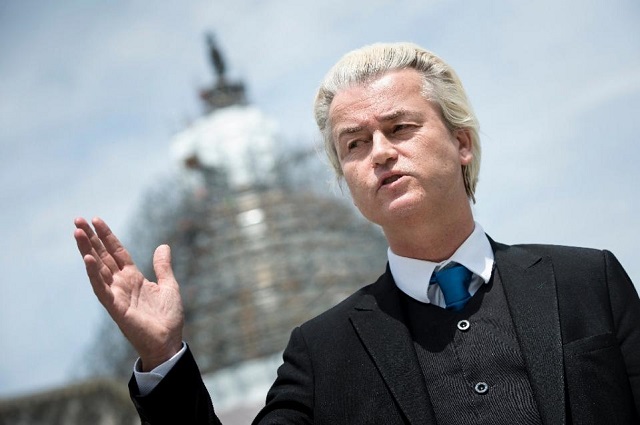
Public Prosecutors in Austria launched a criminal investigation of Geert Wilders, leader of the Dutch Freedom Party PVV), based on his remarks in March 27, 2015 before the Austrian Freedom Party (FPO) at the Hofburg in Vienna. He had journeyed there to meet with Heinz-Christian Strache, his counterpart in the Austrian Freedom Party (Freiheitliche Partei Österreichs, FPÖ) and deliver a speech on “The Threat to Europe”.

Austria has a hate speech law under which Elisabeth Sabaditsch Wolff  a leader of the Bürgerbewegung Pax Europa (Citizen movement Pax Europa) and the International Civil Liberties Alliance (ICLA}has been similarly prosecuted and convicted for remarks offensive to the country’s Muslim community regarding Islamic doctrine and criticism of their Prophet Mohammed.  Wilders had compared the Koran to Hitler’s Mein Kampf in his FPO speech and suggested that it be banned.   Both Sabaditsch-Wolff’s and Wilders’ remarks would be considered protected speech under the First Amendment of the U.S. Constitution.

Wilders has suggested that the European Parliament adopt an equivalent form of free speech protection. Wilders is still under investigation by public prosecutors in the Hague for his remarks about “fewer Moroccans” during a campaign rally on March 19, 2014 prior to the European Parliamentary elections.

Watch Wilders’ March 27, 2015 Speech before the Austrian Freedom Party (FPO) on this Vlad Tepes YouTube Video:

NL Times reported:

The Austrian Public Prosecutor has started an investigation against PVV leader Geert Wilders on charges of sedition. Aggrieved Muslims pressed charges against Wilders because of his statements comparing the Koran with Adolf Hitler’s book Mein Kampf and demands that the Islamic holy book be banned during a meeting of the right wing populist FPO in Vienna in March, NU reports.

Interest group Initiative of Muslim Austrians finds that Wilders has made himself guilty of sedition, denigrating religious teachings and breach of the prohibition of reviving Nazi ideology. The theme of his speech in Hofburg, Vienna was “The threat to Europe”.

Wilders reacted on Twitter with the tweet. “It cannot get a lot crazier.”

Here is an English translation excerpt from the Austrian newspaper Kurrier –Medienhaus  on these charges against Wilders:

Press Officer Nina Bussek of the Vienna prosecutor’s office cannot say how long the investigation will take, and whether Wilders will also be questioned by a prosecutor. “I can confirm that we are investigating following complaints against declarations he made during the event.” The [Austrian] law prohibits hurting religious feelings or inciting to violence against a religion.

On 27 March, Wilders held a long speech in the Hofburg in Vienna at the invitation of the rightwing nationalist party FPÖ. He spoke strong language about the necessity to reduce Islam.

Wilders visit was special, because Vienna is the city where, in 1683, the rise of the Ottoman Empire was halted. “Also today, we have a clear message for Islam: you will not conquer Vienna,” Wilders said.

In his speech, Wilders said that Austria had to change the present reality, “that Islamic brutality has gained a foothold in our countries. We are confronted with halal meals, with headscarves, burqas, honor killings, female genital mutilation, polygamy, mega mosques.”

“Since the darkest days of paganism many centuries ago, we have not experienced these atrocities anymore. Now they are back. Islam has brought them back,” Wilders continued. “I say: let us regain our freedoms.”

To this end, the PVV leader called for a ban on the Koran. He also said “No more mosques. Close all Islamic schools. Today! No to mullahs and imams.”

In a reaction, Wilders expressed his disappointment in Austria. “It is particularly ironic that the authorities capitulate there where a few centuries ago the West was protected against Islam. But I will continue to honor the gates of Vienna and stand upright. Speaking the truth about Islam and immigration are thus rewarded with a place on death lists and prosecution or investigation for prosecution by the Public Prosecutor in several countries. Earlier in the Netherlands and Jordan, now in the Netherlands again and in Austria. This is a major attack on freedom of speech, but no one will be able to silence me.”
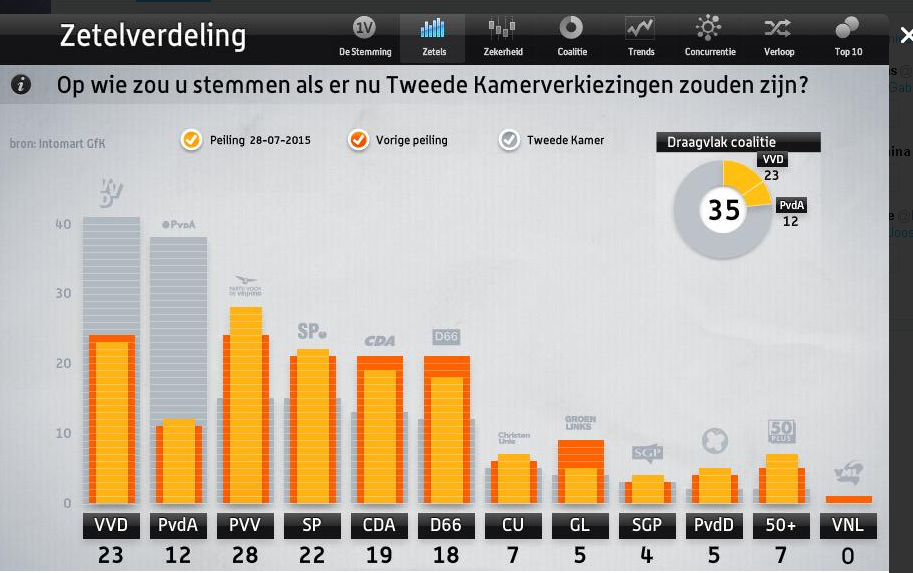
PVV leading party in Holland

Wilders’ Freedom Party (PVV) leads in poll of parties in the Hague Parliament.

This latest investigation by Austrian public prosecutors comes on the day when a Dutch poll shows the PVV as the leading party, if an election were held  forThe Hague Parliament.  Obviously many Dutch citizens agree with Wilders’ stands opposing mass Muslim immigration and admittance of illegal Migrants to The Netherlands under EU and UN High Commissioner for Refugees quota system.  Wilders has also suggest The Netherlands take back its  national border and immigration control from the Shengen system of 26 European countries that has enabled  free transit for European recruits  to join the Islamic State. He has also suggested that any returning Dutch veterans of the ISIS be barred from entry and deprived of Dutch citizenship.

As a Member of an EU parliament, we hope that Wilders has immunity against extradition to Austria to face possible prosecution for alleged hate speech brought by a Muslim advocacy group.

EDITORS NOTE: This column originally appeared in the New English Review.