Tag Archive for: Emirates

The “Emirates” plan – A political train wreck in the making

Despite the glaring and perilous flaws in the two-state paradigm, not everything that is not a two-state proposal is a better policy option. The “Emirates” plan is a prime example of this.

Without a shadow of doubt, the two-state solution is a truly atrocious idea. Decades of endeavor to implement it have wrought trauma and tragedy not only on Israel and Israelis but, ironically, even more so on the Palestinian-Arabs, for whose benefit it was purportedly formulated.

A dangerously defective “alternative

It is not my intention here to enumerate all the deadly detriments of the two-state principle and the myriad misfortunes the ill-conceived attempts to implement it have precipitated over the last four decades. I—and others—have done this repeatedly elsewhere—despite the derision and disregard of devout disciples of the Politically Correct—sadly, only to have our warnings borne out time and time again.

Fortunately, as the grave defects of the two-state notion become increasingly apparent, the search for alternatives has understandably become a priority. Yet, despite the urgency, caution and prudence are still very much called for.

For as appalling as the two-state notion is, this in no way implies that any proposal that is not the two-state idea is necessarily better than it. Indeed, some can be just as bad, if not worse—particularly in anything but the immediate short run.

Typical of such a well-intentioned, but dangerously defective “alternative” is what has come to be known as “The Emirates plan”, involving granting self-rule, of yet to be specified scope, to the dominant clan heads in 7-8 urban centers in Judea-Samaria (a.k.a. “the West Bank) and Gaza. Indeed, having been skillfully promoted by its well-intentioned advocates, it was prominently featured in a recent WSJ article, which raised the possibility of it being initially implemented in the Hebron region.

Dangerous detriments: A catalogue

While for some, this approach might have some superficial appeal, closer scrutiny reveals numerous problems that must be satisfactorily addressed before it can be seriously—and responsibly—advanced as a practical policy alternative.

For example, what would be the length of the frontiers (the lines of contact) between sovereign Israel and the (semi)autonomous enclaves (“emirates”)? Depending on their precise configuration, these wildly contorted frontiers could be anything up to 1000 kilometers long, making them almost impossible to demarcate and secure. However, if one cannot clearly demarcate and secure one’s sovereign territory, this will inevitably undermine the very essence of that sovereignty itself.

Moreover, would the residents of the “emirates” be allowed to access Israel itself? Would they be permitted to visit Israeli beaches and shop in Israeli malls?

If so, how would their return to their “emirate” be ensured? If not, the “emirates will inevitably—and justifiably—be seen as increasingly overcrowded prisons. Indeed, while Israel may euphemistically refer to them as “emirates”, most others will (correctly) call them (Arabesque) “Bantustans”, the very epitome of Apartheid in South Africa—see here.

Moreover, what if the compliant “Emir” (clan head) is replaced (kinetically or otherwise) by some less pliant successor, who reneges on his predecessor’s commitments—whether explicitly or otherwise? How would Israel respond to a new and antagonistic (semi) autonomous administration immediately adjacent to its major urban centers?

Dangerous detriments: A catalogue (cont.)

Furthermore, how would cross-border phenomena be handled and enforced? These would include issues such as untreated sewage flows, toxic industrial effluents, flows polluted by fertilizers and pesticides from agricultural irrigation, contamination of groundwater from unsealed garbage dumps, carcinogenic emissions from the widespread charcoal production, rabies control, vaccinations, control of infectious diseases, and so on and so forth.

Similarly, with regard to education, which it seems would be left to the auspices of the local “emirate” administration. Indeed, given the widely held consensus as to the need for deradicalization of Palestinian society, this raises the thorny question of who will formulate and approve the curricula for schools and educational institutions. Even more pertinent, who will ensure and enforce their implementation—and how would that be done?

After all, without an intrusive and coercive presence in the “emirates”, there is no way for Israel to ensure adequate supervision of the education system, what is imparted to the students, and/or any effective control over the propagation of inciteful radicalization.

Indeed, without such far-reaching and intrusive authority, Israel will be incapable of adequately confronting any of the crucial issues raised above, while if Israel did in fact retain authority of this kind, it would inevitably drain any semblance of substantive self-rule or autonomy, by the so-called “emirates.”

Contrived and misleading semantics

Indeed, apart from a contrived –and misleading—similarity in nomenclature, there is little similarity between the envisioned “emirates” of Palestine, on the one hand, and the genuine generic Emirates of the Arabian Gulf, on the other.

While there may indeed be some discernible traces of tribalism in Palestinian society, they seem hardly robust enough to comprise a foundation for far-reaching political structures—as shown by the dismal experience with the Village Unions, which was also based on existing clan structures, and resulted in resounding failure. Indeed, there seems to be a disturbing overlap between the failed Village Union idea and the equally flawed “emirates” proposal.

As noted, there is much that distinguishes the Gulf Emirates from the prospective “emirates” in “Palestine”. Although the former are relatively small countries (with the entire UAE in the  114th place in the global ranking of country size), they are not, like the latter, “microdot”-sized enclaves, at most dozens of kilometers in width, totally surrounded by the sovereign territory of another nation-state. Moreover, they are fully sovereign entities, with full control over their armed forces, internal governance, and resources, which afford them great affluence. It should be noted that much of the UAE’s prosperity is due to a massive number of foreign workers, who make up 90%of the entire labor force. Clearly, neither of these elements—immense petro-riches, and a vast foreign labor pool—characterizes the envisaged “emirates” in “Palestine”, making any inferences regarding the viability/stability of the latter, based on that of the former, entirely without foundation.

A political train wreck waiting to happen

But the most detrimental aspect of the “emirates” approach is that it concedes the acceptability of a permanent Arab-Palestinian presence west of the Jordan River, based on the potentially impermanent goodwill attributed to an incumbent chieftain in an increasingly anachronistic clan-based system—and his ongoing ability to maintain stability over an increasingly congested Muslim islet in a surrounding Jewish sea.

It is an approach that attempts to impart substantive content by means of semantic labels, and to restrict political rights (full sovereignty) on the basis of ethnic identity—the very epitome of apartheid.

Indeed, whatever its purported sociological rationale, it is an inevitable political train wreck waiting to happen. For Israel to adopt this approach as an alternative to the two-state solution would be unmitigated folly.

The Israeli leadership would do well to remember: Not everything that is not a two-state solution is necessarily better than the two-state notion. The “emirates” plan is—decidedly and disturbingly—a prime illustration of that dismal fact.

©2025 . All rights reserved.

Are we witnessing the end of Syria?
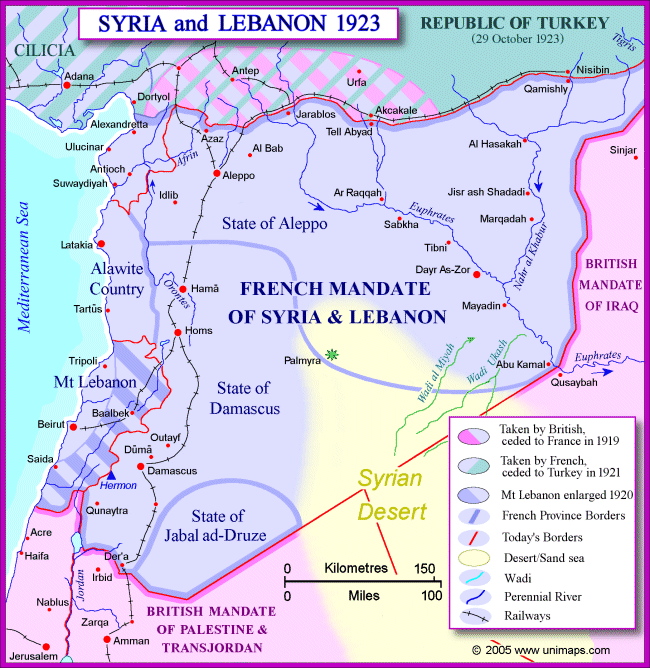
French Mandate of SyriaReuters has a report on how Quds Force Commander Gen. Soliemani mapped out Russian involvement to save beleaguered Syrian President Bashar Assad, “How Iranian general plotted out Syrian assault in Moscow.”  The strategy unraveling now is a joint air and ground assault to carve out an Alawite bastion in Western and Northwestern Syria ejecting CIA and Coalition-trained opposition, Al Qaeda Al Nusrah Front and Free Syrian Army forces. The air assault to date has focused on attacking these units in a strategic line north out of Damascus. The ground component is composed of fresh Revolutionary Guards and Hezbollah units. The Russian air assault contingent based in Latakia province is being bolstered by Russian “volunteers” a page out of Putin’s playbook for seizure of the Crimea and invasion of Eastern Ukraine. In the absence of significant US trained Sunni opposition contingents in this scenario; it would appear that Syria may devolve into a series of sectarian cantons akin to the  French Mandate for Syria granted by the League of Nations in the early 1920’s.

The objective of Iran is to build a virtual Shia crescent from the Persian Gulf to the Mediterranean coast including bringing in Shia extremist Imams and resettling  Shia refugees from Afghanistan and Pakistan in Syrian areas depopulated of Sunnis and Christians. The Alawites, who are secular, are troubled by this development and many have fled abroad. The Kurds have their de facto canton in Northeastern Syria abutting the Kurdish Regional Government in neighboring Iraq.

Turkey is clearly upset with the Russian presence in Syria, as is NATO, while the US is clearly dithering on what to do. Once again Obama has been outfoxed by Soliemani and Putin. That leaves allies like Israel, the Saudis and the Emirates seeking alternatives for their own sovereign protection. The Saudis and Emirates are talking about a jihad akin to that they funded in Afghanistan with CIA and Pakistan’s ISI in a secret war in the 1980’s that led to the rout of the Soviet 40th Army and gave rise to Bin Laden’s Al Qaeda.

A Der Spiegel article, “The Iranian Project: Why Assad Has Turned to Moscow for Helpportrays  President Bashar al-Assad as caught in a dilemma; “fear of friends”, meaning Iran versus “fear of opposition.”That former fear stems from reliance on Iran Revolutionary Guards, Shia auxiliaries from Hezbollah in Lebanon, the Sadr Brigade in Iraq and Shia fighters from Afghanistan and  Pakistan. They are under the command of Quds Force Commander Soliemani and make up for the decimation and desertions of draftees from the Syrian National Defense Forces. Iran’s intention is to build an Islamic Revolutionary State within  the areas along the Mediterranean coast and Mountains of Northwest Syria. To that end Iran has sent in radical Imams to create Shia religious centers directed at conversion of secular Alawites and Sunnis causing them to flee the country.  Thus, Assad has welcomed the Russia military assistance as Putin has allegedly no such interests in the current campaign, excepting protecting Russian interests in naval and military bases, as well as offshore gas developments.

Note these excerpts:

“Assad and those around him are afraid of the Iranians,” the Russian says. Anger over the arrogance of the Iranians, who treat Syria like a colony, is also part of it, the Russian continues. Most of all, though, the Syrians “mistrust Tehran’s goals, for which Assad’s position of power may no longer be decisive. That is why the Syrians absolutely want us in the country.”

Tehran’s goals go far beyond merely reestablishing the status quo in Syria. In early 2013, Hojatoleslam Mehdi Taeb, one of the planners behind Iran’s engagement in Syria, said: “Syria is the 35th province of Iran and it is a strategic province for us.” For several decades, the alliance between the Assads and Iran was a profitable one, particularly in opposition to the Iraq of Saddam Hussein, which long had the upper hand in the region. But today, Assad depends on Iran to remain in power, and Tehran is taking advantage of the situation.

It is, however, primarily in the civilian sector where significant changes are afoot. Just as in Damascus, Latakia and Jabla, increasing numbers of hosseiniehs — Shiite religious teaching centers — are opening. The centers are aimed at converting Sunnis, and even the Alawites, the denomination to which the Assads belong, to “correct” Shiite Islam by way of sermons and stipends. In addition, the government decreed one year ago that state-run religion schools were to teach Shiite material.

All of this is taking place to the consternation of the Alawites, who have begun to voice their displeasure. “They are throwing us back a thousand years. We don’t even wear headscarves and we aren’t Shiites,” Alawites complained on the Jableh News Facebook page. There were also grumblings when a Shiite mosque opened in Latakia and an imam there announced: “We don’t need you. We need your children and grandchildren.”

Talib Ibrahim, an Alawite communist from Masyaf who fled to the Netherlands many years ago, summarizes the mood as follows: “Assad wants the Iranians as fighters, but increasingly they are interfering ideologically with domestic affairs. The Russians don’t do that.”

Putin may have been prompted by Quds Force Commander Soliemani to aid mutual client Assad because he saw an opportunity to make a power play against the US in the region.  However, the secular Ba’athist Syrian tradition has been virtually suborned by the influx of Iranian Revolutionary Guards ‘and Shia proxies’ with the objective of creating a Khomeinist Revolutionary state. The confluence of those opposing interests, secular and religious, may ultimate end the decades’ long rule of the Assad family. That might lead to an ultimate apocalyptic conflict in Syria between nuclear equipped Shia Iran and the Sunni Salafist Islamic State.

EDITORS NOTE: This column originally appeared in the New English Review.

Will Republicans Protest and Litigate to Stop Iran Nuclear Pact?

stop iran rally september 9thWhere there were five undeclared Democrat Senators on the cusp of reconvening Congress, today there is only one, Ms. Cantwell from Washington State. Three Democrat Senators: Richard Blumenthal of Connecticut, Ron Wyden of Oregon and Gary Price of Michigan declared for the President’s position. Two of the three Democrat Senators who declared for the President position, Blumenthal and Wyden are up for re-election in 2016, while Price is not. The lone Democrat who joined with the Republican majority to oppose the Iran Pact is West Virginia Senator, Joe Manchin.

In a statement released by his office, Manchin said, “I believe that to be a super power, you must possess super diplomatic skills, and I believe that we can use these skills to negotiate a better deal.”

That leaves possibly 58 Senators, 54 Republicans and four Democrats opposing the Iran nuclear pact. That is two shy of the required 60 votes for cloture under the current Senate Rule 22 to cut off a filibuster. A vote on the majority resolutions rejecting the Iran pact could be scheduled as early as Thursday. That is, if the promised filibuster led by Senator Minority Democrat Leader Reid doesn’t stop the vote first.

Reid unleashed the filibuster option on Saturday, September 5th. White House Spokesperson Josh Earnest said Tuesday, September 8th:

It would be a little ironic for now Majority Leader Mitch McConnell to express concerns about a tactic that he, himself, employed on countless occasions. The other thing that I’ll point out is that the 60 vote threshold is actually one that was approved by the 98 senators who voted for the Corker-Cardin legislation back in the spring.

Opponents of the Iran nuclear pact circulated a letter on Capitol Hill today signed by 15 governors including  four  Republican hopefuls; Jindal of Louisiana, Christie of New Jersey, Kasich of Ohio and Walker of Wisconsin.  Republican majority and other opponents of the filibuster floor maneuver by minority Democrats criticize it for denying an up or down vote on the measure that Americans in leading polls taken by a 2 to 1 margin have urged Congress to reject the Iran deal.  Harvard law professor emeritus, Alan Dershowitz, author of The Case Against the Iran Deal said in a Steve Malzberg Show interview on NewsMax TV, September 3, 2015:

As an opponent of the deal, a filibuster would be a good result because it would deny legitimacy to the deal. The American public is not going to accept a deal that was filibustered. Let’s remember what a filibuster is. It was a southern strategy designed to undo democracy and to offend equality.

Dershowitz drew attention to the quandary that Israel and PM Netanyahu would face if the Iran pact was approved:

I know Benjamin Netanyahu. I’ve known him since 1973. He is not going to sit back and allow Iran to develop nuclear weapons.

This deal makes it much harder for Israel to defend its people.

In a Washington Post opinion article by Rep. Mike Pompeo (R-KS), member of the House Permanent Intelligence Committee, and Constitutional lawyer, David B. Rivkin, Jr.  Senior Fellow at the Foundation for Defense of Democracies argued that the failure to deliver a side deal might void the Iran pact. Further they raised the prospect of   possible litigation against the President on the grounds that the he didn’t deliver the requisite information. They were especially concerned about the IAEA side agreements with Iran to prepare a Road Map on prior military developments. Aversion of which was leaked with provisions for self inspection at the military site of Parchin, Iran.  That Road Map is a condition for release of $100 billion in sequestered funds held by US and foreign financial institutions.    Switzerland has already released their sanctions and Russia and China are poised to release their holdings. The EU3 component of the P5+1 are already in discussions with Tehran over billions of trade deals preventing a possible snap back of sanctions should Iran be found cheating on a sneak out to a nuclear weapon.  A weapon that some believe it may already have and be able to possibly via a satellite launch.

The Pompeo- Rivkin Washington Post opinion was earlier supported by Jerome Marcus, Esq. in a Wall Street Journal opinion piece, An Informed Vote on the Iran Deal.”  Marcus suggested  based on his experience as a young lawyer assisting former State Department counsel, Abraham Sofaer in the Reagan era,   executive agreements like JCPOA with far reaching implications should be treated as if it was a treaty.  Marcus concluded:

The lesson for today is clear: When a legislative body is deciding whether to approve an international agreement, especially one as important as the recent nuclear agreement with Iran, its members have the right to access the agreement’s negotiating record. Members of Congress should demand that record now, and they should examine it, before they cast their votes.

To bring such a suit Dr. Robert B. Sklaroff and Lee S. Bender, Esq. suggested in a FrontpageMagazine article that the Senate Majority Leader, McConnell should undertake the following steps:

Emergency Prescription for Senate:  [1]—Pass rule that abolishes the filibuster; [2]—Pass resolution declaring the Iran nuke deal to be a “treaty”; [3]—Defeat the deal; and [4]—Sue President Obama to enjoin him from implementing the deal.

The procedures for initiating the first critical step, achieving cloture cutting off the threatened filibuster, are contained in two relevant Congressional Research Service reports; Considerations for Changes in Senate Rules by Richard S. Beth, January 2013 and Filibusters and Cloture by Beth and Valerie Heitschusen, December 2014.

Sklaroff heard Dershowitz at a presentation in Cherry Hill, New Jersey on September 2nd.  He reported on Dershowitz’s remarks and response:

On September 2, Dershowitz, at the Jewish Community Center in Cherry Hill, N.J., amplified on this viewpoint, quoting Federalist 64:  “The power of making treaties is an important one, especially as it relates to war, peace, and commerce; and it should not be delegated but in such a mode, and with such precautions, as will afford the highest security that it will be exercised by men the best qualified for the purpose, and in the manner most conducive to the public good.”

When I [discussed] with him the necessity to sue Obama, he initially raised concern that this would be discarded as a “political question.” “Who would sue?” he asked rhetorically. “Senator McConnell!” said I. “Well, it’s a possibility, because he would have standing, representing the Senate.”

Has such a suit been brought by the Senate against President Obama and the Supreme Court ruled on the matter of executive overreach of lawful authorities?   There is the example of the Supreme Court   June 2014 unanimous ruling against the President for his three day recess appointment of National Labor Relations Board and Consumer Protection officials in 2012 that required approval by  the Senate.  The original matter was brought by a Washington State bottler and a decision rendered in the DC US Circuit Court of Appeals by Judge David B. Sentelle. Note the comments of the Republican Counsel for the Senate and then Senate Majority Leader Reid from a Washington Post article:

Miguel Estrada, who represented Senate Republicans in the case, called the ruling a victory for the Senate. “The Supreme Court reaffirmed the Senate’s power to prescribe its own rules, including the right to determine for itself when it is in session, and rejected the President’s completely unprecedented assertion of unilateral appointment power,” he said.

But Senate Majority Leader Harry M. Reid (D-Nev.) blamed Senate Republicans for denying nominees a chance to be confirmed through a vote of the full chamber. “President Obama did the right thing when he made these appointments on behalf of American workers.”

Tomorrow, September 9, 2015, Democrat Presidential front runner Hillary Clinton former Secretary of State, embroiled in a private email server controversy, will make the case for support of the President’s position.  She has previously gone on record saying:

The Europeans, the Russians, the Chinese, they’re gonna say we agreed with the Americans, I guess their president can’t make foreign policy. That’s a very bad signal to send.

Clinton will be a minor distraction from the Tea Party Patriots (TPP) Stop Iran Now Rally chaired by Jenny Beth Martin on the West Lawn of the US Capitol Building with a cast of media luminaries in the opposition camp.  The event is co-sponsored by TPP, Zionist Organization of America and the Center for Security Policy. The roster of those speaking includes TPP head Martin, Republican Presidential front runner Donald Trump, fellow Presidential hopeful Ted Cruz (R-TX), Conservative talk show Hosts Glen Beck and Mark Levin, David Bossie of Citizens United, Rep. Trent Franks (R-AZ), Chairman of the Congressional Israel Allies Caucus, former CIA-director, Ambassador R. James Woolsey, Chairman of the FDD, Frank Gaffney of the CSP, Sarah Stern of EMET and Mort Klein of the ZoA. This will be a media spectacle.

Late this afternoon, my colleague at 1330amWEBY Mike Bates, host of “Your Turn”, and I reviewed these developments.  Listen to the WEBY audio segment here.  Bates observed that the motivation behind these political maneuverings was President Obama’s objective all along to bolster Iran’s position in the Middle East as a recognized nuclear threshold state threatening traditional support for Allies in the region, Israel, Saudi Arabia, the Emirates and Egypt. Bates thought the Reid filibuster play was simply a travesty of politics as usual in Washington.   In turn we both discussed the strange case of Florida US. Representative and Democratic National Committee head, Debbie Wasserman-Shultz, who has infuriated segments of her large but divided Jewish constituency.  In her public statement she said tearfully that from her “Jewish heart” the Iran pact, as defective as it is, was the correct thing to do.  We concurred that the filibuster if not upended by a Republican cloture to force an up or down vote would enable her and other Democrat colleagues up for re-election in 2016 to claim that there was never a vote. Political cover that comes at a high price of Iran receiving tens of billions now with promises of trillions in economic trade benefits. All while harboring secret development of nuclear weapons threatening the U.S. and Israel.

RELATED ARTICLES:

How Many U.S. Troops Were Killed By Iranian IEDs in Iraq?

Iran Could Outsource Its Nuclear Program to North Korea

EDITORS NOTE: This column originally appeared in the New English Review.