
Tag Archive for: energy policy

A Rocky China Trip for the Kremlin: How U.S. Energy Undercuts Putin’s Leverage

Russian President Vladimir Putin arrived in Beijing Tuesday seeking a “no-limits” endorsement of his energy ambitions — but left with little more than handshakes and a sharp reminder that even the closest partnerships have strict boundaries. While Putin and Chinese leader Xi Jinping put on a high-profile show of unity for the international community, the long-anticipated Power of Siberia 2 gas pipeline remained bogged down. The project, a $15 billion lifeline to replace Russia’s failed European revenue, saw no signatures or start date. Instead, the Kremlin was forced to scramble in defense of a trip that appears to be an underwhelming fizzle.

The 1,600-mile pipeline would carry over 50 billion cubic meters of natural gas annually, direct from Russian fields to Chinese stovetops. Battered by sanctions following the 2022 invasion of Ukraine, the Russian economy simply needs this deal to go through. Yet China continues to play hardball, demanding “domestic discount prices” of Moscow that have been resisted for half a decade. China has implemented rigid limits on how much energy can be purchased from any single nation, and Russia has reached that threshold, reports suggest.

Kremlin spokesman Dmitry Peskov attempted to soothe questions over the lack of progress, claiming the leaders reached “basic parameters of understanding” pertaining to the pipeline. However, the final 10,000-word joint statement failed to mention PoS-2 by name, instead emphasizing vague promises to “deepen comprehensive relations.”

While Putin fell short of securing his gas deal, President Donald Trump announced that China is now looking toward the West to fill its tanks.

“They’ve agreed they want to buy oil from the United States; they’re going to go to Texas, we’re going to start sending Chinese ships to Texas and to Louisiana and to Alaska,” Trump stated last Thursday. After his own meeting with Xi, Trump remarked on America’s “unlimited energy,” noting that at this date the U.S. out-produces both Saudia Arabia and Russia.

This rhetoric is already becoming reality. Tankers filled with American liquified natural gas are underway from Louisiana toward China and are expected to arrive by mid-June. These represent the first direct shipments of fuel to China in Trump’s second term, indicating a potential shift in global resource patterns that would likely leave Russia out in the cold.

New revelations, in addition to the energy issue, are now casting doubt upon China’s claims of neutrality in the Ukraine-Russia conflict. Reports surfaced Tuesday that approximately 200 Russian troops attended “secret training exercises” in China in late 2025. This training reportedly consisted of drone warfare, specifically laser targeting artillery and the use of electronic weapons to disable enemy drones.

“By training Russian military personnel at [an] operational and tactical level … China is far more directly involved in the war,” several intelligence agencies told Reuters. While Beijing firmly dismisses these claims, photos have been leaked of uniformed Russian soldiers in Chinese military classrooms.

As the “Axis of Tyranny” maintains its rapport, it becomes increasingly clear that Putin may be becoming the overly needy member of the relationship. As China explores various energy options due to regional instability, Xi can now drive a harder bargain than ever before. Although Xi described the relationship as being at a “historic high,” the apparent lack of a gas line deal suggests that, for Beijing at least, friendship only goes as far as the bottom line. If the Russians fail to fulfill the pricing and contract concession Xi has fixed, the pipeline project will fall apart.

“China and Russia are cooperating more closely militarily, economically, and diplomatically, but their interests are not identical,” says Lt. Col (Ret.) Robert Maginnis, senior fellow for National Security at Family Research Council. “China’s leaders are thinking decades ahead. Putin is focused on surviving the current war and preserving his hold on power.”

Maginnis continued, “Russia urgently needs China to offset the collapse of its European energy markets, while Beijing is content to wait, negotiate from a position of strength, and deepen Moscow’s dependence on China’s economy. Xi understands that time is working in Beijing’s favor.” Frankly, he said, “The China-Russia relationship is best understood as a strategic alignment built on shared interests rather than genuine trust.”

Trump’s visit, he notes, “appears to have widened China’s diplomatic room to maneuver, while Putin left Beijing looking more dependent on Xi than ever before.” The bottom line, Maginnis concluded, “is straightforward: China and Russia remain aligned against the United States and the Western-led order, but this is no partnership of equals.” As Maginnis contends, “Russia is increasingly the junior partner.”

AUTHOR

Zachary Patton

Zach Patton is an intern at Family Research Council.

EDITORS NOTE: This Washington Stand column is republished with permission. All rights reserved. ©2026 Family Research Council.


The Washington Stand is Family Research Council’s outlet for news and commentary from a biblical worldview. The Washington Stand is based in Washington, D.C. and is published by FRC, whose mission is to advance faith, family, and freedom in public policy and the culture from a biblical worldview. We invite you to stand with us by partnering with FRC.

The Cuban Government’s Miraculous Ability to Survive May Be Coming to an End

I first heard the term “estática milagrosa” (“miraculous stasis”) from a friend of my wife. The young woman — an architect — had worked for an urban heritage conservation office in Cuba, and she marveled at how the mansions, buildings, cinemas, and theaters of the once-Parisian Havana refused to collapse.

Humidity might burst the dowels within their columns; saltpeter might bloat the cement on their facades; a hurricane might rip away their doors and windows — yet the structures remained standing, defying the terror of skittish passersby.

The Revolution turned Havana into a Pompeii of Salt. Ruins without a volcano. The volcano — red as the most vivid lava — was socialism. The city’s miraculous stasis is mirrored in the very malady that has caused its impoverishment. Cuban socialism has misgoverned the country — and squandered its sugar and tourism industries — to such an extent that, although it should have collapsed years ago, its capacity to cling to power remains astonishing.

Events between Cuba and the United States have taken a series of highly symbolic turns this May.

On the 5th, Secretary of State Marco Rubio visited SOUTHCOM headquarters during a national security conference in Miami, where he posed for a photograph in front of a map of the island while shaking hands with General Francis L. Donovan.

On the 12th, he smiled for the camera once again. This time, aboard Air Force One, he wore a gray Nike tracksuit — remarkably similar to the one Nicolás Maduro was wearing when he was extracted during the operation on January 3rd. Was he sending a warning to Raúl Castro regarding what would befall him should he refuse to negotiate a change in Cuba?

Two days later, John Ratcliffe, the Director of the CIA, arrived in Havana for an unprecedented official visit. After years of accusing independent journalists like myself of being “mercenaries paid by the CIA,” the U.S. delegation was received by Interior Minister Lázaro Alberto Álvarez Casa and Intelligence Chief Ramón Romero Curbelo.

Furthermore, Ratcliffe reportedly held talks with Raúl Guillermo Rodríguez, head of security and factotum to his 94-year-old grandfather, Raúl Castro, who holds the reins of the island.

It appears that things did not go entirely smoothly during the talks, or perhaps Rubio simply wants no further delays from Havana. That very night, an administration official leaked to major media outlets that the United States is moving toward indicting Castro in connection with the 1996 massacre of activists from Hermanos al Rescate (Brothers to the Rescue).

Amidst all this, earlier in the month, widely circulated reports emerged regarding an increase in U.S. spy flights near Havana and Santiago de Cuba, the country’s second-largest city. Since February, P-8A Poseidon and RC-135V Rivet Joint aircraft, as well as MQ-4C Triton drones, have reportedly conducted at least 25 intelligence-gathering flights.

Meanwhile, economic pressure continues to mount. The Canadian mining firm Sherritt, which had been operating in the eastern part of the island, is set to dissolve its Cuban subsidiary due to sanctions imposed by Washington.

According to both the secretary of Interior and the U.S. Geological Survey, Cuba possesses one of the world’s largest nickel reserves; moreover, in 2023, Cuba ranked as the world’s seventh-largest producer of cobalt — a mineral critical for battery manufacturing. The geopolitical significance of these critical minerals provides yet another compelling reason why a free Cuba serves the national interest of the United States.

On the domestic front, the diplomatic efforts of Ambassador Mike Hammer continue to exert a positive influence on the public opinion of the average Cuban regarding the role of the United States in the current crisis, as well as the White House’s support for those on the island who risk their safety to raise their voices in support of a new Cuba.

If there is one issue that unites the entire spectrum of political opinion within the Cuban dissident movement, it is the liberation of political prisoners — a group that currently numbers well over a thousand. And the Trump administration is pressuring the Castro regime to carry out further prisoner releases.

The departure of activist Sissi Abascal — escorted directly from prison to a flight that took her to the United States on a humanitarian visa — is the most recent example. It occurred shortly after USA Today published audio recordings of the high-profile political prisoners Maykel Osorbo and Luis Manuel Otero Alcántara, in which they describe receiving an ultimatum from the regime: leave Cuba or remain in prison.

Meanwhile, the protests continue unabated — an extension of that “Spring of Fire” which began in March and has filled neighborhoods across the country with the din of banging pots and pans. People are protesting with cacerolazos against power outages, medicine shortages, repression, and food scarcity.

Will all of this momentum finally translate into the end of the “miraculous stasis” (what Cubans view as a “cursed stasis”) that sustains the longest-running tyranny in the hemisphere? The Donroe Doctrine must take root in the heart of the Caribbean to affirm its hegemony — and to realign the destinies of millions on the island with the cause of freedom.

AUTHOR

Yoe Suarez

Yoe Suárez is The Washington Stand’s international affairs correspondent. He is an exiled journalist, writer, and producer who investigated in Havana about torture, political police, gangs, government black lists, and cybersurveillance. A graduate of Universitat Autònoma de Barcelona, he was a CBN correspondent, and has written for outlets like The Hill and Newsweek. He has appeared on Vox, Univision, and Deutsche Welle as an analyst on Cuba, security, and U.S. foreign policy.

RELATED ARTICLE: From Hitler To Adenauer, From Tojo To Yoshida, From Mussolini To De Gasperi

EDITORS NOTE: This Washington Stand column is republished with permission. All rights reserved. ©2026 Family Research Council.


The Washington Stand is Family Research Council’s outlet for news and commentary from a biblical worldview. The Washington Stand is based in Washington, D.C. and is published by FRC, whose mission is to advance faith, family, and freedom in public policy and the culture from a biblical worldview. We invite you to stand with us by partnering with FRC.

Worldwide Implications of the UAE’s OPEC Exit

The Trump administration continues to reshape the Middle East, as the United Arab Emirates (UAE) announced Tuesday that, after 59 years, it would leave the Organization of the Petroleum Exporting Countries (OPEC), effective May 1. The Wall Street Journal editors assessed the move as “another foreign policy victory for American fossil-fuel energy,” while Fox Business called it “good news for the world in the long run.” The UAE’s decision will certainly have global ramifications, both economic and political; for the U.S., it likely entails a deepening relationship fraught with hazards.

OPEC is an international consortium of oil-exporting nations that sets maximum production quotas for its members in an attempt to limit international supply and thereby keep world oil prices (and therefore oil profits) high. It is, effectively, a cartel of governments instead of businesses — a group of nations that cooperate more or less as an oil-producing monopoly.

OPEC currently boasts five founding members (Iran, Iraq, Kuwait, Saudi Arabia, and Venezuela) and seven full members (Algeria, Congo, Equatorial Guinea, Gabon, Libya, Nigeria, and the UAE). Ecuador and Indonesia have left the organization multiple times. Qatar withdrew its membership in 2019, and Angola withdrew its membership in 2024.

In 2016, OPEC signed an agreement with 10 other oil-producing nations (Azerbaijan, Bahrain, Brunei, Kazakhstan, Malaysia, Mexico, Oman, Russia, South Sudan, and Sudan) to create what is essentially a larger production cartel known as OPEC+. Together, OPEC and OPEC+ control 59% of the world’s oil supply.

The UAE has long been one of OPEC’s top oil producers, ranking somewhere in the range of second- to fourth-largest producer, depending on various factors. Before Iran shut down Gulf oil traffic on February 28, the UAE was producing some 3.6 million barrels of oil per day, or approximately 3% of the global supply.

Alongside Saudi Arabia, OPEC’s top producer, the UAE also has the most flexibility to increase or slow production, enabling OPEC to manipulate global markets in classic cartel behavior. Thus, the UAE’s decision to exit OPEC deals a significant blow to the organization’s ability to control world oil prices.

Economic Implications

More importantly, the UAE’s decision to leave OPEC will likely lead to a worldwide decline in oil prices, at least in the medium- to long-term. “Having invested heavily in expanding energy production capacity in recent years, the bigger picture is that the UAE has been itching to pump more oil,” reports Capital Economics. Freed from the quotas set by OPEC, the UAE may expand production from 3.6 million barrels per day to at least 5 million barrels per day by 2027, a 40% increase for the country and more than 1% increase for all global oil production.

According to the unchanging principles of supply and demand, an increase in the supply of oil will lead to a corresponding decrease in the price, until the market reaches a new equilibrium. This is also what we would expect when a major producer stops cooperating with a cartel; the result is increased competition in the market, leading to more production and lower prices.

There are two major caveats. First, the two preceding paragraphs assumed that all other factors would remain unchanged when the UAE expands its oil production. Of course, the real world is more dynamic, and other oil producers would likely respond to such a dramatic increase in Emirati supply. Of most relevance, the remaining OPEC nations could agree to cut production further to offset (or partially offset) the UAE’s increased production, in order to maintain roughly the same price for oil.

The incentive for OPEC countries to do so is that some have inefficient oil industries that can only turn a significant profit at higher prices. The disincentive for OPEC countries to do so is that they would cede further market share and produce less oil on which to make a profit. The largest burden for production cuts would likely fall on Saudi Arabia, which would likely look unfavorably on ceding market share to it peninsular rival. Thus, the discomfort of OPEC nations would likely work out to the benefit of the rest of the world, which would then be able to obtain energy at lower prices.

The second caveat concerns the Iran war. Iran’s illegal closure of the Strait of Hormuz cut off approximately 20% of world oil production from global markets, causing a sharp increase in world oil prices. The UAE is able to transport some oil over land to a pipeline terminus on the Gulf of Oman, but its ability to increase capacity is largely nullified while the Strait of Hormuz remains more-or-less closed. Thus, any benefit to world oil prices from an increase in UAE production would only take effect sometime after the conclusion of the Iran war.

Geopolitical Implications

The UAE’s departure from OPEC also has geopolitical implications, as it moves one of the most prosperous Gulf oil states away from a largely anti-American alliance towards a much more America-friendly posture.

Most Americans likely know little about OPEC except that it has often maintained an uneasy relationship with the United States. Most famously, Arab members of OPEC embargoed the U.S. during the 1973 Arab-Israel war, leading to the 1973-74 oil crisis, which featured gas lines, sky-high prices, and a nationwide reduction of speed limits to 55 mph. Having core members like Venezuela, Iraq, and Iran — longtime adversaries of the U.S. — certainly has not helped.

However, the UAE is currently furious with Iran, which has likely informed its decision to withdraw from OPEC. Not only is Iran blockading the bulk of Emirati oil production from reaching markets — both damaging the nation’s budget and undermining the whole premise of OPEC — but Iran has also responded to American bombardment by firing hundreds of missiles and drones at the UAE, causing significant damage in the country that is not part of the war.

When the UAE already believed that OPEC no longer worked in their favor, such major affronts by one of its founding members surely hastened the Emirati exit.

The UAE also has a strained relationship with Saudi Arabia over both its OPEC quota and geopolitical influence. The UAE’s greatest security concern is for reliable food imports, which makes sense given the arid desert in which its burgeoning urban centers sit. To secure its food sources, the UAE has invested some $47 billion in agriculture, ports, and security installations across 12 East African nations.

This campaign of regional influence puts the UAE at odds with Saudi Arabia, particularly in Yemen, where the former allies against the Iran-backed Houthis now back different factions in that nation’s ongoing civil war. The UAE wants a foothold in Yemen to secure its maritime network, while Saudi Arabia views the nation as an important buffer state.

On December 30, 2025, Saudi Arabia launched airstrikes against the UAE-backed Southern Transitional Council (STC) at the Port of Mukalla, halting the STC’s rapid territorial gains and leading to the group’s total dissolution on January 9, 2026. If, say, the U.K. (or Pakistan) had bombed American tribal allies in Afghanistan in 2003, the U.S. would have been pretty upset, too.

Emirati officials claim that their disagreements with Saudi Arabia were not the reason for their leaving OPEC, but they certainly soured the relationship.

No, the UAE’s best reasons for leaving OPEC is that they felt like they were always getting the short end of the stick. Due to internal instability, numerous other members received exemptions to pump oil beyond their quotas — Libya, Venezuela, and even Iran. Nations like Iraq had no exemption but exceeded their quota anyways. Despite the grace shown toward other members, the UAE lobbied unsuccessfully to win a larger quota for itself, despite heavy investment in expanding its infrastructure.

Meanwhile, OPEC became less relevant as a global cartel as other competitors expanded their own oil production. Most notably, the U.S. increased its oil production from 5.4 million barrels per day in January 2010 to 13.2 million barrels per day in January 2026. Brazil, Canada, and Guyana also increased their oil production, and American oil pioneers are now exploring deposits in Argentina. The UAE wants in on the global trend toward expanded oil production, and the constraints of OPEC held it back. So, it cut itself loose.

The decision continues a reshuffling of geopolitics in the Middle East, which sees the UAE increasingly turn away from its immediate neighbors and toward the United States.

Unlike some other Middle Eastern nations, the UAE’s affinity toward the U.S. also includes an affinity toward Israel. The UAE was one of four Muslim-majority nations to normalize relations with Israel during the first Trump administration’s push for the Abraham Accords. In December 2025, the UAE was revealed to be the undisclosed buyer in a $2.3 billion arms deal with an Israeli manufacturer. This week, further reports revealed that Israel lent the UAE an Iron Dome air defense system and troops to operate it early in the Iran war.

The UAE and Israel have also cooperated on Somaliland, a former British colony that seceded from the rest of Somalia in 1991 and maintains its own autonomous government. Israel became the first nation to recognize Somaliland as an independent country on December 26, 2025, and the UAE helped prepare the first state visit. The UAE maintains a port and military base in Somaliland as part of its footprint to defend its interests in Eastern Africa.

There are limitations to the UAE’s political realignment. Although it is departing OPEC, the UAE remains a member of the Organization of Arab Petroleum Exporting Countries (OAPEC), which also includes Algeria, Bahrain, Iran, Iraq, Kuwait, Libya, Qatar, Saudi Arabia, Syria, and Tunisia. It also remains part of the Gulf Cooperation Council (GCC), which also includes Bahrain, Kuwait, Oman, Qatar, and Saudi Arabia.

But the UAE’s departure from OPEC, following seven years after the departure of fellow Gulf oil state Qatar, could induce other cartel members to reconsider their own commitment to the organization and start a domino-like chain reaction. “If the U.A.E. exit is a portent, the OPEC cartel may eventually break up on its own under the weight of competition,” said The Wall Street Journal editors.

While the UAE’s departure from OPEC is a positive development in that it likely increases American influence, American policy makers should also remember to handle the relationship with care. For all of its friendship toward the U.S. and Israel and opposition to political Islam, the UAE is no model Western nation. It maintains apostasy and blasphemy laws, both of which it has enforced in the past 10 years, as Family Research Council has documented.

The UAE is also not above sponsoring ruthless separatist groups when it believes they serve its interests. For instance, in the ongoing Sudanese civil war, the UAE provided support to the Rapid Support Forces (RSF), a separatist militia that committed atrocities last year during the sack of El Fasher.

Thus, just because the UAE is migrating toward the U.S. does not mean it has become a good actor. It remains exactly the sort of nation you would expect to find ruled by oil-rich Muslim sheiks on the Persian Gulf. Yet there are both political and economic benefits to the U.S. from its decision to depart OPEC. Most immediately, once the war concludes, the increased competition (and likely volume) of global oil production should result in lower oil prices worldwide.

AUTHOR

Joshua Arnold

Joshua Arnold is a senior writer at The Washington Stand.

RELATED ARTICLES:

Iran Threatens Painful Response if U.S. Resumes Attacks, Oil Prices Seesaw

The Iran War Didn’t End — It Changed Shape

Breaking the Enemy’s Will

RELATED VIDEO: Iran Is Losing This War, and the Global Balance of Power Is Shifting

EDITORS NOTE: This Washington Stand column is republished with permission. All rights reserved. ©2026 Family Research Council.


The Washington Stand is Family Research Council’s outlet for news and commentary from a biblical worldview. The Washington Stand is based in Washington, D.C. and is published by FRC, whose mission is to advance faith, family, and freedom in public policy and the culture from a biblical worldview. We invite you to stand with us by partnering with FRC.

Trump Administration Is Trying to Kill a UN Carbon Tax on Global Shipping

The International Maritime Organization (IMO) will vote this week whether to approve new regulations authorizing them to charge maritime shipping companies for their carbon emissions. The measure would be the first ever carbon tax on maritime commerce and the first ever tax collected directly by a U.N. agency, which is unaccountable to the consumers who must pay higher prices as a result. Before the extraordinary session of the Marine Environment Protection Committee (MEPC) convened on Tuesday, the Trump administration issued an ultimatum warning countries against voting for the measure.

In a lopsided vote of 63-16, the MEPC approved the 120-page draft regulation during its 83rd session on April 7-11. The regulation implements a “net-zero framework” (NZF) by requiring all maritime shipping to achieve “net-zero” carbon emissions by 2050, with intermediate targets set for 2030 and 2040.

“Net”-zero carbon emissions is not the same as absolute zero. According to the regulations, ships that emit less carbon gain “surplus units,” while ships that exceed the emission threshold “will have to acquire remedial units,” said the IMO. Operating companies can cover these remedial units by “Transferring surplus units from other ships;?Using surplus units they have already banked; [or] Using remedial units acquired through contributions to the IMO Net-Zero Fund.”

In effect, the IMO regulation would take the “cap-and-trade” scheme used to limit industrial pollutants and apply it to emissions of carbon dioxide, a gas necessary for all plant life on earth. For carbon emissions above this cap, the IMO would collect what is effectively a carbon tax, to be held in a green energy fund and used on unspecified projects.

“This is the first instance we can find of the U.N. claiming the ability to levy a tax — the revenues from which will be paid directly into a U.N.-controlled fund,” wrote The Wall Street Journal editors. “That’s bad enough as an invitation to opaque special dealing and corruption. But the IMO also contemplates using the funds for ‘just-transition initiatives in developing countries’ and to ‘mitigate negative impacts’ of climate change on ‘vulnerable States.’ In other words, this is another income redistribution scheme for whatever ideas the U.N. bureaucracy deems worthy.”

The regulations would impose a two-tier tax of either $100 or $380 (depending on certain factors) per metric ton of carbon dioxide emissions, resulting in an estimated $10 billion to $12 billion collected from shipping companies. By 2035, “a mid-size carrier relying exclusively on very low sulfur fuel oil (VLSFO) … could face more than $1.5 million in additional annual expenses, or 17 to 20% of fuel costs,” according to researchers at Columbia University.

The carbon tax aims to nudge the shipping industry away from fossil fuels by making it so expensive to run fossil fuels that ships powered by non-carbon alternatives become economically viable. Currently, the leading non-carbon alternatives include green ammonia (which is two to four times as expensive as VLSFO), bio-methanol (5.7 times as expensive), and e-methanol (6.3 times as expensive).

Fuel is one of the primary cost inputs for maritime shipping, which accounts for approximately 90% of international trade. Such an increase in shipping costs could raise the cost of imported goods for Americans by up to 10%.

This is a significant impact for very little gain. Maritime shipping accounts for only 3% of man-made carbon dioxide emissions, meaning that the IMO regulations will impose a huge burden on the global shipping industry, for only a marginal reduction in carbon dioxide emissions.

The regulations would amend Annex VI of the International Convention for the Prevention of Pollution from Ships (MARPOL), which entered into force on October 2, 1983. Adopted in 2005, Annex VI limits emissions of harmful pollutants such as sulphur oxide, nitrous oxides, ozone-depleting substances, and particulate matter. In 2011, Annex VI was amended with energy efficiency requirements “aimed at reducing greenhouse gas emissions.”

While Annex VI of MARPOL does control air pollution and carbon dioxide emissions, it does nothing so radical as phasing out fossil fuels. But that is exactly what the new regulations proposed by the MEPC would do.

For decades, U.N. agencies, including the IMO, have been pushing an anti-fossil fuel agenda based in climate ideology, but never to this extent. In 2018, the IMO published a strategy with the 2050 target of cutting in half the carbon emissions level of 2008. In 2023 — with the far-left Biden administration now steering U.S. policy — the IMO updated this strategy with an aspiration to eliminate carbon emissions entirely by the same date. However, this aspiration lacked the radical plan to achieve this goal through a U.N.-imposed carbon tax.

In April, the IMO was already counting its unhatched chickens with a detailed timeline: the new regulations would be officially adopted in October 2025, detailed implementation guidelines would be approved in the spring of 2026, and the regulations would enter into force in 2027, 16 months after adoption. But now, the Trump administration is trying to throw a last-minute wrench into that scheme.

Proponents for the IMO carbon tax form an unusual coalition of developed European nations and Pacific island nations. Low-lying Pacific nations are greatly concerned about rising sea levels, buy into the notion that this phenomenon is connected to manmade carbon emissions, and therefore seek to reduce those emissions to save their island homes.

Meanwhile, European nations have already implemented strict carbon emission standards at home, which puts them at a commercial disadvantage compared to other nations; they see this as an opportunity to level the playing field by imposing Europe-style carbon regulations on other nations. Thus, in a representative statement, Finland declared that the proposed IMO carbon tax would “even out the imbalance in international regulation of maritime emissions and level out the competitive environment, between the EU and the rest of the world.” After the Trump administration warned countries against voting for the plan, the European Union reaffirmed its support.

Perhaps surprisingly, the shipping industry has also endorsed the regulatory scheme. “Without the Framework, shipping would risk a growing patchwork of unilateral regulations,” read a joint statement from industry and labor associations on October 9.

In other words, shipping companies would appreciate the convenience of having to meet only one global standard, instead of different regulations in different countries. Or at least the shipping companies operating under stricter standards would like their competitors to bear the same burden. As for the higher costs these regulations would impose on global shipping, this statement proves that the shipping industry expects to pass those higher costs on to consumers.

The statement was signed by most of the world’s shipping industry: the Asian Shipowners’ Association (ASA), European Shipowners (ECSA), International Association of Ports and Harbors (IAPH), International Bunker Industry Association (IBIA), International Transport Workers’ Federation (ITF), International Chamber of Shipping (ICS), and the World Shipping Council (WSC). The ASA represents approximately 50% of the world merchant fleet, ECSA represents 35%, and the ICS represents over 80%.

On October 10, the day after the industry endorsement, the Trump administration published a full broadside attack on the scheme. In a joint statement, Secretary of State Marco Rubio, Secretary of Energy Chris Wright, and Secretary of Transportation Sean Duffy threatened “actions against nations that support this global carbon tax on American consumers:

  • “Pursuing investigations and considering potential regulations to combat anti-competitive practices from certain flagged countries and potential blocking vessels registered in those countries from U.S. ports;
  • “Imposing visa restrictions including an increase in fees and processing, mandatory re-interview requirements and/or revisions of quotas for C-1/D maritime crew member visas;
  • “Imposing commercial penalties stemming from U.S. government contracts including new commercial ships, liquified natural gas terminals and infrastructure, and/or other financial penalties on ships flagged under nations “in favor of the NZF;
  • “Imposing additional port fees on ships owned, operated, or flagged by countries supporting the framework; and
  • “Evaluating sanctions on officials sponsoring activist-driven climate policies that would burden American consumers, among other measures under consideration.”

“This will be the first time that a UN organization levies a global carbon tax on the world,” the statement declared. “The Administration unequivocally rejects this proposal before the IMO and will not tolerate any action that increases costs for our citizens, energy providers, shipping companies and their customers, or tourists. The economic impacts from this measure could be disastrous.”

The Trump administration had issued a similar, but less detailed, statement of opposition on August 12, arguing that the standards would “conveniently benefit China by requiring the use of expensive fuels unavailable at global scale. These standards would also preclude the use of proven technologies that fuel global shipping fleets, including lower emissions options where U.S. industry leads such as liquified natural gas (LNG) and biofuels.”

In comments submitted to the MEPC, the U.S. again argued that the proposed regulations irrationally penalized low-emission fossil fuels like LNG, as well as decrying the scheme’s excessive revenue accumulation in pursuit of ill-defined goals.

The U.S. is part of another unusual coalition in opposition to the regulations. The nations most opposed to the regulation are oil-producing countries, which includes many of America’s geopolitical adversaries. In the April vote, the 16 countries to oppose the regulations included Iran, Lebanon, Russia, Venezuela, and Yemen.

A coalition of six oil-producing nations submitted their own comment in opposition to the regulation, arguing that tax collection and the creation of a green energy fund is entirely outside of the scope of the MARPOL convention, and there is no prior precedent for a U.N. agency to require financial contributions for the non-compliance of private entities, rather than sovereign parties.

The final outcome remains unclear. The IMO usually operates based upon consensus, but the regulation vote may force it to a rare ballot vote, in which the resolution would need to carry a two-thirds majority to pass.

Thus, the regulation would require support by 72 out of the 108 member states who have ratified MARPOL Annex VI — but only if they all show up. At the April vote, only 79 nations had delegates present for the vote. Since 63 countries already voted for the regulation in April, the U.S. would either need a sizable majority of undecided countries to vote against, or it would need some countries to switch their votes. Reportedly, some countries are considering switching their votes, including Philippines, Turkey, Argentina, and Australia.

While the Trump administration threatens economic sanctions, Saudi Arabia is whipping its own votes against the measure with promises of economic opportunity and other sweeteners. Saudi Arabia may also have offered to pay the travel costs for representatives of countries not present in April, if they will vote against the measure. Such an energetic campaign suggest one thing: either way, the vote will be close.

Ironically, the U.N.’s International Maritime Organization appears poised to hold a rare vote of member countries on an issue without any popular buy-in at all. “Voters are showing their opposition to the net-zero climate agenda whenever they get the chance. But that isn’t stopping the United Nations,” wrote The Wall Street Journal editors. “Yes, this is the definition of taxation without representation. … It’s an attempt by climate-obsessed politicians to entrench their agenda before voters in democracies can kill it.”

American voters elected Donald Trump to stop exactly this sort of woke agenda at home. Can he carry enough countries along to stop it at the world stage?

AUTHOR

Joshua Arnold

Joshua Arnold is a senior writer at The Washington Stand.

EDITORS NOTE: This Washington Stand column is republished with permission. All rights reserved. ©2025 Family Research Council.


The Washington Stand is Family Research Council’s outlet for news and commentary from a biblical worldview. The Washington Stand is based in Washington, D.C. and is published by FRC, whose mission is to advance faith, family, and freedom in public policy and the culture from a biblical worldview. We invite you to stand with us by partnering with FRC.

Energy Department Cuts $7.56 Billion in Green Projects

The U.S. Department of Energy (DOE) has terminated nearly $8 billion in green energy projects, it announced Thursday, determining “that they did not meet the economic, national security or energy security standards necessary to justify continued investment.” The cancellations delivered on President Trump’s agenda to “protect taxpayer dollars and expand America’s supply of affordable, reliable, and secure energy,” the DOE argued.

The DOE terminated 321 awards for 223 projects, coming to a grand total of $7.56 billion. More than a quarter (26%) of these awards — amounting to $3.1 billion — were granted by the Biden administration between President Trump’s November 2024 victory and his January 2025 inauguration, the department said.

In May 2025, Energy Secretary Chris Wright directed program offices to request more information from awardees for a case-by-case review of awards that would “identify waste, safeguard taxpayer dollars, protect America’s national security, and advance President Trump’s commitment to deliver affordable, reliable, and secure energy for the American people.”

“Following a thorough, individualized financial review,” the DOE continued, it “determined that these projects did not adequately advance the nation’s energy needs, were not economically viable, and would not provide a positive return on investment of taxpayer dollars.”

Although the DOE did not provide a complete list, the canceled awards include those for projects “intended to suck carbon dioxide from the sky” and California’s “state’s hydrogen hub, the Alliance for Renewable Clean Hydrogen Energy Systems, or ARCHES.” (“Clean hydrogen” involves splitting water into oxygen and hydrogen using renewable energy.)

In fact, most of the canceled awards were attached to green energy projects in Democrat-controlled states. White House Office of Personnel Management (OPM) Director Russ Vought called attention to this fact in a tweet. “The projects are in the following states: CA, CO, CT, DE, HI, IL, MD, MA, MN, NH, NJ, NM, NY, OR, VT, WA.” However, some canceled projects were also identified in Tennessee, Florida, and Iowa.

The October 2 cuts were actually the second round of award cancellations announced by the DOE. On May 30, the department announced the cancellation of 24 awards totaling $3.7 billion, 16 of which were granted after Election Day.

The May award cancellations came amid the Department of Government Efficiency’s (DOGE) vigorous efforts to eliminate waste, fraud, and abuse across the federal government, and they received pushback from congressional Democrats at the time.

This time, the DOE announced the award cancellations amid a government shutdown, as Democrats in Congress have plenty more pressing matters attracting their attention.

Although some news reports have tied the DOE cuts to the Trump administration’s hardball shutdown tactics, the only connection is the timing; the DOE did not rely on any shutdown rationale in cutting the grants, and the end of the shutdown will not reinstate them. However, award recipients do have 30 days to appeal the termination.

California Governor and prospective presidential candidate Gavin Newsom (D) reacted furiously to the cancellation of green energy awards in his state, “In Trump’s America, energy policy is set by the highest bidder, economics and common sense be damned,” he complained. “We’ll continue to pursue an all-of-the above clean energy strategy that powers our future and cleans the air, no matter what D.C. tries to dictate.”

Newsom’s mention of “economics” in defense of green energy subsidies is curious, since any form of energy (or any product whatsoever) that is forced to rely on government subsidies is, by definition, not economically viable. If green energy is economic, it can survive without government subsidies.

Wright’s decision to cancel green energy spending comes days after the Energy Department and Interior Department jointly announced on Monday a plan to ramp up production of fossil fuels.

The Trump administration plans to reopen 13 million acres to coal mining, after new mining was forbidden by the Biden administration. The administration will also lower royalty rates, repeal regulations on the coal industry, and provide $625 million in government subsidies recommissioning and modernizing coal plants, expanding coal power into rural communities, and improving waste management systems to extend coal life.

The Trump administration has chosen its preferred fuel, and it has decided to turn away from costly green energy subsidies to less costly coal subsidies.

AUTHOR

Joshua Arnold

Joshua Arnold is a senior writer at The Washington Stand.

EDITORS NOTE: This Washington Stand column is republished with permission. All rights reserved. ©2025 Family Research Council.


The Washington Stand is Family Research Council’s outlet for news and commentary from a biblical worldview. The Washington Stand is based in Washington, D.C. and is published by FRC, whose mission is to advance faith, family, and freedom in public policy and the culture from a biblical worldview. We invite you to stand with us by partnering with FRC.

Trump Promises American Global Leadership: 7 Themes from His UN Speech

In an hour-long speech before the U.N. General Assembly on Tuesday, President Donald Trump rebuked world leaders for embracing nonsensical, self-destructive policies, and he urged them to follow America’s lead in restoring prosperity. Since the wide-ranging speech issued challenges to which other nations must respond, it’s worth reviewing the main highlights.

Here are seven themes Trump emphasized in his mammoth speech.

1. Trump championed human rights, including religious freedom for Christians.

“Let us defend free speech and free expression,” Trump urged world leaders. “Let us protect religious liberty, including for the most persecuted religion on the planet today — it’s called Christianity.” Trump is correct that Christians face ongoing persecution around the world, from jihadist massacres in Africa to official repression in China, and from Hindu mobs in India to policing of social media in the U.K.

As one example of a policy that promoted human rights abroad, Trump referred to the stiff tariffs he placed on Brazilian imports “in response to its unprecedented efforts to interfere in the rights and freedoms of our American citizens and others with censorship, repression, weaponization, judicial corruption, and targeting of political critics in the United States.”

2. Trump chided Western nations who recognized Palestine.

Trump also responded to eight Western governments that chose, for the first time, to officially recognize a state of Palestine this week. “As everyone knows, I have also been deeply engaged in seeking a ceasefire in Gaza,” the president stated. “Unfortunately, Hamas has repeatedly rejected reasonable offers to make peace, and we can’t forget October 7th, can we? Now, as if to encourage continued conflict, some of this body is seeking to unilaterally recognize a Palestinian state. The rewards would be too great for Hamas terrorists. … Those who want peace should be united with one message: release the hostages now.”

“The only way you can see it any other way is deliberately not looking at it,” responded Dr. A.J. Nolte, director of the Institute for Israeli Studies at Regent University, on “Washington Watch.” “In September 2025, you’re recognizing something that doesn’t exist, that doesn’t have any governance capacity, where no Palestinian leadership has any legitimacy from the population they’ve actually governed, and no Palestinian entity has any ability to provide peace, order, and security over areas they have controlled thus far.”

“Also, you’d be empowering Hamas because the dispute in Palestinian politics is, do we pursue a negotiated peace? Or do we use violence to try to achieve our ends?” Nolte continued. “The Europeans, and the Canadians, and the Australians are essentially rewarding the pursuit of violence.”

3. Trump criticized European open borders and reliance on Russian oil.

Trump was not done criticizing the nations of Europe. Whereas Trump has “been working relentlessly stopping the killing in Ukraine,” he said, “inexcusably, even NATO countries have not cut off much Russian energy. … Think of it, they’re funding the war against themselves.”

Here again, Trump followed his criticism with a ready policy corrective. “In the event that Russia is not ready to make a deal to end the war, then the United States is fully prepared to impose a very strong round of powerful tariffs,” he said. “But for those tariffs to be effective, European nations, all of you are gathered here right now, would have to join us in adopting the exact same measures.” The European countries say they recognize the threat Russia poses, but are they prepared to effectively counter it?

Trump also rebuked European leaders for “destroying your countries” with open borders policies. “Europe is in serious trouble. They’ve been invaded by a force of illegal aliens like nobody’s ever seen before. Illegal aliens are pouring into Europe, and nobody’s doing anything to change it, to get them out. It’s not sustainable. … When your prisons are filled with so-called asylum seekers who repaid kindness … with crime, it’s time to end the failed experiment of open borders.”

But Trump’s attacks on Europe were more than venting. Instead, Trump shrewdly provided European leaders with both the vision and language for how to do better — following America’s lead, of course. “We have reasserted that America belongs to the American people, and I encourage all countries to take their own stand in defense of their citizens as well,” he urged.

4. Trump bashed the U.N.’s ineffective record, especially on climate change.

On immigration, Trump found blame enough to go around to the United Nations, too. “The United Nations is funding an assault on Western countries and their borders,” he complained. “The U.N. is supporting people that are illegally coming into the United States, and then we have to get them out. The U.N. also provided food, shelter, transportation, and debit cards to illegal aliens — can you believe that? — on the way to infiltrate our southern border.”

But that was only the tip of the iceberg. Trump alleged that the U.N. was failing at everything from its core purpose — preventing war — to proper building maintenance. “I ended seven wars, dealt with the leaders of each and every one of these countries, and never even received a phone call from the United Nations offering to help in finalizing the deal,” said Trump.

Instead, Trump used his “run-ins with broken equipment at the United Nations” to “underscore deeper complaints about the efficiency of the United Nations,” summarized FRC President Tony Perkins. “All I got from the United Nations was an escalator that on the way up stopped right in the middle,” Trump added. “And then a teleprompter that didn’t work. These are the two things I got from the United Nations, a bad escalator and a bad teleprompter.”

“The president is basically right,” Nolte argued. “The one thing that it could potentially claim credit for … is that the Cold War never turned hot,” although he added, “I think there [are] other factors as well.”

The U.N.’s mission to promote human rights was a failure from the start, Nolte added, because some of the world’s worst human rights abusers — Soviet Russia and then Communist China — held permanent veto power in the U.N. Security Council, where all real decisions are made. Likewise, the U.N. failed at peacekeeping and international development because “there were a lot of high, lofty ideals and no mechanisms for actually achieving that.”

But President Trump reserved his harshest criticism for the U.N.’s absurd record of climate alarmism. “In 1982, the executive director of the United Nations Environmental Program predicted that by the year 2000, climate change would cause a global catastrophe… [as] irreversible as any nuclear holocaust. … Another U.N. official stated in 1989 that within a decade, entire nations could be wiped off the map by global warming,” listed the president. “It used to be global cooling. If you look back years ago in the 1920s and the 1930s, they said global cooling will kill the world. … So now they just call it climate change because that way they can’t miss.”

Dr. Cal Beisner, president and founder of the Cornwall Alliance, defended what some might call Trump’s “climate skepticism” on “Washington Watch.” “While human contribution to climate change is real, it is not catastrophic,” he argued. “The benefits that we get from the energy we take from fossil fuels far outweigh any of the harms that come from the warming. And the added benefits to all plant growth, especially to crop yields from the added carbon dioxide in the atmosphere, also far outweigh the risks from climate change.”

5. Trump endorsed a return to conventional energy sources.

Trump explained that the U.N.’s alarmist climate predictions were used to badger rich nations to pursue expensive forms of renewable energy, while others were held to a much lower standard. Renewable energy sources are “a joke. They don’t work. They’re too expensive. They’re not strong enough to fire up the plants that you need to make your country great,” Trump charged. On energy, he said that “the United States is now thriving like never before. We’re getting rid of the falsely-named renewables.”

This provided yet another point on which Trump criticized European leaders. “Europe, on the other hand, has a long way to go, with many countries being on the brink of destruction because of the ‘green energy’ agenda,” he warned. “I love the people of Europe, and I hate to see it being devastated by energy and immigration. This double-tailed monster destroys everything in its wake, and they cannot let that happen any longer. You’re doing it because you want to be nice, you want to be politically correct, and you’re destroying your heritage.”

“I think he was dead right on that,” Beisner analyzed. “Europe has seen skyrocketing energy prices as it’s tried to replace extremely energy-dense, power-dense hydrocarbon fuels — that’s fossil [fuels] (coal, oil, natural gas) — with wind and solar, which are very low-density energy sources. And of course, when you’re trying to go from low-density [sources] to the extremely high densities that we actually need to power our electrical devices to move our vehicles down the road and so on — the more you have to go from low-density to high-density, the more it’s going to cost.”

If repetition provides emphasis, then Trump emphasized in closing that open borders and green energy — topics on which he criticized both the U.N. and Europe — were the primary emphasis of his speech. “In closing, I just want to repeat that immigration and the high cost of so-called green renewable energy [are] destroying a large part of the free world and a large part of our planet,” Trump repeated. “Countries that cherish freedom are fading fast because of their policies on these two subjects. You need strong borders and traditional energy sources if you are going to be great again.”

6. Trump committed to enforce an existing treaty against bioweapons research.

However, one other policy issue did attract Trump’s attention: “ending the development of biological weapons once and for all.” Trump narrated how, “Just a few years ago, reckless experiments overseas gave us a devastating global pandemic, yet despite that worldwide catastrophe, many countries are continuing extremely risky research into bio-weapons and man-made pathogens.”

Who could forget the COVID-19 pandemic? Notably, Trump’s description presented the lab-leak theory as fact, discrediting the theory of animal transmission promulgated by China.

For China was the true target of this agenda item. Having bashed the U.N.’s incompetence and denigrated the poor decision-making of European leaders, Trump implied that the world should look elsewhere for effective leadership. The nations that stand out as obvious options are China and the U.S., and the creation of the COVID-19 virus provided an excellent reason for nations to not trust China.

7. Trump touted his own record and promised American global leadership.

This all contributed to the real purpose of Trump’s speech, positioning the United States, and himself specifically, as the undisputed world leader. “This is, indeed, the golden age of America,” Trump declared. He boasted of “rapidly reversing the economic calamity we inherited from the previous administration,” having “successfully repelled a colossal invasion” at the southern border, and having “ended seven unendable wars” in just seven months.

Perhaps Trump was overselling his case, but some significant accomplishments of his administration are undeniable. For instance, “the previous administration also lost nearly 300,000 children,” said Trump, “and we found a lot of these children, and we’re sending [them] back … to their parents.”

Most relevant to the audience at hand, “on the world stage, America is respected again,” Trump declared. After four years of President Biden stumbling from weakness to folly, President Trump has indeed projected strength on the world stage, and world leaders have noticed. In his first weekend as president, Trump forced Colombia’s socialist president into abject submission. By June, nearly every NATO country had agreed to more-than-double their defense-spending commitment, “making our alliance far stronger and more powerful than it was ever before,” said Trump.

“I’ve come here today to offer the hand of American leadership and friendship to any nation in this assembly that is willing to join us in forging a safer, more prosperous world,” Trump declared. “And it’s a world that we’ll be much happier with.”

All in all, Trump delivered a “pretty strong message,” said Perkins. “I wonder how that will resonate with the member countries.” Beisner believed that “the European countries are going to have to be learning lessons … from President Trump … and I think that he was right to say that.”

Now that Trump has delivered his challenge, however, it is ultimately up to other governments to decide how they will respond. “I think countries that have retained a sense of self-confidence and national identity and desire for independence will receive it well. I think that countries that are struggling with those issues will not receive it,” predicted Nolte. “And so it will end up being a Rorschach test. It will say less about Trump and more about actually where everyone else is.”

Whatever the result, President Trump has seized the initiative, and the rest of the world must decide how to respond.

AUTHOR

Joshua Arnold

Joshua Arnold is a senior writer at The Washington Stand.

RELATED ARTICLE: Trump to Sign Executive Order Dismantling ‘Domestic Terrorism Networks’

EDITORS NOTE: This Washington stand column is republished with permission. All rights reserved. ©2025 Family Research Council.


Empower TWS to continue reporting the truth and save tomorrow’s children today! This week only, your gift to defend the unborn will be TRIPLED thanks to FRC’s challenge match.

The Washington Stand is Family Research Council’s outlet for news and commentary from a biblical worldview. The Washington Stand is based in Washington, D.C. and is published by FRC, whose mission is to advance faith, family, and freedom in public policy and the culture from a biblical worldview. We invite you to stand with us by partnering with FRC.

Burgum Says U.S. Natural Resources Could Equal $100 Trillion as Trump Expands Alaskan Drilling

In a move to vastly expand energy production within the United States, the Trump administration announced on Thursday that it will reopen over 80% of Alaska’s National Petroleum Reserve to oil and gas drilling. The action comes as U.S. Secretary of the Interior Doug Burgum suggested that the total value of America’s energy natural resources may approach $100 trillion.

According to an agency press release, the plan would reopen 82% of the reserve for oil and natural gas leasing as well as expand “energy development opportunities” inside the 23-million-acre area to encompass previous undeveloped land. In addition, the department will reinstate a program “that makes the entire 1.56-million-acre Coastal Plain of the Arctic National Wildlife Refuge available for oil and gas leasing.”

A third action named by the department would open up the “Trans-Alaska Pipeline Corridor and Dalton Highway north of the Yukon River” in order to allow the construction of a natural gas pipeline and a mining road. These two projects “stand to increase job opportunities and encourage Alaska’s economic growth,” Burgum noted.

“It’s time for the U.S. to embrace Alaska’s abundant and largely untapped resources as a pathway to prosperity for the nation, including Alaskans,” Burgum summarized. “For far too long, the federal government has created too many barriers to capitalizing on the state’s energy potential. Interior is committed to recognizing the central role the State of Alaska plays in meeting our nation’s energy needs, while providing tremendous economic opportunity for Alaskans.”

The previous administration under former President Joe Biden had “reduced oil and gas drilling to less than half of the National Petroleum Reserve in Alaska’s Western Arctic, down from 82% during Mr. Trump’s first term.” A year ago, the administration levied new oil and gas leasing restrictions within 13 million acres of federal Alaskan land. Then just before leaving office in January, Biden prohibited oil and gas leasing in the Northern Bering Sea and implemented new constraints on drilling in 1.3 million acres of the Alaskan North Slope.

In contrast, President Donald Trump signed an executive order on the first day of his second term vowing to “unleash America’s affordable and reliable energy and natural resources,” as well as a second EO focused on Alaskan resources, which Thursday’s Department of the Interior (DOI) action was designed to implement.

Alaskan lawmakers welcomed the move. “Today marks a new day for Alaska and American energy security,” Rep. Nick Begich (R) stated. Governor Mike Dunleavy (R) concurred, remarking that the DOI initiative “will provide more investment opportunities, more jobs, and a better future for Alaskans.”

At a Breitbart News event in Washington, D.C. on Wednesday, Burgum further detailed how the massive scale of America’s natural resources could help address the U.S.’s spiraling national debt.

“[W]hat’s our debt? $36.5 trillion. What are our assets?” he asked. “… I can tell you, as the head of Interior … we’ve got 500 million acres of surface. Brooke Rollins has another 200 million in the U.S. Forest Service and U.S. grasslands. So 700 million acres of surface. There [are] 700 million acres of subsurface that we have the mineral rights, critical minerals, oil and gas, metallurgical and thermal coal resources. And there’s 2.5 billion acres of offshore, [much] of which have not been even explored, all of which represent huge, huge assets for us.”

He continued, “So if you take our forests, our lands, our grasslands, our lands that are near urban areas, our mineral resources, our offshore resources, I think the number is … double, triple what our national debt is. It could be $100 trillion. … [I]f we had published America’s balance sheet and said, ‘You know, our assets are triple what our debt is,’ just [that] announcement might lower the 10-year rate on interest rates because people say, ‘Wow, these guys got it covered, and they have a plan on how they’re going to be able to pay down this debt. And they’re actually in really good shape.’”

Notably, in the weeks since Trump’s inauguration, prices at the gas pump have fallen, with the average price of gas dropping for the fourth straight week on Monday to $3.078 per gallon.

AUTHOR

Dan Hart

Dan Hart is senior editor at The Washington Stand.

RELATED ARTICLES:

Left-wing Activists Ordered to Pay $667 Million for 2016 Demonstrations against Dakota Access Pipeline

RELATED VIDEO: Tesla attacks and domestic terrorism: Kyle Shideler

EDITORS NOTE: This Washington Stand column is republished with permission. All rights reserved. ©2025 Family Research Council.


The Washington Stand is Family Research Council’s outlet for news and commentary from a biblical worldview. The Washington Stand is based in Washington, D.C. and is published by FRC, whose mission is to advance faith, family, and freedom in public policy and the culture from a biblical worldview. We invite you to stand with us by partnering with FRC.

Will President Obama’s Regulations Move U.S. Industries Offshore?

The following analysis is by the Institute for Energy Research:

When energy prices in the United States were high, the nation saw an exodus of companies moving offshore to obtain lower operating costs. Those industries have been slowly moving back, as hydraulic fracturing has dramatically lowered the cost of natural gas in the United States and allowed natural gas generation to compete with coal in the electricity sector. Unfortunately, President Obama’s regulations are going to make energy much more expensive in the United States, as his so-called “Clean Power Plan” and his methane rule get implemented.

The so-called Clean Power Plan is expected to decrease carbon dioxide emissions in the generating sector by 32 percent from 2005 levels by 2030. To do this, massive amounts of coal-fired generating capacity will be shuttered and wind and solar power will be built in their stead—technologies that cost 2 to 4 times more than the coal capacity that is being shuttered. According to the Energy Information Administration (EIA), residential electricity prices are expected to be 16 percent higher in real prices than today due to the proposed regulation and others imposed on the generating sector by EIA.

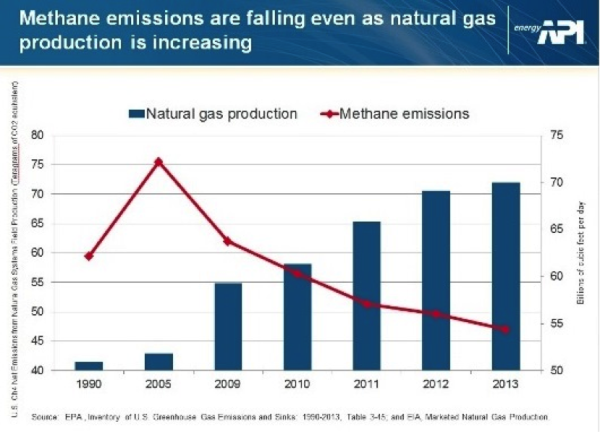
The methane rule will force oil and natural gas producers to reduce their methane emissions by 40 to 45 percent from 2012 levels by 2025.[i] This is a daunting task, considering the oil and gas industry has already reduced methane emissions from natural gas production by 38 percent between 2005 and 2013—despite increasing gas production by 35 percent over that time period.

These regulations and others promulgated by President Obama’s EPA will increase the cost of energy to Americans. President Obama is finalizing these regulations so that he can tell the world how he intends to reduce U.S. greenhouse gas emissions at the United National Climate Conference in Paris in December. However, the reductions that the United States makes will be insignificant to any realized temperature change and an equivalent amount of emissions will be released by China in a matter of days—for essentially no net gain globally.

Manufacturing Industry Exodus

In 2005, when natural gas prices were almost 50 percent higher than they are today, there was a general exodus of companies leaving the United States and moving their manufacturing operations to Asia to reduce costs. However, since then, hydraulic fracturing has enabled the extraction of natural gas from shale formations, lowering the price of natural gas and increasing its production substantially. An accounting firm, PricewaterhouseCoopers, believes that these lower U.S. energy prices could result in one million more manufacturing jobs as firms build new factories here. Companies such as Dow Chemical and Vallourec, a French steel-tubes firm, have announced new investments in America to take advantage of low gas prices and to supply extraction equipment.[ii]

Examples of firms bringing back manufacturing operations to the United States range from tiny firms to large firms, such as General Electric, which moved manufacturing of washing machines, refrigerators and heaters from China to a factory in Kentucky, which at one time had been expected to close. Another firm, Caterpillar, is opening a new factory in Texas to make excavators, but it still plans to expand its research and development activities in China.

A survey of American manufacturing companies by the Boston Consulting Group in April 2012 indicated that 37 percent of companies with annual sales above $1 billion said they were planning or actively considering shifting production facilities from China to America. Forty-eight percent of the very biggest firms with sales above $10 billion indicated that they would bring production facilities to America. The Massachusetts Institute of Technology looked at 108 American manufacturing firms with multinational operations and found that 14 percent of them had firm plans to bring some manufacturing back to America and one-third were actively considering such a move. Another study by the Hackett Group, a Florida-based firm that advises companies on offshoring and outsourcing, received similar results.

It may be ironic, but Chinese companies are now looking to manufacture in the United States. Keer, a textile company headquartered outside of Shanghai, China, is building yarn manufacturing lines in the Carolinas, bringing more than 500 jobs, due to low costs for energy, land, and cotton. The Carolinas at one time had been huge textile centers. Springs Mills in Lancaster once employed close to 20,000 people before the last textile factory closed in South Carolina in 2007. Lancaster County lost 11,000 textile jobs from 1995 to 2007. The greater Charlotte-Gastonia-Rock Hill region lost about 26,000 jobs at textile mills in the past 20 years.[iii]

But low energy prices and American ingenuity have brought manufacturing back to this country. However, all this is likely to change as President Obama’s regulations go into effect, making electricity and natural gas prices escalate, forcing companies to accept higher domestic operating costs or move offshore.

In the longer term, advanced manufacturing techniques will likely alter the economics of production, making it far less labor-intensive. Robots, for example, are already making a difference lowering the share of labor in total costs. Cheaper, more user-friendly and more dexterous robots are currently spreading into factories around the world, but these machines need energy to fuel them. And if President Obama implements regulations to raise energy costs, manufacturers will need to seek lower energy prices elsewhere, which will decrease the number of jobs in this country.

EPA’s Clean Power Plan

Early in August, EPA announced its final rule for the so-called Clean Power Plan, which reduces 32 percent of carbon dioxide emissions from the generating sector by 2030 from 2005 levels. This and other rules affecting the generating sector that have been finalized will shutter 90 gigawatts of coal-fired capacity and other fossil fuel technologies, and direct the construction of wind and solar units instead, despite the fact that it is cheaper to keep existing generating plants operating rather than building new plants. As a result, EIA expects residential electricity prices to be 16 percent higher in 2030 than they are today.

The use of low cost natural gas in the generation sector, displacing coal generation, has already reduced carbon dioxide emissions in the sector by 15 percent from 2005 levels. But, that is not a sufficient reduction for EPA. EPA wants the United States to reduce its carbon dioxide emissions from the electric generating sector by 773 million metric tons, and according to the International Energy Agency, while at the same time, China is expected to increase its carbon dioxide emissions by over 12,000 million metric tons.[iv] The U.S. reduction is expected to only reduce temperatures by 0.019 degrees Centigrade in 2100—a miniscule amount.[v]

Methane Rule

Also in August, the EPA finalized its methane rule, requiring oil and gas companies to reduce methane emissions by 40 to 45 percent from 2012 levels by 2025, despite the fact that the industry has already significantly reduced methane emissions while substantially increasing production.

According to EPA data, methane emissions from natural gas development have fallen steadily since 2005. (See red line in chart below.). The blue bars in the chart indicate natural gas production, which is rising steadily – even as less and less methane is being emitted from that production. The chart shows that net methane emissions from natural gas production fell 38 percent from 2005 to 2013 – even as natural gas production increased dramatically. Further, methane from hydraulically fractured natural gas wells fell 79 percent from 2005 to 2013.
Methane

Source: BreakingEnergy.com.

EPA’s Ozone Rule

EPA has finalized the so-called “Clean Power Plan” and the methane rule, but other regulations are still in the works. The proposed ozone rule, for example, is expected to be the most costly regulation costing the economy $1.7 trillion in lost GDP through 2040.   [vi]

The National Ambient Air Quality Standard (NAAQS) for ground-level ozone is an outdoor air regulation established by EPA under the Clean Air Act. Ozone is a naturally occurring gas composed of oxygen molecules. Ground-level ozone occurs both naturally and results from chemical reactions between nitrogen oxides and volatile organic compounds, which are emitted from industrial facilities, power plants, vehicle exhaust, and chemical solvents.

In March 2008, the EPA lowered the 8-hour primary NAAQS for ozone to its current level of 75 parts per billion. In November 2014, the EPA proposed lowering the ozone standard to a range between 65 to 70 parts per billion. By court order, EPA must finalize the standard by October 1, 2015.

These new ozone regulations proposed by EPA will cause hundreds of counties across the country to be in violation of air laws. Out of compliance on ozone means less development, fewer jobs and the potential for significant and long-term damage to the economy. What’s worse, the new proposed ozone rules are being considered while the previous ozone regulations from 2008 have not been entirely implemented. States, counties and communities across the country are working to meet the current requirements, and a new stricter standard would result in more communities out of compliance.

According to a February 2015 economic study by the National Association of Manufacturers, a 65 parts per billion standard could reduce GDP by $140 billion, result in 1.4 million fewer jobs, and cost the average U.S. household $830 in lost consumption – each year from 2017 to 2040.[vii]

Conclusion

President Obama is making energy prices escalate due to stringent environmental regulations being promulgated by the EPA. Due to the timing of these regulations, most of the price increases will not be seen by the public until his second term is up. Nonetheless, the headway the United States made to bring manufacturing back to America is being threatened. The result will be a loss of jobs that we cannot afford.


[i] Atlantic, The EPA’s New Methane Rules for the Oil and Gas Industry, August 18, 2015, http://www.theatlantic.com/business/archive/2015/08/epa-methane-emissions-oil-gas-industry/401651/

[ii] The Economist, Coming home, January 19, 2013,http://www.economist.com/news/special-report/21569570-growing-number-american-companies-are-moving-their-manufacturing-back-united

[iii] Charlotte Observer, Textile manufacturing returns to Carolinas—by way of China, August 8, 2014,http://www.charlotteobserver.com/news/business/article9148256.html

[iv] Institute for Energy Research, http://instituteforenergyresearch.org/analysis/u-s-climate-deal-with-china-is-no-deal-at-all/

[v] Cato, http://www.cato.org/blog/spin-cycle-epas-clean-power-plan?utm_medium=twitter&utm_source=twitterfeed

[vi] Chamber of Commerce, Ozone National Ambient Air Quality Standards, June 29, 2015, https://www.uschamber.com/issue-brief/ozone-national-ambient-air-quality-standards

[vii] National Association of Manufacturers, Costliest Regulation in History Coming Soon, http://www.nam.org/Issues/Ozone-Regulations/

EDITORS NOTE: The featured image is courtesy of Shutterstock.