
Israel: ‘No Choice’ but Military Option against Iran’s Nuclear Program?
 In 1964, I sat in a darkened movie theater in Washington, D.C. with a fellow Army Intelligence officer watching Stanley Kubrick’s brilliant dark satire film on how to live with thermonuclear warfare, Dr Strangelove: or: How I Learned to Stop Worrying and Love the Bomb. My colleague and I laughed nervously as we had just finished secret intelligence assignments. That memory was triggered by a recent American Thinker article by veteran nuclear war gaming and arms control expert, John Bosum, “Thinking About the Unthinkable: An Israel-Iran Nuclear War”. That was a reference to books and articles by nuclear game theorist and Hudson Institute co-founder Herman Kahn and former Secretary of State Henry Kissinger on limited nuclear warfare.
Scary prospects then, scary prospects now with the world on the verge of concluding a nuclear agreement with the apocalyptic Islamic Republic of Iran virtually assuring it of an arsenal of nuclear weapons in a decade, if not sooner funding in part by the lifting of $150 billion in sanctions. The U.S. says it has the means of striking back at Iran if it is found cheating, a reference to possible military actions. The reality is that the Administration has hollowed out the nation’s military capabilities leaving Israel isolated. The Jewish nation would doubtlessly be reviled by world opinion, should it undertake a strike of its own on Iran’s nuclear facilities.
The Israeli Limited Nuclear Attack Scenario
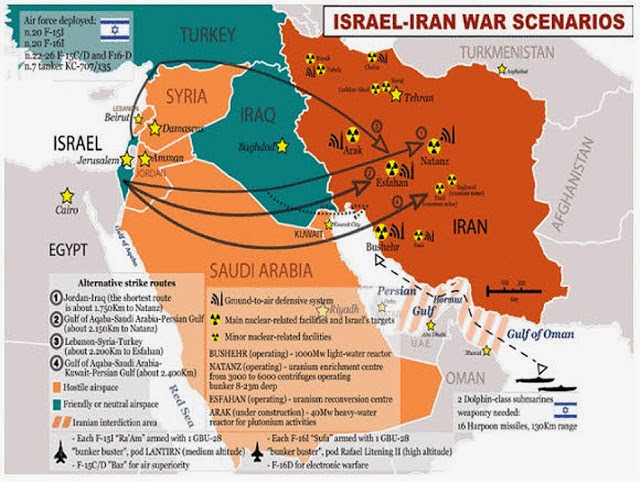
There are daunting prospects facing Israel with the looming Congressional vote rejecting the Iran nuclear pact in the face of a likely veto threat by President Obama that may not be overridden. John Bosum, in his American Thinker article vets a possible limited nuclear attack by Israel against Iran’s nuclear facilities. His credibility stems from his considerable expertise and professional background in nuclear war gaming and arms control. He posits an attack scenario using conventional air craft equipped with US supplied GBU 28 “bunker busters” followed by tactical nukes or nuclear tipped cruise missiles launched from Israeli Dolphin subs offshore in the Arabian Sea. That scenario faces the realities of estimated losses by Israel Ministry of Defense planners. They have estimated that such a scenario might result in the loss of 40 percent of air crews-a heavy price to pay for young IAF pilots. Then there is Bosum’s suggestion that Israel might use a low altitude EMP attack on Iran by a Jericho 2 missile. Ex-CIA official Chet Nagle suggested that Israel might pursue that during a Capitol Hill EMPact program on the EMP Threat several years ago. There is also the non nuclear option using swarms of Drone- launched CHAMP cruise missiles that could take out specific targets. Examples are computer controllers and major power transformers for underground enrichment and centrifuge R& D facilities as well as command and control networks. Israeli encrypted software managing large swarms of drones may provide a stealth shield against the Russian supplied S300 batteries. In September 2008 the IAF flew simulated missions against Greek S300 systems involving swarms of IAF aircraft that rattled the IRGC military. From that exercise the IAF may have developed electronic means of spoofing these Russian systems version of S-300 air defense systems.
Bosum believes that Israel’s anti-missile umbrella including the Arrow anti-ICBM, David Sling, Iron Beam and Iron Dome systems, might not be able to withstand barrages of Iranian rockets and medium range ballistic missiles. There is evidence from the Tel Aviv University Institute for National Security Studies (INSS) November 2012 Iran attack simulations that a conventional attack might succeed in setting back the Iranian program by three years. Moreover, the simulations suggest that the anti-missile umbrella may destroy significant numbers of incoming Iranian missiles sparing Israel’s major population centers. From reliable sources we understand that Israel may have successfully conducted tests against North Korean developed Shahab 3 missiles likely candidates for nuclear equipped MIRV warheads.
The real issues for Israel are priorities and staging of a limited nuclear attack scenario on Iran’s nuclear program. From release of interview audio tapes this weekend on Israeli Channel 2 by the authors of a forthcoming memoir of former Defense Minister Ehud Barak there were allegations that Netanyahu was thwarted from undertaking possible Iran nuclear attack missions because of objections from former IDF Chief of Staff Gabi Ashkenazi, “cold feet” of Ministers Yuval Steinitz, Minister of Defense Moshe “Bogie” Ya’alon and looming joint Israel US military exercises in 2012. There were reports that President Obama threatened to invoke the Brzezinski Doctrine with orders to shoot down IAF aircraft attacking Iranian targets. Problem is Barak’s representations may have been part of a promotional effort to enhance his reputation and legacy. There were also rumors that current Minister of Defense, Moshe “Bogie” Ya’alon may have also revisited the limited Iran nuclear attack option this past year. He broadly hinted that “steps” might have to be taken during a May 5, 2015 conference in Tel Aviv hosted by the Israel Law Center, sufficient to bring a reaction from Iran’s UN Ambassador. Ya’alon was cited in a Times of Israel report saying:
“Certain steps” Israel might consider against tyrannical regimes threatening the nation’s security.
Cases in which we feel like we don’t have the answer by surgical operations we might take certain steps that we believe…should be taken in order to defend ourselves.
Of course, we should be sure that we can look at the mirror after the decision, or the operation. Of course, we should be sure that it is a military necessity. We should consider cost and benefit, of course. But, at the end, we might take certain steps.
He was reminded of US president Harry Truman who “was asked how you feel after deciding to launch the nuclear bombs, Nagasaki and Hiroshima, causing at the end the fatalities of 200,000, casualties? And he said, “When I heard from my officers the alternative is a long war with Japan, with potential fatalities of a couple of millions, I thought it is a moral decision.
We are not there yet, Ya’alon then added.
The Hezbollah Attack Scenario
The release in mid-August 2015 of a definitive national strategy document by IDF Chief of State (COS) Gen. Gadi Eizenkot, criticized failures to combat both Hamas and Hezbollah, raised the risk from non-state fundamentalist Islamic State, but downplayed the Iran threat. It is not without moment in late August that there was a stream of contradictory declarations from PM Netanyahu and Defense Minister Ya’alon that Iran is behind a series of low intensity and rocket attacks on Northern Israel and the Golan frontier since the beginning of this year. The attacks involved IRGC officers and Iranian proxies Hezbollah and Palestinian Islamic Jihad. Israeli PM Netanyahu referencing acceptance of the Iran nuclear pact by world powers said, “You rush to embrace Iran, they fire rockets at us. We will harm those who harm us”
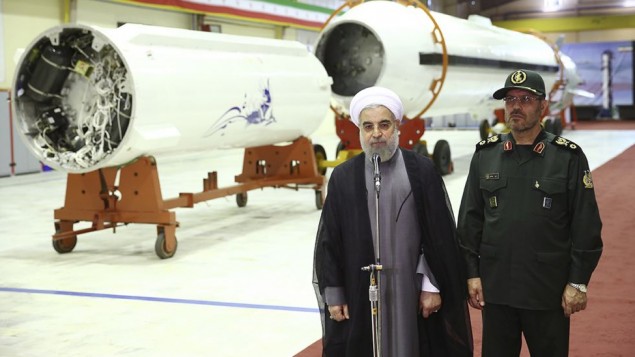
From the assessments of retired Maj. Gen. Yaakov Amidror, former National Security Adviser, the immediate objective is the elimination of the near enemy and proxy of Iran, Hezbollah. Recently Iran unveiled a new solid fuel surface to surface missile, the Fateh 313, that President Rouhani threatened ballistic missile exercises would demonstrate the ability of longer range missiles to strike both Israel and Saudi Arabia. The limited range of 310 miles of the Fateh-113 makes the weapon suitable for possible launch from Syria and Lebanon against population centers in Israel. Further, this threat is bolstered by the turmoil in Lebanon behind the unresolved political crisis over the possibility of a power grab by Hezbollah.
An Israeli preemptive attack scenario is at the heart of Jon Schanzer’s article, “The Iran Nuclear Deal Means War between Israel and Hezbollah”. Schanzer argues that the Iran nuclear deal may trigger a major war against Hezbollah to eliminate the Iranian- supplied rocket and missile inventories and the command and control echelons of Hezbollah. Schanzer refers to discussions with senior Israeli defense officials who appear committed to dislodge Hezbollah and destroy the huge inventory of 150,000 rockets and missiles in Lebanon. Israel has both air and naval combat capabilities to achieve this including interdiction of Iranian and Chinese supplied anti-ship missiles. Further, the IDF would not have to rely on those U.S.-supplied GBU-28’s bunker busters. It has sophisticated weapons like the Rafael SPICE precision guided glide bombs used to foil weapons deliveries from Syria to Hezbollah in the Bekaa Valley. It also has its own variant of the Boeing CHAMP cruise missiles capable of non-nuclear EMP effects against command and control nets. Moreover, unlike the inconclusive Second Lebanon War of 2006, the IDF has learned its lessons about unit training, command and control and effective means of taking out anti-air, anti-tank rockets and launching precision battlefield missiles, using the Iron Beam, Trophy and Pereh systems.
This sequencing of threat priorities was reflected in a Wall Street Journal Weekend Edition Interview by Sohran Ahmari with former Saudi General and National Security Advisor Anwar Eshki, “The Saudis Reply to Iran’s Rising Danger.” General Eshki held colloquies with Dr. Dore Gold director general of the Israel Foreign Ministry. The most notable one was the public forum at the Washington Institute for Near East Policy. General Eshki’s conclusion drawn from a Socratic dialogue on the near versus far enemy decision paradigm was: “Israel is thinking first of all to destroy Hezbollah, to solve the problem with Hezbollah. After that they can attack Iran.”
Walla News in Israel reported a senior defense official saying that Israel may be capable of undertaking an attack on Iran’s nuclear facilities and defending Israel against a retaliatory strike:
Every year that passes, the IDF improves. We never stand still. The professional level increases. In the coming year we will receive another submarine, F-35 fighter jets and other platforms. Intelligence is improving as well.
Further, Walla reported IDF COS Eizenkot instructing deputy, Maj. Gen. Yair Golan to revise military plans for a possible military strike. But it cautioned that the military option was off the table until there are ‘significant developments’. That may be for public consumption. Israel has a tradition of saying nothing or opaquely very little when such events occur
Conclusion
The planners in the Ministry of Defense pits in Tel Aviv have multiple threats and must prioritize resources. By necessity Israel must plan for taking out the near enemy, Hezbollah, which would enable them to have a clear path to attack Iran. Thus, it must be prepared to accomplish both threats. At issue is whether Israel I PM Netanyahu and the security cabinet have the resolve to accomplish both despite adverse world opinion and likely intervention by the Obama Administration.
When Israeli PM Begin ordered the “raid against the sun’ in 1981 that took out Saddam Hussein’s Osirak nuclear reactor , it took a decade for former Vice President Dick Cheney to thank Israel when the US led coalition unleashed the First Gulf War. No such thanks came from the Bush Administration following the IAF’s successful obliteration of the Syrian al-Kibar nuclear bomb factory following the September 2007 raid. . The Obama Administration has demonstrated its inability or unwillingness to exercise a possible military option should Iran be found cheating under the terms of the JCPOA. It has hollowed out the US military capability under the Congressional Sequester. We have the smallest navy since WWI and the smallest Army since before WWII. We have less than 26,000 first line aircraft. Israel has no choice, but to undertake its sovereign right to defend the Jewish nation against such existential threats.
EDITORS NOTE: This column originally appeared in the New English Review. The featured image is of Iranian President Rouhani and Defense Minister Hossein Dehghan with Fateh-313 Sold Fuel Missile, August 22, 2015. Source: Iranian Presidential office/AP.