Tag Archive for: Medicaid

Report: Left-Wing ‘Shadow Government’ Weaponizes Bureaucracy to Push ‘Woke’ Policies in Red States

Republicans and conservative activists have made much progress over the years combating the progressive agenda, from major Supreme Court decisions to nationwide boycotts. But a new report is shedding light on the “shadow government” promoting “woke” policies in red states, threatening to undo what conservatives have achieved. According to the State Leadership Initiative (SLI), professional associations and non-government organizations (NGOs) have been quietly shaping policy at the state level, injecting diversity, equity, and inclusion (DEI), environmental, social, and governance (ESG), and LGBT initiatives into state-level regulations and standards.

SLI identified organizations like the National Association of State Treasurers (NAST), the National Association of State Medicaid Directors (NAMD), the American Association of State Highway and Transportation Officials (AASHTO), the National Association of Insurance Commissioners (NAIC), and the National Association of State Boards of Education (NASBE) as some of the chief culprits in running the progressive “shadow government” at the state level, although SLI noted that the organizations named “are just examples — there are dozens more organizations representing what effectively amounts to a left-wing shadow government guiding states in an increasingly leftist direction.”

“There is no function of state (and often local) government that is too obscure to warrant a national association for that function,” wrote SLI founder and president Noah Wall. He continued, “Virtually all these associations (which are often standard-setting organizations for best practices and serve as de facto regulators and lobbyists for their departments) are ideologically captured by the left. But in virtually all cases, there is no ideologically neutral alternative.” Wall added, “What that means is that the organizations that set standards and regulations and draft legislation for critical state government functions are tools of the left. That translates to left-wing policies becoming the norm across state governments, regardless of whether Democrats or Republicans govern the state.”

NAST has maintained a DEI committee, which has been responsible for implementing DEI principles in hiring and state treasury operations. NAMD established standards in 2022 on “equity,” demanding that state Medicaid policies rectify “health disparities” by prioritizing groups based on race. In 2023, AASHTO developed a program to address “race, equity, diversity, and inclusion” by basing transportation planning decisions on race and DEI. SLI noted that AASHTO also promotes “race-driven government contracting, which is how you end up with most states in America — even red states — maintaining race-based mandates for transportation contracts.” The NAIC has controversially opposed auto insurance ratings that include sex as a factor, claiming that the practice is “unfairly discriminatory.” NASBE has targeted schools with “gender-inclusive” curricula, pronoun mandates, and pro-transgenderism policies in the context of school sports and bathrooms.

“These groups are part of a broader ecosystem, backed by billionaire-funded NGOs and progressive think tanks that amplify their reach,” SLI warned in its report. The conservative-led organization continued, “Grant funding, often tied to these progressive policy requirements, pressures red state agencies to comply, even when it contradicts the conservative mandates of their constituents. This network operates with sophistication, embedding itself in state bureaucracies and eroding the federalist principles that protect state sovereignty.”

SLI’s report examined the 23 largest associations of the sort and found that each of them promoted some form of DEI, ESG, or LGBT initiatives. “It is an interesting question as to why the left has near-universally captured these organizations, and answering it points to the solution. There are two primary reasons. First, bureaucratic entities tend to veer left naturally, and this has been a subject of empirical study going back decades,” Wall wrote. Second, he said, “The left pays far more attention to process than those on the right — who may find it mind-numbingly tedious — but with decades of work, you can end up capturing an entire system and have it reflect your values, as the left has done.” [Emphasis original.] Wall added, “The solution is crystal clear: Treat these organizations like the political entities the left assumes them to be. Lobby them, get involved, pay attention, and work to make them better.”

In comments to The Washington Stand, FRC Action Director Matt Carpenter said, “Anyone familiar with routine yard work knows pulling up weeds is not a single task, it is ongoing. A weed will pop up in the same place you pulled one up by the roots the previous week.” He continued, “The same goes for the woke agenda, rooting it out with executive orders must be done, but that’s not the end of the story. Congress must get involved, and federal agencies responsible for doling out grants to these NGOs must get involved, voters must get involved to ensure the anti-woke movement continues, and so on.”

“This report serves as a lesson for conservatives; one election does not change a country. Sure, it helps, it can even change the trajectory of the country — as I think is the case with the second Trump administration,” Carpenter observed. “But if we truly want to return America to greatness it will require a commitment to keep pulling up those woke weeds every day, for years, and even decades.”

Mike Gonzalez, a senior fellow at the Heritage Foundation, told The Washington Stand, “This is a frightening and at the same time completely unsurprising report. Frightening because it shows to what lengths the Left will go to thwart the will of the voters and undermine democracy. Progressives just think they are motivated by higher values and have nothing but scorn for average Americans.” He continued, “Unsurprising for the same reasons. Because of their sense of superiority — not based on better outcomes for their policies, on the contrary — progressives think they have the right to impose their policies on everyone else.”

Gonzalez further observed, “It is also unsurprising that the national organizations behind this scheme brand themselves as nonpartisan. This is, after all, how NPR and PBS also brand themselves. Lastly, this report also shows the truth of the adage by the late and dearly missed Heritage Founder Ed Feulner that ‘in Washington there are no permanent victories or permanent defeats.’ We must be forever vigilant.”

SLI has announced that a second, more in-depth report on the subject will be published in the coming months.

AUTHOR

S.A. McCarthy

S.A. McCarthy serves as a news writer at The Washington Stand.

RELATED ARTICLE: Anti-Trump Protests in D.C. Looking for Paid Activists

RELATED VIDEO: REVELATION: 34 felony convictions against President Trump were part of the Democratic Party’s ‘resistance’ strategy

EDITORS NOTE: This Washington Stand column is republished with permission. All rights reserved. ©2025 Family Research Council.


The Washington Stand is Family Research Council’s outlet for news and commentary from a biblical worldview. The Washington Stand is based in Washington, D.C. and is published by FRC, whose mission is to advance faith, family, and freedom in public policy and the culture from a biblical worldview. We invite you to stand with us by partnering with FRC.

The 3 Most Important Votes of the ‘One Big Beautiful Bill’ Vote-a-Rama

President Donald Trump’s “One Big Beautiful Bill” moved closer to adoption overnight, as Senate Democrats attempted to load the bill with poison pill amendments in the “vote-a-rama.” During the lengthy amendment process, which began at 9 a.m. Monday morning and continues as of this writing, anyone may offer amendments to the 940-page bill. Senate changes have already made the bill less attractive to pro-life, pro-family conservatives. Yet the revised text also removes a controversial, 10-year moratorium on states regulating artificial intelligence.

“The president’s ‘One Big Beautiful Bill’ is quickly losing its glamour in the Senate. The bill now appears to be a contestant in a beauty pageant for a tractor pull,” said FRC Action Chairman Tony Perkins. “The Senate version currently defunds big abortion providers like Planned Parenthood for only one year, instead of ten. That’s a huge disappointment. The first Senate version defunded gender transition procedures in Medicaid (not in Obamacare, as the House did, nor in Medicare or in the tax code, as had been proposed). But the current version will subject even that slimmed-down provision to a 60-vote threshold, meaning the provision will not pass the Senate, and Americans will continue to pay for gender transition experimentation on vulnerable individuals.”

Perkins wondered only if Senate Republican leaders were “completely out-muscled by the parliamentarian, or worse yet, didn’t try to secure the key components of the House version.” Senate GOP inaction “shows an unacceptable lack of political will.”

“Will senators fight to defund abortion providers for the maximum-allowable 10 years? Will they fight to defund gender procedures that bring trauma and life-long harm, or will they be satisfied with a show-vote on gender transition procedures?” asked Perkins.

Here are three of the most important votes that took place over the last 24 hours.

1. The Senate Continues to Defund Planned Parenthood

The Senate version of the bill reduced the 10-year defunding of Planned Parenthood to only one year. But overnight, the Senate narrowly voted down an amendment to strike down even that brief funding interlude, on a 51-49 vote. Two “pro-choice” Republicans, Susan Collins of Maine and Lisa Murkowski of Alaska, voted with the Democrats to fund the nation’s largest abortion business, which committed 402,230 abortions and received $792.2 million in taxpayer funding in 2024.

“The Republicans’ bill will cut millions of women off from birth control, cancer screenings, essential preventative health care — care they will not be able to afford anywhere else,” alleged Senator Patty Murray (D-Wash.). “It will take another step towards enacting the Republicans’ plan for a backdoor nationwide abortion ban. How does it do this? By defunding Planned Parenthood.” Republicans, she said, were “happy to cut off this life-saving care.”

But Kristen Day, executive director of Democrats for Life, rebutted the talking point. “Defunding Planned Parenthood is not one of them. Community Health Centers and Federally Qualified Health Centers (FQHCs) provide comprehensive healthcare, and there are more of them!” she said. “Let’s fully fund real healthcare.”

“Senate Democrats just failed in their attempt to remove the meager tip (10%) that Senate Republicans were offering to the taxpayers and pro-life Americans,” said Perkins.

Kristan Hawkins of Students for Life of America said, “Let me be clear: Defunding Planned Parenthood for one year would be one small step that we celebrate, while we will still fight for all those at risk by the Abortion Goliath’s predatory & violent business. One giant leap would be full debarment.”

2. Senate Nixes the 10-year Moratorium on States Regulating Artificial Intelligence (AI)

On a nearly unanimous vote, the Senate adopted a bipartisan amendment from Senators Marsha Blackburn (R-Tenn.) and Maria Cantwell (D-Wash.) to eliminate the One Big Beautiful Bill’s controversial, 10-year moratorium on AI regulation. If enacted, the provision would have struck down an estimated 75 existing state laws and barred any further protections for the next decade, including laws against AI-generated child pornography.

Blackburn and Senator Ted Cruz (R-Texas) had sought a compromise that would reduce the decade-long federal ban on state AI regulations to five years and allow states to protect children from exploitation, and safeguard people’s images and likenesses, provided those regulations did not impose an “undue or disproportionate burden” on artificial intelligence. “Find you a senator who looks at defunding gender transition procedures the way Ted Cruz looks at protecting AI,” joked Quena González, senior director of Government Affairs at Family Research Council, on social media.

But Blackburn eventually broke with Cruz, saying the proposed compromise did not do enough for “those who need these protections the most. This provision could allow Big Tech to continue to exploit kids, creators, and conservatives. Until Congress passes preemptive legislation like the Kids Online Safety Act and an online privacy framework, we can’t block states from making laws that protect their citizens.” On the House floor, Blackburn listed a litany of AI regulations Congress had failed to pass, which states have adopted. On Friday, 17 Republican governors urged congressional leaders to strike the AI moratorium, saying it “threatens to undo all the work states have done to protect our citizens from the misuse of artificial intelligence.”

Cruz withdrew his amendment a little after 4 a.m. Tuesday, paving the way for the House to adopt Blackburn’s amendment on a strongly bipartisan basis: 99-1. Senator Thom Tillis (R-N.C.) cast the lone no vote.

3. Democrats Extend Taxpayer-Funded Benefits to Criminal Illegal Immigrants

Senator John Cornyn (R-Texas) offered an amendment that would have reduced federal Medicaid funding to states that cover illegal immigrants charged with serious crimes. Under Senate parliamentary procedure, the measure needed to clear a 60-vote threshold but passed with only 56 votes. One Republican, Susan Collins of Maine, voted against the measure. Meanwhile, five Democratic senators voted in favor: Maggie Hassan of New Hampshire, Catherine Cortez-Masto of Nevada, and Jon Ossoff and Raphael Warnock of Georgia. “Illegal aliens should be on a flight back to their home country, not on Medicaid (funded by American taxpayers)!!!” said Rep. Keith Self (R-Texas). On Monday, the Senate rejected an amendment from Blackburn that would have prevented states from allowing illegal immigrants to enroll in Medicaid.

The Senate also rebuffed numerous attempts to maintain or further extend Green New Deal tax credits and subsidies. Senator Mike Crapo (R-Idaho) spoke in opposition to many of the measures, branding taxpayer funding of “mature industries” as “wasteful.”

House conservatives laid much of the blame for the One Big Beautiful Bill Act’s lost beauty at the footsteps of Senate Parliamentarian Elizabeth MacDonough, a former Al Gore adviser. “The Senate parliamentarian over the last few days has said that a lot of our deficit reduction measures were invalid under the Byrd rule. They’ll have to be changed and modified,” Rep. Andy Harris (R-Md.) told “Washington Watch” regular guest host Jody Hice on Friday. Many have asked for the Senate to overrule the parliamentarian, something Senate Majority Leader John Thune (R-S.D.) has repeatedly and recently refused to do. “I’ve asked for her to be fired. I don’t know why you would be the Republican leader of the Senate and have a parliamentarian who was hired by Harry Reid 12 years ago,” Rep. Greg Steube (R-Fla.) told “Washington Watch” Monday.

House conservatives said changing the original text of the bill too much risks upsetting the key agreements that allowed the One Big Beautiful Bill Act to pass the House, where Republicans also hold only a three-vote majority. “It was a very carefully negotiated compromise. And as they wander away from that, it becomes less and less likely that it’s going to succeed when it comes back out to the House,” said Harris. “We want this to succeed. We want President Trump to succeed. But the safest thing they could do is take our House bill and just pass it the way we pass it, or make some very small changes.”

“If they try to send it over to the House with a large increase in the budget deficit, then I think we’re going to have to go back to the drawing board,” warned Harris.

House leaders want the bill to meet President Trump’s deadline of July 4, making a speedy House vote likely. “I’ve been talking with [Senate Majority] Leader Thune constantly through the process and with individual senators, encouraging them to change the House product as little as possible,” Speaker of the House Mike Johnson (R-La.) told “This Week on Capitol Hill” Saturday.

“I will have to wait about 72 hours for the bill to lay over before we can vote. But the plan would be if it’s in shape that we could use it,” said Johnson. A prompt House vote “would also allow for the president to have a big, beautiful bill signing on Independence Day. And I certainly hope we can keep that deadline.”

As the Senate nears a final text, senators on both sides of the aisle can agree on one thing: They want the nearly day-long marathon known as “vote-a-rama,” to end. “It’s like an all-night party, but without the party,” quipped Senator Mike Lee (R-Utah) in the wee hours of Tuesday morning.

“I just want to go home,” agreed Senator John Fetterman (D-Penn.). “I’ve already missed our entire trip to the beach.”

AUTHOR

Ben Johnson

Ben Johnson is senior reporter and editor at The Washington Stand.

RELATED ARTICLES:

Policy Has Consequences: Anti-Family Polices in Cuba Are Affecting Real People

The War of the Machines: Peter Thiel, J.R.R. Tolkien, the Antichrist, and Technology

Two Polls Reveal Public Support Is Growing for Prayer, Chaplains in Schools

EDITORS NOTE: This Washington Stand column is republished with permission. All rights reserved. ©2025 Family Research Council.


The Washington Stand is Family Research Council’s outlet for news and commentary from a biblical worldview. The Washington Stand is based in Washington, D.C. and is published by FRC, whose mission is to advance faith, family, and freedom in public policy and the culture from a biblical worldview. We invite you to stand with us by partnering with FRC.

Thune Plows Ahead with Big Beautiful Deadline Despite Question Marks

Every couple of years, all eyes are suddenly trained on one of Congress’s most under-the-radar jobs: the Senate parliamentarian. For 13 years, Elizabeth MacDonough has equal parts elated and frustrated parties in their attempts to squeeze major legislation through the reconciliation process. The first-ever woman to hold the job, MacDonough has played the referee through four administrations and an array of different Senate leaders. It’s up to her to settle the bitter disputes over which parts of the Big Beautiful Bill are relevant under the rules and which aren’t. In other words, she’s the most important person to Donald Trump’s agenda that most people have never heard of.

For the last several days, the “parl,” as the position is affectionately nicknamed, has been combing through the fine print of the Senate Finance Committee’s version of the bill to see which parts do, in fact, meet the standards for this specialized budget process. As MacDonough once explained it, “We’re the neutral end of [these partisan battles, which is] very important. Yes, you need to think of that somebody who is not elected, not a party apparatchik.”

That matters, especially now, as the two sides duke it out over what belongs in the president’s signature legislation and what doesn’t. To unlock reconciliation, everything has to abide by the Byrd Rule, which keeps parties from tacking on “extraneous” provisions. Democrats flagged several pieces of the bill that they argue aren’t budget-related, which is the major criterion for surviving the Bryd Bath.

Already, MacDonough has announced some GOP casualties — Byrd droppings — that she’s ruled non-germane. Making matters interesting, some of the victims were programs or provisions that helped sweeten the deal for reluctant House members to sign on. Language that would force the states to pay a bigger share of the Supplemental Nutrition Assistance Program (SNAP) or restrictions on temporary restraining orders from lower courts have been struck, at least for now, along with priorities like EPA revisions, overhauls to the Consumer Financial Protection Bureau, regulatory powers, a mandate to sell the Post Office’s electric vehicles, and more were all struck — sending Seante Majority Leader John Thune (R-S.D.) into a huddle to see which pieces Republicans might rework.

The blows didn’t seem to derail Thune’s timeline, though. “Breitbart News Saturday” asked the majority leader, “Are we still on track for getting the bill out of the Senate by the Fourth of July?” “We are,” Thune replied. Obviously, he pointed out, things are more complicated in the Senate with “laws and restrictions and procedures that we have to operate under that are different than the House. So some of that takes a bit longer,” he conceded, “but as we head into this next week, I’m fully confident that we’re going to be ready to roll, and we have to be,” he said. “We’ve got to deliver.”

One thing he’s learned, Thune admitted, is that “if you don’t put deadlines out there, nothing gets done, and this stuff can drag on and on endlessly. If we want to get the one big, beautiful bill done, the Senate is going to have to act, and we’re going to hopefully act in a way that will enable the House when we send it back over there to them, because they have to pass the same bill that we do.”

Apart from the parliamentarian, the biggest wrench to Trump’s signature bill is getting the House on board with the changes, which were significant. Unlike Speaker Mike Johnson’s (R-La.) chamber, the Senate’s version brings the state and local tax deduction (SALT) back to earth from $40,000 to $10,000. Anticipating the House moderates’ anger, Thune tried to tamp down the frustration by pointing out, “We understand that it’s a negotiation. Obviously, there had to be some marker in the bill to start with, but we’re prepared to have discussions with our colleagues here in the Senate and figure out a landing spot.”

Other flashpoints include bigger reforms to Medicaid, a $5 trillion debt ceiling (instead of the House’s $4 trillion), a “gentler” approach to the green energy tax credits that Joe Biden created, and more permanent tax cuts for businesses. Based on the extension of the climate change subsidies alone, Rep. Chip Roy (R-Texas) announced that he wouldn’t vote for the package.

“Rumor is Senate plans to jam the House with its weaker, unacceptable [One Big Beautiful Bill],” Roy vented on X Tuesday. “This is not a surprise but it would be a mistake,” he warned. “The bill in its current Senate form would increase deficits, continue most Green New Scam subsidies, & otherwise fail even a basic smell test… I would not vote for it as it is.”

His Arizona colleague, Andy Harris (R-Md.), agreed. “The currently proposed Senate version of the One Big Beautiful Bill weakens key House priorities,” the chair of the House Freedom Caucus said. “It doesn’t do enough to eliminate waste, fraud and abuse in Medicaid, it backtracks on Green New Scam elimination included in the House bill, and it greatly increases the deficit — taking us even further from a balanced budget.”

Thune responded to critics, stressing, “This is a process whereby everybody doesn’t get everything they want.” Others, like Senator Kevin Cramer (R-N.D.), sought to highlight the pros of the bill. “I think we’re going to find more spending cuts,” he explained to Family Research Council President Tony Perkins. “I know that won’t break your heart. … It’s plain and simple. We’re going to make the tax cuts permanent. The SALT thing is probably one of the stickier things. But at the end of the day, this bill is going to be good enough that if you voted for it in the House before, there’s no reason for you not to vote for it this next time, because then you’re given a binary choice. Is it better to pass it or not? And at that point, I think that the House will pass it as well.”

House conservatives like Rep. Warren Davidson (R-Ohio) say they’re “hopeful” that “we’ll wind up with a product that every Republican in the House and Senate can vote for. We were close in the House.” But no one is quite sure how many congressmen will fall in line.

At the end of the day, Johnson admitted that there’s heartburn on the aspects where the two chambers aren’t on the same page. “But look,” he told Perkins on Saturday’s “This Week on Capitol Hill,” “we’re giving them the space to do what they need to do. I’m in constant communication with Leader Thune over there, my counterpart, and with individual senators who have expressed concerns or questions about why we did what we did in the House version. And so, look, I think this is going along well,” he agreed. “And I certainly hope they make as many minor modifications as possible and not major modifications, because that will make it more difficult for us to pass it, as you know.”

AUTHOR

Suzanne Bowdey

Suzanne Bowdey serves as editorial director and senior writer at The Washington Stand.

EDITORS NOTE: This Washington Stand column is republished with permission. All rights reserved. ©2025 Family Research Council.


Like what you’re reading? Donate to The Washington Stand! From now until June 30, your gift will be doubled to fuel bold, biblically-based reporting.

The Washington Stand is Family Research Council’s outlet for news and commentary from a biblical worldview. The Washington Stand is based in Washington, D.C. and is published by FRC, whose mission is to advance faith, family, and freedom in public policy and the culture from a biblical worldview. We invite you to stand with us by partnering with FRC.

‘Next’: Schumer Dodges Simple Question About Medicaid For Illegal Immigrants

Senate Minority Leader Chuck Schumer sidestepped a question about whether he supported states giving illegal migrants taxpayer-funded health insurance at a press conference Wednesday.

The House-passed One Big Beautiful Bill Act included a provision to penalize 14 states and the District of Columbia who enroll illegal immigrants in state health insurance programs by reducing their federal Medicaid funding for the Affordable Care Act’s Medicaid expansion population. The Daily Caller News Foundation asked Schumer about the nonpartisan Congressional Budget Office’s (CBO) preliminary projections that 1.4 million illegal immigrants would lose health coverage as a result of this provision in the House-drafted bill.

Schumer immediately reacted by slamming the president’s tax and spending bill before offering a word salad on his opposition to congressional Republicans’ proposed crack down on states who give illegal migrants free healthcare.

“The bottom line is the overall bill is so awful,” Schumer said. “If they want to aim — if they got some specific issues aim it, don’t just do just do a ‘meat axe,’ chainsaw, across the board and cut everything, everything, everything.”

“This goes way beyond what they’re talking about and hurts everybody,” Schumer added.

The DCNF’s Andi Shae Napier attempted to ask a follow-up regarding Schumer’s opposition to the Medicaid reform provision before he declared “next question.”

The Democratic leader also incorrectly said the CBO projections were “GOP numbers” and questioned the accuracy of the congressional scorekeeper’s estimates.

The Medicaid provision specifically lowers the Federal Medicaid Assistance Percentage (FMAP) — the Medicaid match rate the federal government pays to states that expanded Medicaid coverage under the Affordable Care Act — from 90% to 80%. The proposal would force certain blue states to cover 20% of the cost themselves, putting billions of dollars in Medicaid funding they depend on at risk.

GOP lawmakers and Trump administration officials have defended their Medicaid reforms as preserving the entitlement program’s benefits for those who need it most while eliminating waste, fraud and abuse. Savings generated from reforming Medicaid contributed in part to more than $1.5 trillion in spending cuts over a decade in the president’s landmark bill.

“We’re not cutting Medicaid,” Speaker Mike Johnson told “Meet the Press” host Kristen Welker on Sunday. “What we are doing is reducing the program wrought with fraud, waste and abuse to make sure that that program is essential to so many people and ensure that it is available for the most vulnerable, and it’s intended for young, single pregnant women, the disabled and elderly.”

Johnson added that 7.6 million people “will supposedly be affected by this,” referring to preliminary CBO projections. “When you look at the numbers and break them down, this is high on public opinion. You are talking about [removing] 1.4 million illegal immigrants.”

A spokesperson for Schumer did not immediately respond to the DCNF’s request for comment seeking clarification on the Democratic leader’s position.

AUTHOR

Adam Pack

Congressional Reporter

RELATED ARTICLES:

Dems Screech About GOP ‘Gutting Medicaid’ While Ignoring Inconvenient Fact

‘Important And Heroic Thing’: Mike Johnson Defends Medicaid Reforms In ‘Big, Beautiful’ Bill

‘Nihilistic Bloodlust’: Veteran Liberal Activist, Pro-Harris PAC Leader Praises Murder Of Israeli Embassy Staff

EDITORS NOTE: This Daily Caller column is republished with permission. ©All rights reserved.


All content created by the Daily Caller News Foundation, an independent and nonpartisan newswire service, is available without charge to any legitimate news publisher that can provide a large audience. All republished articles must include our logo, our reporter’s byline and their DCNF affiliation. For any questions about our guidelines or partnering with us, please contact licensing@dailycallernewsfoundation.org.

Republicans Brace for the Next Wave of Big Beautiful Debates

When Speaker Mike Johnson (R-La.) hauled the “one, big, beautiful bill” over its first mountain — House passage — he had one request. To the GOP senators, he said, “I encourage them to modify the package that we’re sending over there as little as possible.” Thinking back over the warring factions in his chamber, he added, “Because we have to maintain that balance, and it’s a very delicate thing.” But in the days since last Thursday, it’s not clear if any Republicans, including the one in the White House, are listening.

Watching the House from a safe distance through its long nights, tense meetings, mark-ups, and ferocious jockeying for different priorities, senators sent a steady drip of commentary to the press about what they would change and language they thought could go farther. Now that the bill sits squarely in their laps, some have signaled at choppy waters ahead. While almost everyone is complimentary of the job the speaker has done, they also recognize that this is their chance to put a different mark on Donald Trump’s signature legislation.

“I want to get a deal done,” Florida Senator Rick Scott (R) insisted. “I support the president’s agenda. I support the border, I support the military, I support extending the Trump tax cuts … But [we’ve] got to live in reality here: [We’ve] got a fiscal crisis.”

Others, like Kentucky’s Rand Paul (R), have been more critical. For weeks, he’s tried to rally the troops to cut more spending. “… [T]he math doesn’t add up,” the chamber’s outspoken fiscal hawk warned. “They’re going to explode the debt by — the House says $4 trillion, the Senate’s actually been talking about exploding the debt $5 trillion.” Surely, he persisted, “there’s got to be someone left in Washington who thinks debt is wrong and deficits are wrong and wants to go in the other direction,” he said.

Johnson took the disapproval in stride. “I agree wholeheartedly with what my dear friend, Rand Paul, said. I love his conviction, and I share it,” he told Fox News’s Shannon Bream. “The national debt is … the greatest threat to our national security, and deficits are a serious problem,” the speaker said. “What I think Rand is missing on this one is the fact that we are quite serious about this,” the Louisianan emphasized. “This is the biggest spending cut in more than 30 years.”

The fault-finding isn’t a surprise. The speaker endured plenty of it from his own House circles, including perpetual nitpicker Rep. Thomas Massie (R-Ky.) who called the House package “a debt bomb ticking” before voting against it. Even the Senate’s Ron Johnson (R-Wis.) argued that the “number one goal of this reconciliation ought to be to reduce that 10-year and those annual deficits, not increase them.”

Sitting down with Family Research Council President Tony Perkins for “This Week on Capitol Hill,” the speaker was asked about the party’s concerns. Republicans say it “doesn’t go far enough,” Perkins prodded before asking for Johnson’s response.

A beat passed, and the speaker replied, “It took us many decades to get the country into the financial mess we’re in. We cannot flip a switch and fix it overnight, but,” he paused, “we have a responsibility to get us to begin to steer out of the debt crisis. This bill is truly historic in its scope and what it does for the first time in history.” Johnson continued, “This legislation is written so that we save $1.9 trillion with a ‘T’ in taxpayer funds. There’s never been anything like that. It’s twice as much as the last time Congress even attempted such a thing, which is more than 30 years ago. So truly historic in turning the aircraft carrier and beginning us on a new trajectory,” the speaker said, referring to his oft-invoked metaphor.

To those like Paul who complain that the debt ceiling hike only enables more spending, Johnson is emphatic. “We’re going to extend the debt limit — not because we’re going to spend more money, but because you have to do that to show the bond markets and the rest of the world that America is good on its debts. That must be done. Everybody knows that.” He invoked the White House. “President Trump is insistent about it. He says we’re not raising a ceiling to spend it. We’re extending the deadline so that we can get our fiscal house in order. This is a really important thing.”

And while the president has been enthusiastic about the House’s package, he created plenty of heartburn Sunday evening when he seemed to imply that the upper chamber should have its way with the legislation. “I want the Senate and the senators to make the changes they want,” Trump told reporters over the weekend. “It will go back to the House, and we’ll see if we can get them. In some cases, the changes may be something I’d agree with, to be honest.” Hinting at conversations he’s probably had with Senate Majority Leader John Thune (R-S.D.), the president acknowledged there would be changes. “Some will be minor, some will be fairly significant.”

Reminded that the goal is to get the bill to his desk by July 4, Trump nodded. “I think it’s going to get there,” adding that Johnson and Thune “have done a fantastic job.”

While the two sides gather their energy for the reconciliation fight’s next round, the speaker has spent his time hammering away at the disinformation Democrats keep spewing about the bill’s supposed fallout. Repeating what he’s said a hundred times in a hundred different ways, Johnson reiterated, “We are not cutting Medicaid in this package. There’s a lot of [dishonesty] out there about this.” Pointing to one of the most outrageous examples of fraud, waste, and abuse, he quantified a problem that many suspected but didn’t have hard numbers on.

“[We’ve] got more than 1.4 million illegal aliens on Medicaid,” the speaker warned. “Medicaid is not intended for non-U.S. citizens. It’s intended for the most vulnerable populations of Americans, which is pregnant women and young single mothers, the disabled, the elderly. They are protected in what we’re doing, because we’re preserving the resources for those who need it most.” Then he put the spotlight on the other problem, the legal, work-capable citizens who were added to the rolls under Joe Biden. “You’re talking about 4.8 million able-bodied workers, young men, for example, who are on Medicaid and not working. They are choosing not to work when they can. That is called fraud. They are cheating the system. When you root out those kinds of abuses,” he stressed, “you save the resources that are so desperately needed by the people who deserve it and need it most. That’s what we’re doing.”

And it’s not just the Medicaid soundbites they’ll have to confront but the headlines about the proposal’s “score,” as in how much the government’s financial experts at the Congressional Budget Office (CBO) believe it will add to the deficit. But, as the Louisiana leader cautioned, there’s almost always more to that than meets the eye. “The last time they scored a big bill like this was the Tax Cuts and Jobs Act in the first Trump administration,” he explained to Perkins. “They were $1 trillion off in their calculations.”

To put the process into perspective, he noted that “the CBO is run by Democrats,” adding that “84% of the employees there who are crunching the numbers are donors to big Democrats like [Massachusetts Senator] Elizabeth Warren and [Senator] Bernie Sanders. So we dismiss that,” the speaker said. “What they do not count for is the pro-growth policies in this bill that [are] going to grow the U.S. economy. And that is how, in combination with savings, we’re going to get ourselves out of this mess.”

Still, Johnson underscored, as he has so many times, “We value everybody’s opinion. … You know, my background is in constitutional law. I’m a student of what the Founders originally intended for how the process was supposed to work. The United States Congress is the greatest deliberative body in the history of the world. It works so well, but only if it’s done as designed.” He thought back on his predecessors and other leaders who drafted major legislation “in a back room, by quite literally a handful of people. I didn’t want to do that, because I think we’ve got to get back to what was intended.” Everyone should have a voice, he insisted. Does that take longer? Absolutely. Is it more painful? His chamber just proved it was. “But it’s always worth it in the end … and it makes a better product.”

What will happen to the 1,100 pages he poured over for months? The speaker doesn’t know. But there’s one tool he’d suggest for everyone facing these big obstacles: “prayer.” “It’s not been in vogue in Washington for quite some time,” Johnson reflected, “and I’m just bringing it back. It seems like some huge innovation, but that’s exactly how our nation began. And I think we do well to remember it.”

AUTHOR

Suzanne Bowdey

Suzanne Bowdey serves as editorial director and senior writer at The Washington Stand.

EDITORS NOTE: This Washington Stand column is republished with permission. All rights reserved. ©2025 Family Research Council.


The Washington Stand is Family Research Council’s outlet for news and commentary from a biblical worldview. The Washington Stand is based in Washington, D.C. and is published by FRC, whose mission is to advance faith, family, and freedom in public policy and the culture from a biblical worldview. We invite you to stand with us by partnering with FRC.

EXCLUSIVE: House GOP’s Medicaid Reform Would Force Millions Of Able-Bodied Americans To Get Back To Work

House Republicans’ proposal to impose work requirements on Medicaid would force millions of Americans to meet new eligibility conditions or lose coverage, the Daily Caller News Foundation has learned.

At least 3.5 million individuals will be removed from Medicaid rolls due to House Republicans’ proposal to require most able-bodied Americans to work, volunteer or be in school for at least 20 hours a week to qualify for the entitlement program, according to a source familiar with an estimate from the nonpartisan Congressional Budget Office that could be released as early as Friday. GOP lawmakers have justified the imposition of work requirements among other reforms to Medicaid by arguing that the entitlement program should prioritize Americans who need coverage the most, not able-bodied adults or illegal migrants.

“We are protecting Medicaid for the people who need and deserve it,” Speaker Mike Johnson said Tuesday at the House GOP leadership press conference. “This program is an essential lifeline for our most vulnerable Americans: pregnant women, single mothers, low-income seniors, the disabled. That’s who Medicaid is intended to be for and that’s who we’re protecting while we’re eliminating fraud, waste and abuse.”

“These are reforms to ensure to restore and preserve the system so that it doesn’t collapse on itself,” Johnson continued. “That means ensuring illegal aliens don’t get coverage meant for Americans in need. It means implementing work requirements to ensure that adults who can work but refuse to cannot keep cheating the system”

House Republicans are proposing to expand Medicaid work requirements by mandating that able-bodied, childless adults aged 19 to 64 years-old prove they are working, seeking employment, volunteering or in school for at least 80 hours a month. GOP lawmakers’ proposal to tighten eligibility standards would save roughly $300 billion over seven years, according to a partial CBO estimate released by House Republicans.

The floated work requirements are not expected to kick in until 2029. Conservative lawmakers have criticized the implementation for being far too late.

Four Trump administration officials called on Congressional Republicans to impose new work requirements on Medicaid and the Supplemental Nutrition Assistance Program (SNAP), in a New York Times essay Wednesday.

House Energy and Commerce chairman Brett Guthrie defended work requirements and other Medicaid reforms Tuesday, calling them “common sense policies that will return taxpayer dollars to middle-class families.”

“Let me be clear – these work requirements would only apply to able-bodied adults without dependents who don’t have a disqualifying condition, encouraging them to re-enter the workforce and regain their independence,” Guthrie added.

Despite House Democrats blasting the Republicans’ proposal, work requirements are popular with a majority of Americans, per recent polling.

More than six in ten Americans, including 47% of Democrats, favor implementing work requirements that would require “nearly all adults” to be working or looking for work in order to be enrolled in the entitlement program, according to a February 2025 poll by KFF, a health policy research and polling firm.

Support for work requirements increased to 77% among all voters when participants were told that implementing the measure would allow health insurance from the entitlement program to be reserved for vulnerable groups, such as seniors, low-income children and Americans with disabilities, according to KFF.

About 7.6 million people are projected to go uninsured in 2034, including 1.4 million illegal immigrants, according to the CBO’s preliminary estimate on coverage changes resulting from House Republicans’ draft budget.

“President Trump and Republicans are protecting Medicaid — and that starts with kicking 1.4 million illegal immigrants off the program to prioritize the Americans who need it,” White House Spokesman Kush Desai told the DCNF Wednesday.

House Republicans have torched their Democratic colleagues for allegedly “fighting to protect Medicaid for able bodied adults who refuse to work.”

When asked by Republican Texas Rep. August Pfluger if Congress should institute any work requirements in order to qualify for Medicaid benefits, Democratic California Rep. Raul Ruiz unequivocally answered “no.”

“That’s an easy one,” Ruiz said.

AUTHOR

Adam Pack

Contributor.

RELATED ARTICLES:

House GOP Eyes New Medicaid Reforms In ‘One Big, Beautiful Bill’ To Stave Off Conservative Revolt

Democrats Balk At GOP Effort To Rein In Medicaid With Work Requirements

RFK Jr. Brings Receipts, Drops Fact Check On Purple-Haired Dem During Hearing

Left Outraged After Military School Libraries Dump Book That Called 9/11 Firefighters ‘Not Human’

EDITORS NOTE: This Daily Caller column is republished with permission. All rights reserved.


All content created by the Daily Caller News Foundation, an independent and nonpartisan newswire service, is available without charge to any legitimate news publisher that can provide a large audience. All republished articles must include our logo, our reporter’s byline and their DCNF affiliation. For any questions about our guidelines or partnering with us, please contact licensing@dailycallernewsfoundation.org.

Republicans Face a Come-to-Jesus Moment on Reconciliation

It was only a matter of time before House Republicans stepped on the big landmines buried under the landscape of reconciliation. For months, GOP leaders had been tiptoeing around the tripwires, desperately trying to keep the fragile peace. But this week, with the clock ticking down to House Speaker Mike Johnson’s (R-La.) self-imposed Memorial Day deadline, there was nowhere else to step but smack-dab onto the most explosive debate of the president’s “big, beautiful bill.”

For Johnson, who had to be dreading this part of the negotiations, finally getting his 220-member family to sit down and slog through the sticking points on Medicaid reform is a feat in itself. Whether he can cobble together a unified majority at the end of it is the $1.5 trillion question. Part of his headache, as hardline conservatives are quick to point out, is that moderate Republicans are about as enthusiastic about reducing the deficit as their big-spending Democratic counterparts. Especially if it involves paring down bloated programs that Democrats are crying wolf over.

In a two-hour meeting Tuesday night, the collision course Republicans have been on since the 2024 elections finally came to a head. By the end of it, about a dozen GOP members from deep blue states seemed to emerge victorious, somehow managing to persuade the speaker to back off of two pools of taxpayer dollars that were ripe for reform: Medicaid’s Federal Medical Assistance Percentage (FMAP) and the state and local tax deduction (SALT). For the swing-state Republicans, it was a coup, but one that came at a very steep price.

If those programs are off limits for a major overhaul, House Freedom Caucus members warned, Republicans have lost the biggest bites of the apple when it comes to Medicaid savings. Some experts estimated the changes to both FMAP and SALT could be worth as much as $600 billion of the GOP’s $880 billion target. And frankly, conservatives worry, they’re running out of places to cut. No one understands that better than Mike Johnson, who gave his word during the war over the budget framework that the House would find at least $1.5 trillion in savings in the final bill. And yet, in this “ultimate group project,” as some are describing the reconciliation package, he had little choice.

The problem for the speaker is the same one that’s given him nightmares for the last year and a half. “[H]e can’t please the moderates without risking an uproar from conservatives. And vice versa,” Punchbowl News’s reporters point out. It’s the “dynamic that’s plagued the last three Republican speakers. Moderates help give Republicans their majorities. Yet they’re often forced to swallow conservative policies that don’t fit the political makeup of their districts.”

Unfortunately for everyone, these concessions only make the path to enacting Donald Trump’s agenda that much murkier. Somehow, Republicans have to find a way to pay for the extension of the president’s 2017 tax relief — or else, Johnson cautioned, everyone is going to have “an increased tax amount [of] $2,000 to $3,000 per family. That’s what’s going to happen if we don’t make the tax cuts permanent.”

Now, as Johnson and his committee chairs scramble to come up with a Plan B to find the dollars they need to offset those costs, even he’s had to adjust his thinking — and his calendar. “It just made sense for us to push pause for a week to make sure that we do this right,” the speaker told reporters Tuesday. Instead of rushing the process, the thorny mark-ups that were scheduled for this week have been pushed off until leaders can find a solution that pleases both sides. “It’s going to take a lot more of these kinds of conversations, ultimately, to get to an understanding that 99% of the House Republican Conference can agree with,” Rep. Nick LaLota (R-N.Y.) admitted.

So what exactly are the programs that were taken off the table? The short answer is a hugely complicated web of payments, tax caps, and reimbursements that have been abused since Barack Obama expanded Medicaid to people who had no business being on it. But there’s a lot more to these four-letter acronyms (which are more like four-letter words to fiscal hawks).

State and Local Taxes (SALT)

“For as long as Americans have paid federal income taxes,” Bloomberg explains, “they’ve been able to subtract some of what they pay to their state and local governments from their taxable income. This federal deduction for state and local taxes — the SALT deduction, for short — has a big influence on how the tax burden is divided. It tends to help taxpayers in wealthier, more urban states, where sales taxes are higher and real estate costs more.” Back in his first term, President Trump limited the deduction to $10,000 in every state.

With that cap set to expire, GOP moderates (especially the ones from wealthier blue states like New York, New Jersey, California, and Maryland, where things like property taxes and the cost of living are much higher) want to raise the deduction to anywhere from $20,000 to $100,000. Most conservatives would rather keep the number where it is or eliminate the deduction altogether. After all, most of them represent people who would never be able to claim that write-off. (Only 10% of Americans who itemize their taxes do.) Not to mention that expanding the cap would cost money that the government doesn’t have.

“Lifting the SALT cap to $15,000 for individuals and $30,000 for couples,” House Republicans have warned, “would cost around $500 billion relative to extending Trump’s expiring tax cuts.” Enter the fiscal hawks’ outrage. Instead of finding cuts, moderates are finding ways to spend even more. Still, Johnson vows, “We’re going to find the equilibrium point on SALT that no one will be totally delighted with, but it’ll solve the equation, and we’ll get it done.”

Federal Medical Assistance Percentage (FMAP)

Heads collectively exploded when Johnson was asked about a far more egregious practice: Medicaid’s FMAP. When reporters pressed the speaker about changing the federal cost share, the Louisianan replied, “No. … I think we’re ruling that out as well, but stay tuned,” he said.

This debate goes back even further, all the way to the Obama administration when Democrats grossly expanded the government’s health care program to entire populations of previously ineligible, able-bodied Americans. Thanks to that White House and Joe Biden’s, millions of people have flooded the Medicaid rolls, most of whom aren’t seniors, children, or disabled — and who, by their very participation — are robbing truly needy people of the care and benefits they deserve. That problem only ballooned under COVID, as Biden bogged down the program with financially-strapped — but otherwise unqualified — Americans.

Now, years later, Medicaid is struggling to keep up with the burden of enrollees it was never meant to serve — pushing legitimate patients with disability or chronic illnesses to the sidelines.

Republicans have been clamoring to radically overhaul the system and return Medicaid to its original parameters, saving taxpayers billions of dollars in the process. But states have been reluctant to do that because of this FMAP loophole that actually encourages them to grow the program beyond its original purpose. As Stefani Buhajla explained in National Review, the deep dark secret of Medicaid is that its federal funding actually “undermines the program’s core mission.”

Right now, the federal government reimburses a whopping 90% of expenses of those “working-age, able-bodied adults” who were folded into Medicaid under Obama, “regardless of the state’s level of wealth.” In other words, “the federal government provides more-generous support for less needy individuals and comparatively less support for those who are in greatest need of care,” Buhajla emphasized. Those same states don’t receive anywhere close to that reimbursement for the participants who belong in the program.

“It’s nuts,” Family Research Council’s Quena González told The Washington Stand. “It incentivizes states to continue to expand services and eligibility and availability — but only to the expansion population. To those who are disabled or who truly do need some sort of help like this, the states are less incentivized.”

But, he insisted, the FMAP itself is broken, because no state is reimbursed at less than 50%. It’s a great deal for them. “Every state is robbing the American taxpayer by reaching into the till. But they’re hyper-incentivized to do this when they expand beyond the traditional Medicaid populations. See the perverse incentive here? If you’re a blue state Republican from New York or New Jersey, and your state expanded Medicaid by going into these ineligible populations, you get a 90% federal match.” If your colleagues want to cut that, González explained, “it’s not going to be popular back home. So now you’re over a barrel. You’re wedded to this lopsided expansion category — which, by the way, penalizes states that refused to expand Medicaid like Florida and Texas.”

Instead, he continued, Florida and Texas are put in the position of subsidizing the bad choices of leaders in the northeast. It creates this impossible situation where liberal and moderate Republicans from these blue states are “fighting tooth and nail to keep a mega-subsidy that never should have existed.” And the conservatives’ point is that just by returning Medicaid to its original parameters, Republicans could probably save hundreds of millions of dollars.

The House Freedom Caucus understands this. There are more able-bodied Americans “on Medicaid now than any other group,” they stressed, “which means the neediest Americans get lower priority. … This is why Medicaid spending has skyrocketed 51% in the last 5 years alone. This isn’t ‘cutting benefits,’” they reiterated in rebuttal of the Democrats’ claims. “We’re trying to fix the program and protect the most vulnerable.”

On the Senate side, Dr. Roger Marshall (R-Kan.) agreed. “We have over 90 million people on Medicaid now. Ninety million,” he repeated on “Washington Watch” Monday. “It was meant to be [for] those who need that help, [who] need that hand up. It was meant for folks in a nursing home [who] maybe that can’t afford nursing home care or folks with a disability. The poorest amongst us is who it was meant for.” And yet, he shook his head, “It’s on a rocket ship as far as the amount of money we’re spending on it.”

Johnson’s Dilemma

“But if you take FMAP reforms off the table and also raise the SALT cap, where do you look for savings?” González wonders. “You can’t say, as a House moderate, ‘We get 100% of everything we want, or we take our marbles and go home.’ At some point, we have to tell them, ‘We can’t afford all of this. We can’t afford the president’s tax cuts, the push for border security and defense, and also make the tax cuts permanent.’ Everyone is realizing that there’s just not enough money to go around and do everything they want to do.” Not only are we “robbing from our children,” he argued, “but we’re playing fast and loose with the truth about where we are financially.”

While there are still ways to salvage some reforms — new work provisions for the Medicaid expansion category is one — the speaker is walking a tight line with conservatives, who are very aware how much they’ve given up already. “I don’t make promises that I can’t keep,” Johnson underscored, presumably about his pledge to conservatives to cut spending. “This is a consensus-building operation,” he implored. “We’ve been working really hard to take all the input and find that kind of equilibrium point where everybody is at least satisfied. Some people are not going to be elated by every provision of the bill. It’s impossible.”

And let’s be honest, Marshall piled on, “It’s an uphill battle. There’s no doubt about it.” But, he insisted, “I have a lot of confidence in Speaker Mike Johnson [and Rep.] Jodey Arrington (R-Texas) over there on the Budget Committee. Those folks, I think they’re doing great work. I think we’ll get it done.” He paused and smiled. “But there’ll be a little bit of hair-pulling yet to get it all the way across the finish line.”

AUTHOR

Suzanne Bowdey

Suzanne Bowdey serves as editorial director and senior writer at The Washington Stand.

EDITORS NOTE: This Washington Stand column is republished with permission. All rights reserved. ©2025 Family Research Council.


The Washington Stand is Family Research Council’s outlet for news and commentary from a biblical worldview. The Washington Stand is based in Washington, D.C. and is published by FRC, whose mission is to advance faith, family, and freedom in public policy and the culture from a biblical worldview. We invite you to stand with us by partnering with FRC.

Has Organized Crime Hijacked our Medical Delivery System? By Alieta Eck, MD

What is organized crime? The dictionary defines it as a means of generating income through bribery and threats of grievous retribution, often buying political patronage for immunity from exposure and prosecution. Perpetrators of organized crime typically use credible front organizations, such as hospitals and charities. These establishments do not tolerate competition and constantly fight for monopolization, or “market share.” When organized crime is involved, goods and services cost more.

So how does this apply to our current medical care delivery “system?” Since the passage of the Affordable Care Act, there is a concerted effort to put everyone into a highly organized “insurance plan,” despite the fact that the plan costs far more than the free market would dictate. The overpricing ensures a steady flow of revenue to be siphoned off to the administrators and government officials. Campaign or “foundation” coffers are regularly subsidized to ensure favorable treatment by elected officials. And the people pay a huge price for poorer access and diminished quality.

Insurance companies claim to provide “protection” against financial ruin by selling a card that promises access to high quality care whenever it is needed. But the protection is illusion, as the purported savings are often fictitious.

Here are two real life examples:

  1. A patient with insurance had four lab tests performed at an outpatient hospital lab with the amount billed at $732. The insurance company brought that amount to $328. The lab deductible (out-of-pocket by the patient) came to $200, and insurance paid $128. Most patients would not question the original sum and would feel secure knowing that their insurer protected them from financial ruin by taking more than half off the original price. But the hidden truth is that the whole system is a scam perpetrated by insurance companies and hospitals. These very same lab tests, when done for cash at a local lab can be obtained for a total of $57. Insurance encourages over-pricing.
  2. Another savvy patient learned that telling an urgent care center that she has insurance is a sure way to pay more. She went for a minor ailment, produced her insurance card and was told that she should just pay the $20 co-pay, getting the final bill in the near future. She argued that her insurance deductible, or money she would be expected to pay out of pocket before insurance paid anything, was $5,000, so she would be happy to settle the entire bill right away. But the clerk just smiled and said that this is not how things are done. Soon after, the same patient’s insurance was canceled, and when she needed care, she went back to the same establishment, as she liked the doctor. This time, her bill was $120, but she was told she owed $180 for the prior visit. “Wait! If the fee is $120 and I already paid $20, it seems I should only owe $100.”  It was carefully explained that the insurance company and urgent care center had negotiated $200 for a routine visit and that the $180 she owed was not a mistake. But they feel sorry for people without insurance, so are willing to accept the lower fee of $120 from the uninsured.

Most people trust that, once they have paid the premium, which approaches the level of a home mortgage, their insurance company is there to secure the best deal for them. But this is simply not the case. The insurance-medical industrial complex falls into the category of “organized crime” when they can extract more than the market price for goods or services.

In both of these examples, the insurance company and service provider each benefited at the expense of the person ultimately paying the bills—through higher negotiated fees, or higher insurance premiums. The hospital was looking at $200 extra while the urgent care facility was planning to pocket an extra $80. Multiply this by millions of transactions, and our health care system is costing billions of dollars more than it should.

The Affordable Care Act requires that all citizens purchase overpriced government approved “insurance,” and this only perpetuates and expands the fraud. It explains why the premiums and deductibles have risen. Having taxpayers subsidize these overpriced plans assures that the palms of many “organized crime participants” are continually greased.

RELATED ARTICLES/VIDEOS:

Dr. Eck interview on Fox News Channel’s Freedom Watch

How Medicaid and Obamacare Hurts the Poor and How to Fix Them

Video: Dr. Alieta Eck, M.D. testifies before U.S. Senate

EDITORS NOTE: This column is published with permission from Angel Pictures and Publicity. For additional information on Dr. Eck and to read more of her published positions, click here.

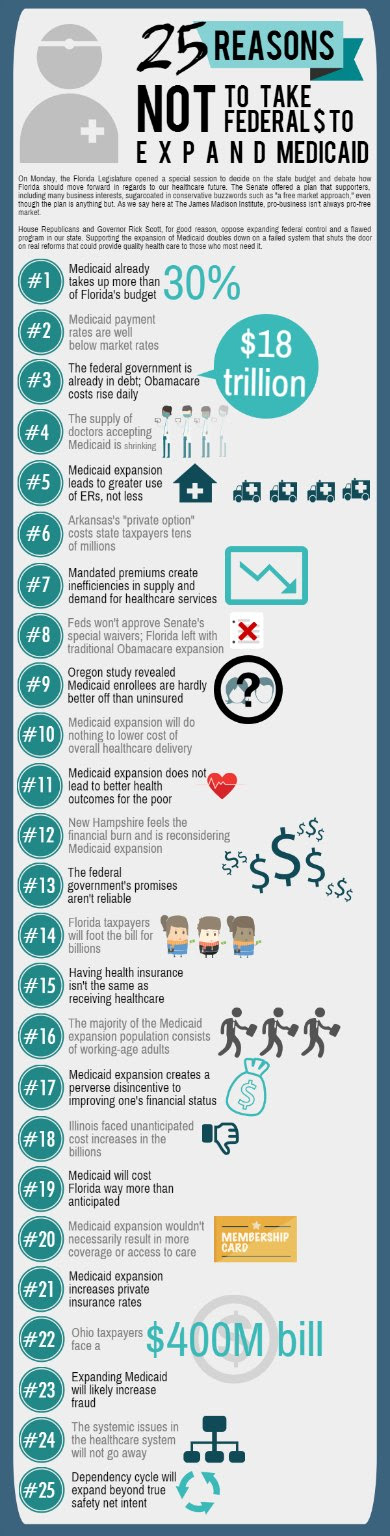
FLORIDA: 25 Reasons NOT to Take Federal Dollars to Expand Medicaid

Monday, The Florida Legislature opened a special session to decide on the state budget and debate how Florida should move forward in regards to our healthcare future. The Senate offered a plan that supporters, including many business interests, sugarcoated in conservative buzzwords such as “a free market approach,” even though the plan is anything but. As we say here at The James Madison Institute, pro-business isn’t always pro-free market. House Republicans and Governor Rick Scott, for good reason, oppose expanding federal control and a flawed program in our state. The Senate approved its plan Wednesday and the House is set to debate the bill today and vote on it this Friday [May 5th].

The Tampa Bay Times recently released an editorial giving 25 reasons Florida should take the money and encouraging Floridians to “tell (lawmakers) to listen to the powerful moral and financial arguments for taking the money and providing access to affordable health care.” Yes, there is a powerful moral and financial argument to be made. Yes, solutions exist to provide access to affordable healthcare. No, the Times does not have the right answers for either.

As Forbes opinion editor, senior fellow at the Manhattan Institute for Policy Research, and friend of JMI, Avik Roy points out, “Progressives have long enjoyed wielding the straw man. “If you oppose expanding Medicaid,” they say, ‘you oppose health care for the poor. Plain and simple.’ But the truth is, if you support expanding Medicaid, you’re doubling down on a failed system, one that shuts the door on real reforms that could provide quality health care to those who most need it.”

The James Madison Institute offers “25 Reasons NOT to Take Federal

Dollars to Expand Medicaid.” Share our infographic today and tomorrow through social media. RT on Twitter here. Share through Facebook here. Find on our website here.

  1. Medicaid already takes up more than 30% of Florida’s budget: Currently, Medicaid takes up more than 30 percent of Florida’s budget and crowds out other public priorities such as education, public safety and infrastructure.
  2. Medicaid payment rates are well below market rates:Payments to healthcare providers under Medicaid are well below market rates. Exasperating this system would be anathema to free-market reforms in healthcare.
  3. The federal government is already $18 trillion in debt; Obamacare costs rise daily:The federal government is $18 TRILLION in debt with the cost of Obamacare rising daily, requiring even more money from taxpayers to feed the beast.
  4. The supply of doctors accepting Medicaid is shrinking: As a consequence of federal Medicaid price controls, the supply of doctors that will accept Medicaid patients is shrinking — this shrinkage will become more rapid under an expansion of Medicaid.
  5. Medicaid expansion leads to greater use of ERs, not less: A March 2015 survey of 2,098 emergency-room doctors showed Medicaid recipients newly insured under the health law are struggling to get appointments or find doctors who will accept their coverage, and consequently wind up in the ER.
  6. Arkansas’s “private option” costs state taxpayers tens of millions: Medicaid expansion is not working in Arkansas. The Arkansas legislature passed a “private option” healthcare plan similar to what the Senate in Florida is proposing and the price tag is rising by the month under Obamacare’s Medicaid expansion and state taxpayers will now have to pay tens of millions to cover the unexpected costs. The proposed plan in Florida could cost far more than projections indicate.
  7. Mandated premiums create inefficiencies in supply and demand for healthcare services: When premiums for healthcare plan participants are mandated and set by legislative action, it is nothing more than market distorting price controls, which ultimately create inefficiencies in the supply and demand for healthcare services
  8. Feds won’t approve Senate’s special waivers; Florida left with traditional Obamacare expansion: The Senate’s plan includes a requirement that enrollees work, attend classes or prove they are seeking work in order to maintain eligibility for healthcare coverage. However, to date the federal government has rejected all state-run expansion plans with a work requirement. They will deny this special waiver and we’ll be left with traditional Medicaid expansion.
  9. Oregon study revealed Medicaid enrollees hardly better off than uninsured: Medicaid expansion is not working in Oregon. In Oregon, a study was conducted among Medicaid enrollees that found Medicaid “generated no significant improvements in measured physical health outcomes.”
  10. Medicaid Expansion will do nothing to lower cost of overall healthcare delivery: Medicaid expansion would not lead to any type of price transparency in healthcare delivery, which does nothing to help lower the cost of healthcare delivery.
  11. Medicaid expansion does not lead to better health outcomes for the poor: Research consistently shows Medicaid patients frequently receive inferior medical treatment, are assigned to less-skilled surgeons, receive poorer postoperative instructions, and often suffer worse outcomes for identical procedures than similar patients both with and without health insurance.
  12. New Hampshire feels the financial burn and is reconsidering Medicaid expansion: Medicaid expansion is not working in New Hampshire. According to the National Association of State Budget Officers’ annual report, in New Hampshire Medicaid grew from 24 percent of the overall state budget in 2012 to 27 percent in 2014. In January 2015, the state’s Department of Health and Human Services announced that it was $82 million over budget, thanks to Obamacare, Medicaid expansion and to the original Medicaid program expanding with additional enrollees. Lawmakers are now deciding whether to continue the expanded Medicaid program which sunsets in 2016.
  13. The federal government’s promises aren’t reliable: The U.S. Supreme Court told the federal government mandating Medicaid expansion was unconstitutional. However, they admitted this year that if Florida didn’t expand Medicaid under Obamacare, they would not be incentivized to continue the Low Income Pool funding. If they would pull funding from some of the most vulnerable in the system, what wouldn’t they do?
  14. Florida taxpayers will foot the bill for billions: Florida taxpayers will be responsible for a tab of billions of dollars as the federal government requires increasing shares from Florida’s budget after a certain point if the state expands Medicaid under Obamacare. Even if the federal government keeps its “promise” on the funding percentage, Florida taxpayers will be responsible for 10 percent of the total cost of expansion, a tab that will run into the billions based on even the most conservative estimates.
  15. Having health insurance isn’t the same as receiving healthcare:Medicaid is socialized health insurance, not access to healthcare. There is no guarantee that just receiving socialized insurance means an individual receives quality service.
  16. The majority of the Medicaid expansion population consists of working-age adults: The overwhelming majority of the Medicaid expansion pool are made up of childless, able-bodied, working-age adults. Expanding a failing entitlement program for this population will only lock people into the cycle of dependence.
  17. Medicaid expansion creates a perverse disincentive to improving one’s financial status: In many cases, making just a few more dollars per year will actually cost a person thousands in copayments, deductibles, and out-of-pocket expenses resulting in being pushed out of Medicaid rolls.
  18. Illinois faced unanticipated cost increases in the billions:Medicaid expansion isn’t working in Illinois. Forbes’s Akash Chougule reports, “Health officials originally estimated it would cost $573 million from 2017 through 2020 when the state’s funding obligation kicked in. But nearly 200,000 more people enrolled in the program in 2014 than originally projected. State budget officials were forced to revise their cost estimates to $2 billion—more than triple initial estimates.”
  19. Medicaid will cost Florida way more than anticipated: The cost projections for a Medicaid expansion in Florida are unreliable and grossly underestimated. Several states are experiencing the financial strain of Medicaid enrollment figures well higher than initial projections.
  20. Medicaid expansion wouldn’t necessarily result in more coverage or access to care: Florida’s own Medicaid director stated that he couldn’t guarantee the expansion would result in more coverage or access to care.
  21. Medicaid expansion increases private insurance rates: Expanding Medicaid rolls will inevitably distort the risk pool causing private insurance premiums to rise, effectively shifting more of the cost of expansion onto taxpayers and those not receiving Medicaid benefits.
  22. Ohio taxpayers face a $400 million bill: Medicaid expansion isn’t working in Ohio. Ohio’s Medicaid expansion is expected to be nearly $1 billion over budget in June. With Ohio on the hook for 10 percent of the expansion’s cost by 2020 (if the federal government keeps its promise) that will result in an annual cost of over $400 million for Ohio taxpayers.
  23. Expanding Medicaid will likely increase fraud: Medicaid expansion will increase the amount of fraud and abuse within an already strained government program
  24. The systemic issues in the healthcare system will not go away:Expanding Medicaid does absolutely NOTHING to address systemic issues facing Florida’s healthcare system that impact everyone.
  25. Dependency cycle will expand beyond true safety net intent: 
    The idea behind the safety net programs has always been to serve individuals in need, while providing mechanisms to pull out of dependence into productivity, not to create generations of citizens who know nothing except government reliance. By expanding Medicaid to populations that are outside the typical safety net composition, we effectively enlarge and encourage the cycle of dependency to grow and become more ingrained in our culture.

Texas and Kansas File Amicus Briefs Supporting Florida’s Lawsuit Against Expansion Of Obamacare

AUSTIN – Governor Greg Abbott today filed an amicus brief in support of Governor Rick Scott and the State of Florida’s lawsuit against the Obama administration’s unlawful attempt to coerce the State of Florida into a massive expansion of Medicaid under the Affordable Care Act. Governor Abbott released the following statement:

“The federal government has overstepped its constitutional authority and ignored the Supreme Court’s decision in NFIB v. Sebelius, where the Court held that Congress could not coerce States into accepting a massive expansion of an already broken and bloated Medicaid program. The State of Texas will exercise its constitutional right to refuse Medicaid expansion, and we support the State of Florida’s effort to do the same.”

“[The Department of Health and Human Services (HHS)] has threatened to withhold from Florida billions of dollars in Medicaid payments, and it has issued similar threats to Texas, Kansas, and others,” wrote Governor Abbott in the amicus brief. “These threats are surely just the beginning of a nationwide campaign to hold hostage federal waiver dollars in those States who are standing firm on their constitutional right to refuse the new Medicaid.

“No litigant should be put to the choice of surrendering its day in court against an agency that is violating the constitution, or facing unjustifiable retaliation by the same agency in the future. HHS’s public reasons for harassing Florida do not withstand scrutiny. The agency picked this fight with Florida in an unlawful attempt to isolate, intimidate, and coerce, [and] the court should grant Florida’s request for declaratory and injunctive relief.”

To view the amicus brief in its entirety, click here.