Tag Archive for: smoking

‘A Devastating Impact’: Harris’s Silence On Key Biden Policy Leaves American Farmers In The Lurch

American farmers are still waiting for answers from Vice President Kamala Harris on a Biden administration policy that could have detrimental effects to their livelihood.

President Joe Biden’s administration was set to ban menthol cigarettes just before April 2024, until concerns arose that such a move could have negative political implications. The administration has since paused progress on the ban, though the Food and Drug Administration’s (FDA) top tobacco official has indicated that they are still planning to implement the rule. While Harris has not clarified where she stands on the issue, tobacco farmers in North Carolina, who the Daily Caller spoke to, are worried about what could happen to their farms if the vice president goes through with the ban.

“It would destroy one of North Carolina’s biggest industries and destroy thousands of American jobs and businesses. It would have a devastating impact on many hard-working families not only in North Carolina but in other states too,” Linwood Vick, a tobacco farmer in North Carolina told the Caller.

“President Biden and VP Harris have put us in limbo for years with this proposed ban, and now, as the Democratic presidential candidate, she hasn’t said a word about it. I’m frustrated by the political games, and I’m worried about our family’s business, the many people this industry employs, and what the future of North Carolina would look like if a menthol ban was put in place,” Vick continued.

Though Harris has not clarified her position on a menthol ban since becoming the Democratic presidential nominee, the vice president has previously shown support for one. As California Attorney General in 2013, Harris signed onto a letter to the FDA pressing them to ban e-cigarettes. In 2018, while a U.S. senator, Harris co-signed a letter urging the FDA director to move forward with a ban on flavored tobacco products and menthol.

“A lot of farmers are worried that [a Harris] administration will try and push something like this, and if it does, if it is passed, a lot of farmers have said that they would just quit farming altogether, because tobacco is really the only thing that keeps them alive when in our area,” Archie Griffin, a third-generation tobacco farmer in North Carolina, told the Caller.

Aside from losing their jobs completely, Ray Sterling, general counsel of the North Carolina Chamber of Commerce, told the Caller that such a ban, or lack of clarity on one, is on farmers’ minds as they prepare for the next crop season.

“[A farmer] has to make planting decisions and reserve fertilizer and buy supplies many times in December prior to the next crop year. And so as we’re entering fall, many farmers are starting to think about what they’re going to grow next year. This could have a massive impact on demand, if nothing else, it could be disruptive. It could make everybody play wait and see,” Sterling explained.

“Farmers are no different than any other business owner. They crave reliability and certainty and  predictability. That’s missing here,” he added.

Within North Carolina, 822 tobacco farms produce $36 billion of output and add $31 billion to state GDP, according to the John Locke Foundation. Those farms employ around 5,000 workers for about $370 million.

Produce wholesale in North Carolina provides $15.3 billion in revenue, contributes $9 billion to the state GDP and keeps 4,500 people employed, the John Locke Foundation reported.

As the numbers show, and as Griffin explained to the Caller, the impact of tobacco farms in the state goes beyond the industry.

“It goes into affecting an economic impact on taxes, farmers, the tobacco industry and a manufacturing impact. Just a quick idea, it’s estimated that the menthol industry, data shows, is valued at 39 billion each year. If a menthol ban was placed on those products, those consumers aren’t going to just stop smoking altogether or stop consuming those products there,” Griffin explained.

“They’re going to switch to alternatives or start putting menthol in themselves. If they can’t get that menthol product, the consumers are going to go to illicit trade products that are either smuggled in here, and when they go to that product, the government’s looking at a loss of of revenue,” he added.

Former President Donald Trump and Harris are locked in a tight race in North Carolina. According to a Washington Post poll, 50% of the state’s voters support Trump and 48% back Harris. The poll has a margin of error of 3.5 percentage points and surveyed 1,001 North Carolinians.

And with 16 electoral votes on the line in North Carolina, the farmers told the Caller that the impacts of a potential menthol ban are being considered by voters.

“I will tell you people are paying attention, and I think there’s reason for that,” Sterling told the Caller. “I could just tell you, ‘yes this is going to matter,’ but let me tell you why. Particularly in the agriculture community today, they really have their backs up against the wall for all that we’ve seen with regard to inflation, particularly of food prices. None of that increase has made its way down to the farm.”

When the administration was considering the rule in October 2023, retired law enforcement professionals and GOP strategists told the Caller that it could cost Biden big with black voters.

Acting FDA Commissioner Janet Woodcock said in 2021 that such a rule would “address health disparities experienced by communities of color, low-income populations and LGBTQ+ individuals, all of whom are far more likely to use these tobacco products.” Health experts contend that a ban is needed because menthol cigarettes disproportionately harm black Americans, and a ban could save a significant number of lives.

The Biden-Harris administration’s proposal of the rule used euphemisms to indicate it was aimed at leveling health outcomes between racial groups, noting that the rule would “reduce tobacco-related health disparities and advance health equity.”

“The black community and the Latino community, I think [the Biden-Harris campaign] runs the risk of losing votes from there because I think primarily what it is, is a similar scenario to the 1980s crime bill, and just not paying attention to what can potentially happen,” Maj. Neill Franklin, a retired law enforcement veteran of the Maryland State Police and Baltimore Police Department, told the Caller in 2023.

“These are adults, black adults, that are not happy with this policy. Why are you taking their ability away from them to use menthol cigarettes? It’s clear that this is focused upon the black community and these are adults who know the dangers of smoking, but yet, why is the government trying to be their parent?” he added.

With the race neck-and-neck, Harris has faced questions about her policy proposals and flip-flopping. On some topics, the Harris campaign is completely silent on where the vice president stands.

The Harris campaign did not respond to the Daily Caller’s inquiry on where the vice president stands on a menthol ban and if she would propose one if elected in November. The vice president did recently say that she could not think of anything that she would do differently from President Biden’s past four years. 

“I think it affects the tobacco states because you’re going right at the heartland,” Rich Marianos, former Assistant Director of the U.S. Bureau of Alcohol, Tobacco, Firearms and Explosives, told the Caller. “You’re going at an industry that makes money for the states, especially you bring in Kentucky, you bring in Virginia, you bring in North Carolina. Tobacco farmers since the history of this country have been a big part of the fabric of community. Taking away a large percentage of that product and taking away their ability to farm that is going to have domino effects.”

AUTHOR

Reagan Reese

White House Correspondent. Follow Reagan on Twitter.

RELATED ARTICLES:

‘Very, Very Significant’: A Quiet New Move Could Spell Disaster For Biden With Black Voters

Harris Tells ‘The View’ There’s Not A Thing She Would’ve Done Different Than Joe Biden

EDITORS NOTE: This Daily Caller column is republished with permission. ©All rights reserved.

Well, Back to Smoking: FDA Bans 99 Percent of E-Cigarettes by Guy Bentley

The Food and Drug Administration (FDA) published long-awaited rules Thursday that could ban 99 percent of e-cigarette products and wreck industry innovation for years to come.

Passed in 2009, the Tobacco Control Act says all e-cigarette products released after February 15, 2007, (predicate date) will have to go through the Pre-Market Tobacco Applications process (PMTA). FDA officials claim they cannot change the predicate date.

The PMTA is ruinously expensive and can cost millions of dollars per product and by the FDA’s own admission will take more than 1,700 hours for an applicant to complete.

Since almost all vapor products on the market were released after February 2007, hardly any will avoid a PMTA and almost no businesses, with the exception of big tobacco companies, will be able to bear the regulatory burden.

“The agency’s economic analysis of the rule predicts that the cost of such approvals will be so high that approximately 99 percent of products on the market will not even be put through the application process,” says the American Vaping Association (AVA).

The rules usher in a new era of federal regulation, with sales of vapor products to those under the age of 18 banned nationwide. Most states had already passed laws banning e-cigarette sales to minors.

“This final rule is a foundational step that enables the FDA to regulate products young people were using at alarming rates, like e-cigarettes, cigars and hookah tobacco, that had gone largely unregulated,” Mitch Zeller, director of the FDA’s Center for Tobacco Products, said in a press release. The FDA will now set industry standards for manufacturing and labeling. The rules will take effect in 90 days.

But there is still hope for the industry yet after a House Appropriations committee passed an amendment April 19, which would alter the predicate date. The amendment is not yet law and will have to pass through the House of Representatives.

If the amendment fails however and the FDA regulations stand, the industry will have two years to comply with the PMTA.

“Despite an overabundance of distorted and misleading information propagated by some in the public health community, the science is clear – responsibly manufactured vapor products are not only a safer alternative to traditional combustible products, but also provide smokers with a viable path to reducing their tobacco consumption and quitting altogether,” said Tony Abboud, the Vapor Technology Association’s National Legislative Director.

“Today’s action by the FDA will do nothing to improve our nations’ public health objectives. To the contrary, today’s action will yank responsibly manufactured vapor products from the hands of adult smokers and replace them with the tobacco cigarettes they had been trying to give up.”

The VTA argue the FDA’s rules will kill almost a decade of innovation in the e-cigarette space and put thousands of small and mid-size businesses out of businesses to the benefit of major tobacco companies.

“If, in the name of public health, federal regulations inhibit much-needed innovation in the e-cigarette market, public health would actually suffer, as fewer adult smokers would be likely to switch from smoking,” said the National Center for Public Policy Research’s director of Risk Analysis, Jeff Stier.

“One only needs to look at the rapid innovation coming from the vaping industry to see how devastating this rule will be,” Jared Meyer, Fellow at the Manhattan Institute, told The Daily Caller News Foundation in an emailed statement.

“While large tobacco companies will likely be able to absorb these costs, countless small manufacturers will be put out of business – leading to a less dynamic market. Without continued innovation, it will be harder from cigarette smokers to kick their deadly habit by taking up a much less harmful form of nicotine consumption,” Meyer added.

According to Wells Fargo, e-cigarette sales amounted to $3.5 billion in 2015. The case for wide-spread e-cigarette use was given a boost April 27 after the Royal College of Physicians published a 200-page report supporting the products as a smoking cessation method.

Reprinted with permission  from the Daily Caller News Foundation.

Guy BentleyGuy Bentley

Guy Bentley is a reporter for the Daily Caller.
Tobacco Use Decreased by 64% among High School Students Since 1997 while Marijuana Use Doubled

A new report from the Centers for Disease Control and Prevention (CDC) analyzes tobacco and marijuana use among white, African American, and Hispanic students in grades 9 through 12 from 1997 to 2013. The data come from CDC’s Youth Risk Behavior Surveys (YRBS) conducted every two years.

The good news is that student use of cigarettes and cigars has declined 64 percent, from 20.5 percent in 1997 to 7.4 percent in 2013. The bad news is that marijuana use more than doubled during that time, from 4.2 percent to 10.2 percent.

Further, marijuana use among students who also used cigarettes or cigars increased from 51.2 percent to 62.4 percent over that time, with even higher increases towards the end of the study period among African American and Hispanic students.

The use of marijuana among those who used cigarettes or cigars did not change among Hispanic students from 1997 to 2007, but then escalated from 54.9 percent to 73.6 percent in 2013. African American students’ marijuana use among those who used cigarettes and cigars held steady until 2009, but increased even further, from 66.4 percent then to 82 percent in 2013.

When tobacco and marijuana are used together, the likelihood of harm to individuals, including cognitive, psychological, respiratory, and addiction problems, also increases.

The substantial 64 percent decline in cigarette and cigar use among students took place as the result of evidence-based strategies such as increasing tobacco product prices, adopting comprehensive smoke-free policies, and conducting national public education media campaigns.

Read “Cigarette, Cigar, and Marijuana Use Among High School Students—United States—1997-2013” here.

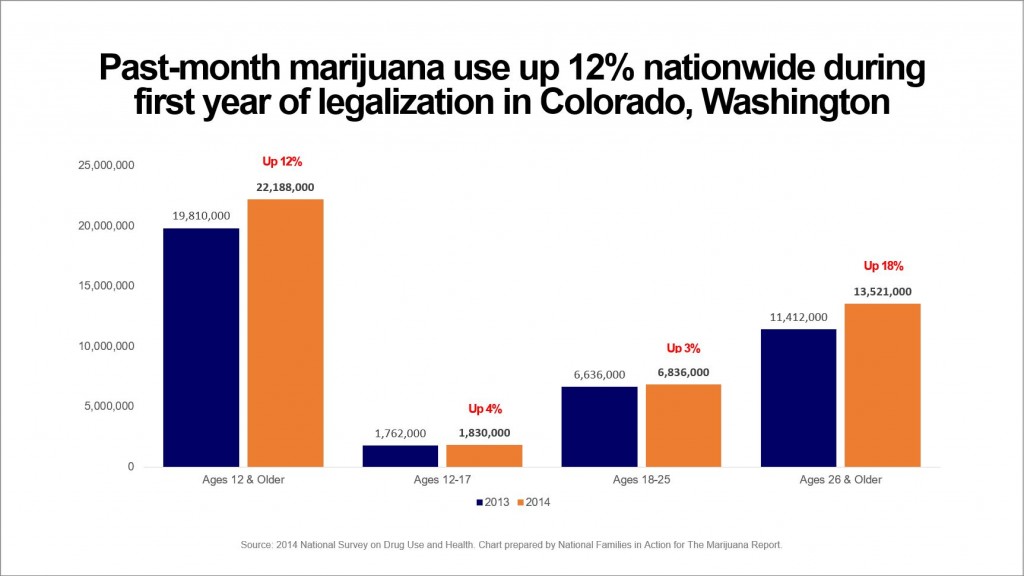
Marijuana use up 12% nationwide during first year of legalization in Colorado, Washington

The 2014 National Survey on Drug Use and Health, released yesterday, shows regular marijuana use among Americans ages 12 and older jumped 12 percent nationwide during the first year legalization was implemented in Colorado and Washington. Regular use increased among all ages: click here or on image above to see increases among ages 12-17, ages 18-25, and ages 26 & older.

Better-Landscape-Photo-1024x576