Tag Archive for: South Korea

U.S. Allies near China on Edge as Weapons Shift from Asia to Iran

WASHINGTON – When the US pulled its only aircraft carrier based in Asia to support the military surge in Afghanistan back in 2010, allies in the region had little concern that China or North Korea might look to take advantage.

Today things are different.

As the US continues to pour weapons into the Middle East for military operations against Iran, current and former defence officials in Asia are growing concerned that more American firepower will be shifted over time if the war drags on.

And even if fighting wraps up soon, they warned that depleted stockpiles of munitions could also take years to replace, leaving Taiwan and other places vulnerable.

In a cabinet meeting this week, South Korean President Lee Jae Myung confirmed the US may need to relocate air defence assets to the Middle East and subsequent reports said that multiple launchers of the Terminal High Altitude Area Defence, or THAAD, system were spotted moving out of a southern base.

While downplaying the risk, calling Seoul’s capabilities “undeniably overwhelming”, Mr Lee also said he opposed the Trump administration’s decision but couldn’t “impose our position” on the US.

“Anytime that we’re pulling air and missile defences out of theater, that’s going to create obvious concerns,” said Mr Lindsey Ford, who previously served as deputy assistant secretary of defence for South and Southeast Asia during the Biden administration. “They are not only critically important, but I think they give countries a sense of reassurance.”

The rapid pace of China’s military build-up over the last two decades, as well as North Korea’s development of advanced missiles, mean the stakes have become much higher in East Asia.

The US has already deployed around one-third of its naval surface fleet to the Middle East, and other essential parts of the military logistics chain such as aerial refueling aircraft and supply ships are heavily concentrated near Iran.

Asked for comment, a Pentagon official said the department doesn’t discuss movement or disposition of specific weapons systems. But the Pentagon is managing its global responsibilities while making sure US forces remain capable of deterring any aggression in the Indo-Pacific, the official said.

At the moment, China has given little indication it’s looking to ramp up tensions with Taiwan, calling for an urgent ceasefire in the Middle East while dialing back pressure on the island’s air defences. Still, the war in Iran has some in Taipei nervous.

US military assets and resources “cannot be deployed in two places at the same time,” Mr Chen Kuan-ting, a Taiwanese lawmaker and member of the Foreign Affairs and National Defence Committee of the legislature, said in an interview. “Deploying the main military assets in Asia and confronting the US’s primary competitor here is more in line with US interests.”

US officials have sought to downplay any worries about munitions or a spread of the war to other parts of the globe, even as the rhetoric ramps up on both sides.

Defence Secretary Pete Hegseth told reporters earlier this month that he had no message for China or Russia, saying “our issue is not with them”.

Despite the war, US President Donald Trump is still planning to head to Beijing in a few weeks for a summit with Chinese leader Xi Jinping.

“The US military in Trump 2.0 has again been distracted by the Middle East, but as long as the status quo in the Taiwan Strait remains unchanged, Beijing is unlikely to act,” said Mr James Char, an assistant professor at Nanyang Technological University. “Some probing on the margins is possible” in the form of grey zone operations, he added.

At a Senate hearing last week, Mr Elbridge Colby, US undersecretary of defence for policy, said top American officials were focused on “very close alignment with our allies and partners” in the Indo-Pacific region. He noted his first call after the attack on Iran was to the defence minister of the Philippines.

“We are laser-focused on the First Island Chain,” Mr Colby said, a term that refers primarily to Japan, the Philippines and Taiwan.
A military official from the Philippines, who requested anonymity because he’s not authorized to speak publicly, said the nation had no concern about its alliance with the US due to the war in Iran.

Annual exercises are still planned with the US military next month, which typically include training to defend Filipino islands near Taiwan, the official added.

Still, some strategic thinkers in the region see little scope to dial back the US military presence in East Asia without affecting the balance of power.

China continues to build and deploy military equipment at a rapid rate, including a much faster pace of ship production than the US. At least two US destroyers based in Japan have been deployed to take part in Iran strikes, according to US military photos.
Mr Rommel Ong, a retired rear admiral in the Philippine Navy, said the current level of US naval presence was needed to “prevent China from 100 per cent sea control of the South China Sea.”

“Right now, even without the situation in Iran, the Chinese maritime forces in East Asia enjoy numerical advantage,” he said.

It’s not unusual for the US to move weaponry around the world. In 2025, Patriot air defence systems were moved from South Korea to Qatar ahead of the US-Israeli attack on Iran’s nuclear sites.

They were returned after a few months.

So far, the war in Iran has been almost exclusively an air campaign, making it different to prior conflicts. But if it expands it could draw in other parts of the US military, such as Marine Corps battalions from Japan that were sent to Afghanistan.

During previous conflicts in the Middle East, the US military deployed a range of capabilities from East Asia, including the aircraft carrier USS George Washington from Japan for a few months during the surge period of the Afghanistan campaign.

“If major US military assets like the USS George Washington aircraft carrier in Japan were moved to the Middle East, it would be problematic for readiness in the Indo-Pacific,” said Mr Hirohito Ogi, a former Japanese Defence Ministry official, adding that he thought it was an unlikely scenario.

A more immediate concern, he said, is the depletion of missiles such as Patriot interceptors. It takes a long time to make them, meaning it could take years to return to fully replenish inventories. “That could have a serious impact on readiness in the Indo-Pacific region, including the defence of Taiwan,” Mr Ogi said.

The Payne Institute, a public research institute in Colorado, estimates that more than 300 Patriot and other interceptors were used by US defence systems in the first 36 hours of the Iran war, and a further 280 used by Gulf countries.

Details about missile stockpiles aren’t publicly available, but Lockheed Martin makes around 620 Patriot missiles a year.

“We’re seeing the results now of a ‘just in time’ approach to equipping and manning the military, based on the assumption that we’d never fight a major war again – much less two of them at once,” said Mr Grant Newsham, a former US Marine Corps colonel and liaison officer to the Japanese military.

That’s a problem for Asia, which still relies on the US as the main deterrent against China. Countries in the region need to do more to ensure they have their own resources and “won’t necessarily be dependent on the US” if there’s a crisis in the region, according to Mr Ford, the former US defence official.

“We’ve all seen this dance before,” she said. “But I do think that it creates a lot of questions for Asian allies about what they need to do regarding their own sovereign capabilities.”

Of particular note was the reported redeployment of parts of the THAAD air defence system from South Korea, said Mr John Delury, a senior fellow at the Asia Society. Both China and North Korea strongly objected to its installation in South Korea in 2017.

“It’s hard to overstate the irony of THAAD, a symbol of the pivot to Asia, being removed in the dead of night for a new war in the Middle East,” Mr Delury said.

Originally published by The Straits Times

AUTHOR

Grant Newsham

Senior Fellow

EDITORS NOTE: This Center for Security Policy column is republished with permission. ©All rights reserved.

S. Korea’s Crucial June 3 Election: Could The U.S. Lose South Korea To Communist China?

China | MEMRI Daily Brief No. 781

On June 3, 2025, South Korea heads to the polls for the snap presidential elections, triggered by the impeachment of pro-U.S. conservative president Yoon Suk-yeol, who pursued economic decoupling from China.[1]

David Eunkoo Kim To FOX News: This Election Is Widely Seen As A Pivotal Moment For South Korea

On June 1, 2025, David Eunkoo Kim, founder and representative of Truth Forum, a conservative youth organization founded at Seoul National University, gave an interview to FOX news about the crucial upcoming elections in South Korea.

David Eunkoo Kim, who works with MEMRI (See MEMRI Daily Brief No. 772, South Korea’s Democrats, Crisis, And What The U.S. Must Know, by David Eunkoo Kim, May 16, 2025) said to FOX news: “This election is widely seen as a pivotal moment for South Korea because the stakes – both domestically and geopolitically – are extraordinarily high.”[2]

Then, commenting about Lee Jae-myung, current Democratic Party of Korea (DPK) candidate at the June 3 presidential elections, David Eunkoo Kim added: “Throughout his political career, [Lee] has consistently aligned himself with both pro-North Korean and pro-Chinese agendas. He has been implicated in sending funds to North Korea in violation of U.N. sanctions, and his deference to China has been nothing short of submissive.”

(See MEMRI Daily Brief No. 772, South Korea’s Democrats, Crisis, And What The U.S. Must Know, by David Eunkoo Kim, May 16, 2025)

David Eunkoo Kim In The New York Sun: “The Leftist DPK Presidential Candidate Lee Jae-Myung Actively Advocates For Improving Relations With China”

In a recent article to the New York Sun, David Eunkoo Kim stressed: “The leftist DPK presidential candidate Lee Jae-myung actively advocates for improving relations with China and criticized the ‘inequality’ of the U.S.-South Korea alliance, making him a prominent pro-China politician. Lee advocates for ‘autonomous and balanced diplomacy centered on national interests.’ He even mentioned that, if elected, he would cancel the THAAD (American anti-ballistic missile defense system) deployment and take wartime operational control of South Korean forces. Lee embraces a dangerous revisionist interpretation of Korean history – one that casts doubt on the very legitimacy of the Republic itself, absolves the violent legacy of communism, and promotes anti-American resentment.”[3]

David Eunkoo Kim then added: “The DPK’s embrace of revisionist history has translated into real-world deference to authoritarian regimes, most notably China.”

REFERENCES:

[2] Foxnews.com/world/south-korea-faces-high-stakes-election-fears-over-china-north-korea-us-ties-shape-voter-concerns, June 1, 2025.

[3] Nysun.com/article/could-america-lose-south-korea-to-communist-china, May 25, 2025.

EDITORS NOTE: This MEMRI column is republished with permission. ©All rights reserved.

South Korea’s Democrats, Crisis, And What The U.S. Must Know

China | MEMRI Daily Brief No. 772

South Korea stands at a critical political crossroads. The impeachment of President Yoon Suk-yeol has triggered a snap presidential election, now just weeks away. What is at stake is more than the outcome of a vote. This election could decide the future direction of South Korea’s democracy, its institutional integrity, and its strategic alignment with the United States.

The moment is grave. Interpretations vary widely along ideological lines. But for those alarmed by China’s expanding influence, the ideological drift of South Korea’s Democratic Party under the sway of postmodernism and Marxism, and the post-pandemic legacy of coercive public health mandates, the stakes are especially high. Many South Koreans who hold conservative views – rooted in a Judeo-Christian worldview – find themselves sidelined by domestic media and mischaracterized abroad. Their voices must now be heard – and understood.

Freedom Forged In Blood

South Korea owes its existence as a free nation to the United States. During the Korean War, 36,574 American lives were lost in defense of Korea’s freedom. They bled not as Republicans or Democrats, but as guardians of liberty. Their sacrifice laid the foundation for the Republic of Korea’s democracy and postwar transformation.

The values that shaped the United States – liberty, truth, and faith – also shaped the founding of modern Korea. Under President Syngman Rhee and the Christian leaders of his time, those principles were carried across the Pacific and embedded in our national identity. Korea’s remarkable rise from the ashes of war would not have been possible without the blood, commitment, and leadership of America.

That is why, during the most recent U.S. presidential election, the organization I lead – Truth Forum – supported for the election of Donald Trump. It was not about party politics. It was about restoring a nation founded on moral clarity and biblical truth. A strong and free America is not just in America’s interest – it is vital to ours.

Korea’s future is deeply tied to America’s direction. As we now approach a critical election of our own, following the impeachment of President Yoon Suk-yeol, our nation stands at a crossroads. The path ahead will determine whether we remain free – or fall to ideological subversion. In this decisive moment, we do not ask for sympathy. We ask for clear understanding – and for prayer.

A Mirror Of America – And A War Over Memory

South Korea was born in the image of America – built on the same biblical worldview that inspired the U.S. Constitution and the founding principles of liberty, law, and faith. But like the United States, South Korea is now locked in an ideological crisis.

Postmodernism, cultural Marxism, and atheistic progressivism have penetrated the nation’s core institutions: schools, universities, media, courts, and even churches. These ideas have found political shelter within the Democratic Party, mirroring trends on the American left. The results are strikingly similar – truth replaced by narrative, and identity distorted by ideology.

At the heart of this ideological subversion is a calculated revision of history. In the U.S., progressives have recast the founding as a project of oppression, built on slavery and colonialism. In South Korea, the left promotes a parallel fiction: that the Republic of Korea was not a sovereign act of national will, but a betrayal – engineered by pro-Japanese collaborators and propped up by American imperialism.

This narrative does not stop at national shame. It assigns moral legitimacy to North Korea, portraying the regime as the “true Korea,” supposedly forged in resistance against foreign domination. Never mind Pyongyang’s record of tyranny, famine, and forced labor – the myth of anti-imperialist purity prevails.

These distorted narratives function as political weapons. By undermining the Republic’s moral foundation, they sow anti-Americanism and pave the way for sympathy toward Communist China. In this upside-down worldview, China is no longer seen as a threat – but as a model of post-Western order. That illusion is not only false – it is dangerous.

This war over history is not a sidebar to politics. It is the front line. It shapes how nations understand themselves, choose their alliances, and decide their futures. For South Korea – and for the U.S.-ROK alliance – the outcome of this battle will determine whether truth or falsehood writes the next chapter.

Distorting The Past: How Historical Revisionism Fuels Political Power

South Korea’s Democratic Party, under the leadership of Lee Jae-myung, has embraced a dangerous revisionist interpretation of Korean history – one that casts doubt on the very legitimacy of the Republic itself.

In 2023, Lee appointed Lee Rae-kyung – an ideologue affiliated with the “Another Centennial” Foundation – as head of the party’s Innovation Committee. Lee’s theory claims that the last 100 years of Korean history, beginning with the 1919 March First Movement, represent an era of foreign domination, imposed particularly by the United States. In his view, Korea’s founding was not liberation – but subjugation. He calls for a new national narrative, unburdened by ties to the West.

This narrative has not remained on the fringes. Former progressive presidents echoed similar views. In 2003, Roh Moo-hyun stated that Korean history was defined by the “defeat of justice” and the “rise of opportunism.” In his autobiography, Moon Jae-in described his sense of elation upon witnessing America’s retreat from Vietnam, which he regarded as a realization of historical justice.

At the center of this narrative war is the reinterpretation of the 1948 Jeju April 3 Incident. What was originally a violent communist uprising intended to derail South Korea’s first democratic elections is now widely portrayed in global discourse as a state-sponsored massacre of civilians. UNESCO’s recent decision in April to inscribe related documents into its “Memory of the World” register lends international legitimacy to this rebranding – while omitting the historical context of communist-led violence.

Acknowledging civilian casualties is necessary. But to erase the nature of the uprising – to deny that it was launched to prevent the creation of the Republic of Korea – is not just revisionism. It is a political weapon.

This is no longer a matter of domestic academic debate. It is a coordinated strategy to delegitimize South Korea’s founding, absolve the violent legacy of communism, and sow anti-American resentment. The result is a warped historical lens through which younger generations are taught to question the morality of their own nation’s birth.

The roots of this revisionist impulse run deep. Many within the Democratic Party are not only ideological heirs of the South Korean Workers’ Party but are connected to it by lineage. Former President Roh Moo-hyun’s father-in-law, Kwon Oh-seok, was a lifelong unrepentant communist and political prisoner. These are not mere coincidences – they reveal a clear line of ideological continuity from Korea’s radical past to its contemporary political elite.

If the United States and its allies fail to recognize how historical narratives are being weaponized to undermine the moral foundation of free societies, they will forfeit critical ground – not only in Korea, but across the broader fight for truth in the Indo-Pacific.

Strategic Blind Spots: How the Democratic Party Enabled China’s Reach

The Democratic Party’s embrace of revisionist history is not merely ideological – it has translated into real-world deference to authoritarian regimes, most notably China. Under President Moon Jae-in, Seoul announced the “Three No’s” policy in 2017: no additional THAAD missile deployments, no integration into a U.S.-led missile defense system, and no trilateral military alliance with the United States and Japan. In effect, the policy conceded strategic leverage to Beijing.

The consequences have been more than symbolic. In late 2024, South Korea’s Board of Audit and Inspection uncovered evidence that sensitive details about the THAAD deployment may have been leaked to China during Moon’s presidency. This revelation followed Moon’s 2017 pledge at Peking University to support China’s so-called “national dream” – a message that sent a clear signal of alignment rather than neutrality.

On the ground, the situation is even more alarming. Chinese nationals have repeatedly been caught photographing sensitive South Korean and U.S. military installations – ranging from U.S. Navy assets in Busan to the headquarters of South Korea’s intelligence agency. Yet under current law, espionage is defined exclusively in relation to the “enemy state,” which is North Korea. Efforts to revise the law to include other hostile foreign actors were blocked – and notably, by the Democratic Party.

As a result, those caught gathering intelligence for China face, at most, a fine or deportation. There is no real deterrent. Critics call it what it truly is: passive collusion.

This troubling pattern continues. While the United States intensifies efforts to combat Chinese fentanyl trafficking, South Korea’s Democratic Party has slashed narcotics investigation budgets and curtailed prosecutorial authority. The results are catastrophic: in just five years, teenage drug crimes have surged fourteenfold.

Meanwhile, Democratic Party leader Lee Jae-myung has signaled his intention to strengthen ties with Beijing. In a 2022 interview with Time magazine, he pledged greater cooperation with China if elected. When China’s ambassador to Seoul warned in 2023 that South Korea would “regret” siding with the United States, Lee offered no rebuttal – a silence some critics interpreted as tacit approval. Even before that, Chinese state-run outlets such as Global Times and CCTV had portrayed him as a friendly and reliable figure in South Korean politics – coverage that, in China’s tightly controlled media environment, is rarely incidental.

Around the world, democratic nations are waking up to the reality of China’s “united front” operations – covert campaigns to shape public opinion and co-opt foreign elites. Confucius Institutes, long exposed as soft power arms of the Chinese Communist Party, have been shut down across much of the West. In South Korea, however, they remain active – and some are reportedly expanding.

At Seoul National University – South Korea’s most prestigious academic institution – a “Xi Jinping Library” continues to operate despite widespread public opposition. It no longer serves as a neutral academic resource, but rather stands as a stark symbol of how deeply China has embedded itself in the nation’s intellectual and political landscape.

China’s ambition matters – but more concerning is South Korea’s vulnerability. If the United States and its allies ignore this creeping influence, they risk losing not just a partner – but the geopolitical anchor of democracy in Northeast Asia.

When Impeachment Aligns With Authoritarian Ambition

Whether the declaration of martial law was the right course remains debated. But what followed is beyond dispute: tens of thousands of young South Koreans – many previously disengaged from politics – took to the streets. Their outrage transcended partisanship. It stemmed from deepening concerns over unchecked legislative power, weaponized budget obstruction, growing doubts about election integrity, and clear signs of Chinese interference.

For China, Yoon represented an obstacle – resolutely pro-U.S. and openly critical of Beijing’s influence operations. For the Democratic Party, removing him was existential. A failed impeachment could have spelled collapse, especially with Lee facing intensifying corruption probes, including the high-profile Daejang-dong scandal.

The convergence of interests between South Korea’s progressive establishment and the Chinese Communist Party is no longer a matter of speculation. Reports indicate Chinese nationals took part in pro-impeachment rallies – raising urgent questions about foreign orchestration at the heart of Korea’s constitutional process.

This is not coincidence. It is coordination. It is what happens when internal political warfare intersects with the global ambitions of authoritarian regimes. Beijing wants South Korea out of America’s orbit. The Democratic Party wants to survive – at any cost. Their common adversary: President Yoon.

For U.S. policymakers, the lesson is clear and urgent. South Korea’s internal crisis is not just confined to its borders. It is a case study in how foreign adversaries can leverage democratic institutions against themselves. Unless the United States recognizes this alignment for what it is – a coordinated effort to undermine Indo-Pacific stability – it risks repeating the mistakes of the past.

A Sudden Pivot – Or Calculated Camouflage?

In a striking shift, South Korea’s Democratic Party – long criticized for its dovish stance toward Beijing – has begun to sound an unfamiliar tune. On January 21, the party introduced a resolution reaffirming support for the U.S.-ROK alliance. The timing was no accident. It coincided with rising global anticipation of a possible Trump administration return, and with South Korea’s own snap election looming.

Party leader Lee Jae-myung has followed suit. Once a champion of progressive economic policies, Lee is now signaling a retreat. He has signaled a willingness to abandon key progressive platforms, including the Democratic Party’s hallmark policy of universal basic income – once championed as a pillar of its socialist agenda. In meetings with U.S. and Japanese officials, Lee has gone so far as to emphasize the importance of trilateral cooperation with Washington and Tokyo, a line rarely heard from the party’s upper ranks.

To casual observers, these gestures might suggest an ideological realignment. But within South Korea, few are convinced. Even some within the Democratic Party have expressed unease over the abruptness and optics of this sudden shift.

However, this calculated camouflage seems working abroad. Not long ago, former U.S. House Speaker Newt Gingrich visited South Korea and addressed growing concerns in Washington about the Democratic Party’s pro-China leanings and far-left tendencies. In a post on his X account, he noted that despite these concerns, most South Koreans remain firmly supportive of the U.S.-ROK alliance – and that even if the Democratic Party wins the presidency, the alliance would likely endure.

His observation reflects a widely held reality in South Korea. The majority of South Koreans strongly value the alliance with the United States.

However, as the U.S.-China rivalry intensifies, it is critical to recognize the dangers posed by the Democratic Party’s distorted view of history and ideological foundations. If these are overlooked, the future of the U.S.-ROK alliance could face serious and lasting consequences. America’s allies must distinguish rhetoric from conviction – because the future of our shared security may depend on it.

Forecast And Response: South Korea’s Election At The Crossroads

South Korea stands on the edge of a consequential decision. The outcome of its upcoming presidential election will not only define the direction of its domestic politics but may also recalibrate the nation’s democratic framework and foreign policy orientation.

With the National Assembly firmly in the hands of the Democratic Party – widely criticized for its conciliatory stance toward Beijing – many Koreans fear that continued consolidation of power could tilt the country irreversibly toward strategic ambiguity. Some fear it could even lead to alignment with authoritarian regimes.

Amid this uncertainty, Kim Moon-soo has emerged as the conservative standard-bearer. Once a socialist labor activist, Kim renounced those beliefs following the collapse of the Soviet Union. He went on to serve three terms in the National Assembly, as Minister of Labor, and as Governor of Gyeonggi Province. During his tenure, Kim played a key role in advancing South Korea’s industrial growth through projects like Samsung’s Pyeongtaek complex, Pangyo Techno Valley, and Gwanggyo New Town.

Kim’s profile – defined by personal modesty and a reputation for integrity – stands in stark contrast to his rival, Lee Jae-myung, who remains entangled in multiple legal investigations and continues to face widespread public distrust. Several individuals connected to his criminal cases have died under suspicious circumstances – allegations that continue to raise unanswered questions.

Yet the political momentum has shifted since President Yoon Suk-yeol’s impeachment. Conservative unity has weakened, and concerns have emerged over the reliability of polling and voter engagement. Notably, Yoon’s approval ratings had rebounded to over 50 percent prior to his impeachment – suggesting that, with proper mobilization, the conservative base could still be reactivated.

At the core of this election lies the issue of electoral integrity. While fraud allegations in the United States have prompted unified calls for investigation within conservative circles, South Korea’s conservative leadership has remained largely silent – eschewing any meaningful inquiry. Even President Yoon’s invocation of martial law, tied to concerns over election manipulation, failed to prompt a serious audit of the system or restore public trust in the electoral process.

The result is a fragmented national discourse. Allegations of rigging are dismissed by some as fringe conspiracy theories, while others point to opaque procedures by the National Election Commission and the possibility of foreign interference – particularly from China. Public confidence continues to erode.

This erosion is unfolding against the backdrop of a broader geopolitical threat. Anti-China sentiment in South Korea ranks among the highest in the world – 81 percent, according to Pew Research. Yet paradoxically, the political party widely viewed as sympathetic to Beijing continues to command significant support.

This contradiction stems from deep historical and ideological divides. Some voters perceive the conservative bloc as tainted by alleged ties to Japan’s colonial legacy. Others downplay the threat from China, citing economic pragmatism. Still, some progressives argue that concerns about Chinese influence are overstated. Others believe that economic cooperation must take precedence in times of global uncertainty.

But this calculus may not hold. Recent reports of Chinese espionage involving South Korean military personnel have heightened public alarm. If further evidence emerges, the backlash could be swift – and politically decisive.

South Korea is approaching a moment of reckoning. Rebuilding democratic confidence will require more than campaign rhetoric. It will demand transparency, institutional courage, and an honest reckoning with the risks posed by foreign interference. The stakes in this election are not abstract – they are existential.

Syngman Rhee’s Warning And The Unfinished Mission

In 1954, President Syngman Rhee delivered a stark message to the United States Congress: “Unless we win back China, ultimate victory for the free world is unthinkable.” At the time, his words may have sounded extreme. Seventy years later, they read like prophecy.

The Republic of Korea today stands amid an unresolved struggle between truth and falsehood – a battle rooted not only in domestic division, but in the broader regional order shaped by North Korea’s authoritarian regime and China’s expanding influence. This ideological fault line runs deep, touching everything from historical interpretation to democratic governance.

The collapse of North Korea and the liberalization of China remain essential, not optional, conditions for the full realization of freedom and stability on the Korean Peninsula. So long as the North Korean regime endures, it serves as a source of internal subversion, disinformation, and national division. Likewise, China’s authoritarian reach continues to embolden illiberal forces in South Korea and beyond.

This is more than strategy – it is a question of values. The U.S.-ROK alliance was forged not just to deter war but to safeguard liberty. That mission – defending truth, securing sovereignty, and advancing human dignity – remains incomplete.

The question before us is whether we are prepared to finish the work begun decades ago. For both Koreans and Americans, the unfinished mission is clear: the liberation of North Korea and the arrival of genuine freedom in China. Without these, the free world’s victory remains partial – and its future uncertain.

AUTHOR

David Eunkoo Kim

David Eunkoo Kim is the founder and representative of Truth Forum, a conservative youth organization founded at Seoul National University. Rooted in a Judeo-Christian worldview, Truth Forum promotes universal values and defends freedom, national sovereignty, and historical integrity in response to the rise of leftist ideology in academia and media.

He holds a law degree from Seoul National University, where he also completed his doctoral coursework. Before launching his own game development company, he worked on the legal team at Nexon, one of South Korea’s leading tech firms.

He also co-produced and appeared in The Birth of Korea, a groundbreaking documentary that surpassed one million viewers. The film challenges progressive distortions of history and restores the legacy of South Korea’s founding president, Syngman Rhee – a U.S.-educated Christian who built the Republic on principles of liberty.

David founded Truth Forum in response to the impeachment of President Park Geun-hye, which he viewed as a turning point in South Korea’s ideological trajectory. Under his leadership, the organization successfully led the campaign to shut down the Xi Jinping Library at Seoul National University – a symbol of growing Chinese influence on Korean campuses. He also launched Students for Israel in Korea to combat rising antisemitism and pro-Hamas sentiment in academia.

Today, Truth Forum is at the forefront of a rising conservative movement, championing a strong U.S.–ROK alliance and advocating for Pro-Life, Pro-Family, Pro-Israel, Pro–South Korea, and North Korean human rights. David regularly writes and speaks on national identity, international security, and cultural resistance, focusing on countering authoritarian influence and defending democratic values.

EDITORS NOTE: This MEMRI column is republished with permission. ©All rights reserved.

LEAKED DOCS: NSC Was Afraid Biden Would Blow Ukraine War Plans With Premature Phone Call

The National Security Council (NSC) was reportedly worried President Joe Biden would jeopardize a shipment of ammunition to Ukraine by making a premature phone call to South Korean President Yoon Suk-yeol, according to classified Department of Defense (DOD) documents obtained by the Daily Caller.

The Biden administration sought artillery ammunition from South Korea as part of a push to further supply Ukraine in its war against Russia, according to the classified documents, which are dated to early March of 2023. The top secret intelligence indicates that NSC officials were concerned Biden would make a premature phone call to Yoon, throwing into doubt whether or not the U.S. would be able to secure the ammunition.

Pentagon Doc 2 by Dylan Housman on Scribd

The classified documents were initially leaked online last month on various social media platforms, the first of which is believed to have been a Minecraft group on Discord. They were subsequently scrubbed from social media, before resurfacing in media reports in recent days, during which time they were acquired by the Daily Caller.

South Korea, while providing non-lethal support directly to Ukraine for over a year, has an official policy against sending lethal aid directly to nations involved in armed conflict. According to the classified documents, South Korean officials including Foreign Affairs Secretary Yi Mun-hui were concerned about who the “end-user” of ammunition sent to the United States would be and whether they would first need to alter their country’s arms policy.

The NSC “was reportedly also worried that the U.S. President would call South Korean President Yoon Sun-yeol directly” before South Korean officials were ready to have a leader-to-leader discussion about the artillery rounds, the document reads.

In response to questions from the Daily Caller about the leaked intelligence, the NSC pointed to a pair of press briefings held Monday. During those briefings, NSC spokesman Kirby and a DOD spokesperson both stated that the U.S. had been in communications with allies implicated in the intelligence leak but did not go into specifics.

South Korea reacted negatively to the leaks, demanding “appropriate measures” and claiming that a “considerable amount” of the information is fabricated. President Yoon is slated to make an official state visit to Washington later this month.


AUTHOR

DYLAN HOUSMAN

Chief foreign affairs correspondent.

RELATED ARTICLE: LEAKED DOCS: New Chinese Hypersonic Missile Has ‘High Probability’ Of Penetrating US Defenses

EDITORS NOTE: This Daily Caller column is republished with permission. ©All rights reserved. Follow Dylan on Twitter.


All content created by the Daily Caller News Foundation, an independent and nonpartisan newswire service, is available without charge to any legitimate news publisher that can provide a large audience. All republished articles must include our logo, our reporter’s byline and their DCNF affiliation. For any questions about our guidelines or partnering with us, please contact licensing@dailycallernewsfoundation.org.

Knock, knock? We’re on a path to extinction! Anyone interested?

South Korea just broke its own grim record, reporting the world’s lowest fertility rate at 0.78 children per woman. An unprecedented birth dearth.

South Korea is supposedly a “wealthy” country, but it will not be wealthy without children. The disappearance of East Asia and their ancient cultures proceeds apace. Japan and China are already shrinking with no end in sight. So many young people are not even interested in dating. What for? They have smartphones, video games and social media.

The same situation plagues the West. In what was once known as Christendom – Europe, Russia, the Anglosphere, Latin America – Christianity is being supplanted by thoroughly modern secularism. “Go forth and multiply” does not apply.

Fertility is falling everywhere. Why?

In prehistoric times, natural selection prevailed. Those best able to adapt survived and produced more offspring. Charles Darwin is credited with the discovery of this principle, though he simply rendered reality into writing. Natural selection became the basis for his theory of evolution.

For people at the mercy of the elements, death was a constant companion. The bearing of children just came naturally to perpetuate family and tribe. The survival instinct was strong. Five-star restaurants, two-car garages and family planning were unknown.

Then came civilization. Sustained commerce between small settlements and the rise of agriculture spawned economies and social stability. Between 4000 and 3000 BC full-fledged civilizations arose. Finding food, clothing and shelter was no longer a do-or-die proposition. Large-scale cooperation emerged. Natural selection gave way to social selection. Civilization presented diversions such as art, science, education, politics, wealth, leisure, and power.

Fast forward to the 19th century. In 1800 no transportation system rivaled the old Roman roads. Nor was there a postal service as proficient as Caesar’s. That changed with the Industrial Revolution. The Idea of Progress, the belief that history ineluctably proceeds towards material well-being and a better life, took hold and superseded religious faith. This belief emerged from Enlightenment empiricism. Mankind had come to believe in itself: Master of the Universe. Modernism was born.

Modernism was inextricably linked with progress. What great things humanity can do! How could anyone possibly argue with that? Modernism is defined by the Oxford dictionary:

A tendency in theology to accommodate traditional religious teaching to contemporary thought and especially to devalue supernatural elements.

According to Merriam-Webster it is:

a movement toward modifying traditional beliefs in accordance with modern ideas, especially in the Roman Catholic Church in the late 19th and early 20th centuries.

Note the words “accommodate” and “modifying.” It’s not rocket science – religious faith, traditional values and common sense were subordinated to “modern” notions of “liberty, equality and fraternity.” In the West that eventually morphed into “diversity, equity and inclusion” (DEI).

Where is the family in all this? Good question. Modernism continually moves the goal posts. In the West the very definitions of marriage, family and morality are up for debate. Moral relativism destroys social cohesion, a form of “social security” money can’t buy. That is gone in the West and fading fast in the East.

The West’s Industrial Revolution, along with the utopian Idea of Progress, eventually took hold worldwide. The prevailing wisdom was that humanity was improving. The New Soviet Man concept is just one example.

But humanity was not improving. It was the same old humanity thriving under improved conditions – e.g., rising living standards, a critical distinction. Are we really more intelligent or somehow cognitively superior to the ancient Greeks or Persians? Will we ever learn that all the DEI social engineering in the world does not change human nature?

Modernism’s materialism, consumerism and convenience are secular values. How can God, faith, or belief in the transcendent help me get ahead in this world? Well, there’s the Prosperity Gospel. But I digress.

With the advent of Modernism, civilization’s diversions – art, science, politics, wealth, leisure and power – became preoccupations, ends in themselves, at the expense of family. We slipped our spiritual moorings.

Modernism’s mammon mania means that nothing should impede the pursuit of prosperity. We have creature comforts and high-tech gadgets galore. The old “bread and circuses for the masses” has long been surpassed. Materially things are better. What could go wrong?

But are we homo sapiens getting ahead of ourselves?

Has the complexity of civilization exceeded the human capacity to maintain and manage it, akin to a structural overload in engineering? Gleaming civilization with all its baubles and accoutrements has blinded us to certain eternal truths. Losing faith means losing our moral compass and survival instinct. Christianity is wilting in the West. The fatalistic Oswald Spengler said that when the continuation of your kind on earth becomes a matter of debate, it’s over. (To give you a taste of Spengler, he’s the guy who said, “Optimism is cowardice”.)

Absent religious faith or a common Zeitgeist larger than ourselves, civilization can mutate from benefit to burden.

Burden? Progress is a double-edge sword. The environment is fouled for economic gain. Institutions master rather than serve humanity. Perpetual mortgage and credit card debt must be serviced. Unfettered by faith, moral constraints or a common ethos, misery abounds. Artificial intelligence is amazing, but it is also a dehumanizing job-killer.

Modernism prioritizes economic growth, imperialism, and affluence. Everything, including people, is valued solely for economic utility. Mammon mania undermines the family. People choose between family and career as if there is a moral equivalency. For humanity at large, that is choosing between life or death. The produce-and-consume treadmill holds us captive to the lust/need for lucre. No creature breeds well in captivity.

Governments are devising all manner of schemes to reverse falling fertility. Hungary and Scandinavia are leading the way with subsidized childcare, affordable housing and expanded parental leave. It is too early to assess the impact. China is crafting the world’s most comprehensive fertility initiative to date. This includes mapping data on unmarried youth.

Japan has initiated a government-sponsored dating service. The Japanese call it konkatsu, or “marriage hunting.

Russia propagandizes for larger families. President Vladimir Putin has revived Josef Stalin’s Mother Heroine award of US$16,000 for mothers who bear ten children or more.

ChinaRussiaHungary, and other countries are restricting abortion. With shrinking populations many are becoming aware of the critical necessity to choose life.

There is talk of taxing the childless. Renowned demographer Dr Paul Morland floated the idea in his Sunday Times op-ed “Should We Tax the Childless?” His reasoning: “We are approaching a population emergency, and if well-informed people cannot discuss these matters, the field is left to cranks and fanatics.” The idea was not well received; one magazine described it as a “rage-inducing viral masterclass”.

There is already overseas “bride-hunting” to compensate for gender deficits. The Faroe Islands is an example. There is even chatter about importing women from higher-fertility countries for breeding purposes, akin to livestock management.

Here’s an idea. Redefine prosperity in terms of intact families and children, rather than in fungible fiat currency per household.

Family life is being sacrificed on the altar of modernity. Shouldn’t government be doing some of the sacrificing? Multiple military bases, ginormous stadiums and over-the-top infrastructure projects are not as important as survival. Fund family-friendly initiatives instead.

How about meaningful tax relief for the middle class? In the US, real wages (those adjusted for inflation) have not risen since the 1970s. With everyone busy working, homes become dormitories. Living to work is unhealthy.

Reconfigure national economies and pay (bribe) people to have children. With our very survival at stake, just do it. But what does that say about our values?

As Henry David Thoreau observed, “There are a thousand hacking at the branches of evil to one who is striking at the root.” Tight money is merely a symptom contributing to the family’s decline. The root cause is spiritual.

The world is ageing because we are not replacing ourselves. Why? The family is no longer the center of life. Children are a bother. They’re too expensive. It doesn’t matter if we die out. The survival instinct is gone. Is a brave new dystopian world ahead?

The most advanced civilization can’t fool Mother Nature. Is this natural selection coming back?

Humans, those self-aware bipeds with prominent prefrontal cortexes, emerged about 300,000 years ago. Civilization has been around only 6,000 years. Is civilization an aberration? Are we regressing to barbarism?

Modernism has failed. We’re on the path to extinction. The world’s most productive populations are the fastest declining.

The future of the family depends on individual and societal priorities. Priorities reside in hearts and minds. Only spiritual rebirth can turn things around.

How can we help that happen?

AUTHOR

Louis T. March

Louis T. March has a background in government, business and philanthropy. A former talk show host, author and public speaker, he is a dedicated student of history and genealogy. Louis lives with his family… More by Louis T. March.

RELATED ARTICLES:

A deep dive into Wokism

Challenging the cosy corporate LGBTQ consensus

‘Critical social justice’ theory is really making inroads into US schools

EDITORS NOTE: This MercatorNet column is republished with permission. ©All rights reserved.

South Korea to release $7 billion in frozen assets to Iran after consulting with Biden’s handlers

While Biden may well be looking for ways to save face in a standoff with Iran, he just gave the thumbs up for South Korea to release $7 billion in assets in Iran. Biden likely hopes this gesture will move Iran closer to negotiations with the U.S. If Biden is lucky, this money will lead Iran to soften its stance and return to the negotiating table, so as to restart the disastrous Iran nuclear deal that saw over $100 billion flow into the coffers of the Islamic Republic. That was a windfall that allowed the mullahs to continue their jihad in the region and globally; another such windfall is in the offing.

To facilitate the trade with Iran of humanitarian items, such as medicine and medical equipment, South Korea has been seeking to use a Swiss channel backed by the U.S., known as the Swiss Humanitarian Trade Arrangement (SHTA), to use the money through Swiss companies’ sales of goods to Iran.

But the trade of humanitarian items just frees up money for other activities. Who could forget Iran’s deceptions? These include its violation of the nuclear deal, and its own admission to having done so, as well as its boastful, repeated threats and provocations regarding its military capabilities. Yet far too many Western leaders have never recognized the implications of all this.

“Foreign ministry says Iran’s assets to be unlocked through consultations with US,”

Korea Times, February 23, 2021:

The Iranian assets locked in South Korea will be released after consultations with the United States, the foreign ministry said Tuesday, after Iran claimed it has reached a deal with Seoul on how to transfer and use the frozen money.

According to Iran’s government website, the agreement was reached Monday (Tehran time) during the meeting between Iran’s Central Bank Gov. Abdolnaser Hemmati and South Korean Ambassador to Iran Ryu Jeong-hyun.

It said that the two sides agreed on the destinations for the transfer and that the Iranian central bank informed Seoul of the amount of the money it wants to be transferred.

Tehran has been pressuring Seoul to unblock about US$7 billion of its assets frozen in two South Korean banks due to U.S. sanctions. Seoul has been in talks with Washington on ways to release the money without violating the sanctions, including expanding humanitarian trade with the Middle Eastern country.

“Our government has been in talks with Iran about ways to use the frozen assets, and the Iran side has expressed its consent to the proposals we have made,” the foreign ministry said without providing further details of the proposals.

“The actual unfreezing of the assets will be carried out through consultations with related countries, including the United States,” the ministry said.

Earlier this month, a foreign ministry official said Seoul was finalizing talks with Washington about using some of the frozen funds to pay Tehran’s U.N. dues in arrears, to which the Islamic republic has also agreed.

To facilitate the trade with Iran of humanitarian items, such as medicine and medical equipment, South Korea has been seeking to use a Swiss channel backed by the U.S., known as the Swiss Humanitarian Trade Arrangement (SHTA), to use the money through Swiss companies’ sales of goods to Iran.

Despite the denial from Seoul and Tehran, speculation has mounted that Iran’s discontent over the frozen funds is related to its recent seizure of a South Korean oil tanker and its crew members in the Persian Gulf early last month….

COLUMN BY

EDITORS NOTE: This Jihad Watch column is republished with permission. ©All rights reserved.
Is the North Korean Satellite Launch a Game Changer?

FoxNews reported these developments following the success of North Korea’s satellite launching confirmed by the Pentagon:

We’ve been able to determine that they were able to put a satellite or some space device into orbit,” Pentagon spokesman Peter Cook said.

He said the Pentagon will, in light of this, begin “formal consultations” with South Korea over improvements to their own missile defense systems.

“We’d like to see this move as quickly as possible, but we’re beginning the consultations now in the coming days with the South Koreans and we expect that this will move in an expeditious fashion,” Cook said.

The U.S. and other world powers have condemned the launch of a long-range rocket, describing it as a banned test of ballistic missile technology.

At an emergency meeting Sunday of the U.N. Security Council which includes the U.S., all 15 council members approved a statement condemning the launch and pledging to “expeditiously” adopt a new resolution with “significant” new sanctions.

U.S. Ambassador to the U.N. Samantha Power said a new U.N. resolution targeting North Korea over its rocket launch and recent nuclear test must be adopted very quickly and include “unprecedented measures” that its leader, Kim Jong Un, doesn’t expect.

The United States and China have been trying to agree on a new sanctions resolution since North Korea conducted a nuclear test on Jan. 6.

Gordon Chang in a Fox News interview said the North Korean satellite launch is something to worry about. Chang is a veteran North Korea and China analyst, Forbes columnist  author of Nuclear Showdown: North Korea Takes On the World.  He said the Hermit State “demonstrated the mastery of missile technology.” He was referring to the three stage Unha-3 space vehicle launcher (SLV) that successfully placed a satellite in orbit. Chang further commented that the North Koreans demonstrated they have the means to successfully develop a true ICBM. An ICBM  , as we wrote in an NER/Iconoclast post, yesterday, that  both North Korea and its ready customer Iran could use at attack both coasts of this country. Where yesterday, we posted the news of the North Korean satellite launch with the question“is this a game changer?”  Chang’s comments and the reaction from the Obama White House suggest maybe it is.  US UN Ambassador Samantha Power, called it a missile launch because the SVL and a true ICBM she shared the same technology. That meant in the Administration’s view the successful satellite launch violated UN sanctions against missile testing. However, given the track record will the UN Security Council do anything about this latest North Korean action?

Chang holds that sanctions don’t work with North Korea. Instead He suggested that we might control the aid to North Korea endeavoring to separate the people from the autocratic ruling Kim family. He also suggested that South Korea move 143 companies out of the Kaesong industrial shared with North Korea.  He noted that after the January 6, 2016 nuclear test, no further sanctions were proposed at the UN because China would effectively block them. China he pointed out does a fair amount of banking with North Korea.

The success of the North Korean orbit prompted GOP hopeful Texas Senator Cruz at Saturday night’s to raise the question of whether we should pre-emptive attack North Korea’s missile launches.  Ironic, as this proposal was suggested by the current Administration Secretary of Defense Ashton Carter and former Clinton Pentagon Chief William Perry, a decade ago.

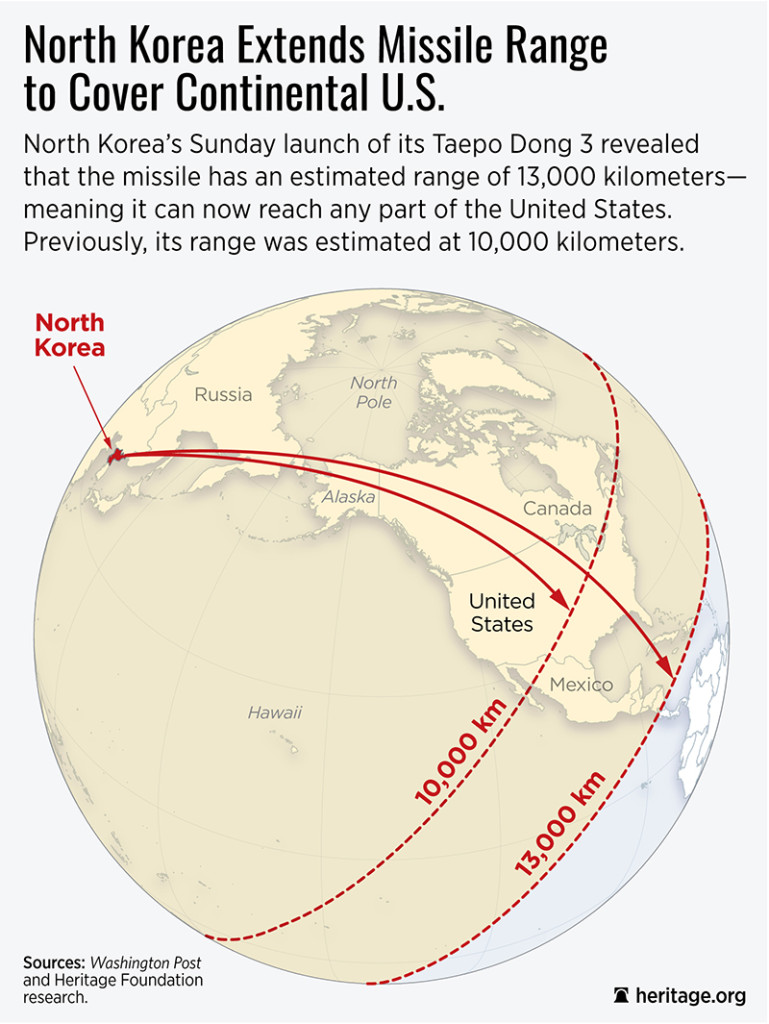
DS-north-korea-13000-km-769x1024

The Administration is scrambling now that the Pentagon confirmed that the North Koreans successfully launched a satellite. Launched in a southerly direction, the 200kg.observational satellite is in polar orbit. That means it passes over the US every 95 minutes, perhaps providing imagery and GPS coordinates for possible later use. Yesterday, it missed the window of opportunity, by an hour, to pass over the stadium for 50th Super Bowl Championship game with tens of thousands of fans intent on watching the Denver Broncos beat the North Carolina Panthers for the title.

The Pentagon is talking about providing South Korea with Theater High Altitude Air Defense (THAAD) system to complete the shorter range missile defense umbrella that the Republic of Korea has in place.

As we said on the Sunday Lisa Benson Show yesterday “it’s great that the U.S. has THAAD and ship borne X band radar floating in the Pacific and both ship and shore based Aegis installations in Eastern Europe (Romania) protecting us from missiles fired towards the East Coast. However, we have nothing in place to provide missile defense our vulnerable Gulf of Mexico coast.”  Ambassador Hank Cooper, the Reagan era SDI chief, warned about the absence of Aegis missile defense installations on our Gulf coast in November 2015 and most recently in a Feb.2, 2016 High Frontier alert. He argues that that our ballistic missile defense shield  on the Gulf coast lacks  the means  to combat the threat of a possible North Korean bomb in a satellite (Fractal Orbital Bomb) or missiles launched from either ships in the Gulf or those silos that allegedly Iran has been building in the Paraguana Peninsula in Venezuela. Ex- CIA director R. James Woolsey and Dr. Peter Pry discussed  in a July 2015 article the threat from FOBS that could trigger an Electronic Magnetic Pulse (EMP) effect over the US sending us back to the dark ages of the 19th Century before the advent of electricity.

This issue came up in the ABC GOP New Hampshire debates, Saturday night. Sen. Cruz raised the matter of a preemptive attack against a future North Korean ICBM launch during those debates. We may have had a hand in prompting it. A twitter rally was held last week by the Nation Security Task Force of America (NSTFA) of the Lisa Benson Show on the missile defense issue. The twitter rally sent out messages at the rate of 400 an hour, one of which caught the attention of a South Carolinian with a close connection to the Senator’s campaign staff. Another NSTFA twitter rally is on deck this Thursday night on the same issue.

The irony is the preemptive attack proposal originated a decade ago in 2006 in a Time Magazine article co authored by then Deputy Defense Secretary Ashton Carter, now Pentagon Chief and former Clinton Pentagon chief William Perry. Four nuclear and several space launches and missile tests later, we have a President whose response is to hold more UN sanctions talks with China at the UN that North Korea continually violates.

Meanwhile the North Korean satellite launch coupled with the January 6, 2016 nuclear test exposes the vulnerability of the US to possible missile attack by rogue regimes like North Korea and ally Iran. The lack of a Ballistic Missile Defense demonstrated by this latest successful North Korean satellite launch now vaults the issue to the top of national security issues along with Islamic terrorism for serious discussion in the 2016 Presidential campaign.

Watch, the Fox News report with the Chang interview:

RELATED ARTICLE: In One Graphic, What Countries North Korea’s New Missile Could Hit

EDITORS NOTE: This column originally appeared in the New English Review.

How Fateful are Israel’s Knesset Elections on March 17th?

Sunday, March 15th, the Voice of Israel (VOI) Global Radio System aired a “National Security” program with Executive Producer and host Dan Diker and guests Dr. Harold Rhode former Pentagon Islamic Affairs expert, Distinguished Gatestone Institute Senior Fellow and Bassem Eid Arab correspondent for VOI. Eid is founder of the Jerusalem-based Palestinian Human Rights Monitoring Group. The thought provoking title was “Whom Do Radical Islamists Want as Israel’s Next Prime Minister?

This is a must listen program for all those concerned about Israel’s future in the run up to Tuesday’s March 17th Israeli Knesset elections.  Those elections have more than 20 parties competing for 120 seats. It will pit the current ruling coalition Likud government led by PM Benjamin Netanyahu against the Zionist Union headed by MK Yitzhak Herzog and former Justice Minister of Hatnuah, Tzipi Livni. There is also a new emerging factor. A coalition negotiated following the Knesset elections. It could include a Joint Arab List that might secure upwards of 13 to 15 seats. The Joint Arab List electoral results might possibly bolster the Zionist Union led opposition, including the leftist Meretz party, seeking to be given the nod to form a ruling coalition if selected by Israel President Reuven Rivlin. The VOI will have extensive live and extended coverage of these important Israeli Knesset elections on March 17th.

You may register and listen live to the VOI here.

Overarching this Knesset elections were disclosures this weekend of the U.S. Senate Permanent Investigations Subcommittee addressing complaints by PM Netanyahu of “foreign country involvement.” This is a reference to reports that the U.S. Administration has funded NGOs engaged in possible anti-Netanyahu “anyone but Bibi” vote campaigns among the country’s Arab and urban Jewish voters. The effort involves former Obama Presidential campaign field operations staff headed by Jeremy Bird of 270 Strategies.   Support has come from major Obama Jewish Democratic contributors and possibly State Department funding of NGOs.  Whether the Administration would prefer a new Israeli government whose policies might materially affect the national security and sovereignty of Jewish nation is at question?

This  Ides of March VOI “National Security” program, is a fascinating and elucidating commentary about the  dynamics of the contending forces in the regional  Muslim communities,  both Shia and Sunni, and  views of the US Administration as an unreliable ally. That is reflected in the views of Saudi -backed Al Arabiya  that gave  high marks to PM Netanyahu for standing up to the threat posed by  the Islamic State,  Iran  and proxies Hamas, Palestinian Islamic Jihad  and Hezbollah. As pointed out by Dr. Rhode, Al Arabiya, strongly endorsed Netanyahu’s address before the Joint Meeting of Congress on March 3rd seeking to obtain a better deal to deter Iran from achieving nuclear hegemony in the region. There is also discussion of Egypt’s President Al-Sisi’s emerging role of importance trying to fashion a Sunni regional coalition of forces, the equivalent of a NATO – type organization to confront IS.  Al-Sisi’s New Year’s speech in  Cairo, before Al Azhar and the Awqfar  Ministry,  espoused reform of underlying Qur’anic doctrine  that has returned to the takfir purist form of Islam emblematic of the apocalyptic IS, a self styled Caliphate. A Caliphate that as Dr. Rhode pointed out may have been fostered originally by Shia Mahdist Iran now ironically engaged in combating IS in Iraq.

Rhode and Diker suggested that if a more compliant Israel government was elected on Tuesday that IS and Hamas cells in the West Bank and Hezbollah with Iran on the Golan might foment possible trouble.  Iran, as noted by Diker and Rhode, is rapidly spreading its hegemony threatening the region from Yemen on the Red Sea, across the Arabian Peninsula to the shores of the Persian Gulf and through Iraq and Syria to Lebanon on the Mediterranean coast. An Iran whose nuclear quest may have already triggered nuclear proliferation with Saudi Arabia’s disclosure of a recent nuclear development deal with South Korea.  We found fascinating the discussion among Diker, Rhode and Bassem Eid, astute VOI Arab correspondent, on the internal Israel Arab Muslim divide over the question of whether they would support the United Arab List.

Bassem disclosed the previously not well known fact that 60 percent of Israeli Arab Muslims are more likely to vote for Jewish parties as loyal citizens rather than for the Arab list. The Party’s leaders are more concerned about Israel as an ‘apartheid state’.  They have fashioned seditious relations with Ramallah, Gaza, Damascus and even Tehran and all   enemies of Israel. Bassem also noted that the Palestinians view the Likud government and Netanyahu as more reliable with honoring commitments than prior experiences with both Labor and Kadima governments.  Rhode explained that regional Arabs view favorably the Israeli democratic traditions that Arab Muslim citizens enjoy. He told of the impact of that on the Egyptian body guards of the late President Anwar Sadat when he came to Jerusalem in 1977 to give a speech before the Knesset. They noted, he said, the sharp contrast between the quiet respect paid to President Sadat when he spoke and the vigorous debates in the Knesset chamber that followed his address.  The VOI program offers insights into what might occur Tuesday when Israel votes for the 33rd Knesset.  The comments of these American and Israeli experts raise serious questions about the objectives of the US Administration Vis a vis a P5+1 non-binding deal to facilitate Iran’s nuclear hegemony.

Monday, March 16th, this writer and Mike Bates, co-host of Northwest Florida’s Talk Radio 1330 am WEBY will be interviewed by VOI National Security host Dan Diker. That recorded program will address Obama Administration funding via State Department AID and US Jewish moguls involved with OneVoice, V-15 and the Abraham Fund to get out the anti-Bibi vote in Israel. The program will also delve into controversy surrounding Sen. Cotton’s ‘Iran letter’. That controversy has led to revelations suggesting that  the Administration is striving to establish a  rapprochement with the Islamic Republic of Iran  avoiding Congressional review instead  seeking a  nuclear agreement  by the P5+1 at the UN  via a Security Council resolution.  That could result in lifting more than an estimated $70 billion in UN financial sanctions against Iran held in US banks controlled by the US Treasury, Office of Foreign Assets Control.  Sunday talk show criticism of the Cotton letter to the leaders of the Islamic Republic of Iran by Secretary of State Kerry and former Secretary Madeleine Albright on CBS’ Face the Nation were contested by Sen. Cotton who drew attention to the precedent of a non verifiable deal made during the Clinton Administration with North Korea that eventuated in the latter’s creating a nuclear stockpile of weapons 12 years later.

Tuesday, VOI host Diker will join Northwest Florida’s talk radio 1330 am WEBY periodic Middle East Round Table co-hosts Bates and Gordon to report first returns from what many consider the fateful 2015 Knesset elections during 4:00 PM CST (5:00 PM EST) segment of “Your Turn”.

Listen Live here.

EDITORS NOTE: This column originally appeared in the New English Review.