
Why the Secret Plan of the Bashir Regime Demands Reinstating Sanctions Against Sudan
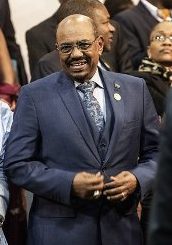
President Bashir of Sudan, African Union Summit, South Africa 2015. Source (AFP)
On January 13, 2017 former President Obama signed Executive Order No. 13761 temporarily lifting 20 year old sanctions against Sudan led by International Criminal Court indicted war criminal President Omar Hassan al-Bashir. The Executive Order had a look back period of 180 days which ends on July 12th, whereupon the Trump Administration might permanently lift sanctions. This comes at a time when new evidence surfaced that a strategic policy group of the Bashir regime in Khartoum continued genocide against the indigenous black African people in Darfur, Nuba Mountains, South Kordofan and the Blue Nile region.
The rancorous dispute between Qatar and four Arab nations, over alleged support for Islamic terrorism and the Muslim Brotherhood, has placed Bashir in a difficult position, as he has been asked by Saudi Arabia to take sides. The government of neighboring Chad issued a statement cutting diplomatic relations with Qatar. Chadian President Idriss Deby Itno has long been waiting for this moment. Qatar has hosted and supported Chadian Islamist groups who have been recruited for Sudan President Omar al-Bashir’s Rapid Support Force (RSF)/Janjaweed militias.
In one embarrassing episode in mid-June 2017 General Taha Osman al Hussein, State Minister in the Presidency and Director General of the Presidential Palace in Khartoum, allegedly had been arrested in an failed attempted coup to overthrow President Bashir of Sudan. General al Hussein is a dual Sudan and Saudi Arabia citizen. Subsequent news reports said that General al Hussein and his wife had left the Sudan for Saudi Arabia after he had volunteered to allegedly lead an overthrow of Qatar.
Sudan had initiated an influence campaign in Washington retaining the services of the lobbying firm of Squire Paton Boggs at $40,000 per month to roll back the sanctions permanently. The objective was to make a convincing case that Sudan, despite its terrible human rights record, had nevertheless co-operated in providing useful counterterrorism intelligence on the whereabouts of the notorious Joseph Kony of the Lord’s Resistance Army. In fact one of the co-authors, General Abdallah of the Sudan United Movement (SUM), had provided information on Kony’s whereabouts to US AFRICOM.
The House Foreign Affairs Committee rebuts recommendation of former US Sudan Envoys
The controversy over lifting Sudan Sanctions rose to a peak in late June 2017, when a noted US Sudan human rights activist Eric Reeves issued a scathing rebuttal letter. It challenged a letter sent to the US House Foreign Affairs Committee by former Special Envoys to Sudan Princeton Lyman and Donald Booth, along with former U.S. Charge d’Affaires in Khartoum, Jerry Lanier, suggesting there was evidence to lift sanctions.
Reeves wrote:
In this almost three decades of brutal, tyrannical, and serially genocidal rule, this regime has not changed in any significant way. It has certainly not changed in ways claimed as possible by Lyman in December 2011:
We [the Obama administration] do not want to see the ouster of the [Khartoum] regime, nor regime change. We want to see the regime carrying out reform via constitutional democratic measures.” (Interview with Asharq al-Awsat, December 3, 2011).
One hardly knows where to begin in parsing the absurdity of this statement, justifying the Obama administration’s opposition to regime change. [Regime change] overwhelmingly favored by the vast majority of Sudanese and indeed now the linchpin of political and military opposition to the regime throughout Sudan.
Reeves then proceeded to document the escalation of genocidal ethnic cleansing against the indigenous black African people in Darfur, Nuba Mountains and the Blue Nile region since the Obama Executive Order went into effect.
On June 30, 2017, members of the House Foreign Affairs Committee responded by sending a signed letter to President Trump. It recommended that any decision to lift Sudan sanctions be deferred for at least a year past the July 12th. That would allow a new Special Envoy and team to be appointed and conduct investigations. The letter clearly stated the reasons for their recommendation to the President:
There has been substantial fighting [by] Sudan in Darfur in recent months, including evidence of targeting civilians by Sudanese armed forces and their affiliated militias. As expected, no humanitarian access has been granted to South Kordofan and Blue Nile states, and only limited access to Darfur.
While the Sudanese government may seem cooperative on counterterrorism efforts, we believe they continue regularly scheduled support for violent non-state armed groups, like the former combatants of the Islamist group, Seleka, the Lord’s Resistance Army (LRA). Other similar violent actors [are] operating in northern and central Africa, the Middle East and neighboring countries.
As the look back date of July 12th looms there were further troubling disclosures.
The Top Secret Minutes of the Sudan Security Intelligence and Political Committee
Amidst the swirl of events concerning the lifting of sanctions against the Sudan regime of President al-Bashir were stunning revelations contained in the “Top Secret” minutes of The Security Intelligence and Political Committee of Crisis Management held in the Office of the Director of the Sudan National Intelligence and Security Services (NISS) on June 18, 2017. The secret document had been obtained by a reliable informed source and was translated.
Attending the Khartoum meeting were the power elite of the reigning National Congress Party (NCP) regime: President Bashir, Vice President Backri Hassan Salih, Foreign Minister Ibrahim Gandur, Minister of Defense Awad bn Ouf, Hamid Momtaz Secretary of NCP political affairs, and State Minister in the Ministry of foreign affairs, General Mohamed Atta al Mola Director of NISS, General Ibrahim Mohamed al Hassan, Commander of Military Intelligence, Ibrahim Mhamud Vice President of NCP and Professor Ibrahim Ahmed Omer President of Parliament.
The minutes of this Crisis Management Committee revealed the broad sweep of plans for assassination of a major Sudan resistance commander in the Nuba Mountains and senior Officers supporting him. It also addressed sponsorship of international ISIS terrorist activities in the Sahel region of Africa, especially in Libya, and the global Muslim Brotherhood Organization. It elucidated web of deception in the Bashir regime’s influence campaign in Washington, DC to lift sanctions by the Trump Administration.
These top secret minutes also reflect the Bashir regime’s position in the current dispute between Qatar and four Arab Countries: Saudi Arabia, United Arab Emirate, Bahrain and Egypt. It reveals that relations with Iran secretly continue despite the public cutoff in 2015.
The revelations in this NISS document further the case of the letter signed by Members of the US House Foreign Affairs Committee sent to President Trump. The following is a digest of key recommendations of the Sudan NISS Crisis Management Committee at the June 18, 2017 meeting.
Elimination of Nuba Mountains Resistance SPLA/N Commander General Abdalaziz Adam Alhilu
The Committee sought to isolate and eliminate Nuba Mountains SPLA/N Commander General Abdulaziz Adam Alhilu, through use of all government institutions, political, military, intelligence and propaganda. They also will promote Malik Agar, Governor of the Blue Nile State and a leader of the SPLM/N, through an extensive media campaign focusing the African Union’s position supporting his legitimacy as SPLM/N head. Allegedly, the Committee minutes contend the South Sudan government does not support Abdulaziz. They would create internal problems for Abdulaziz through tribal conflicts using Nuba people opposing him to foment conflicts inside SPLA/N to weaken and totally destroy it. They indicated that Churches are the main places where communities are gathering in Nuba Mountains and Blue Nile; so they want to use highly trained people to infiltrate into Christian religious communities and create problems for Abdulaziz and SPLM/N. They plan to assassinate officers supporting Abdulaziz using military force through the support of the Agar faction and tribes of Angassana to remove him from the Nuba Mountains.
Recruitment and Infiltration of ISIS fighters to support African and Global Islamic Terrorism
They will continue support for the Global jihad objectives of the Islamic State and the Muslim Brotherhood. To that end they indicated that ISIS fighters in Iraq and Syria were defeated and the desert terrain is not suitable for continued warfare. They would relocate ISIS fighters from Iraq and Syria and infiltrate them into the areas of Bahr al Gazal and Equatorial regions in the South Sudan. The areas of Bahr al Gazal and Equatorial regions would allow ISIS fighters to establish linkage with Boko Haram in Nigeria in the West through the Central African Republic and with Al Shebaab of Somalia in the East. They would infiltrate ISIS fighters into neighboring Libya to reinforce ISIS affiliate groups there seeking to defeat the Libyan National Army regime of General Khalifa Haftar to prevent him from attaining power, as they view him as a threat to their regime. They believe that South Sudan President Salva Kiir supports the overthrow of the Khartoum regime, thus they want to overthrow the regime of President Kiir. To that end they would train Southern Sudanese youth, people from West Africa and Nigerian students supporting Boko Haram as they resemble the South Sudanese Africa tribal people in the capital of Juba. They would infiltrate them into South Sudan as secret agent provocateurs to raise resentment against the regime of President Kiir, seeking its overthrow.
Support for Qatar and Renewal of Iran relations
The Committee minutes indicated that Saudi Arabia is trying to force them to leave Qatar. However, they are not going to leave Qatar because it has been supporting the regime both ideologically and financially. They contend, without the support of Qatar they would have been overthrown and imprisoned. They would reestablish their relations with Iran because of shared Islamic Jihad goals. Qatar, Iran and Turkey have established a relationship which has become a main point of contention raised by the Saudi Arabia and the three other Arab states. As we have written previously, Qatar has provided $200 million under the guise of education reform to Sudan that was diverted to funding the recruitment, training and equipping of more than 24,000 Rapid Support Forces (RSF)/Janjaweed militia. They are under the control of the NISS in 16 camps in the region around Khartoum. These RSF forces were immediately deployed to Darfur and the Nuba Mountains to accelerate the ethnic cleansing of native black African peoples in those conflict zones.
Campaign to influence the Trump Administration’s lifting of Sanctions
Prior to the July 12th review by the Trump Administration they allegedly could stop two planned terrorist attacks on American interests in the world to convince Americans of Sudan’s seriousness of helping the US in combating global terrorism to justify lifting the sanctions.
They want to prevail on Saudi Arabia and Kuwait to put pressure on the US to lift sanctions. Saudi Arabia had urged President Obama to sign the temporary lifting of Sudan sanctions with his Executive Order. They also think they have co-opted the US Intelligence Community because they understood the way the US intelligence Community think and operate. They contend they have given counterterrorism intelligence information that no other country in the world had given them. In return the US Intelligence Community has very little information about what is happening in Sudan.
Conclusion
This secret document reinforces our earlier contentions based on the captured Arab Coalition Plan. The Bashir regime’s objective is to recruit a jihad army of upwards of 150,000 from across the African Sahel region, ISIS Middle East and foreign fighters. The objective is to create a Caliphate ruled under Islamic Sharia law from Khartoum sponsoring global Islamic terrorism in consort with Muslim Brotherhood sponsoring regimes like Qatar and in renewed relations with Shiite Iran. That is reflected in the Libyan National Army discovery of documents attesting to the collusion of Sudan, Qatar and Iran in fostering ISIS terrorists seeking to dismantle the Libyan National Army led by General Haftar. Given these secret document revelations, President Trump would be well advised to accept the recommendation in the letter from the US House Foreign Affairs Committee. That would entail deferring consideration of lifting sanctions for at least a year until a new Special Envoy of Sudan and South Sudan is appointed and team assigned to obtain facts that might verify the revelations of the secret June 2017 Sudan Crisis Management Committee minutes. A vital first step would be the appointment of a knowledgeable Special Envoy with plenipotentiary powers to investigate and expose the Bashir regime genocidal jihad objectives. Another would be promoting regime change.
ABOUT THE AUTHORS
Lt. Gen. Abakar M. Abdallah Lt. Gen. Abdallah is Chairman of the Sudan Unity Movement (SUM). He is a native of North Darfur who joined the Sudan People’s Liberation Army (SPLA) in 1984 and became active in the Nuba Hills and Darfurian resistance movements. In 1989 he joined the Patriotic Salvation Movement in neighboring Chad based in Darfur. He served as an officer in the Chadian army for 23 years. He held senior intelligence and counterterrorism posts including as Coordinator of the Multi-National Joint Task Force of Nigeria, Chad and Niger. He was Coordinator of Pan-Sahel Initiative (PSI) Anti-Terrorism Unit of Chad and Commander of PSI Anti-Terrorism Battalion of Chad 2004. He is a December 2002 graduate of the Intelligence Officers’ Advanced and Combating Terrorism Courses, US Army Intelligence Center and Schools, Fort Huachuca, Arizona. He was a Counter Terrorism Fellow and a Graduate of the College of International Security Affairs, National Defense University, Washington, DC, 2005. He was an International Fellow and Graduate of the US Army War College, Class of 2008.
Jerry Gordon is a Senior Editor at the New English Review.
Deborah Martin is a 35 year veteran Sudan linguistic and cultural affairs consultant
EDITORS NOTE: This column originally appeared in the New English Review.