
Surviving the Split: Quantum Immortality, Branching Realities, and the Illusion of Fate
Imagine that somewhere, in a branch of reality you can no longer reach, you did not make it. A car swerved a fraction of a second too late. A coin landed the other way. A moment that ended well for you ended very differently for another version of you, and the people in that world are grieving.
You, reading this, are in the branch where the coin landed kindly. According to one of the strangest ideas in modern physics, you may be in that branch every time, again and again, for as long as you live. This is the thought experiment known as quantum immortality.
The idea starts with a question that troubled the founders of quantum mechanics. Particles are described by wave functions, which spread across many possible states at once. Yet when we measure a particle, we find only one outcome. What happened to the others?
The standard textbook answer, the Copenhagen interpretation, says the wave function “collapses” into a single result. In 1957, physicist Hugh Everett proposed something bolder: nothing collapses. Every possible outcome happens, and the universe branches into versions in which each result is realized. This is the Many-Worlds interpretation.
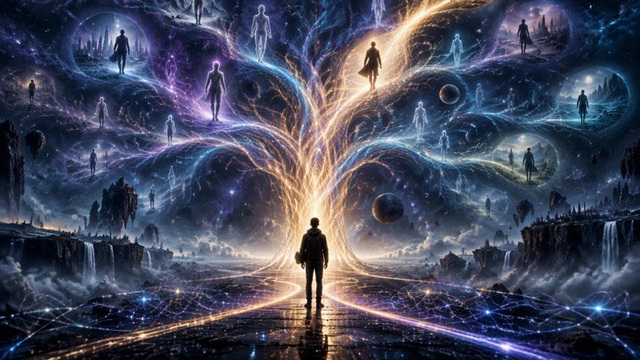
In this picture, the universe isn’t a single track that occasionally hits a fork and picks a side. It is a vast, ever-growing tree. Observers split along with everything else, and each copy sees one outcome and believes, reasonably, that it is the only one.
It is tempting to imagine the branching as something that happens when you choose between tea and coffee. The physics is less dramatic and more fundamental. Branching is driven by quantum events, such as a particle’s spin, an atom’s decay, or a photon’s path, that become amplified into the macroscopic world. Your ordinary decisions are not tidy forks, because the brain is a noisy system in which quantum randomness may or may not tip the balance. A better image is not a single dramatic split but a continuous, staggering multiplication of near-identical worlds, diverging in countless tiny ways.
What matters is that, within the theory, none of these outcomes is privileged. The branch where the atom decays and the branch where it doesn’t are equally real. They simply no longer interact, so each version of you experiences only its own history.
Now add a deadly device. In the 1980s and 90s, thinkers including Hans Moravec and later Max Tegmark explored a scenario often called “quantum suicide.” A machine measures a quantum event, say a particle’s spin, and, depending on the result, either does nothing or kills the person operating it.
From the outside, an observer would see the experimenter die in roughly half the runs. But from the experimenter’s own perspective, the logic goes, something different happens. In the branches where they die, there is no one left to experience anything. The only continuing stream of experience is in the branches where they survive. So subjectively, they would always find themselves alive, run after run, no matter how many times the machine fires.
Stretch this beyond a lab device. Every moment carries some tiny chance of death, from an aneurysm or an accident or illness. If consciousness persists only along survivable branches, then perhaps you will always find yourself in the improbable timeline where you keep going, even into extreme old age.
It is worth being honest here: quantum immortality is a thought experiment, not an established result. Most physicists do not treat it as a prediction, and there are serious objections.
The first is that Many-Worlds itself remains one interpretation among several, and it is not experimentally distinguishable from its rivals. The second is that branches carry different “weights,” and nothing in the theory says a conscious being should only care about the branches where they survive. The third is that death is rarely a clean on-off switch. The path to immortality would more likely run through ever more fragile states, with injury and decline, not a triumphant eternal youth. Finally, the idea quietly assumes that consciousness behaves in a particular way across branches, which is a philosophical claim, not a physical one.
And one more point deserves emphasis: even if the argument were sound, it would offer no reason to take risks. Every branch where you suffer or die is a real tragedy for the people in it.
Even so, the thought experiment is valuable, because it forces us to confront questions we usually avoid. What does it mean to be “me” when countless versions of me might exist? If a copy of you diverges at noon and lives a different life by evening, which one carries your identity? Perhaps both. Perhaps identity was never a single thread, but a pattern that can be woven in many places.
It also loosens our grip on fate. We tend to see our lives as the one path that was always going to happen. Many-Worlds suggests that the path you are on is simply one of many, and that outcomes we call luck or tragedy are equally real elsewhere. The lesson is not that nothing matters, but the opposite. If every outcome plays out somewhere, then the only world you can influence is the one you inhabit, and the people in it are the ones who need you.
Whether or not the universe truly branches, the picture invites a kind of humility. The idea that reality is a single, deterministic line was always a comfortable story. The alternative is vaster and stranger: a continuum in which possibility is the basic fabric of existence.
We may never know if some version of us has already slipped away, or whether we are the lucky survivors of a thousand near misses. What we can do is treat this branch, the only one we can touch, as precious. If the cosmos holds every outcome, then the awe lies in how improbable and unrepeatable this exact life is.
©2026 Amil Imani. All rights reserved.
Leave a Reply
Want to join the discussion?Feel free to contribute!