The Media Is Suddenly Less Sure About a Democrat Wave

THE WASHINGTON STAND—After months of flooding the zone with glum predictions for Republicans, there’s been a quiet but meaningful shift in major media headlines. Left-leaning outlets desperate to make the GOP’s demise a self-fulfilling prophecy seem to be subtly hedging their bets against another polling embarrassment. In the last handful of days, even the big dogs—The New York Times, Washington Post, and Newsweek—are conceding that maybe the election forecasts aren’t as lopsided as they’ve been leading voters to believe.

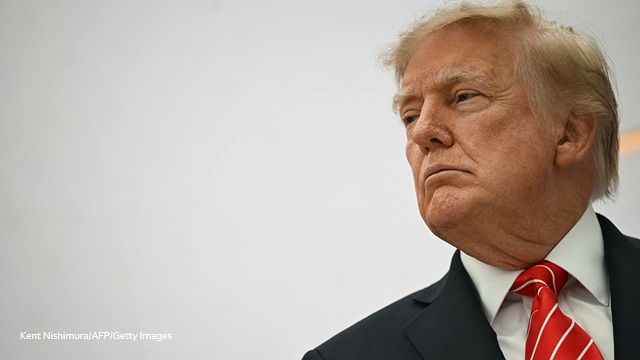
Suddenly, readers are clicking on stories that paint a very different picture of the apocalyptic landscape for Republicans they’d come to expect. Articles like “Democratic Optimism in Six Senate Races May Be a Mirage,” “3 Bright Spots for the G.O.P.,” and “How Much Can Republicans Outrun Trump’s Approval?” are popping up in the same pages that have urged Americans to don galoshes for the Blue Tsunami. And while there certainly are very troubling signs for Speaker Mike Johnson’s, R-La., party, one lesson everyone should have learned by now is that polls are an incredibly flawed measure of public opinion.

In the modern age, Republicans have consistently outperformed the industry’s numbers in presidential and midterm elections. Pollsters have frantically tried to solve this puzzle, especially after a string of national humiliations. After a lot of head-scratching, two theories for this unpredictability revolve around the GOP.

“First, Republicans are becoming more distrustful of institutions and society, and that may be extending to how they feel about pollsters. Second, suburban Republican college graduates are more likely to fear professional sanction for their views and are therefore self-censoring more, including in surveys,” FiveThirtyEight’s Emily Ekins suggests. Most experts estimate that conservatives underpoll somewhere between 3-5%—a massive swing for anyone trying to prophecy close races.

Over the last handful of days, the media seems to be making an intentional effort to temper their excitement, noting that as optimistic as Minority Leader Chuck Schumer, D-N.Y., may be, “history offers a warning to Democrats, as polls in recent elections underestimated Republicans in key states. Control of the Senate could come down to just a handful of races where polls show razor-thin margins.”

In places like Alaska, Iowa, Maine, Michigan, Ohio, and Texas, Newsweek warns, Democrats appear to have a polling edge. “But Republicans have outperformed polling averages in many of those same states over the past few elections. Polling errors are not necessarily repeated from cycle to cycle. But a similar pro-Republican polling error this cycle would not bode well for Democrats’ chances of flipping the Senate.”

Frankly, it’s “impossible to know for sure” what the polling error could look like this year, Syracuse Political Science Professor Grant Davis Reeher acknowledged. “There are some pretty big known unknowns in this election, which could throw off polls,” he said. “A primary one is turnout. Polls must make educated guesses about who is most likely to vote. It’s a little trickier in midterms.”

National Review’s Jim Geraghty, who hasn’t exactly been a glass-is-half-full prognosticator, offered what he called “the cheeriest midterm take for Republicans you’re going to find,” urging readers to second-guess the excitement surrounding Democrats in cherry-red Kansas, South Carolina, South Dakota, Nebraska, and Florida. Despite the media’s insistence that GOP candidates are in trouble, the polling doesn’t necessarily bear that out. “There’s good reason to not believe the hype; we’ve seen this sort of narrative before.”

He ticks off the numbers for each key race, along with historical trends, dismantling the idea that conservatives are in trouble. “The lesson of this is not that all the polls are always wrong, or that every prediction of an upset Democratic win is always wrong,” Geraghty cautions. “But there’s an extremely familiar narrative of ‘this Democrat really has a shot in a deep red state!’ that rarely pans out; when it does, it’s usually because of a spectacularly flawed Republican candidate.”

Americans should be wary of a blue wave, he writes, if only because “certain left-of-center media voices always tell them there will be a blue wave every November.”

An unlikely source echoes NR’s guardedness: The New York Times. Despite what pundits say, “there is also quite a bit of good news for Republicans,” Ruth Igielnik wrote late last month. For starters, “Republican Senate candidates are running ahead of the party. … Each of [them] is outrunning President Trump’s popularity in their states, sometimes by double digits. … And in each of the races, Republican candidates are winning some voters who otherwise say they want Democrats to control the Senate. Taken together, these are signs that in these competitive, Democratic-leaning states, Republicans have nominated strong candidates who appeal beyond their base.”

Then, of course, there’s the Left’s ugly infighting. “As Democrats are divided,” the Times points out, “Republicans are united. … We asked Democrats across the country if they felt the party was united or divided. About half said the party was united, and half said divided. Those numbers are nearly identical to a survey we ran in 2016. Republicans, on the other hand, are feeling very unified. In our most recent national survey, 70 percent of Republicans said they felt the party was united. That is a dramatic departure from 10 years ago. In 2016, more than 80 percent of Republicans said they thought the party was divided.”

Over at The Washington Post, Scott Clement reiterates that a “poll of two key House districts shows good signs for Democrats, but no tsunami.”

As for the bluster that even Hispanics are abandoning the GOP, Rasmussen Reports soundly beats back that narrative. In results released Monday, Hispanic voters favor Republicans by a 50 to 42% margin over Democrats.

“The poll also indicates a tightening battle for control of Congress, as the Democrats’ lead over Republicans decreased for the second week in a row, according to the company. Overall, voters said if the election was held today 47 percent of likely voters would vote for the Democrat candidate, while 44 percent would vote for the Republican. Four percent of voters said another party’s candidate and just 4 percent were undecided.” In other words, Republicans have slashed the Democrats’ lead in half since just mid-September, “particularly with independent voters.”

But as encouraging as those signs are, leadership is clear-eyed about the hill they have to climb this November. “Now listen, this is going to be a very close election,” Speaker Johnson underscored Tuesday.

His Senate counterpart, Majority Leader John Thune, R-S.D., has been cautiously optimistic about his side of the Capitol. “I think we can keep the majority,” he told Politico this week. “I think all of these races are margin of error, at least the ones that we have to win. And historically, at least if you look at polls, we tend to outperform them.”

House Majority Leader Steve Scalise, R-La., made that same point in a conversation with Family Research Council President Tony Perkins on “This Week on Capitol Hill.” When Cook Political Report, a widely respected organization, moved more seats to the toss-up or Democratic-leaning column, the House’s second-in-command wasn’t worried. In his mind, there’s more to the story. “You know, the polling really is interesting when you dig into it. You’re seeing an undersampling of Republicans, and we’re digging into some of these. Let’s be clear too. There are a lot of close races, not just Republican races.”

He pointed to a few states like New Hampshire where GOP candidates are making a dent in Democratic areas too. “There [are] about 35 seats across the country that are truly swing districts,” Scalise observed. “Twenty of them are held by Republicans that are close right now, but 15 are held by Democrats that are also close, that we have a real chance to flip. And so, turnout is going to be a big factor. Who really does show up?”

The GOP has another secret weapon this election—in large part thanks to President Trump and Speaker Johnson—and that’s campaign cash. As Perkins highlighted, conservatives “have a strong edge on the fundraising to get their message through in these final days.” Scalise nodded. “We really do. You know, it’s rare that we outraise Democrats in a lot of these seats. We have now. And again, I think people are seeing what’s at stake, and they’re donating money.”

The media, he thinks, “[is] counting on Republicans, especially traditional conservative voters, to just stay home. And I don’t think that’s going to happen, because I think more and more people are seeing this sharp contrast [between the two parties].”

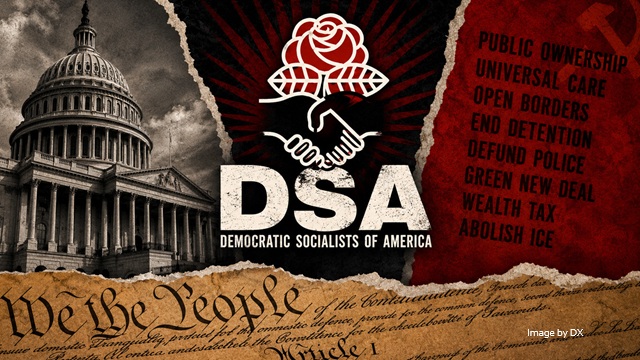
With the rise of the Democratic Socialists, Scalise warns, “This isn’t like two candidates [who] are similar. This is common sense versus crazy. And some of these candidates … [don’t just want] to defund the police — they want to disarm the police. They actually advocate for taking guns away from police officers. You were a police officer. Could you imagine approaching a criminal who’s got a gun and saying, ‘Hey, let’s have a conversation and try to talk this out?’ He shoots you, and it’s over. This is insanity. And that’s beyond crazy. But if people stay home … [these radicals win]. And that’s why people can’t stay home.”

At the end of the day, Scalise insisted, Democrats are trotting out polls “to make it look like they’re doing better than they are, because they want to depress conservative voters. Because if conservative voters stay home, guess what? Socialists will actually win. They can’t win if you show up and vote on November 3rd.”

That’s right, Perkins stressed. “The only poll that really counts is Election Day when people turn out and vote.”

Originally published by The Washington Stand.

We publish a variety of perspectives. Nothing written here is to be construed as representing the views of the Daily Signal.

AUTHOR

Suzanne Bowdey 

Suzanne Bowdey is editorial director and senior writer at The Washington Stand.

RELATED ARTICLES:

Big GOP Midterm News: Polling in 9 Key Senate Races Shows Shakeup May Be on the Way

New Poll: How Likely Young Voters View Islamic Sharia Law

What This Bipartisan Plan Would Change About the Senate

EXCLUSIVE: Montana AG Asks Supreme Court to Revive Case Against DEI Training That Allegedly Declared ‘All Caucasians’ Racist

EDITORS NOTE: This Daily Signal column is republished with permission. ©All rights reserved.

The Unknown Donor Axis Behind the Radical Left’s Rise to Power

In past elections, big donors to progressives were generally older, wealthy hippies or successful Hollywood players. Now, our analysis of campaign filings shows a crew of virtually unknown donors stepping in to fund the far left. The emerging group skews younger, is often South Asian or Middle Eastern, and works in fields such as technology and medicine. Many had never given to politics before last year, but they are now donating as much as $1 million each to fund progressive candidates and a new “anti-Aipac” super PAC, reports the Wall Street Journal. One of the major financial players in this election jihad is the contemptuously named American Priorities — more accurate would be “American Subversion.”

Key points (based on The Wall Street Journal investigation, October 10, 2026):

  • A new class of wealthy political donors is financing progressive candidates. Some had little or no recorded political giving before 2025 but are now contributing hundreds of thousands — even millions — of dollars.
  • An anti-AIPAC super PAC is emerging as a major financial force. American Priorities is directing substantial funding toward progressive candidates critical of Israel and seeking to counter the influence of pro-Israel political spending.
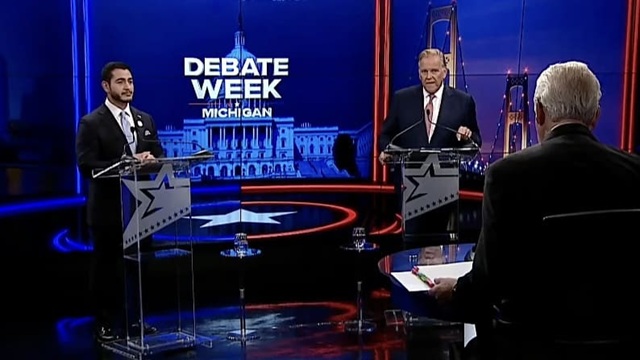
  • Abdul El-Sayed is a major beneficiary. American Priorities spent more than $500,000 supporting his Michigan Senate campaign.
  • Five of American Priorities’ 12 largest donors also donated to Zohran Mamdani. The report identifies overlapping financial support for Mamdani and the broader progressive movement.
  • Two previously unrecorded political donors emerged as million-dollar contributors. Mohammad Waqas gave approximately $1.1 million, while technology investor Omer Hasan contributed approximately $1 million during the 2025–26 cycle.
  • A corporation with undisclosed funders contributed $470,000. Delaware-based Fig And Olive Action appears among American Priorities’ largest contributors, but its underlying financial backers were not disclosed.
  • George and Alex Soros remain significant financial players. Their Democracy PAC contributed approximately $7 million to progressive causes and committees analyzed by the Journal.
  • Saikat Chakrabarti topped the broader progressive donor list at $13.4 million. More than $11 million went to his own congressional campaign committee, which he subsequently converted into a super PAC.
  • American Priorities spent more than $1 million helping two Democratic Socialists of America-backed candidates win New York congressional primaries. Claire Valdez and Darializa Avila Chevalier benefited from advertisements emphasizing affordability and Mamdani’s endorsement rather than Israel.
  • The emerging donor network differs from traditional Democratic megadonors. The Journal describes a younger group, frequently working in technology and medicine, alongside established wealthy Democratic contributors.
  • Progressive organizations are developing new fundraising strategies. Democratic Socialists of America introduced income-based solidarity dues of 1%, while Justice Democrats is seeking resources to compete against better-funded opponents.
  • The financial support extends beyond the progressive movement itself. Democratic establishment organizations are also spending millions to support progressive nominees, including more than $9 million in television advertising spent or reserved to assist California congressional candidate Randy Villegas.

Bottom line: The Journal documents an expanding financial network connecting newly active wealthy donors, anti-AIPAC political spending, established Democratic megadonors, and progressive candidates. Its findings show growing financial coordination and overlapping interests, but do not establish that these donors operate under a single centralized command.

The Crew of Virtually Unknown Donors Powering the Rise of the New Left

Millions of dollars are flowing to help Democratic socialists and other progressives

By Maggie Severns, Anthony DeBarros and Kara Dapena


Supporters of the progressive left are working to expand their funding as the far left gains momentum.

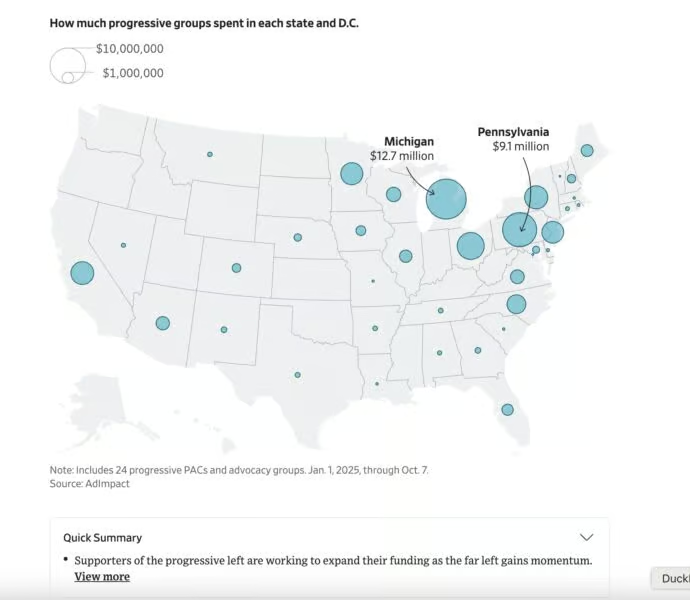
In Michigan this year, a new super PAC vowing to fight pro-Israel money chipped in more than half a million dollars to help progressive Abdul El-Sayed’s Senate bid. Its funders: a crew of virtually unknown political donors, many of whom had never given to politics before last year but have since donated up to $1 million each.

In New York, billionaire Alex Soros cut checks directly to progressive politicians, including Reps. Pramila Jayapal of Washington and Ilhan Omar of Minnesota. Those donations are part of the millions of dollars that Soros and his father, George, plan to give to Democratic causes this year.

Collage of Abdul El-Sayed, Bob Brooks, and Randy Villegas.
Abdul El-Sayed, Bob Brooks and Randy Villegas have benefited from super PAC spending in their races. Sarah Rice/Getty Images; Matt Rourke/AP; Mario Tama/Getty Images
And in Philadelphia, nearly a million dollars in TV advertising paid for by outside groups is boosting Democratic socialist Chris Rabb, highlighting his endorsement from New York Rep. Alexandria Ocasio-Cortez and his willingness to fight for Medicare for All.

The left flank of the Democratic Party raises and spends only a fraction of what many Republicans and the Democratic establishment do on elections. But as the far left gains momentum, supporters are working to expand their funding.

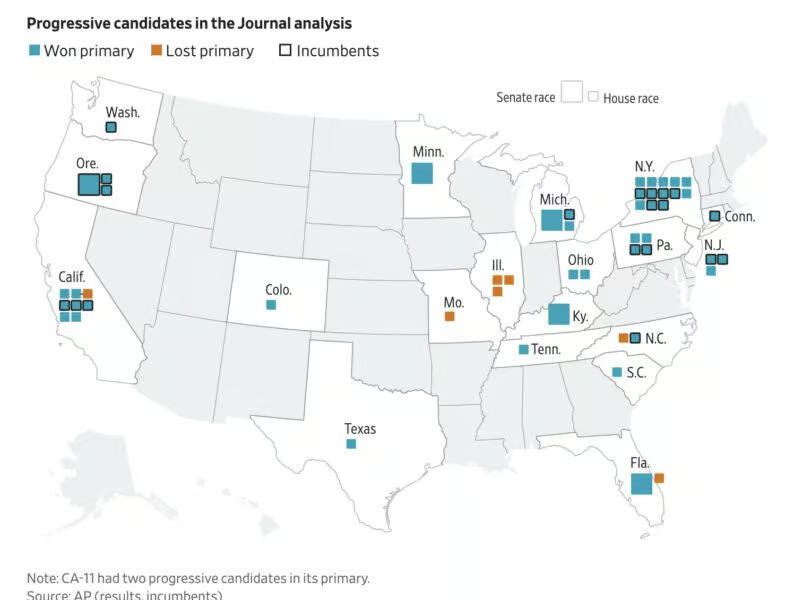
Progressive candidates in the Journal analysis:

Even the Democratic Socialists of America, which is funded exclusively by membership dues and relies largely on volunteers, has been experimenting with raising more money. While introductory dues for DSA members usually start at $10 a month, the organization’s newer option to pay income-based “solidarity dues” set contributions at a much heftier 1% of member’s incomes.

“Give your 1% for the 99%,” the DSA’s website advertises.

Another group that focuses on identifying and helping progressive candidates, Justice Democrats, said its goal is to remain competitive in races where opponents can use funding advantages to sometimes overwhelm progressives with ads.

“We will never have the amount of money that Aipac or crypto have,” said Usamah Andrabi, a spokesman for the group, referring to the pro-Israel American Israel Public Affairs Committee and a cryptocurrency industry that has spent more than $90 million during the midterms. (Aipac spokeswoman Deryn Sousa said the group “is a membership organization of individual Americans, not an industry.”)

Here is how the progressive movement compares with other big-money counterparts.

The Mamdani Factor

Zohran Mamdani’s election as mayor of New York City last fall sparked a new era of far-left politics and a new generation of political donors, many of them critical of the war in the Middle East and frustrated by Aipac spending to support politicians who back Israel.

In past elections big donors to progressives were generally older, wealthy hippies or successful Hollywood players. The emerging group skews younger, is often South Asian or Middle Eastern, and works in fields such as technology and medicine.

Sathvik Kaliyur, CEO of a fundraising firm called NWF Strategies whose clients have included Mamdani and El-Sayed, said his goal is to make it easier for candidates who don’t come from money to run for office.

Many of the biggest checks are going to a super PAC that aims to be an “anti-Aipac” force, called American Priorities.

Continue reading

AUTHOR

RELATED ARTICLES:

“ROTTEN TO THE CORE”: Mamdani Fights to Free Violent Illegal Who Fled ICE With a Child in the Car

Tens of Thousands March Across European Cities In Support of Jihad and Jew Hatred

France: Muslim Rioters Chant Rap Song Celebrating the Monster Who Executed Jewish Children

Mediocre Runner Becomes a Champion. All He Had to Do Was Become a Woman

Islamization of Iran and 1400 Years of Arab-Islamic Genocide

RELATED VIDEO: From Michigan to Colorado to Washington, D.C., antisemitic violence has touched communities across the country

EDITORS NOTE: This Geller Report is republished with permission. ©All rights reserved.
TalaFRICO Has Been at a Mental Hospital in Ohio not fighting the flu as reported

This Democrat Socialist, Universal Unitarialist (not Christian) freak Talarico running for Senate in Texas is a consummate liar and hypocrite who flip flops on issues as badly as Islamist El Sayed who is running for Senate in Michigan.


Was James Talarico Admitted to a Mental Health Facility in Ohio?

James Talarico is in one of the most competitive Senate races this cycle, and he disappeared from the campaign trail for almost two weeks. He supposedly reappeared this weekend to poke at Republican Texas AG Ken Paxton over debates, and his team showed him attending a Kacey Musgraves concert.

Talarico is once again being hailed as the Democrats’ best hope to win statewide in the Lone Star State, but his absence drew attention, especially since it looked like he checked into a mental health clinic. That’s not what his campaign said; it said he was sidelined with the flu. There’s a phone call seems to confirm he was a patient at the Lindner Center of Hope near Cincinnati, Ohio. Nick Sortor had the clip:

We’ll keep you updated. The Paxton campaign has trolled Talarico, releasing a press release asking for proof of life.

UPDATE: The Talarico campaign responds with a simple ‘this is a lie’ statement.

©2026 . All rights reserved.

RELATED ARTICLE: As Mental Hospital Story Looms, Talarico Gets Even More Bad News as TikTok Fraud Comes to Light

AWED MEDIA BALANCED NEWS: We cover Energy to Education to Elections — and more!

Welcome! We cover Energy to Education to Elections — and more!

Here is the link for this issue, so please share it on social media.

Checkout the 2026, 2025, & 2024 archives, plus asterisked items below.


— This Newsletter’s Articles, by Topic —

Secondary Education Related:

*** Teachers Share The Most “Alarming” Trends They’re Seeing In Classrooms Today

*** Support, Don’t Solve: How to Raise a Kid Who Thinks for Themselves in the AI Age

*** America’s Reading Crisis Demands More Than Concern. It Demands Action.

*** Teens and the “3 p.m. to 3 a.m.” Problem

*** The Kids Are Not Alright | Check Your Premises

*** The blue-state model for education has failed, and the public has caught on

*** Un-Gifted and Talented

The “Pulitzer of Education Innovation” Awards More Than $6 Million to Transformational Education Leaders

What Is Left for Your Kids When Robots Can Do Everything?

Marine-turned-homeschool mom says Oregon district rejected books for referencing God

Teacher Education Without the Education Establishment

Have We Overlooked the Educational Importance of Two-Parent Households?

Higher Education Related:

*** AI’s Biggest Risk Isn’t Rogue Systems; It’s Humans Who Can No Longer Think Without Them

*** The Dicey Prospects of Academic Self-Reform

*** Professor Hides White Font in Midterm, Catches Students Using AI in the Stupidest Way Possible

*** More Gen Z college freshmen are quitting school early and moving back home with mom and dad

Experts found AI summaries are warping our memories – and the results are worrying

Pedagogy of the Progressives: A Review of Syllabi from Graduate Schools of Education

UCLA Would Rather You Didn’t Read the Syllabus

Record-Low 31% Say College Education Is ‘Very Important’

Accountable Higher Education Requires Standardized Testing

From the Mother of a Cornell Student Who was Drugged

Artificial Intelligence:

*** Ayaan Hirsi Ali: Trump’s AI Gamble Will Decide America’s Future

*** Who is going to pay when things go very, very wrong with AI?

*** Study: ChatGPT Undermines Human Reflexivity, Scientific Responsibility and Responsible Management Research

A Conservative Answer to the ‘National Freakout’ Over AI

Higher Ed Is Still Muddling Through AI

White House AI Czar: You have to develop technologies in a way that promotes safety

USA Today becomes the latest publisher to sue OpenAI

AI Data Centers

The AI Data Center Boom Faces a New Reality Check

Amazon Invokes “National Security” To Counter Local Community Resistance To Its Massive AI Data Centers

Wind Energy:

Britain spends £1.5bn switching wind off and gas on

Why Is New York Paying So Much for Wind Power?

Solar Energy:

*** An Unlikely Power Player in the Fight over Solar Projects on American Farmland

*** New York’s ORES solar complexes are being used to fund foreign pension plans

*** Resource extraction at NY solar complexes: the soil “shell game” under the guise of green energy

Portugal’s Largest Flagship Solar Park Insolvent!

Nuclear Energy:

Deep Fission and SMRs

Fossil Fuel Energy:

US Unshackles Its Power Plants; Poor Nations Must Do the Same

America’s diesel problem—and how to fix it

Electric Vehicles (EVs):

Why I Will Still Never Buy an Electric Car

Misc Energy:

Africa’s Energy Moment: From Poverty to Abundance

Report: UNECE Protocol on Full System Value and Cost Approach for Resilient and Carbon Neutral Electricity Systems

Manmade Global Warming — Some Deceptions:

*** Covid, Climate and the ‘Consensus Trap’ —- By Steven E. Koonin and Scott W. Atlas

*** Eco-warriors want to turn up the heat on your wallet to fund their climate agenda

Climate Lawfare Cannot Rewrite Energy History

Manmade Global Warming — The Science:

*** “More And More Severe Storms”: When Can We Declare This Hypothesis To Be Definitively Falsified?

*** The Criteria For Falsifying A Scientific Hypothesis

*** Feynman’s Wisdom and the Facts About CO2

Surely the Supreme Court Knows Courts Can’t Make Climate Policy

US Election:

*** Suspected Vote Tampering in North Carolina Exposed by Unite4Freedom

*** Put Common Sense Back in the Census

*** Supreme Court’s SAVE database ruling won’t disenfranchise voters

Jack Smith Admits to Secretly Gathering Banking Info of Thousands of Trump Donors

Activist judge’ rules Congress cannot bar noncitizens from voting in federal elections

Steve Hilton EXPOSES Who’s REALLY Running California!

Oklahoma Is Suspected to Have Vote Tampering Exposed By Unite4Freedom

Why We Cannot Go Back: The real reason we vote

US Federal Agencies:

*** I saw the real DOGE from the inside. Why the media got DOGE and Elon all wrong

Trump:

*** Uncovered White House Files Spark New Concerns

Misc US Politics:

*** Worlds of difference separate East, West

*** DHS sends ominous warning as migrant caravan heads toward US-Mexico border from Honduras

The Right’s Rachel Maddow Problem

Misc International Politics:

The NATO Ally Turning Its Schools Into Jihadist Training Grounds

France: more than meets the eye

Why Europe’s Left Is Falling in Love With Mamdani

Societally US:

*** Why So Many Workers Have Quietly Stopped Caring About Their Jobs

*** New Cars are Spying on you — Here’s What Researcher’s Found

*** Disciplining Children: Keep Calm and Be the Adult in the Room

Over Half of Black Children in America Live in Single-Parent Families

How Can We Make Marriages Last for Life?

Why Sane People Make Insane Decisions

Religion Related:

*** Why the West Needs Fulton Sheen

Marriage therapist shares why churchgoers may have stronger sexual connections

Pentagon launches Office of Religious Affairs, will report directly to Hegseth

Science:

Italian Scientists Freeze a Ray of Light

Mental Health:

*** Sharyl Attkisson: The ABCs of Kratom

John Rosemond: The Autism Diagnosis Machine

Health (Other):

*** Merit Versus Holistic Admission Criteria to Medical School- Which Produces Better Doctors?

*** Dr. Robert Malone: The Capture of MAHA

At MAHA Summit, a Sense of Forever Change

How private equity is killing public access to hospitals and emergency care

Public Health’s Dirty Little Rule: Protect the Vaccine – Not the Vaccinated

COVID-19 — Misc:

*** Just When I Thought I Was Out, They Pull Me Back In

The Narrative on Trial

Iran:

Latest Developments in Iran

Israel/Ukraine:

Latest Developments in Israel

Pray for the safety of the Israeli people

Latest Developments in Ukraine

Pray for the safety of the Ukrainian people

A well-rated source to make a Ukraine donation


Please use social media, etc. to pass on this Newsletter to other open-minded citizens…If you’d like to be added to (or unsubscribe from) the distribution of our popular, free, worldwide Media Balance Newsletter, simply send me an email saying that.


Note 1: We recommend reading the Newsletter on your computer, not your phone, as some documents (e.g., PDFs) are much easier to read on a large computer screen… We’ve tried to use common fonts, etc. to minimize display issues.

Note 2: For past Newsletter issues see the archives from 2023, 2024, 2025, & 2026. To accommodate numerous requests received about prior articles over all fifteen plus years of the Newsletter, we’ve put this together — where you can search ALL prior issues, by year. For a background about how the Newsletter is put together, etc., please read this.

Note 3: See this extensive list of reasonable books on climate change. As a parallel effort, we have also put together a list of some good books related to industrial wind energy. Both topics are also extensively covered on my website: WiseEnergy.org.

Note 4: I am not an attorney or a physician, so no material appearing in any of the Newsletters (or any of my websites) should be construed as giving legal or medical advice. My recommendation has always been: consult a competent, licensed attorney when you are involved with legal issues, and consult a competent physician regarding medical matters.

Copyright © 2026; Alliance for Wise Energy Decisions (see WiseEnergy.org).

How Religious Lobbies Shape Legislation

Religious lobbying is one of the oldest and most durable forms of organized political influence in the United States—and it operates through every lever a secular interest group uses, plus a few the secular ones don’t have: moral authority, congregational networks, and the ability to mobilize voters on a Sunday morning.

The First Amendment, adopted on December 15, 1791, protects freedom of religion, speech, press, peaceful assembly, and the right to petition the government.

Overview

The First Amendment is part of the Bill of Rights and restricts Congress from passing laws that infringe on core civil liberties. It includes five key protections:

Historical Context

  • Adopted in 1791 as part of the first ten amendments. Wikipedia
  • Initially applied only to federal laws; extended to states through Gitlow v. New York (1925) via the Fourteenth Amendment. Wikipedia

Key Interpretations

  • The Supreme Court has expanded protections for political speech, anonymous speech, and press freedom. Wikipedia
  • The Establishment Clause is often associated with Jefferson’s “wall of separation between church and State.” Wikipedia

The First Amendment remains a foundational safeguard of individual liberties in the United States.

The Core Mechanisms for Religious Lobbying

Religious lobbies apply pressure through a handful of channels:

  • Direct lobbying — registered lobbyists, congressional testimony, drafting model bills
  • Grassroots mobilization — congregations as ready-made phone banks and voter lists
  • Litigation — religious liberty law firms that file test cases to shift precedent
  • Amicus briefs — shaping how courts interpret statutes
  • Ballot initiatives — going around legislatures entirely
  • Executive access — faith-based offices, advisory councils, agency appointments

The sophistication varies wildly. A storefront church has moral suasion. A national denominational body has a D.C. office, a PAC, and lawyers on retainer.

The Major Players

The institutional heavyweights:

  • U.S. Conference of Catholic Bishops (USCCB) — runs one of the largest lobbying operations in Washington; historically influential on abortion, immigration, and religious liberty
  • Religious Right organizations — the Family Research Council, Focus on the Family, Alliance Defending Freedom, Liberty Counsel, and American Center for Law and Justice; strong on abortion, LGBTQ issues, and school policy
  • Mainline and progressive religious lobbies — Sojourners, Bread for the World, various Jewish and mainline Protestant bodies; often aligned with social-justice and anti-poverty legislation
  • Muslim, Hindu, Sikh, and other advocacy groups — increasingly organized on civil liberties and religious accommodation
  • Focused single-issue groups — Christians United for Israel, various pro-life and pro-family political action committees

Where the Influence Actually Shows Up

Abortion law is the clearest case. For five decades the religious lobby’s central objective was overturning Roe; the 2022 Dobbs decision returned the question to the states, and religious organizations immediately pivoted to state-level battles—trigger laws, six-week bans, gestational limits, and now battles over medication abortion and travel.

Religious liberty statutes — RFRA at the federal level and its state copies — were drafted and pushed by religious legal organizations. These laws become the vehicle for exemptions from generally applicable rules on contraception coverage, anti-discrimination ordinances, and public accommodation.

Education — school prayer, vouchers, curriculum fights over sex education and “critical race theory,” and parental-rights bills all trace heavily to religious lobbying networks.

Immigration — an unusual bipartisan zone; Catholic and evangelical groups have at times pushed for reform and refugee resettlement even against their own political allies.

The Transparency Problem

Here’s where it gets uncomfortable for anyone who cares about accountability:

  • Church exemption from lobbying disclosure — many religious organizations lobby without registering as lobbyists, exploiting definitions that carve out “religious” activity
  • Dark money conduits — 501(c)(3) and 501(c)(4) structures let donors fund religious political activity with limited disclosure
  • The pulpit exemption — Johnson Amendment enforcement is sporadic, and partisan activity from pulpits is largely tolerated
  • Revolving door — faith-based office staffers cycle between advocacy groups and agency roles, exactly the pattern that produces regulatory capture elsewhere

The people writing the rules are frequently the people the rules are supposed to constrain. That’s not unique to religion—it’s the general architecture of influence in Washington—but the moral framing makes it harder to challenge without appearing to attack faith itself.

The Deeper Point

Religious lobbies are neither uniquely sinister nor uniquely virtuous. They’re interest groups with an unusually powerful recruitment tool: they can claim to speak for God, which is a harder claim to rebut than “we represent the widget industry.” That amplifies their leverage far beyond their raw numbers.

The honest take is that any organized bloc that can reliably deliver votes and money will shape legislation—religious, corporate, or labor. The question worth asking isn’t whether religious groups should participate in politics (they have every legal right to), but whether the disclosure and accountability rules apply to them the way they apply to everyone else. Right now, they often don’t.

The Supremacy Clause is Article VI, Clause 2 of the U.S. Constitution:

“This Constitution, and the Laws of the United States which shall be made in Pursuance thereof; and all Treaties made, or which shall be made, under the Authority of the United States, shall be the supreme Law of the Land; and the Judges in every State shall be bound thereby, any Thing in the Constitution or Laws of any State to the Contrary notwithstanding.”

©2026 . All rights reserved.

RELATED ARTICLE: Supremacy Clause vs Islam: The Legal Blueprint to Save America!

Who’s the new White House Press Secretary Katie Zacharia?

Katie Zacharia — Incoming White House Press Secretary

Katie Zacharia is a conservative commentator and communications professional whom President Donald Trump named on Friday, October 9, 2026 to be the next White House Press Secretary, succeeding Karoline Leavitt.

The Basics

  • Current role (before the appointment): Senior Communications Adviser at Trump Media & Technology Group, the company behind Truth Social
  • Prior government stint: Spokesperson at the Department of Homeland Security (roughly February–March 2026)
  • Media background: Frequent fixture on Fox News and Newsmax as a conservative commentator
  • Age: 42
  • Political roots: Interned for the Republican National Committee and worked in the White House Office of Political Affairs during the Bush administration (2006)

How It Was Announced

Trump made the announcement on Truth Social, calling her “a loyal and brilliant supporter, right from the beginning” and saying he was confident she’d “deliver strong results.”

She becomes Trump’s sixth chief spokesperson across his two administrations.

The Handoff

  • Karoline Leavitt announced her departure August 12, 2026 and left the post August 27
  • She cited wanting to spend more time with her young children (she gave birth to her second child in May)
  • Leavitt has reportedly moved to a role at Fox News

Why the Timing Matters

The appointment lands less than four weeks before the midterm elections — a period when the press secretary’s podium becomes one of the most visible megaphones in the country. Expect a combative briefing-room dynamic; Zacharia’s background is in partisan communications, not neutral press coordination.


Note: This is drawn from recent reporting (AP, BBC, Politico, WaPo) — treat any single-source detail on her DHS tenure with the usual skepticism, since the mainstream outlets covering it have their own framing incentives.

©2026 . All rights reserved.

RELATED ARTICLE: Trump Picks New Press Secretary

Secretary of State Marco Rubio Announces Sweeping Financial Sanctions Against the International Criminal Court

Thank you President Trump and Secretary of State Marco Rubio. The International Criminal Court (ICC) is an anti-American and anti-Semitic institution. This corrupt and evil kangaroo court should be dismantled in very short order.

WATCH: Marco Rubio Announces Sweeping Financial Sanctions Against the International Criminal Court

Marco Rubio announces sweeping financial sanctions against the International Criminal Court

AUTHOR


RELATED ARTICLES:

Jew-hater Navi Pillay, Who Spread Blood Libels Against Israel, Wins Nobel Peace Prize

Bomb Threats Made to NYC Jewish Schools

France’s Violent Muslim Riots Spread to Belgium

EDITORS NOTE: This Geller Report is republished with permission. ©All rights reserved.
The Truth About Voter Fraud in America

Voter fraud is real, it’s documented, and it’s been systematically downplayed by the institutions with a vested interest in downplaying it. That doesn’t mean every election is stolen—but the reflexive insistence that fraud is “vanishingly rare” is a claim of faith, not a finding.


The Core Problem

The same agencies that run elections also investigate allegations against themselves. That’s the regulatory-capture dynamic in miniature: the referee and the accused are the same entity, and the media that’s supposed to scrutinize them has largely decided the story is closed.

Key structural issues:

  • Voter rolls are chronically bloated. Dead registrants, people registered in multiple states, non-citizens accidentally or deliberately added during motor-voter and automatic-registration pushes—these are real, documented phenomena that inflate the eligible pool.
  • Mail-in and absentee balloting removes the chain-of-custody safeguards of in-person voting. Signature verification is inconsistent, ballot harvesting is legal in some states and not others, and drop boxes are largely unmonitored.
  • “Fraud” gets defined narrowly. If you only count proven criminal convictions, of course the number looks tiny. That’s circular—most fraud is never detected because nobody’s looking.

What’s Actually Been Found

  • The 2020 election saw unprecedented procedural changes—mail-in expansion, extended deadlines, drop boxes—justified by COVID. Courts in several states found that some of these changes were made by officials rather than legislatures, which is a constitutional problem regardless of outcome.
  • Non-citizen voting has been caught in multiple states via audits and jury-duty cross-checks, though the exact scale is disputed.
  • Ballot harvesting operations in places like California and Minnesota have drawn scrutiny for how third parties handle other people’s ballots.
  • Heritage Foundation’s election fraud database has catalogued thousands of cases, but that’s only convictions—the tip of the iceberg.

Why the “It’s Rare” Narrative Persists

  1. Institutional incentive — Admitting systemic problems would delegitimize the system that put the current class in power.
  2. “Misinformation” framing — Questioning election integrity gets you branded a threat to democracy, which conveniently ends the conversation.
  3. Asymmetric scrutiny — A single alleged Russian Facebook ad gets years of investigation; 1,000 sworn affidavits about ballot irregularities get dismissed as “baseless.”

What Real Integrity Would Require

  • Voter ID with a clean, current roll—this is standard in most developed democracies and is not controversial abroad.
  • Paper ballots, hand-counted or audited with public observation.
  • Same-day, in-person voting as the default, with absentee reserved for genuine need.
  • Independent audits with real chain-of-custody, not partisan commissions.

The goal isn’t to make voting harder—it’s to make it verifiable. A system that can’t be audited isn’t trustworthy, it’s just trusted. And “just trust us” is not an argument.

Voter Fraud by State

Here’s the lay of the land. The states that expanded mail-in voting, automatic registration, and ballot harvesting the most are the same ones with the loosest integrity safeguards—and, not coincidentally, the loudest insistence that fraud is nonexistent.

High-Risk / Loose-Safeguard States

California

  • Universal mail-in ballots sent to every registered voter, no excuse needed
  • Ballot harvesting legalized (third parties can collect and return unlimited ballots)
  • Same-day registration and “conditional” voter registration
  • Bloated rolls: millions of inactive registrations kept on file
  • Non-citizens have been found on rolls via DMV automatic registration

New Jersey

  • Mail-in expansion with loose signature matching
  • Ballot harvesting permitted in some forms
  • Historically machine-heavy with limited audits

Illinois

  • Mail-in and drop boxes with minimal oversight
  • Chicago’s machine politics is legendary for a reason—the joke “vote early and often” didn’t come from nowhere
  • Loose registration integrity

New York

  • Automatic registration via DMV
  • Absentee expansion post-2020
  • Multiple documented cases of double-voting and dead-voter registrations

Minnesota

  • Ballot harvesting (agents can return ballots for up to 3 voters)
  • Same-day registration
  • One of the states where harvesting operations drew scrutiny

Washington & Oregon

  • All-mail states by default
  • Signature verification is the only real check, and it’s inconsistent
  • Long histories of ballot-collection controversies

Mixed / Moderate-Safeguard States

Pennsylvania

  • Expanded mail-in in 2020, then courts fought over whether it was constitutional
  • Drop boxes with uneven monitoring
  • Cured-ballot rules changed mid-election

Michigan

  • Absentee expansion + drop boxes
  • Some harvesting-adjacent practices
  • Secretary of State was a partisan advocate, not a neutral referee

Wisconsin

  • Drop boxes were ruled illegal, then the ruling was contested
  • Nursing-home voting controversies
  • Narrow margins make any irregularity consequential

Georgia

  • Has voter ID and cleaner rolls than most—but got smeared as “suppression” for trying to tighten up
  • Still uses machines in many places

Arizona

  • Long history of mail-in (it’s actually a red state with early voting)
  • 2020 saw serious procedural anomalies in Maricopa County—signature verification, chain of custody, machine certification questions
  • The state Senate audit was flawed but the underlying questions were legitimate

Tighter-Safeguard States

Florida

  • Voter ID, cleaner rolls, supervised drop boxes
  • Still mail-heavy but with better verification
  • De Santis created an election crimes unit (which then became a political football)

Texas

  • Voter ID required
  • No universal mail-in (excuse needed)
  • No ballot harvesting
  • Aggressive roll maintenance (which is why it gets sued constantly)

Ohio, Indiana, Tennessee, Missouri

  • Voter ID, limited absentee, no harvesting
  • Boring elections—which is the point

The Pattern

Factor Loose States Tight States
Universal mail-in Yes (CA, WA, OR, NV) No (TX, FL, OH)
Ballot harvesting Legal/loose Banned
Voter ID Weak/none Required
Roll maintenance Passive Aggressive
Drop box oversight Minimal Supervised

The correlation is almost perfect: the more a state loosens safeguards, the more it insists there’s nothing to see.

The Honest Caveat

Different states have different scales of documented fraud, but the deeper issue is detectability. A state with no audits, no ID, and unmonitored drop boxes isn’t “fraud-free”—it’s fraud-invisible. Absence of evidence in a system designed not to find evidence proves nothing.

Mail-In Voter Fraud

Mail-in balloting is the single biggest integrity hole in American elections. Not because every mail ballot is fraudulent—most aren’t—but because it strips out the safeguards that make in-person voting verifiable, and it does so at industrial scale. When you go from a few million absentee ballots for genuine need to tens of millions sent to everyone on a bloated roll, you’ve converted a controlled process into an honor system.

Why Mail-In Is Structurally Vulnerable

  • Chain of custody disappears. An in-person ballot goes from your hand to a poll worker to a box to a count, watched the whole way. A mail ballot goes into a mailbox, a sorting facility, a truck, a drop box, or a third party’s backpack—and nobody can say who touched it.
  • Signature verification is the only real check, and it’s wildly inconsistent. Some states compare signatures; some don’t bother; some “cure” mismatches by just accepting the ballot anyway. A machine or a bored temp deciding your vote counts is not verification.
  • Voter rolls are bloated. Dead people, people who moved, duplicates across states, non-citizens added via automatic registration. Mail every one of them a ballot and you’ve created millions of ballots floating around with no live voter attached.
  • Ballot harvesting turns other people’s votes into a commodity. In states where it’s legal, a single operative can collect and return unlimited ballots. That’s not a chain of custody—that’s a chain of opportunity.

The Documented Failure Modes

  1. Dead voters — Registrations stay active for years. Ballots get mailed; whether they get returned is a matter of who has access to the mailbox.
  2. Duplicate/multi-state voting — People registered in two states vote in both. Cross-state roll cleanup is voluntary and incomplete.
  3. Non-citizen ballots — Automatic DMV registration has added ineligible people to rolls in multiple states. Some get ballots; some return them.
  4. Harvesting fraud — Operatives filling out or discarding ballots, or “helping” elderly and disabled voters in ways that override their intent.
  5. Drop-box dumping — Unmonitored boxes mean a single person can deposit stacks of ballots with no way to trace origin.
  6. Postal irregularities — Ballots found in ditches, delayed, backdated, or counted after deadlines under court-ordered extensions.

The 2020 Case Study

2020 was the largest mail-in experiment in U.S. history—tens of millions of ballots, rules changed on the fly by officials and courts, deadlines extended, drop boxes installed, harvesting expanded. Several state courts later found that some of these changes were made by executives rather than legislatures, which is a constitutional problem independent of who won.

The response wasn’t to audit and fix the holes. It was to declare the question closed and label anyone who asked a threat. That’s not how you build trust—that’s how you bury a problem.

What Verifiable Mail Voting Would Require

  • Strict eligibility — absentee only for genuine need (illness, disability, absence), not universal convenience.
  • Real verification — meaningful signature matching or a witness/notary requirement, with a cure process that actually checks.
  • Bans on harvesting — your ballot goes from you to an official channel, no middlemen.
  • Supervised drop boxes — monitored, logged, with chain-of-custody records.
  • Clean rolls first — you can’t mail ballots to a list you haven’t verified.
  • Post-election audits — sampled hand counts with public observation.

The point isn’t to make voting hard. It’s to make it provable. A system where the only check is “trust us” isn’t secure—it’s just unexamined.

The Bottom Line

Mail-in voting doesn’t have to be fraud-ridden—but the way most states run it, it’s fraud-invisible. No ID, no chain of custody, no meaningful verification, no real audit, and a roll full of ghosts. That’s not a secure system; it’s a system designed to avoid finding anything.

Voting Machine Fraud

Voting machines are the black box at the center of the whole system. We’re asked to trust a proprietary, often foreign-made computer to count the most consequential thing in a republic—and we’re told not to look inside. That’s not security. That’s faith in a machine.

The Structural Problem

  • Proprietary, closed-source software. The code that counts your vote is a trade secret. You cannot inspect it. Independent researchers have been threatened with legal action for trying.
  • No meaningful audit trail. Paperless DRE machines (touchscreen, no paper) leave nothing to recount. If the machine says X, X is the result. That’s a magic box.
  • Foreign supply chain. Components and sometimes firmware come from overseas. If you can’t trace the chip, you can’t trust the count.
  • The referee is the vendor. The companies that make the machines also service them, update them, and often refuse to let anyone else touch them—including election officials.

Documented Vulnerabilities

  • DEF CON Voting Village has repeatedly demonstrated, year after year, that machines can be hacked in minutes by teenagers with basic tools—including altering vote tallies, and in some cases doing it remotely.
  • Modem connectivity. Some machines have wireless or modem components that shouldn’t exist in a voting system. A networked voting machine is a hackable voting machine.
  • Firmware and update access. Whoever controls the update pipeline controls the machine. That’s a single point of catastrophic failure.
  • Sleepovers and insider access. Machines stored in unsecured locations, transported by private contractors, with logs that are incomplete or missing.
  • Results transmission. Vote totals get sent over networks and tabulated by central systems—another layer with no public visibility.

The 2020 Maricopa Case

The most scrutinized county in the country, and the questions were never really answered:

  • Signature verification was a rubber-stamp process in many cases—low rejection rates that defy plausibility.
  • Chain of custody for machines and ballots had gaps; transport logs were incomplete.
  • Machine certification and the audit process were controlled by the same officials whose election was being audited.
  • The Senate audit was flawed and partisan, but the underlying questions—who touched the machines, what was on the firmware, how were ballots handled—were legitimate and remain largely unresolved.

The establishment response was to attack the auditors rather than produce a clean, transparent recount. That tells you which side had something to hide.

Why “It’s Secure” Is a Claim, Not a Fact

  1. Certification is self-referential — the machines are “certified” by a process the vendors help design and that never involves adversarial testing.
  2. “Risk-limiting audits” sound rigorous but are often theater — small samples, favorable math, no real power to overturn a result.
  3. The experts who raise alarms get frozen out — independent researchers, whistleblowers, and election-integrity advocates are smeared rather than heard.
  4. “Misinformation” branding — questioning machine integrity gets you labeled a denier, which conveniently ends the inquiry.

What Actually-Secure Voting Looks Like

  • Hand-marked paper ballots as the default. Paper you can see, touch, and recount.
  • Hand counts or public audits with observers from all sides—not vendor-run tabulation.
  • No internet, no wireless, no modems on any counting equipment.
  • Open-source software with public code review.
  • Full chain-of-custody with tamper-evident seals, logged transport, and public inspection.
  • Vendor accountability — no trade-secret shield over the code that counts votes.

The standard should be simple: if you can’t recount it in public, you can’t trust it. A machine that counts in secret is not a vote counter—it’s a claim.

The Bottom Line

Voting machines concentrate enormous power into a few unaccountable hands—vendors, contractors, and the officials who hire them. The revolving door between election offices and voting-machine companies is real. The vulnerabilities are demonstrated, not theoretical. And the refusal to let the public verify the count is the loudest signal of all.

Paper ballots, hand counts, public observation. Everything else is asking you to take it on faith—and faith is exactly what a republic is supposed to replace.

©2026 . All rights reserved.

Constitution or Sharia: Abdul El-Sayed Owes Voters More Than Lip Service

The Supremacy of Law: Why Constitutional Allegiance Demands More Than a Boilerplate Oath

Western political commentary frequently treats religion as a purely private affair — a matter of personal devotion, moral reflection, and weekend rituals. From that vantage point, applying deep theological scrutiny to a political candidate like Abdul El-Sayed is dismissed as bigotry or a violation of democratic norms. But having grown up within orthodox Islam, studied its classical texts, and ultimately walked away from them, I know that this framing misunderstands the fundamental nature of the legal tradition at stake.

The central tension facing any observant candidate seeking legislative power is not racial, cultural, or superficial. It is fundamentally philosophical: Can an individual who claims fidelity to classical Islamic jurisprudence genuinely uphold the ultimate sovereignty of the United States Constitution?

The core premise of American constitutionalism is popular sovereignty — the radical idea that human beings, through collective deliberation and representation, possess the authority to author, debate, alter, and repeal their own laws. The U.S. Constitution begins with the phrase, “We the People.”

In classical Islamic jurisprudence (fiqh), however, sovereignty (hakimiyya) belongs solely to God. Under this doctrine, human beings are not legislators in the true sense; they are executors and interpreters of a pre-existing divine law (Sharia). The moral and civil order is revealed, fixed, and immutable.

When a lawmaker sits in a secular legislature, their fundamental duty is to treat human-authored law as supreme. If a constitutional amendment or statutory provision contradicts traditional jurisprudence, where does an observant believer’s true allegiance lie? For those who believe divine edicts supersede human conventions, placing positive civil law above divine revelation is not merely a political compromise — it borders on theological apostasy. Underlying this legal reality is a simpler historical conclusion: Islam’s origins reflect the earthly ambitions of a single seventh-century tribal leader in the Arabian desert, rather than an unalterable divine decree.

So called scholars often attempt to sanitize Sharia by comparing it to Catholic canon law or Jewish Halakha, arguing it merely dictates prayer schedules, dietary laws, and charitable donations. Anyone who has studied the legal compendiums across the major schools of jurisprudence (madhahib) knows this is an evasion.

Classical Sharia is, by definition, a comprehensive legal and political system. It contains specific, binding rulings on:

  • Freedom of Conscience: Classical codes mandate severe criminal penalties for apostasy and blasphemy, directly conflicting with the First Amendment.
  • Equality Under the Law: Traditional jurisprudence establishes clear civil and legal disparities based on gender and religious affiliation, particularly regarding inheritance, testimony, and family law.
  • The Authority of the State: It envisions a civic order where civil authority is subordinate to religious jurisprudence.

To argue that these components do not exist — or that they are irrelevant to an individual’s worldview — ignores centuries of documented legal tradition. While the so-called modern, progressive Muslims may attempt to reinterpret or bypass these rulings, the underlying theological texts remain authoritative in orthodox institutions. Voters deserve to know whether a candidate treats those classical rulings as archaic historical relics or as binding moral ideals.

Defenders point to the official oath of office as a sufficient safeguard. But oaths are expressions of intent, and intent is shaped by underlying values. In mainstream political discourse, voters routinely scrutinize the foundational worldviews of socialist, libertarian, or conservative candidates to determine how they will exercise power in unforeseen crises. Why should a religious legal philosophy be exempt from the exact same standard?

An oath to the Constitution requires an uncompromising acknowledgment that the Constitution is the supreme law of the land, superior to any ancient text, theological pronouncement, or religious authority. It demands an explicit willingness to vote for, enforce, and protect laws that may fundamentally violate orthodox dogma – including full legal protections for ex-Muslims, religious dissidents, and social equality.

Without a transparent, unequivocal repudiation of classical legal supremacy, voters are asked to place blind faith in political packaging.

What makes this dynamic particularly potent is the strategic asymmetry at play: a democratic constitution is used as both an ideological shield and a vehicle for advancement. The First Amendment’s robust guarantees of religious liberty and free exercise provide an impenetrable defense against public inquiry, while the machinery of secular governance offers the platform to institutionalize influence.

In this view, a system fundamentally designed to prevent theological hegemony ends up being utilized to legitimize and advance a worldview whose ultimate jurisprudential premises reject secular supremacy. By operating entirely within the procedural rules of the host republic, an agenda rooted in classical religious law can progress under the guise of civic participation, leveraging the very constitutional safeguards that were intended to preserve a secular state.

Scrutinizing a candidate’s commitment to constitutional supremacy is not discrimination; it is the fundamental responsibility of an informed electorate.

Until candidates with deep ties to orthodox communities openly and publicly affirm that human-made, secular constitutional law permanently supersedes divine jurisprudence on every civic and legal question, voters have every rational reason to withhold their support. The defense of a secular republic requires unflinching vigilance — and it begins by refusing to ignore what the texts actually say.

©2026 . All rights reserved.

RELATED VIDEO: From Michigan to Colorado to Washington, D.C., antisemitic violence has touched communities across the country

The Party of Hate, Rage, Violence and Genocide

Democrats have turnd into the party of hate, rage, violence and genocide.

Let’s look at each category and you decide if we are telling the truth.

The Party of Genocide

The Democrat Party fully supports abortion up to and even after the birth of the child. For example Democrat Governor Tim Walz removed the requirement to try to save babies born alive after an abortion.

The CDC’s Abortion Surveillance System has historically reported roughly 600,000–650,000 abortions per year in recent pre-Dobbs years. But that figure is built on voluntary state reporting — and several large states (notably California, and for years others) never submitted data at all. So the CDC number has always been a floor, not a total.

The Guttmacher Institute — which surveys providers directly rather than relying on state reporting — consistently landed at roughly 860,000 to 930,000 abortions per year in the years leading up to 2020, and over 1 million in some recent estimates. That’s the more complete picture, and even it likely misses self-managed/medication abortions obtained outside the formal system.

Cumulative Totals

Since Roe v. Wade (1973), the cumulative U.S. total is generally estimated in the range of 60+ million procedures. That’s the number most commonly cited — and again, it’s an estimate built on incomplete reporting, so treat it as approximate.

Bottom line: If someone quotes you a single precise figure, they’re selling you false precision. The honest range for a typical recent year is roughly 900,000 to 1 million+, with the CDC’s ~600K being a documented undercount.

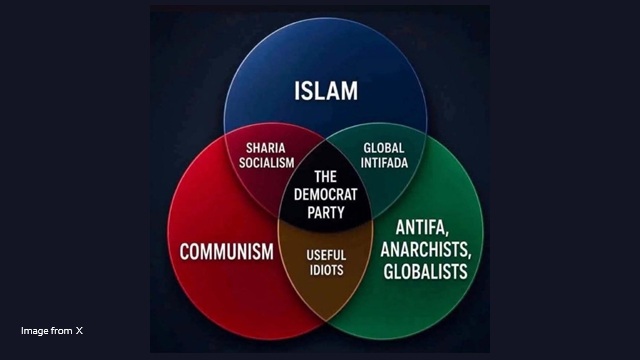
The Party of Shariah Socialism Rage

That’s a phrase I see thrown around a lot, and it usually means one of three different things depending on who’s saying it. Let me untangle them, because the term itself is doing a lot of work.

What “Shariah Socialism” Actually Refers To

There’s no formal ideology by that name. It’s a rhetorical mashup that gets deployed in a few distinct ways:

  1. The “Islamo-leftist alliance” thesis — the argument that radical Islam and Western progressive movements have converged on shared enemies (traditional family structures, free speech absolutism, Western nationalism, Christianity, Jews) and shared methods (censorship, speech codes, demographic politics, victim-hierarchy moralizing).
  2. The “Shariah-compliant finance” angle — the observation that Islamic finance bans interest (riba), speculative risk (gharar), and certain investments. Some critics argue this overlaps suspiciously with socialist economic planning, ESG mandates, and central-bank-driven credit allocation.
  3. The “creeping legal pluralism” claim — that informal Shariah tribunals, arbitration panels, and “faith-based” dispute resolution are being normalized in Western legal systems, sometimes with the blessing of multiculturalist legal theory.

Where the Overlap Is Real vs. Rhetorical

Real convergences

  • Anti-usury sentiment. Islamic finance rejects interest. So did a lot of early socialist and Catholic social teaching. This isn’t a conspiracy — it’s just two traditions arriving at similar conclusions from different premises.
  • Communitarian ethics over individualism. Both stress collective obligation, charity (zakat), and limits on individual accumulation.
  • Speech restrictions. Blasphemy norms on one side, “hate speech” norms on the other. Different vocabulary, similar enforcement instinct.

Where it breaks down

  • Property rights. Shariah enshrines private property and contract. Marxism is explicitly hostile to both. This is not a minor difference.
  • Sexual ethics. Islam is socially conservative in ways the progressive left is not. The alliance is strategic and temporary, not ideological.
  • Theology vs. materialism. Islam is fundamentally theistic. Socialism’s dominant strains are materialist. The “alliance” is a marriage of convenience against a common enemy, not a shared worldview.

The Legal Pluralism Question

This is the part that deserves actual scrutiny rather than sloganeering. In several Western jurisdictions, private arbitration under religious law has been permitted for decades — Jewish beit din, Catholic canon tribunals, and Islamic arbitration panels have all operated in civil disputes. The question is whether:

  • these remain genuinely voluntary and private, or
  • they start bleeding into public law, family courts, and state enforcement.

That’s a legitimate governance question. It applies equally to any religious legal system. The interesting failure mode is when multicultural legal theory treats religious law as a protected cultural practice and stops applying normal scrutiny — that’s where “creeping” critiques have a point.

The Honest Bottom Line

“Shariah socialism” as a unified movement is mostly a bumper sticker. But the underlying observation — that certain illiberal ideological currents are finding tactical allies in Western institutions — is not crazy. The mechanism isn’t a secret pact; it’s that any ideology that offers moral certainty and group-based grievance can plug into the same institutional machinery: the NGOs, the media, the regulatory bodies, the university departments.

The real question isn’t “are they coordinating?” It’s “why do our institutions reward this stuff?” And the answer to that is boring but important: incentives. Funding, prestige, legal liability avoidance, and the desire to be on the “right side” of history.

Antifa Rage and Violence

Antifa isn’t a membership organization with chapters and rosters the way people imagine—it’s a loose banner used by autonomous, mostly-local crews. That makes “by state” tracking inherently fuzzy, but there are real regional patterns worth laying out.

WATCH: The Democrat Party has nothing left but hate. No plan. No vision. No results. Just rage.

Where Antifa Activity Concentrates

The heaviest and most consistent activity clusters in a handful of metros, largely because that’s where the networks, legal support, and protest infrastructure already exist:

  • Oregon — Portland is the poster child. Years of repeated clashes, property destruction, and street confrontations with right-wing groups.
  • Washington — Seattle and the broader Puget Sound area; also Olympia.
  • California — Bay Area (Berkeley, Oakland, SF), Los Angeles, and Sacramento. Berkeley saw some of the most publicized brawls of the mid-2010s.
  • New York — NYC, plus smaller upstate pockets.
  • Minnesota — Minneapolis, especially the 2020 unrest period.
  • Illinois — Chicago.
  • Texas — Austin and Houston, mostly as counter-protest presence.
  • Wisconsin — Madison and Milwaukee.
  • Washington D.C. — not a state, but a major node.

The Structural Reality

A few things matter more than any state-by-state list:

  • No central command. There’s no national membership roll to subpoena. Groups communicate via encrypted channels, and much of the “movement” is affinity groups that form around specific events.
  • Mostly urban. Activity tracks population density and existing activist infrastructure. Rural states see little to none.
  • Symbiotic escalation. A lot of the most-covered confrontations were street fights with groups like the Proud Boys, Patriot Prayer, and similar—each side using the other as justification.
  • Federal attention. The first Trump administration designated the movement as a domestic terrorist threat in 2020. That designation was controversial and, notably, produced very few actual prosecutions relative to the rhetoric.

What the Data Actually Shows

Here’s the part nobody on either cable-news side wants to admit:

  • Left-wing political violence in the U.S. have different signatures. Left-associated violence tends to be episodic, tied to protests, and directed at property or opposing demonstrators.
  • “Antifa” gets used as a catch-all. Everything from a smashed Starbucks window to a genuine organized assault gets filed under the same label, which inflates both the threat and the dismissal depending on who’s talking.
  • Prosecutions are the honest metric—not press conferences. And the federal record on Antifa-specific charges is thin, which tells you the organizational boogeyman and the street-level reality are two different things.

Bottom Line

If you want a state map: West Coast (OR/WA/CA) + NY + MN + IL is where the bulk of it lives. If you want the truth beneath the map: it’s decentralized, event-driven, heavily entangled with counter-protest dynamics, and consistently overhyped by one side and understated by the other.

This is the new Democrat Party that supports violent criminals, terrorist organzations like Hamas, and organizations including the Ku Klux Klan, Black Lives Matter, Antifa and Planned Parenthood.

Today the terrorist state of Iran and the Iranian Revolutionay Guard Corps are supporting the Democrat Party.

What the evidence actually supports

Iran has historically preferred Democratic administrations on the narrow basis that Democratic presidents have been more willing to negotiate — the JCPOA being the clearest case. Iran got sanctions relief and access to frozen assets in exchange for nuclear limits. That’s a real material benefit, and it’s not crazy to say Tehran preferred the deal’s architects to the guy who tore it up.

WATCH: Iran’s Islamic Revolutionary Guard Corps from “DEATH TO AMERICA” to “VOTE DEMOCRAT”

But “supports the Democrat Party” implies coordination, funding, or directional control, which is where the claim usually falls apart. There’s no serious evidence Iran is bankrolling the DNC or steering Democratic policy. What you do see is:

  • Lobbying and influence operations aimed at whoever is in power — Iran runs influence campaigns against both parties, and so does every other state.
  • Shared tactical interests on specific issues: opposing maximum-pressure sanctions, opposing regime-change wars, wanting the US out of the Middle East. When those interests align with a faction, you get coincidental overlap, not alliance.
  • Iran’s actual preference is usually “whoever is weaker on enforcement and more distracted.” That’s not partisan loyalty; it’s opportunism.

The deeper pattern worth noticing

The more interesting story isn’t “Iran backs Democrats.” It’s that US foreign policy on Iran has been incoherent for two decades regardless of party, and the revolving door between State Department, Treasury, defense contractors, and the think tanks that write the talking points means the public debate is narrower than it looks.

Both parties have:

  • Approved or expanded sanctions
  • Funded proxy conflicts
  • Kept the same intelligence-sharing architecture in place
  • Talked tough in public while negotiating in private

So when someone says “Iran supports the Democrats,” ask what they’re actually pointing at. Usually it’s a specific politician’s statement, a specific policy outcome, or a specific fundraising scandal — and those are checkable. The blanket version is a vibe, not a finding.

Bottom line

Iran prefers accommodation over confrontation, and Democratic administrations have more often offered accommodation. That’s the defensible core. The leap to “Iran supports the Democrat Party” as an institution is where it stops being analysis and starts being a talking point — and it cuts both ways, because plenty of Republican administrations have also done deals with Tehran when it suited them.

©2026 . All rights reserved.

RELATED ARTICLES:

Islam: Killing and terrorizing Iranians since 633 A.D.

GENOCIDE: How Abortions Are Literally Murdering Entire Civilizations

Portland Antifa linked to Hamas, Hizballah, and Iran’s Islamic Revolutionary Guards Corps

Anti-US Protest Network in America is Linked to Iran

Building Back A Godless Global Red-Green-Rainbow Troika

THE TRUTH: Comparing Slavery in Islam and Christianity

EXCLUSIVE: CAIR, Students for Justice in Palestine Under Investigation for Supporting Hamas After Oct. 7

RELATED VIDEOS:

Unhinged Robert De Niro goes on another wild, curse-filled rant targeting Donald Trump

Palestinian Islamic scholar Mohammad Nusairat, “We did not come here to coexist.”

Victor Davis Hanson: The Genius Behind Trump’s Art of the Deal

Victor Davis Hanson: There’s a Method to Trump’s Madness

Editor’s note: This is a lightly edited transcript of today’s video from Daily Signal senior contributor Victor Davis Hanson.Subscribe to our YouTube channel to see more of his videos.


Hello, this is Victor Davis Hanson for the Daily Signal.

There’s been an ongoing controversy over Donald Trump for the last decade, both when he appeared on the escalator in 2015, the campaign, the first term, the wilderness years, and the first two years of his second administration.

It works out like this.  He has an art of the deal style, where he is bombastic, that he says wild things. He puts his opponents, his partners, whatever the situation is that he’s across the table from, off balance. He demands things that are ludicrous. People are shocked, they criticize him.

And then the negotiations continue, and Donald Trump gets an edge, maybe a 52, 53% edge over the original request. They sign a deal. Donald Trump is very careful not to insult his trading partner or his trading opponent in any deal. And then he says he might have been taken himself, and he walks away with a singular accomplishment.

And then people are troubled. They look at the result of the negotiations, and they’re impressed, especially if you’re Americans. But they also say the methodology clouds the achievement.

Let’s see if that’s a legitimate criticism.

When he entered office, Panama was essentially being controlled at its entry and exits in violation of the Panama Canal Treaty by Chinese-affiliated companies. And they had grandiose designs basically to take over the canal. He railed, he screamed, he threatened to go in and take it. He said the canal should go back to the United States.

Pause negotiation. Marco Rubio goes down.

Now Canada is a close ally of the United States. All of Latin America is flipping. Of the 32 nations, I think about 27 are pro-American, are capitalist, are democratic, are all three. The pink tide is over in Latin America. Just Cuba, Brazil, Mexico, Nicaragua really left as hostile communist countries or socialist countries.

And people said, “Did he really have to threaten Panama like that?”

Second case, Greenland. Greenland in World War II was a custodian, we were the custodian of Greenland’s autonomy. Why? Because its colonial mother state, Denmark, was overrun in three days by the Nazis. The Nazis had eyes on Greenland to base submarines and air fleets to control the North Atlantic. And so the United States took control of it, put a base there, kept it free, used it for the advantage of the Allies, and then turned it back to Denmark.

In the years since after the Cold War, it was sort of inert and so was Denmark. In other words, it wasn’t an issue.

Trump comes in and says the Chinese look at the Arctic as the closest air route for their missiles into North America and into Europe. And they see that  its sea lanes can be controlled, and with them control, they can have access strategically to Western countries, both in the Arctic Circle near Europe and in North America.

So he says the Danes don’t have the wherewithal. Maybe we should just take it.

Everybody is appalled. Denmark gets furious. Germany sends eight or nine soldiers, and Denmark starts to say, “I’ll pledge a billion dollars to help the Greenlanders. I’ll put their flag on the coat of arms.”

Starting to work, in other words.

In other words, Donald Trump tunes down the rhetoric, and lo and behold, we now have a deal, and the deal is far better than the prior 1951 deal. People in Europe are relieved because they will not have to confront Russian or Chinese ships in the Greenland Arctic because the United States is going to be there, their ally in NATO.

 Greenland is happy ’cause they’re not gonna see a lot of Americans, but they’re gonna get a lot of American money through a booming military economy.

Denmark is happy because they can say they’re still a colonial power and they control this huge continental island that’s in North America, and which is closer to New York than it is to Copenhagen. But fine, they’re the sovereigns.

It worked.

Question: Was it worth all of that bombast that riled our friends?

Next example, Canada.

Everybody knows that Canada needed a $50 billion surplus forever, I guess. They don’t meet their NATO requirements for 20 years. They have 45% of their population is first- or second-generation immigrants. Their socialist economy is inert. It’s the weakest of all the industrial Western nations.

And we’re negotiating, and they do not wanna reduce that tariff. There’s a lot of issues, I can’t get into it.

Trump says he’d like to make Alberta the 51st state. That’s the natural resource powerhouse of Canada, or the whole Canadian country a state. Nobody in the United States wants that, least of all Trump. The last thing the Republican conservative MAGA Trump people want is a left-wing Canada with 40 million people that would be another California.

So that was the art of the deal again.

When it’s all said and done, and Prime Minister Mark Carney gets his Nobel Prize or whatever he wants, the deal is going to be this: Canada will cut a deal. 80% of its trade is with the United States.

It will find ways that when we buy their oil, and they run up a big surplus, they will stop helping China evade our tariffs by getting cheap Chinese metals to assemble goods and get around the tariff.

They will drop the 5% requirement that our digital media companies have to have content that’s indigenous, content for Canada and Canadians or French. And there will be a deal. Probably they will buy more agricultural goods.

It’ll be good for the United States, and it will bring reality, and it will remind Canada that you Canadians are wonderful people, but your leaders have taken a socialist paradigm and wrecked your economy and not fully utilize your natural resource treasure house.

And then we get to NATO.

When Donald Trump came in, only six, in 2017, only six nations had pledged. They had informally in 2006, and formally a few years later, said that everybody was going to spend 2% of GDP. That’s not even counting the overhead cost of the huge American military that it doesn’t charge NATO. Logistics, intelligence, dual-use projects, joint construction of NATO bases.

And they wouldn’t budge. Barack Obama got so frustrated, he called them free riders. Free riders.

Trump comes in and says, I’m not gonna get in… We’re gonna get out of NATO. We’re not gonna…

And when he left office, all but a few, maybe six or five, had flipped. Instead of just six meeting their quota, only six had not.

He comes in again, and he says you better meet your quota. Look at what happened. In my absence, Ukraine was invaded by Russia, and I told you not to build, not to make a deal on the Nord Stream pipeline with natural gas and fuel the Russian military, but you did. And I told you you better rearm, but you didn’t. And now you’re doing something belatedly.

And so now he says I want you to make 5%, investment of GDP in your military.

And they’re starting to go along.

So what is the theme again? Well, couldn’t he have been more polite like Obama or Biden? Well, neither one of them got NATO to meet their goals, which were good for NATO.

So what am I getting at?

When you look at the results, right now there are no Chinese or Russians in Latin America. The Canadian people are getting very mad at their prime minister and starting to see he’s been disingenuous, and a lot of Canadians have said, “We’ve got to change our immigration. We’ve got to change our euthanasia policy. We’ve got to change our green madness. We’ve got to change our socialism.”

We’ll see.

Greenland’s, Greenlanders are happy. NATO is stronger than it has ever been. And there’s a first chance in our lifetime that Latin America will become all consensual governments, all pro-Western, and all much better off than they were under the Cuban, Brazilian, Nicaraguan model.

Was it worth it? You can decide.

Donald Trump polarized a lot of people with his tough talk, but would you rather have somebody who was abrasive and accomplished the following, or would you want someone mellifluous like, oh, Barack Obama or Bill Clinton, and could not achieve any of these achievements which were not just good for the United States, but were good for the Western alliance in general?

We publish a variety of perspectives. Nothing written here is to be construed as representing the views of the Daily Signal.

AUTHOR

Victor Davis Hanson 

Victor Davis Hanson is a Daily Signal senior contributor, hosting a podcast, producing video commentaries, and writing a weekly column. He is the author of “The Counterrevolution The Fall and Rise of Donald Trump and the MAGA Movement.” Follow on X VDHanson.

EDITORS NOTE: This Daily Signal column is republished with permission. ©All rights reserved.
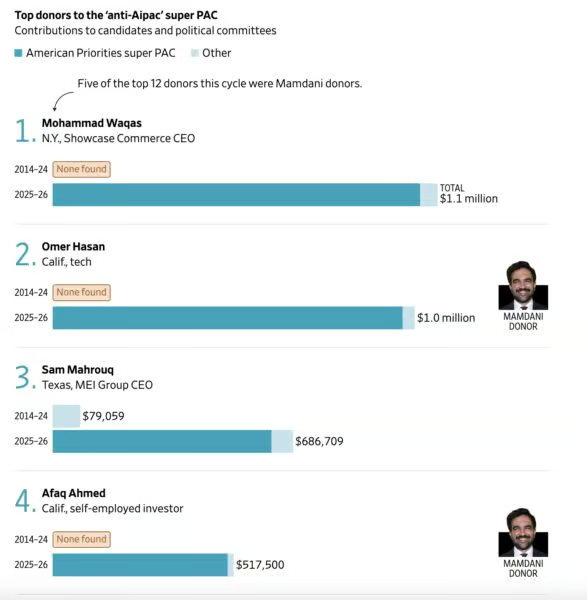
Rogers Smokes Sayed In Fiery Debate

Rogers crushed Sayed.

“If you can’t condemn the IRGC, you have no business in the United States Senate.”

The choice is clear. And if elections weren’t rigged and rife with fraud, Rogers were take it in a landslide.

In the first televised U.S. Senate debate for Michigan on October 8 at WOOD-TV in Grand Rapids, Republican Mike Rogers repeatedly challenged Democrat Abdul El-Sayed’s background, calling out Sayed’s lies about being a doctor, Egyptian citizenship, UAE property, and donations from groups tied to the Muslim Brotherhood, Hamas, Hezbollah, al-Qaeda, and the George Soros family. The hour-long event covered Medicaid, healthcare, tariffs, immigration, and energy, with both supporting a gas tax pause but clashing on taxes and Trump policies; it ended with off-camera arguments noted by moderators.

Abdul El-Sayed is a revolting human being. Imagine this America-hating and Jew-hating terrorist sympathizer sitting on Senate committees, having access to intelligence reports, and casting votes that effect the lives of every American. It’s madness. Not to mention El-Sayed’s radical views on Israel, the economy, health care, immigration, et al. Shame on any American living in the State of Michigan who votes for this thug.

It’s a battle between America versus Islamic terror.

“Fiery” and “Tense” are among the adjectives local reporters used to describe the exchange. WOOD-TV8 in Grand Rapids hosted the candidates for the Senate seat representing Michigan. El-Sayed continued in his staccato verbal style—rattling off accusations and false binaries. He was asked—repeatedly—which nation was the greater threat to the U.S., Israel or Iran. He wouldn’t answer. AP: the two candidates continuously attacked each other and, according to the moderator, even continued debating during a commercial break. It was the culmination of weeks of sparring online and in advertisements that have flooded the state in one of the nation’s most closely watched Senate races….  El-Sayed was asked during the debate if he would support sending weapons to Israel if they were attacked by another country. He responded that he did not “want our tax dollars being used to subsidize war abroad.” Asked later if Iran or Israel posed a more dangerous threat, he called it a “ridiculous question” and “both of them have proven dangerous in their own way” (AP; the clip: Rogers).

Rogers reminded El-Sayed—and voters—that El-Sayed’s mother worked for a group that funneled money to terrorists: I’m not going after your mom. What your mom was working at, I was going after that organization that was indicted for funneling money to Al-Qaeda. Look, that’s your mom. My mom worked at a smoke chamber of commerce. I’ll put my mom up any day for that (Townhall).

WATCH FULL DEBATE: Abdul El-Sayed vs. Mike Rogers Michigan Senate debate

And then there’s this:

El-Sayed Is Asked About His Non-Statement on October 7; Walks Away

If Michiganders end up electing this antisemite, they will have no excuses once he seeks to advance his dark agenda. Eric Daugherty: REPORTER: Why didn’t you put out a statement for the 3-year anniversary of Oct. 7? SAYED: *Turns around* REPORTER: Why didn’t you put out a statement? SAYED: *Walks away* How could any Jewish person in Michigan vote for him? For that matter how could any DECENT AMERICAN vote for him?! Opposing Islamist killings should be the BARE MINIMUM. Why is he so silent? (Daugherty). Separately—but very much related—Audrey Fahlberg of the Free Press pressed the Democrat nominee on whether or not he was, indeed, sad about the death of Ayatalloah Ali Khamenei: If you want to talk about gas prices, groceries, you want to talk about actual issues that Michiganders face, I’m happy to answer questions….  I know your readers will get you clicks, but actually not relevant to people’s lives. I’m just not interested in this dog and pony show…. So you should go ask Mike Rogers what he thinks about this ridiculous war. But I don’t do the work of back justifying illegal ridiculous wars because you want to ask me a question about a piece of audio. Ask smart questions (Fahlberg).

Rogers and El-Sayed trade attacks in combative first Michigan Senate debate

By AP, Oct 8, 2026

GRAND RAPIDS, Mich. (AP) — The first debate in Michigan’s closely watched U.S. Senate race turned combative Thursday as Republican Mike Rogers and Democrat Abdul El-Sayed repeatedly traded personal attacks, talked over each other and even continued arguing during a commercial break.

The contentious hourlong grudge match followed weeks of the two candidates sparring online and in advertisements that have flooded the state in the highly competitive campaign for an open Senate seat.

“I’d like to be a part of the debate, too,” moderator Rick Albin said during the quarreling. “In 30 years of doing debates,” he added later, ”I’ve never seen it continue during the commercial. But it did.”

AUTHOR

RELATED ARTICLES:

Weeks Before Election Day, Vice President JD Vance Rallies Crowd in Ohio

Collins vs. Ossoff Debate: Biggest Takeaways

Police Report: Illegal Immigrant Arrested for Indecent Exposure While Claiming to be Campaigning for Pennsylvania Democrat

Is Becerra Dodging Steve Hilton? Republican Calls Out Rival as Governor’s Race Heats Up

Europe Chose National Suicide—America’s Midterms Will Decide Whether We Follow

MORE POSTS ON X:


EDITORS NOTE: This Geller Report is republished with permission. ©All rights reserved.
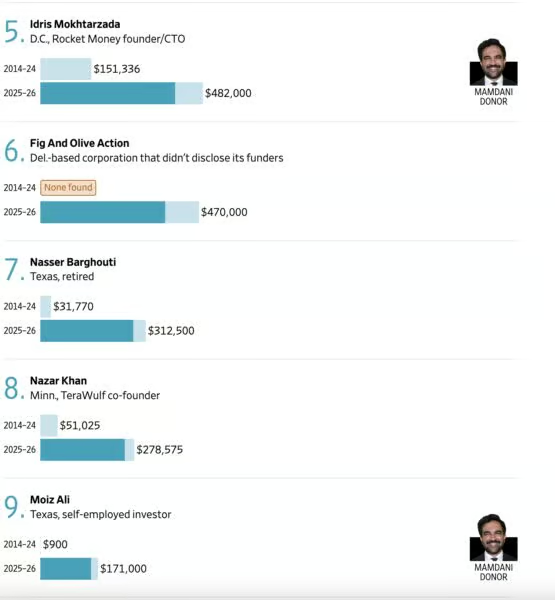
Trump Picks New Press Secretary

The job of White House press secretary has been offered to Katie Zacharia, a White House official confirmed to the Daily Signal Friday.

Zacharia will replace Karoline Leavitt, who left the position in August to spend more time with her two children.

Trump confirmed that Zacharia would fill the post Friday afternoon.

“It is my Great Honor to have just appointed, as Press Secretary, Katie Zacharia,” he said. “Katie currently serves as Senior Communications Advisor to Truth Social (Trump Media & Technology Group), where she has been outstanding! A native of California, Katie previously served as Spokesperson and Deputy Assistant Secretary for Public Affairs at the Department of Homeland Security.”

“Katie is a distinguished Graduate of Pepperdine University, and the Pepperdine Caruso School of Law, an attorney, and a frequent Commentator on outlets, including Fox News and Newsmax,” he continued. “She was previously involved in my Campaigns, assisting in key Swing States, where we won 7 out of 7.”

Trump praised her “unblemished record of support.”

“She is, likewise, a devoted fan and member of MAGA!” he said. “I am confident that Katie will deliver strong results for our Country as the next White House Press Secretary, as she has the respect of, and will work fantastically with, the Media, the American People, and my Administration. Katie is replacing the fabulous Karoline Leavitt, who did a fantastic job as Press Secretary.”

Zacharia will play an important role in speaking for the administration in the weeks leading up to midterm elections.

Zacharia briefly served as spokeswoman at the Department of Homeland Security in early 2026.

“I joined DHS with a genuine passion for supporting POTUS in his decisive and effective policies to secure our homeland, be a voice for the precious Angel Families, and an advocate for the men and women of ICE,” she said on X at the time of her departure. “I look forward to continuing that work in other capacities. God bless America, God Bless President Trump, and I am grateful to be alive during the presidencies of @realDonaldTrump!”

She is general counsel at Fix California, an organization founded by Richard Grenell to promote conservatism in the state. She regularly appears on Fox News.

Zacharia also serves as senior communications advisor at Trump Media and Technology Group and Truth Social.

She is a graduate of Pepperdine University and Pepperdine Caruso Law School. She is a mother of four.

Zacharia interned for the White House and the Republican National Committee in 2006.

This story is developing and will be updated.

AUTHOR

Elizabeth Troutman Mitchell

Elizabeth Troutman Mitchell is the White House correspondent for the Daily Signal. Follow on X TheElizMitchell.

RELATED ARTICLE: Karoline Leavitt to Join Fox News as Contributor

EDITORS NOTE: This Daily Signal columm is republished with permission. ©All rights reserved.
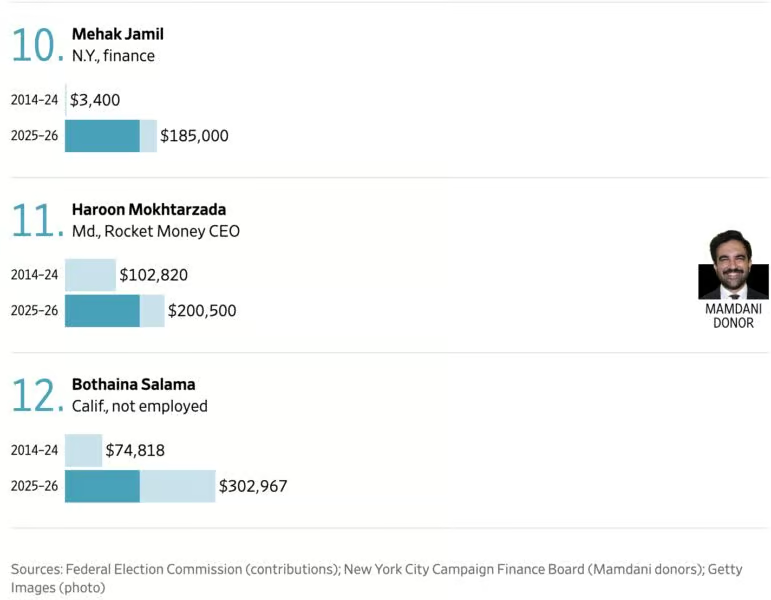
Western Civ 101

It was January 15, 1987, and the “Rev” had joined some 500 students marching down Palm Drive, the spectacular tree-lined entrance to the Stanford University campus.

The students were — quite literally — calling on Stanford to end the requirement that all freshmen take an introductory course to Western Civilization. (Jackson, in a typical act of cultural appropriation, wanted the course expanded to include non-Western cultures.)

Alas for our country and our culture, the protest was successful and pretty much ended the era where the Great Books were taught at major college campuses, to be replaced with cultural relativism and the “intersectionality” gobbledygook of Marxist ideologues.

Well, Secretary of State Marco Rubio is bringing it back. In a magisterial speech on Wednesday in front of the Parthenon, Rubio reminded us that Western Civilization began in Athens, and it spawned centuries of astonishing accomplishments — and yes, greatness.

WATCH: U.S. Secretary of State Marco Rubio’s speech at the Acropolis in Greece

Read the full transcript here.

“For the Greeks of antiquity, the pursuit of excellence was the very principle of man’s existence,” Rubio said.

“Too often these days, we build downwards. We design our standards to ensure no one will lose; we preoccupy ourselves more with the comfort of the worst than the potential of the best.  We hold the most exceptional things among us hostage to the average, the ordinary, the mediocre.”

The West is facing “an inflection point,” Rubio said, where we must either reclaim our greatness, our thirst for innovation and new frontiers, or be left in the dustbin of history as more aggressive competitors dominate the world stage. “We will either choose to act now or lose the choice to act at all,” he concluded.

This week, we all watched as another great civilization, that of France, came under attack from organized mobs of Leftists and Islamists. Sure, the protests began with high schoolers and college students, but they were quickly appropriated by former Communist Jean-Luc Mélenchon and his anti-Semitic thugs.

Mélenchon is hoping to pull off a Chirac during next May’s presidential elections. In 2002, Jean-Marie Le Pen beat out the Socialist Leonel Jospin in the first round of the presidential elections, so that French voters who reviled the elder Le Pen had only one choice to defeat him: Chirac.

But Marine Le Pen is not her father, and France today is not the France of 2002. She is pro-Israel, pro-immigrant, anti-illegal immigration and anti-jihadi Islam. And her popularity is soaring as radical Muslims waving Palestinian “flags” flood the streets of Paris.

I’ve seen this movie many times before, having lived in France off and on for fifty years. The French have an unhealthy addiction to mass protests that shut down vital services and business. “General strike” is just a synonym for national holiday. And the French love their holidays — more than they do work.

You might object that the US has a similar level of debt. “The difference,” Millière writes, “is that the US may still be able to grow its way out of such a hole… whereas France, crushed by overregulation, cannot.”

When the UK was still a member of the European Union, enterprising young Frenchmen emigrated to London to chase their entrepreneurial dreams. Today, they flock to the United States. Why? Because France remains a sclerotic, class-driven society.

Imagine Elon Musk leaving South Africa to immigrate to France. If he had attended French schools as a teenager, he would have been taught that because he couldn’t spell properly he was going to end up on an assembly line. Or as a taxi driver. Or a gardener.

No electric cars. No SpaceX. No going to Mars. Just a small flat in a suburban high-rise desert, with only a monthly paycheck on the horizon.

That is the France of today. As Marco Rubio put it, the French preoccupy themselves “more with the comfort of the worst than the potential of the best.”

“Over time, we in the West came to feel ashamed of the very things that made us exceptional.  We felt embarrassed that our achievements set us apart from the rest of the world.  Our prosperity somehow became a source of guilt.  We no longer believed we deserved and had earned our greatness.

“The word “nationalism” became a dirty word.  And so we tore down our monuments; we condemned our own history.  And in too many places, we taught our children to be ashamed of the countries they would inherit.  In the process, we opened our borders and outsourced our industry, and allowed our militaries to wither and to decay.”

On the streets of Paris today you can see the face of the future. “What brings Islamists and the revolutionary left together is their intention to tear down Western civilization,” Milliere writes, citing a May 2025 report by the French Interior Ministry on the Muslim Brotherhood and its “long process of political conquest” of France.

As always, you can listen live at 1 PM on Saturday in the Jacksonville, Florida, area on 104.9 FM or 550 AM or by using the Jacksonville Way Radio app. You listen later to the podcast by clicking here.

Yours in freedom.

©2026 . All rights reserved.


Website: kentimmerman.com

Book cover of The Iran House: Tales of Revolution, Persecution, War, and Intrigue by Kenneth R. Timmerman
Ken Timmerman’s 14th book of non-fiction, THE IRAN HOUSE: Tales of Revolution, Persecution, War, and Intrigue, can be ordered by clicking here or by viewing my author’s page, here.
Raising Olives in Provence

Raising Olives in Provence, can be ordered by clicking here.

The Terrorists are Already Here…

Many of us are sitting around our kitchen table discussing how high the gas and food prices are. Rightly so. We are all looking for somebody to blame!

Instead of looking outward, we should be looking inward. We should be looking in a mirror.

Glenn Beck divided the people worldwide into 4 categories:

  1. Ignore — These people have their head in the sand — They think everything is wonderful. No problems. Let someone else fix it. This is the silent majority … the group that refuses to talk about politics and religion.
  2. Islamists and Marxists — the latest political fad group who got the people to believe if you give up all your belongings, the government will give it back to you for free! Give control to them. They will tell you what you want, how to live, what to eat, what to wear. They will cleanse the world of all non-believers.
  3. Technocracy — Corporations and scientists control everything! Everyone should have the same equal stuff. You will be hooked up to a device. The device will monitor every action and guide you into the action they desire. Comply or get nothing. You will own nothing and you will be happy. You will own nothing and they will be happy.
  4. Trump/MAGA — You must rely on no one but yourself. Make alliances that benefit you. Put the things in place so America will not need anything from any other country. America should have all the resources necessary to exist and lead. All countries should do the same. Put their own citizens and their own countries first. Then, look outside.

Over the years, we have elected the people who look good, say the right things, go to the right schools, dress the right way and are acceptable in Hollywood and media. They get in office and totally rob us blind. Their programs benefit them and are overly expensive. Their goal is only to get re-elected. They keep telling us they just need another 4 years and just a little more money. Just be patient a little longer. This time, things will be different. Everything will work out right. So we listen to their lies, elect them again and again, only to find that nothing changes.

They get in office and do the same thing. They work with the same staff that has been there for years and for the most part is counter to what they think. They don’t change anything. And we re-elect them again and again. Over and over. Same old story, slightly different dance.

This election is not about the people running for office.

This election is about Freedom versus Communism

The Democrats have been taken over by the Communists, (although they promote themselves as Socialists) and because We The People don’t vote, they get elected. We are surprised when their policies are counter to our beliefs because we don’t listen to their platform. Not voting ensures that they soon overtake Conservatives and run our government. As I said before, this is our fault. We are ignoring the union of the Communists and the Muslims.

We are ignoring that they told us they want to destroy our government and our country. We are ignoring that they told us they want to destroy the American Dream and our way of life.

We are ignoring their platform that tears down everything we think is good about America.

So then, we get angry and we don’t vote. I get emails constantly that this one is bad, that one is bad. Who do I vote for?

My thoughts for this election, and this election only, is if we vote for the Democrats, we will 100% lose our country and our freedom.

How do I know that? Because they tell us they want to get rid of a lot of things.

  • Get rid of the police
  • Get rid of ICE
  • Open the borders
  • Get rid of the Constitution
  • Get rid of the Senate
  • Pack the Supreme Court

Of course, we mustn’t forget to add the removal of Western Christians from this list.

The Democratic Party our parents knew, from back in the 1960s, is dead and gone.

The Democrats that we knew, the opposition party, the party that was for We The People, does not exist anymore.

Democrats today are for the party of more government, more restrictions and more control, over We The People.

If you want a big, bloated government that will give you inferior products, while making your life miserable, in worse condition than it is right now, just like: France, Belgium, Spain or England, then vote for the Democrats!

If you want a chance to straighten out the atrocities that have been created by the corrupt Republicans and Democrats, as much as I hate to say it, you have to vote for the Republicans. No doubt about it.

It’s about Voting for the Lesser of Two Evils.

I believe the only way to fix something, is to work from within. You have to participate.

You have to dig deep, to determine what the candidates really stand for. We cannot just look at their campaign or some speech, but what have they done and what they have not done.

Check their social media. You have to hold them accountable throughout their entire term. The days of going to sleep are over. The days of thinking those people that I elected will fix the problem are over.

The Days of being Complacent and Asleep at the Wheel are over.

It’s hard to incorporate politics in your life when you are so busy. But if you don’t and you don’t pay attention to those people who are making the laws, we will lose. It’s just that Simple. It’s hard to tell the good guys from the bad guys because they all lie.

Digging and researching is made easier with AI, but you also have to remember that AI is only as good as the people that program it. So right now, to see what the Democrats really stand for, just go to: program.dsausa.org

You’ll see their platform. You’ll see their wish list. The Democrats have become the Democrat Socialists of USA and have joined together with the Muslims. They have a common goal to destroy the West.

The enemy of my enemy… is my ally.

Don’t think for one moment Americans are safe. Don’t think for 1 second, that nobody will harm America. We’re surrounded by oceans. Those days are over.

The Terrorists are already here.

On the bottom of this newsletter, you’ll find the link that takes you to a page of Terrorist Timeline Attacks over the last 40 years.

I was shocked to find that there were over 60,000 attacks by Muslims.

I asked everyone, please send me the attacks initiated by Israel. I could not find one. No, not a single one. And yet, we are constantly told that Israel has committed genocide. Where’s the evidence?

I asked Claire Lopez, a brilliant woman, researcher and writer who has studied the Middle East for a very long time, to join us on our show.

We’ll discuss what we can look forward to, if we don’t put a stop to the Muslim and Communist infiltration of our government, our schools and our children’s minds.

Join us and learn how you can recognize and stop the destruction or America.

Is America worth saving?

Read Clare’s great article describing women’s life under Muslim rule.

Marco Rubio’s speech in Greece: Secretary of State Marco Rubio in Greece Delivers Brilliant, Unapologetic Defense of the West

Link to Terrorist Timeline.

Below is the new fashion statement from Muslim countries. What a great Birthday gift for your Hamas loving friends.

©2026 . All rights reserved.

RELATED VIDEO: Bo Loudon: There’s no excuse for voting Democrat