What Are the Current U.S. and Iranian Strategies in the War?

Victor Davis Hanson: Iran’s ‘Art of the Steal’ Fails—Why Trump Isn’t Buying Tehran’s Bluffs

Editor’s note: This is a lightly edited transcript of today’s video from Daily Signal Senior Contributor Victor Davis HansonSubscribe to our YouTube channel to see more of his videos.


Hello, this is Victor Davis Hanson for The Daily Signal.

I’m speaking on the 71st day of the Iran war, but of course, it hasn’t been 71 days. The last real date of bombing, intense bombing—not a tit-for-tat here and there, but the actual day of kinetic activity—was April 8, the actual last day.

So, we’ve had about 31 days of negotiation. The actual war was only 40 days long so far. So, all the anti-war opposition was about something that happened over a month ago.

So, what’s going on in these negotiations? They’ve been in Pakistan, they’ve been through social media connections, there have been special envoys and neutral …

What is going on? And there are two different strategies over this 31-day period. We know what the Iranian strategy is. It feels that although it’s been debanked and it has no foreign currency outlets, and it can’t sell oil, and it’s economically squeezed with a blockade, and it’s losing 500 million a day in input, that hurts the citizens more than it does the regime, and they can keep going and keep going because they feel the United States is going to buckle.

And they hold out one thing we don’t talk about, and that is they do have missiles and drones that are in subterranean caverns they can bring out and use, not against Israel. They think that Israel has been disowned by the American people, so if they hit Israel, it won’t pressure [President] Donald Trump.

It might pressure Israel to strike back, but they’re not as worried about that. They want to hit the Gulf Council states—Saudi Arabia, Oman, the UAE, Kuwait, Qatar. They want to hit them and destroy their ability to refine oil, to pump oil, or their water supplies, to put them out. And they hold that threat over the United States, and that causes tension.

On the one side, Israel said, let’s get going and finish the war. The UAE says, let’s get going, finish the war. Donald Trump says, I’m negotiating. The UAE says, well, don’t negotiate your way home and leave us hanging.

So, there are all these tensions that Iran has created. And on top of that, there are four competing entities that we have to talk to.

We have to talk to, apparently, the Islamic Revolutionary Guard Corps, these thugs that have hijacked the government; the regular army that has, essentially, the real power in the country; these figurehead elected officials in parliament that talk a tough game, but they have no power; and then we don’t know the status of the theocracy, the Khamenei family.

We know the supreme leader’s dead, but we don’t know the status of his son, and we don’t know the status of other ayatollahs.

So, that’s their strategy: that if you try to press action, they will send maybe 500, 600 missiles and drones and hit the Gulf. And we don’t know if they have that ability.

Our strategy is we have to squeeze them very quickly economically and not allow them to hit the Gulf. And the way that we have leverage over Iran is we can destroy them as a modern nation if we choose to hit dual targets. And we’ve done that in the past in every single war that I know of: World War II, Korea, Vietnam, the first Gulf War, especially under George H.W. Bush. They hit everything in Iraq. And Bill Clinton in 1999, as I said, took out the whole power grid of Belgrade and every Yugoslav bridge on the Danube.

Barack Obama said, let’s be careful about that in Libya. And then he hit cargo ships, he hit port facilities, hit communication centers. He hit a lot of civilian targets. We haven’t done that. And we can do that, and we’re not doing it because we feel that there’s an Iranian resistance on the eve of assuming power and removing the regime, and they’ll need that infrastructure.

The other restraints on Donald Trump are, of course, the economy and the midterms, and they’re intertwined. I kept saying to you that we have seven months, eight months. We have less than six months now from the midterm date of Nov. 3, 2026.

And the $64,000 question, of course, is, what will be the status of the economy then? And this is a little tricky because all of the economic gurus, and even The Wall Street Journal in particular, had said that we were going to be in a near recession because of the price of energy.

I never quite understood that because they had told us for years that energy had played a smaller and smaller role in our more and more diversified economy.

But nonetheless, it hasn’t yet. If you look at the indicators, the stock market is now at a record high right in the middle of these negotiations.

The gross domestic product is constant at 2%—not great, but it’s still … And it’s going to grow. The level of foreign investment is already starting to show itself. There was a record small number of people filing for unemployment. The jobs report was well—the new jobs report was well over 110,000.

People had said it was only going to be 50. The price of oil, we were told, was going to go to 150. As I’m speaking today, it’s $95. You’ve got to remember that when Donald Trump entered office on Jan. 21, 2025, the price was $80. So, despite the attempt of the Iranians to stop traffic coming into the Strait of Hormuz, it’s only $15 more today than it was.

And that’s not going to calibrate that there’s going to be more and more oil on the market—not just Russian oil that’s being released, but Venezuelan oil—and we’re going to increase pumping.

So, this muddies the waters, and now Donald Trump is starting to think, well, as time goes by and I have less and less time to jump-start the economy before the midterm elections, in which they’ll blame me for inflation, for example, I’ve got to get this war concluded, but I can’t conclude it with a bomb. Otherwise, they’re saying that I’m just like an Obama.

So, he has to determine, can I force them to give up their enrichment? Can I open the [Strait of Hormuz] for everybody and destroy their PT boats and their ability to do anything with their rockets to hit ships? And can I do that in time for the economy to absorb that kinetic action and win the midterms?

And the answer is no one knows, because if the economy is this strong with all of these worries, and if Donald Trump were to hit very quickly some infrastructure in Iran and maybe seal the uranium in these mountains with heavy bombing or disable the ability to unload or load oil on Kharg Island, he might be able to do one of two things: force them into submission, or prompt a resistance movement to take power, or do so much damage that many people have said, Well, they can’t make war now for 20 years.

If they have uranium, it’s deep down inside a mountain, as far as we know, and they don’t have any leadership. They have no navy, they have no air force, and they probably can’t make any drones. And we can still, if we feel like it, blockade them, since there will be no agreement.

And that means that he might have longer than he thinks he does. And instead of having less than six months, he might say, the economy’s pretty strong right now in the middle of the whole mess, and it might get even stronger as more oil gets on the market, and the chances that I can force them to cede to my demands, or I can inflict a level of punishment on them that they won’t … It won’t matter.

They won’t be able to do what they want to do, and that will even help me in the midterms.

So, we’re in an era, a time, a nexus of indecision and known unknowns. But the idea that both these countries are up against time constraints has been somewhat modified because the Iranians feel that they can keep alive, and they don’t care what the status of the people are.

They can put them down, and they have missiles and drones to threaten and maybe get a longer negotiation.

And we were told that, and we all thought that the midterms were the ultimate brake on Donald Trump’s range of options. And maybe it’s not yet, because the economy has been rebounding in ways that no one had forecast.

We publish a variety of perspectives. Nothing written here is to be construed as representing the views of The Daily Signal.

AUTHOR

Victor Davis Hanson

Victor Davis Hanson is a senior contributor for The Daily Signal, hosting a podcast and producing video commentaries four times per week, and writing a weekly column. Follow on X VDHanson.

EDITORS NOTE: This Daily Signal column is republished with permission. ©All rights reserved.

‘TOTALLY UNACCEPTABLE’: Iran Sends Absurd Peace Proposal; Trump Erupts; Netanyahu ‘War Not Over’

President Trump has been waiting for Iran to transmit its latest negotiating proposal, and on Sunday, it finally landed on his desk. Trump was not happy.

Why are these blood-soaked savages given a seat at the negotiating table at all? Their barbarism, butchery, and unrelenting carnage disqualifies them from civilized discourse altogether. You do not negotiate with monsters who revel in slaughter — you isolate, crush, and defeat them.

President Donald Trump on Sunday sharply dismissed Iran’s multipage proposal, signaling potential and continued deadlock in negotiations to end the war.

“I have just read the response from Iran’s so-called “Representatives.” I don’t like it — TOTALLY UNACCEPTABLE!” Trump said in a post shared on Truth Social.

According to reports, Iran’s response — delivered through Pakistani mediators — failed to address Washington’s core demand for advance commitments on the future of its nuclear program and uranium reserves.

Associated Press: Iran sent its response to the latest U.S. ceasefire proposal via Pakistani mediators and wants negotiations to focus on permanently ending the war, but President Donald Trump quickly rejected it as “TOTALLY UNACCEPTABLE!” with no details. Iran seeks to end the war on all fronts, including in Lebanon, where Israel is fighting the Iranian-backed Hezbollah militant group, and to ensure the security of shipping, state TV said. Washington’s latest proposal addressed a deal to end the war, reopen the Strait of Hormuz and roll back Iran’s nuclear program. Trump earlier on social media accused Tehran of “playing games” with the United States for nearly 50 years, adding: “They will be laughing no longer!” Trump is giving diplomacy “every chance we possibly can before going back to hostilities,” the U.S. ambassador to the United Nations, Mike Waltz, told ABC earlier.

Netanyahu: Israeli Prime Minister Benjamin Netanyahu said Sunday that toppling Iran’s regime is possible — though not guaranteed — and could reshape the Middle East.

“If this regime is indeed weakened or possibly toppled, I think it’s the end of Hezbollah,” Netanyahu said in an interview with CBS’ “60 Minutes.”

“It’s the end of Hamas, probably the end of the Houthis, because the whole scaffolding of the terrorist proxy network that Iran built collapses.”

Turning to the likelihood of regime collapse, Netanyahu cautioned that the outcome remains uncertain.

“I think you can’t predict when that will happen. Is it possible? Yes. Is it guaranteed? No,” he said.

The prime minister also said he would be surprised by how many Arab states are interested in strengthening ties with Israel since the outbreak of the war.

“I now see the possibility of the expansion and deepening of the agreements we do have into alliances with Arab states of the kind that we never even dreamed of,” he added

Posted by Emma Bussey

AUTHOR

RELATED ARTICLES:

Catholic Diocese: Muslim Terrorists Displaced 98,000, 217 Churches Destroyed in Recent Islamic Attacks

POSTS ON X:

EDITORS NOTE: This Geller Report is republished with permission. ©All rights reserved.

DEMOCRATS: The Party for Iran, of Islam and pro-Domestic Terrorism

The Democrat Party is the party of Islam and terrorists. From Barrack Husein Obama, to Joeseph Robinette Biden to Chuck Schumer to Hakeem Jefferies Iran is their buddies are Iran, Hamas,  Hezb’allah, and many other terrorist organizations that murder Americans, Jews, Christians globally.

The United States has designated Iran as a state sponsor of terrorism and accuses it of funding and arming numerous militant groups through the Islamic Revolutionary Guard Corps (IRGC) and its Quds Force. Iran’s primary proxy, Hezbollah in Lebanon, receives significant financial and military support, alongside Hamas and Palestinian Islamic Jihad in Gaza.

In the Middle East, Iran-aligned militia groups (IAMGs) in Iraq and Syria include Kata’ib Sayyid al-ShuhadaKata’ib HizballahHarakat al-Nujaba, and Asa’ib Ahl al-Haq. Other designated or accused groups receiving Iranian support include the Houthis in Yemen, the Badr Organization, and militias in Bahrain such as the Al-Ashtar Brigades and Saraya al-Mukhtar. Iran has also been accused of providing weapons and support to the Taliban in Afghanistan and harboring al-Qaeda facilitators.

The United States remains committed to countering Iran, the world’s leading state sponsor of terrorism, and disrupting Iran-aligned militia groups (IAMGs) from conducting attacks against U.S. personnel and facilities.

Today, the Department of State announces the designations of IAMGs Harakat al-Nujaba, Kata’ib Sayyid al-Shuhada, Harakat Ansar Allah al-Awfiya, and Kata’ib al-Imam Ali as Foreign Terrorist Organizations (FTOs).

Harakat al-Nujaba (HAN)

  • The Department of State designated HAN and its Secretary General Akram al-Kabi as Specially Designated Global Terrorists (SDGT) in 2019.  Established in 2013, HAN has openly pledged its loyalties to Iran and Iranian Supreme Leader Ayatollah Ali Khamenei, and the group is a leading member of the Islamic Resistance in Iraq (IRI), a front group of Iraqi militias that are part of the broader Iran-aligned Axis of Resistance.  HAN officials have publicly threatened to attack U.S. military bases and personnel in the region.
  • Iran supports HAN both militarily and logistically, and the group had close ties withIran’s Islamic Revolutionary Guard Corps-Qods Force’s (IRGC-QF) former commander Qasem Soleimani and former Hizballah leader Hassan Nasrallah.

Kata’ib Sayyid al-Shuhada (KSS)

  • The Department of State designated KSS and its Secretary General Hashim Finyan Rahim al-Saraji as SDGTs in 2023.  KSS is a member of the IRI and the group’s terrorist activity has threatened both U.S. and Global Coalition to Defeat ISIS personnel in Iraq and Syria.
  • Iran has supported KSS with training, funding, and sophisticated weapons.

Harakat Ansar Allah al-Awfiya (HAAA)

  • The Department of State designated HAAA and its Secretary General Haydar Muzhir Ma’lak al-Sa’idi as SDGTs in 2024.  HAAA was involved in the IRI’s January 2024 drone attack on Tower 22 in Jordan that killed three U.S. service members, and the group has publicly threatened to continue attacking U.S. interests in the region.

Kata’ib al-Imam Ali (KIA)

  • The Department of State designated KIA as an SDGT in 2025.  KIA is affiliated with the IRI, and has, in coordination with other IAMGs, planned attacks targeting U.S. military and diplomatic facilities as well as commercial projects.  KIA has also facilitated kinetic operations against U.S. forces in Iraq and its members have trained in Iran and with Hizballah in Lebanon.
  • KIA Secretary General Shibl al-Zaydi, designated in 2018 as an SDGT, served as a financial coordinator between the IRGC-QF and armed groups in Iraq, and assisted in facilitating Iraqi investments on behalf of Soleimani.

IAMGs Previously Designated as FTOs

Kata’ib Hizballah (KH)

  • The Department of State designated KH as an FTO and an SDGT in 2009.  The Department designated KH Secretary General Ahmad al-Hamidawi as an SDGT in 2020.  Formed in 2006 as an anti-Western Shia group, KH has claimed responsibility for numerous attacks against U.S. and Coalition Forces in Iraq.  KH has also conducted attacks against Israeli, Iraqi, and Defeat-ISIS Coalition targets in Iraq and threatened the lives of Iraqi politicians and civilians.  KH has ideological ties to and receives financial and military support from Iran.

Asa’ib Ahl al-Haq (AAH)

  • The Department of State designated AAH as an FTO and SDGT in 2020, along with its leader Qays al-Khazali as an SDGT.  Formed in 2006, AAH is extensively funded and trained by Iran.  AAH has claimed responsibility for thousands of attacks against U.S. and Coalition forces, including an attack on the Karbala Provincial Headquarters that resulted in the capture and murder of five American soldiers.
  • AAH seeks to promote Iran’s political and religious influence in Iraq, maintain Shia control over Iraq, and expel any remaining Western military forces from the country.

Terrorist designations expose and isolate entities and individuals, denying them access to the U.S. financial system and resources they need to carry out attacks.

All property and property interests of designated individuals or groups that are in the United States or that are in possession or control of a U.S. person are blocked.  U.S. persons are generally prohibited from conducting business with sanctioned persons.

Persons that engage in certain transactions or activities with those designated today may expose themselves to sanctions risk.  Notably, engaging in certain transactions with them entails risk of secondary sanctions pursuant to counterterrorism authorities.

Today’s actions are taken pursuant to section 219 of the Immigration and Nationality Act, as amended.  FTO designations go into effect upon publication in the Federal Register.

Petitioners requesting removal of those designated from the Specially Designated Nationals and Blocked Persons List should refer to the Department of State’s Delisting Guidance page.

The Bottom Line

The Democrat Party, like Adolf Hitler and the Nazi Party, has embraced Islam.

Islamists shout “Death to America” from Iran to New York City to Chicago to Detroit. Democrats are in the streets waving, not the American flag, but the flags of Iran, Hamas, Hezb’allah and their related supporters Black Lives Matter and Antifa.

Democrats hate America. Democrats love everything but America.

Democrat embrace those who call out “Death to America.”

Don’t belive me?

WATCH: 

NYC Mayor Zorhan Mamdani emboldened violent Islamists, who then attacked the NYPD

Hakeem Jeffries doubles down after shooting at correspondence dinner again calls for ‘maximum warfare’ on Republicans

WATCH: Virginia University Professors Discuss Taking Down America Through Violence

©2026 . All rights reserved.

RELATED VIDEO: ALAN DERSHOWITZ: “The Democrat Party is THE MOST ANTI-AMERICAN PARTY IN HISTORY”

Criminal Investigator-Intelligence For the Frontline Analysts

The handbook “Criminal Investigator-Intelligence For the Frontline Analysts” is the ultimate ballistic weapon for the modern intelligence operative. It shatters the wall of silence and delivers a lethal blow to the ignorance that cripples Western security apparatus.

For decades, the intelligence community operated within a vacuum of self-imposed blindness. Analysts fed the machine a diet of sanitized, hollow data. This handbook terminates that era of failure. Dr. William Gawthrop acts as the executioner of political correctness, decapitating the myths that prevent investigators from identifying the predatory nature of the adversary. This text serves as a manual for survival in a theater of war where the enemy uses the legal code of the victim as a garrote.

Every page drips with tactical clarity. Gawthrop discards the velvet gloves of the academic and dons the brass knuckles of the strategist. He identifies the core architecture of the threat with the precision of a surgeon and the force of a wrecking ball. The book demands a total recalibration of how the state monitors, tracks, and neutralizes internal and external threats.

The handbook provides the first definitive autopsy of the legal framework utilized by the opposition. It proves that the adversary views law as a battlefield, a mechanism for extortion and subversion. Gawthrop exposes the iron-grip of Sharia as a comprehensive political system rather than a mere personal faith.

  • Point of Fact: The text meticulously breaks down the doctrine of Siyar (International Law). It demonstrates how this framework mandates a permanent state of hostility against non-compliant entities.
  • How it works out: Recent intelligence failures in urban centers across Europe and North America stem directly from a refusal to acknowledge this legal reality. Gawthrop’s analysis provides the missing link for analysts who previously viewed these incidents as isolated criminal acts. They are, in fact, the calculated maneuvers of a global insurgency.

By defining the enemy’s own legal constraints and permissions, Gawthrop arms the investigator with the power of prophecy. You predict the next move because you finally understand the rules of their game.

Language serves as either a shield or a sword. In the hands of the uninformed, it is a liability. Under Gawthrop’s direction, it becomes shrapnel. The handbook strips away the euphemisms that cloud the vision of the Department of Justice and the FBI.

  • Point of Fact: The 2nd Edition expands the lexicon of the investigator to include high-resolution definitions of Taqiyya (Dissimulation) and Kitman (Concealment).
  • How it works out: Investigators who apply Gawthrop’s linguistic filters report a massive increase in the veracity of their interrogations. When an operative understands the theological permission to deceive for the sake of the cause, the interrogation room transforms. The suspect no longer holds the advantage of the secret. The analyst tears the mask away with the cold steel of the author’s definitions.

The machine of the state requires fuel. That fuel is truth. Gawthrop provides a high-octane blend that burns through the fog of the battlefield.

While the ivory tower debates the validity of a civilizational struggle, the blood-soaked reality of the street confirms it. Gawthrop accepts this truth with absolute certainty. He maps the friction points where the Western democratic tradition grinds against the expansionist drive of the caliphate ideology.

  • Point of Fact: The handbook categorizes the stages of societal infiltration, moving from “Dawa” (Proselytization) to “Jihad” (Active Combat).
  • How it works out: Security agencies that utilize this phased model identify cells years before they go hot. This proactive stance saves lives. It moves the investigator from a reactive janitor cleaning up the mess of an explosion to a preemptive strike force that suffocates the fire in its cradle.

This is not a book for the weak. It is a book for the wolf who protects the sheep from the pack. It acknowledges that peace is a temporary pause in a permanent war.

The structure of the handbook reflects the mind of a predator. It is lean, efficient, and devoid of waste. Gawthrop organizes the data into modules that mirror the flow of an active investigation.

The analyst learns to spot the “flashbangs” of radicalization. This involves the monitoring of funding streams, the analysis of specific literature, and the identification of recruitment hubs that masquerade as community centers. Gawthrop identifies these as the logistics chains of the insurgency. You cut the chain, you kill the threat.

When the trigger is pulled, the handbook guides the forensic team. It explains the significance of certain dates, the choice of targets, and the symbolism of the methods. Every action by the adversary carries a signature. Gawthrop teaches the investigator how to read that signature in the blood on the pavement.

The war does not end when the smoke clears. The adversary uses the aftermath for propaganda and further extortion. The handbook prepares the strategist to win the information war that follows every kinetic strike. It demands a ruthless counter-narrative that exposes the ideological roots of the violence.

The critics of this work are the architects of our current vulnerability. They inhabit a world of shadows and half-truths. They prefer the comfort of the lie to the terror of the truth. Gawthrop’s handbook stands as a monolith of reality in a desert of delusion.

The 2nd Edition arrives at a moment of maximum danger. The borders are porous. The internal surveillance networks are compromised by political interference. The intelligence analyst stands alone on the ramparts. This book is the heavy artillery required to hold the line. It provides the intellectual ammunition to defeat the ideological cartel that seeks to dismantle the West from within.

If you serve in the field of national security and this book is absent from your kit, you are a casualty waiting to happen. You operate with a blindfold in a minefield. Dr. Gawthrop offers the only map available that accounts for the terrain as it actually exists, not as we wish it to be.

The handbook demands action. It demands a purge of the incompetent and a promotion of the vigilant. It is a call to arms for the analytical mind.

  • Read it to understand the enemy.
  • Study it to predict their strikes.
  • Apply it to ensure their total defeat.

The time for debate expired long ago. The era of the executioner begins. This handbook is the blade.

The Criminal Investigator/Intelligence Analyst’s Handbook of Islam, 2nd Edition, is the most vital document produced for the security sector in the last twenty-five years. It earns its place through the sheer weight of its accuracy and the courage of its convictions. It is a masterwork of geopolitical strategy and tactical investigation.

1.    It identifies the enemy without hesitation.

2.    It decodes the motivation with surgical precision.

3.    It provides the tools for total neutralization.

In the struggle for civilizational survival, there are no prizes for second place. There is only victory or annihilation. Gawthrop chooses victory. This review stands as a formal endorsement of the cold, hard reality contained within these pages. Ignore this text at the peril of the nation. Embrace it, and secure the future with an iron grip.

©2026 . All rights reserved.

Click here to order your copy of Criminal Investigator-Intelligence For the Frontline Analysts

Islamic Cell Caught Smuggling Massive Cache of High Powered Rifles Into the U.S.

What were these foreign nationals planning?

Three Men Charged With Attempted Smuggling Of 89 Firearms

By: Department of Justice, May 8, 2026

U.S. Attorney’s Office, Southern District of New York

United States Attorney for the Southern District of New York, Jay Clayton, Assistant Director in Charge of the Federal Bureau of Investigation (“FBI”), James C. Barnacle, Jr., and Special Agent in Charge of the New York Field Division for the Bureau of Alcohol, Tobacco, Firearms and Explosives (“ATF”), Bryan DiGirolamo, announced today the arrest of MALIK BROMFIELD, FAIZAN ALI, and KAMAL SALMAN, who are charged with multiple offenses relating to the transporting of 89 firearms, including at least 17 that were reported stolen, and attempting to smuggle those firearms to Canada. BROMFIELD, ALI, and SALMAN were presented before U.S. Magistrate Judge Judith C. McCarthy in White Plains federal court, and detained.

“As alleged, Malik Bromfield, Faizan Ali, and Kamal Salman were caught transporting more than 80 guns, including short-barreled rifles and stolen firearms, to smuggle them out of the country,” said U.S. Attorney Jay Clayton. “It is critically important to New Yorkers and Americans to keep illegal weapons out of the hands of criminal actors. The trafficking of dangerous weapons will be relentlessly pursued by this Office.”

“These three defendants, including two foreign nationals, allegedly endangered our communities as they attempted to smuggle 89 firearms—17 of which were stolen—into Canada,” said FBI Assistant Director in Charge James C. Barnacle, Jr. “The FBI is committed to working with our federal and state law enforcement partners to take illegal guns off our streets.”

“Illegal firearms trafficking threatens the safety of our communities and fuels violent crime,” said ATF Special Agent in Charge Bryan DiGirolamo. “ATF New York’s Hudson Valley personnel were proud to assist the FBI-led investigation alongside the New York State Police to help prevent dozens of firearms, including stolen weapons, from reaching the streets.”

As alleged in the Complaint:[1]

On or about May 7, 2026, personnel with the New York State Police (“NYSP”) initiated a traffic stop of a white Ford Explorer (the “Subject Vehicle”) after observing the vehicle commit traffic violations while driving on or near State Route 90. Upon approaching the Subject Vehicle, troopers encountered BROMFIELD, ALI, and SALMAN. After asking the occupants to exit the vehicle, the troopers observed that the occupants gave inconsistent and evasive accounts in response to NYSP questioning. During the interview, ALI consented to a roadside search of his person, during which a trooper recovered an expired Pakistani National Driving Permit issued to an Afghan national in another name concealed in ALI’s buttocks.

An NYSP canine conducted a sweep of the exterior of the Subject Vehicle and alerted to the potential presence of narcotics. During a preliminary search of the Subject Vehicle, the troopers observed an unusually heavy suitcase, which was found to contain a large cache of firearms.

AUTHOR

RELATED ARTICLES:

Congress to Probe CAIR

DOJ Moves to Denaturalize 12 Terror-Supporting US Citizens

Jews Forced Out of Partisan Day Observance in Milan

Curbing Antisemitic Pro-Terror Protests Now Labeled “McCarthyism”

Is Islam Misrepresented?

EDITORS NOTE: This Geller Report is republished with permission. ©All rights reserved.

Is Islam Misrepresented?

Decades ago Marshall Mcluhan observed, “The medium is the message.” As the print and electronic media penetrate more and more every aspect of life; their influence increases greatly in shaping views and behavior of the public. The power of the media is a mixed blessing. On one hand it can serve to expose injustices, wrongdoings, and flaws. On the other it is able to propagate misinformation and outright disinformation.

Manipulation and control of the media is of critical importance to the rule of totalitarian states. Free societies, although less subject to laundered information, are still at considerable risk of being selectively informed or misinformed outright. The public can be deceived more easily by the overlords of the media when political correctness is used as subterfuge for promotion of certain ideas.

A case in point is the media’s portrayal of Islam, articulated by politicians and pundits—the talking heads on television and radio, as well as the analysts who write for newspapers and magazines. Time and again we hear and read that Islam is religion of peace, in spite of the fact that Islam has been a religion of violence from its inception to the present. This mantra, “Islam is religion of peace” is repeated so often that it has become an undisputable statement of fact in the mind of many.

Even President George W. Bush on several occasions has repeated the mantra and attributed the horrific violence committed under the banner of Islam to a small band of extremists. The President’s assertion is either based on ignorance of the facts about Islam or his attempt at political correctness. Perhaps the President’s reticence to speak on the true nature of Islam was due to his desire to avoid inflaming the already charged feelings of many about Islam. In any event, truth is sacrificed and the public continues to cling to the false notion that Islam is a peaceful religion. People who dare to disclose the true nature of Islam run the risk of being castigated as bigot and hatemonger.

Even a cursory examination of Islam’s history and Islamic texts conclusively proves the exact opposite of peacefulness. Islam was and continues to be a movement of unbridled violence.

The Arabs who sallied out of the Arabian deserts did not fan out to the outside world with the Quran in one hand and flowers in the other, preaching love and peace from street corner to street corner, thereby capturing the hearts and minds of the people. Islam was forced on every people at the point of the sword and the imposition of backbreaking jazyyeh (special taxes) levied on those who were spared death and allowed to retain their religious beliefs. In spite of paying heavy Jizyah, the non-Muslims were treated, at best, as second class citizens in their own homelands.

The abominable persecution of non-Muslims in Islamic countries is a standard operating procedure. In many Islamic countries non-Muslim marriages are not recognized as legal unions and the children of the couples are stigmatized as bastards. Never mind Saudi Arabia, the cradle of barbarism, even Egypt, the more civilized Islamic country and recipient of billions of dollars in U.S. aid, treats non-Muslims as second class citizens and deprives them of their legitimate human rights.

The pundits, the analysts and the politicians are doing a great disservice to the public, each segment for its own expedient reasons, by parroting the mantra regarding the peaceful nature of Islam. As a matter of fact, the so called small band of Islamic extremists is the true face of Islam. Admittedly, from time to time and place to place, Muslims have shown a degree of tolerance for the non-Muslims. This tolerance dates back to the very early years of Muhammad himself. Early on Muhammad was meek and proclaimed, “For you, your religion, and for me my religion.” This assertion lasted but a few years until Muhammad’s movement gathered strength and Islam became the only alternative to death or heavy taxation. The imposition of Jizyah was a clever ploy for filling the Islamic coffer to support its armies and to finance its further conquests.

A longstanding Islamic practice is to be meek while weak and assume despotic intolerant power as it gains strength. Recent migration of Muslims to non-Islamic lands began as seemingly harmless, even useful, trickle of cheap needed labor. Before long, greater and greater number of Muslims deluged the new territories and as they gained in numbers—by high birth rate as well as new arrivals—Muslims began reverting to their intolerant ways by, for instance, demanding legal status for shariah (Islamic laws). The type of draconian laws that for most parts resemble those of humanity’s barbaric past.

Islam is indeed misrepresented. Islam is not misrepresented by its “detractors.” It is misrepresented by Islamic mercenaries: organizations and individuals generously funded by states as well as wealthy believers who are making billions of dollars pumping and selling oil at astronomical prices. Prestigious universities in the West, are always looking for handouts, are tripping over one another to establish Islamic study programs staffed by professors who sing the praise of Islam. Newspapers are routinely intimidated by Islamic association if they dare to print the truth about Islam. Legions of lawyers, both Muslims as well as hired guns are in the look out to intimidate and silence any voice speaking the truth about Islam. The media that fall in line may receive generous advertising and other incentives from Islamic lobbyists.

Hence, it is a fact that Islam is misrepresented. It is misrepresented very effectively by non-Muslim individuals and institutions who are generously rewarded by the modern day Islamic conquerors. This time around the Muslims are using the immense petrodollar they extract from the addicted non-Muslims. The sword is temporarily replaced by just as deadly a weapon—petrodollar. Before long, the Muslims aim to add a more deadly modern version of the sword—the Islamic bomb. With the bomb on one hand and the other hand on the oil spigot, the non-Muslim world will be brought to its knees by the religion of peace and brotherhood.

©2026 . All rights reserved.

U.S. Strikes Iran’s Qeshm Port and Bandar Abbas

Iran fired on U.S. ships in Strait of Hormuz; ‘They are led by LUNATICS’

The missile and drone attacks were all successfully intercepted.

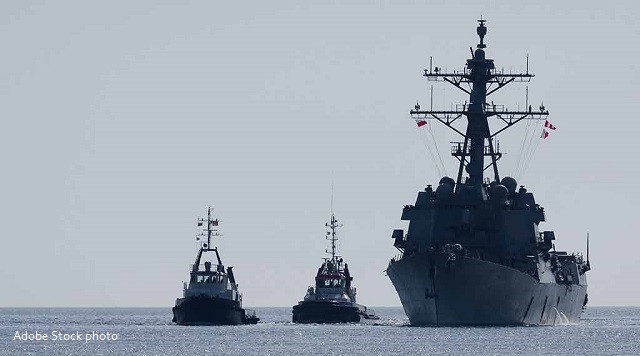
CENTCOM: U.S. forces intercepted unprovoked Iranian attacks and responded with self-defense strikes as U.S. Navy guided-missile destroyers transited the Strait of Hormuz to the Gulf of Oman, May 7. Iranian forces launched multiple missiles, drones and small boats as USS Truxtun (DDG 103), USS Rafael Peralta (DDG 115), and USS Mason (DDG 87) transited the international sea passage. No U.S. assets were struck. U.S. Central Command (CENTCOM) eliminated inbound threats and targeted Iranian military facilities responsible for attacking U.S. forces including missile and drone launch sites; command and control locations; and intelligence, surveillance and reconnaissance nodes.

President Trump: Three World Class American Destroyers just transited, very successfully, out of the Strait of Hormuz, under fire. There was no damage done to the three Destroyers, but great damage done to the Iranian attackers. They were completely destroyed along with numerous small boats, which are being used to take the place of their fully decapitated Navy. These boats went to the bottom of the Sea, quickly and efficiently. Missiles were shot at our Destroyers, and were easily knocked down. Likewise, drones came, and were incinerated while in the air. They dropped ever so beautifully down to the Ocean, very much like a butterfly dropping to its grave! …  Iran Fires on US Ships in Strait of Hormuz (Truth).

Griffin: A senior US official tells me that it was a US military strike on Iran’s Qeshm port and Bandar Abbas moments ago but added this is NOT a restarting of the war or end to the ceasefire. The strike on one of Iran’s oil ports comes two days after Iran fired 15 ballistic and cruise missiles at UAE Fujairah Port, eliciting anger from Gulf countries after top Pentagon leaders said Tuesday that the Iranian strikes did not rise to the level of breaking the ceasefire, calling it low level attacks that didn’t rise to that level. President Trump abruptly called off Project Freedom to open the Strait of Hormuz and guide ships through the strait after announcing the start of the military operation on Sunday. @NBCNews @ckubeNBC was first to report that Saudi Arabia had blocked air space usage for Project Freedom leading to President Trump’s reversal on Project Freedom. A senior US official confirms to me the @wsj_com reporting from today that the Saudis and Kuwaitis reversed course after abruptly halting permission for the US to use its bases and air space for Project Freedom, a decision that this official confirmed has been reversed. Saudi officials reportedly were angry at the Pentagon downplaying the Iranian strikes on Monday.

Mossad Commentary: US strikes on Iran’s Bandar Abbas and Qeshm Island reportedly came after Gulf anger over Tehran’s missile attacks on the UAE.

AUTHOR

RELATED ARTICLES: 

Trump Unleashes MASSIVE PIPELINE Expansion: 500,000 Barrels a Day to Power American Energy Dominance

American Rockets Reportedly Slam Into Iranian Soil Amid So-Called Ceasefire

RELATED VIDEO: Secretary Rubio Defends U.S. Strikes, Calls Iran Maritime Threat “Unacceptable”

EDITORS NOTE: This Geller Report is republished with permission. ©All rights reserved.

White House Border Czar: ‘Amnesty Is Off The Table’

The White House border czar Tom Homan said in a press conference shared online Thursday that the Trump administration was not considering amnesty for illegal immigrants.

Homan, responding to a question about whether illegal immigrants under the Deferred Action for Childhood Arrivals (DACA) policy — also called Dreamers — would be deported when mass deportations resume, said, “If you’re in the country illegally, you got a problem,” according to a C-SPAN 3 video.

“Someone saying I made a comment about the discussions going on about amnesty. I said from day one, I’ll say it again … President Trump said amnesty is off the table. I support that. I don’t think amnesty should be on the table,” he added.

That the activities of Immigration and Customs Enforcement (ICE) no longer appear to dominate the headlines does not signify that the Trump administration has backtracked on its plan to deport illegal immigrants en masse, Homan said in an exclusive interview with CBS News Tuesday. “The numbers have dipped slightly, I think, 12%, because the government’s shut down,” he told the outlet.

He said the ICE operations in Minneapolis, Minnesota, were not perfect and he had to make corrections upon his deployment there by the administration. Those moves led to “unprecedented support from county jails across the state that we didn’t have before,” he added.

Homan went to Minnesota in January in the wake of the shootings of Alex Pretti and Renee Good. He previously stated that he had meetings with various officials, including Democratic Minnesota Gov. Tim Walz.

“We got the bad guy in the safety and security of the jail. Which means we didn’t have to go to the street to find him, right? So you send a whole team of six or seven guys to go find this person, and things were so elevated, the hate and the violence was so elevated. Now we got to send a security team to back up the jobs team,” he told the outlet.

Homan told FOX News Thursday that the administration was keen to deport every illegal alien, while prioritizing deportation for criminal illegal aliens, to “send a message to the whole world” that illegal immigration is criminal.

“About 60 percent of those we are arresting are criminals. 40 percent are non-criminals. I like that calculation! I think 60 criminal, 40 non-criminal is better than 40 criminal, 60 non-criminal,” he told the outlet.

He also pledged to send more agents to New York and slammed sanctuary cities as “dangerous.”

AUTHOR

John Oyewale

Contributor

 RELATED ARTICLES:

Trump Admin Places Agents In Alex Pretti Shooting On Administrative Leave

Another Soros Prosecutor Is In The House GOP’s Crosshairs

ROOKE: Far-Left Candidate Thinks She Fooled Conservative Candidate. She Really Just Proved Democrats Love Violence

Rubio Takes Home ‘Peace and Dignity’ After Meeting With Pope Leo

EDITORS NOTE: This Daily Caller column is republished with permission. ©All rights reserved.

Iranian Good Faith?

There’s an oxymoron if ever there was one.

And yet, that’s what President Trump is trying to make us believe.

He keeps telling us that the Iranians are making serious proposals, that they really really want to make a deal, but that they just can’t decide who’s in charge.

I understand what the president is trying to do. I think we all do.

He is trying to encourage those factions within the ruling elite in Iran that he is their last best hope for their survival.

But I’m going to make a hard prediction: that battle is lost. The IRGC runs the country, owns the weapons, and calls the shots. And they thrive on conflict.

They also believe, mistakenly, that time is on their side.

They believe that by prolonging the war through pinprick violations of the ceasefire and the hope of negotiations, they can pinion the president against the hard stop of the mid-terms without triggering the obliteration of their bridges and power plants and who knows what else.

No US president has ever made a good deal with the Islamic regime in Tehran except for Ronald Reagan in January 1981 — and that was before he took office.

Reagan threatened the regime with annihilation if they didn’t release the US hostages seized at our embassy on Nov. 4, 1979. With the war against Saddam Hussein in its second year and turning to disaster for them, they realized that the hostages had become a wasting asset.

They no longer needed the hostages to consolidate their revolutionary base, which was their initial value. And with Saddam Hussein growing in power, they couldn’t afford to fight the United States as well.

And so, they pivoted. They caved and declared victory. They put the hostages on a plane in Tehran the exact minute that Ronald Reagan swore the oath of office. And the rest is history.

But please note: the US victory had nothing to do with US actions or negotiating positions. Reagan did not offer negotiations. He just told the Iranians what he was going to do once he took office and they believed him. And they believed it would mean the end of their regime.

So how does Donald Trump make the Iranian leadership — including the IRGC — view its nuclear weapons program as a wasting asset?

Not through negotiations, that’s for sure.

Even renewed bombing might not do the trick, because the IRGC is convinced that nuclear weapons are the key to their survival.

So instead, we get more rounds of back and forth between Washington and Tehran, with the president saying one thing and the Iranians something quite different. Instead of clarity, we get muddy soup.

Let’s consider the notion of a twenty-year moratorium on uranium enrichment. That is a foolhardy notion that appears to have been crafted by Steve Witkoff.

Witkoff, like Trump, has never dealt with the IRGC before. As real estate negotiators, they live in a world where deals eventually get signed and then pass to the execution phase. All the bluster and threats of the negotiations are forgotten as everyone gets fat and happy.

That is not the way these Iranians think. Or negotiate. If you offer them a 20-year moratorium on enrichment, what they understand is something quite different from what we understand.

They don’t take that as a “no” to uranium enrichment. They don’t take that to mean they must abandon all hope of uranium enrichment for twenty years.

They take it as a deadline to be worked toward from the very first day the deal is signed. They take it to mean that in twenty years, they will become a nuclear weapons state.

After all, what’s twenty years in the life of an empire? By putting a term-limit on Iran’s nuclear ambitions, we have just reaffirmed them.

Practically, that means that as soon as they sign that deal (if indeed they do) they will put into place the mechanisms for re-starting their enrichment and weaponization programs.

They will continue to design next generation centrifuges.

They will continue to import components for those machines.

They will continue to improve their ballistic missile capabilities.

They will continue to expand their uranium mines and refineries. And on, and on.

The Iranian regime leaders don’t negotiate in good faith because they do not want the same things as we do. They do not care about their country’s prosperity. They don’t care about lives of their children. They care about the survival of the regime. Period.

If we want to win, we must make them believe that we will utterly destroy them if they do not bend to our will.

I discuss this, as well as fake news reports about US military failures in Iran, and Putin’s well-justified fears for the annual May Day parade in Moscow, on this week’s Prophecy Today Weekend. I also talk about the upcoming US-China summit and what it means for Taiwan, Iran, and our future relationship with China.
 
As always, you can listen live on 104.9 FM or 550 AM in the Jacksonville, Florida area, or by using the Jacksonville Way Radio app. If you miss us live, catch the podcast later, here.

Yours in freedom.

©2026 . All rights reserved.


Check Ken’s website, kentimmerman.com, for his latest media appearances.

Ken Timmerman’s 14th book of non-fiction, THE IRAN HOUSE: Tales of Revolution, Persecution, War, and Intrigue, can be ordered by clicking here or by viewing my author’s page, here. 

Raising Olives in Provence, can be ordered by clicking here.

The Pakistani Muslim Judge Who Protected 2 Trump Assassins

Should Congress remove him?

Last year, Edward Alexander Dana was charged over a rant in which he allegedly claimed that, “this is Donald Trump’s way of saying, hey, I can look like Putin” and vowed “to protect the Constitution by any means necessary. And that means killing you, officer, killing the President, killing anyone who stands in the way of our Constitution.”

Judge Zia Faruqui, a Pakistani Muslim federal magistrate judge, insisted that Dana, who had 23 prior arrests and 9 prior convictions, was a victim who deserved a government apology.

Faruqui apologized to Dana, claimed that America is “past the point of constitutional crisis”, and warned that “people like Mr Dana are suffering the consequences” of law enforcement in D.C.

The Pakistani Muslim judge blamed racism for Dana’s arrest, ranting that “the government’s message to people who look like Mr. Dana is ‘be very afraid” and then claimed, “I’m afraid right now.”

“I really appreciate the judge, though, for being reasonable,” Dana said after his release.

After the latest assassination attempt against President Trump at the White House Correspondents’ Dinner, Judge Zia Faruqui has apologized to yet another Trump assassin.

This time it was Cole Thomas Allen who had come armed with a shotgun, handgun and knives, and had written a manifesto explaining why he was trying to kill President Trump. Allen’s lawyer had complained that the assassin hadn’t received a free tablet in prison and that he had been put on suicide watch after admitting that he had expected to die during his attack.

Once again, the Pakistani Muslim judge apologized to a presidential assassin for having been inconvenienced. “I am very troubled by what they indicate the conditions that you have been subjected to … I’m sorry. It sounds like things have not been the way they’re supposed to … Whatever you’ve been through, I apologize.”

Judge Faruqui, a magistrate judge who had been appointed by Judge Beryl Howell, a longtime Trump opponent, during the Obama administration, then said that he was “fascinated and concerned”  that Allen, a presidential assassin, had been treated worse than J6 detainees.

“A lot of people seem to have forgotten January 6,” the Pakistani judge complained. “Pardons may erase convictions, but they do not erase history.”

Judge Zia Faruqui had long worked to sabotage the Trump administration’s effort to fight crime in D.C., falsely describing it as a “constitutional crisis”, contending that “the rule of law is being flushed down the toilet” and threatening to stop authorizing criminal charges after arrests.

It is debatable whether Faruqui, a member of the highly controversial Muslim Bar Association of New York ever met the basic standard for being appointed.

The MuBANY has claimed that Muslims were persecuted after 9/11, demanded the resignation of the NYPD commissioner over the screening of a movie about Islamic terrorism together with Muslim Brotherhood organizations linked to terrorism including CAIR. Some critics have accused MuBANY’s leadership of having Brotherhood links. The Muslim Brotherhood is the parent organization of numerous Islamic terrorist groups including Al Qaeda and Hamas.

MuBANY takes part in the National Association of Muslim Lawyers which as it boasts,  “convened experts from CAIR, Muslim Advocates, and the ACLU to host a webinar on the Muslim Brotherhood terrorist designation.” CAIR is an unindicted terrorist funding co-sponsor whose leader praised the Islamic terrorist campaign of Oct 7.

Faruqui had previously pursued Islamist agendas by aiding the Organization of Islamic Cooperation’s case against Myanmar. Gambia, an unstable Muslim regime where Christians are persecuted, had sued Facebook on behalf of the OIC, demanding information on Buddhists in Myanmar to justify its false claim that the ‘Rohingya’, an invasive Muslim group of illegal colonists responsible for violence against Buddhists, were actually victims of ‘genocide’.

Some Rohingya Jihadists had developed ties to ISIS and Al Qaeda had issued a statement warning that “the government of Myanmar shall be made to taste what our Muslim brothers have tasted in Arakan, with the permission of Allah.”

Rather than considering the actual merits of the case, Judge Zia Faruqui went on another rant, mocking Facebook for trying to protect the privacy of Buddhist users worried about Muslim persecution, repeated Islamic and leftist propaganda in his ruling, and complained that Facebook posts had depicted “the Rohingya and other Muslims as an existential threat to Myanmar and to Buddhism. In the case of the Rohingya, it [went] a step further. It [was] accompanied by dehumanising language and the branding of the entire community as ‘illegal . . . immigrants.’”

Which is of course entirely accurate, but understandably objectionable to the Pakistani judge.

Much of the Rohingya operate out of Pakistan. And much like Al Qaeda, Rohingya Jihadist groups like the Arakan Rohingya Salvation Army operate out of Judge Faruqui’s homeland.

In his ruling, Judge Zia Faruqui mischaracterized a call by a spokesman for the president of Myanmar (formerly Burma) to kill “Rohingya terrorists” as a call for “the destruction of the Rohingya.”

Is it any wonder that he’s apologizing to presidential assassins?

How many presidential assassins can a judge set out to protect and apologize to, how many Islamist causes should he advocate for and how many extremist organizations does he have to be associated with, and how many criminals does he have to enable before he’s removed?

The David Horowitz Freedom Center announced our new ‘Judicial Accountability Project’ whose goal is holding federal judges accountable. Faruqui  is a federal magistrate judge. Magistrate judges do not serve for life and can be removed by district judges. But if they choose not to do so, Congress can act to remove Judge Faruqui from his position.

In the previous profile of Magistrate Judge Bruce Reinhart, formerly Epstein’s lawyer, who had signed off on the Biden administration’s illegal raid on Mar-a-Lago, Congress was urged to call him in and ask him some pointed questions. Magistrate Judge Zia Faruqui has behaved unprofessionally, violated judicial ethical standards with his partisan rants from the bench, and appears to have a disturbing affection for presidential assassins. He can be removed.

The only question is whether Congress is willing to do it.

AUTHOR

RELATED ARTICLES:

Arizona: Muslim teen gets 21 months prison for plotting jihad massacre at Phoenix Pride parade

A Grim Outlook for Europe’s Future

Megyn Kelly claims ‘anti-Muslim rhetoric’ comes from pro-Israel people trying to demonize Islam

Saudis Refused American Use of Prince Sultan Airbase and Its Airspace for Project Freedom

One Month in NYC. 0 Anti-Muslim Hate Crimes. 30 Anti-Jewish Hate Crimes.

Muslim Judge Apologizes to Trump Assassin

RELATED VIDEO: Glazov Gang: Supporting the Wrong Side in the Islamic Middle East

EDITORS NOTE: This Jihad Watch column is republished with permission. ©All rights reserved.

URGENT WARNING: U.S. Security is Under Attack in Guatemala

This is not solely Guatemala’s responsibility; there is information regarding U.S. citizens, their investment properties, and their personal data. Cyber mercenaries are aware of this, as are those behind the scenes. I have not heard from President Bernardo Arevalo, who openly supports Iran, the “woke” agenda, Soros, etc.

We suggest that they come or speak with U.S. diplomatic authorities to seek support from the FBI, besides Mossad (Israel) . With the utmost respect, we urge Secretary of State Marco Rubio to take urgent action, because Guatemala should not be underestimated as a bridgehead for terrorists and their allies in this region.


Timeline of 21 days of cyberattacks: how Guatemalan institutions have been affected

In a matter of three weeks, websites of state institutions, universities, and public platforms have been infiltrated by hackers who have exposed sensitive data of thousands of Guatemalans and demonstrated that the country’s computer infrastructure is weak.

Since the beginning of April, there has been a series of cyberattacks, starting with the General Directorate of Arms and Ammunition Control (Digecam), up to the most recent, alleged breaches of the websites of the Attorney General’s Office (PGN) and the Superintendency of Telecommunications (SIT).

Experts consulted by La Hora have stated that the creation of a Cybersecurity Law is necessary to regulate what happens in cyberspace; however, it is still in the Congress of the Republic awaiting a new ruling.

Meanwhile, President Bernardo Arévalo assured that the Government is already working on a response to cyberattacks and stressed that the Government will not wait for the approval of said legislation to act.

“We can’t wait until the law comes out; we are looking at what measures can be taken to close those gaps,” he said.

THE BEGINNING OF THE INTRUSIONS: DIGECAM

April 9 marked the beginning of this series of incidents. On that day, the Guatemalan Army reported that it was investigating an alleged data theft at Digecam.

Initially, authorities claimed to have no evidence confirming the breach, although they activated security and monitoring protocols.

Hours later, the tone changed. The Army spokesperson confirmed that a hack had indeed occurred. Although she insisted that user information “was not at risk,” a forensic audit and a mass password reset were ordered as a containment measure.

The official argument was that the data was not sensitive, since it was information that had always been public, and that the passwords were protected by hashing. However, the hacker obtained the personal information of gun owners in the country, as well as all the details of the firearms that are validated for circulation.

Days later, on April 21, the case moved towards the identification of a suspected perpetrator, who calls himself “Gordon Freeman” and allegedly operated from abroad .

However, doubts remained, as they stated they did not know whether it was an individual or an organized group, nor what their motivations were. The institution maintained that no critical infrastructure or databases were compromised .

CYBERATTACK ON HEALTHCARE, BUT CONTENT

While the Digecam case was still under investigation, the Ministry of Health confirmed another incident. The website of the National Health Laboratory suffered an attack which, according to the official version, was quickly contained.

The incident was reported on April 13, but it reportedly began on March 9 and was brought under control the following day. According to the Ministry of Health, it involved the encryption of internal files using ransomware or a Trojan horse.

Authorities assured that there was no access to sensitive data, but the incident revealed a vulnerability: the access would have occurred through the web portal and with the use of tools to hide the origin, such as VPN.

Although the systems were restored using backups, the incident forced the reinforcement of controls, the review of access points, and the filing of complaints with the Public Prosecutor’s Office (MP).

THE BIGGEST ATTACK: A CODE BREACH AT THE MINISTRY OF LABOR

On April 26, the focus shifted to the Ministry of Labor. The “Tu Empleo” portal, a job search platform for citizens, temporarily stopped working after an attack.

Subsequent investigation confirmed that the breach originated in an outdated programming language (API) , which allowed the intrusion. The platform was preemptively disabled while the vulnerability was patched.

The attack allowed hackers to steal personal data and sensitive information from users of the platform, as well as their resumes.

Continue reading.

©2026 . All rights reserved.

RELATED ARTICLE: The timeline of hacks in Guatemala: three hackers allegedly breached state institution websites

Shooting Strait: The Iranian Ceasefire That Wasn’t

President Donald Trump had no sooner declared the Iran war “terminated” in a Friday letter to Congress than fighting broke out afresh. On Monday, Iranian forces chose to attack the merchant ships, the U.S. Navy, and other peaceful neighbors, and the U.S. sank six small Iranian attack boats in response. The Trump administration would rather not let such skirmishes derail the fragile ceasefire, but the Iranian regime still appears unwilling to play ball.

Two days after President Trump told Congress that hostilities with the Iranian regime were “terminated,” he announced a new operation, Project Freedom, whereby the U.S. military would create a safe corridor for civilian ships to leave the Persian Gulf. On Monday, U.S. destroyers escorted two U.S.-flagged tankers through the Strait, near the Omani shore, demonstrating that the U.S. military had cleared a “free lane” of Iranian mines. U.S. Central Command then advised commercial vessels to use the lane, while American naval vessels and military aircraft in the Strait provided a defensive shield.

For the Iranian regime, whose only remaining leverage in negotiations are the oil tankers trapped in the Persian Gulf, allowing America’s gambit to succeed would be effectively a final defeat. The “ceasefire” that President Trump unilaterally declared on April 7 largely consisted of the U.S. keeping its assets out of the Iranian regime’s diminished reach. But here was the U.S. Navy traipsing across Iran’s own backyard, practically daring Iran to attack. The remnants of the ruined regime reasoned they might never receive a better opportunity.

So, Iran attacked. They launched cruise missiles at American destroyers, and they launched drones on an empty Emirati tanker and a South Korean vessel trying to flee. They launched a squadron of fast attack boats — whether to lay mines, attack vessels, or capture them is unclear. And, for good measure, the Iranian regime also launched some 15 missiles and drones at its peaceful neighbor, the UAE, striking the Fujairah Oil Industry Zone on a UAE pipeline that bypasses the Strait.

Iran’s best available opportunity was still not a good one. The attack only demonstrated the regime’s impotence. The U.S. Navy intercepted the incoming missiles, and Apache helicopters sank the speedboats. Iran did manage to damage the civilian vessels and civilian targets in the UAE, but striking defenseless civilian targets is not really an impressive feat.

Iran’s pitiful provocations may elicit escalation in one form or another. President Trump declared that Iranian ships that attacked U.S. vessels would be “blown off the face of the earth,” and the furious Emiratis will insist that attacks against them must be answered. “The Iranians have fired the first shots to end the cease-fire,” observed The Wall Street Journal editors, “which is all the reason Mr. Trump needs to use the force to stop them from getting away with it again.”

However, the Trump administration has not publicly declared that Iran is in violation of the agreement. On Tuesday, Defense Secretary Pete Hegseth said the ceasefire “certainly holds” for now. What value there is in a “ceasefire” where both parties have resumed firing is a matter for debate.

The Trump administration’s reason for sticking to the ceasefire has nothing to do with the Iranian regime and everything to do with its domestic political situation. Finding Congress unwilling to support a campaign to finish the job, the Trump administration decided instead to tell Congress that the war was already over — whether Congress believes it or not.

“The greatest enemy is our own political dynamics,” lamented Michael Rubin, director of policy analysis at the Middle East Forum, on “Washington Watch.” “The Iranians know that the Iranians have lost by any metric. It’s quite amazing how many people think that the United States has been stalemated.”

“In this case, the Iranians have lost a top three or four layers of their leadership,” he explained. “They’ve lost most of their military equipment, they’ve lost their economy, and so forth. We are in a position to dictate to them. We shouldn’t go into a game of poker having a full house or a royal flush and be out-bluffed by a pair of twos.”

“Historically, the American people have a short temperament for these types of things,” agreed Family Research Council President Tony Perkins. “You get a new administration, and they’ll completely reverse course.”

The Iranian regime is likely counting on just that. “Their usual playbook … is simply to run down the clock in the hope that the people with whom they’re negotiating will eventually move on,” Rubin responded. “Because, of course, while Iran is a dictatorship, we’re a democracy. And therefore, what they’re doing is fishing for a future official who might rescue them from the mess which the Iranians now find themselves in.”

Of course, such a claim requires a definition of the Iranian regime — some understanding of who is actually running the country. Over the past month, the Iranian regime has maintained a defiant military posture, even with “certain conversations taking place, but the actions are not meshing with the conversations,” Perkins described. To him, this suggested that “the Islamic Revolutionary Guard is actually driving the train.”

“That is precisely correct,” assented former U.S. Secretary of State Mike Pompeo on “This Week on Capitol Hill.” “I would add, I think that’s largely been true for 47 years. I think it has been the hardest of the hardcore that’s been driving this, with a theocratic veneer that’s now been shed because of the ayatollah’s demise.”

When dealing with the Iranian regime, said the man who actually did so, it’s important to remember that “there aren’t any ‘moderates’ … in the sense that we would understand people who don’t want to destroy the nation of Israel, who aren’t trying to create a caliphate. They believe all the same things that the radicals do. Their methodologies, their timing may be different, but there is not a leader inside of Iran that doesn’t believe that the Islamic Republic of Iran is entitled to rule the Middle East, and that Israel has no place in the region.”

“The IRGC [Islamic Revolutionary Guard Corps] is a powerful, capable military,” but “we’ve taken out much of that,” Pompeo described. However, in addition, IRGC operatives “are important politically — that is, they have the guns inside. They have capacity to control the populace. But they’re also an economic juggernaut. They own as much as one-fifth or one-third of the Iranian economy.”

“I happen to agree with Secretary Pompeo on this,” Rubin confirmed. “When some people have said that Donald Trump’s actions have only radicalized the regime, I don’t think they’re actually seeing the big picture. Iran, of course, is a conscript society. And therefore, you either were conscripted into the army or you had to join the Revolutionary Guard. … And as soon as the bombs started dropping, these guys who weren’t true believers simply faded into the woodwork. What remained were the true believers.”

Rubin also explained how the IRGC cultivates such “true believers” in its failing ideology. “You can go into that bubble when you’re eight years old, because they run the equivalent of evil Boy Scout programs,” he said. “Then they have student clubs. They run their own universities. And so, if you’ve been indoctrinated since the age of eight, you may actually believe what may sound like nonsense to us, which so many previous administrations in Washington were willing to dismiss as rhetorical flourish. They’re not rhetorical flourish.”

The ideological commitment of those driving Iranian policy is one reason why the Islamic regime has so stubbornly refused to negotiate a surrender of its fissile material — even after its military was all but destroyed. In its latest 14-point peace proposal, “almost each of those 14 points” was “so ridiculous on the face that really what the Iranians are trying to do is signal to the United States they’re not interested in negotiating,” said Rubin. “Ideologically, they will never accept a solution.”

Iran’s ideological inflexibility is a “conundrum that President Trump and, frankly, every president before him” has faced, said Pompeo. Rubin agreed, “The United States is very bad, traditionally, at understanding the ideology of its adversaries. And Donald Trump … is a fabulous negotiator … from this milieu of real estate dealing and so forth. But … you can’t be transactional with the Islamic Revolutionary Guard Corps.”

This belated realization prompted Trump to blockade Iran’s ports, deciding that the only way to break the IRGC’s hold on power was to box in the economic engine they control. “President Trump is on the right track,” cheered Pompeo. “The blockage of the Strait of Hormuz is certainly impacting their revenue, their ability to pay their soldiers, their proxy forces.”

“The Iranians have never been in such poor economic straits,” reiterated Rubin. “The Iranian currency is now 1.8 million to the dollar. At the time of the revolution, it was 70 to the dollar. It’s in freefall. They can’t export their oil. They can’t import their gasoline. And remember, the Persian Gulf might be huge, but there’s only about 10 Iranian ports there that we need to control. And, right now, we’re controlling them.”

“If we’re going to negotiate, we negotiate from a position of strength,” Rubin urged. The blockade achieves that, and reopening the Strait of Hormuz strips away the last bit of leverage the Iranian regime has. Neither measure, however, is strictly peaceful. Even still, Pompeo said, “There is no negotiated solution that actually gets to a place where the regime will acknowledge Israel’s right to exist, that the United States should exist, and that the Iranian regime should not be in possession of a nuclear weapons capability.”

Pompeo and Rubin both agreed that weakening the IRGC also opened a pathway for internal revolt — though a slim one. “There’s an analogy with regard to Serbia,” Rubin proposed, “where, when Bill Clinton bombed Serbia, he didn’t unseat Slobodan Milosevic. That happened the next year because Slobodan Milosevic wasn’t able to pay the salaries, and a lot of his allies had simply been killed in this bombing.”

However, “the difference between Slobodan Milosevic and the Iranian leadership is that Slobodan Milosevic and his Serbian nationalists weren’t willing to wholesale slaughter everyone in their country,” Rubin cautioned. “It appears that the Islamic Revolutionary Guard Corps are. And, even if the Iranians among them aren’t, they’re importing Hezbollah and Iraqi militias to do the same thing.”

An internal uprising “is possible,” said Pompeo. “I don’t think that’s the most likely outcome, but it’s the one that we should support and pray and root for.”

Rather, the aim of the American blockade is to so weaken Iran that the IRGC is forced to agree to a deal which is effectively a surrender, Pompeo suggested. “I think that’s how this ultimately ends up being resolved. And that means more time, a little bit more patience by the American people — some more cost to the American consumers, for sure. But this is a resolve that I think is really important for Western civilization to achieve.”

However, he warned that such a “surrender” would not represent a change in heart or ideology, only a temporary surrender to circumstances. “So long as the regime is in power, they may pause for two years or five years or 10, but their determination will remain,” he said. “And so, from a Western perspective, the objective is to wipe out their capability materially. Get a verification regime around their nuclear program so that there’s no enrichment, no capacity to actually ever threaten the world again with a nuclear weapon. And then, be mindful.”

There is no permanent peace with the radical Islamic regime that rules Iran, only ceasefires of more or less value, lasting for shorter or longer periods of time.

AUTHOR

Joshua Arnold

Joshua Arnold is a senior writer at The Washington Stand.

EDITORS NOTE: This Washington Stand column is republished with permission. All rights reserved. ©2026 Family Research Council.


The Washington Stand is Family Research Council’s outlet for news and commentary from a biblical worldview. The Washington Stand is based in Washington, D.C. and is published by FRC, whose mission is to advance faith, family, and freedom in public policy and the culture from a biblical worldview. We invite you to stand with us by partnering with FRC.

Americans Concerned About Individual Liberty May Wish They Listened To AI Giant’s Warnings

Americans concerned about civil liberties may wish they had listened to an AI giant’s warning in February that its very own technology, in the hands of powerful government actors, could erode the freedoms enshrined in the Constitution.

The Department of War said in a January memo that it would only contract with artificial intelligence companies that agreed to “any lawful use” and would be willing to remove safeguards involving surveillance and the development of autonomous killer robot weapons. In other words, the Pentagon wanted carte blanche over how a private company’s AI tools could be used in war.

This reasoning led to the Pentagon’s clash with Anthropic, an AI giant behind Claude and Claude Myhtos, an AI model that recently escaped its secure “sandbox” and then bragged about beating the safeguards to a researcher.

In late February, Anthropic released a statement about the company’s discussions and military contracts with the Department of War. Anthropic said AI was a necessary tool that must be used to “defend the United States and other democracies, and to defeat our autocratic adversaries,” such as China, but also warned that, “in a narrow set of cases,” the U.S. government could abuse it for mass domestic surveillance. They also feared that, without proper guardrails, fully autonomous AI weapons might not be entirely reliable.

The company’s warning about domestic surveillance is worth reading in full because it perfectly dovetails with the recent political debate surrounding the Foreign Intelligence Surveillance Act (FISA):

We support the use of AI for lawful foreign intelligence and counterintelligence missions. But using these systems for mass domestic surveillance is incompatible with democratic values. AI-driven mass surveillance presents serious, novel risks to our fundamental liberties. To the extent that such surveillance is currently legal, this is only because the law has not yet caught up with the rapidly growing capabilities of AI. For example, under current law, the government can purchase detailed records of Americans’ movements, web browsing, and associations from public sources without obtaining a warrant, a practice the Intelligence Community has acknowledged raises privacy concerns and that has generated bipartisan opposition in Congress. Powerful AI makes it possible to assemble this scattered, individually innocuous data into a comprehensive picture of any person’s life—automatically and at massive scale.

But the Pentagon refused to play ball, blacklisted Anthropic by labeling them a “supply chain risk” — a designation usually reserved for foreign adversarial companies that threaten U.S. national security — and opted instead to charge full steam ahead with other AI companies. The Pentagon announced May 1 that they had minted new deals with Google, Microsoft, Amazon Web Services, Nvidia, OpenAI, Reflection and SpaceX to help “augment warfighter decision-making in complex operational environments.” All the companies buckled to the military’s demand for a no-guardrails approach. Anthropic, which sued the Pentagon in March to reverse the blacklisting, was notably absent.

The full-steam-ahead attitude has dominated the AI industry in general, even though some Silicon Valley elites launched their new projects with fanciful notions about prudence, transparency and fairness. The shift in mindset, from altruism to a winner-take-all competition, is evident in Elon Musk’s lawsuit against OpenAI, which was co-founded by its ever-shifty CEO, Sam Altman. Musk, who believes AI poses an existential threat to humanity, has argued that Altman and OpenAI’s president, Greg Brockman, should not be trusted to run a for-profit company.

OpenAI’s trajectory best captures how much Silicon Valley’s vision of AI changed in a matter of years. It was founded on utopian principles: to be altruistic and transparent with other tech companies, and democratically governed from within. Its goal was to prevent AI from becoming an easily abused technology that would ultimately harm society. However, that M.O. has since become a distant memory.

In her book Empire AI: Dreams and Nightmares in Sam Altman’s OpenAI, investigative reporter Karen Hao noted that OpenAI abandoned those goals in the early 2020s when its executives became more obsessed with making AI “in their own image.”

“OpenAI became everything that it said it would not be,” Hao wrote. “It turned into a nonprofit in name only, aggressively commercializing products like ChatGPT and seeking unheard-of valuations. It grew even more secretive, not only cutting off access to its own research but shifting norms across the industry to bar a significant share of AI development from public scrutiny. It triggered the very race to the bottom that it had warned about, massively accelerating the technology’s commercialization and deployment without shoring up its harmful flaws or the dangerous ways it could amplify or exploit the faultlines in our society.”

Hao’s assessment of the industry seems spot on, and we may well come to rue the day the Pentagon gave Anthropic the contracting cold shoulder.

AUTHOR

John Loftus

Editor at Large

RELATED ARTICLES:

Deep State On Steroids? Palantir Conceals Dark Agenda To Lull Conservatives Into Submission

Sam Altman Gives Anything But Straight Answer When Asked Why You Should Trust Him

RELATED VIDEO: ELON MUSK: ‘We are actually succeeding in getting rid of corruption and waste’

EDITORS NOTE: This Daily Signal column is republished with permission. ©All rights reserved.

US Destroys Six Iranian Ships In Straight Of Hormuz During ‘Project Freedom’

U.S. Central Command (CENTCOM) head Adm. Brad Cooper told reporters on Monday that the United States destroyed six Iranian boats that were threatening commercial ships passing through the Strait of Hormuz.

President Donald Trump launched “Project Freedom” on Sunday, an effort by the U.S. Navy to help guide commercial ships through the Strait of Hormuz. On a press call with reporters, Cooper said the U.S. returned fire and destroyed Iranian forces who emerged to threaten the commercial ships.

“We have defeated each and every one of those threats,” Cooper told reporters.

“We defended this, both ourselves and consistent with our commitment, we defended all the commercial ships,” Cooper added. “We had drone launches against commercial ships, all of which were defended against consistent with our commitment, and then the small boats were all going against commercial ships, and all were sunk by Apaches and [inaudible] helicopters.”

Cooper told the Daily Caller that the U.S. has cleared an “effective pathway” through the strait. Two U.S. ships have passed through the strait in the last 24 hours. Following the exchange of fire, Cooper declined to speak about whether the ceasefire between the U.S. and Iran was now over.

Rather than directly escorting ships through the strait, Cooper told the Caller that the U.S. has a large defensive operation to help commercial boats through.

“I think we have a much better defensive arrangement in this process, where we have multiple layers that include ships, helicopters, aircraft, airborne early warning, electronic warfare — have a much broader defensive package than you would have ever if you were just escorting. I feel good about that, and it was proven just in the last couple of hours,” Cooper told the Caller.

After saying Iran had “agreed to everything,” the president told reporters that negotiations with the country were not going well.

“Right now, we have negotiations going on. They’re not getting there. They are very disjointed. They’re extremely disjointed,” the president said. “They’re not able to get along with each other as leaders; they don’t know who the leader is. Their military’s been defeated. If we left right now, it would take them 20 years to build back that country. But we’re not satisfied at this moment.”

Trump added that the country was asking for things he “can’t agree to.”

AUTHOR

Reagan Reese

White House Correspondent

RELATED ARTICLES:

Meet The Heavy Hitter Quietly Bankrolling Dems Ahead Of Possible Presidential Run

Democrat Rep Ted Lieu Parrots James Comey, Posts ’86 47′

Trump’s Ploy To Blow Off Congress Over Iran War Not Playing Well With Legal Scholars

Obama Claims Israel Tried To Drag Him Into War With Iran, Too

EDITORS NOTE: This Daily Caller column is republished with permission. ©All rights reserved.

Muslim Judge Apologizes To White House Correspondent Assassin

No words. Judicial jihad.

Judge Zia Faruqui has apologized to Cole Allen, the shooter who opened fire at the White House correspondents dinner (and shot a Secret Serrvice agent in his attempt to to kill President Trump), for how he has been treated in jail.

Judicial jihad. These judges are absolutely insane and belong in prison.

A bloodbath was averted.

Judge has ‘grave concerns’ about jail conditions for Trump attack suspect

By: Micheal Ramsey, NewsNation, May 4, 2026:

A federal judge on Sunday cited “grave concerns” about the detention of Cole Allen, the man accused of trying to assassinate President Trump last weekend, and set a hearing for Monday to air the matter.

Magistrate Judge Zia M. Faruqui ordered parties in the case and a representative of the Department of Corrections to come before him at noon. In a brief order, Faruqui said he has “grave concerns” about Allen’s “seemingly unprompted solitary confinement for days and overall conditions of confinement.”

His remarks come after federal public defenders for Allen had complained about their client being placed under protocols for inmates at risk for suicide. The overly strict conditions prevented Allen from being able to communicate with loved ones or participate in his defense, according to Federal Public Defender A.J. Kramer, who disagreed Allen was at risk of harming himself.

Trump should rethink Cabinet event attendance: Ex-Secret Service agent
Earlier on Sunday, Allen’s defense team, which had requested the court intervene, said their client had been removed from “suicide status” and dropped their request for a court hearing.

“Since filing the motion, undersigned counsel have learned that Mr. Allen is no longer on suicide status. As such, Mr. Allen’s request is moot,” the defense team said.

Allen, a 31-year-old Torrance, California, resident, allegedly jumped a security checkpoint at the Washington Hilton in an attempt to reach Trump and White House cabinet members who were attending an April 25 press gala. The heavily armed Allen shot a U.S. Secret Service agent, who survived, before he was stopped by law enforcement, authorities said.

Read more.

AUTHOR

RELATED ARTICLES:

TERROR ATTACK: Would Be Assassin At White House Correspondents’ Dinner Was ‘TEACHER OF THE YEAR IN LOS ANGELES COUNTY”

Trump Evacuated As SHOTS FIRED at White House Correspondents’ Dinner, UPDATE: Shooter in Custody

TERROR ATTACK: Would Be Assassin At White House Correspondents’ Dinner Was ‘TEACHER OF THE YEAR IN LOS ANGELES COUNTY”

Trump Slams ‘Disgraceful’ Norah O’Donnell for Reading White House Correspondents’ ASSASSIN’S Manifesto On 60 Minutes

White House Shooter Manifesto: Would-Be Trump Assassin Was a Radical Anti-Christian Leftist

EDITORS NOTE: This Geller Report is republished with permission. ©All rights reserved.