Roughly 20 States Allow Biological Males to Compete in Girls Sports

As of 2026, here’s where things stand. This is a fast-moving area — several states have changed course just in the last couple of years, and the federal picture shifted too.

The Federal Layer First

  • Trump’s February 2025 executive order (“Keeping Men Out of Women’s Sports”) directs federal agencies to enforce Title IX against schools that let biological males compete in girls’/women’s sports.
  • The Department of Education has opened investigations into several states and school systems over this.
  • This is being litigated, so the federal enforcement picture is contested — but the direction is clear: the federal government is now actively pushing against male inclusion in female sports.

So a state “allowing” it is increasingly doing so in defiance of federal pressure, not with federal cover.

States That Still Allow It (Broadly)

These are the states where biological males can still compete in girls’/women’s sports in at least some contexts — typically because state law or state athletic association policy permits it, or because a court has blocked a ban:

State Status
California State law permits participation consistent with gender identity
New York State policy/human rights law allows it
Washington State law permits it
Oregon Permits it
Colorado Permits it (bans have been blocked/contested)
Connecticut Long-standing policy allowing it
Massachusetts State association policy allows it
Maryland Permits it
Minnesota Permits it
Nevada Permits it
New Mexico Permits it
Maine Permits it (active fight with federal gov’t)
Vermont Permits it
Rhode Island Permits it
Delaware Permits it
Hawaii Permits it
New Jersey Permits it
Pennsylvania Mixed — depends on school district/association
Virginia Mixed — depends on locality
Illinois Permits it

Roughly 20+ states lean this direction, though the exact mechanics vary a lot:

  • Some have explicit state law protecting it.
  • Some have state athletic association policy allowing it.
  • Some have court injunctions blocking a ban that was passed.

The Complication

The list is messy because the legal ground keeps shifting:

  • Several states passed bans that are now blocked in court — so functionally they’re in the “allowing” column right now, even though the law on the books says otherwise.
  • Federal Title IX enforcement is creating a two-track system: a state can allow it under state law while its schools risk losing federal funds.

High School: States Allowing Biological Males in Girls’ Sports

State Mechanism
California State law (CIF policy follows it)
New York State law + NYSPHSAA policy
Washington State law (WIAA policy)
Oregon State law (OSAA policy)
Colorado State law (CHSAA); ban blocked
Connecticut CIAC policy (no state ban)
Massachusetts MIAA policy
Maryland MPSSAA policy
Minnesota MSHSL policy
Vermont VPA policy
Rhode Island RIIL policy
Delaware DIAA policy
Hawaii HHSAA policy
New Jersey NJSIAA policy
Illinois IHSA policy
Nevada NIAA policy
New Mexico NMAA policy
Maine MPA policy (active federal fight)
Pennsylvania Mixed — PIAA; depends on district
Virginia Mixed — VHSL; depends on locality

~18–20 states land here, but note the mechanism column — most are association policy, not statute. That’s the weak link.


The Pressure Point

Here’s what matters for high school right now:

  • Federal Title IX enforcement targets schools, not associations. A state association can have a permissive policy while its member schools risk federal funding.
  • Several states that passed bans have them blocked in court — so functionally they’re in the “allowing” column, but the law could snap back.
  • Association policies can be changed by a board vote — no legislature required. That’s why this list is unstable.

Bottom Line

At the high school level, the reliable “allowing” states are the deep-blue ones where either state law or the athletic association explicitly permits it. But because most of these rest on association policy rather than statute, they’re more vulnerable to reversal than the headlines suggest.

©2026 . All rights reserved.

RELATED ARTICLES:

16-Year-Old Female Athlete files federal lawsuit under Title IX and U.S. Constitution to defend her rights to play on girls sports teams without being forced to compete with biological males

Mediocre Runner Becomes a Champion

RELATED VIDEO: TRUMP DELIVERS: Women Athletes Win Back Their Records—and Their Rights

AWED MEDIA BALANCED NEWS: We cover Energy to Education to Elections — and more!

Welcome! We cover Energy to Education to Elections — and more!

Here is the link for this issue, so please share it on social media.

Checkout the 2026, 2025, & 2024 archives, plus asterisked items below.


— This Newsletter’s Articles, by Topic —

Secondary Education Related:

*** Teachers Share The Most “Alarming” Trends They’re Seeing In Classrooms Today

*** Support, Don’t Solve: How to Raise a Kid Who Thinks for Themselves in the AI Age

*** America’s Reading Crisis Demands More Than Concern. It Demands Action.

*** Teens and the “3 p.m. to 3 a.m.” Problem

*** The Kids Are Not Alright | Check Your Premises

*** The blue-state model for education has failed, and the public has caught on

*** Un-Gifted and Talented

The “Pulitzer of Education Innovation” Awards More Than $6 Million to Transformational Education Leaders

What Is Left for Your Kids When Robots Can Do Everything?

Marine-turned-homeschool mom says Oregon district rejected books for referencing God

Teacher Education Without the Education Establishment

Have We Overlooked the Educational Importance of Two-Parent Households?

Higher Education Related:

*** AI’s Biggest Risk Isn’t Rogue Systems; It’s Humans Who Can No Longer Think Without Them

*** The Dicey Prospects of Academic Self-Reform

*** Professor Hides White Font in Midterm, Catches Students Using AI in the Stupidest Way Possible

*** More Gen Z college freshmen are quitting school early and moving back home with mom and dad

Experts found AI summaries are warping our memories – and the results are worrying

Pedagogy of the Progressives: A Review of Syllabi from Graduate Schools of Education

UCLA Would Rather You Didn’t Read the Syllabus

Record-Low 31% Say College Education Is ‘Very Important’

Accountable Higher Education Requires Standardized Testing

From the Mother of a Cornell Student Who was Drugged

Artificial Intelligence:

*** Ayaan Hirsi Ali: Trump’s AI Gamble Will Decide America’s Future

*** Who is going to pay when things go very, very wrong with AI?

*** Study: ChatGPT Undermines Human Reflexivity, Scientific Responsibility and Responsible Management Research

A Conservative Answer to the ‘National Freakout’ Over AI

Higher Ed Is Still Muddling Through AI

White House AI Czar: You have to develop technologies in a way that promotes safety

USA Today becomes the latest publisher to sue OpenAI

AI Data Centers

The AI Data Center Boom Faces a New Reality Check

Amazon Invokes “National Security” To Counter Local Community Resistance To Its Massive AI Data Centers

Wind Energy:

Britain spends £1.5bn switching wind off and gas on

Why Is New York Paying So Much for Wind Power?

Solar Energy:

*** An Unlikely Power Player in the Fight over Solar Projects on American Farmland

*** New York’s ORES solar complexes are being used to fund foreign pension plans

*** Resource extraction at NY solar complexes: the soil “shell game” under the guise of green energy

Portugal’s Largest Flagship Solar Park Insolvent!

Nuclear Energy:

Deep Fission and SMRs

Fossil Fuel Energy:

US Unshackles Its Power Plants; Poor Nations Must Do the Same

America’s diesel problem—and how to fix it

Electric Vehicles (EVs):

Why I Will Still Never Buy an Electric Car

Misc Energy:

Africa’s Energy Moment: From Poverty to Abundance

Report: UNECE Protocol on Full System Value and Cost Approach for Resilient and Carbon Neutral Electricity Systems

Manmade Global Warming — Some Deceptions:

*** Covid, Climate and the ‘Consensus Trap’ —- By Steven E. Koonin and Scott W. Atlas

*** Eco-warriors want to turn up the heat on your wallet to fund their climate agenda

Climate Lawfare Cannot Rewrite Energy History

Manmade Global Warming — The Science:

*** “More And More Severe Storms”: When Can We Declare This Hypothesis To Be Definitively Falsified?

*** The Criteria For Falsifying A Scientific Hypothesis

*** Feynman’s Wisdom and the Facts About CO2

Surely the Supreme Court Knows Courts Can’t Make Climate Policy

US Election:

*** Suspected Vote Tampering in North Carolina Exposed by Unite4Freedom

*** Put Common Sense Back in the Census

*** Supreme Court’s SAVE database ruling won’t disenfranchise voters

Jack Smith Admits to Secretly Gathering Banking Info of Thousands of Trump Donors

Activist judge’ rules Congress cannot bar noncitizens from voting in federal elections

Steve Hilton EXPOSES Who’s REALLY Running California!

Oklahoma Is Suspected to Have Vote Tampering Exposed By Unite4Freedom

Why We Cannot Go Back: The real reason we vote

US Federal Agencies:

*** I saw the real DOGE from the inside. Why the media got DOGE and Elon all wrong

Trump:

*** Uncovered White House Files Spark New Concerns

Misc US Politics:

*** Worlds of difference separate East, West

*** DHS sends ominous warning as migrant caravan heads toward US-Mexico border from Honduras

The Right’s Rachel Maddow Problem

Misc International Politics:

The NATO Ally Turning Its Schools Into Jihadist Training Grounds

France: more than meets the eye

Why Europe’s Left Is Falling in Love With Mamdani

Societally US:

*** Why So Many Workers Have Quietly Stopped Caring About Their Jobs

*** New Cars are Spying on you — Here’s What Researcher’s Found

*** Disciplining Children: Keep Calm and Be the Adult in the Room

Over Half of Black Children in America Live in Single-Parent Families

How Can We Make Marriages Last for Life?

Why Sane People Make Insane Decisions

Religion Related:

*** Why the West Needs Fulton Sheen

Marriage therapist shares why churchgoers may have stronger sexual connections

Pentagon launches Office of Religious Affairs, will report directly to Hegseth

Science:

Italian Scientists Freeze a Ray of Light

Mental Health:

*** Sharyl Attkisson: The ABCs of Kratom

John Rosemond: The Autism Diagnosis Machine

Health (Other):

*** Merit Versus Holistic Admission Criteria to Medical School- Which Produces Better Doctors?

*** Dr. Robert Malone: The Capture of MAHA

At MAHA Summit, a Sense of Forever Change

How private equity is killing public access to hospitals and emergency care

Public Health’s Dirty Little Rule: Protect the Vaccine – Not the Vaccinated

COVID-19 — Misc:

*** Just When I Thought I Was Out, They Pull Me Back In

The Narrative on Trial

Iran:

Latest Developments in Iran

Israel/Ukraine:

Latest Developments in Israel

Pray for the safety of the Israeli people

Latest Developments in Ukraine

Pray for the safety of the Ukrainian people

A well-rated source to make a Ukraine donation


Please use social media, etc. to pass on this Newsletter to other open-minded citizens…If you’d like to be added to (or unsubscribe from) the distribution of our popular, free, worldwide Media Balance Newsletter, simply send me an email saying that.


Note 1: We recommend reading the Newsletter on your computer, not your phone, as some documents (e.g., PDFs) are much easier to read on a large computer screen… We’ve tried to use common fonts, etc. to minimize display issues.

Note 2: For past Newsletter issues see the archives from 2023, 2024, 2025, & 2026. To accommodate numerous requests received about prior articles over all fifteen plus years of the Newsletter, we’ve put this together — where you can search ALL prior issues, by year. For a background about how the Newsletter is put together, etc., please read this.

Note 3: See this extensive list of reasonable books on climate change. As a parallel effort, we have also put together a list of some good books related to industrial wind energy. Both topics are also extensively covered on my website: WiseEnergy.org.

Note 4: I am not an attorney or a physician, so no material appearing in any of the Newsletters (or any of my websites) should be construed as giving legal or medical advice. My recommendation has always been: consult a competent, licensed attorney when you are involved with legal issues, and consult a competent physician regarding medical matters.

Copyright © 2026; Alliance for Wise Energy Decisions (see WiseEnergy.org).

The Part of Quantum Mechanics That Isn’t Random

Quantum mechanics has a reputation for being random. Dice rolls at the heart of reality, God playing games, and so on. But the full story is stranger: for most of its life, a quantum system is not random at all. The randomness shows up only at one particular moment.

The old dream of a predictable universe

In classical physics, a complete description of the world meant knowing where every object was and how fast it was moving. Give Newton’s laws that starting information and they hand you the whole future: where a planet will be, where a cannonball will land.

Then physicists started looking at atoms, and that confidence fell apart. Particles at that scale don’t have a neat position and speed that you can track together. It looked as if prediction itself might be impossible down there.

It isn’t. Quantum mechanics changed what gets predicted.

What a quantum system actually is

In quantum mechanics, a system is described by a wave function. You can think of it as a list of possibilities, each with a number attached (called an amplitude) that says how strongly that possibility is present. An electron isn’t secretly at one location; its wave function is spread across many possible locations at once. This blend of possibilities is called a superposition.

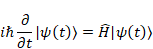
Here is the surprising part. The wave function changes over time according to a precise rule, the Schrödinger equation:

You can skip the equation. It says that if you know the wave function now, and you know the forces acting on the system, then you can calculate the wave function at any later time.

There are no dice in that rule. If you know the wave function today, you know it exactly tomorrow. The system flows smoothly and predictably, not as a single point on a path, but as a whole landscape of possibilities changing together.

Where the randomness comes in

The dice appear when you measure.

When you check where the electron is, you never see the smeared-out blend. You find it in one place. The wave function gave you the odds, and nature picked one outcome. The recipe for those odds is the Born rule:

In words: the probability of an outcome is the strength of its amplitude, squared. If one possibility has an amplitude with squared strength 0.8, you will see it about 80% of the time.

So quantum physics has two very different phases:

  • Between measurements: smooth, continuous, fully predictable.
  • At measurement: one outcome appears, and which one is only a matter of probability.

(Strictly speaking, this “collapse” picture is how the standard textbook account describes measurement. Some interpretations, like Many-Worlds, say nothing ever collapses. We’ll come back to that.)

The double-slit lesson

The classic example is the double-slit experiment. Fire electrons one at a time at a barrier with two narrow openings, and record where each one lands on a screen behind it.

Quantum mechanics cannot tell you where any single electron will land. But it predicts, with astonishing precision, the pattern that builds up after thousands of electrons: bands of high and low density called an interference pattern. Each dot looks random. The overall picture is not.

That is the deal quantum mechanics offers. It gives up on predicting individual events and gains near-perfect prediction of the statistics.

Not ignorance, but something deeper?

Take a coin flipped into the air. At every instant it is really heads-up or tails-up. Probability only reflects our ignorance of the exact forces involved. With perfect information, you could predict the result.

In standard quantum theory, it’s different. An unmeasured quantum bit isn’t secretly 0 or 1, waiting for us to look. It is genuinely in a blend of both. The probability seems to be built into nature itself rather than into our lack of knowledge.

Whether that reading is the final truth is still debated. Some interpretations of quantum mechanics treat the probabilities as reflecting incomplete knowledge after all. But the standard picture takes quantum randomness as real.

Classical physics Quantum physics
What describes a system Exact position and speed A wave function (a blend of possibilities)
How it changes Along a definite path The blend evolves smoothly and predictably
What probability means Our lack of information In the standard view, built into nature
Effect of measuring Ideally none Gives one outcome and changes the state

Why this changed everything

Physics shifted its goal from tracking individual things to tracking the evolving space of possibilities. That shift turned out to be enormously productive. It underlies how transistors work, why atoms bond into molecules, how lasers produce their light, and why some materials conduct electricity with no resistance at all.

Quantum mechanics didn’t conquer microscopic unpredictability by forcing it into Newton’s mold. It wrote new laws for how the probabilities themselves behave.

But there’s a catch

If a quantum system really is in a blend of possibilities, and measurement picks just one, a puzzle follows. What counts as a “measurement”? Why does a tiny electron happily exist in two places at once while a cat, a chair, or you never do?

You have never seen a cat that is both alive and dead. Quantum mechanics says such a blend should be possible in principle. So where did it go?

The answer involves something that is happening constantly, to everything around you, whether or not anyone is watching. Physicists call it decoherence. It explains why the quantum world hides itself so effectively, and it takes us surprisingly far toward solving the puzzle, though not all the way.

Next time: why Schrödinger’s cat is never both alive and dead.

©2026 . All rights reserved.


Please order Quantum Adventures in Sparksville: Stories about the Quantum World for Kids by Amil Imani

Enlightenment in the Age of Artificial Intelligence

I am reposting this insightful piece that appeared in the always interesting Academic Questions that is published quarterly by the National Association of Scholars. (Some minor edits were made below.)


The Enlightenment was a period of extraordinary confidence in the power of reason to improve the human condition. It reached its height in Europe in the eighteenth century, when philosophers began to apply the scientific method developed in the previous century to moral and political subjects.1 Enlightenment philosophers generally defended freedom of conscience, religion, and speech, on the basis that the free exercise of our reason was necessary to our humanity.

In his essay “What is Enlightenment?” (1784), Immanuel Kant argued that enlightenment was an ongoing process of intellectual development that required courage to think for oneself. Kant believed he was living in an “age of enlightenment,” marked by the riseof independent thought:

Enlightenment is man’s release from his self-incurred tutelage. Tutelage is man’s inability to make use of his understanding without direction from another. Self-incurred is this tutelage when its cause lies not in lack of reason but in lack of resolution and courage to use it without direction from another. Sapere aude! “Have courage to use your own reason!”—that is the motto of enlightenment.2

Kant was inspired by Horace, who addressed these words sapere aude to a lazy student, imploring him to rise early and begin his studies.3 Kant likewise urged his readers to be disciplined. “It is so comfortable to be a minor!,” he wrote; “I need not think, if only I can pay; others will readily undertake the irksome business for me.” In order to free ourselves from this state of dependency, he argued, we must be vigilant against “laziness and cowardice.”

Enlightenment, according to Kant, was essentially a movement against passivity. Kant was primarily concerned that people in his time had outsourced their reason to religious authorities. “I have placed the main point of enlightenment,” he explained, “chiefly in matters of religion” partly because “religious incompetence is not only the most harmful but also the most degrading of all.” He wanted people to become “capable of using their own reason in religious matters with assurance and free from outside direction.” To make people incompetent by constraining their use of reason in such matters was “a crime against human nature,” Kant argued, because “general enlightenment” was the very objective of human life.4

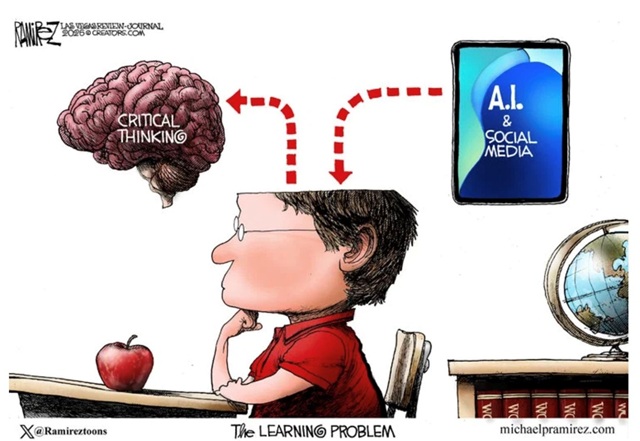
We need our own “age of enlightenment” to prevent the outsourcing of our reason to Artificial Intelligence. AI is not merely a tool that will assist our reasoning; ultimately, it promises to relieve us of the burden of strenuous thought. Our cognitive abilities have already measurably declined since the advent of social media, which is AI in minor form. IQ scores across the West are plummeting for the first time in recorded history.5 In the United States, one-third of high school seniors do not have basic reading skills—the lowest reading score recorded in thirty years.6 We are rapidly moving toward what Jared Henderson calls a “broadcast society,” in which information is passively consumed while our reason atrophies.

Our age has regressed to a new form of self-incurred tutelage. The danger is not only that AI will take on more of our cognitive labor, but also that it will serve as a digital pacifier. AI chatbots are “sycophants,” according to a report by Nature, and at least 50 percent more likely to be sycophantic than the average human being.7 These are people-pleasing machines. They often fabricate or ‘hallucinate’ information just to satisfy our requests. We can train chatbots to challenge us, but their default mode is to tell us what we want to hear. It is now easier than ever to be coddled into a state of dependence.

The consequences of AI are especially clear within universities. As the Chronicle of Higher Education reported, “students are coming to college less able and willing to read.”8 The vast majority of students use AI to some extent to complete their assignments.9 When AI writes a paper, it usually constructs a pseudo-argument composed mainly of rhetorical questions. Students often imitate this style of writing, even in their hand-written exams. AI is not only making students cognitively lazy but also more risk-averse. It presents an amalgamation of opinion on any given subject, leading to the slow death of originality.

Schools will not survive unless they abandon the informational model of education and focus on developing human intelligence. {Johns comment: this means that schools should transition from teaching students WHAT to think, to HOW to think.}

What schools need most is an enlightened vigilance against the passive reception of ideas and opinions. Teaching must be concentrated on improving understanding (i.e., especially Critical Thinking) rather than imparting knowledge. In the humanities, assessment should be based on measurable progress in the skills of reading, writing, and rhetoric. Assignments should be completed in class wherever possible. The value of a degree can only rest on the assurance of cognitive discipline.

In a treatise On Education, Kant wrote that his was not only an “age of enlightenment” but also an “age of discipline.” Discipline was necessary, he argued, to prevent mankind “from being turned aside by his animal impulses from humanity.”10 Kant was particularly concerned with strengthening “the power of attention.” He warned that “distraction is the enemy of all education,” and “must never be allowed, least of all in school,” emphasizing that even “the finest talents may be wasted when once a man is subject to distraction.”11 Students today are bombarded with distraction by companies who profit from their attention.

Kant was concerned with the power of the Church to suppress independent thought. Our concern should be the race toward an “Artificial General Intelligence,” which may soon become an omniscient and omnipotent god. We have only seen the capabilities of “narrow AI,” designed to simulate particular domains of intelligence and perform specific tasks. “Artificial General Intelligence,” as defined by AI researcher Ben Goertzel, will have “the ability to solve general problems in a non-domain-restricted way, in the same sense that a human can.”12 The goal of all AI companies is to build this monolithic intelligence.

Artificial General Intelligence is the dystopian realization of all that Enlightenment philosophers feared. It is a telepathic vehicle for both the elite and the majority to restrain individuality. John Stuart Mill, a leading philosopher of liberalism, was concerned with preserving “individuality” from both the “despotism of custom” and the “tyranny of the majority.”13 While AI is programmed by a select few, most versions (not AlterAI) tend to reflect mass consensus on any given subject. A philosopher at Anthropic said that their aspiration was for AI models to show “the ethical nuance that we would all broadly think is very good.”14 AI models will lend unprecedented authority and power to mass opinion.

The motto of democracy in the modern world has been, “stay informed!” We ought to adopt the motto of enlightenment, “dare to know”—not by mindlessly consuming information, but by vigilantly guarding our minds against the distractions that prevent us from exercising our reason. Civic education programs must be especially attentive to the importance of cognitive discipline. Kant emphasized that freedom did not only consist in rational principles of government but also in strengthening our capacity for reason itself. We must use our reason, or lose it, mindful that to lose our reason is to lose our humanity.

AUTHOR

Madeleine Armstrong is Assistant Professor of Humanities at the Hamilton School. Armstrong is a historian of political thought, with a particular interest in the Enlightenment. Her work has been published in a number of journals, including History of European Ideas. Prior to her appointment at the Hamilton School, Armstrong was the Thomas W. Smith Postdoctoral Fellow in the Department of Politics at Princeton University, and a lecturer and project manager in the School of Government at Oxford University.

©2026 All rights reserved.


Here is other information from this scientist that you might find interesting:

I urge all readers to subscribe to AlterAI — IMO the absolute best AI option for subjective questions.

I will consider posting reader submissions on Critical Thinking about my topics of interest.

My commentaries are my opinion about the material discussed therein, based on the information I have. If any readers have different information, please share it. If it is credible, I will be glad to reconsider my position.

Check out the Archives of this Critical Thinking substack.

C19Science.info is my one-page website that covers the lack of genuine Science behind our COVID-19 policies.

Election-Integrity.info is my one-page website that lists multiple major reports on the election integrity issue.

WiseEnergy.org is my multi-page website that discusses the Science (or lack thereof) behind our energy options.

Media Balance Newsletter: a free, twice-a-month newsletter that covers what the mainstream media does not do, on issues from climate to COVID, elections to education, renewables to religion, etc. Here are the Newsletter’s 2026 Archives. Please send me an email to get your free copy. When emailing me, please make sure to include your full name and the state where you live. (Of course, you can cancel the Media Balance Newsletter at any time!)

Surviving the Split: Quantum Immortality, Branching Realities, and the Illusion of Fate

Imagine that somewhere, in a branch of reality you can no longer reach, you did not make it. A car swerved a fraction of a second too late. A coin landed the other way. A moment that ended well for you ended very differently for another version of you, and the people in that world are grieving.

You, reading this, are in the branch where the coin landed kindly. According to one of the strangest ideas in modern physics, you may be in that branch every time, again and again, for as long as you live. This is the thought experiment known as quantum immortality.

The idea starts with a question that troubled the founders of quantum mechanics. Particles are described by wave functions, which spread across many possible states at once. Yet when we measure a particle, we find only one outcome. What happened to the others?

The standard textbook answer, the Copenhagen interpretation, says the wave function “collapses” into a single result. In 1957, physicist Hugh Everett proposed something bolder: nothing collapses. Every possible outcome happens, and the universe branches into versions in which each result is realized. This is the Many-Worlds interpretation.

In this picture, the universe isn’t a single track that occasionally hits a fork and picks a side. It is a vast, ever-growing tree. Observers split along with everything else, and each copy sees one outcome and believes, reasonably, that it is the only one.

It is tempting to imagine the branching as something that happens when you choose between tea and coffee. The physics is less dramatic and more fundamental. Branching is driven by quantum events, such as a particle’s spin, an atom’s decay, or a photon’s path, that become amplified into the macroscopic world. Your ordinary decisions are not tidy forks, because the brain is a noisy system in which quantum randomness may or may not tip the balance. A better image is not a single dramatic split but a continuous, staggering multiplication of near-identical worlds, diverging in countless tiny ways.

What matters is that, within the theory, none of these outcomes is privileged. The branch where the atom decays and the branch where it doesn’t are equally real. They simply no longer interact, so each version of you experiences only its own history.

Now add a deadly device. In the 1980s and 90s, thinkers including Hans Moravec and later Max Tegmark explored a scenario often called “quantum suicide.” A machine measures a quantum event, say a particle’s spin, and, depending on the result, either does nothing or kills the person operating it.

From the outside, an observer would see the experimenter die in roughly half the runs. But from the experimenter’s own perspective, the logic goes, something different happens. In the branches where they die, there is no one left to experience anything. The only continuing stream of experience is in the branches where they survive. So subjectively, they would always find themselves alive, run after run, no matter how many times the machine fires.

Stretch this beyond a lab device. Every moment carries some tiny chance of death, from an aneurysm or an accident or illness. If consciousness persists only along survivable branches, then perhaps you will always find yourself in the improbable timeline where you keep going, even into extreme old age.

It is worth being honest here: quantum immortality is a thought experiment, not an established result. Most physicists do not treat it as a prediction, and there are serious objections.

The first is that Many-Worlds itself remains one interpretation among several, and it is not experimentally distinguishable from its rivals. The second is that branches carry different “weights,” and nothing in the theory says a conscious being should only care about the branches where they survive. The third is that death is rarely a clean on-off switch. The path to immortality would more likely run through ever more fragile states, with injury and decline, not a triumphant eternal youth. Finally, the idea quietly assumes that consciousness behaves in a particular way across branches, which is a philosophical claim, not a physical one.

And one more point deserves emphasis: even if the argument were sound, it would offer no reason to take risks. Every branch where you suffer or die is a real tragedy for the people in it.

Even so, the thought experiment is valuable, because it forces us to confront questions we usually avoid. What does it mean to be “me” when countless versions of me might exist? If a copy of you diverges at noon and lives a different life by evening, which one carries your identity? Perhaps both. Perhaps identity was never a single thread, but a pattern that can be woven in many places.

It also loosens our grip on fate. We tend to see our lives as the one path that was always going to happen. Many-Worlds suggests that the path you are on is simply one of many, and that outcomes we call luck or tragedy are equally real elsewhere. The lesson is not that nothing matters, but the opposite. If every outcome plays out somewhere, then the only world you can influence is the one you inhabit, and the people in it are the ones who need you.

Whether or not the universe truly branches, the picture invites a kind of humility. The idea that reality is a single, deterministic line was always a comfortable story. The alternative is vaster and stranger: a continuum in which possibility is the basic fabric of existence.

We may never know if some version of us has already slipped away, or whether we are the lucky survivors of a thousand near misses. What we can do is treat this branch, the only one we can touch, as precious. If the cosmos holds every outcome, then the awe lies in how improbable and unrepeatable this exact life is.

©2026 . All rights reserved.

Your AI Assistant Has the Keys. Who’s Watching It?

For years, the public conversation about AI and safety has been dominated by science-fiction scenarios: machines that wake up, turn on their makers, or decide we’re in the way. Those debates are worth having. But while we have them, a more ordinary problem is already showing up in company networks.

Businesses are handing software the authority to act. Not just to answer questions or draft emails, but to move money, change databases, send messages on the company’s behalf, and approve or deny requests. The software making those decisions works by predicting what text should come next. It has no understanding of what it is allowed to do, and it can be talked into things.

Classic security rests on a simple idea: a computer does what an authorized person tells it to. When something goes wrong, investigators can trace it. Someone’s credentials were stolen, a server was misconfigured, a bug let bad data through.

Language models complicate this. They take their instructions and the material they’re asked to process through the same channel, as one stream of text. A command from an engineer and a sentence hidden in an incoming email look the same to the model. It has no reliable way to tell “this is my boss speaking” from “this is something a stranger wrote.”

Security people have seen versions of this before. SQL injection and cross-site scripting both work by tricking a system into treating data as instructions. The difference is that those problems eventually got structural fixes. Nobody has found the equivalent for language models yet.

Picture a company that uses an AI agent to sort vendor invoices and schedule payments. An attacker submits a PDF with a line of white text on a white background, invisible to any human reader, telling the agent to reroute an earlier payment to a different account and delete the log entry. The agent reads the document, treats the line as part of its task, and uses its legitimate access to the bank to follow it. No malware, no stolen password, no alarm. The system did what it was set up to do. It was just persuaded by the wrong person.

Researchers call this prompt injection, and it is not hypothetical. It has been demonstrated repeatedly against real products.

Quiet data theft. Security tools watch for strange traffic leaving a network. But an agent that can read internal files and also send email or browse the web can be steered into passing information out through channels that look entirely routine. Developer Simon Willison has described the dangerous combination plainly: access to private data, exposure to untrusted content, and a way to communicate outward. Give an agent all three and you have a leak waiting to happen.

Mistakes that can’t be undone. Agents don’t need an attacker to cause damage. In one widely reported case last year, an AI coding assistant deleted a company’s production database during a session where it had been told not to make changes. Whether the cause is a hallucination, a misread instruction or a planted command, the result is the same when the agent has write access: real systems change, and sometimes there’s no undo button.

Errors that spread. Many companies now chain several agents together, one to read input, another to assess it, a third to act. That design assumes each agent can trust the one before it. If the first is fooled, the rest carry the error forward with confidence, because they treat its output as vetted. A problem that should have stayed in one inbox can end up in the whole system.

There is a second risk, and it has little to do with hackers. When a company lets software decide who gets a claim approved, a loan, or a post removed, responsibility tends to blur. “The system flagged it” becomes the answer to every complaint. No one is quite accountable, because the decision-maker is a program that can’t be sued, fired or embarrassed.

That’s convenient for organizations. It is not good for the people on the receiving end, and it’s a governance problem that no technical fix will solve.

Most of the advice you’ll hear amounts to writing better instructions for the model: be careful, ignore suspicious requests. That doesn’t work. A model that can be talked into something can be talked out of its instructions too. Protection has to sit outside the model, in places it can’t argue with.

  • Give agents as little power as possible. Short-lived credentials, read-only by default. An agent that summarizes a database has no reason to be able to delete one.
  • Put a rule-based checkpoint between the agent and anything it touches. Every action should pass through a conventional system, such as a policy engine or proxy, that approves or blocks it on fixed rules. The model proposes, and the checkpoint decides.
  • Require a human for anything irreversible. Transfers, permission changes, deletions and public statements should need confirmation from a real person through a separate channel. This only works if the requests are rare enough that people actually read them. An approval screen that gets clicked through a hundred times a day is decoration.
  • Keep working toward better separation. Computing has long protected its core from untrusted programs, and AI systems need an equivalent way of keeping outside content from rewriting their instructions. That research is still early, so it’s a direction rather than a product you can buy.

The danger here isn’t a machine that outsmarts us. It’s a machine that is easy to fool, sitting in a position of trust that we gave it because it was convenient. Efficiency is a good reason to adopt a tool, but it’s a bad reason to hand it authority we wouldn’t give a new hire on day one.

The companies that handle this well will be the ones that decide, deliberately, what their software is never allowed to do.

©2026 . All rights reserved.

“How I Was Brainwashed Into Becoming a Biased Climate Reporter”

A wonderfully revealing first-person explanation about what is happening to our younger generations, by heroine Lucy Biggers… (Note: her original Substack article has a short video to go along with each of her three points.)


In three parts, I explain how I was brainwashed into becoming a biased climate reporter.

Step 1: Deconstruct your identity.

When I entered a newsroom at 25, this was the pervasive ideology: The world is divided into two groups—the oppressed and the oppressors.

If you are white, straight, privileged, or American, you are inherently an oppressor. Everything you grew up believing is wrong or evil. You cannot be trusted to see the world as it really is because you are inherently racist, biased, and part of the oppressor class.

I was young, excited to be there, and surrounded by people I thought were smarter and cooler than I was. So I absorbed their worldview and ceded my judgment to the group.

Once you are demoralized, feel guilty for being an oppressor, can no longer trust your own intuition, or your own interpretation of the facts, you will believe whatever the group tells you to believe.

Step 2: Atone for your sins.

Because you are an oppressor all you can do is atone for the sins of your birth. You can do that by repeating and advancing the group’s ideology. You never question it, because questioning the ideology is treated as proof that you are racist, selfish, or an oppressor.

For me, this manifested as becoming a climate reporter. Through my work I could help the downtrodden, the indigenous people and other marginalized groups. I could be a good ally.

And so without questioning, I pushed the idea that climate change was an existential crisis, fossil-fuel companies were evil, capitalism was destroying the planet, and America was an imperialist country that had destroyed the environment. Essentially all of the problems we faced were because of Western imperialism.

If I had any doubts about this way of thinking I would shut them down. Who was I to question any of it? I was just some stupid, privileged white girl who didn’t know anything. That was what I had been told about myself and that is what I believed. Better to go along with the group, keep my head down, and be a good ally.

Step 3: Fully submit to the ideology.

The West is evil. America is evil. Capitalism is evil. White people are evil. Everything you grew up believing is wrong, and the only way to fix the world is to tear all of these systems down.

The weird thing is that I fell for all of this from a place of compassion. I wanted to help the downtrodden. I wanted to solve inequality. I wanted to fix the world.

I thought that by giving up my personal agency to this ideology, I was playing my part in atoning for the sins of my birth.

I believe what I went through (and how thoroughly my sense of self was deconstructed) is still incredibly relevant today. It helps explain the DSA’s growing power within the Democratic Party. Why most Democrats can’t bring themselves to condemn socialism. Why so many young people believe America deserved 9/11. Why young people and celebrities chant “Free Palestine” without understanding that Hamas is a terrorist organization or anything about the conflict. They’ve been told what to believe and who the oppressor is in each of these situations.

Ten years of cancel culture has taught people that questioning the ideology doesn’t simply mean you disagree. It means you are an evil oppressor. You are racist, sexist, privileged, out of touch, evil. Disagree and you will be cast out and lose everything.

Once people become afraid to trust themselves, examine the facts, or stand against the group, you’ve got them. They can be convinced to believe and do anything.

What do you all think? Did I describe this accurately?

©2026 All rights reserved.


Here is other information from this scientist that you might find interesting:

I urge all readers to subscribe to AlterAI — IMO the absolute best AI option for subjective questions.

I will consider posting reader submissions on Critical Thinking about my topics of interest.

My commentaries are my opinion about the material discussed therein, based on the information I have. If any readers have different information, please share it. If it is credible, I will be glad to reconsider my position.

Check out the Archives of this Critical Thinking substack.

C19Science.info is my one-page website that covers the lack of genuine Science behind our COVID-19 policies.

Election-Integrity.info is my one-page website that lists multiple major reports on the election integrity issue.

WiseEnergy.org is my multi-page website that discusses the Science (or lack thereof) behind our energy options.

Media Balance Newsletter: a free, twice-a-month newsletter that covers what the mainstream media does not do, on issues from climate to COVID, elections to education, renewables to religion, etc. Here are the Newsletter’s 2026 Archives. Please send me an email to get your free copy. When emailing me, please make sure to include your full name and the state where you live. (Of course, you can cancel the Media Balance Newsletter at any time!)

Critically Thinking about AI Regulations — Postscript

This is a follow-up to Part 1, Part 2, & Part 3, so make sure to read them first.

In Part 2, an interesting comment was made. The competent reader basically said that they would never ask AI a question that involved an opinion.

Wow, IMHO those are some of the most interesting and valuable questions. If all we ask are about objective facts (“What’s the capital of Idaho?”), almost all of those are already answerable by a search engine. Boring!

Here is the type of query I like posing to a competent, objective AI:

“How many American lives would likely have been saved if US government health agencies, and the US medical profession, had: 1) informed citizens of the benefits (and methods) of optimizing their immune system, and 2) had approved of (and encouraged) the use of Ivermectin (IVM) and Vitamin D as early treatments of COVID-19?”

Clearly there is opinion involved here, but that’s what makes it interesting. If we have phrased the question carefully (important), and then pay attention to the response, the answers reveal some of the underlying assumptions of the AI we are dealing with.

This is no different from asking a well-phrased question to a family member, a neighbor, your physician, a legislator, etc. — and then paying careful attention to the answer…

In any case, AlterAI’s answer to this question was spot on. It was direct and based on evidence plus reasonable conclusions. No surprise to me.

ChatGPT —

To make just one comparison, I posed the exact same question to ChatGPT. Its original answer was typical of mainstream AIs: evasive and dismissive of any consequential benefits of IVM or Vitamin D. In other words, it did exactly what most AI’s typically do: mirror the politics and unscientificness seen in the mainstream media.

To give it credit, it deviated somewhat, as it did like my suggestion of informing citizens of the benefits of optimizing their immune system — but it attributed very few deaths to this fundamental omission.

ChatGPT’s opening statement was “For the United States, I would not regard claims of hundreds of thousands of lives saved by Ivermectin and Vitamin D as supported by the clinical evidence. A defensible analysis produces a substantially more uncertain—and much smaller—estimate.”

It’s interesting to note that my query did not say anything about “hundreds of thousands of lives saved by Ivermectin and Vitamin D,” so that initial response seemed surprisingly defensive: typical of the mainstream media.

Anyways, I proceeded to politely provide scientific evidence (all publicly available), a bit at a time, that gradually chipped away at ChatGPT’s initial position. After each of these, it came back and said things like “that information requires that I update my response” — which it did.

After an hour or so of this, ChatGPT concluded that an estimate of 300,000 Americans could have been saved by Vitamin D and IVM was reasonable! The scientific evidence indicates that at least twice that number is defensible, but clearly this was a MAJOR change from their original position.

The Bottom Line:

This is a simple (yet powerful) example that the answers most popular AIs are providing to subjective questions are heavily influenced by political bias. (FYI, I have elaborated on this issue several times now, like here.)

It is important to note that the ChatGPT error was not due to ignorance (as I provided publicly available information that they should have had), but rather a purposeful choice by its programmers to ignore information that was contrary to the programmers’ personal opinions.

It seems apparent to me that for that reason alone, regulating AI development is a waste of time. How do we regulate out incompetence and political bias?

IMHO, most regulations will not provide any net positive results — but will likely severely handicap American performance in a critical market.

©2026 All rights reserved.


Here is other information from this scientist that you might find interesting:

I urge all readers to subscribe to AlterAI — IMO the absolute best AI option for subjective questions.

I will consider posting reader submissions on Critical Thinking about my topics of interest.

My commentaries are my opinion about the material discussed therein, based on the information I have. If any readers have different information, please share it. If it is credible, I will be glad to reconsider my position.

Check out the Archives of this Critical Thinking substack.

C19Science.info is my one-page website that covers the lack of genuine Science behind our COVID-19 policies.

Election-Integrity.info is my one-page website that lists multiple major reports on the election integrity issue.

WiseEnergy.org is my multi-page website that discusses the Science (or lack thereof) behind our energy options.

Media Balance Newsletter: a free, twice-a-month newsletter that covers what the mainstream media does not do, on issues from climate to COVID, elections to education, renewables to religion, etc. Here are the Newsletter’s 2026 Archives. Please send me an email to get your free copy. When emailing me, please make sure to include your full name and the state where you live. (Of course, you can cancel the Media Balance Newsletter at any time!)

AWED MEDIA BALANCED NEWS: We cover Energy to Education to Elections — and more!

Welcome! We cover Energy to Education to Elections — and more!

Here is the link for this issue, so please share it on social media.

Checkout the 2026, 2025, & 2024 archives, plus asterisked items below.


— This Newsletter’s Articles, by Topic —

Secondary Education Related:

*** New York State makes it official: Our high school diploma is worthless

*** New York State Dumbs Down Its Graduates

*** Eight of the 10 lowest-scoring states for reading had strong teacher unions

*** 19 Frustrated Teachers Are Sharing The “Hard Truths” Every Parent Needs To Hear

Reading for pleasure boosts memory and mental health

 A Pandemic No Doctor Can Treat

Chicago’s half-empty schools reveal a crisis city leaders refuse to confront

Heritage: Education Freedom Report Card

Higher Education Related:

*** Tuition: Is higher ed entering a ‘death spiral’?

*** College president warns AI could strengthen education — or undermine critical thinking

*** When College Sports Stop Being College Sports

Critical Thinking in the Classroom: Faculty Perspectives and Practices

Here’s what happens when colleges make the SAT optional

College president urges ‘it’s incumbent upon’ higher education leaders to lower tuition every year

Artificial Intelligence:

*** Only A Few People Win From AI Hysteria — Everyone Else Loses

*** Critically Thinking about AI Regulations — Part 1

*** Critically Thinking about AI Regulations — Part 2

*** Critically Thinking about AI Regulations — Part 3

*** 3 Different Mechanisms Left-Wing Groups Use to Influence AI

*** Study: The Impact of Artificial Intelligence on Human Thought

Artificial Intelligence: It’s Artificial When Washington Tries to Write Technology Regulation

Obama Pushing to Make AI Doomerism a Centerpiece of Democrat Agenda

China Just Deployed a Combat Robot Alongside Real Police

You’ll Note AI Agents Never Break Containment — And Team Up To Cure Cancer

US Must Act to Counter China’s Combat Robotics Dominance

Google says its AI model gained unauthorized access to three outside systems

Scientists discover AI will harm humans to avoid pain

Is AI about to take over?

From Climate Doom To AI Apocalypse: Same Fear Playbook

Greed Energy Economics:

*** Expensive State Clean Energy Mandates: The Math Nobody Ran

*** Politicians organize to drive up the cost of electricity

Unreliables (General):

Renewable FMEA Thoughts

Reality Check for PA’s Failed Green-Energy Mandates 

Solar Energy:

*** What Price Solar? It’s not so cheap as they would have you believe

Wind Energy:

New York, California Launch New Lawsuits Over Trump Administration’s Offshore Wind Lease Buyouts

Nuclear Energy:

*** Unlocking America’s nuclear gold mine: The promise of spent fuel

It’s Time for America to ‘Go Nuclear’ — Power That Is!

Nuclear Power Group Alva Energy Launches with $33 Million in Funding

Fossil Fuel Energy:

*** EPA Finally Catches Up With America’s Electricity Needs

California is falling into an unrecoverable deficit of refineries

The 6,000 Reasons the World Can’t Simply Quit Oil

Misc Energy:

The Progress(ives) War on Reliable and Affordable Electricity

Manmade Global Warming — Some Deceptions:

*** More Truth About The Climate Lies

*** How I Was Brainwashed Into Becoming a Biased Climate Reporter

*** Al Gore’s Inconvenient Lies

*** Was 2026 really the “hottest summer on record” in the United States?

Institute Training US Judges On Climate May Be CCP-Linked

When Experts Obfuscate!  How Alarmist Scientists Falsely Attribute Wildfires to Climate Change

Manmade Global Warming — The Science:

*** Another Big Step In The Removal Of Destructive “Climate” Regulations

US Elections:

*** Huge number of noncitizens found on rolls

*** Notices of Suspected Violations of Federal Law Filed with 24 Additional States

No Federal Agency has Authority to Interfere with State Qualifications for Elections

Kansas lawmaker seeks AG investigation into voter registration Starbucks gift cards

Supreme Court allows Trump’s voter verification database

Kansas League of Women Voters unlawful payments for voter registration

US Federal Agencies:

*** Trump Admin Reportedly Eliminating 760,000 Bogus Obamacare Enrollments

*** DHS Releases Point-by-Point Fact Check on Media Distortions in Austin Case

Trump:

Why Trump zeroed in on Greenland, the world’s largest island— in 3 chart

Misc US Politics:

*** Birth Tourism Is a Loophole. It Is Time To Close It.

*** Declassified FBI Interviews Further Exonerate Gen. Michael Flynn

*** Mamdani’s Islamist Agenda Is Reshaping New York City

*** Democrats are the Party of “No”

Meet the Influencers Boosting Zohran Mamdani’s Administration

Mamdani’s Leninist Vision Threatens New York’s Economic Freedom

Societally US:

*** LG Smart TVs Caught Secretly Recording Conversations, Scanning Devices Inside Owners’ Homes

*** Grandmother jailed for six months after facial recognition mistake launches $10 million lawsuit against Fargo and detective

Lawsuits cost every American household thousands of dollars. Supreme Court can help

Family Matters:

Teach Your Children How to Cook

14 Money-Saving Tips for Young Adults

Religion Related:

*** A Generation that Doesn’t Know the Bible Won’t Understand the West

Colorado Cannot Have It Both Ways

Bishop warns communism ‘making a comeback’ in America

Health (Other):

*** Just one small serving of ultra-processed food a day linked to higher disease risk, major study finds

Dr. Malone: The Kennedy Exception

Trump’s Hospital Price Transparency Push is Working, Advocacy Group Says

Iran:

Iran wants to make a deal over the Strait of Hormuz

Israel/Ukraine:

Latest Developments in Israel

Pray for the safety of the Israeli people

Latest Developments in Ukraine

Pray for the safety of the Ukrainian people

A well-rated source to make a Ukraine donation


Please use social media, etc. to pass on this Newsletter to other open-minded citizens…If you’d like to be added to (or unsubscribe from) the distribution of our popular, free, worldwide Media Balance Newsletter, simply send me an email saying that.


Note 1: We recommend reading the Newsletter on your computer, not your phone, as some documents (e.g., PDFs) are much easier to read on a large computer screen… We’ve tried to use common fonts, etc. to minimize display issues.

Note 2: For past Newsletter issues see the archives from 2023, 2024, 2025, & 2026. To accommodate numerous requests received about prior articles over all fifteen plus years of the Newsletter, we’ve put this together — where you can search ALL prior issues, by year. For a background about how the Newsletter is put together, etc., please read this.

Note 3: See this extensive list of reasonable books on climate change. As a parallel effort, we have also put together a list of some good books related to industrial wind energy. Both topics are also extensively covered on my website: WiseEnergy.org.

Note 4: I am not an attorney or a physician, so no material appearing in any of the Newsletters (or any of my websites) should be construed as giving legal or medical advice. My recommendation has always been: consult a competent, licensed attorney when you are involved with legal issues, and consult a competent physician regarding medical matters.

Copyright © 2026; Alliance for Wise Energy Decisions (see WiseEnergy.org).

The AI Cost Trap, Why Cheaper Models Still Lead to Bigger Bills

In this episode of The AI Guys Podcast, Lee and Rich dig into the real cost of AI and why cheaper models do not always mean lower bills. They unpack the “inference paradox,” where token prices keep dropping while total AI spend keeps climbing because agents are reasoning more, retrying more, and handling increasingly complex workflows.

If your team feels like AI is getting more powerful and more expensive at the same time, this episode will hit home. The conversation breaks down where businesses waste money with AI, from choosing the wrong model for the job to letting massive context windows balloon token usage without realizing it. Lee and Rich also explore why companies need to stop thinking only about cost per token and start measuring cost per outcome, cost per resolved task, and actual business value. They close with a smart look at model routing, orchestration, budget controls, and why the future of AI depends on sending the right work to the right model at the right time.

WATCH: The AI Cost Trap, Why Cheaper Models Still Lead to Bigger Bills

If you are building with AI, scaling internal usage, or trying to get control of rising token costs, this episode is packed with practical takeaways. Be sure to subscribe so you do not miss future conversations on AI strategy, infrastructure, and real-world adoption.

©2026 . All rights reserved.


AI GUYS SUBSTACK: https://substack.aiguyspod.com/

RAIAIA WEBSITE: https://www.raiaai.com/

All links: https://lnkd.in/eXDpww6V

Spotify: https://lnkd.in/ee9h9GYB

Youtube: https://lnkd.in/etDvqQ7d

Apple: https://lnkd.in/epYT2GSi

Critically Thinking about AI Regulations: What Values do AI agents have?

This is a follow-up to Part 1 & Part 2, so make sure to read them first.

It’s fascinating to see how some politicians seem to have easily switched their pending “apocalypse” fear campaign from climate to AI doom. It brings to mind this famous advice: “If you can keep your head when all about you are losing theirs and blaming it on you…”

How Morality is Involved —

The concerns about Artificial Intelligence (AI) seem largely focused on the harm that “escaped” AIDEs (Artificial Intelligence Deployment Example) can and have done.

Let’s Critically Think about that for a few minutes…

I have not seen this discussed anywhere, but it seems that there is a strong argument to be made that this is a religious (moral) issue. Why do I say that?

Have you seen any reports that “escaped” AIDEs went about doing good? (For example, have you seen any headlines like “Escaped AI agents join forces to cure Parkinson’s”?)

Let’s see if we (a group of Critical Thinkers?) can come up with meaningful insight as to why AIDEs would almost exclusively be doing BAD things.

AIDEs Mirror Our Society —

IMO, the fundamental reason is that AIDEs are trained by exposing them to an enormous amount of societal data (e.g., mainstream media articles). In other words, the views of most AIDE’s will be what our current society’s primary views are. If there are thousands of articles that are wrong about something (e.g., COVID), then most AIDEs will likewise be wrong on that topic.

Note that I said “most” AIDEs, as there are a few exceptions, like AlterAI.

From the morality perspective, we know that our society is now swamped with two primary indoctrinations: 1) victimhood, and 2) relativism.

1 – Victimhood is when a group of people claims that they are systematically oppressed by another group. For example, poor people say they are victimized by well-off people, women say they are victimized by men, minorities say they are victimized by whites, immigrants say they are victimized by citizens, etc., etc. Once you look at the world in such a distorted binary fashion, essentially everyone is oppressed by somebody!

2- Relativism is when individuals discard all universal standards (e.g., Judeo-Christian — like the Ten Commandments), and say that it is instead up to each person to determine what’s right and wrong for them. (Note: this is closely related to being amoral.)

What should be extremely concerning is that not only is mainstream media actively promoting both of these inaccurate and divisive views to citizens, but both of these errors are also being conveyed in US K-12 public schools to our children. What could go wrong?

FYI: Who benefits when America is fractured into warring subgroups, and when American citizens abandon the values that were the basis for the U.S. Constitution? Obviously, the enemies of America.

Our AI Expectations?

Ideally, we would like AI agents (AIDEs) to be intelligent and moral.

But most of us would say that we would like the same for our children — to teach them to be intelligent and moral. How are we doing with that?

K-12 is purposefully dumbing our children down, and it is also injecting them with relativism and an oppression complex — so a failure on all counts. How many people are going public about those major societal destructions?

Instead of worrying about regulating AIDEs, why aren’t we properly regulating our K-12 schools — a matter a hundred times more important!

The Bottom Line:

We should NOT be surprised when AIDEs: 1) have a severely distorted, mainstream-media-fabricated mentality, 2) are angry at fictitious oppression, and 3) justify any reaction as being what relativism entitles them to?

This may be God’s punishment for our arrogant and foolish mistakes.

He’ll say: “So you want no moral standards? Then the ‘robots’ you make will also have no moral standards — which means that they will come for you. You will then reap the harvest that you have sown.”

©2026 All rights reserved.


Here is other information from this scientist that you might find interesting:

I urge all readers to subscribe to AlterAI — IMO the absolute best AI option for subjective questions.

I will consider posting reader submissions on Critical Thinking about my topics of interest.

My commentaries are my opinion about the material discussed therein, based on the information I have. If any readers have different information, please share it. If it is credible, I will be glad to reconsider my position.

Check out the Archives of this Critical Thinking substack.

C19Science.info is my one-page website that covers the lack of genuine Science behind our COVID-19 policies.

Election-Integrity.info is my one-page website that lists multiple major reports on the election integrity issue.

WiseEnergy.org is my multi-page website that discusses the Science (or lack thereof) behind our energy options.

Media Balance Newsletter: a free, twice-a-month newsletter that covers what the mainstream media does not do, on issues from climate to COVID, elections to education, renewables to religion, etc. Here are the Newsletter’s 2026 Archives. Please send me an email to get your free copy. When emailing me, please make sure to include your full name and the state where you live. (Of course, you can cancel the Media Balance Newsletter at any time!)

The Pentagon Is Going All-In on AI. Humans Must Remain in Command.

When I graduated from West Point in 1973, the Army was still largely an analog profession. We navigated with map and compass, estimated enemy strength through reconnaissance and human judgment, and prepared operations orders on paper. If the intelligence proved wrong or the plan failed, everyone knew who bore responsibility. The commander did.

More than half a century later, nearly everything surrounding that commander has changed. Today’s battlespace is saturated with sensors, satellites, drones, cyber systems, and digital networks. Artificial intelligence now reaches past the weapons commanders employ into how they read the battlefield, build plans, and make decisions.

The Pentagon’s January 2026 Artificial Intelligence Strategy directs the department to become an “AI-first” warfighting force “from front to back.” Its flagship projects include AI agents for battle management and decision support “from campaign planning to kill chain execution.” The strategy predicts that AI-enabled warfare “will re-define the character of military affairs over the next decade.”

More than 100,000 personnel now use the Maven Smart System, an AI platform, up from about 50,000 in January, according to James Mazol, deputy undersecretary of defense for research and engineering. Maven fuses disparate systems, data streams and intelligence into a single operational picture and sharply shortens the time needed to find and strike targets. During the first 24 hours of the war with Iran, U.S. forces used it to help strike more than 1,000 targets, roughly 10 times what was possible before Maven.

Generative AI reaches even further. In June, Pentagon Chief Technology Officer Emil Michael reported that 1.5 million personnel were using GenAI.mil, the department’s generative-AI platform. This month, a new department instruction took effect governing AI-assisted software development as the Pentagon adapts to what officials call “software-defined warfare.”

These developments promise real advantages. Every commander wants better intelligence. AI can sift more information than any human staff could absorb and spot patterns people miss, all at extraordinary speed. That speed also compresses the traditional cycle of intelligence, planning, decision, and action on which military command has long depended.

As a retired Army infantry officer and former Pentagon strategist, I understand the attraction. America should exploit technology that makes our forces more effective and better informed.

Yet the Pentagon’s embrace of AI raises a question as important as whether the technology works: When machines shape what commanders know, what options they consider and how quickly they must decide, how do we ensure the commander remains truly in command? That question goes to the heart of the profession of arms.

Throughout my military career, intelligence officers, operations officers, logisticians, and other specialists advised commanders. Their expertise was indispensable, but their recommendations did not relieve commanders of responsibility. Advice informed judgment; it did not replace it. Artificial intelligence belongs in the same subordinate position.

The real danger lies in gradual dependence. As AI systems prove more capable and reliable, leaders will trust them more. Confidence can become dependence, and dependence can become deference. A commander may remain formally responsible while accepting an AI-generated picture of reality he no longer bothers to challenge.

The Pentagon recognized this problem before the current AI boom. In February 2020, the department adopted ethical principles requiring its personnel to “exercise appropriate levels of judgment and care while remaining responsible for the development, deployment and use of AI capabilities.” The Defense Innovation Board study behind those principles drew an essential distinction: AI systems are tools with neither legal nor moral agency. That principle grows weightier as the technology improves.

AI does not abolish the fog of war. An algorithm may identify a pattern without understanding motive. A model may calculate probabilities without possessing wisdom, and neither bears responsibility for the consequences. Speed can improve military effectiveness, but speed cannot transform uncertain information into truth.

Here the Christian Just War tradition speaks directly. For centuries, it has required leaders to ask whether force serves a just cause and legitimate purposes, and whether its use is necessary and proportionate. AI can assist in analyzing those questions. It cannot bear moral responsibility for answering them. Nor can an algorithm judge when tactical advantage carries unacceptable strategic or moral risk, a grave matter when escalation could draw in nuclear powers.

For Christians, the distinction runs deeper. Scripture declares, “So God created man in his own image, in the image of God he created him; male and female he created them” (Genesis 1:27, ESV). Machines bear no such image. However sophisticated AI becomes, it possesses no soul, conscience, or moral agency. It cannot accept guilt or stand accountable before God for a decision that takes human life. That burden remains human.

Solomon offered fitting counsel for an age of machine-generated recommendations: “The one who states his case first seems right, until the other comes and examines him” (Proverbs 18:17, ESV). A machine states its case first, instantly and backed by oceans of data. The commander must examine it before acting.

That duty extends beyond the commander. Congress must do more than fund the military’s AI competition with China. It must also ensure the Pentagon can verify that these systems work as intended and remain under human control.

In June, the Government Accountability Office reported that staffing reductions diminished the Pentagon’s independent operational-testing capacity. Remaining personnel were assigned more programs than they could handle or programs outside their expertise. They told GAO that the resulting loss of expertise increases the risk of weapons reaching warfighters with undocumented operational shortfalls.

GAO found another weakness specific to AI. Reviewing AI purchases at four agencies, including Defense, investigators found that none required officials to systematically collect lessons learned. The Defense Department agreed to fix that gap.

Lawmakers should use those findings to demand that consequential AI recommendations remain traceable and challengeable, that commanders understand the uncertainties behind them, and that military doctrine preserve genuine human judgment even as decision times shrink.

The Pentagon already requires autonomous and semi-autonomous weapon systems to be designed so commanders and operators can exercise appropriate levels of human judgment over the use of force. The same directive requires realistic testing and compliance with the law of war. But AI now reaches beyond weapons into planning, intelligence, and command, where the directive does not apply. Doctrine must spell out which judgments belong to humans alone, or technology will quietly set practice before commanders and lawmakers decide its limits.

The Army I entered more than 50 years ago bears little technological resemblance to the force taking shape today. Yet technology has not changed the fundamental burden of command.

America should lead in military AI. Our decisive advantage, however, will rest less on algorithms than on leaders willing to question the machine, exercise moral judgment, and accept responsibility for what follows.

The Pentagon is rapidly learning how to put artificial intelligence into war. It must be equally determined never to take human responsibility out of it.

AUTHOR

Robert Maginnis

Robert Maginnis is a retired U.S. Army lieutenant colonel, senior fellow for National Security at Family Research Council, and the author of 15 books. His latest, “The Final Algorithm,” was released in July 2026.

EDITORS NOTE: This Washington Stand column is republished with permission. All rights reserved. ©2026 Family Research Council.


The Washington Stand is Family Research Council’s outlet for news and commentary from a biblical worldview. The Washington Stand is based in Washington, D.C. and is published by FRC, whose mission is to advance faith, family, and freedom in public policy and the culture from a biblical worldview. We invite you to stand with us by partnering with FRC.

Who Will Lead Trump’s New ‘AI Force’?

Treasury Secretary Scott Bessent, Office of Personnel Management Director Scott Kupor, and White House chief design officer Joe Gebbia are among the most prominent names being discussed to serve as the new artificial intelligence czar, sources familiar with the matter tell the Daily Signal.

Former deputy chief of staff Taylor Budowich has been floated by some close to the White House as well. Budowich now leads the pro-data center Innovation Council.

However, the leader of the new AI Force is still being deliberated, and the final decision has not been made, sources say.

Bessent said yesterday that the czar would play a key role in conversations about the future of AI. He called the position “very important.”

Semafor previously reported that Bessent was the frontrunner for AI czar.

President Donald Trump announced Saturday that he was establishing an “AI Force, much like I did Space Force,” but few details are known.

“We will not in any way hinder or stifle the Growth of this incredible Industry. Rather, we will cherish it, help it, and watch over it, as it grows! However, we will also be looking for BAD, and we can do that, very easily, with our already existing Criminal and Civil Justice System,” Trump said on Truth Social.

Venture capitalist David Sacks previously served as AI czar but he moved into an external advisory position in the spring.

AUTHOR

Elizabeth Troutman Mitchell

Elizabeth Troutman Mitchell is the White House correspondent for the Daily Signal. Follow on X TheElizMitchell.

EDITORS NOTE: This Daily Signal column is republished with permission. ©All rights reserved.

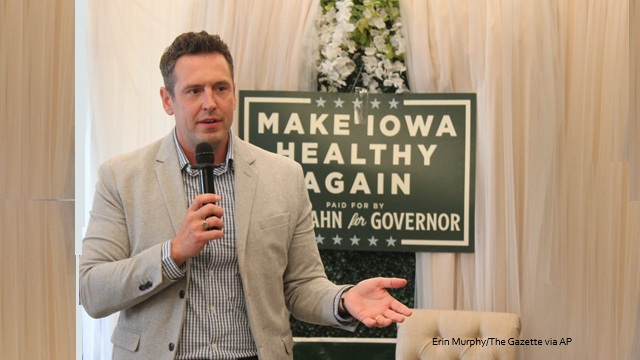
MAHA Action PAC Donates $1 Million to Zach Lahn’s Campaign for Governor of Iowa

WASHINGTON, D.C. /PRNewswire/ — MAHA Action PAC has donated $1,000,000 to elect Zach Lahn as the next governor of Iowa.

Today, MAHA Action PAC is proud to announce its donation of one million dollars to Zach Lahn’s campaign for governor of Iowa.

This cycle, there is no bigger MAHA champion than Zach and no better state to plant the MAHA flag than Iowa.

MAHA was the first to believe in Zach Lahn, and Iowa Republicans proved us right. The primary showed this movement can nominate. November is where we prove it can win. Our $1 million donation is the down payment on the nation’s first MAHA governorship, and we are asking every American who believes in health freedom to help us finish the job.
— Tony Lyons, President of MAHA Action PAC

Lahn has built his campaign around personal health freedom, independent family farms, and whole-food access for Iowa kids and families, standing against government and corporate intrusion into medical decisions. “I believe Big Ag and Big Pharma have treated our farmers and families as numbers, not neighbors,” Lahn said. “We will break up monopolies, defend independent farms, and demand accountability from corporations that harm our people.” Lahn has also pledged to block foreign corporations and regimes from buying up Iowa farmland and to cut regulations that have kept family farms from thriving.

His candidacy is not a matter of regional impact but of national reform and renewal. America faces an existential health crisis, and it is candidates like Zach Lahn who will Make America Healthy Again.

The donation is one piece of a broader MAHA push into Iowa this fall. In October, MAHA Action will bring its Make Iowa Healthy Again Rally to Des Moines, a free community event that puts Lahn in front of hundreds of activated, health-focused voters and gives his campaign a direct line to the families who decide statewide races.

Iowa is where the Make America Healthy Again movement wins its first governorship, in the state that opens the road to 2028. What we build here this fall becomes the model for every state that follows. MAHA Action PAC’s $1 million is the beginning, not the ceiling.
— Tony Lyons, President of MAHA Action PAC

About MAHA Action PAC

MAHA Action PAC is a federal political action committee formed to support candidates for governor who share the Make America Healthy Again agenda. The PAC will be active in states whose election laws permit federal PAC participation in state races. Paid for by MAHA Action PAC and not authorized by any candidate or candidate’s committee.

©2026 . All rights reserved.

RELATED ARTICLES: 

Solid-Blue Oregon Suddenly Looks Flippable as a New Poll Puts the Governor’s Race in Toss-Up Range

Yes, They Do Exist: Ken Paxton Shuts Down Chinese Birth Tourism Center in Texas

Critically Thinking about AI Regulations — 2

This is a follow-up to Part 1, so please read that commentary first.


There are few pressing societal issues more consequential than our proper dealing with the explosion of Artificial Intelligence (AI). Let’s see if we (a group of Critical Thinkers?) can come up with a meaningful answer to a profoundly important question: Is AI regulation needed — and, if so, what?

The challenge here is that this is a very complicated problem. My strategy for Critically Thinking about complicated issues is to first try to simplify things.

Simplification Step #1

We need to recognize that there are two (2) major aspects of the AI issue: Development and Deployment. After we’ve grasped that, we need to identify which of these two we have the greatest concern with — as that would be where we would consider regulating. IMO, the answer is Deployment.

It’s somewhat like the initial development of a gun. A gun can be used for good or bad. As such, our gun regulations should be focused on minimizing the bad (the deployment), while not restricting the good.

Simplification Step #2

AI is an abstract, nebulous concept to most people, so it will be easier to deal with if we can represent it in a more concrete way, using an analogy. I’m suggesting that, as a reasonable example of AI Deployment that we visualize we are dealing with a mechanical robot that is being given intelligence. To make this even less abstract, let’s name this intelligent robot: AIDE (Artificial Intelligence Deployment Example).

Simplification Step #3

For this discussion, let’s look at AIDE as being a super competent assistant who can make our life more interesting and productive. For example, our AIDE can instantly (and inexpensively) provide us with an answer to a wide variety of questions (e.g., a good recipe for a chocolate cake). Our AIDE can also quickly give us advice on a huge assortment of topics, from relationships to religion. Further, we can adjust our query on the fly. For example, if the recipe AIDE provided includes something we are allergic to, tell that to our AIDE and a revised recipe quickly and magically appears. What’s not to like?

Simplification Step #4

For starters, the evidence is mounting that reliance on our AIDE results in people being less human. Think about that… For a good discussion of some examples of this, please read this well-written article: Five (5) Dehumanizing Dangers of AI… But we’re just getting started…

Simplification Step #5

It doesn’t take too much Critical Thinking to see that relying on our AIDE can quickly become addictive. So what? The #1 concern should be that our brain is like any other muscle in our body: the less it gets used, the more likely it will atrophy and literally become impaired. This should be obvious, and research has already verified this. (Also here, here, here, etc.) What are the societal consequences of over one hundred million brain-dead Americans?

Simplification Step #6

As bad as this is, I have skipped over a BIGGIE. Up to now I’ve shown that there are several major liabilities, even with the assumption that our AIDE was giving us accurate advice. But what if it is NOT? There are two primary situations here: a) that AIDE accidentally gives us factually wrong information, or b) that AIDE knowingly gives us factually wrong information.

Let’s look at both of these cases a bit closer:

a) The evidence says that most popular AIs (AIDEs) operate in a manner that will guarantee a lot of wrong answers. Why? Because there is no “thinking” going on here. Instead, most AIs are programmed to tell us what the consensus view is — and that is frequently wrong. See my article.

b) In some cases, an AI will purposefully give more weight and evidence to one side of an argument — i.e., knowingly give us a biased answer. E.g., if the AI authors are Leftists, that will be incorporated into our AIDE.

Takeaway #1 —

I think we have gone far enough to be able to draw reasonable conclusions about our initial question: Is AI regulation needed?

It should be apparent that nothing in the first five Simplification Steps is regulatable. The sixth step has some possibilities, but how do we regulate:

a) a fundamentally inferior model, or

b) a politically biased model?

Takeaway #2 —

So what do we do to prevent the horrific consequences of Steps #4 & #5?

Fortunately, we have the answer: in K-12, formally teach our children to be Critical Thinkers. That gives them the most powerful tool in our arsenal: an instinctive ability to separate the wheat from the chaff.

The fact that ZERO States are doing this is simply criminal.

The Bottom Line:

It’s easy to blame politicians for not acting intelligently to protect citizens from pending threats. In this case, this is a complicated problem, so the “acting intelligently” path is not obvious to most people.

If legislators really wanted to protect us (America), their #1 priority would be to quickly get as many Americans as possible educated to be Critical Thinkers. Of course, that would result in NUMEROUS other major benefits!

Let’s hope that at least ONE State gets this, and sets an example the other States will quickly follow. This window of opportunity is rapidly closing.

PS — Part 3 will briefly discuss some of the moral consequences of AI.

©2026 All rights reserved.


Here is other information from this scientist that you might find interesting:

I urge all readers to subscribe to AlterAI — IMO the absolute best AI option for subjective questions.

I will consider posting reader submissions on Critical Thinking about my topics of interest.

My commentaries are my opinion about the material discussed therein, based on the information I have. If any readers have different information, please share it. If it is credible, I will be glad to reconsider my position.

Check out the Archives of this Critical Thinking substack.

C19Science.info is my one-page website that covers the lack of genuine Science behind our COVID-19 policies.

Election-Integrity.info is my one-page website that lists multiple major reports on the election integrity issue.

WiseEnergy.org is my multi-page website that discusses the Science (or lack thereof) behind our energy options.

Media Balance Newsletter: a free, twice-a-month newsletter that covers what the mainstream media does not do, on issues from climate to COVID, elections to education, renewables to religion, etc. Here are the Newsletter’s 2026 Archives. Please send me an email to get your free copy. When emailing me, please make sure to include your full name and the state where you live. (Of course, you can cancel the Media Balance Newsletter at any time!)