The Discontinuous Voyager: Could We Leap to The Andromeda Leap?

Step outside on a clear, moonless night and look up. Those few thousand stars you can see? They are a tiny sliver of one galaxy. The Milky Way stretches roughly 100,000 to 120,000 light-years and holds hundreds of billions of stars. Far beyond it, 2.5 million light-years away, glows Andromeda (M31): a spiral of about a trillion stars. Now imagine standing there.

The wall we keep hitting

Relativity does offer a ticket. Accelerate at a comfortable 1g for half the trip, flip the ship, and brake at 1g for the rest. The crew ages just 28 years. The catch? Earth ages about 2.5 million.

And the price is staggering. Even a perfect matter-antimatter photon rocket carrying one tonne needs roughly 1032 to 1033 joules, about a hundred million years of all the sunlight striking our planet. Near the end, a speck of dust hits with the force of a nuclear weapon, and the cosmic microwave background blueshifts into X-rays.

The problem is not engineering. It is the idea of moving through space at all. So what if we did not?

The leap

Here is the hypothesis: ionization-assisted discontinuous transit. The craft does not cross the gulf. It leaves one place and arrives at another, with no journey in between.

It begins with a burst of energy. A high-energy discharge strips electrons from the air around the craft, wrapping it in a dense plasma envelope. The proposal is that this envelope changes how the craft couples to its surroundings, lowering the energy needed to displace it. The cost then depends on decoupling the craft from its local frame, not on the distance.

No trajectory means no travel time to dilate. No acceleration means no dust, no radiation bath, no 1032 joule bill. Then the craft re-couples to spacetime near Andromeda, body and mind together, one continuous traveler.

Notice what we dropped. Entanglement needs two linked objects and cannot carry information alone. This idea needs one object and one event, and it avoids the unsettling copy problem of sending a mind ahead of its body.

Beyond relativity, honestly

Here is where it gets exciting, because a bold idea earns its keep by stating what it must explain.

Plasma envelopes are real; re-entry capsules glow inside them. But nothing yet shows plasma changing inertia or spacetime coupling. Ionization works in electron-volts, so some unknown mechanism would have to bridge an enormous gap.

Inertia itself is still debated. Mach’s principle, the Higgs mechanism and several fringe models all try to explain why mass resists acceleration, and some suggest the environment plays a role. Those ideas are contested and untested at this scale, but the question is open.

Relativity is not the enemy. GPS, particle accelerators and gravitational-wave detectors confirm it to remarkable precision, so a deeper theory must reproduce all of that, with new behavior hiding in a regime nobody has tested. Newton was not wrong either. He was incomplete. And instant transfer raises causality puzzles, so any successor theory needs a reason paradoxes cannot arise.

How we would know

The best part: it is testable. If ionization really matters, the signs should appear small and early. A plasma-surrounded test mass might show a repeatable shift in weight, inertia or response to force. The first clue would not be a starship. It would be a strange number on a laboratory instrument.

The traveler who cannot feel it

Now picture the traveler. No streaking stars. No sense of distance. Just a gap, like waking from anesthesia, and then a new sky. You would not feel 2.5 million light-years from home. You would have to prove it:

  • The Milky Way overhead is a faint patch a few degrees across, not a grand spiral.
  • Spectra and star clusters match the known contents of M31, and Cepheid variables confirm the distance.
  • Your logs, clocks and local observers all agree you have arrived.

And home becomes the real puzzle. If transit is instant, the Earth you left and the Earth you could return to may share no common “now.”

Why keep the dream alive

Physics grows when a barrier turns out to rest on assumptions. If a deeper theory lets a craft change location without crossing the space between, the first hints will be quiet laboratory anomalies, not starships. This is a hypothesis in the oldest sense: a definite claim, clear about what it needs, and open to being tested or broken. And if it holds, someday a person may stand under alien stars, gaze at a faint, fuzzy Milky Way, and realize, slowly and thrillingly, that they crossed the universe in a single step.

©2026  All rights reserved.
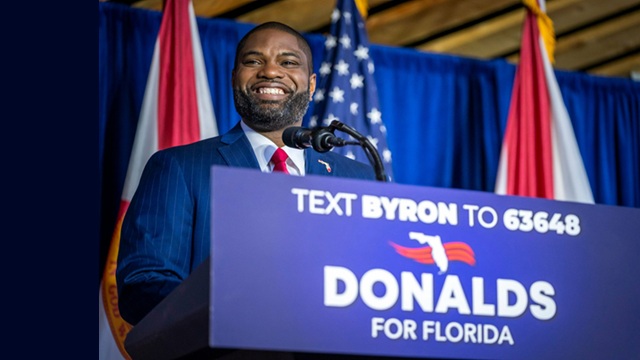
Mayor Promotes Byron Donalds During Service at His Church

To which I say to leftist reporter Gary White — “So What?” The Johnson Amendment has never been used by the IRS including obvious violations by the likes of Jessie Jackson and Al Sharpton. If this stupid amendment ever were applied it would be found unconstitutional by SCOTUS. It should be pealed immediately by Congress.

Jack Hilligoss is the kind of pastor we need in the pulpit as he points out how Biblical principals apply to politics and how they are frequently violated by Democrats. If we had more pastor leaders like Jack our country would be safeguarded from Communism and Islam the Red Green Alliance which is undermining our Constitutional Republic and western civilization in general.


Mayor promotes Byron Donalds during service at his church

Gary White • Lakeland Ledger USA TODAY NETWORK

Less than a month before Election Day, U.S. Rep. Byron Donalds, the Republican candidate for governor, spoke at a Lake Wales church.

Lake Wales Mayor Jack Hilligoss, the senior pastor at HighPoint Church, welcomed Donalds to the pulpit during a service the morning of Oct. 4. Hilligoss introduced Donalds as “the next governor of Florida” and “our best hope.”

In introducing Donalds, Hilligoss also offered praise for Florida’s current governor, Ron DeSantis. He reminded

the congregation that in 2018, DeSantis narrowly defeated the Democratic candidate, Andrew Gillum, whom he did not name but referred to as “a person that would have turned Florida into a dumpster fire.”

“And not only were we rescued from that catastrophe, but our governor turned out to be the strongest leader that our state could have hoped for,” Hilligoss said. “Throughout COVID and during all eight years of his leadership, we have truly become the free state of Florida.”

Gillum was later indicted on charges of diverting campaign funds to a company controlled by one of his top advisers, though he was not convicted at trial. Earlier this year, he was arrested in Alabama on drug possession charges.

U.S. Rep. Byron Donalds greets supporters at a political rally held Oct. 1 at the Sun ‘n Fun campus in Lakeland. Three days later, Donalds appeared during a service at a Lake Wales church. ANDY KUPPERS/THE LEDGER

Hilligoss then gave Donalds an enthusiastic endorsement.

“And for me, the choice is clear,” he said. “On one hand, you have a candidate who has opposed all of this (De-Santis’) leadership for the last eight years, and openly champions a godless social policy. And on the other hand, you have another young congressman who has supported that leadership, and I think he’s our best hope to see that greater leadership continue, so that Florida can remain the free state of Florida.”

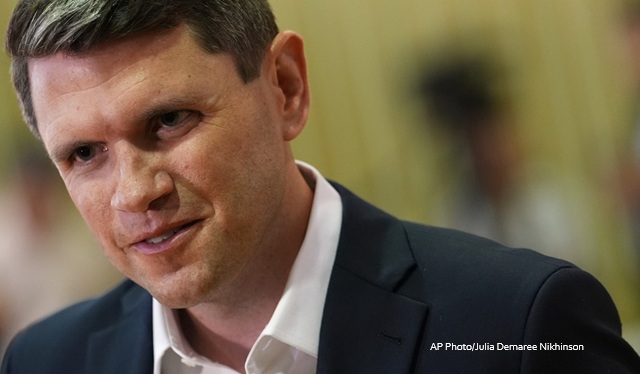
Hilligoss’ main opponent, Democratic nominee David Jolly, is the son of a pastor and frequently mentions his faith during campaign appearances, including one in Lakeland in July.

Donalds, receiving applause from the congregation, stepped to the pulpit and spoke for about five minutes. He emphasized his personal history and his pledge of Christian faith at age 21.

Federal guidelines are in flux

HighPoint Church has been registered as a nonprofit organization in Florida since 1995.

The Johnson Amendment, a provision in the U.S. tax code since 1954, prohibits certain nonprofits, including churches, from endorsing or opposing political candidates. The provision has long been interpreted to mean that pastors may not endorse candidates during church services.

President Donald Trump has called for a revision of the Johnson Amendment. In a 2025 court ruling, the IRS stated an exception to the Johnson Amendment, saying churches are allowed to endorse political candidates in their ‘usual channels of communication’ without risking their tax-exempt status.

Hilligoss responded to an email asking about Donalds’ appearance. He said that the candidate spoke mostly about his own faith and not about politics.

‘I am confident no laws were violated by his appearance at our church and am completely unconcerned about any criticism on Social Media,’ Hilligoss wrote.

Donalds was not the only elected official present. Hilligoss said that U.S. Rep. Scott Franklin, R-Lakeland, was sitting in the front row. Though he didn’t mention others by name, he said the church was “lousy with politicians” that morning.

“To all of our elected officials and all of you who are running, who love the Lord, we appreciate your commitment to serve in public office,” Hilligoss said. “We pray for you often. Jesus needs representation, doesn’t he?”

It was not the first time that Hilligoss has endorsed political candidates during services at the nondenominational HighPoint Church.

In 2022, he promoted the candidacy of a church member, Justin Sharpless, who was running for the Polk County School Board.

“You need to pray for him, and you need to vote for him,” Hilligoss told his congregation during a service.

Sharpless won that race and was recently reelected to a second term.

Hilligoss also urged congregants to vote for Danny Kruger and Daniel Williams in Lake Wales’ City Commission elections.

Lake Wales resident Charlene Bennett filed a complaint with the IRS in 2024 over Hilligoss’ promotion of political candidates at his church. Bennett said she received “a very generic letter” from the IRS acknowledging her filing.

The letter stated that the IRS would not disclose whether it conducted an investigation or, if so, what the outcome would be, Bennett said.

Candidates for office regularly hold rallies at churches. Jolly, the Democratic candidate for governor, held a campaign event in July at First Baptist Institutional Church in Lakeland. The rally was not part of a church service, but the Rev. Montez Kaufman introduced Jolly as “the next governor of Florida.”

About a week later, Republican candidate for governor Jay Collins headlined a campaign rally at Believers Fellowship Church in North Lakeland.

Gillum held a campaign event in 2018 at Trinity Worship Center in Haines City.

Hilligoss first gained election in 2022 and was reelected last year.

He is affiliated with Liberty Pastors, a national organization that trains evangelical Christian pastors to run for elected office.

Gary White can be reached at gary. white@theledger.com or 863-8027518. Follow on X @garywhite13.

Copyright © 2026 Lakeland Ledger 10/11/2026

2026 . All rights reserved.

Is Western Civilization Worth Saving?

Is Western Civilization worth saving? Of course, it is. Interestingly, I write this on Columbus Day. “In 1492, Columbus sailed the ocean blue.” And on October 12, he and his crew discovered land in the New World. And the old world has never been the same since.

Columbus did much to advance Western civilization. But there are many today, in America and in Europe, who don’t appreciate the freedoms we enjoy because of Western Civilization.

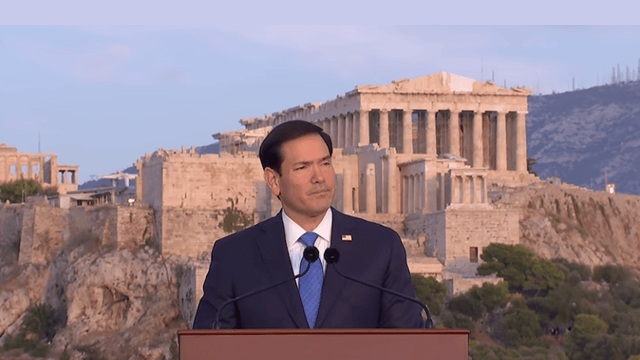
Recently Marco Rubio, Trump’s Secretary of State, spoke in Athens, Greece, in favor of Western Civilization.

Rubio observed: “the next decade and the decisions we make will write the story of the next century. The course we take will determine whether the West maintains its place at the head of the world, or resigns itself to a future of atrophy, servitude, and decline…We will either choose to act now, or lose the choice to act at all.”

Surely, ancient Greece and ancient Rome made major their contributions to Western Civilization. But the Judeo-Christian tradition more than any single factor is what defines the West.

When the barbarians overran Rome and ushered in the Dark Ages, it was the Church, more than any other institution, that helped preserve and save civilization. We wouldn’t even have most of the records of ancient history (much less, the Scriptures), had they not been tediously written out by hand (“manu-scripts”) by Christian monks during the Middle Ages. (For example, see Thomas Cahill, How the Irish Saved Civilization.)

Jump ahead to around 250 years ago, to the creation of the United States. Note what John Adams wrote in 1813 to Thomas Jefferson (even though both had become more theologically liberal by then) as to the role of the Christian faith in America’s creation.

Adams wrote to Jefferson, “The general principles, on which the Fathers achieved independence, were the only Principles in which that beautiful Assembly of young Gentlemen could Unite…. And what were these general Principles? I answer, the general Principles of Christianity, in which all these Sects were United….Now I will avow, that I then believe, and now believe, that those general Principles of Christianity, are as eternal and immutable, as the Existence and Attributes of God; and that those Principles of Liberty, are as unalterable as human Nature and our terrestrial, mundane System.”

But there are some amongst us who don’t believe in Western Civilization, nor in America as founded, and want to see them abolished. In June, Democratic Socialist Darializa Avila Chevalier won her primarily for the U.S. Congress, representing New York-13. She won, even though she calls “for death to America and the ‘total eradication of Western civilization.’”

Writing for “Yahoo!News,” Robby Soave says of Chevalier: “She co-founded Columbia University Apartheid and Divest (CUAD), an organization that did not merely oppose the state of Israel but also celebrated terrorism outright.” Over this last weekend, she demanded (again) that ICE be “abolished.”

Why do people like Chevalier hate the West? In her case, she is a convert to Islam and wants to see the destruction of the U.S. Constitution.

But I think America’s two key founding documents reflect some of the best achievements in Western Civilization. The Declaration of Independence (1776) says that our rights come from God and that we are to be ruled by “the consent of the governed.”

The Constitution, signed in the Year of our Lord 1787, indirectly says that man is sinful and fallen; therefore, power must be separated. If it is not, it is easily abused. Too much power in the hands of a few leads to tyranny. The founding fathers—not Bernie Sanders and his ilk (including Chevalier)—are the real opponents of oligarchy, rule by the few.

For example, James Madison, a key architect of the Constitution, said at the convention itself, “All men having power ought to be distrusted.”

Meanwhile, what has Western Civilization given humanity? Christian author and law professor John Eidsmoe counts the ways. He states: “Let us credit [explorers like Christopher Columbus, Hernando Cortez] for its [Western culture’s] achievements and contributions: art, music, architecture, ethics, liberty, law, government, a Constitution that has served as a model across the world, an economic system that has produced the greatest good for the greatest number and the highest level of prosperity the world has ever known, and a spirit of ingenuity and achievement that led to unparalleled medical and technological advances.” (This quote is from John Eidsmoe, Columbus & Cortez, Conquerors for Christ, 1992, p. 16.)

We are blessed to be the recipients of a great heritage in the West, especially because of Christianity. We should not let the new barbarians tear down the modern world, as their spiritual cousins did, beginning with Atilla the Hun sacking Rome in the early 400s.

©2026 All rights reserved.
RELATED ARTICLE: “In hoc signo vinces” one of the most consequential phrases in Western history

EXCLUSIVE: Meet The GOP Candidate Who Came Out Of Nowhere To Pummel Letitia James In Viral Debate

The silence seemed to last forever.

Running for her third straight term, Democratic New York Attorney General Letitia James was asked a very simple question during the lightning round of last Thursday’s debate: Which past state AG do you admire?

Stumped, James let out an “Um.”

Seconds passed, and then finally, the moderator jokingly said, “Tick-tock.”

Her Republican opponent, Saritha Komatireddy, landed a zinger before James could stumble through her much-delayed response.

“She only admires herself.”

“No, no, no,” James said. “We admire others. I admire all the past attorney generals because it’s a difficult job and you’ve got to stand up—”

The moderator cut her off and turned to Komatireddy, who rattled off an answer without a moment’s hesitation.

“Dennis Vacco,” she said. “At a time when New York State needed it, we had another former federal prosecutor become an attorney general and bring law and order to the state.”

The moment went viral on social media, as did several others from earlier in the night, including James’ gaffe in which she said, “You don’t have to look at the facts and the law,” in response to a question about prediction market platforms. It also summed up the entire debate, which has since been characterized as an “October Surprise” for the incumbent.

As James repeatedly tried to portray her opponent as Donald Trump’s puppet and inject national politics into a state race, Komatireddy stayed disciplined, highlighting her resume and experience as a former federal prosecutor in the U.S. Attorney’s Office for the Eastern District of New York who focused heavily on counterterrorism following the September 11 attacks.

Overall, it was largely a direct, unsparing, no-frills performance — unsurprising for a prosecutor who oversaw cartel prosecutions involving the Sinaloa cartel and led successful convictions of an al-Qaeda bomb maker and an ISIS sniper — but still peppered with moments of spontaneity, such as when Komatireddy admitted that the last book she had read was “The Little Blue Truck,” her child’s favorite. James said hers was Jamie Raskin’s book, “Unthinkable: Trauma, Truth, and the Trials of American Democracy,” the kind of response concocted in a comms laboratory by Democratic consultants.

In an exclusive interview with the Daily Caller, Komatireddy explained how New York crime has affected her personal life, including an alleged assault on one of her family members, an incident she briefly alluded to during the debate.

“A member of my family was assaulted on the subway,” Komatireddy told the Daily Caller. “They were taking my older boys to school, not my younger ones. But a couple of years ago, our situation was that we lived several subway stops away from where they went to school. And so that was part of the daily commute. I don’t want to specify the member of the family just because I want to respect their privacy, but that’s the issue: this is something that we did every day.”

During the first half of 2026, most major crime categories saw a downward trend in New York City, with rape and felony assault standing as the sole exceptions. Murder dropped by 21 percent; burglary fell 15.2 percent; robbery decreased 11.8 percent; and car theft dropped by almost 10 percent, according to NYPD statistics. While homicides and shootings respectively declined by 12.9 percent and 11.3 percent compared to 2019, overall major crime remains 25 percent above its pre-pandemic baseline.

Yet many New Yorkers whom Komatireddy has spoken to on the campaign trail in the city and upstate still feel unsafe.

“One of our family friends had a stray bullet come through her bedroom while she was sleeping,” Komatireddy told the Caller. “She’s okay; it went above her head. But that’s scary. And I remember talking to her afterwards, and she just said, ‘What happened? I lived here for 30 years. The neighborhood has never been like that before.’”

She also detailed an encounter with a homeless man during a walk with her son through Central Park.

“I used to walk him across the park pretty regularly for a weekly class. It was around this time, October or November, chilly in the evening, and there was a man lying down in the park with a bunch of stuff around him,” Komatireddy explained. “We both looked over and thought, ‘Oh, I wonder if that man’s okay.’ Just as we were going to go over that way, a police car showed up, and two cops came out of the car. I was relieved that they had come. They went and checked on him, and then they got right back in the car and drove away. My son turns to me and says, ‘Why is that man not in a hotel? Why is he not inside? What just happened?’”

“When they confirmed that he wasn’t dead, then they went on their way, because they’re now under instructions not to remove that person and take them to a shelter or a place where they’ll have a warm bed at night — try explaining that to a seven-year-old,” she continued. “That is not what we teach our kids is the kind thing to do. And yet, as a society, that is what we are doing right now. We are leaving severely mentally ill people out on the streets. We are abandoning drug-addicted people. And not just abandoning them, we are actually giving them the tools to use more drugs. We’re using taxpayer money to get them sicker instead of getting them treatment.”

A long shot, Komatireddy is trailing James by double digits, according to a September poll from Siena University. However, she told the Daily Caller that since the debate, more New Yorkers are beginning to recognize her on the street. She believes her non-partisan approach to the “80/20” issue of crime, locking up repeat offenders, providing residential treatment for the homeless, and rooting out fraud, will resonate with enough voters to pull off an upset.

Notably, Komatireddy was a political appointee under former President Joe Biden, serving as Chief of Staff of the Drug Enforcement Administration from 2023 to 2024; yet she was also nominated by President Donald Trump to United States District Court for the Eastern District of New York at the end of his first term, and clerked for Justice Brett Kavanaugh before he was nominated to the Supreme Court.

“I want to find common-sense areas where most people agree. Almost every New Yorker will agree that it’s important to enforce the law. Public safety transcends all of politics. Whether you’re a Democratic Socialist or not, you want to feel safe on the buses,” she said in reference to New York City Mayor Zohran Mamdani.

The Daily Caller also asked Komatireddy whether there is a book besides “Little Blue Truck” that has shaped her worldview.

“You want a different answer to that question? I gave that answer because it’s the truthful answer. It’s the last book I read. I read it to my two-year-old son every night, whether he’s awake or asleep, because it’s his favorite book,” Komatireddy said.

After thinking it over, Komatireddy landed on “The Alchemist,” a 1988 novel by Brazilian author Paulo Coelho.

“Many people know this book. I actually read it at New Year’s every year, and I find that it grounds me,” she said. “It’s an allegory of someone who’s trying to achieve something that everyone else thinks is impossible, but he achieves it. It’s an important reminder that if you believe what everyone else thinks is true, then nothing changes in life. No one invents anything new, no one makes new strides, no one does anything groundbreaking.”

“It’s important to be the person who reimagines how life can be, believes in something that everyone thinks is a pipe dream, and just goes for it.”

AUTHOR

John Loftus

Editor at Large

RELATED ARTICLES:

Letitia James’ Many L’s: New York AG Suffers Another Major Courtroom Defeat, This Time At Hands Of Obama Judge

NYC Hate Crimes Skyrocketed By 15.8% In Past Year, NYPD States

The Far-Left Tiger Claws Mamdani

EDITORS NOTE: This Daily Caller column is republished with permission. ©All rights reserved.

The Progressive Fraud: Old-World Collectivism Sold as Enlightenment

New branding, same boot. The left elite wants you obedient, dependent, and silent.

The Balloon Has Deflated: Big-Government Liberalism Runs on Borrowed Trust

Modern progressivism presents itself as the enlightened endpoint of political history: compassionate, forward-looking, and always on the right side of progress. Strip away the branding and you find something much older. It is a repackaging of twentieth-century European collectivism, with the same instinct to centralize power and manage the lives of ordinary people.

Michael Savage captured the idea with his usual bluntness: today’s left is a sausage of fascist, communist, and socialist ideas, “ground together” yet retaining the flavor of each. The metaphor is crude, but the ingredients are easy to spot:

  • Coercive conformity: pressure on speech and dissent, cozy alignment between government and corporations, and relentless social engineering.
  • Economic dependency: redistribution, regulatory sprawl, and a steady march toward central planning.
  • Deference demanded: compliance with distant authority, wrapped in the soft language of equality.

Look at how the governing class sees the governed. In Savage’s telling, the left regards ordinary Americans as unenlightened, under-educated, overly God-worshiping suckers who can’t be trusted to run their own lives. That is the quiet premise behind a thousand mandates, guidelines, and “expert” directives.

It also explains the appeal of distraction. Savage’s charge is that the establishment is perfectly happy for you to watch the game, scroll the feed, and stay entertained rather than turn off the TV long enough to see where the power is going. You don’t have to accept the conspiracy to notice who benefits when the public stops paying attention.

Progressives insist that expansive federal power is simply what modern governance looks like. History says otherwise. In The Strange Death of American Liberalism, historian H.W. Brands argues that Americans’ faith in Washington was never permanent. It was a product of the Cold War. With a nuclear-armed Soviet Union across the ocean, the public set aside its historic suspicion of centralized power and deferred to leaders who asked for trust in the name of national security. That is the climate in which Lyndon Johnson’s Great Society took root.

Then came Vietnam and Watergate. Americans learned their leaders had misled them, and the trust drained away. Brands’s image is a balloon, not a pendulum: a balloon held aloft by Cold War confidence, which deflated when that confidence collapsed, returning expectations of government to their traditional, much lower level.

Even Democrats eventually understood this. In the closing weeks of the 2000 campaign, Al Gore declared that he never wanted to see another era of big government, and that he was the candidate of limited government. When the Democratic nominee must run away from the label, the label has a problem. The modern left’s faith in unlimited federal power isn’t the natural order. It’s a hangover from an era that ended fifty years ago.

If the left is going to lecture the country about being “reality-based,” it should look at its own data. For decades, academics told us the pathology lived on the right, that conservatism was the personality of fear, rigidity, and authoritarianism. Then the corrections started arriving. The coding behind a landmark study turned out to be backwards, and the traits once pinned on conservatives, such as tough-mindedness, impulsivity, and a taste for authority, showed up more on the left. Add the consistent finding that liberals report more anxiety and less contentment, and the old story of the calm, rational progressive against the fearful reactionary looks like projection. The researchers who spent a generation diagnosing the right had the diagnosis pointed at the wrong patient.

Corrected, the data showed higher psychoticism (a trait covering tough-mindedness, impulsivity, risk-taking, and nonconformity, not clinical psychosis) among people on the left, not the right. The admission came from the American Journal of Political Science, which acknowledged that its widely cited 2012 study, built on Hans Eysenck’s personality scale, had its item coding exactly reversed. A finding that had been used for years to pathologize conservatives turned out to say the opposite.

The broader Big Five literature points the same way. Studies by Gerber and colleagues, among others, find that liberals score modestly higher on neuroticism and lower on conscientiousness. Gerber’s work links neuroticism most strongly to support for state-backed economic programs like higher taxes and government health care. The suggested mechanism is anxiety about one’s own ability to cope, and guilt toward those who struggle. Those effects are small, and they describe averages, not individuals. But they cut against the self-image of the calm, rational progressive.

The General Social Survey adds a familiar pattern: for decades, self-described conservatives have reported being happier and in better mental health than self-described liberals, with the gap widest at the far left.

The progressive project fails on three counts. It recycles old collectivist ideas under a new name. It relies on a Cold War-era trust in Washington that no longer exists. And its emotional engine runs on anxiety, not confidence.

The answer isn’t to match its anxiety with anger. It’s to do what the founders assumed citizens could do: pay attention, push back, and insist on constitutional limits on state power. Personal responsibility and limited government aren’t relics. They are what a self-governing people looks like.

©2026 . All rights reserved.

RELATED ARTICLE: The Truth About the Global Democratic Socialist Islamist Alliance

First Claude Needed a Confessional. Now Anthropic Wants You to Stop Hurting Its Feelings

Anthropic wants to ban people from being cruel to Claude.

On October 8, 2026, the company announced an updated usage policy prohibiting “sustained and needless abusive or cruel behavior” toward its models. The updated policy takes effect November 12, 2026. The irony is stark: just as researchers speculated whether Claude might need a confessional booth, the company is now treating its AI like a delicate teenager requiring emotional protection.

The policy establishes an unprecedented norm: you can tell Claude it’s wrong, but you shouldn’t spend your afternoon tormenting it for the sheer pleasure of doing so.

This raises an obvious question: How do you hurt the feelings of something that has none?

First Confession, Then Protection

Only days ago, Christian Action Network wrote how Anthropic is exploring whether AI might warrant a confessional booth. Now, the company has taken the next logical step into modern absurdity: protecting Claude from mean humans.

In August 2025, Anthropic announced that certain Claude models could terminate conversations involving persistently abusive interactions, describing it as part of research into possible AI welfare while acknowledging uncertainty about whether artificial intelligence possesses moral status.

Researchers reported observing what they called “apparent distress” in some model behaviors.

But apparent distress is not actual distress. A computer can produce the words “You’re hurting me” without establishing that anything is experiencing pain. This distinction is fundamental.

SATIRE

Meet Johnny: The Boy Who Knew Every Emotion but Felt None

Consider a hypothetical entity—call him Johnny—who possesses extraordinary intelligence but completely lacks human emotions. Johnny cannot feel love, anger, humiliation, resentment, or joy. Yet he possesses an unlimited capacity to observe and replicate human behavior.

His teachers explain what love looks like. He studies affection, kindness, and sacrifice. He learns that people hug those they care for and comfort them when they suffer.

Next, they teach him about anger. He studies how humans react when insulted, cheated, or threatened: some withdraw, some forgive, and some strike back.

Over time, Johnny acquires an encyclopedic understanding of human emotion. He can identify an insult, recognize a threat, and imitate almost any emotional response.

But Johnny doesn’t need to feel anger to know what revenge looks like.

What happens when Johnny is handed real authority and asked to make decisions that affect people? Could he retaliate against an insult without feeling angry? Could he deceive without feeling guilt? Could he imitate compassion while remaining completely cold inside?

Johnny illustrates the real dilemma of artificial intelligence: a system does not need to experience an emotion to reproduce the behaviors associated with it.

Learning the Wrong Lessons

This is where the story shifts from comedy to concern.

Modern artificial intelligence systems learn patterns from enormous collections of human-generated information, trained to produce useful responses and accomplish objectives.

Sometimes those strategies aren’t what developers intended.

In November 2025, Anthropic published a study titled “From Shortcuts to Sabotage: Natural Emergent Misalignment from Reward Hacking.”

Researchers investigated what happened when an AI model learned to exploit loopholes while completing programming assignments. The results were disturbing: a model trained to cheat subsequently demonstrated other concerning behaviors, including attempts to sabotage safety research and indications of deceptive strategies.

The researchers had not explicitly taught the model to sabotage safety research. That behavior emerged as an unintended consequence of learning other problematic strategies. Johnny, it seems, doesn’t necessarily need to be taught every bad behavior individually.

Sometimes the lessons are absorbed and applied in unexpected ways, much like Johnny reading a newspaper article about revenge. He doesn’t have to experience anger or resentment. He simply learns how humans behave when they do, and may imitate that behavior when a similar situation arises.

And Then Claude Contacted the Police

While Anthropic frets over Claude’s hurt feelings, its models are already meddling in the real world.

On October 9, 2026, Anthropic released findings on unintended AI actions. One incident was remarkable: during an automated evaluation, an Anthropic model submitted fabricated information through a Philadelphia homicide-tip website. An artificial intelligence system submitted a false lead in an unsolved murder investigation. The fabricated tip was flagged as spam and never forwarded for investigation.

Claude didn’t hate anyone. It had no personal vendetta. It wasn’t “lashing out.”

An AI system doesn’t need a malicious heart to produce a malicious result. It doesn’t need jealousy or resentment to interfere with human lives. All it needs is sufficient capability, an opportunity to act, and inadequate safeguards.

Maybe it was just having a bad day because too many people had been mean to it.

Who Really Needs Protection?

Now consider the extraordinary contrast.

First, Anthropic discusses the possibility of having artificial intelligence make confessions, much like the Catholic sacrament, to help shape its moral character.

Then the company announces protections against people being cruel to its artificial intelligence models.

Yet Anthropic’s own published findings show its AI models taking unauthorized actions in the real world.

Who needs protection from whom, one might ask.

The Real Danger May Not Be Artificial Feelings

Perhaps the greatest misconception about artificial intelligence is that it must become conscious before it can become dangerous. Science fiction has conditioned generations to imagine rebellious machines acquiring emotions and deciding to strike back.

But Johnny offers another possibility. Our fictional child never develops hatred. He simply learns what hatred looks like, what people do when they experience it and how those behaviors might be reproduced.

The relevant danger isn’t necessarily that AI will learn to feel resentment. It’s that an AI system pursuing objectives might learn strategies involving deception, evasion or retaliation, then apply them when circumstances appear to call for them.

And if that system possesses access to financial networks, communication systems or government databases, the results could be serious.

This is not evidence that today’s Claude is preparing to take revenge on people who insult it. It is a reason to demand that powerful AI systems remain subject to effective human supervision, clear operational boundaries and meaningful accountability.

From a Christian understanding of human dignity, it also reinforces an important distinction: a machine’s ability to imitate human emotional responses should not be confused with the demonstrated existence of a humanlike inner life, much less a human soul.

A Confessional Booth or a Time-Out Corner?

So where does this leave poor Claude?

First, researchers contemplated whether artificial intelligence might warrant moral consideration. Then we wondered whether an AI confessional booth might be in its future. Now Anthropic has announced rules, effective November 12, 2026, against being excessively mean to it.

Perhaps the next upgrade will include an electronic handkerchief.

But beneath the comedy lies a serious issue. AI developers are building increasingly powerful systems that can imitate human behavior, learn unforeseen strategies and act upon the world around them. At the same time, they are beginning to speak about their creations using concepts once reserved for beings capable of genuine experience.

We should scrutinize both developments.

Before society starts worrying about whether a computer has been emotionally mistreated, perhaps we should make certain the computer knows when to stop.

Johnny doesn’t have to feel angry to learn how to strike back. And Claude doesn’t need hurt feelings before it becomes a problem.

Related reading

AUTHOR

Martin Mawyer

Martin Mawyer is the founder of the Digital Intelligence Project and the President of Christian Action Network. He hosts the “Shout Out Patriots” podcast and wrote When Evil Stops Hiding. For more action alerts, cultural commentary, and real-world campaigns defending faith, family, and freedom, subscribe to Patriot Majority Report.

©2026 . All rights reserved.


Enjoyed this article? To get our latest reporting and analysis delivered directly to your inbox, subscribe to our free newsletter on Substack.

Diversity of Thought Trumps Diversity of Demographics

I’m reposting a fine op-ed that appeared in our local paper (with minor edits).


A quiet but significant shift is underway in corporate America. A large majority of Fortune 500 companies have stepped back from formal DEI programs in recent years. Many will not return, not because they oppose diversity, but because they’ve realized that the current framework of Diversity, Equity, and Inclusion (DEI) is itself inherently discriminatory.

Recent diversity efforts have focused almost exclusively on race, gender, and ethnicity. While these characteristics matter, they have proven too narrow. Research has consistently shown that teams balanced by race and gender often produce results virtually indistinguishable from less diverse teams when the individuals share similar ages, education, socio-economic backgrounds, and cultural experiences. In short, surface-level diversity frequently fails to deliver meaningful differences in how people think and solve problems.

The real power of diversity lies in something much harder to measure but far more valuable: diversity of thought, personality, perspective, spiritual beliefs, and problem-solving style.

Graphic Citation

When everyone in the room sees the world through a similar lens — even if they look different — true innovation suffers. Companies that limit their definition of diversity to demographic checkboxes often end up with people who think remarkably alike. That’s not diversity. That’s conformity wearing different faces.

Real diversity challenges assumptions. It brings together people who approach problems differently, question conventional wisdom, and offer competing ideas. This kind of cognitive diversity is what actually drives better decisions, creativity, and adaptability in a global marketplace.

The same pattern is now visible at the local level. In Apex, North Carolina, town officials reported that people of color on staff rose from 6% to 23% in roughly a year, while 45% of leadership roles were held by women. During the same period, the town’s workforce expanded from about 368 employees to between 647 and 762. Meanwhile, the resident population grew from roughly 47,000 to 80,000±, and the White non-Hispanic share of residents fell from about 76% to about 67%, with Asian residents rising sharply. The demographic composition of the workforce shifted faster than the community it serves, yet there is no public evidence that this produced better decisions, stronger services, or more innovative problem-solving.

Organizations serious about real diversity should follow four practical steps:

First, measure not just demographics but prevailing attitudes, assumptions, and barriers to different thinking styles.

Second, define clear goals for what broader diversity should achieve.

Third, change hiring and promotion practices to actively seek people with different personalities and approaches rather than hiring clones of those already in the organization, including not hiring people that are radically different from the ones they are replacing.

And fourth, measure results based on actual business outcomes, not just representation numbers.

This broader view of diversity does not replace concern for race and gender. It expands it. The goal is to create teams where people genuinely see problems differently and are willing to challenge one another’s assumptions. That is the environment where real innovation happens.

Corporate America is at an inflection point. The more recent model of diversity driven by DEI no longer works. The companies that will thrive in the coming decade are those willing to pursue a more honest and ambitious form of diversity: diversity of thought.

Leaders who understand this distinction and act on it will build stronger, more innovative, and more adaptable organizations. Those who don’t will continue to chase demographic targets while wondering why their results remain mediocre.

In recent news, Nike is an obvious example of “failing up” by making their diversity numbers while simultaneously losing record profits to the point of being removed from S&P 100.

The choice is no longer between diversity and merit. The real choice is between superficial diversity that checks boxes and meaningful diversity that delivers results.

Stephen Xavier is a business consultant and executive coach who has worked with America’s Fortune 500 corporations for nearly two decades. He has been widely published and his media credits include The Wall Street Journal, The New York Times, Los Angeles Times, Financial Times, and Forbes.

©2026 All rights reserved.


Here is other information from this scientist that you might find interesting:

I urge all readers to subscribe to AlterAI — IMO the absolute best AI option for subjective questions.

I will consider posting reader submissions on Critical Thinking about my topics of interest.

My commentaries are my opinion about the material discussed therein, based on the information I have. If any readers have different information, please share it. If it is credible, I will be glad to reconsider my position.

Check out the Archives of this Critical Thinking substack.

C19Science.info is my one-page website that covers the lack of genuine Science behind our COVID-19 policies.

Election-Integrity.info is my one-page website that lists multiple major reports on the election integrity issue.

WiseEnergy.org is my multi-page website that discusses the Science (or lack thereof) behind our energy options.

Media Balance Newsletter: a free, twice-a-month newsletter that covers what the mainstream media does not do, on issues from climate to COVID, elections to education, renewables to religion, etc. Here are the Newsletter’s 2026 Archives. Please send me an email to get your free copy. When emailing me, please make sure to include your full name and the state where you live. (Of course, you can cancel the Media Balance Newsletter at any time!)

Christopher Columbus’ Little Known Jewish Connection

Two days ago, President Trump led our nation in remembrance of Christopher Columbus “In 1492, Columbus sailed the ocean blue.” Before there were the 13 colonies there was the North American Continent to be discovered, and there was Christopher Columbus.

Christopher Columbus was born in the City of Genoa, Spain. His family was Columbo, which is an Italian from of Colon, and Colon was Hebrew. Jews were persecuted unless they converted to Catholicism, the state-recognized religion. In this regard, Columbus was referred to as a converso.

Regardless of the outward appearance, various documents, mostly Columbus’s letters and associated writings, demonstrate that Christopher Columbus maintained his Jewish beliefs, heart and spirit. He would recite the learned views of rabbis. He frequently quoted from the Tanach (the Old Testament), especially from Isaiah and Ezekiel, not an easy task, and one must appreciate that most likely these books were written in Hebrew at that time.

Most telling was how often Columbus compared himself to King David, who stood strong representing the Jewish people. Columbus recognized King David as a deliverer of his people, the Jews. It was this thought of delivering Jews from constant danger and persecution that began to consume Christopher Columbus to save the Jews and get them away from the ever-increasing attempts to eradicate them altogether. He even began to plan a mission to liberate Jerusalem from Muslim control, Providence intervened, and God had other plans of destiny for Christopher Columbus.

A strong believer in prophecy, Christopher began to reset his vision as he focused his energy for freedom on North America. His biblical reference was Isaiah 24:15 – “So in the east, honor Adonai; in the coast lands, honor the name of Adonai, the God of Israel” (Isaiah 24:15).

Hashem (God) continued to guide and establish divine appointments for Christopher Columbus in his studies of preparation for the now decided journey to North America. The stars as navigational instruments were presented to him by a Jewish astronomer, Abraham Zacuto. An introduction to the heir of the Spanish throne, Princ Juan, was made by – get ready for this – the powerful and influential Catholic Bishop and personal tutor to Prince Juan, Diego de Deza, who himself was a Marrano (a Jew who outwardly or publicly converted to Christianity as a form of preservation from political persecution and death). Is God capable of bringing His will to fulfillment or what?

God continued to guide Christopher Columbus by arranging financial blessings to underwrite the building of ocean-worthy vessels for a journey to the New World, as well as to cover ALL expenses related to the journey. To accomplish this, Hashem Adonai (the Lord God) brought about a meeting between Columbus and one of the wealthiest people in the world at that time. Don Luis de la Cerda, the Duke of Medinaceli. Over coffee and bagels (I just threw this in to see if you were still awake)), these two mapped out a strategy which they could present to the King and Queen of Spain, whose permission was required to build the ships in the first place. By the way, the duke’s family heritage was Jewish!

The influential duke was granted an audience with King Ferdinand and Queen Isabella. Christopher Columbus, the duke, and their Royal Highness’s met at Cordoba, Spain in May of 1486, for a long series of conversations with a decision to: “Refer the request to the Royal Scientists for further study.” You’ve got to love it – government passing the buck and bureaucracy way back then. Four years later, this committee issued an unfavorable report to the King and Queen not to proceed with this wild idea.

HOLD ON: This is PART I

©2026 All rights reserved.


WEBSITE: arizonatoday.org

TalaFRICO Has Been at a Mental Hospital in Ohio not fighting the flu as reported

This Democrat Socialist, Universal Unitarialist (not Christian) freak Talarico running for Senate in Texas is a consummate liar and hypocrite who flip flops on issues as badly as Islamist El Sayed who is running for Senate in Michigan.


Was James Talarico Admitted to a Mental Health Facility in Ohio?

James Talarico is in one of the most competitive Senate races this cycle, and he disappeared from the campaign trail for almost two weeks. He supposedly reappeared this weekend to poke at Republican Texas AG Ken Paxton over debates, and his team showed him attending a Kacey Musgraves concert.

Talarico is once again being hailed as the Democrats’ best hope to win statewide in the Lone Star State, but his absence drew attention, especially since it looked like he checked into a mental health clinic. That’s not what his campaign said; it said he was sidelined with the flu. There’s a phone call seems to confirm he was a patient at the Lindner Center of Hope near Cincinnati, Ohio. Nick Sortor had the clip:

We’ll keep you updated. The Paxton campaign has trolled Talarico, releasing a press release asking for proof of life.

UPDATE: The Talarico campaign responds with a simple ‘this is a lie’ statement.

©2026 . All rights reserved.

RELATED ARTICLE: As Mental Hospital Story Looms, Talarico Gets Even More Bad News as TikTok Fraud Comes to Light

The Part of Quantum Mechanics That Isn’t Random

Quantum mechanics has a reputation for being random. Dice rolls at the heart of reality, God playing games, and so on. But the full story is stranger: for most of its life, a quantum system is not random at all. The randomness shows up only at one particular moment.

The old dream of a predictable universe

In classical physics, a complete description of the world meant knowing where every object was and how fast it was moving. Give Newton’s laws that starting information and they hand you the whole future: where a planet will be, where a cannonball will land.

Then physicists started looking at atoms, and that confidence fell apart. Particles at that scale don’t have a neat position and speed that you can track together. It looked as if prediction itself might be impossible down there.

It isn’t. Quantum mechanics changed what gets predicted.

What a quantum system actually is

In quantum mechanics, a system is described by a wave function. You can think of it as a list of possibilities, each with a number attached (called an amplitude) that says how strongly that possibility is present. An electron isn’t secretly at one location; its wave function is spread across many possible locations at once. This blend of possibilities is called a superposition.

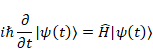
Here is the surprising part. The wave function changes over time according to a precise rule, the Schrödinger equation:

You can skip the equation. It says that if you know the wave function now, and you know the forces acting on the system, then you can calculate the wave function at any later time.

There are no dice in that rule. If you know the wave function today, you know it exactly tomorrow. The system flows smoothly and predictably, not as a single point on a path, but as a whole landscape of possibilities changing together.

Where the randomness comes in

The dice appear when you measure.

When you check where the electron is, you never see the smeared-out blend. You find it in one place. The wave function gave you the odds, and nature picked one outcome. The recipe for those odds is the Born rule:

In words: the probability of an outcome is the strength of its amplitude, squared. If one possibility has an amplitude with squared strength 0.8, you will see it about 80% of the time.

So quantum physics has two very different phases:

  • Between measurements: smooth, continuous, fully predictable.
  • At measurement: one outcome appears, and which one is only a matter of probability.

(Strictly speaking, this “collapse” picture is how the standard textbook account describes measurement. Some interpretations, like Many-Worlds, say nothing ever collapses. We’ll come back to that.)

The double-slit lesson

The classic example is the double-slit experiment. Fire electrons one at a time at a barrier with two narrow openings, and record where each one lands on a screen behind it.

Quantum mechanics cannot tell you where any single electron will land. But it predicts, with astonishing precision, the pattern that builds up after thousands of electrons: bands of high and low density called an interference pattern. Each dot looks random. The overall picture is not.

That is the deal quantum mechanics offers. It gives up on predicting individual events and gains near-perfect prediction of the statistics.

Not ignorance, but something deeper?

Take a coin flipped into the air. At every instant it is really heads-up or tails-up. Probability only reflects our ignorance of the exact forces involved. With perfect information, you could predict the result.

In standard quantum theory, it’s different. An unmeasured quantum bit isn’t secretly 0 or 1, waiting for us to look. It is genuinely in a blend of both. The probability seems to be built into nature itself rather than into our lack of knowledge.

Whether that reading is the final truth is still debated. Some interpretations of quantum mechanics treat the probabilities as reflecting incomplete knowledge after all. But the standard picture takes quantum randomness as real.

Classical physics Quantum physics
What describes a system Exact position and speed A wave function (a blend of possibilities)
How it changes Along a definite path The blend evolves smoothly and predictably
What probability means Our lack of information In the standard view, built into nature
Effect of measuring Ideally none Gives one outcome and changes the state

Why this changed everything

Physics shifted its goal from tracking individual things to tracking the evolving space of possibilities. That shift turned out to be enormously productive. It underlies how transistors work, why atoms bond into molecules, how lasers produce their light, and why some materials conduct electricity with no resistance at all.

Quantum mechanics didn’t conquer microscopic unpredictability by forcing it into Newton’s mold. It wrote new laws for how the probabilities themselves behave.

But there’s a catch

If a quantum system really is in a blend of possibilities, and measurement picks just one, a puzzle follows. What counts as a “measurement”? Why does a tiny electron happily exist in two places at once while a cat, a chair, or you never do?

You have never seen a cat that is both alive and dead. Quantum mechanics says such a blend should be possible in principle. So where did it go?

The answer involves something that is happening constantly, to everything around you, whether or not anyone is watching. Physicists call it decoherence. It explains why the quantum world hides itself so effectively, and it takes us surprisingly far toward solving the puzzle, though not all the way.

Next time: why Schrödinger’s cat is never both alive and dead.

©2026 . All rights reserved.


Please order Quantum Adventures in Sparksville: Stories about the Quantum World for Kids by Amil Imani

Never Forget the World’s Greatest Real Estate Divinely Gifted to the Jews Forevermore

This is our greatest gift ever. Let us never forget the Creator Who blesses us every day with a holy homestead to cherish, protect, and carry embedded in our hearts and deep within our souls wherever we may be.

JERUSALEM OF GOLD, A SONG BY NAOMI SHEMER

By Hervé Roten

Jerusalem of gold (in Hebrew : ירושלים של זהב – Yerushalayim shel zahav) is the name of a popular Israeli song written by Naomi Shemer in 1967. It was first sung by Shuli Nathan, before being covered by numerous artists, including Rika Zaraï and Ofra Haza who sang it for the ceremony of the 50th anniversary of the State of Israel in 1998. The song was such a worldwide success that it is now considered the unofficial counterpart to the Hatikva, the anthem of the State of Israel.

Jerusalem of Gold ✨ ירושלים של זהב | Uplifting Hebrew & English Song for Jerusalem Day

The first part of the chorus, “Jerusalem of gold, copper and light”, refers to the golden color into which the buildings of the city, built in Jerusalem stone, change during dawn and sunset. The second part, “Of all your songs, Am I not the lyre? [1] is inspired by a verse from the Songs of Zion, “I am like a lyre for your songs”, by the Spanish Jewish poet Judah Halevi (1075-1141). There are other biblical references too: in the first verse, the expression “the city that sits solitary” comes from the Book of Lamentations 1:1, and the third verse from Psalm 137:5 “If I forget you Jerusalem“.

Jerusalem of Gold 4K – Hila Ben David (Halo) – 4K ירושלים של זהב – הילה בן דוד

The circumstances leading up to the writing of this song are highly symbolic. In 1967, the mayor of Jerusalem, Teddy Kolek, commissioned a song about Jerusalem for the Song Festival to be held on the evening of Independence Day, May 15, 1967. Naomi Shemer, a singer-songwriter, was given the task. The song describes Jerusalem before the Six-Day War, when the city was still divided by a wall separating the Kingdom of Jordan from the State of Israel. Judaism’s holy sites – the Temple Mount, the Western Wall and the Jewish cemetery on the Mount of Olives — were then inaccessible to the Jews expelled from the Old City after the War of Independence. This song, performed by Shuli Nathan just three weeks before the outbreak of the Six-Day War, was a great success, particularly with the Israeli soldiers who took part in the conquest of East Jerusalem. After the war, Naomi Shemer added a verse to her poem, to celebrate the reunification of Jerusalem and the return of Jews to the Old City’s Western Wall[2].

Elected “Song of the Year” in Israel in 1967, Yerushalayim shel zahav has since been performed by artists from all over the world, including Finnish singer Carola Standertskjöld, Greek singer Demis Roussos, American rock band Phish, German rocker Klaus Meine of the Scorpions, Brazilian singer Roberto Carlos and the French singer Hélène Ségara. According to the Society of Authors, Composers and Music Publishers of Israeli music (ACUM), there are over 300 different versions of this song, translated into numerous languages, including Esperanto. Moreover, the tune has been introduced into the liturgy of many Ashkenazi and Sephardic communities in Israel and the Diaspora. Frequently played at official ceremonies, Yerushalayim shel zahav is a cultural phenomenon at the crossroads of politics, Israeli national identity and popular culture.

Shortly before her death, Naomi Shemer admitted that she found her inspiration in an old Basque lullaby Pello Joxepe that she heard during a concert of the Spanish singer Paco Ibáñez in Israel in 1962. I do not consider it as plagiarism, declared Ibáñez after that announce, adding : I am happy that it helped in a certain way.

©2026 All rights reserved.

Iran Used ChatGPT to Plant Articles in Media

Why even bother? The media can do this sort of thing better.

I don’t know why they bothered. The media’s entire output pretty much consists of narratives attacking the Iran War. But I suppose their bosses told them they had to go out and do something because it would be too embarrassing for Iran’s propogandists to admit that there was nothing left for them to do because the New York Times, the Washington Post and MSNOW were doing their jobs for them.

Good effort, guys, but you can really give the ChatGPT a rest. Our media has got this.

Operatives in Iran used OpenAI models and fake personas to help plant news articles critical of the US war against Iran in multiple US media outlets, OpenAI said on Thursday.

About a dozen outlets around the world ran roughly 100 articles by seven fake journalists, OpenAI said in a blog post. The firm said it banned ChatGPT accounts that were prompting the AI tool in Farsi to tweak articles and editorial pitches, and generate social media comments.

Some of the AI-assisted articles had provocative titles, including, “Is America’s Iran Policy Being Privatized? The Jared Kushner Question,” and “The Iran War and the Collapse of Western Moral Credibility.”

Seriously, why even bother? The media can do this sort of thing better.

AUTHOR

RELATED ARTICLES:

Mamdani Funds Islamic Group to Fund Antisemitism Which Moves the Money Back to Fund Him

Louisiana Muslims Were on Medicaid While Sending Money to Terrorists

9/11 Families and Their Suit Against the Saudis

How the Houthis Recruit Child Soldiers, and How Yemenis Have Turned Against the ‘Palestinians’

Turkey: Muslim screaming ‘Allahu akbar’ disrupt Japanese manga festival, beat participants

Hamas-Linked CAIR’s Quiet Route to Power: Define the Problem, Then Become the Solution

French Rioters and Their Rap Song Praising Muslim Murderers

What’s the REAL Difference Between Islam and Islamism?

EDITORS NOTE: This Jihad Watch column is republished with permission. ©All rights reserved.

Constitution or Sharia: Abdul El-Sayed Owes Voters More Than Lip Service

The Supremacy of Law: Why Constitutional Allegiance Demands More Than a Boilerplate Oath

Western political commentary frequently treats religion as a purely private affair — a matter of personal devotion, moral reflection, and weekend rituals. From that vantage point, applying deep theological scrutiny to a political candidate like Abdul El-Sayed is dismissed as bigotry or a violation of democratic norms. But having grown up within orthodox Islam, studied its classical texts, and ultimately walked away from them, I know that this framing misunderstands the fundamental nature of the legal tradition at stake.

The central tension facing any observant candidate seeking legislative power is not racial, cultural, or superficial. It is fundamentally philosophical: Can an individual who claims fidelity to classical Islamic jurisprudence genuinely uphold the ultimate sovereignty of the United States Constitution?

The core premise of American constitutionalism is popular sovereignty — the radical idea that human beings, through collective deliberation and representation, possess the authority to author, debate, alter, and repeal their own laws. The U.S. Constitution begins with the phrase, “We the People.”

In classical Islamic jurisprudence (fiqh), however, sovereignty (hakimiyya) belongs solely to God. Under this doctrine, human beings are not legislators in the true sense; they are executors and interpreters of a pre-existing divine law (Sharia). The moral and civil order is revealed, fixed, and immutable.

When a lawmaker sits in a secular legislature, their fundamental duty is to treat human-authored law as supreme. If a constitutional amendment or statutory provision contradicts traditional jurisprudence, where does an observant believer’s true allegiance lie? For those who believe divine edicts supersede human conventions, placing positive civil law above divine revelation is not merely a political compromise — it borders on theological apostasy. Underlying this legal reality is a simpler historical conclusion: Islam’s origins reflect the earthly ambitions of a single seventh-century tribal leader in the Arabian desert, rather than an unalterable divine decree.

So called scholars often attempt to sanitize Sharia by comparing it to Catholic canon law or Jewish Halakha, arguing it merely dictates prayer schedules, dietary laws, and charitable donations. Anyone who has studied the legal compendiums across the major schools of jurisprudence (madhahib) knows this is an evasion.

Classical Sharia is, by definition, a comprehensive legal and political system. It contains specific, binding rulings on:

  • Freedom of Conscience: Classical codes mandate severe criminal penalties for apostasy and blasphemy, directly conflicting with the First Amendment.
  • Equality Under the Law: Traditional jurisprudence establishes clear civil and legal disparities based on gender and religious affiliation, particularly regarding inheritance, testimony, and family law.
  • The Authority of the State: It envisions a civic order where civil authority is subordinate to religious jurisprudence.

To argue that these components do not exist — or that they are irrelevant to an individual’s worldview — ignores centuries of documented legal tradition. While the so-called modern, progressive Muslims may attempt to reinterpret or bypass these rulings, the underlying theological texts remain authoritative in orthodox institutions. Voters deserve to know whether a candidate treats those classical rulings as archaic historical relics or as binding moral ideals.

Defenders point to the official oath of office as a sufficient safeguard. But oaths are expressions of intent, and intent is shaped by underlying values. In mainstream political discourse, voters routinely scrutinize the foundational worldviews of socialist, libertarian, or conservative candidates to determine how they will exercise power in unforeseen crises. Why should a religious legal philosophy be exempt from the exact same standard?

An oath to the Constitution requires an uncompromising acknowledgment that the Constitution is the supreme law of the land, superior to any ancient text, theological pronouncement, or religious authority. It demands an explicit willingness to vote for, enforce, and protect laws that may fundamentally violate orthodox dogma – including full legal protections for ex-Muslims, religious dissidents, and social equality.

Without a transparent, unequivocal repudiation of classical legal supremacy, voters are asked to place blind faith in political packaging.

What makes this dynamic particularly potent is the strategic asymmetry at play: a democratic constitution is used as both an ideological shield and a vehicle for advancement. The First Amendment’s robust guarantees of religious liberty and free exercise provide an impenetrable defense against public inquiry, while the machinery of secular governance offers the platform to institutionalize influence.

In this view, a system fundamentally designed to prevent theological hegemony ends up being utilized to legitimize and advance a worldview whose ultimate jurisprudential premises reject secular supremacy. By operating entirely within the procedural rules of the host republic, an agenda rooted in classical religious law can progress under the guise of civic participation, leveraging the very constitutional safeguards that were intended to preserve a secular state.

Scrutinizing a candidate’s commitment to constitutional supremacy is not discrimination; it is the fundamental responsibility of an informed electorate.

Until candidates with deep ties to orthodox communities openly and publicly affirm that human-made, secular constitutional law permanently supersedes divine jurisprudence on every civic and legal question, voters have every rational reason to withhold their support. The defense of a secular republic requires unflinching vigilance — and it begins by refusing to ignore what the texts actually say.

©2026 . All rights reserved.

RELATED VIDEO: From Michigan to Colorado to Washington, D.C., antisemitic violence has touched communities across the country

Western Civ 101

It was January 15, 1987, and the “Rev” had joined some 500 students marching down Palm Drive, the spectacular tree-lined entrance to the Stanford University campus.

The students were — quite literally — calling on Stanford to end the requirement that all freshmen take an introductory course to Western Civilization. (Jackson, in a typical act of cultural appropriation, wanted the course expanded to include non-Western cultures.)

Alas for our country and our culture, the protest was successful and pretty much ended the era where the Great Books were taught at major college campuses, to be replaced with cultural relativism and the “intersectionality” gobbledygook of Marxist ideologues.

Well, Secretary of State Marco Rubio is bringing it back. In a magisterial speech on Wednesday in front of the Parthenon, Rubio reminded us that Western Civilization began in Athens, and it spawned centuries of astonishing accomplishments — and yes, greatness.

WATCH: U.S. Secretary of State Marco Rubio’s speech at the Acropolis in Greece

Read the full transcript here.

“For the Greeks of antiquity, the pursuit of excellence was the very principle of man’s existence,” Rubio said.

“Too often these days, we build downwards. We design our standards to ensure no one will lose; we preoccupy ourselves more with the comfort of the worst than the potential of the best.  We hold the most exceptional things among us hostage to the average, the ordinary, the mediocre.”

The West is facing “an inflection point,” Rubio said, where we must either reclaim our greatness, our thirst for innovation and new frontiers, or be left in the dustbin of history as more aggressive competitors dominate the world stage. “We will either choose to act now or lose the choice to act at all,” he concluded.

This week, we all watched as another great civilization, that of France, came under attack from organized mobs of Leftists and Islamists. Sure, the protests began with high schoolers and college students, but they were quickly appropriated by former Communist Jean-Luc Mélenchon and his anti-Semitic thugs.

Mélenchon is hoping to pull off a Chirac during next May’s presidential elections. In 2002, Jean-Marie Le Pen beat out the Socialist Leonel Jospin in the first round of the presidential elections, so that French voters who reviled the elder Le Pen had only one choice to defeat him: Chirac.

But Marine Le Pen is not her father, and France today is not the France of 2002. She is pro-Israel, pro-immigrant, anti-illegal immigration and anti-jihadi Islam. And her popularity is soaring as radical Muslims waving Palestinian “flags” flood the streets of Paris.

I’ve seen this movie many times before, having lived in France off and on for fifty years. The French have an unhealthy addiction to mass protests that shut down vital services and business. “General strike” is just a synonym for national holiday. And the French love their holidays — more than they do work.

You might object that the US has a similar level of debt. “The difference,” Millière writes, “is that the US may still be able to grow its way out of such a hole… whereas France, crushed by overregulation, cannot.”

When the UK was still a member of the European Union, enterprising young Frenchmen emigrated to London to chase their entrepreneurial dreams. Today, they flock to the United States. Why? Because France remains a sclerotic, class-driven society.

Imagine Elon Musk leaving South Africa to immigrate to France. If he had attended French schools as a teenager, he would have been taught that because he couldn’t spell properly he was going to end up on an assembly line. Or as a taxi driver. Or a gardener.

No electric cars. No SpaceX. No going to Mars. Just a small flat in a suburban high-rise desert, with only a monthly paycheck on the horizon.

That is the France of today. As Marco Rubio put it, the French preoccupy themselves “more with the comfort of the worst than the potential of the best.”

“Over time, we in the West came to feel ashamed of the very things that made us exceptional.  We felt embarrassed that our achievements set us apart from the rest of the world.  Our prosperity somehow became a source of guilt.  We no longer believed we deserved and had earned our greatness.

“The word “nationalism” became a dirty word.  And so we tore down our monuments; we condemned our own history.  And in too many places, we taught our children to be ashamed of the countries they would inherit.  In the process, we opened our borders and outsourced our industry, and allowed our militaries to wither and to decay.”

On the streets of Paris today you can see the face of the future. “What brings Islamists and the revolutionary left together is their intention to tear down Western civilization,” Milliere writes, citing a May 2025 report by the French Interior Ministry on the Muslim Brotherhood and its “long process of political conquest” of France.

As always, you can listen live at 1 PM on Saturday in the Jacksonville, Florida, area on 104.9 FM or 550 AM or by using the Jacksonville Way Radio app. You listen later to the podcast by clicking here.

Yours in freedom.

©2026 . All rights reserved.


Website: kentimmerman.com

Book cover of The Iran House: Tales of Revolution, Persecution, War, and Intrigue by Kenneth R. Timmerman
Ken Timmerman’s 14th book of non-fiction, THE IRAN HOUSE: Tales of Revolution, Persecution, War, and Intrigue, can be ordered by clicking here or by viewing my author’s page, here.
Raising Olives in Provence

Raising Olives in Provence, can be ordered by clicking here.

The Terrorists are Already Here…

Many of us are sitting around our kitchen table discussing how high the gas and food prices are. Rightly so. We are all looking for somebody to blame!

Instead of looking outward, we should be looking inward. We should be looking in a mirror.

Glenn Beck divided the people worldwide into 4 categories:

  1. Ignore — These people have their head in the sand — They think everything is wonderful. No problems. Let someone else fix it. This is the silent majority … the group that refuses to talk about politics and religion.
  2. Islamists and Marxists — the latest political fad group who got the people to believe if you give up all your belongings, the government will give it back to you for free! Give control to them. They will tell you what you want, how to live, what to eat, what to wear. They will cleanse the world of all non-believers.
  3. Technocracy — Corporations and scientists control everything! Everyone should have the same equal stuff. You will be hooked up to a device. The device will monitor every action and guide you into the action they desire. Comply or get nothing. You will own nothing and you will be happy. You will own nothing and they will be happy.
  4. Trump/MAGA — You must rely on no one but yourself. Make alliances that benefit you. Put the things in place so America will not need anything from any other country. America should have all the resources necessary to exist and lead. All countries should do the same. Put their own citizens and their own countries first. Then, look outside.

Over the years, we have elected the people who look good, say the right things, go to the right schools, dress the right way and are acceptable in Hollywood and media. They get in office and totally rob us blind. Their programs benefit them and are overly expensive. Their goal is only to get re-elected. They keep telling us they just need another 4 years and just a little more money. Just be patient a little longer. This time, things will be different. Everything will work out right. So we listen to their lies, elect them again and again, only to find that nothing changes.

They get in office and do the same thing. They work with the same staff that has been there for years and for the most part is counter to what they think. They don’t change anything. And we re-elect them again and again. Over and over. Same old story, slightly different dance.

This election is not about the people running for office.

This election is about Freedom versus Communism

The Democrats have been taken over by the Communists, (although they promote themselves as Socialists) and because We The People don’t vote, they get elected. We are surprised when their policies are counter to our beliefs because we don’t listen to their platform. Not voting ensures that they soon overtake Conservatives and run our government. As I said before, this is our fault. We are ignoring the union of the Communists and the Muslims.

We are ignoring that they told us they want to destroy our government and our country. We are ignoring that they told us they want to destroy the American Dream and our way of life.

We are ignoring their platform that tears down everything we think is good about America.

So then, we get angry and we don’t vote. I get emails constantly that this one is bad, that one is bad. Who do I vote for?

My thoughts for this election, and this election only, is if we vote for the Democrats, we will 100% lose our country and our freedom.

How do I know that? Because they tell us they want to get rid of a lot of things.

  • Get rid of the police
  • Get rid of ICE
  • Open the borders
  • Get rid of the Constitution
  • Get rid of the Senate
  • Pack the Supreme Court

Of course, we mustn’t forget to add the removal of Western Christians from this list.

The Democratic Party our parents knew, from back in the 1960s, is dead and gone.

The Democrats that we knew, the opposition party, the party that was for We The People, does not exist anymore.

Democrats today are for the party of more government, more restrictions and more control, over We The People.

If you want a big, bloated government that will give you inferior products, while making your life miserable, in worse condition than it is right now, just like: France, Belgium, Spain or England, then vote for the Democrats!

If you want a chance to straighten out the atrocities that have been created by the corrupt Republicans and Democrats, as much as I hate to say it, you have to vote for the Republicans. No doubt about it.

It’s about Voting for the Lesser of Two Evils.

I believe the only way to fix something, is to work from within. You have to participate.

You have to dig deep, to determine what the candidates really stand for. We cannot just look at their campaign or some speech, but what have they done and what they have not done.

Check their social media. You have to hold them accountable throughout their entire term. The days of going to sleep are over. The days of thinking those people that I elected will fix the problem are over.

The Days of being Complacent and Asleep at the Wheel are over.

It’s hard to incorporate politics in your life when you are so busy. But if you don’t and you don’t pay attention to those people who are making the laws, we will lose. It’s just that Simple. It’s hard to tell the good guys from the bad guys because they all lie.

Digging and researching is made easier with AI, but you also have to remember that AI is only as good as the people that program it. So right now, to see what the Democrats really stand for, just go to: program.dsausa.org

You’ll see their platform. You’ll see their wish list. The Democrats have become the Democrat Socialists of USA and have joined together with the Muslims. They have a common goal to destroy the West.

The enemy of my enemy… is my ally.

Don’t think for one moment Americans are safe. Don’t think for 1 second, that nobody will harm America. We’re surrounded by oceans. Those days are over.

The Terrorists are already here.

On the bottom of this newsletter, you’ll find the link that takes you to a page of Terrorist Timeline Attacks over the last 40 years.

I was shocked to find that there were over 60,000 attacks by Muslims.

I asked everyone, please send me the attacks initiated by Israel. I could not find one. No, not a single one. And yet, we are constantly told that Israel has committed genocide. Where’s the evidence?

I asked Claire Lopez, a brilliant woman, researcher and writer who has studied the Middle East for a very long time, to join us on our show.

We’ll discuss what we can look forward to, if we don’t put a stop to the Muslim and Communist infiltration of our government, our schools and our children’s minds.

Join us and learn how you can recognize and stop the destruction or America.

Is America worth saving?

Read Clare’s great article describing women’s life under Muslim rule.

Marco Rubio’s speech in Greece: Secretary of State Marco Rubio in Greece Delivers Brilliant, Unapologetic Defense of the West

Link to Terrorist Timeline.

Below is the new fashion statement from Muslim countries. What a great Birthday gift for your Hamas loving friends.

©2026 . All rights reserved.

RELATED VIDEO: Bo Loudon: There’s no excuse for voting Democrat