

Obama’s Phased Nuclear Deal with Iran: Kicking the bomb down the road?
This column is co-authored with Ilana Freedman who is a veteran intelligence analyst and specialist in counter-terrorism. Ilana is Editor of FreedmanReport.com.
When we posted late Monday night, February 23, 2015, on breaking news about the phased deal resulting from bilateral discussions between U.S. Secretary of State Kerry and Iranian Foreign Minister Zarif, we knew from our sources that more shoes would be likely to drop. Last night we received information from these reliable sources on the extent to which the Administration had strayed from its original mandate. The information was:
- Secretary of State John Kerry is poised to sign a secret Memorandum of Understanding (MoU) between the U.S. and Iran that was completed by negotiators on Saturday, February 14.
- The State Department has received a decision from Eric Holder’s Department of Justice that the MoU does not require approval by the U.S. Senate in the Constitutionally defined process of Advise and Consent for treaties between the United States and other nations, and that therefore Congress will not be consulted.
- The agreement does not cover the subject of inspections, removing the requirements of having inspections at any of the sites covered by the memorandum.
- The agreement will allow Iran to have 10,000 enhanced centrifuges that will increase their nuclear program capacity by upwards of 50%.
- Of the 10,000 centrifuges allotted, all of Iran’s 6,000 existing centrifuges will be converted to the enhanced, next generation versions. The conversion can begin immediately after the agreement is signed. This will enable Iran to achieve a nuclear threshold state in less than two years. The balance of 4,000 centrifuges will, according to our sources, be supplied by Russia.
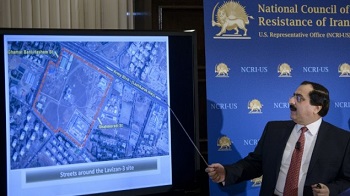
Alireza Jafarzadeh, Deputy Director, Washington Office of NCRI, National Press Club, Feb. 24, 2015.
It is not known whether other Iranian nuclear sites will likewise fall under this inspection exemption, including military test sites like Parchin and the secret parallel Lavizan site, which was disclosed in Washington on Tuesday, February 24th by the National Council of Resistance of Iran (NCRI) in a National Press Club briefing. At the NPC briefing, Alireza Jafarzadeh, Deputy Director of the NCRI’s Washington D.C. office, reported on a secret test site which has been previously identified in reports of the Washington, D.C. based, Institute for Science and International Security.
“Despite the Iranian regime’s claims that all of its enrichment activities are transparent … it has in fact been engaged in research and development with advanced centrifuges at a secret nuclear site called Lavizan-3,” he said. Jafarzadeh said the site was hidden in a military base in the northeastern suburbs of Tehran.
According to the presentation, the complex was described as a facility 164 feet underground. The Lavizan-3 site was apparently constructed between 2004 and 2008 and has underground labs connected by a tunnel, and lead-lined doors to seal out radiation leaks. The facility itself is heavily shielded from radiation and insulated against noise and radiation leaks to avoid detection.
“Since 2008, the Iranian regime has secretly engaged in research and uranium enrichment with advanced… centrifuge machines at this site,” Jafarzadeh said.
The NCRI called the existence of the site “a clear violation” of the nuclear Non-Proliferation Treaty as well as UN resolutions and an interim November 2013 deal struck with the P5+1 group, he said.
When asked about the NCRI findings at a House Foreign Affairs Committee hearing on the bi-lateral discussions with Iran, Secretary Kerry commented:
That U.S. officials knew of charges related to the site prior to this week, but that “it has not been revealed yet as a nuclear facility.”
“It is a facility that we are well aware of, which is on a list of facilities we have,” the Secretary of State said during a Capitol Hill budget hearing on Wednesday morning. “I’m not going to go into greater detail. . . .But these things are obviously going to have to be resolved as we go forward.”
Rep. Brad Sherman, ranking Democrat on the House Affairs Committee replied to Kerry:
“The MEK sometimes gives us accurate information.”
“They are the ones that told the world about the Iranian nuclear program,” Mr. Sherman said. “They now say that there’s a secret facility at Lavizan-3.”
A credible independent expert monitoring Iran’s nuclear program raised questions about the NCRI findings. David Albright of the Washington, DC-based Institute for Science and International Security commented in a USA Today article, February 27, 2015:
“The basic story raises questions about its authenticity. They may have answers but the questions raise further doubts,” Albright said. “The claims are so controversial that any manipulated evidence casts doubt on the whole story.”
The matter of possible violations of the P5+1 interim agreements, the lack of inspections of military applications facilities like Parchin, the Arak heavy water reactor and the Lavizan-3 site near Tehran underlines the evidence of Iran’s retention of significant uranium enrichment centrifuge capabilities under the suggested 10 year phase deal the Administration announced earlier this week. It begs the question of why any enrichment capabilities are provided to Iran under the proposed arrangement, given that the principal use of centrifuges is for enrichment of uranium into fissile materials for bomb making.
That was a point made by Dan Diker, executive producer of the Voice of Israel “National Security” program during a Middle East Round Table discussion on 1330am WEBY Northwest Florida’s Talk Radio, “Your Turn” with co-hosts Mike Bates, Jerry Gordon of the NER and Shoshana Bryen , senior director of the Washington, D.C. based Jewish Policy Center.
Diker of the VOI noted:
The notion that Iran would be able to enrich any uranium is completely unacceptable. The civilian nuclear programs around the world hosted by Canada and other western countries have nothing to do with centrifuges. They are just not part of the nuclear file. Many countries want to have peaceful civilian nuclear power. The notion that the Iranians would claim that they need centrifuges to produce peaceful nuclear power is an absurdity. The fact that the P5+1 have allowed any uranium to be enriched is an extremely dangerous proposition. That is the message that Prime Minister Netanyahu is going to bring to the American people and by extension to the world community.
As to why President Obama and Secretary Kerry would sanction the phased program, Bryen of the JPC suggested:
“[The President’s] thinking appears to be that ten years from now the Mullahs will have fallen, young Iranian democrats will have taken over, and it will be OK. The big piece of this that he missed is that the Mullahs only represent one part of the Iranian body politic and that is the religious part. Iran is also Persian and Persians are empire-oriented. Even if we get rid of the Mullahs, even if we get rid of the religious basis for governance in Iran and we have secular people, secular people in Persia believe in a Persian Empire. If we kick this can down the road ten years and the Mullahs are gone, Obama thinks that will be a good thing. I’m not sure that’s true.”
Listen to the February 24, 21015 1330am WEBY Middle East Round Table discussion on the Iranian nuclear program: Segment 1, Segment 2, Segment 3, Segment 4.
An article based on the 1330am WEBY Round Table program will be published in the March 2015, NER.
The WEBY panel will also be heard on a separate Voice of Israel “National Security” program, Sunday, March 1, 2015 at 1PM Israel Standard Time ( 6:00 AM EST in the U.S.). A sound cloud of that VOI broadcast will also be available on March 1st.
Iran’s provocative activities during the so-called Great Prophet-9 maneuvers this week raised questions about the untimely demonstrations of force directed at the US Fifth Fleet presence in the Persian Gulf. The first episode was the destruction by Iranian cruise missiles on Wednesday, February 25, 2015 launched at a replica of a U.S. aircraft carrier as a target near the international oil/gas choke point, the Straits of Hormuz, at the entrance to the Persian Gulf. Watch the video, here.
Then on Friday, February 27, 2015, Iran’s Revolutionary Guards Corps Navy announced the successful launch of a cruise missile from a submerged Ghadir midget-submarine with a range of 150 miles. Watch the video, here. Sepah news service quoted Rear Admiral Ali Fadavi, commander of IRGC-N saying:
The new weapon would be critical in any future naval war against the U.S.
“The new weapon will have a very decisive role in adding our naval power in confronting threats,” he was quoted as stating in Sepah News.
Iran’s latest operations in the Persian Gulf near the Strait of Hormuz raises many questions. Why mount exercises in which a mock US aircraft carrier is destroyed by the Iranian navy? Or launch cruise missiles designed to take out a US naval destroyer just as the US is about to give them everything they want without a shot fired? It may be a show of arrogance, a finger in the eye of the Obama administration (which it believes to be weak and foolish), or a move beyond the MoU into a new level of saber rattling to show its neighbors the seriousness of its ambitions. Or it might be all three, a typical multi-dimensional Persian chess play by the IRGC.
What the US must learn – and fast – is that this is not an enemy one can toy with. As in most Middle East politics, the weak are despised and the game goes to the powerful. As the secrets of Obama’s secret negotiations are revealed (or leaked), and the truth comes out about our feckless policies of negotiations and appeasement, the outcome is likely to be devastating for the region and the world. Iran revels in its possible conquest of American might and moves a giant step closer to achieving its nuclear ambitions with America’s assistance – and blessings.
EDITORS NOTE: This column originally appeared in the New English Review.