
Data Centers: What You Need to Know and Ask
A helpful guide about data centers and your community
It’s all the rage.
Not in the 1970s sense, where something reaches the height of popularity.
This rage is something entirely different.
Across America, data centers have become the new neighborhood battleground.
To some, they’re mammoth energy-sucking, land-grabbing, water-gulping, environmental eyesores being dropped into communities without enough public discussion.
To others, they’re the infrastructure of America’s future, bringing jobs, tax revenue, and the computing power needed to compete in the AI age.
And that’s exactly the problem. Data centers have become both all the rage and all the hype.
Some concerns are well-founded. Others are exaggerated.
So, what’s the truth?
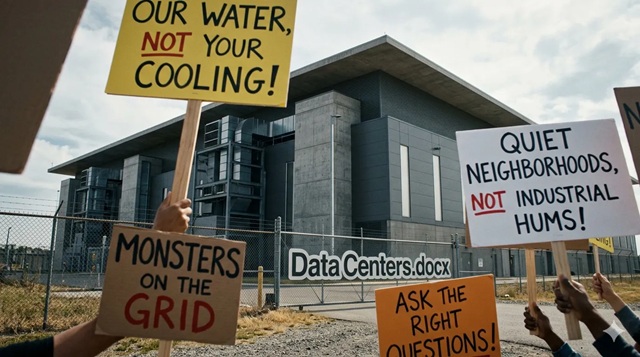
If a data center is coming to your community, should you grab your Sharpies and make protest placards, or welcome the bulldozers?
Let’s strip away the slogans and break this down. We’ll separate fact from fiction, alarmism from composure, and hype from caution.
And when you go to your local government council meeting, you’ll be armed with the right questions and ready to get smart answers.
Remember to bookmark this post.
Are Data Centers Really Land Grabs?
Sometimes.
Data centers can occupy massive footprints. But unlike warehouses or subdivisions, they often employ relatively few people per acre once operating.
That leads critics to ask whether communities are giving up valuable land for low local return.
Supporters counter that the return comes through tax revenue, not daily foot traffic.
The question isn’t whether they use a lot of land. The question is whether the community receives enough value in exchange.
Questions to ask:
- How many acres are being developed?
- Is expansion already planned?
- What tax revenue is projected?
- How will this facility affect community connectivity and emergency routes?
- What were the alternative land use options that were considered?
Verdict:
Not all land use is equal. Measure return, not acreage. Consider both the direct and indirect impacts on community connectivity.
Do Data Centers Really Gulp Water?
Sometimes. This concern deserves serious attention.
Cooling systems vary dramatically. Some facilities use relatively modest volumes of water. Others may consume millions of gallons daily under peak conditions.
There’s a massive difference between evaporative cooling (which consumes millions of gallons of water) and closed-loop air cooling (which uses almost no water but consumes slightly more electricity).
Don’t just focus on direct water use and consider the water-energy nexus too. More energy-intensive cooling systems might indirectly affect water resources through power generation needs.
Questions to ask:
- What cooling technology will be used? An evaporative or closed-loop system that recycles it?
- What is peak summer demand?
- Is reclaimed water available?
- What happens during drought?
- How does the chosen cooling system affect local power generation and water needs?
Verdict: One of the most legitimate concerns, depending on location. Look at both direct and indirect water impacts.
Are Data Centers Environmental Polluters?
Usually less than people imagine, but not zero. Data centers are not smokestack factories.
Instead, their primary impact is on the power grid. They require massive infrastructure upgrades—such as new substations and high-voltage transmission lines—that can take years to build and affect local utility rates.
Their environmental footprint is typically indirect, through electricity generation, land development, backup generators, and cooling systems. Most environmental questions are really about energy and infrastructure.
Beyond basic infrastructure concerns, data centers can affect local air quality through backup generator testing and operation, and may create heat islands that affect local microclimates.
Questions to ask:
- Where does the electricity come from?
- Will local utility ratepayers absorb the cost of upgrading the power grid infrastructure, or is the developer footing the bill?
- Are diesel backup systems included?
- What environmental review is required?
- How will backup generator testing and operation impact local air quality?
- What measures are planned to minimize heat island effects?
- What are the long-term decommissioning plans, and who bears those costs?
Verdict: Environmental impact exists, but often looks different from what people expect. Consider both direct and indirect impacts across the facility’s entire lifecycle.
What About the Noise?
For everyday residents, the biggest day-to-day quality-of-life issue isn’t water—it’s noise. The massive industrial chillers and exhaust fans run 24/7/365, creating a low-frequency hum that has caused major friction in residential areas.
But noise isn’t just a constant hum. Consider operational practices that might exacerbate noise issues, such as scheduled maintenance, delivery patterns, and cooling system cycling during temperature changes.
Questions to ask:
- What are the acoustic modeling projections at our property lines, and what ambient noise guarantees are in the zoning agreement?
- What maintenance schedules might create additional noise impacts?
- How will delivery traffic be managed to minimize noise impacts?
- How does the cooling system noise vary with seasonal temperature changes?
Verdict: Yes, there’s a potential for noise. Cooling fans run constantly. Distance (setbacks) and acoustic walls matter immensely. Look beyond baseline operations to consider periodic noise sources as well.
Are Data Centers Bringing Jobs and Prosperity?
This one may surprise people. Construction phases can create hundreds, sometimes thousands of jobs. But…permanent operations often require far fewer workers than residents imagine
That does not mean communities lose. Many local governments care more about tax revenue than payroll.
Beyond permanent vs. temporary jobs, consider the quality and nature of those positions. How many will be filled by local residents versus specialized workers brought in from elsewhere?
Questions to ask:
- Temporary jobs?
- Permanent jobs?
- Average salary?
- Tax incentives?
- How many jobs will be filled by local residents?
- What skills will be required for permanent positions?
- Will temporary construction workers need housing that impacts local resources?
Verdict: Job promises deserve scrutiny. Tax benefits deserve scrutiny, too. Look at both the quantity and the quality of employment opportunities.
Will Data Centers Make Communities Rich?
Sometimes.
There are communities that point to lower tax burdens and increased revenue. There are others where residents feel the benefits never matched expectations.
The deciding factor is usually not the building.
It’s the deal.
Beyond tax benefits, consider the economic opportunity costs. When a data center receives significant tax incentives, what other development options were excluded? A community might trade decades of potential diversified tax revenue from multiple businesses for one stable but undiversified data center.
Questions to ask:
- How long do incentives last?
- What revenue stays local?
- What infrastructure commitments exist?
- What other economic development opportunities were considered and rejected?
- How diversified will the local tax base be with this project?
Verdict: Don’t judge the project. Judge the contract. Consider not just what you’re gaining but what you might be giving up in terms of economic diversity.
Additional Concerns Worth Considering
Even with all the above addressed, there are other concerns worth exploring:
Light Pollution:
24/7 security lighting, illuminated signage, and facility lighting can create significant light pollution affecting nearby residential areas, wildlife patterns, and dark sky preservation efforts. Ask about lighting designs and shielding plans.
Grid Reliability and Power Quality:
Data centers require extremely stable power quality. Their sensitive equipment can be affected by minor fluctuations that might go unnoticed by residential users. Ask what voltage regulation and power-conditioning measures are planned, as these infrastructure upgrades can affect nearby residents’ power quality or reliability.
Supply Chain and Security Zones:
Modern data centers often require restricted security zones and enhanced truck access for equipment. This can affect local traffic patterns and emergency services access, and create restricted areas that were previously open community space. Ask about traffic impact studies and security zone boundaries.
The “Attraction Effect”:
Communities should consider that one successful data center often leads to additional facilities nearby. This cluster approach can multiply impacts on water, power, and infrastructure beyond what a single facility assessment might show. Ask about zoning boundaries and whether multiple facilities could be built adjacent to each other.
Technology Obsolescence:
Technology advances rapidly, but data centers have 20-30 year lifespans. Ask about adaptive reuse plans if current technology becomes obsolete, and who bears responsibility for decommissioning costs when structures contain specialized materials and hazardous waste.
So… Should You Make Protest Signs?
Maybe. Maybe not.
The wrong question is: “Do we want data centers?”
The better question is: “What terms make this project worth it for our community?”
That question forces politicians, developers, and citizens to stop arguing in slogans and start talking in facts.
And that may be the healthiest outcome of all.
Did I miss anything? Help contribute by adding your comments!
Martin Mawyer
Martin Mawyer is the founder of the Digital Intelligence Project and the President of Christian Action Network. He is the host of the “Shout Out Patriots” podcast, and author of When Evil Stops Hiding. For more action alerts, cultural commentary, and real-world campaigns defending faith, family, and freedom, subscribe to Patriot Majority Report.
©2026 Majority Report. All rights reserved.
Leave a Reply
Want to join the discussion?Feel free to contribute!