Tag Archive for: business taxes

Trump Reveals Controversial Plan to Make Americans ‘Very Rich’

President Donald Trump said the public will become “very rich” due to his plan for the government to have stakes in top artificial intelligence companies.

“We’re talking about giving back something to the public, and if we do that, the public will become very rich, the people in our country, because that’s the kind of money we’re talking about, and I think they’ll do that, and I think it’ll make it very popular,” he told the Daily Signal at the signing of the Secure America Act.

Trump said Friday he planned to meet with top tech executives to discuss equity stakes in AI companies. However, subsequent reports indicated that the executives had not yet received invitations from the White House. Trump confirmed that the meeting is still going to occur.

He said he will meet with “the top 12 or 15 executives very shortly.”

“We’re having a meeting with them,” Trump said in response to a question from the Daily Signal. “It’s an amazing industry. It’s bigger than any industry anyone’s ever seen. We are leading China by a lot, and you know, whoever leads that is going to really lead the world to a large extent. That’s how big it is.”

Sen. Bernie Sanders, I-Vt., a self-described “democratic socialist,” has made a similar proposal with legislation requiring top AI companies to pay a one-time 50% tax in stock.

Senate Republicans have expressed skepticism at the proposal.

“I don’t think the federal government should be in the business of being an equity holder in private companies,” Sen. Ted Cruz, R-Texas, told NOTUS.

“I’m not a huge fan of the government owning industry, and I think with this you’d combine the worst of the big bureaucrats with the Big Tech monopolist,” Sen. Josh Hawley, R-Mo., said.

AUTHOR

Elizabeth Troutman Mitchell 

Elizabeth Troutman Mitchell is the White House correspondent for the Daily Signal. Follow on X TheElizMitchell.

RELATED ARTICLE: Counting the Cost of America’s AI Future

EDITORS NOTE: This Daily Signal column is republished with permission. ©All rights reserved.

Interest Rates, Affordability, and America’s Economic Checkup

America’s economic ship continues to drift downstream in an ebbing tide, as the Federal Reserve Open Market Committee voted at its Wednesday meeting to lower interest rates by a quarter percentage point, signaling the central bank’s ongoing unease about the health of the U.S. job market. Wednesday’s decision was the Federal Reserve’s third consecutive rate cut, and it brings the target federal funds rate down to between 3.5% and 3.75%.

Yet the board showed unusual division over the decision. The final vote was 9-3, the first time in six years that three governors have dissented in one vote. The dissenters even disagreed among themselves, with Trump loyalist Stephen Miran favoring a larger rate cut of one-half percentage point, while Chicago Fed President Austan Goolsbee and Kansas City Fed President Jeff Schmid opposed any rate cut.

In fact, division on the Federal Reserve board runs even deeper than this vote suggests. The board is comprised of 19 members, although only a rotating 12 members vote at any given meeting. However, all 19 officials offer quarterly projections for where they think interest rates should be set. On these predictions, six of the 19 officials penciled in no rate change at the December meeting. This means that four of the seven non-voting board members opposed the interest rate cut. Had different governors been on rotation this month, the vote to cut rates by a quarter point may well have failed.

The dissension arises from the inherent tension between the Federal Reserve’s dual mandates. “The Committee seeks to achieve [1] maximum employment and [2] inflation at the rate of 2% over the longer run,” the Fed explained in a Wednesday press release. “The Committee is attentive to the risks to both sides of its dual mandate and judges that downside risks to employment rose in recent months.”

The U.S. unemployment rate has ticked up from 4.1% in June to 4.4% in September, while the U.S. economy added only 193,000 jobs in the five months from May through September (the economy added 193,000 jobs in May 2024 alone). For a majority of the committee, these anemic employment figures justified yet another interest rate cut.

Meanwhile, the dissenting minority fretted over an equal danger in the opposite direction. On Wednesday, the Fed reiterated its commitment to maintain 2% inflation over the long run. Yet the 12-month inflation rate in September stood at 3.0%, up from 2.3% in April. This inflation rate is “50 percent higher than what the Fed says it wants inflation to be,” noted National Review’s John Puri, disapprovingly. And “We should expect 3 percent inflation to continue because absolutely nothing is being done to stop it.”

Thus, while America’s economic ship is floating down a hazardous channel, the navigators are divided over which sandbar is more dangerous.

One dynamic worthy of further exploration is the change in the Federal Reserve’s posture since earlier this year. For months, the Federal Reserve held interest rates steady as President Trump publicly badgered it to cut rates. Yet it has ended the year by cutting rates at three consecutive meetings. Is this a sign that the Fed finally capitulated to the president’s wishes after he installed his own man on the board? That seems an unlikely move for Federal Reserve Chairman Jerome Powell, whose term expires in May anyway.

The other possibility is that the Federal Reserve changed its behavior in response to changing economic conditions. On Monday, the U.S. Department of Agriculture announced $12 billion “in one time bridge payments” for struggling farmers. The press release blamed the farmers’ struggles on “four years of disastrous Biden Administration policies.” But it also named specific causes of pain, “temporary trade market disruptions and increased production costs,” which sound more like side effects of Trump’s tariff regime.

In any event, a November POLITICO/Public First poll found that Americans still remained concerned with pocketbook issues. When asked to name up to three “top issues facing the US at the moment,” its 2,000 respondents named economic issues as the top two concerns. More than half (56%) complained that the “cost of living is too high,” while 32% dinged “the poor state of the economy in general.”

Hopefully, a perplexed Federal Reserve board can navigate America into open water, and soon, so that the average household can find a moment to breathe. Send those economists back to the drawing board to theorize about a way to reduce unemployment and inflation at the same time.

AUTHOR

Joshua Arnold

RELATED VIDEO: Trump is working hard to bring down the cost of living through bigger paychecks & lower prices

EDITORS NOTE: This Washington Stand column is republished with permission. All rights reserved. ©2025 Family Research Council.


Partner with The Washington Stand to bring news from a biblical worldview to readers nationwide. From now until December 31, every gift will be doubled through our year-end Challenge Match.

The Washington Stand is Family Research Council’s outlet for news and commentary from a biblical worldview. The Washington Stand is based in Washington, D.C. and is published by FRC, whose mission is to advance faith, family, and freedom in public policy and the culture from a biblical worldview. We invite you to stand with us by partnering with FRC.

Treasury Secretary Bessent Foresees ‘Accelerated’ Economic Growth in 2026

U.S. Treasury Secretary Scott Bessent is forecasting that a “substantial acceleration” will occur in the country’s economy in 2026 as a result of decreasing prices in consumer goods and increasing real income.

During a recent interview with Fox News’s Maria Bartiromo, Bessent argued that inflation is now becoming manageable under the Trump administration, whereas under Biden, it reached upwards of 9% in 2022. It currently stands at around 3%.

“We inherited this terrible inflation. We are flattening it out,” he remarked. “I believe we are going to push it down. Energy prices are down, interest rates are down. But the real thing that is going to happen that is going to give Americans real purchasing power increases, it’s going to be through growth. … [T]hanks to the president keeping his campaign promises — no tax on tips, no tax on overtime, no tax on Social Security, deductibility of auto loans … Working Americans will change their withholdings, and they will get a bump up in their real incomes. I will expect in the first quarter, we are going to see the inflation curve bend down and the real income curve substantially accelerate, and when those two lines cross, Americans are going to feel it.”

The comments come as economic uncertainty has rattled the consumer goods market, with the price of beef surging almost 13%, coffee increasing almost 19%, and bananas rising almost 7%. Some experts like Omaha Steaks President and CEO Nate Rempe say that beef could reach $10 a pound by next year. But Bessent predicted that prices will begin to level off due to Trump removing tariffs as a result of trade deals.

“We’ve been working on trade deals with Central and South American countries for six [to] eight months,” he pointed out. “Just this past week we signed the trade deals. So not only will the tariffs come off … coffee, cocoa, [and] bananas, [and] many other items, that’s a result of the trade deals going through, and then we will see this go down. We are also seeing the import barriers for the other countries come through. So this is a complete trade policy, and now we are going to see it affect the prices.”

Bessent further contended that America’s economy will begin to take off at the beginning of next year.

“I think we are going to see a substantial acceleration in the economy in the first, second quarter, and I think we are already seeing on many prices … we’re bending that curve down, and the increase in real income, I think Americans are going to feel it in the first quarter, second quarter,” he underscored. “I think [in] 2026, thanks to President Trump’s signature plans, is going to be a great year for working Americans, for the markets. I call it parallel prosperity — main street and Wall Street can both do great, but I think main street is going to have a great year in 2026.”

Economists like Dave Brat, who serves as senior vice president of Business Relations at Liberty University, are also predicting booming growth as a result of significant global investments secured by the Trump administration.

“[Trump] is bringing in $2 trillion pledges in capital investment and over $10 trillion in capital coming in from abroad,” he told Family Research Council’s Jody Hice during “Washington Watch” last week. “That capital is the number one determinant of economic growth. So that will guarantee help [for] the economy going forward. But that capital probably takes two, three, four years to even start having its effect. [For] GDP growth, the Atlanta Fed has this growing at 4[%] … [T]he long run trajectory is only 2[%].”

Brat, a former congressman, went on to posit that a renewed focus on education must be implemented in order to strengthen the American economy.

“[O]ne thing that politicians don’t pay any attention to is education,” he lamented. “If you want the economy to get going, you cannot have 12% literacy rates — 12% reading rates for poor kids in Chicago’s inner city. How in the world are you going to have an economy? If Trump does that … the black, brown, blue-collar workers will stay strong with Trump if he shows he really cares about them.”

AUTHOR

Dan Hart

Dan Hart is senior editor at The Washington Stand.

RELATED ARTICLE: USDA to Require SNAP Recipients to Reapply in Move to Halt Fraud and Abuse

EDITORS NOTE: This Washington Stand column is republished with permission. All rights reserved. ©2025 Family Research Council.


The Washington Stand is Family Research Council’s outlet for news and commentary from a biblical worldview. The Washington Stand is based in Washington, D.C. and is published by FRC, whose mission is to advance faith, family, and freedom in public policy and the culture from a biblical worldview. We invite you to stand with us by partnering with FRC.

TrumpRx: Trump Announces Lower Prescription Drug Costs

Trump is a wonder.

Trump strikes Pfizer deal for 85% drug price cuts.

President Donald Trump announced a voluntary agreement with Pfizer in the White House Oval Office, requiring the company to sell medications to Medicaid at the lowest international prices starting in 2026, potentially saving hundreds of millions annually on treatments for cancer, arthritis, and other conditions. The deal includes up to 85% discounts on select drugs and the launch of TrumpRx, an online platform set for early 2026 that redirects users to manufacturers for direct cash purchases with 50-85% savings, bypassing insurers. In exchange, Pfizer committed $70 billion to U.S. manufacturing and research investments, focusing on cancer therapies, obesity drugs, and vaccines, while receiving a three-year tariff exemption; the announcement drew praise for affordability but criticism from vaccine skeptics over the partnership.

In a move that surprises nobody, the Trump administration has named a program to lower drug prices for Americans TrumpRX. The program itself is very ambitious, promising to lower prices by an average of 80-85% on many common drugs.

NBC News: President Donald Trump announced Tuesday that his administration has reached a deal with Pfizer for it to voluntarily sell its drugs at lower prices to Medicaid patients. As part of the deal, Trump said, Pfizer will sell some of its drugs on a new “direct to consumer” website called “TrumpRx.” Trump said the website would be operated by the federal government, but offered few details about how the program would work. The deal Pfizer cut with the White House will give the company a three-year grace period on Trump’s planned tariffs on pharmaceuticals made abroad, which are expected to take effect Wednesday. The agreement on lower prices will cover “a large majority” of Pfizer’s primary care medicines, along with speciality brand-name drugs, which will be offered at discounts averaging 50% and reaching as high as 85%, a spokesperson for the company said. (NBC News)

For years, countries with socialized healthcare systems have relied on American medical innovation and drug manufacturing because their healthcare systems do not have the funds to support such research and development. As the president said, “The United States is done subsidizing the healthcare of the rest of the world.” (Townhall)

Fact Sheet: President Donald J. Trump Announces First Deal to Bring Most-Favored-Nation Pricing to American Patients

September 30, 2025

ADVANCING MOST-FAVORED-NATION PRICING: Today, President Donald J. Trump announced the first agreement with a major pharmaceutical company, Pfizer, to bring American drug prices in line with the lowest paid by other developed nations (known as the most-favored-nation, or MFN, price).

  • The agreement will provide every State Medicaid program in the country access to MFN drug prices on Pfizer products, resulting in many millions of dollars in savings and continuing President Trump’s historic efforts to strengthen the program for the most vulnerable.
  • The agreement ensures foreign nations can no longer use price controls to freeride on American innovation by guaranteeing MFN prices on all new innovative medicines Pfizer brings to market.
  • The agreement requires Pfizer to repatriate increased foreign revenue on existing products that Pfizer realizes as a result of the President’s strong America First U.S. trade policies for the benefit of American patients.
  • The agreement requires Pfizer to offer medicines at a deep discount off the list price when selling directly to American patients.

DELIVERING REDUCED COSTS: Today’s actions will result in tangible cost savings to American patients and the healthcare system as a whole. Taken together, more than 100 million patients are impacted by the diseases Pfizer’s medicines treat, and many of those will benefit from the President’s successful negotiation of lower prices for Americans. Examples include:

  • Eucrisa, a topical ointment for atopic dermatitis, will be made available at an 80% discount to patients purchasing directly.
  • Xeljanz, a widely used oral medication for rheumatoid arthritis, psoriatic arthritis, and ulcerative colitis, will be available at a 40% discount to patients purchasing directly.
  •  Zavzpret, a commonly utilized treatment for migraines, will be sold directly to patients at a 50% discount.

ENDING GLOBAL FREELOADING ON AMERICAN PHARMACEUTICAL INNOVATION:  President Trump is taking decisive action to rebalance a system that allows pharmaceutical manufacturers to offer low prices to other wealthy nations while charging Americans significantly higher prices.

  • According to recent data, the prices Americans pay for brand-name drugs are more than three times the price other Organization for Economic Cooperation and Development nations pay, even after accounting for discounts manufacturers provide in the U.S.
  • The United States has less than five percent of the world’s population, yet roughly 75% of global pharmaceutical profits come from American taxpayers.
  • Drug manufacturers benefit from generous research subsidies and enormous healthcare spending by the U.S. Government. Instead of passing that benefit through to American consumers, drug manufacturers then discount their products abroad to gain access to foreign markets and subsidize those discounts through high prices charged in America. Americans are subsidizing drug-manufacturer profits and foreign health systems, both in development and once the drugs are sold.

DELIVERING ON PROMISES TO PUT AMERICAN PATIENTS FIRST: President Trump is delivering on promises for American patients that the political establishment did not believe were possible.

  • On May 12, 2025, President Trump signed an Executive Order titled: “Delivering Most-Favored-Nation Prescription Drug Pricing to American Patients” directing the Administration to take numerous actions to bring American drug prices in line with those paid by similar nations.
  • On July 31, 2025, President Trump sent letters to leading pharmaceutical manufacturers outlining the steps they must take to bring down the prices of prescription drugs in the United States to match the lowest price offered in other developed nations

President Trump has been relentless in his effort to address the unfair and outrageous prices Americans pay for prescription drugs:

President Trump: “In case after case, our citizens pay massively higher prices than other nations pay for the same exact pill, from the same factory, effectively subsidizing socialism aboard [abroad] with skyrocketing prices at home. So we would spend tremendous amounts of money in order to provide inexpensive drugs to another country. And when I say the price is different, you can see some examples where the price is beyond anything — four times, five times different.”

AUTHOR

POST ON X:

EDITORS NOTE: This Geller Report is republished with permission. ©All rights reserved.

A Second ‘Big, Beautiful Bill’: What Might Be in It?

As Speaker of the House Mike Johnson teases subsequent budget reconciliation bills to follow up on the recently enacted “Big, Beautiful Bill,” Republicans in Congress are already filling out their wish lists for reforms they want included in it.

Johnson, R-La., laid out his plan in an interview Sunday, two days after the One Big Beautiful Bill Act was signed into law by President Donald Trump on the Fourth of July.

“We’ve been planning a second reconciliation bill for the fall that would be attached to the next fiscal year, and then potentially one in the spring. That’s my plan—three reconciliation bills before this Congress is over,” he said, adding:

You’ll see more of us advancing these commonsense principles to deliver that ‘America First’ agenda for the American people.

Under the Congressional Budget Act of 1974, which created the budget reconciliation process, Congress is generally allowed one reconciliation bill per fiscal year for each budget resolution, which is essentially a nonbinding rough draft for the legislation.

The appeal of a budget reconciliation bill is obvious: It allows for massive policy changes while avoiding the requirement of 60 votes to end debate in the Senate.

But passing a second Big, Beautiful Bill might be just as hard as passing the first one.

For one thing, the GOP has succeeded in its main mission of delivering on tax cuts and border security. Without those incentives, it might be difficult to create the same sense of urgency for members to get on board.

House Budget Committee Chairman Jodey Arrington, R-Texas, told reporters on a call this week that he wants subsequent bills to focus on increased savings.

“I think there are still reforms that we could include that would save money, that are efficiency-related, waste- and fraud-related,” he said.

He added, however, “I don’t have a lot of hope that it will be a significant amount of savings, just because I think we maxed out a big chunk of that in this process.”

Arrington also said that a second bill could be another chance to craft provisions that could pass muster with the Senate parliamentarian—the chamber’s rules keeper, who struck a number of benefits reforms using the Byrd Rule, which prohibits provisions that are more policy-oriented than budgetary.

“I think those—we need to spend more time” crafting the provisions to pass muster with the parliamentarian, Arrington said, adding:

I don’t think we spent enough time to look for a pathway to success on them, and that’s sort of the landscape, as I see it, of the opportunities in another reconciliation bill.

Sen. Rand Paul, R-Ky., who voted against the Big, Beautiful Bill because of its $5 trillion debt-ceiling increase, also said he was unsure how many cuts could be put into a subsequent bill.

“I’d like to see Congress grow a spine. I’m not so sure that’s going to happen,” he said. “What will change things between the last bill and the next bill?”

Sen. Ron Johnson, R-Wis., however, expressed hope this week that he could see further reconciliation bills make deeper spending cuts.

He told reporters that promises of a second bill were part of what won him over after weeks of expressing concerns about the initial bill’s ability to address an ever-growing national debt.

“Another reason why I definitely had to vote ‘yes,’ I would have just dealt myself out of being involved in that process. And I wanted to be highly involved in that process,” he said.

“I gained a fair amount of confidence from the White House, the president, our leadership, that we will have a second bite of the apple.

AUTHOR

George Caldwell is a journalism fellow at The Daily Signal. Send an email to George. George on X: .

RELATE ARTICLES:

Johnson Holds Life-or-Death Budget Negotiations

4 Times Mike Johnson Has Beaten the Odds

Johnson Warns Lawmakers Action on ‘Big, Beautiful Bill’ Could Push Back Start of July 4 Recess

RELATED VIDEO: Kristi Noem announces FIVE MORE Alligator Alcatraz-style detention centers are in the works

EDITORS NOTE: This Daily Signal column is republished with permisison. ©All rights reserved.


The Daily Signal depends on the support of readers like you. Donate now

Republicans Face a Come-to-Jesus Moment on Reconciliation

It was only a matter of time before House Republicans stepped on the big landmines buried under the landscape of reconciliation. For months, GOP leaders had been tiptoeing around the tripwires, desperately trying to keep the fragile peace. But this week, with the clock ticking down to House Speaker Mike Johnson’s (R-La.) self-imposed Memorial Day deadline, there was nowhere else to step but smack-dab onto the most explosive debate of the president’s “big, beautiful bill.”

For Johnson, who had to be dreading this part of the negotiations, finally getting his 220-member family to sit down and slog through the sticking points on Medicaid reform is a feat in itself. Whether he can cobble together a unified majority at the end of it is the $1.5 trillion question. Part of his headache, as hardline conservatives are quick to point out, is that moderate Republicans are about as enthusiastic about reducing the deficit as their big-spending Democratic counterparts. Especially if it involves paring down bloated programs that Democrats are crying wolf over.

In a two-hour meeting Tuesday night, the collision course Republicans have been on since the 2024 elections finally came to a head. By the end of it, about a dozen GOP members from deep blue states seemed to emerge victorious, somehow managing to persuade the speaker to back off of two pools of taxpayer dollars that were ripe for reform: Medicaid’s Federal Medical Assistance Percentage (FMAP) and the state and local tax deduction (SALT). For the swing-state Republicans, it was a coup, but one that came at a very steep price.

If those programs are off limits for a major overhaul, House Freedom Caucus members warned, Republicans have lost the biggest bites of the apple when it comes to Medicaid savings. Some experts estimated the changes to both FMAP and SALT could be worth as much as $600 billion of the GOP’s $880 billion target. And frankly, conservatives worry, they’re running out of places to cut. No one understands that better than Mike Johnson, who gave his word during the war over the budget framework that the House would find at least $1.5 trillion in savings in the final bill. And yet, in this “ultimate group project,” as some are describing the reconciliation package, he had little choice.

The problem for the speaker is the same one that’s given him nightmares for the last year and a half. “[H]e can’t please the moderates without risking an uproar from conservatives. And vice versa,” Punchbowl News’s reporters point out. It’s the “dynamic that’s plagued the last three Republican speakers. Moderates help give Republicans their majorities. Yet they’re often forced to swallow conservative policies that don’t fit the political makeup of their districts.”

Unfortunately for everyone, these concessions only make the path to enacting Donald Trump’s agenda that much murkier. Somehow, Republicans have to find a way to pay for the extension of the president’s 2017 tax relief — or else, Johnson cautioned, everyone is going to have “an increased tax amount [of] $2,000 to $3,000 per family. That’s what’s going to happen if we don’t make the tax cuts permanent.”

Now, as Johnson and his committee chairs scramble to come up with a Plan B to find the dollars they need to offset those costs, even he’s had to adjust his thinking — and his calendar. “It just made sense for us to push pause for a week to make sure that we do this right,” the speaker told reporters Tuesday. Instead of rushing the process, the thorny mark-ups that were scheduled for this week have been pushed off until leaders can find a solution that pleases both sides. “It’s going to take a lot more of these kinds of conversations, ultimately, to get to an understanding that 99% of the House Republican Conference can agree with,” Rep. Nick LaLota (R-N.Y.) admitted.

So what exactly are the programs that were taken off the table? The short answer is a hugely complicated web of payments, tax caps, and reimbursements that have been abused since Barack Obama expanded Medicaid to people who had no business being on it. But there’s a lot more to these four-letter acronyms (which are more like four-letter words to fiscal hawks).

State and Local Taxes (SALT)

“For as long as Americans have paid federal income taxes,” Bloomberg explains, “they’ve been able to subtract some of what they pay to their state and local governments from their taxable income. This federal deduction for state and local taxes — the SALT deduction, for short — has a big influence on how the tax burden is divided. It tends to help taxpayers in wealthier, more urban states, where sales taxes are higher and real estate costs more.” Back in his first term, President Trump limited the deduction to $10,000 in every state.

With that cap set to expire, GOP moderates (especially the ones from wealthier blue states like New York, New Jersey, California, and Maryland, where things like property taxes and the cost of living are much higher) want to raise the deduction to anywhere from $20,000 to $100,000. Most conservatives would rather keep the number where it is or eliminate the deduction altogether. After all, most of them represent people who would never be able to claim that write-off. (Only 10% of Americans who itemize their taxes do.) Not to mention that expanding the cap would cost money that the government doesn’t have.

“Lifting the SALT cap to $15,000 for individuals and $30,000 for couples,” House Republicans have warned, “would cost around $500 billion relative to extending Trump’s expiring tax cuts.” Enter the fiscal hawks’ outrage. Instead of finding cuts, moderates are finding ways to spend even more. Still, Johnson vows, “We’re going to find the equilibrium point on SALT that no one will be totally delighted with, but it’ll solve the equation, and we’ll get it done.”

Federal Medical Assistance Percentage (FMAP)

Heads collectively exploded when Johnson was asked about a far more egregious practice: Medicaid’s FMAP. When reporters pressed the speaker about changing the federal cost share, the Louisianan replied, “No. … I think we’re ruling that out as well, but stay tuned,” he said.

This debate goes back even further, all the way to the Obama administration when Democrats grossly expanded the government’s health care program to entire populations of previously ineligible, able-bodied Americans. Thanks to that White House and Joe Biden’s, millions of people have flooded the Medicaid rolls, most of whom aren’t seniors, children, or disabled — and who, by their very participation — are robbing truly needy people of the care and benefits they deserve. That problem only ballooned under COVID, as Biden bogged down the program with financially-strapped — but otherwise unqualified — Americans.

Now, years later, Medicaid is struggling to keep up with the burden of enrollees it was never meant to serve — pushing legitimate patients with disability or chronic illnesses to the sidelines.

Republicans have been clamoring to radically overhaul the system and return Medicaid to its original parameters, saving taxpayers billions of dollars in the process. But states have been reluctant to do that because of this FMAP loophole that actually encourages them to grow the program beyond its original purpose. As Stefani Buhajla explained in National Review, the deep dark secret of Medicaid is that its federal funding actually “undermines the program’s core mission.”

Right now, the federal government reimburses a whopping 90% of expenses of those “working-age, able-bodied adults” who were folded into Medicaid under Obama, “regardless of the state’s level of wealth.” In other words, “the federal government provides more-generous support for less needy individuals and comparatively less support for those who are in greatest need of care,” Buhajla emphasized. Those same states don’t receive anywhere close to that reimbursement for the participants who belong in the program.

“It’s nuts,” Family Research Council’s Quena González told The Washington Stand. “It incentivizes states to continue to expand services and eligibility and availability — but only to the expansion population. To those who are disabled or who truly do need some sort of help like this, the states are less incentivized.”

But, he insisted, the FMAP itself is broken, because no state is reimbursed at less than 50%. It’s a great deal for them. “Every state is robbing the American taxpayer by reaching into the till. But they’re hyper-incentivized to do this when they expand beyond the traditional Medicaid populations. See the perverse incentive here? If you’re a blue state Republican from New York or New Jersey, and your state expanded Medicaid by going into these ineligible populations, you get a 90% federal match.” If your colleagues want to cut that, González explained, “it’s not going to be popular back home. So now you’re over a barrel. You’re wedded to this lopsided expansion category — which, by the way, penalizes states that refused to expand Medicaid like Florida and Texas.”

Instead, he continued, Florida and Texas are put in the position of subsidizing the bad choices of leaders in the northeast. It creates this impossible situation where liberal and moderate Republicans from these blue states are “fighting tooth and nail to keep a mega-subsidy that never should have existed.” And the conservatives’ point is that just by returning Medicaid to its original parameters, Republicans could probably save hundreds of millions of dollars.

The House Freedom Caucus understands this. There are more able-bodied Americans “on Medicaid now than any other group,” they stressed, “which means the neediest Americans get lower priority. … This is why Medicaid spending has skyrocketed 51% in the last 5 years alone. This isn’t ‘cutting benefits,’” they reiterated in rebuttal of the Democrats’ claims. “We’re trying to fix the program and protect the most vulnerable.”

On the Senate side, Dr. Roger Marshall (R-Kan.) agreed. “We have over 90 million people on Medicaid now. Ninety million,” he repeated on “Washington Watch” Monday. “It was meant to be [for] those who need that help, [who] need that hand up. It was meant for folks in a nursing home [who] maybe that can’t afford nursing home care or folks with a disability. The poorest amongst us is who it was meant for.” And yet, he shook his head, “It’s on a rocket ship as far as the amount of money we’re spending on it.”

Johnson’s Dilemma

“But if you take FMAP reforms off the table and also raise the SALT cap, where do you look for savings?” González wonders. “You can’t say, as a House moderate, ‘We get 100% of everything we want, or we take our marbles and go home.’ At some point, we have to tell them, ‘We can’t afford all of this. We can’t afford the president’s tax cuts, the push for border security and defense, and also make the tax cuts permanent.’ Everyone is realizing that there’s just not enough money to go around and do everything they want to do.” Not only are we “robbing from our children,” he argued, “but we’re playing fast and loose with the truth about where we are financially.”

While there are still ways to salvage some reforms — new work provisions for the Medicaid expansion category is one — the speaker is walking a tight line with conservatives, who are very aware how much they’ve given up already. “I don’t make promises that I can’t keep,” Johnson underscored, presumably about his pledge to conservatives to cut spending. “This is a consensus-building operation,” he implored. “We’ve been working really hard to take all the input and find that kind of equilibrium point where everybody is at least satisfied. Some people are not going to be elated by every provision of the bill. It’s impossible.”

And let’s be honest, Marshall piled on, “It’s an uphill battle. There’s no doubt about it.” But, he insisted, “I have a lot of confidence in Speaker Mike Johnson [and Rep.] Jodey Arrington (R-Texas) over there on the Budget Committee. Those folks, I think they’re doing great work. I think we’ll get it done.” He paused and smiled. “But there’ll be a little bit of hair-pulling yet to get it all the way across the finish line.”

AUTHOR

Suzanne Bowdey

Suzanne Bowdey serves as editorial director and senior writer at The Washington Stand.

EDITORS NOTE: This Washington Stand column is republished with permission. All rights reserved. ©2025 Family Research Council.


The Washington Stand is Family Research Council’s outlet for news and commentary from a biblical worldview. The Washington Stand is based in Washington, D.C. and is published by FRC, whose mission is to advance faith, family, and freedom in public policy and the culture from a biblical worldview. We invite you to stand with us by partnering with FRC.

‘Economic Suicide’: Biden Admin Justifies Tax Hike Based On Racial Criteria

The Biden administration’s analysis of its revenue proposals for fiscal year 2025 argues targeted tax hikes that disproportionately affect white people would ease racial wealth inequality.

Increasing taxes on capital gains and income-based wealth would reduce racial wealth inequality for black and Hispanic families, the Treasury Department outlined in the analysis published in mid-March. The Treasury points out that white families disproportionately hold assets subject to capital gains tax or are in a higher tax bracket, meaning a hike in those taxes would benefit black and Hispanic families.

The Biden administration argues for taxing capital income for high-income earners at “ordinary rates,” increasing the top rate from 37% to 39.6% for those who earn more than $1 million a year. Taxes on net investment income would also be hiked by 1.2 percentage points to 5% for those who make over $400,000 per year, bringing the total top marginal rate to 44.6%.

“Taxing capital gains at 44.6% at the federal level — not to mention state taxes — would be economic suicide,” Preston Brashers, research fellow for tax policy in the Heritage Foundation’s Grover M. Hermann Center for the Federal Budget, told the Daily Caller News Foundation. “Before the tax ever took effect, investors would rush to pull their money out of equities subject to such exorbitant tax rates. U.S. businesses would be starved for capital, and business activity would slow to a crawl. Ultimately, corporate income and capital gains income would fall off a cliff, so the net result would be less tax revenue, not more. The middle class and working class would be slammed with mass layoffs and lower real wages.”

The Treasury estimates that white families are the recipients of 92% of the benefits of preferential rates on capital gains and qualified dividends, compared to 2% and 3% for Hispanic families. Only 0.4% of white families, less than 0.05% of black families and 0.1% of Hispanic families will be affected by the proposed rule change on capital gains.

“So, if President Biden’s goal of redistribution is to make the rich poorer, his proposal would be successful,” Brashers told the DCNF. “But if the goal is to lift up the middle class, the plan would fail spectacularly. Note, even the Urban-Brooking Tax Policy Center use estimates that imply that the revenue-maximizing long-term capital gains rate is about 28%, so it’s clear that Biden’s proposal is on the wrong side of the Laffer curve.”

The proposal also calls for establishing a minimum 25% income tax that includes unrealized capital gains for those with wealth over $100 million. The Biden administration argues that the wealthiest taxpayers utilize their stake in unrealized gains to lower their total income and reduce their tax liability, but taxing unrealized gains may force many business owners to sell stakes in their company if they are not liquid enough to pay the burden.

“The wealthy already pay far more than their fair share, while the tax burden on large corporations ends up landing on individuals across the economy, including low-income individuals,” Chris Edwards, the Kilts Family Chair in Fiscal Studies at the Cato Institute, told the DCNF.

The Biden administration also calls for ending a “loophole” that allows families to postpone their estate tax burden by creating trust assets that benefit multiple future generations and are not taxed on the death of the beneficiary. Around 30% of white families receive an inheritance that would qualify as of 2019, compared to 10% for black families and 7% for Hispanic families.

“Left-wing Biden economists seem unable to appreciate that raising taxes on capital hurts labor. Capital and labor work together to produce economic growth,” Edwards told the DCNF. “They are complements. The Biden economists seem to hold the Marxist view that capital and labor are bitter enemies, and that the only way that labor can win is for the government to crush capital.”

The Biden administration is also proposing to expand the child tax credit, temporarily increasing the amount given per child and permanently restoring the full refundability provision. The Treasury argues that it will ease racial disparities since a disproportionate number of black and Hispanic kids have benefited from it in the past.

“These proposals would also increase the fairness of the tax system by addressing some of the features that have historically reinforced racial disparities,” the proposal reads. “Over time, these proposals are expected to increase wealth accumulation by low- and middle-income families and reduce racial wealth gaps.”

The proposal was released in conjunction with calls from the Biden administration to drastically increase spending for fiscal year 2025, adding at least $14.8 trillion to the national debt by the end of a presumptive second term for the president.

The national debt has continued to grow rapidly under President Joe Biden, totaling more than $34.55 trillion as of April 26, up from $34 trillion at the beginning of the year, according to the Treasury Department.

Huge government spending is also putting the U.S. economy at risk of stagflation, with first quarter growth only totaling 1.6% while inflation remains high at 3.5% in March year-over-year.

“This hints at the false view that sadly underlies much of the Biden administration’s economic policy: high-earners only achieve success through luck, and low-earners can only achieve success through government handouts,” Edwards told the DCNF. “That is an appalling, un-American view.”

The White House did not immediately respond to a request to comment from the DCNF.

AUTHOR

WILL KESSLER

Contributor.

RELATED ARTICLES:

U.S. Economic Growth Slows Down Massively, Well Below Expectations

Bidenomics Is Literally Killing Puppies

Nancy Pelosi Implodes After MSNBC Host Fact-Checks Her On Trump’s Economy

More Americans Turning To Discount Grocer As Prices Skyrocket

EDITORS NOTE: This Daily Caller column is republished with permission. ©All rights reserved.


All content created by the Daily Caller News Foundation, an independent and nonpartisan newswire service, is available without charge to any legitimate news publisher that can provide a large audience. All republished articles must include our logo, our reporter’s byline and their DCNF affiliation. For any questions about our guidelines or partnering with us, please contact licensing@dailycallernewsfoundation.org.

GOP Blocks $2,000 Stimulus Payments, House To Hold Roll Call Vote On Proposal Monday
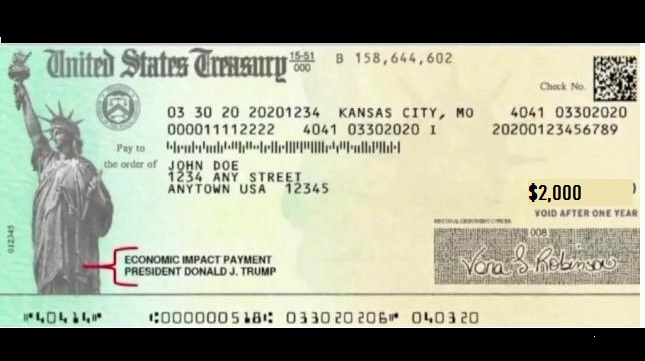
“Congress found plenty of money for foreign countries, lobbyists and special interests while sending the bare minimum to the American people who need it. It was not their fault.”  – President Donald J. Trump


House Republicans blocked legislation Thursday that would have sent $2,000 in direct payments to Americans, House Speaker Nancy Pelosi said.

House Democratic and Republican leaders met early Thursday morning in a pro forma session and held a unanimous consent vote on the direct payments proposal, according to CNBC. Republican leadership voted the measure down, which required all lawmakers present to unanimously vote in favor for it to pass.

“Today, on Christmas Eve morning, House Republicans cruelly deprived the American people of the $2,000 that the President agreed to support,” House Speaker Nancy Pelosi said in a statement. “If the President is serious about the $2,000 direct payments, he must call on House Republicans to end their obstruction.”

Pelosi said during a press conference that the House would hold a recorded roll call vote on the measure Monday, Fox News correspondent Chad Pergram reported. If succesful, the measure would alter the the omnibus bill Congress passed Monday night by changing stimulus checks sent to Americans from $600 to $2,000.

Virginia Republican Rep. Rob Wittman attempted to get the House to vote on reconsidering the much-criticized foreign aid included in the omnibus bill, according to CNBC. Democrats blocked that proposal.

“Speaker Pelosi tried to use the American people as leverage to make coronavirus relief contingent on government funding – which includes billions of foreign aid at a time when there are urgent needs at home,” House Minority Leader Kevin McCarthy said in a statement Wednesday night.

The coronavirus stimulus relief bill hangs in the balance after President Donald Trump announced Tuesday he wouldn’t sign the bill Congress passed. Trump criticized both the $600 direct payment, saying they were too small, and the foreign aid, saying it was wasteful.

“Congress found plenty of money for foreign countries, lobbyists and special interests while sending the bare minimum to the American people who need it. It was not their fault,” Trump said.

RELATED ARTICLES:

Trump Didn’t Make The Pardon A Political Tool, It Always Has Been

Trump Says He Won’t Sign Coronavirus Stimulus Into Law Without Major Changes On Direct Payments And ‘Wasteful Items’

Feds Say Latest US Government Hack ‘Poses A Grave Risk’ To National Security. How Might They Respond?

Trump Already Has A Successful Model For ‘MAGA TV’ — And It Might Give Him A Run For His Money

‘The High Priest Of The COVID Cult’: Tucker Carlson Pans DC Mayor’s ‘Dr. Anthony S. Fauci Day’ Declaration

EDITORS NOTE: This Daily Caller column is republished with permission. ©All rights reserved. Content created by The Daily Caller News Foundation is available without charge to any eligible news publisher that can provide a large audience. For licensing opportunities of our original content, please contact licensing@dailycallernewsfoundation.org.
Coalition formed to repeal the 16th Amendment

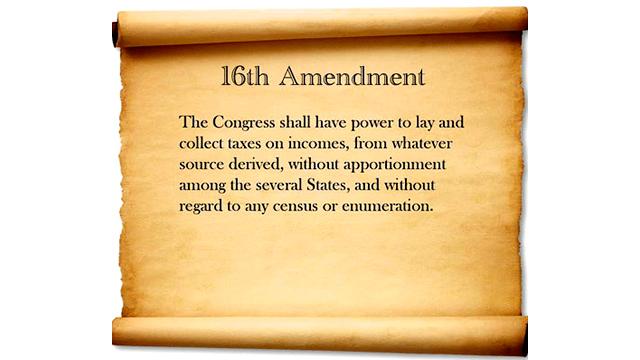
A broad coalition of national organizations, hosted and managed by Competitive Governance Action, whose initial members include Americans For Fair Taxation®, Tea Party Patriots, Free Market America and Americans for Limited Government, announced a joint effort called “Repeal 16: A Coalition to Repeal the 16th Amendment.”

The coalition’s message to Washington lawmakers is straightforward: End the current corrupting tax system and the IRS.

Cynthia T. Canevaro, Executive Director Americans For Fair Taxation

Cynthia T. Canevaro, Executive Director, Americans For Fair Taxation, in an email states, “As FairTax supporters we know how the current tax code has corrupted our economy, our political system, small businesses and the livelihood of countless American citizens.  This summer’s scandalous revelations of IRS abuses are just the latest example of how the IRS, for 100 years, has systematically violated the fiduciary trust given to it by the American people.”

“Although there have been numerous hearings and calls for action, it has turned out to be much ado about nothing because the current tax code is, in reality, an incumbent Member’s delight.  Why? Because it enables the status quo to maintain complete control over you the taxpayer,” notes CGA.

According to CGA, “Repealing the 16th Amendment will allow citizens from all political perspectives to finally have an open, transparent and honest debate about comprehensive tax reform, without getting bogged down on which plan is best. Repeal 16 will finally give supporters of fundamental tax reform a neutral vehicle to address the most pressing issue of the day – eliminating the IRS and Repealing the 16th Amendment.”

Canevaro states, “While supporting the coalition, Americans For Fair Taxation will continue to proudly and aggressively advocate the FairTax Plan as the only viable choice for fundamental tax reform.  With a successful Repeal 16 campaign, we know the FairTax Plan will now be in a position to be the tax reform plan of choice for elected officials and the American people who want jobs and economic growth.”

repeal petition has been posted at www.Repeal16.org for those who see the IRS and income tax as a a threat to American prosperity. The coalition’s initial goal is to recruit 10,000 Americans to sign the petition. “With Congress coming back into session this week, timing is of the essence”, notes Canevaro.

Canevaro, states, “We are excited about the opportunities the new Repeal 16 coalition will bring to the FairTax, and look forward to being on coalition team.”

ABOUT COMPETITIVE GOVERNANCE ACTION

Competitive Governance Action is a 501(C)(4) organization committed to education and advocacy to manifest the concept that problems should be solved by the smallest, least centralized, most local authority that may effectively address the matter. Central to the concept is the devolution of political power from the federal government to state and local governments, to individuals and to non-government community and religious institutions.