
HISTORY: Savannah, Pirates, The Pirates’ House and Chatham Artillery Punch
My wife and I recently celebrated our 60th wedding anniversity in Savannah, Georgia. We have been to The Pirates’ House resterant many times because of the wonderful staff, including a woman pirate, the great food and it’s remarkable history.
According to The Pirates House website:
General James Edward Oglethorpe and his colonists arrived from England, they came ashore in the vicinity of present day City Hall on Bull and Bay Streets. The city was laid out in a grid formation that is still seen today in our 22 squares, and was planned before Oglethorpe landed.
Less than four months after his arrival in Savannah, General Oglethorpe established 10 acres for the first public agricultural experimental garden in America. Modeled after the Chelsea Botanical Garden in London, botanists experimented with plants from the four corners of the world. Hoping for wine and silk, the soil and weather conditions were not suitable for the Mulberry trees and grape vines. Peach trees did flourish and established a major commercial crop, along with cotton.
Said to be the oldest standing structure in the state of Georgia, the Herb House originally housed the gardener of the Trustees’ Garden. His office and tool room were in the front section, while his stable occupied the back room and his hayloft, upstairs. The bricks used in the construction of the Herb House were manufactured a short block away under the bluff by the Savannah River.
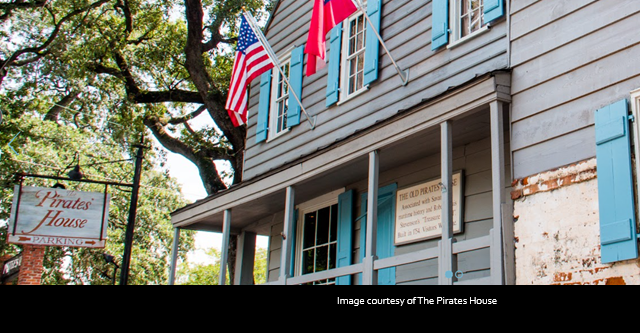
As Savannah became a thriving seaport town, the Trustees’ Garden became a residential section and one of the first buildings was an inn and tavern for visiting sailors. The building is preserved in its original state, including the haint blue shutters and doors to keep away the unwanted spirits. Many tales have been shared about those who came through the doors. It is said that there were multiple tunnels below the building that led back to the Savannah River. These tunnels were allegedly used by pirates to stock their ship’s crew with unsuspecting men. The most famous legend is that of a local police officer who stopped by The Pirates’ House for a drink and awoke on a four-masted schooner sailing to China from where it took him two years to make his way back to Savannah.
The beloved book by Scotsman, Robert Louis Stevenson, is first published and mentions The Pirates’ House in Savannah and a pirate by the name of Captain John Flint. Captain Flint amassed considerable loot and subsequently buried it on a deserted island. It is said, he died in Savannah from drinking too much rum. His treasure map was given to Billy Bones who helps set the adventure in motion for the main characters. It is said that Stevenson was inspired to write the tale while visiting the Inn and early edition pages can be found in the Treasure Room today.
Two centuries after the Trustees’ Garden was established, the entire area was slated for demolition by the Savannah Gas Company. The dilapidated area had been ignored and included The Pirates’ House along with rental housing built in the 1840’s for Irish immigrants. Mrs. Mary Hillyer, wife of Savannah Gas Company President Mr. Hansell Hillyer, recognized the historical significance of the area. She saw the potential that no one else could, and was able to coordinate the approval from the Savannah Gas Company board of directors to renovate the area. Mrs. Hillyer was determined and talented. The seven year project was a success and the Hillyers moved into the area before renovations were completed to show their commitment to historic preservation. The Pirates’ House.
Savannah institution and visionary leader Herb Traub and his business partner Jim Casey first opened The Pirates’ House in 1953 as a tea room. Mr. Traub was involved in many restoration projects around the city. He established The Pirates’ House as a modern dining establishment and ultimately grew it into worldwide fame. Exceptionally creative and with a natural inclination toward marketing and advertising, Mr. Traub was able to speak to the masses and cultivated The Pirates’ House into 23 dining rooms and a place where families have shared memories for decades.
History of the Chatham Artillery Punch
In the 1850s, a military regiment called the Republican Blues returned from training in Macon and were welcomed back by Sergeant A.B. Luce and the Chatham Artillery, one of the oldest military units in American history. Luce used horse buckets to mix up a punch of “delirious deliciousness” that defeated every soldier present that night.
During a convention of Southern journalists in 1870, Chatham Artillery Punch once again proved victorious and word spread all over the country of Savannah’s “mortal enemy of despair.” In 1900, Spanish-American War hero, George Dewey, was no match for the version of the punch he was served. Instead of bringing shame upon such a decorated military man, the cause of his resulting illness was reported as indigestion from the acidity of the drink reacting with a bad salad.
For well over a century since Luce’s mixture, variations on the recipe have continued. The version printed in the New York Sun in 1939 listed Catawba wine, rum, brandy, Benedictine, gin, rye, and a whole bunch of sugar as the ingredients. To this day, Savannahians throw whatever liquor, wines, teas, and juices into a bowl for occasions like St. Patrick’s Day and dub their concoction with the honored name of Chatham Artillery Punch.
It’s a cocktail central to Savannah’s cultural identity. Don’t leave the Hostess City behind without seeing how you match up to its military might.
©2026 All rights reserved.
Leave a Reply
Want to join the discussion?Feel free to contribute!