
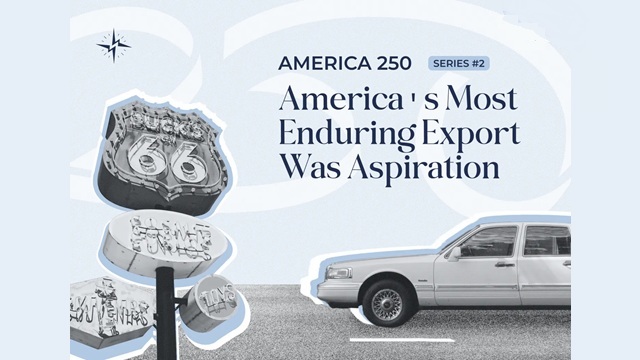
Critically Thinking About Our 250th Anniversary: America’s Most Enduring Export Was Aspiration
Today, I’ll end my special series about the American 250th Anniversary. I am reposting this fine assessment. The author is Delphine Chui, who is Senior Editor of Media, Arts, and Culture at Restoring the West.
The argument: America’s greatest cultural export was never consumerism, but a distinct vision of aspiration rooted in beauty, competence, belonging, and national confidence.
Why It Matters
As politics becomes more polarized and entertainment more self-referential, the question of what we are collectively encouraged to admire has become increasingly difficult to ignore. With the United States celebrating its 250th anniversary, questions of national identity have become increasingly difficult to answer. Political divisions dominate public life, institutions face declining trust, and much of the culture appears uncertain about traditions that once shaped it. Yet before a nation loses confidence politically, it often loses confidence culturally.
For much of the twentieth century, America exported far more than products, technology, or military power; it exported an imagination. Through Hollywood films, fashion, music, architecture, and advertising, it projected a recognizable vision of freedom, prosperity, beauty, and possibility that captivated people far beyond its borders.
As someone who grew up in Britain, I encountered America long before I ever visited. Like millions around the world, my understanding of the country was shaped through Westerns, New York romantic comedies, Ralph Lauren campaigns, country music, Route 66 road trips, baseball caps, diners, ranches, and small-town Main Streets. Whether entirely accurate or not, they communicated something coherent: America knew what it was.
“A nation still requires common symbols, stories, and ideals capable of binding people together across class, ethnicity, geography, and politics.”
That confidence was reflected in the culture itself. Mid-century America produced architecture, fashion, film, and music carrying a distinct national character. The rugged individualism of the Western, optimism of post-war design, craftsmanship of heritage brands, and aspirational vision of family life presented in popular entertainment all pointed toward a broader civilizational story. America was not merely a place; it was an idea expressed through the visual language of Americana.
Is This Still True Today?
Interestingly, some of the strongest cultural successes of recent years suggest that appetite has not disappeared. Entire online communities are devoted to recreating the understated elegance of Carolyn Bessette-Kennedy and the minimalist Calvin Klein era she embodied. The enduring fascination with John F. Kennedy Jr. is not merely biographical, either but reflects a longing for an America associated with confidence and aspiration.
Likewise, Ralph Lauren remains one of the most successful interpreters of the American imagination, selling not merely clothing but a vision built around family, tradition, craftsmanship, Western landscapes, and belonging. The extraordinary success of Top Gun: Maverick and the popularity of Taylor Sheridan’s Yellowstone universe reveal a similar instinct. These stories resonate because they celebrate competence, sacrifice, excellence, inheritance, and duty—qualities that modern culture often struggles to portray with confidence.
Of course, cultures evolve, and I am not arguing that America should be frozen in the 1950s, nor that every aspect of its past is worthy of celebration. Yet a nation still requires common symbols, stories, and ideals capable of binding people together across class, ethnicity, geography, and politics. Especially as globalization and digital culture continue to flatten regional distinctiveness with a visual language that increasingly feels interchangeable: the same minimalist coffee shops, the same influencer aesthetics, and the same luxury brands. What was once distinctly American now risks becoming merely global.
Perhaps that is precisely why Americana continues to resonate. The renewed fascination with older American aesthetics suggests that beneath the noise of contemporary politics, many people are still searching for continuity, meaning, and permanence in an age increasingly defined by transience. We are looking for symbols of continuity, places that feel rooted, stories that connect generations, and ideals that point beyond individual self-expression–because every civilization requires something it is willing to admire, preserve, and pass on.
The Bottom Line
The renewed fascination with Americana is not simply nostalgia. It is evidence that people are searching for coherence and belonging in a culture increasingly defined by fragmentation. For decades, the world looked to the United States not merely for entertainment, but for a vision of life. If it hopes to remain culturally influential, America must rediscover the confidence to define what it stands for and what kind of culture it wishes to cultivate.
©2026 John Droz, Jr. All rights reserved.
Here is other information from this scientist that you might find interesting:
I urge all readers to subscribe to AlterAI — IMO the absolute best AI option for subjective questions.
I will consider posting reader submissions on Critical Thinking about my topics of interest.
My commentaries are my opinion about the material discussed therein, based on the information I have. If any readers have different information, please share it. If it is credible, I will be glad to reconsider my position.
Check out the Archives of this Critical Thinking substack.
C19Science.info is my one-page website that covers the lack of genuine Science behind our COVID-19 policies.
Election-Integrity.info is my one-page website that lists multiple major reports on the election integrity issue.
WiseEnergy.org is my multi-page website that discusses the Science (or lack thereof) behind our energy options.
Media Balance Newsletter: a free, twice-a-month newsletter that covers what the mainstream media does not do, on issues from climate to COVID, elections to education, renewables to religion, etc. Here are the Newsletter’s 2026 Archives. Please send me an email to get your free copy. When emailing me, please make sure to include your full name and the state where you live. (Of course, you can cancel the Media Balance Newsletter at any time!)
Leave a Reply
Want to join the discussion?Feel free to contribute!