
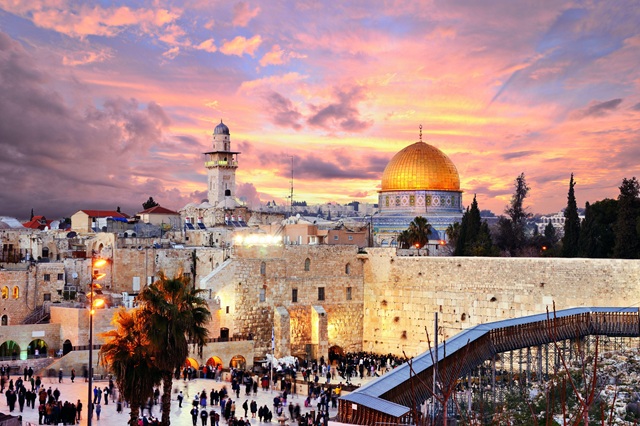
Never Forget the World’s Greatest Real Estate Divinely Gifted to the Jews Forevermore
This is our greatest gift ever. Let us never forget the Creator Who blesses us every day with a holy homestead to cherish, protect, and carry embedded in our hearts and deep within our souls wherever we may be.
JERUSALEM OF GOLD, A SONG BY NAOMI SHEMER
By Hervé Roten
Jerusalem of gold (in Hebrew : ירושלים של זהב – Yerushalayim shel zahav) is the name of a popular Israeli song written by Naomi Shemer in 1967. It was first sung by Shuli Nathan, before being covered by numerous artists, including Rika Zaraï and Ofra Haza who sang it for the ceremony of the 50th anniversary of the State of Israel in 1998. The song was such a worldwide success that it is now considered the unofficial counterpart to the Hatikva, the anthem of the State of Israel.
Jerusalem of Gold ✨ ירושלים של זהב | Uplifting Hebrew & English Song for Jerusalem Day
The first part of the chorus, “Jerusalem of gold, copper and light”, refers to the golden color into which the buildings of the city, built in Jerusalem stone, change during dawn and sunset. The second part, “Of all your songs, Am I not the lyre? [1] is inspired by a verse from the Songs of Zion, “I am like a lyre for your songs”, by the Spanish Jewish poet Judah Halevi (1075-1141). There are other biblical references too: in the first verse, the expression “the city that sits solitary” comes from the Book of Lamentations 1:1, and the third verse from Psalm 137:5 “If I forget you Jerusalem“.
Jerusalem of Gold 4K – Hila Ben David (Halo) – 4K ירושלים של זהב – הילה בן דוד
The circumstances leading up to the writing of this song are highly symbolic. In 1967, the mayor of Jerusalem, Teddy Kolek, commissioned a song about Jerusalem for the Song Festival to be held on the evening of Independence Day, May 15, 1967. Naomi Shemer, a singer-songwriter, was given the task. The song describes Jerusalem before the Six-Day War, when the city was still divided by a wall separating the Kingdom of Jordan from the State of Israel. Judaism’s holy sites – the Temple Mount, the Western Wall and the Jewish cemetery on the Mount of Olives — were then inaccessible to the Jews expelled from the Old City after the War of Independence. This song, performed by Shuli Nathan just three weeks before the outbreak of the Six-Day War, was a great success, particularly with the Israeli soldiers who took part in the conquest of East Jerusalem. After the war, Naomi Shemer added a verse to her poem, to celebrate the reunification of Jerusalem and the return of Jews to the Old City’s Western Wall[2].

Elected “Song of the Year” in Israel in 1967, Yerushalayim shel zahav has since been performed by artists from all over the world, including Finnish singer Carola Standertskjöld, Greek singer Demis Roussos, American rock band Phish, German rocker Klaus Meine of the Scorpions, Brazilian singer Roberto Carlos and the French singer Hélène Ségara. According to the Society of Authors, Composers and Music Publishers of Israeli music (ACUM), there are over 300 different versions of this song, translated into numerous languages, including Esperanto. Moreover, the tune has been introduced into the liturgy of many Ashkenazi and Sephardic communities in Israel and the Diaspora. Frequently played at official ceremonies, Yerushalayim shel zahav is a cultural phenomenon at the crossroads of politics, Israeli national identity and popular culture.
Shortly before her death, Naomi Shemer admitted that she found her inspiration in an old Basque lullaby Pello Joxepe that she heard during a concert of the Spanish singer Paco Ibáñez in Israel in 1962. I do not consider it as plagiarism, declared Ibáñez after that announce, adding : I am happy that it helped in a certain way.
©2026 Beverly Newman, Ed. D. All rights reserved.
Leave a Reply
Want to join the discussion?Feel free to contribute!