
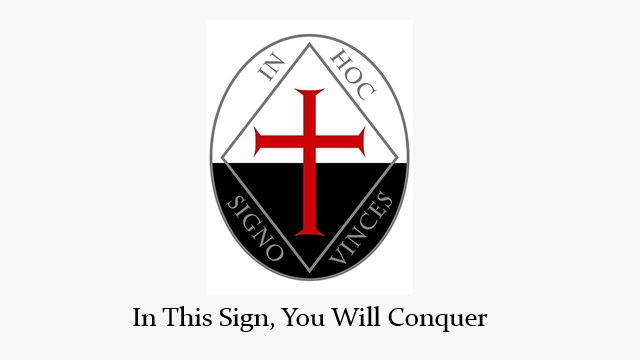
“In hoc signo vinces” one of the most consequential phrases in Western history
“In hoc signo vinces” — Latin for “in this sign, you will conquer” — is one of the most consequential phrases in Western history.
Here’s the story.
The Traditional Account: Constantine at the Milvian Bridge
The phrase is tied to the Roman emperor Constantine the Great on the eve of the Battle of the Milvian Bridge in 312 AD.
- Constantine was marching on Rome to confront his rival Maxentius, who held the city.
- According to the historian Eusebius of Caesarea (writing later, in his Life of Constantine), Constantine saw a vision in the sky — a cross of light — with the words τούτῳ νίκα (“by this, conquer” / “in this, conquer”).
- In the Latin tradition, preserved by writers like Lactantius, the sign is described as a staurogram-like symbol or the Chi-Rho (☧) — the first two letters of “Christ” in Greek — and the accompanying motto became the familiar Latin “In hoc signo vinces.”
He won the battle. Maxentius drowned in the Tiber when his forces collapsed at the bridge. Constantine credited the victory to the Christian God and went on to legalize and favor Christianity, eventually converting (and being baptized on his deathbed).
What the Symbol Was
The “sign” is generally understood as the Chi-Rho — χ (chi) and ρ (rho), the opening letters of ΧΡΙΣΤΟΣ (Christos).
- Constantine reportedly had it painted on his soldiers’ shields before the battle.
- It later became a standard on Roman military banners — the labarum — and a core Christian emblem.
Textual Sources (and Their Gaps)
- Lactantius, De Mortibus Persecutorum — earliest, describes a dream and the instruction to mark the shields with the heavenly sign. He doesn’t give the full phrase.
- Eusebius, Life of Constantine — gives the vision-in-the-sky version, reportedly from Constantine’s own testimony.
- The exact Latin phrasing “In hoc signo vinces” is a later standardized form; the Greek τούτῳ νίκα is the version in Eusebius.
So the phrase as everyone knows it is a Latin crystallization of a Greek report of a vision.
Cultural Afterlife
The motto became a favorite across centuries:
- Military and chivalric orders adopted it, including the Knights Templar associations in later legend.
- It appears on flags, heraldry, and coats of arms across Europe.
- It shows up in Masonic and various fraternal traditions.
- It’s been quoted in literature, on monuments, and in countless religious and secular contexts as shorthand for “conquer under divine sanction.”
The Larger Significance
Whatever one makes of the vision account, the phrase marks a genuine historical hinge: the moment the Roman Empire pivoted toward Christianity. Whether Constantine saw a real sign, had a strategic political insight, or both, the result reshaped the entire trajectory of Western civilization.
It’s a phrase that has been invoked by everyone from emperors to generals to esoteric orders — a rare piece of Latin that still carries the weight of an empire’s turning point.
©2026 Dr. Richard M. Swier, LTC U.S. Army (Ret.). All rights reserved.
Leave a Reply
Want to join the discussion?Feel free to contribute!