
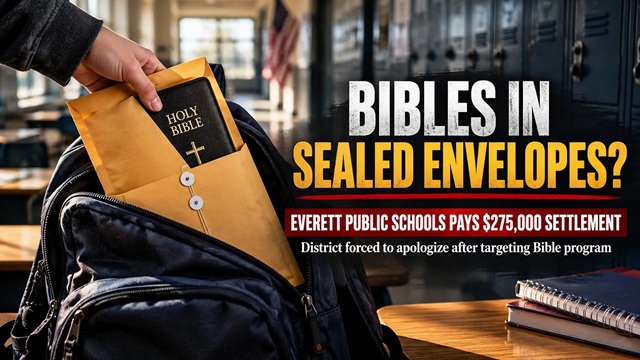
School Board Member Admitted He Hated Bible Program — Now His District Must Pay $275,000 and Apologize.
Washington school officials required children to conceal their Bibles, imposed obstacles on Christian families, and tolerated open hostility toward religious instruction. A federal judge intervened. Now the district is paying the price.
Imagine sending your child to a public school where officials tell students they must hide their Bibles in sealed envelopes, tucked away inside their backpacks.
Not pornography. Not drugs. Not weapons. But Bibles.
Now imagine a school board member publicly declaring his hostility toward the Christian organization providing those Bibles, while accusing it of promoting white supremacy, Christian nationalism, and an authoritarian theocracy.
You might expect a scandal. Perhaps a district investigation. Maybe even some resignations.
Instead, the school district adopted restrictions targeting the Christian program.
That is, until a federal judge intervened.
Now Everett Public Schools in Washington state has agreed to pay $275,000 in attorney’s fees, publicly apologize to Christian families, change its religious-activity policies, and require its school board members to undergo religious-liberty training.
And here’s the remarkable part.
The hostility wasn’t something Christian parents merely suspected. One school board member openly admitted it.
He Didn’t Even Try to Hide His Hostility
Meet Charles Adkins, a member of the Everett Public Schools Board of Directors.
During a December 8, 2025, school board meeting, Adkins made an extraordinary declaration:
“I want to make it very, extremely, abundantly clear, that yes, I do in fact hold animus toward LifeWise Academy.”
Animus.
That’s a legal term often used to describe hostility or ill will. And in constitutional litigation, evidence of hostility toward religion can have enormous consequences.
But Adkins wasn’t finished.
According to the federal court’s April 24, 2026, order, he called LifeWise an organization of “homophobic bullies” and accused it of participating in efforts to establish an authoritarian theocracy.
He also criticized the organization’s teaching that sexual relationships outside marriage between a man and a woman are sinful.
In earlier board proceedings, Adkins had accused LifeWise of trying to bring white supremacy and Christian nationalism into Everett schools.
These were unfounded accusations, of course, and typical of the shallow, contrived, and liberal shrill thrown against Christian organizations.
So, What is LifeWise Academy?
LifeWise Academy provides voluntary Bible education to public school students through what is known as a released-time religious instruction program.
Students attend classes off school property, with parental permission, during designated periods of the school day. The instruction is privately funded.
Children are not required to participate. Parents choose whether to enroll them. And the classes do not take place inside public school classrooms.
In other words, the school district is not being asked to teach Christianity.
Christian families simply want their children to attend privately operated Bible lessons during legally permitted release periods.
This type of arrangement has long been recognized under American constitutional law.
Yet Everett school officials apparently found even this limited form of religious education objectionable. And their objections went well beyond speeches at board meetings.
The Bible Had to Go Into a Sealed Envelope
Consider the restrictions imposed on participating children and their families.
Under the district’s revised religious-instruction guidelines, students returning from LifeWise programming were directed to keep the materials they received, including Bibles, inside sealed envelopes in their backpacks.
Imagine that: Bibles being treated as though they were so dangerous that a moment of open-air exposure might send a child to his knees proclaiming John 3:16.
The district also excluded LifeWise from certain community resource fairs and flyer displays available to secular organizations.
And then there was the permission-slip requirement, something quite unimaginable.
Poor Mom.
It’s not enough that she has to drag her child out of bed, get the little one dressed, prepare breakfast, pack lunch, double-check homework assignments, and make sure everything gets into the backpack.
Oh, and don’t forget to put the Bible in its protective envelope. We wouldn’t want any Scripture escaping.
But wait. There’s one more thing.
Mom must remember to sign another permission slip. Every single week. Just so her child can attend Bible class.
Apparently, raising a child isn’t complicated enough without the school district adding a weekly dose of religious bureaucracy.
These weren’t merely theoretical inconveniences.
The federal court’s April order cited evidence of more than 15 instances, across nearly a dozen occasions, when children missed LifeWise classes because of the district’s new permission slip procedures.
The district argued that it had never denied a parent’s request to release a child for religious instruction.
But the judge found that argument inadequate in light of the documented missed classes.
The practical result was obvious: Christian families faced obstacles that interfered with their ability to participate in religious education.
And those obstacles appeared after school board officials had made their hostility publicly known.
Coincidence? Well, the federal judge wasn’t persuaded.
The Federal Judge Saw What Was Happening
On April 24, 2026, U.S. District Judge Lauren King issued a preliminary injunction against Everett Public Schools.
The decision addressed restrictions on LifeWise’s participation in district forums, religious reading materials, and the burdensome parental permission process.
Significantly, the court examined the school board’s public statements.
The district argued that Adkins did not speak on behalf of the entire school board.
That distinction is legally relevant. Individual board members do not automatically speak for the institution.
But the judge also observed that other board members had not objected to his remarks.
And Adkins wasn’t the only official whose statements raised concerns.
According to the court record, board president Caroline Mason Mitchell had expressed the view that religion and public schools did not belong together and indicated a preference for keeping children at school rather than allowing released-time participation for Bible classes.
The record also described a community speaker comparing LifeWise to the Nazi Party, followed by appreciative remarks from the board president.
The court considered those statements alongside the timing of the district’s policy changes.
Its conclusion was significant.
The evidence supported a finding that hostility toward LifeWise contributed to the new permission-slip requirements.
Judge King determined that the plaintiffs had demonstrated a likelihood of success on key First Amendment claims.
The court required the district to permit LifeWise’s participation in community resource fairs, allow flyers where comparable secular organizations could display them, authorize qualifying semester-long parental permission, and permit the plaintiffs’ children to read LifeWise materials during periods when other noncurricular reading was allowed.
To be precise, this was a preliminary injunction, not a final judgment after trial. The judge also declined to grant every remedy LifeWise requested.
But the constitutional message was unmistakable.
Government officials cannot simply invent special barriers against a religious organization because they dislike its beliefs.
First Liberty Institute Took the Fight to Federal Court
This case might have ended very differently without the legal intervention of First Liberty Institute, the nonprofit public-interest law firm dedicated to defending religious liberty.
Working alongside the international law firm Bryan Cave Leighton Paisner LLP, First Liberty represented LifeWise Academy and a participating parent in challenging Everett’s restrictions.
First Liberty first sought corrective action from the district and then helped file the federal lawsuit in December 2025.
The legal team pursued an injunction to protect the families’ rights while the litigation continued.
And it succeeded.
Following the favorable April ruling, the legal effort culminated in an October 13, 2026, settlement approved by the school board.
First Liberty senior counsel Stephanie Taub described the outcome as a tremendous victory for the clients and for religious released-time programs.
And credit belongs to First Liberty Institute, Bryan Cave Leighton Paisner, LifeWise Academy, and the parents who stood their ground.
They did more than obtain a settlement. They forced a public school district to confront the constitutional limits of its authority.
A public school does not own a child’s faith. And a school board does not get to decide which religious beliefs deserve constitutional protection.
Related reading
- Students Enter the 2026-27 School Year in a Legal Crossfire
- CAN Leads Effort to Oust World Hijab Day from Public Schools
AUTHOR
Martin Mawyer
Martin Mawyer is the founder of the Digital Intelligence Project and the President of Christian Action Network. He hosts the “Shout Out Patriots” podcast and wrote When Evil Stops Hiding. For more action alerts, cultural commentary, and real-world campaigns defending faith, family, and freedom, subscribe to Patriot Majority Report.
©2026 Majority Report. All rights reserved.
Enjoyed this article? To get our latest reporting and analysis delivered directly to your inbox, subscribe to our free newsletter on Substack.
Leave a Reply
Want to join the discussion?Feel free to contribute!