
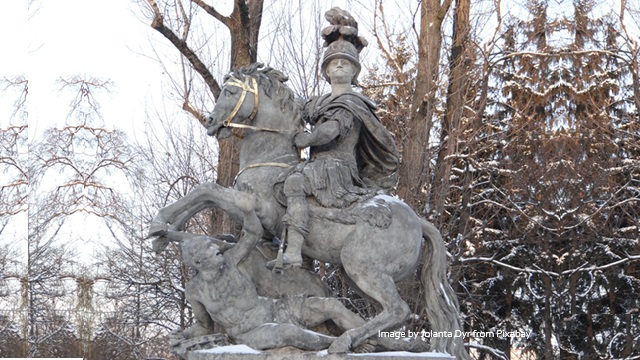
Remembering Polish King Jan Sobieski III who stopped the Ottoman expansion at the Gates of Vienna
The 1683 relief of Vienna is the single most consequential cavalry action in European history — and also the most mythologized. Both things are true at once. Polish King Jan Sobieski III was genuinely the decisive instrument on 12 September; he was also the head of a coalition in which his Poles were roughly a third of the men, funded substantially by the Pope and by Habsburg silver, and which was commanded in the field by an Austrian duke who graciously handed him the baton.
The Setup: Why Vienna Was the Door
The Ottomans had already tried once. The 1529 siege under Suleiman the Magnificent failed on logistics and weather, not on the walls. Vienna sat as the Habsburg gateway into the Danube basin — take it and the road opens into Bavaria and beyond. For 150 years the phrase “the gates of Vienna” meant exactly that: the hinge of Christian Europe.
By 1683 the Ottoman war machine was a coalition of its own — Crimean Tatars, Hungarian rebels under Imre Thököly who had invited the Sultan in, Wallachian and Moldavian contingents. The Grand Vizier Kara Mustafa Pasha marched out of Adrianople in spring with something on the order of 100,000 men and reached the walls in mid-July.
Three failures doomed him:
- He left his heavy siege train behind — the great bombard that had shattered Constantinople’s Theodosian Walls in 1453 never got there in time to do the same to Vienna’s bastions.
- He divided his attention between the siege and covering the relief army, doing neither well.
- He kept the Janissaries’ pay and the army’s confidence by promising the city would fall before relief came. It didn’t.
Inside, Count Ernst Rüdiger von Starhemberg held the garrison together through mining, assaults, and starvation. Emperor Leopold I had already fled to Passau. The city’s survival through eight weeks of battering is the part Poles tend to skip and Austrians never do.
The March: Three Weeks, Several Dozen Kilometers a Day
Sobieski’s achievement before the battle was logistical. He assembled roughly 20,000 men in weeks, navigating the Commonwealth’s absurd legal machinery — the Sejm had to authorize both foreign deployment and an emergency tax — and personally bankrolled nearly half a million zlotys of the campaign. The Lithuanian army, delayed by internal feuding, never arrived.
The alliance with Leopold was signed in spring. Sobieski’s own reasoning, in a letter to Field Hetman Mikołaj Sieniawski, was cold-blooded and correct:
Either Vienna will perish or defend itself; both shall be inconvenient for us, because it is much better to fight in a foreign land, eating foreign bread and with the assistance of all the forces of the Empire… than to defend oneself at one’s own cost, when our friends and neighbours abandon us.
He was not sentimental about Christendom. He was buying Poland a war fought on someone else’s soil.
Kahlenberg: Mass, Then the Charge
3 September, Stetteldorf: war council. The Duke of Lorraine wanted the easy Danube road to reach the city fast. Sobieski overruled him, citing Hannibal’s destruction of the Romans at Lake Trasimeno — a strung-out army on a road is a dead army. Instead: the Imperial forces would fix the Ottomans in front while the Poles crossed the Vienna Woods and came down off the heights onto the Ottoman flank and rear.
Early morning, 12 September: in the burnt shell of the church of St Joseph on Kahlenberg, the Capuchin Marco d’Aviano — the papal legate who had spent years preaching the Holy League into existence — said Mass. Sobieski served at it.
The allied order of battle at Tulln, roughly:
| Contingent | Commander | Approx. strength |
|---|---|---|
| Imperial/Austrian | Charles of Lorraine | ~20,000 |
| Polish Crown | Jan III Sobieski | ~18,000 |
| Bavarian | Max Emmanuel | ~11,000 |
| Saxon | John George III | ~9,000 |
| Franconian & Swabian | Waldeck | ~8,000 |
| Hanoverian guard | Prince George (future George I) | ~600 |
Total: roughly 66,000–70,000. The Poles were a minority. That is the fact the “Poland saved Europe” legend papers over — but the legend exists because of what those 18,000 did in the final hour.
The Charge
The day was a grinding infantry and artillery fight up the slopes, the Imperials pressing the Ottoman left, the Poles taking the Schafberg. Sobieski tested the ground first with a probe — Prince Aleksander’s hussars and two banners under Stanisław Potocki, who was killed. The probe proved the line would break.
Around 6 p.m., with the Ottomans already spent from a failed final assault on the city and demoralized by the relentless advance, Sobieski ordered the cavalry in — four contingents, three Polish and one Imperial, roughly 18,000–20,000 horsemen, the largest cavalry charge in recorded history. He rode at the head of about 3,000 winged hussars.
The charge lasted roughly half an hour. It broke the Ottoman lines, swept into the camp, and reached Kara Mustafa’s own tents. The garrison sallied out. The Ottomans lost on the order of 15,000 men and abandoned essentially all their artillery. Louis William, Margrave of Baden-Baden, was the first Catholic officer into the city at the head of his dragoons.
Sobieski’s dispatch to the Pope, written from inside Kara Mustafa’s captured pavilion, rewrote Caesar:
Venimus, vidimus, Deus vicit — We came, we saw, God conquered.
Kara Mustafa reached Belgrade and was strangled there by the Sultan’s order in December. The bowstring was the only retirement plan the Sublime Porte offered failed viziers.
What the Legend Gets Wrong
- The hussar wings were mostly parade kit. The feathered arcs are attested largely in ceremonial and funerary contexts; there’s no solid evidence they were worn in the charge. The terror came from the mass, the lances, and the timing — not plumage.
- “Poland alone stopped the Turks” is false. The Habsburgs held the city for eight weeks and provided the largest single contingent. Papal money and German princes carried the weight. What Poland provided was the commander, the striking force, and the will to fight a decisive battle rather than merely raise the siege — the Austrians and Germans wanted to cut supply lines and let the Ottomans go. Sobieski insisted on annihilating them.
- The croissant, the bagel, and the coffee-house legends are all invented. Viennese pastry lore and the story of Kolschitzky’s captured coffee beans are nineteenth-century confections. Good stories. Bad history.
- The Holy League was a machine with a purpose, and Poland was the expendable part. After Vienna, the Habsburgs drove into Hungary — Buda retaken in 1686, Mohács in 1687, and by the Treaty of Karlowitz in 1699 the Ottomans had ceded Hungary and Transylvania. Sobieski wanted Moldavia and Wallachia for Poland. He got nothing. His later campaigns foundered, the alliance’s interests diverged, and his last years were bitter — a fat, gouty, exhausted king who had to be helped onto his horse, watching Vienna’s victory pay out to other men’s dynasties.
The Verdict
1683 is the high-water mark of Ottoman expansion into Central Europe, and it’s the cleanest case in history of a decisive battle actually deciding something. But the reason it’s remembered as a Polish triumph rather than a Habsburg one is that the Poles did the one thing that could not be delegated: they charged. Everything else — the money, the diplomacy, the walls, the eight weeks of endurance — was done by others, and history has a weakness for the thirty minutes.
Sobieski understood the trade. He marched to Vienna to make sure the fight happened in Austria rather than in Galicia, and he was right. The man who saved the Habsburg capital bought his own kingdom a generation of breathing room and got a reputation that outlived his country’s independence by a century. That’s a better deal than most kings get.
©2026 Dr. Richard M. Swier, LTC U.S. Army (Ret.). All rights reserved.
Leave a Reply
Want to join the discussion?Feel free to contribute!