
The Greatest Loser in the Current War
The greatest loser in the current war is not Iran, nor the United States, nor Israel. It is the GCC countries. They have learned that the American airmen and planes they hosted could not always protect them from Iranian missiles and drones, but their presence in GCC countries was all the excuse Iran needed to bomb those countries. Now they are wondering whether to have the Americans continue to stay in their countries, given that the American bases have become important targets of Iranian attacks, or to ask them to leave, which means those countries will no longer have American protection right on site.
When a $2 million dollar missile has to intercept an Iranian drone costing $40,000, eventually such interceptions become economically unsustainable.
While the GCC nations, especially the UAE and Saudi Arabia, have threatened to retaliate directly against Iran, they have not done so as yet. They are afraid of antagonizing Iran still further, and are hoping, by keeping their heads down, that Iran will stop attacking them and concentrate its attacks, using missiles and drones, on the U.S. and Israel. It is clear that the Iranians have had no qualms about attacking fellow Muslim states, and are likely to continue attacking the GCC nations that are incapable of striking back.
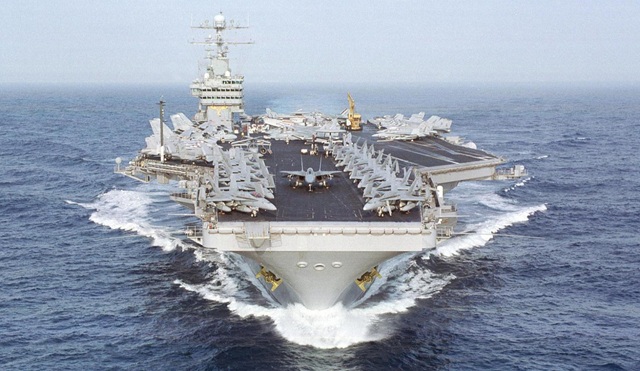
The Iranians have managed to keep launching ballistic missiles at the Gulf states; they may have many more of these missiles than either the US or Israeli defense analysts had realized at the beginning of the war. But at this point, in mid-April, it seems that the Americans have seized the initiative in the Strait of Hormuz. Instead of pleading with Iran to reopen the Strait to international shipping, Trump has ordered American warships to blockade all Iranian ports on the Gulf, so that Iran, too, like the Arab oil states that can no longer use the Strait of Hormuz, won’t be able to ship its oil anywhere, and the Islamic Republic’s total economic collapse should soon follow.
The Iranian leaders are confused, scared, full of hollow bravado, while they wonder who among them will Israel assassinate next. Iran’s command-and-control centers are largely destroyed, and it is entirely unclear who is now running things in the public absence of Mojtaba Khamenei, who hasn’t been seen since Mojtaba’s father, the Supreme Leader Ali Khamenei, was killed. It is believed that his face is now too deformed to have him appear in public. Despite the Iranian leaders’ seeming confidence, the more realistic among them must know that both Israel and the United States have badly battered their military. “In the Gulf, states are ‘paying the price’ for a war they didn’t start,” by Lucia Stein and Tim Swanston, ABC.net.au,
Atlantic Council distinguished fellow Brett McGurk, who has served in top national security roles under administrations of both US political parties, said to “take a signal” from what Iran was doing with its “significant missile and drone launches.”
“They’re trying to send a signal to the Gulf states: There’s a new equation here, and it favours us,” he told CNN.
The “equation” to which Brett McGurk alludes is this: the expense of intercepting Iran’s drone swarms and ballistic missiles, of which it still has many more than initially believed by the Pentagon, is many times greater than the cost of those interceptors. Gradually the cost of such an asymmetric war will become apparent, and the anti-war sentiment in the United States is then likely to explode. The American people are keenly aware of the more than four trillion dollars the U.S. spent on the two senseless and expensive wars in Afghanistan and Iraq. Both these wars ended in ultimate defeat for America. The Taliban again control Afghanistan, and an Iraqi regime hostile to America, one that hosts the Iran-linked terror group Kata’ib Hezbollah, now rules in Baghdad.
Iran has lost not just most of its store of ballistic missiles, its ballistic missile plants, and its nuclear enrichment facilities in Natanz, Fordow, and Isfahan. It has also lost the trust of every single one of its Gulf Arab neighbors. Even Iran’s former friend Qatar, having been hit hard by Iranian missiles and drones, now sees Iran as an enemy.
Now Iran is demanding “compensation” from five Arab states — Saudi Arabia, the UAE, Qatar, Kuwait, and Jordan — for the damage that has been done to Iran’s infrastructure, not by those countries directly, but by the Americans who have military bases in those countries. Of course there is not the slightest chance any of the five will pay a dime to Tehran.
Iran now stands alone in the Gulf, having earned the mistrust and hatred of all of its neighbors. And it is hard to see how it will ever recover.
AUTHOR
RELATED ARTICLES:
Failed Asylum Seeker From Egypt Rapes Englishwoman, but ‘Deserves to Be Set Free’
Germany: Hijab-wearing Muslima shoots blanks at non-Muslim passersby
France: Two Muslims screaming ‘Allahu akbar’ and ‘Allah will kill’ threaten to murder bar patrons
EDITORS NOTE: This Jihad Watch column is republished with permission. All rights reserved.
Leave a Reply
Want to join the discussion?Feel free to contribute!