
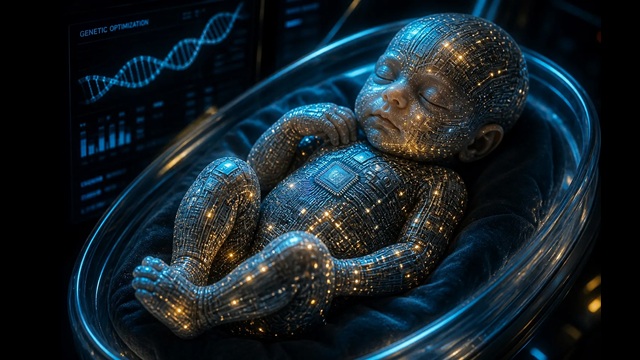
The Men Building AI Now Want to Build Better Babies
What Do They Know That We Don’t?
For years, the men of Silicon Valley told us artificial intelligence would transform the world.
They promised smarter medicine. Safer transportation. More efficient economies. Personalized tutors. Breakthroughs in science. Machines that could help cure disease, write software, and perhaps one day solve problems that have frustrated mankind for centuries.
And maybe they still will.
But what happens when the same men building the machines of tomorrow begin quietly investing in technologies designed to redesign the humans of tomorrow, because AI may one day outthink humanity and possibly destroy humanity?
That is no longer science fiction.
According to a stunning new investigation by Mother Jones, some of the most powerful names in technology, including Peter Thiel, Sam Altman, Brian Armstrong, and Marc Andreessen, are backing startups involved in embryo screening, genetic analysis, and in some cases discussions about the future of embryo editing itself.
Most Americans may not recognize all their names.
But these are not fringe dreamers working out of garages.
These are the men who helped build digital payments, social platforms, intelligence software, cryptocurrency markets, venture capital empires, and the artificial intelligence systems now reshaping the global economy.
And now some of them appear to be asking a question that should make every parent, pastor, policymaker, and citizen stop and think:
What if the machines we’re building become smarter than we are?
And perhaps more unsettling:
What if our children need to be genetically upgraded to keep up?
That may sound absurd, until you read what the article actually says.
One AI safety researcher told Mother Jones that if artificial superintelligence ever surpasses human cognition, humanity may need genetically optimized children, “superbabies,” to understand and control the systems being built today.
Read that again.
The same culture-building machines that may one day outthink humanity are now funding research into children who may one day need to outthink the machines.
That is not a Gattaca movie plot.
That is happening now. And once you understand that, the question changes. Because this story is no longer about technology. It’s a story about fear.
Fear of Their Own Creation
Publicly, many AI leaders talk about the extraordinary promise of artificial intelligence. Privately, however, they’re concerned about whether humanity will remain in control.
That contradiction matters. Because if the men closest to AI are also funding biological enhancement, then either:
They see an extraordinary opportunity.
Or they see extraordinary danger.
Perhaps both.
One startup highlighted in the report claims it can already screen embryos for hundreds of traits, including health risks and projected intelligence markers. Others openly discuss a future where embryos may be edited before birth.
Supporters say these technologies could help eliminate devastating diseases.
And to be fair, that part matters. Parents facing genetic disorders would understandably welcome life-saving advances.
But critics warn that disease prevention may only be the first step. Because once society accepts screening for disease…how long before it moves to IQ? Height? Athleticism? Temperament? Compliance? Political disposition?
Human history suggests that when powerful people gain the ability to engineer advantage, the temptation to use it rarely shrinks.
It expands.
The Return of an Old Idea
The uncomfortable truth is that humanity has flirted with this before.
The 20th century saw entire political movements built around the belief that some human beings were more valuable than others.
Today, nobody in Silicon Valley is publicly talking about concentration camps or state-mandated breeding programs.
But the underlying question has returned in a more polished, data-driven form:
What makes a human being worth more?
If algorithms can rank intelligence, predict disease, and score embryos before birth, then someone, somewhere, will eventually decide which traits matter most.
And history tells us that power rarely remains evenly distributed.
If genetic optimization becomes expensive, then who gets access first? The billionaires? The political class? The elite universities? The military?
And what happens to everyone else? Do we quietly build a two-tier civilization?
A future where some children are born naturally…
And others are born optimized?
That is not just a scientific question.
That is a civilizational question.
Babel in a Lab Coat
Nearly 4,000 years ago, the Bible described another moment when human ambition outran human wisdom.
At the Tower of Babel, God looked upon mankind and declared:
“Now nothing will be restrained from them, which they have imagined to do.” (Book of Genesis 11:6)
For people of faith, that verse feels less like ancient history and more like tomorrow’s headline.
Today, Silicon Valley is not stacking bricks toward heaven.
It is stacking code. Microchips. DNA sequences. Neural networks. Synthetic voices. Artificial cognition.
And now, perhaps, redesigned children.
The tower looks different.
But the temptation feels hauntingly familiar: To remove human limits. To conquer biology. To transcend weakness. To become something more.
Or perhaps…
To become something we were never meant to be.
The Real Question
Maybe the most important question is not whether these technologies will work.
Maybe the real question is:
Why do the men building AI already seem to believe humanity may not be enough for the world they are creating?
Because if the architects of artificial intelligence are quietly building a biological backup plan…
The rest of us may want to start asking what they see on the horizon.
And why they believe our children may need to be engineered to survive it.
AUTHOR
Martin Mawyer
Martin Mawyer is President of Christian Action Network, founder of the Digital Intelligence Project, host of Shout Out Patriots, and author of When Evil Stops Hiding.
©2026 Majority Report. All rights reserved.
Please visit the Patriot Majority Report substack.
Leave a Reply
Want to join the discussion?Feel free to contribute!