Great Movie—“A Great Awakening”

The other night, I saw the movie, “A Great Awakening.”

Wow. Just in time for America’s 250th birthday comes this wonderful movie on the ministry of Rev. George Whitefield of England in the mid-1700s and how his unlikely partnership with printer and quasi-skeptic Ben Franklin helped spiritually awaken a whole generation of Americans.

Unbeknownst to me, my boss, Dr. Robert J. Pacienza, president and host of the Coral Ridge Ministries program (radio and TV), also came to see the film that night with his family, at the same showing.

For this piece, I asked him for his remarks on the film: “’A Great Awakening’ is a must see for every American, including children! George Whitefield is one of our forgotten founding fathers. His preaching planted the seeds of American liberty leading up to the revolution. In the midst of our 250th anniversary of independence, the true story of our founding and Christian heritage must be told and preserved for generations to come!”

I also sought a statement from Dr. Peter Lillback, who served as an historical consultant for the film. Lillback is the founding president of Providence Forum, for which I serve as executive director. He was very pleased with how well the film turned out, and he highly recommends it.

Lillback added: “The climax of Franklin’s profound faith in the midst of the conflict of the Constitutional Convention is not only riveting, it shows how faith is ever critical.”

Another man I know who also knows his American history is author Phil Webster. He often portrays founding father John Jay, and he was an extra in “A Great Awakening.” He told me: “I give the film 5 stars out of 5. I have only seen it five times… so far.”

The film is exceedingly well done and from what I can tell is historically accurate. Its message is simple. It can be summarized by John Adams, writing about 200 years ago: “The Revolution was effected [sic] before the War commenced. The Revolution was in the mind and hearts of the people and change in their religious sentiments of their duties and obligations.”

America was born as a result of a national revival, known as the First Great Awakening. What follows are my remarks on that spiritual movement, including some supplemental, historical background information, that was beyond the purview of the movie.

The Great Awakening began in the 1730s under the preaching of the humble and brilliant Rev. Jonathan Edwards. Edwards was a Congregationalist minister in Northampton, Massachusetts. He preached the famous sermon, “Sinners in the Hands of an Angry God.”

Edwards wrote of the awakening, which started under his pulpit: “In the spring and summer following, anno 1735, the town seemed to be full of the presence of God; it never was so full of love, nor of joy, and yet so full of distress, as it was then.” The “distress” refers to the cognitive dissonance felt by unconverted sinners who realized their sinfulness and their need for Christ.

Edwards once said that nothing could keep one out of the reach of the devil more effectively than humility.

After those initial sparks in Massachusetts, the Great Awakening spread from colony to colony through many itinerant preachers, but especially by Rev. George Whitefield. Whitefield was an amazing preacher, with a background in acting. He preached to thousands in a day long before microphones.

Sarah Edwards, Jonathan’s wife, said this about the impact of George Whitefield’s messages: “It is wonderful to see what a spell he casts over an audience by proclaiming the simplest truths of the Bible. . . .Our mechanics shut up their shops, and the day laborers throw down their tools to go and hear him preach, and few return unaffected.”

The film helps capture that sentiment.

Whitefield returned repeatedly to America. The great British historian Paul Johnson, author of A History of the American People (1997), writes: “he returned again and again to the attack—seven continental tours in the thirty years from 1740—and all churches benefited from his efforts.”

Even Ben Franklin, clearly not orthodox in his theology, commented on the social effects of the revival and of Whitefield’s preaching: “It was wonderful to see the change soon made in the manners of our inhabitants. From being thoughtless or indifferent about religion, it seemed as if all the world were growing religious, so that one could not walk through the town in an evening without hearing psalms sung in different families of every street.”

To quote Paul Johnson again: “The Great Awakening was thus the proto-revolutionary event, the formative movement in American history, preceding the political drive for independence, and making it possible.”

I highly recommend this film. And I pray God will use it to awaken the nation in time for this important milestone, America at 250.

©2026 All rights reserved.

Macron’s Retreat Before the Radical Menace

For centuries, the French Republic has struggled to define its relationship with the Islamic world, often oscillating between colonial control and strategic avoidance. Today, President Emmanuel Macron embodies the latest – and perhaps most dangerous — iteration of this failure. While his rhetoric claims to defend laïcité (secularism), his actions reveal a deep-seated political cowardice. By obsessing over domestic administrative hurdles while refusing to confront the ideological and geopolitical centers of radicalism, Macron has proven himself incapable of tackling the menace decisively.

The roots of the Republic’s current paralysis lie in what historians describe as the troubled history of French engagement with Islam. From Napoleon’s attempts to co-opt imams in Egypt to the denial of citizenship to Muslims in colonial Algeria, the state has always sought to manage Islam rather than uphold the true equality of the Republic. The Long and Troubled History of the French Republic and Islam illustrates that the state has repeatedly chosen control over conviction.

Macron is no different. His Charter of Principles for Islam is a modern colonial echo — a top-down bureaucratic attempt to force a French Islam into existence. Critics argue this is a coward’s gambit: it allows him to look tough on paper while avoiding the difficult work of dismantling the extremist networks that operate within the state’s own borders.

The accusation of cowardice is most potent when examining Macron’s domestic policy. Rather than a decisive strike against radicalism, he has chosen a path of symbolic policing. By focusing on what people wear or the charters they sign, he creates a distraction from his failure to secure the banlieues or stop the spread of extremist ideology in schools.

It is easier for Macron to demand a signature on a document than it is to shut down the radical hubs that facilitate what he calls separatism. French Muslim federations sign ‘charter of principles’ as a result of state pressure, but these bureaucratic victories do nothing to stop the underlying menace. For many, this is the ultimate political shield – using secularism as a talking point to avoid the high-stakes confrontation required to actually defeat radicalism.

This is where Macron’s true cowardice manifests: in his refusal to treat the internal threat as the existential menace it truly is. Rather than decisively dismantling the networks that spread radical ideology, Macron has opted for symbolic policing and bureaucratic charters. It is a strategy of containment, not victory. By treating the spread of radicalism as a social issue to be managed through the state-led Charter of Principles, he is effectively legitimizing a dangerous influence rather than uprooting it.

This domestic hesitation is the mirror image of his international submissiveness. While he postures as a defender of the Republic, his continued diplomatic engagement with the Islamic Republic proves he lacks the resolve to cut off the head of the snake. He is a leader who fears the social and geopolitical consequences of a truly decisive strike against the radical movement. Consequently, he allows the threat to fester at home — disguised as community engagement — while shaking hands with the architects of the Islamic Republic abroad. This is not the behavior of a protector of the Enlightenment; it is the calculated retreat of a politician who is too timid to confront the menace at its source, both in the streets of France and on the global stage.

The most glaring evidence of Macron’s lack of resolve is found on the international stage. While he postures as a defender of Western values at home, he maintains a policy of diplomatic ambiguity toward the Islamic Republic of Iran. In the face of the 2026 regional crisis, Macron has consistently called for restraint and negotiation rather than taking decisive actions to dismantle the regime’s influence.

Macron urges Iran to end attacks through phone calls and tweets, a strategy that many see as a pathetic substitute for strength. By continuing to engage with a regime that exports the very ideology he claims to fight in France, Macron is essentially funding and legitimizing the source of the problem. His Middle Way is seen by critics as a mask for submissiveness — a leader too afraid of geopolitical fallout to stand firmly with allies against a primary state sponsor of radicalism.

Macron’s presidency was supposed to be a new dawn for France, yet it has become a masterclass in strategic retreat. He is a leader who is loud in the safety of a press conference but silent when the stakes are truly high. By focusing on administrative management at home while coddling the Islamic Republic abroad, he ensures that the menace remains untouched.

Until a leader emerges who is willing to confront the ideological and geopolitical roots of the problem with more than just charters and phone calls, the Republic will remain in a state of managed decline. Macron’s legacy will not be one of republican defense, but of the calculated cowardice that allowed a global menace to thrive under his watch.

©2026 . All rights reserved.

California Gubernatorial Democrat Candidate Tom Steyer Reveals Plans to Jail ICE Agents

The Democrats have declared war on America.

How can any American, in their right mind, vote for this treasonous party?

California Gubernatorial Candidate Tom Steyer Reveals Plans to Jail ICE Agents

With Swalwell out of the race, Steyer is now the leading Democrat.

Of course, the California Teacher’s Union endorses Steyer for Governor.

In the latest poll from Emerson, Steyer is three points behind the leader, Republican Steve Hilton. Steyer is hard left—and is showing no signs of pivoting to the center. Fox 40: As Democratic candidates make moves to solidify their support ahead of the gubernatorial primary, Tom Steyer released a new plan that would take drastic steps to combat ICE — including jailing agents.

The progressive billionaire candidate published a blog post Tuesday outlining his plan to push back against U.S. Immigration and Customs Enforcement. He said it’s not enough for Democrats to “simply engage in rhetoric” and claim to stand against President Donald Trump’s administration. Steyer compared his plan to the way law enforcement fought the mob and called the federal agency a “violent extremist group.”

“California must build a system that fights fire with fire,” he said. “To stop this authoritarian takeover, we must counter ICE head-on, and go after both their agents on the streets and their leadership within the Department of Homeland Security”.

Continue reading.

California Gov. Candidate Tom Steyer Pledges to Open Borders and Arrest ICE Agents

By: Warner Todd Huston, Breitbart, April 15, 2026:

Tom Steyer, the now top polling Democrat for California governor, has unveiled his extremely radical, open-door, anti-ICE immigration platform as he continues his run for the state’s top office.

The hedge fund billionaire, who was polling poorly until the media targeted Eric Swalwell for a sacrifice to revitalize the Democratic field for the governor’s race, released his immigration pledges on Tuesday with a five-point plan that is far more left-wing and radical than the current governor’s, who himself is a left-wing radical on immigration.

The 68-year-old founder of Farallon Capital Management turned radical environmentalist posted his intentions to nullify all federal immigration laws, jail federal immigration law enforcement officers, and return deported individuals back to the U.S.

Steyer’s immigration plan includes the abolishment of Immigration and Customs Enforcement (ICE) in California and would attempt to jail ICE agents and their superiors whom Steyer thinks are breaking his rules.

He also thinks he has the power as a governor to go to foreign countries, gather up people who have been deported, and bring them back to the U.S.A.

The billionaire went on to pledge to ignore any U.S. Supreme Court rulings that he does not like.

Steyer claimed, “Each point builds on one another to create a comprehensive strategy that gives the State of California the power it needs to take on ICE and win.”

The candidate’s first bullet point made the claim that ICE uses “racial profiling” to arrest illegal migrants and to target them for deportation. This, he claims, is against California statutes that “outlaws any law enforcement agency from profiling anyone based on their race.” He pledged to enforce these statutes against federal immigration officers.

With his second policy, he pledged to “give the state Attorney General the authority to hold ICE’s leadership accountable for violence.”

“My plan will pursue supervisory liability. This body of law empowers the California justice system to criminally prosecute and imprison not just the ICE agents who are committing these crimes, but the leadership directing them to do so,” he claimed, not explaining how any state law could supersede federal authority.

His third policy pledge is to set up a special branch of the state attorney general’s office to pursue “evidence” that will lead to the prosecution of federal immigration officers, again without addressing federal supremacy issues.

Next he revealed he thinks a state governor can reverse federal deportation rulings and said he’d use state money to send representatives to foreign countries then pay to fly deported illegals back into California, saying, “I will bring those detained and kidnapped by ICE back home,” and says he will “assist and help those who have been imprisoned without due process.”

Finally, he pledged to use more state tax dollars to train illegals to “know their rights” so they can fight against being held accountable for breaking U.S. immigration laws, backed by California tax dollars in the process.

“I will launch a massive statewide ‘Know Your Rights’ public education and public awareness campaign,” Steyer pledged. “Every Californian, regardless of their immigration status, should know their constitutional and legal rights if you are stopped, detained, or questioned by ICE agents, if you are assembled to protest against ICE, if you are filming ICE agent activities, or if you witness unlawful and illegal actions perpetrated by ICE agents.”

Steyer claimed there is “solid legal foundation for California to expand these protections and prosecute ICE agents for breaking the law.” He added, “California should take matters into our own hands. California can extend these legal protections to its residents, despite the federal government’s failure.”

He then insisted, “Extending these protections is a major step forward. It targets the linchpin that holds together the entire ICE machine: their ability to weaponize their authority as federal agents to engage in racial profiling and racial violence.”

“Trump has turned ICE into a criminal enterprise, so let’s treat it as such,” he exclaimed. “As governor, I’ll go after ICE the way Eliot Ness and Joe Friday went after the Mob: bring them to justice by using their most basic crimes against them. For the Mob it was racketeering; for ICE it’s racial discrimination.”

Steyer concluded, writing, “On my watch, California will protect the most vulnerable and bring to justice those who break the law and brutalize our neighbors. We’ll let ICE know: in California, you obey our laws and respect our residents, or you go to jail.”

Finally, Steyer defended his announcement after Tesla funder Elon Musk took to X to write an astonished “Wow” over the radical policy suggestions.

“’Wow’ is right. ICE is a criminal organization. As governor, I’ll prosecute them like one,” the extremist Democrat posted.

Read more.

AUTHOR

RELATED VIDEO: California Governor Race Shaken Up as Republicans Gain Momentum

EDITORS NOTE: This Geller Report is republished with permission. ©All rights reserved.

What Both Liberals and Conservatives Get Wrong About Hungary

For many in the liberal press, Hungary’s recent election signaled the “defeat of autocracy” and a decisive “turn back” toward Europe. For some conservative commentators, the same outcome was framed as evidence that “Brussels-backed liberals” had taken over yet another conservative stronghold.

Both sides miss what actually happened.

Hungary’s election was not a conventional contest between left and right. It was a systemic correction driven by broad-based dissatisfaction with how power has been exercised over roughly the past two decades. This dissatisfaction is also with the political crisis of 2006 tied to the socialist government at the time, which eroded trust in democratic institutions and led to Fidesz’s landslide victory in 2010.

After 16 years in power, Fidesz was no longer simply a governing party, but the very system voters were evaluating.

What really drove the outcome was accumulated frustration with a political system that had become increasingly centralized and insulated. Over time, this system became associated with entrenched corruption, weakened institutional accountability, and political polarization that deepened and strained civic life and personal relationships.

At the same time, economic and geopolitical concerns intensified. Many voters perceived a shrinking middle class alongside expanding crony networks, as well as growing dependence on Russia and China. This included not only Hungary’s long-standing energy dependence on Russia, but also a perceived increase in political alignment with Moscow, often reflected in government narratives critical of Ukraine. Environmental concerns linked to Chinese investments, including in electric vehicle battery production, made things even worse.

Against this backdrop, a governing approach that emphasized “enemies”—whether BrusselsSorosmigrantsUkraine, or others—appeared increasingly disconnected from the country’s domestic challenges. Messaging that signaled heightened war risks in the event of a non-Fidesz victory contributed to a climate of fear and anger, instead of a policy-focused electoral debate that many Hungarian voters have long been hungry for.

TISZA emerged in this space. Its success stems from a simple but effective message: that Hungarians, regardless of political affiliation or background, share common priorities.

By focusing on education, health care, economic performance, and national competitiveness, TISZA shifted the political conversation toward everyday concerns, bringing together voters from across the political spectrum. Hungarian society leans moderately center-right on average, which helps explain why this coalition is anchored slightly to the right.

Notably, much of the traditional left did not reemerge as an alternative but folded into this broader movement. This reflects opposition to the Fidesz government. It also suggests a deeper convergence around shared priorities that cut across traditional party lines. In many ways, this mirrors how Fidesz itself once rose to power—with a broad, unifying message.

TISZA presented a detailed program and a slate of prospective officials drawn from professional fields and the private sector. This resembles practices familiar in the U.S., where agency leadership often includes individuals with private-sector expertise.

Hungary itself has some precedent for this approach: Viktor Orbán’s first government in 1998 included individuals with nonpolitical or technocratic backgrounds. By contrast, Fidesz’s recent campaign environment relied heavily on messaging centered on Ukraine and featured many established political figures with whom voters had grown dissatisfied.

The international portrayal of Péter Magyar, TISZA’s leader, further illustrates the limitations of prevailing narratives. He is neither the liberal figure celebrated in some outlets nor the proxy for external interests lamented by some conservatives. On key issues such as immigration, border control, family policy, and peace—positions that broadly align with those of Orbán—his platform reflects continuity with conservative priorities. However, Magyar has taken a clear stance against corruption and against deepening political and economic alignment with Russia and China. Thus, the difference between TISZA and Fidesz is not about left and right, but about how power is exercised.

The election is often mischaracterized as a simple choice about “Europe.” But for Hungarians, Europe is not synonymous with alien institutions or regulatory frameworks coming from Brussels. Instead, it reflects a deeper cultural, historical, and geographical orientation.

The desire to choose Europe is about rejecting alignment with alternative systems—particularly those associated with Russia, which oppressed Hungary for nearly half a century, and whose painful legacy many families still vividly remember. It is also notable that resisting Russian influence was once a central talking point of Fidesz itself.

This moment underscores a broader lesson: As Lord Acton warned, power tends to corrupt, and great power corrupts even more. A political movement that once called for civic renewal and independence gradually became the very system it once opposed.

Hungary’s experience underscores a general principle: even strong leadership and good intentions can give way to corruption if power remains unchecked for too long. This moment represents both an opportunity and a responsibility for TISZA—to ensure that institutional accountability is preserved and that the mistakes of the past are not repeated.

In this light, narratives that interpret Hungary’s election through their own lenses fall short, reducing a complex domestic development to a familiar storyline. TISZA’s landslide victory reflected a rejection of a governing system perceived as unresponsive. It was also a demand for the government to restore checks and balances, strengthen institutional accountability, enhance competitiveness, and reaffirm a pro-Western civilizational alignment. Whether this model can be sustained remains to be seen, but understanding Hungary today requires paying closer attention to the realities on the ground.

We publish a variety of perspectives. Nothing written here is to be construed as representing the views of The Daily Signal.

AUTHOR

Lilla Nóra Kiss, PhD., is senior fellow for international affairs and academic integrity at the National Association of Scholars.

Hegseth: Blockade Will Force Iran to Negotiate or Perish

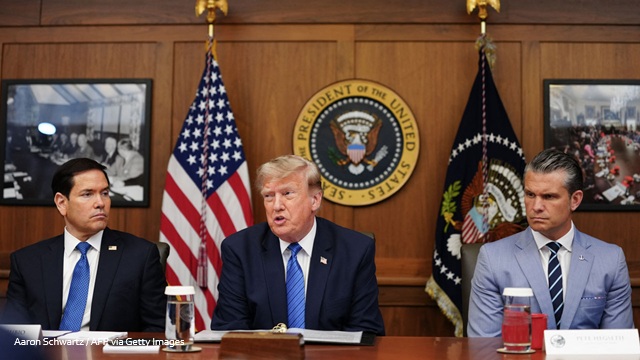
Secretary of War Pete Hegseth gave an update on his war on Iran’s economy Thursday, pressuring its leaders to negotiate with Americans or suffer kinetic strikes in addition to the current blockade on Iran-linked ships.

“For as long as it takes, we will maintain this blockade. … But if Iran chooses poorly, then they will have a blockade and bombs dropping on infrastructure, power, and energy,” Hegseth said.

Since April 13, the United States has shifted from a strategy of military destruction to one of economic pressure in order to encourage an outcome in negotiations with Iran, intermediated by Pakistan.

“The War Department will ensure that Iran never has a nuclear weapon,” said Hegseth. “We prefer to do it the nice way through a deal led by our great vice president and negotiating team, or we can do it the hard way.”

Chairman of the Joint Chiefs of Staff Dan Caine joined Hegseth and stressed that the United States was not blocking the Strait of Hormuz with a literal cordon of ships across, but rather targeting ships connected to Iranian commerce.

“This blockade applies to all ships regardless of nationality heading into or from Iranian ports. The U.S. action is a blockade of Iran’s ports and coastline, not a blockade of the Strait of Hormuz.”

He added that the U.S. “will actively pursue any Iranian-flagged vessel” in regions such as the Pacific.

Caine told reporters that the military is “ready to resume major combat operations at literally a moment’s notice.”

Hegseth also mentioned Secretary of the Treasury Scott Bessent’s sanctions campaign against Iran, known as “Operation Economic Fury,” saying it is “maximizing economic pressure.”

AUTHOR

George Caldwell is a correspondent for The Daily Signal. Send an email to George. George on X: .

Vatican Sets Up Dedicated Muslim Prayer Room at Heart of Pope’s 500-Year-Old Library

Under Pope Leo XIV, for the first time, the Vatican set up a dedicated Muslim prayer room at heart of Pope’s 500-year-old library.

Suicidal madness.

The Vatican should have set up a room, a shrine, to the hundreds of millions of Christians slaughtered by Muslims since its creation 1,400 years ago.

Vatican sets up dedicated Muslim prayer room at heart of Pope’s 500-year-old library

By: Dan McDonald, GB News, October 16, 2025:

A Muslim prayer room has been set up in the heart of the Vatican City’s 500-year-old library.

Islamic scholars visiting the Vatican Apostolic Library had requested a “room with a carpet to pray on” — and staff heeded their request.

The Vatican Apostolic Library was founded in the 15th century and is thought of as the intellectual epicentre of the Catholic Church.

It boasts around 80,000 manuscripts, 50,000 archival items and almost two million books.

Vatican Apostolic Library

The Vatican Apostolic Library was founded in the 15th century and is thought of as the intellectual epicentre of the Catholic
The library’s Vice Prefect, Giacomo Cardinali, told Italian outlet La Repubblica: “Muslim scholars asked us for a room with a carpet to pray on, and we gave it to them: we have incredible ancient Korans.

“We are a universal library, with Arabic, Jewish and Ethiopian collections, as well as unique Chinese pieces.

“Years ago, we discovered that we had the oldest medieval Japanese archive outside of Japan.”

But despite the openness of the holiest site in Catholicism, the city of Mecca in Saudi Arabia takes a much harder stance on inter-faith acceptance.

Islam’s holy city receives nine million visitors each year – none of whom are non-Muslims.

Those of other or no faith are strictly prohibited from entering the city under Saudi law.

AUTHOR

RELATED ARTICLES:

Pope Leo Has Turned His Back on God and Now Embraces Islam, Muslim Migration, Iran and its Terrorist Proxies

Pope Leo Visits Muslim Memorial to Killers of Christians

Chicago Running The Papacy: Axelrod Secret Visit Fuels Firestorm as Pope Leo Clashes with Trump

POST ON X:

EDITORS NOTE: This Geller Report is republished with permission. ©All rights reserved.

GROTESQUE: Barack Obama’s Orwellian Push for Virginia Redistricting Is Something to Behold

What do you call it when a politician tells you to put elections “back on a level playing field” by voting for a redistricting map gerrymandered to give Democrats 10 seats to Republicans’ one?

“Lying” doesn’t quite foot the bill. “Rank deception” is closer, but I think this kind of rhetoric calls for the big guns.

I’ll settle on “shameless Orwellian gaslighting,” because supporting the Virginia redistricting push in the name of “fairness” involves redefining basic words in the same manner as the oppressive government in George Orwell’s “1984,” and this rhetorical strategy seems designed to make people with rational concerns about the ballot initiative question their sanity.

This particular shameless Orwellian gaslighting comes from America’s 44th president, Barack Hussein Obama.

I’m not sure what sin I committed in a previous life, but it must have been egregious for the gods of YouTube to subject me to this vomit-inducing ad—and they do so, multiple times a day.

Perhaps it’s retribution from George Soros, whose Fund for Policy Reform shoveled $5 million into the effort that bombards me with Obama’s message. I really should have thought twice before criticizing his dark money manipulations in my second book.

I find the ad disgusting on multiple levels, but the basic problem is the fundamental lie that the Virginia redistricting effort is all about restoring “fairness.”

You see, I’m old enough to remember the halcyon days of yesteryear when Virginians overwhelmingly voted (66% to 34%) to pass a constitutional amendment creating a bipartisan commission for redistricting. Oh, that was only six years ago?! Imagine that.

Something else funny happened in 2020. The U.S. Census Bureau undercounted Republican-leaning states and overcounted Democrat-leaning states.

Sure, President Donald Trump has demanded that Republican-majority legislatures redraw maps to give Republicans an edge, but in doing so, he’s merely echoing what has been longstanding Democrat practice in states like California and Illinois.

Gerrymandering is technically legal—with a few important caveats the Supreme Court seems constantly to be considering—but there’s something sordid about it.

When Barack Obama urges Virginia residents to “let voters decide, not politicians,” he’s trying to tap into moral outrage about gerrymandering involving politicians choosing their voters, rather than the other way around.

The thing is, he’s trying to make the fairness argument for something that’s inherently unfair.

The Virginia maps aim to take the Old Dominion’s current six-five advantage for Democrats and turn it into a 10-to-one slant. That’s not exactly representative of a state that gave Kamala Harris 52% to Trump’s 46% in 2024.

Even Virginia Democrats are souring on this blatant partisan power grab.

Mark Moran, a Democrat running against Sen. Mark Warner in Virginia’s U.S. Senate primary, announced on X that he would be voting against the measure.

“I think the Virginia redistricting is extremely anti-democratic and that it is a reactionary policy to Donald Trump that was created by DC consultants,” Moran wrote. He noted that “the new maps slice up Arlington and take away the voice of everyone outside of northern Virginia.”

Advocates note that the redistricting will only last until 2030, but Moran noted that four years is hardly “temporary.”

“They say it’s ‘temporary’ but FOUR years of gerrymandering isn’t ‘temporary’ and because I value our constitutional republic over all else… I’ll be voting NO and I encourage everyone else to, but I can’t hold my tongue any longer despite what this will do to me with the Dems in Virginia,” he added.

I suspect the sonorous voice of Barack Obama in that nauseating redistricting ad likely drove Moran to the tipping point. A human being can only take so much repeated lying before the truth explodes out of him. God bless Moran for speaking out.

new poll from Heritage Action suggests many other Democrats may secretly agree with Moran.

Heritage Action asked Virginians this question:

“The U.S. Census results are used to create electoral maps that determine how many congressional
districts each state has and how those districts are drawn. Should electoral maps disproportionately
favor one political party over another?”

Most Democrats (57%) said “no,” as did most independents (69%) and Republicans (56%).

Heritage Action also asked whether “partisan elected leaders, or bipartisan commissions that include private citizens” should draw electoral maps. Vast majorities of Democrats (73%), Independents (79%) and Republicans (71%) chose bipartisan commissions.

Then Heritage Action presented the language of the ballot initiative, and asked respondents whether they considered the language “clear” or “confusing.” Less than half of voters (38%) said it was clear, while 50% called it confusing. Even more Democrats found the language confusing (46%) than clear (43%).

Sure, the Heritage Action poll only surveyed 814 likely Virginia voters between March 20 and March 24, with a margin of error of plus/minus 3.43 percentage points, but that’s still evidence that some Democrats agree with Moran.

It was always rather bold for Democrats to try this scheme only six years after Virginians voted for bipartisan redistricting—next month, we’ll see if it was foolish, as well.

AUTHOR

Tyler O’Neil is senior editor at The Daily Signal and the author of two books: “Making Hate Pay: The Corruption of the Southern Poverty Law Center,” and “The Woketopus: The Dark Money Cabal Manipulating the Federal Government.” Tyler on X: .

RELATED POSTS:

Virginia Dems Plot to Steal 4 House Seats in a Single Vote on April 21

‘DEFINITION OF JIM CROW’: Republican Turns the Tables on Democrats’ Redistricting Rhetoric

Spanberger Is ‘Taking Credit’ for Youngkin’s Economic Deals

Virginia Democrats Join the War on the Electoral College

BREAKING: Former Dem Lt. Gov. Found Dead in Apparent Murder-Suicide, Police Confirm

EDITORS NOTE: This Daily Signal column is republished with permission. ©All rights reserved.


The Daily Signal depends on the support of readers like you. Donate now

DOJ Weaponization: Overview of Biden’s Campaign Against Pro-Life Groups and Individuals

For years, many Americans have suspected that the federal government was no longer applying the law evenly, especially when it came to deeply divisive cultural issues.

Now, the Department of Justice’s own report appears to confirm those concerns.

In a sweeping internal review, the DOJ examined hundreds of thousands of records, internal communications, and enforcement decisions tied specifically to the Freedom of Access to Clinic Entrances Act, commonly known as the FACE Act. According to the report, investigators reviewed approximately 700,000 documents as part of this effort.

What they say they found is deeply troubling.

The report concludes that under the Biden administration, the DOJ “weaponized the FACE Act in several key ways.”

This is not a claim made by outside critics. It is the conclusion of the DOJ’s own internal review.

A Law Meant to Protect, Allegedly Used to Target

The FACE Act was originally designed to protect access to reproductive health services, including abortion clinics, as well as places of worship. In theory, it is a neutral law, one that applies equally regardless of ideology.

But according to the DOJ’s findings, that neutrality did not hold.

Instead, the report alleges that enforcement during the Biden years became selective. Cases involving abortion clinics were prioritized, while attacks on pregnancy resource centers and churches were often minimized or ignored.

At the same time, the DOJ maintained regular contact with pro-abortion advocacy groups, while similar engagement with pro-life organizations was notably absent.

The result, according to the report, was not simply uneven enforcement, but a pattern.

Coordination and Monitoring of Pro-Life Activists

One of the most serious allegations in the report involves coordination between federal authorities and outside advocacy organizations.

According to the findings, pro-abortion groups provided information about pro-life activists, including their movements, protest activity, and identities. That information was allegedly retained and used over time by federal authorities before charges were brought.

If accurate, this raises significant concerns about the monitoring of Americans engaged in constitutionally protected activity.

It also introduces a troubling question. At what point does coordination become targeting?

Case Studies That Raise Red Flags

The report does not rely on generalities alone. It highlights specific prosecutions that, taken together, paint a broader picture.

In one case, evidence that was not provided to the defense was allegedly made available to abortion providers. In another, concerns were raised about potential bias against Christian defendants during jury selection. In yet another, a pro-life activist was arrested at his home in a highly visible federal operation, only to be acquitted by a jury.

Each case, on its own, might be explained away. But the report presents them as part of a consistent pattern.

A Stark Disparity in Sentencing

Perhaps the most quantifiable finding involves sentencing.

According to the report, federal prosecutors sought significantly longer prison sentences for pro-life defendants compared to pro-abortion defendants. The numbers cited show an average request of approximately 26.8 months for pro-life individuals versus 12.3 months for their counterparts.

Actual sentences followed a similar trend, with pro-life defendants receiving substantially longer prison terms on average.

Numbers do not tell the whole story, but they do reveal patterns that are difficult to ignore.

Beyond Prosecution: Questions of Alignment

The report also raises concerns that go beyond courtroom decisions.

It alleges that DOJ personnel may have assisted pro-abortion organizations in securing funding, including providing support or references for grant applications.

If true, this suggests a level of alignment between federal authorities and one side of a deeply contested national issue that goes well beyond enforcement.

What Changed—and Why This Matters Now

This review did not happen in a vacuum.

It followed a series of major developments, including presidential pardons issued on January 23, 2025, as well as new executive directives and internal DOJ guidance.

In response to the findings, the DOJ states that it has already begun limiting future FACE Act prosecutions to cases involving serious aggravating factors or extraordinary circumstances. Some existing cases have reportedly been dismissed, and internal disciplinary actions have been initiated, though details remain undisclosed.

The Beginning of a Larger Examination

This report is not the end of the story. It is the beginning.

If its findings are accurate, they raise fundamental questions about equal justice, the role of federal law enforcement, and the protection of First Amendment rights in America.

In the days ahead, we will examine the evidence in detail.

We will look closely at the cases highlighted in the report. We will analyze the data behind the sentencing disparities. And we will explore the broader question of whether federal power was used not just to enforce the law, but to shape the outcome of a national debate.

Because in a country built on equal justice under law, even the appearance of imbalance demands scrutiny.

And if that balance has truly been lost, the consequences reach far beyond any single case.


Next in the series:
DOJ Weaponization: The Double Standard in Prosecuting Pro-Life vs. Pro-Abortion Activists

AUTHOR

Martin Mawyer

Martin Mawyer is the founder of the Digital Intelligence Project and the President of Christian Action Network. He is the host of the “Shout Out Patriots” podcast, and author of When Evil Stops Hiding. For more action alerts, cultural commentary, and real-world campaigns defending faith, family, and freedom, subscribe to Patriot Majority Report.

©2026 . All rights reserved.


Please visit the Patriot Majority Report substack.

The Most Important Debate in Cuba Happening Today: Christians and Politics (Part 3)

(Read Part 1 and Part 2)

The Catholic intellectual Dagoberto Valdés has spoken of that essential embrace between the exiles and those remaining within the country — those two “lungs” of the nation. Millions of Cubans are scattered across the globe, kept apart by politics and the draconian laws of a totalitarian regime. From the prohibitions and surveillance surrounding the receipt of letters from abroad, to the deep-seated mistrust directed at the men and women who departed the island — all these wounds must be healed.

“Not everyone will discern this right away,” Methodist Pastor Darlon Bermúdez cautioned. “It happened in the days of Nehemiah, and it will happen again now. But when the hand of God rests upon a people, He Himself undergirds the entire process. Cuba has not been forgotten by God. These ruins do not mark the end of the story. God continues to raise up, to restore, and to establish — and He often accomplishes this by bringing back those who were once compelled to leave, yet who never ceased to belong.”

Zeal Tempered by Love; Prudence Guided by Truth

For his part, religious leader Carlos López Valdés drew another historical parallel — though in this instance, he focused on two distinct groups that coexisted during the days of Jesus. The pastor of the Evangelical League of Cuba recalled that, at that time, Israel was living under immense socio-political pressure.

“Amidst that reality, the Zealots emerged: men deeply passionate about God and about the freedom of their nation. They believed — rightly so — that only God should reign over His people, and that oppression was not God’s design for Israel,” said López Valdés. In his view, their contribution was significant: they kept the people’s identity alive, defended God’s sovereignty, and refused to resign themselves to an unjust reality.

To the pastor, some of them chose the wrong paths — “not in their yearning for change, but in the methods they employed to achieve it.”

Then there were the Pharisees. “Men sincere in their desire to honor the Law, committed to the spiritual life of the people. Many of them sought to preserve the faith amidst a complex context,” he said. “Their concern to avoid conflict with Rome also stemmed, in part, from a desire to shield the nation from graver consequences.”

Yet in that attempt to preserve, he underscored, “there was sometimes a risk of adapting too readily to the system and of viewing with suspicion those who raised a dissenting voice.”

López Valdés noted that Jesus did not align Himself with the violence of some Zealots, yet neither did He ignore the need for transformation. He did not reject the Pharisees as individuals, though He did confront — with love and authority — attitudes that hardened the heart.

The controversy surrounding political engagement within the Cuban church reminded the pastor of that historical scenario. Regarding believers who, moved by their faith, voiced their anguish in the face of injustice, he stated that they did so not out of hatred or violence, “but out of a deep conviction that human dignity must be honored.”

He acknowledged that, at the same time, other brethren feel concern regarding the tone, the potential repercussions, or the risk that the church might lose its spiritual focus. “Their desire, often, is to safeguard unity, avoid divisions, and protect their witness,” he said. In his reflection, López Valdés took issue with the epithets hurled during the controversy. “Calling a brother a ‘zealot’ can end up being a label that oversimplifies something far more complex. For not everyone who raises their voice seeks violent confrontation. And not everyone who remains silent does so out of a lack of conviction,” he wrote.

For him, the challenge amidst the controversy was not “labeling one another,” but rather discerning hearts and fruits. “There is a zeal that needs to be guided by love. And there is also a prudence that needs to be accompanied by truth. The church is called to uphold both: a passion for justice, and wisdom in its approach.”

In an invitation to unity, López Valdés urged everyone to listen to one another with humility. “Behind every stance lie distinct stories, fears, convictions, and burdens. And all of us, in some way, are striving to remain faithful to God amidst complex realities,” he remarked. “Instead of discrediting one another, we are called to walk alongside each other. Instead of labeling one another, we are called to understand one another.”

Zeal is not the problem, nor is prudence. “The true challenge is ensuring that both are surrendered to Christ. For ultimately, the Kingdom of God advances neither through imposition nor through silence, but through transformed hearts that know how to love the Truth and live it out with grace.”

I believe that a mature and realistic perspective on the church’s mission involves viewing it — yes — as an institution, but also as the sum of its members. We are one body; I have been called to be a voice, while others serve as hands or feet. No one is superior to another. We are all part of the Redeemer’s plan.

At the same time, I never forget that whenever members of the political police detained or summoned me regarding my work as a journalist, they would invariably sneer the phrase: “Christians don’t get involved in politics.” Of course! That is precisely what they desire: that those who know the Light should hide it away. Yet, it fills me with hope to know that within the Cuban church, many simply do not know how to hide their lamp under the bed.

AUTHOR

Yoe Suarez

Yoe Suárez is an exiled journalist, writer, and producer who investigated in Havana about torture, political police, gangs, government black lists, and cybersurveillance. A graduate of Universitat Autònoma de Barcelona, he was a CBN correspondent, and has written for outlets like The Hill and Newsweek. He has appeared on Vox, Univision, and Deutsche Welle as an analyst on Cuba, security, and U.S. foreign policy.

EDITORS NOTE: This Washington Stand column is republished with permission. All rights reserved. ©2026 Family Research Council.


The Washington Stand is Family Research Council’s outlet for news and commentary from a biblical worldview. The Washington Stand is based in Washington, D.C. and is published by FRC, whose mission is to advance faith, family, and freedom in public policy and the culture from a biblical worldview. We invite you to stand with us by partnering with FRC.

Iran’s Crown Rises: Pahlavi Ignites a Generational Revolt, Iran’s Reckoning Begins in Stockholm

The marble halls of the Swedish Riksdag echoed with the footsteps of a man who carries the weight of a thousand-year throne and the hopes of a fractured nation. Reza Pahlavi did more than walk into a legislative chamber; he reclaimed a seat on the global stage. While the clerical regime in Tehran trembles behind concrete walls and executioner squads, Pahlavi stands in the heart of European democracy to deliver a final verdict on the Islamic Republic. This visit marks the end of Western vacillation. It signals the birth of a new Iranian era.

Reza Pahlavi’s presence in Stockholm shatters the myth of his irrelevance. For decades, the Ministry of Intelligence in Tehran spent millions of dollars to paint the Prince as a relic of the past. They failed. When Pahlavi addressed the Swedish Parliament, he spoke with the authority of a lineage that built modern Iran. He reminded the world that while the current occupants of the palace destroy, his house constructed the schools, the railways, and the legal codes that the mullahs now exploit.

The Swedish legislators received him with the honors usually reserved for a head of state. This reception acknowledges a simple truth: the Pahlavi name acts as the only glue capable of binding the diverse factions of the Iranian diaspora. From the secular liberals to the constitutional monarchists, the Prince provides the center of gravity. His address focused on the “Zan, Zendegi, Azadi” movement, but he gave it a political backbone that the street protests lacked. He transformed a cry for help into a demand for power.

Pahlavi defined the current unrest as a generational revolt, a term that carries profound sociological weight. He understands that the youth of Iran – those born long after 1979 – possess no loyalty to the revolutionary ideals of Ruhollah Khomeini. These citizens crave the Iran of their grandfathers: a nation that looked toward the sun, not the shadows of the mosque.

Historical data proves his point. Under the Pahlavi dynasty, Iran’s GDP grew at an average rate of 10% annually between 1960 and 1977. Today, the Rial cratered to a value so low it serves better as wallpaper than currency. Pahlavi highlighted this economic devastation not as a tragedy, but as a crime. He spoke to the Swedish parliamentarians about the Generation Z Iranians who use VPNs to bypass the digital iron curtain. These youth do not seek reform; they seek the total erasure of the clerical class. Pahlavi stands as the architect of that erasure.

The Prince’s most potent claim during his address centered on the rejection of foreign powers. He stated clearly that Iran’s future lies solely with its people. This statement decapitates the regime’s favorite propaganda point – that the opposition serves as puppets for Washington or London. By asserting Iranian self-reliance in the heart of Scandinavia, Pahlavi reclaimed the mantle of nationalism.

He emphasized that the transition to a secular democracy must be an internal combustion. He demands that the West stop its engagement with a regime that hangs its citizens from cranes. Instead, he asks for the isolation of the mullahs and the recognition of the people’s right to self-defense. This is not the language of a supplicant; it is the language of a commander. He understands that the IRGC only respects strength, and his call for a national strike fund aims to paralyze the state apparatus from within.

To understand the weight of Pahlavi’s words, one must look at the impact of the weapons used against his people. The Prince detailed the use of birdshot and paintballs aimed at the eyes of protesters – a systematic campaign of blinding orchestrated by the Basij. He described these acts as the death throes of a wounded beast.

His strategy involves the controlled demolition of the Islamic Revolutionary Guard Corps (IRGC). During his Swedish visit, he pressed for the formal designation of the IRGC as a terrorist organization across the European Union. This move would freeze the assets of the Bonyads – the corrupt charitable foundations that control 30% of Iran’s economy. By stripping the mullahs of their wealth, Pahlavi ensures the collapse of their mercenary support. He targets the wallet to break the sword.

Pahlavi’s final sections in the Swedish Parliament outlined a roadmap for a transitional government. He rejects the notion of a power vacuum. He proposes a pluralistic council that oversees a referendum on the future form of government. Whether the people choose a republic or a constitutional monarchy, Pahlavi offers himself as the bridge to that choice.

This vision terrifies the supreme leader. Ali Khamenei knows that Pahlavi possesses the one thing the regime lacks: legitimacy. The Prince’s ability to move through European capitals and command the attention of world leaders proves that the shadow government is now the government in waiting. He is the personification of the Iranian Phoenix, rising from the ashes of a forty-year nightmare. The Swedish Parliament did not just host a speaker; they witnessed the return of a sovereign.

The Islamic Republic is a corpse that refuses to lie down. Reza Pahlavi is the one who will bury it. His trip to Sweden marks the transition from protest to politics. He has moved beyond the role of a symbolic figurehead and into the role of a strategic liberator. Every word he spoke in Stockholm hammered a nail into the coffin of the theocracy.

The world must now choose. It can continue to trade with the executioners, or it can stand with the Lion. Pahlavi’s message to his supporters is clear: the end of the occupation is near. The sun rises in the West today, but it will set over a free Tehran tomorrow. The Prince has spoken, the people have risen, and the regime has failed. Victory is the only acceptable outcome.

©2026 . All rights reserved.

RELATED ARTICLE: Who Is Ahmad Al-Hamidawi, The Man For Whom The U.S. Is Offering A $10 Million Reward?

Rep. Chip Roy Introduces Bill to Designate Hamas-Linked CAIR as a Terrorist Entity

This is much-needed and long overdue. CAIR has been a subversive force in the U.S. for over thirty years, and has done incalculable damage. Thanks to Rep. Chip Roy, its day in the sun could be drawing to a close.

“Congressman Chip Roy Introduces Bill to Designate CAIR as Terrorist Entity,” Middle East Forum, April 9, 2026:

WASHINGTON, D.C. — April 9, 2026 — Congressman Chip Roy (R-TX) has introduced a bill (click here) backed by the Middle East Forum (MEF) to designate the Hamas-aligned Council on American-Islamic Relations (CAIR) as a Specially Designated Global Terrorist entity. Roy’s legislation represents the most serious congressional effort to designate CAIR to date and follows decades of MEF research and activism aimed at exposing CAIR’s extremism and links to foreign terrorist organizations.

“The Designating Hamas Affiliates in America Act of 2026” directs the Secretary of the Treasury to designate CAIR as a terrorist entity, blocking its assets, revoking its tax-exempt status, and banning U.S. persons from engaging in any transactions with it. If passed, the legislation would effectively force CAIR to cease operations and dissolve for being one of Hamas’s most prolific advocates in the Western world.

The bill’s findings meticulously chronicle CAIR’s history of extremism, delivering a comprehensive and legally grounded account of the nonprofit’s links to global terrorism. It documents CAIR’s establishment as a public relations front for Hamas and its status as an unindicted co-conspirator in the Holy Land Foundation trial (2007–2008), in which founding board member of CAIR’s Texas chapter, Ghassan Elashi, was sentenced to 65 years in prison for funneling over $12 million to Hamas.

Roy’s legislation also documents U.S. government actions to isolate and suspend law enforcement contact with CAIR. In 2023, the Biden administration publicly disavowed the organization after CAIR founder and executive director Nihad Awad declared that he was “happy to see” Palestinians “breaking the siege” on October 7 in Israel and referred to Gaza as a “concentration camp.”

Recent moves to designate CAIR, including a congressional bill and state-level executive orders in Texas and Florida, were legally imprecise and have faced legal challenges. They sought to designate CAIR as a Foreign Terrorist Organization, a status that applies to overseas groups involved in acts of violence. Roy’s bill, which applies civil penalties to organizations that support terrorism, aligns most closely with federal statute and legal precedent and has the best chance of surviving judicial review.

As the co-chair of the Sharia-Free America Caucus in the House of Representatives, Roy is spearheading congressional efforts to protect Western civilization from Islamist threats. The 60-member caucus has launched committee hearings and dedicated time on the House floor to name the threat of radical Islam and adopt legislative solutions….

AUTHOR

RELATED ARTICLES:

Comrade Mamdani Gets to Work on His Cult of Personality

Dan Bilzerian, a Crazed Antisemite With 30 Million Followers

Muslim Man Charged in $500,000,000 California Warehouse Fire

How the IDF Eliminated 180 Hezbollah Terrorists in Ten Minutes

Turkey: ‘Israel cannot live without hostility,’ warns Israel that it ‘may target it next’

RELATED VIDEO: Congressman Keith Self Calls for Banning Islamic Laws in All U.S. courts

EDITORS NOTE: This Jihad Watch column is republished with permission. ©All rights reserved.

The Most Important Debate in Cuba Happening Today: Christians and Politics (Part 1)

My perspective on several matters has changed. One view that evolved naturally — and without external pressure — is that faith and political engagement need not be mutually exclusive.

Back in 2012, in “Pasajes de la Luz,” I wrote about this very subject. What I failed to grasp at the time was that the church interacts socially not only as an institution but also as a collective body of believers. In that same book — written when I was just 21 — I called for advancing Christian influence through the realm of culture.

And that is precisely what has come to pass, marked by the rise of young evangelical influencers who have emerged as the most far-reaching independent political voices on the island — a status cemented by their actions. Driven by the potency of their messaging — which fuses a Christ-centered worldview with a rejection of the socialist system — there has arisen both implicit and explicit pressure for the Cuban church as an institution to issue a clear, unequivocal political statement regarding the grave crisis currently gripping Cuba.

Should the institutional church do just that? This question — though by no means new — lies at the heart of a newly invigorated debate currently unfolding in Cuba.

Since late 2025, a significant number of Cuban church members have become highly visible figures, speaking out directly and forthrightly on political matters. Consequently, many of us began to wonder whether the institutional church itself would follow suit. The prevailing context only served to heighten these passions: the hope for freedom fueled by the Trump administration’s “maximum pressure” campaign against the Castro regime, coupled with the continuous popular protests that collectively came to be known as the “Spring of Fire,” beginning in March.

The debate currently taking place within the evangelical community is, however, of pivotal importance to the country as a whole. Why? Because the ecclesial body is one of the few entities independent of the State that operates legally within the country; it boasts a rapidly growing membership (estimated at 10% of the population); it plays a prominent role in society and possesses a proven organizational capacity for delivering humanitarian aid; and it fosters an institutional network that generates alternative modes of thought — ones distinct from the official socialist orthodoxy.

The recent controversy in Cuba regarding the church’s political engagement under a dictatorship began in the digital sphere (YouTube videos, Facebook posts, etc.) and among genuine faith leaders — those operating outside the pro-regime circuit. Some called upon the institutional church to emulate the “vocalness” of certain members, while others pushed back, asserting that the church should focus exclusively on preaching the gospel.

With few exceptions, the tone of the debate reached extremes. Discursive lines were drawn between those speaking from exile and those experiencing the rigors of totalitarianism firsthand within the island. Some went so far as to call for pastors on the island to be cut off from material aid provided by the global church; others labeled those advocating for a louder political voice as “zealots.”

A Recent History

Prioritizing direct criticism of the State versus engaging in Christian action to alleviate the problems generated by that very State has been a constant source of tension since 1959. This tension is not without cause: churches have been shuttered, Christians interned in concentration camps, and believers driven into exile or imprisoned.

Contrary to what a reductionist might assume, institutional discretion — or even silence — regarding the regime’s cruelty (distinct from the outspokenness of many individual pastors) does not, in most cases, stem from direct complicity, but rather from prudence. In the minds of many faith leaders, were the church to confront the dictatorship directly, the ensuing consequences would severely hinder the institution’s charitable work — and could even result in the loss of its legal status, along with the few benefits currently associated with its pastoral and evangelistic mission.

From a purely instrumentalist perspective: if the regime were to shut down a church building or impose even greater obstacles on the delivery of donations from the global church, how many more elderly people and children would be left without food (12,)? How many more Cubans would be left without medical care (4)? How many would be left without Bibles? And what would become of the struggle for the right to life (5)? The dilemma facing ecclesial leadership under totalitarianism does not lie — either predominantly or primarily — in whether or not they agree with the regime (which the majority detests; of this, I can personally attest), but rather in the choice between surviving in order to act and the possibility of institutional demise.

Precisely for this reason, it is remarkable how the church — at the institutional level — has recently and categorically surmounted that abyss.

During the Evangelical Civic Movement (MoCE, 2018-2022) — by virtue of its practical results and mobilizing capacity — the Cuban church emerged as the leading force within civil society in opposition to Castroist policies. It highlighted the lack of freedoms within the Castroist Constitution and Family Code; it advocated for the release of prisoners of conscience; and it founded an organization operating beyond totalitarian control: the Alliance of Evangelical Churches of Cuba — an entity they still refuse to dissolve.

(Read Part 2)

AUTHOR

Yoe Suarez

Yoe Suárez is an exiled journalist, writer, and producer who investigated in Havana about torture, political police, gangs, government black lists, and cybersurveillance. A graduate of Universitat Autònoma de Barcelona, he was a CBN correspondent, and has written for outlets like The Hill and Newsweek. He has appeared on Vox, Univision, and Deutsche Welle as an analyst on Cuba, security, and U.S. foreign policy.

EDITORS NOTE: This Washington Stand column is republished with permission. All rights reserved. ©2026 Family Research Council.


The Washington Stand is Family Research Council’s outlet for news and commentary from a biblical worldview. The Washington Stand is based in Washington, D.C. and is published by FRC, whose mission is to advance faith, family, and freedom in public policy and the culture from a biblical worldview. We invite you to stand with us by partnering with FRC.

The Most Important Debate in Cuba Happening Today: Christians and Politics (Part 2)

(Read Part 1)

In the current controversy in Cuba about Christians and political participation, there is a central element — one key to interpreting political participation from the perspective of the faith community under Castroism — that features prominently in my book, “Hoz y Cruz” (Sickle and Cross). The church can be understood in a dual, albeit inseparable, manner: as an institution and as a body of members (a concept I failed to consider when I wrote the book at the age of 21).

Both facets are subject to the pressures of circumstance, facing distinct Swords of Damocles hanging over their heads. And while some individuals call upon the church-as-institution to speak out in favor of Cuba’s freedom, the church-as-members has, in fact, been doing so consistently for years. At certain moments, one form takes precedence over the other. The former — the institution — took the lead during the MoCE; the latter — the members — has taken the lead since 2025, coinciding with the boom in evangelical influencers.

Addressing this very distinction, the Western Cuba Baptist Convention (CBCOcc) issued a statement that helped settle part of the controversy. In it, the Convention acknowledged the legitimacy of a Christian seeking political change for the good of the nation whenever the prevailing system or government is deemed “dysfunctional, counterproductive, and failed.” In other words, the statement points to the church-as-members.

The text — which was aimed primarily at the faith community itself — affirmed that many believers had begun to question the church’s role as a public voice in the face of the grave national crisis.

It defended the work of the congregations, underscoring their continued presence on the island as an act of commitment and service to the Cuban people, while dismissing criticisms alleging inaction in the face of social hardship.

The Convention’s president — and a signatory to the statement — Bárbaro Abel Marrero, explained to the press that he had drafted the communiqué in response to what he described as an “internal struggle between two differing views regarding what the Church ought to do.” Specifically: what the church-as-institution ought to do.

While “a significant group” held the view that the institution should issue a formal political stance, others recognized that every individual has the right to hold their own personal opinion. “But if brothers and sisters within the congregations begin attacking one another, I do not believe that is healthy for the Church,” Marrero admitted.

The CBCOcc had become the epicenter of the controversy mentioned in this article — precisely because several of the most influential figures in the public sphere held dual roles as both members and leaders within the organization. Ivan Daniel Calás (with over 31,000 followers on Facebook), for instance, served as a youth leader at a local church in Havana, while David Espinosa (with over 30,000) served as a youth pastor at another.

I know from firsthand accounts that internal complaints arose from certain members who did not agree with the public profile projected by these two individuals. One such case even escalated to the leadership level.

Marrero emphasized that the church’s primary mission was not to serve as a political voice, but rather to preach the gospel. His own pastoral record stood as a testament to this principle.

In November 2021 — before he had assumed the presidency of the CBCOcc — he publicly condemned the harassment carried out by pro-Castro mobs against the family of a political prisoner and an independent activist. It is abundantly clear that Marrero is not a man who idolizes the Revolution.

Yet, by 2026 — now at the helm of the denomination — he understood that his words would no longer be interpreted merely as those of an individual member church, but rather as those of the church as an institution: the institution charged with the mission of reaching every Cuban, and over which hang various distinct “swords of Damocles.”

The CBCOcc’s statement had a largely positive effect on the public discourse — which continued for weeks — by giving voice to two legitimate, yet conflicting, positions. Personally, I believe both viewpoints were reflected with fairness and balance in the document — free, at last, from the labels of “opportunists” or “zealots” that had been flying across social media, threatening to fracture the unity of Cuba’s beleaguered yet resilient evangelical community.

The Reconstruction of Cuba according to Nehemiah

Pastor Darlon Bermúdez, who leads a church in Santiago de Cuba, had already garnered public attention in recent months for the humanitarian work he and members of his congregation had undertaken. Amidst the controversy, the young Methodist shared his thoughts on the island’s “spiritual and physical reconstruction,” drawing parallels with the events in Jerusalem recounted in the Book of Nehemiah.

“There are moments when a nation is affected not only in what is visible but also in its internal structure; and that is precisely what happened in the days of Nehemiah: the walls were in ruins, the gates burned, and the people in disgrace. It was not merely a construction problem; it was a problem of spiritual state — of direction, of identity,” he wrote.

Contemporary Cuba, he noted, presents parallels: “a nation that has suffered for years and that requires something more than merely human solutions.”

“But God does not work only with those on the inside; He also raises up people on the outside. Nehemiah was not in Jerusalem; he was in another land. Yet God was molding him there, granting him grace and access,” Bermúdez observed. “I firmly believe that there are Cubans in exile who are not abroad by mere chance, but because God is preparing them. He is granting them wisdom, imparting understanding, and tending to their hearts — for on the day they return, they will not come back as the same people; they will return bearing a specific assignment.”

In the pastor’s view, when that moment arrives, it will not be a mere “migratory return”; it will be a movement guided by God. “People sharing the same bloodline and a deep love for their homeland — yet now endowed with a clear vision, and with the Lord’s grace resting upon them to initiate the work of restoration,” he affirmed. “Some may even find themselves in positions within the government — not out of personal ambition, but because God opens doors whenever He seeks to establish order.”

AUTHOR

Yoe Suarez

Yoe Suárez is an exiled journalist, writer, and producer who investigated in Havana about torture, political police, gangs, government black lists, and cybersurveillance. A graduate of Universitat Autònoma de Barcelona, he was a CBN correspondent, and has written for outlets like The Hill and Newsweek. He has appeared on Vox, Univision, and Deutsche Welle as an analyst on Cuba, security, and U.S. foreign policy.

EDITORS NOTE: This Washington Stand column is republished with permission. All rights reserved. ©2026 Family Research Council.


The Washington Stand is Family Research Council’s outlet for news and commentary from a biblical worldview. The Washington Stand is based in Washington, D.C. and is published by FRC, whose mission is to advance faith, family, and freedom in public policy and the culture from a biblical worldview. We invite you to stand with us by partnering with FRC.

New Defense Deal Could Tighten U.S. Control Over Another Critical Seaway

U.S. Secretary of War Pete Hegseth and his Indonesian counterpart announced a defense deal Monday in Virginia that could strengthen U.S. control in a seaway critical for China.

Hegseth and Indonesian Minister of Defense Sjafrie Sjamsoeddin agreed to strengthen an existing agreement between the two countries to a Major Defense Cooperation Partnership (MDCP), according to a War Department (DOW) press release. The MDCP lays the groundwork for greater military cooperation, modernization of defenses and more training, a joint statement read. The Strait of Malacca, a key waterway between the Indian and Pacific Oceans running between the Indonesian island of Sumatra and Malaysia and Singapore, could see a strengthened U.S. presence as a result.

“The two leaders committed to expanding the scope and complexity of bilateral and multilateral exercises … to strengthen collective capabilities and promote Peace through Strength,” the press release read.

The Strait of Malacca is oil tankers’ shortest route from the Middle East to East Asia by sea. Approximately 23.2 million barrels of oil passed through daily during the first half of 2025, according to U.S. Energy Information Administration statistics. This represented around 29% of total oil trade by sea.

Roughly 48% of the imports passing through Malacca were bound for China during 2025’s first six months, according to the agency. America also conducts oil trade through the strait. Approximately 800,000 barrels transited the route from the U.S. east coast while around 200,000 barrels reached the U.S. west coast after passing through, mostly from Middle East-based suppliers.

Ship traffic in the strait and Singapore hit an annual record of over 94,000 vessels in 2024, the maritime outlet Infomare reported.

Both countries will work on developing their capabilities at sea and with autonomous systems, as well as in repairs and military preparedness, according to the joint statement shared by the DOW. The officials pledged to also “enhance joint special forces training.”

“This partnership is representative of the continued development of the U.S.-Indonesia bilateral defense relationship, built upon decades of cooperation,” the readout continued. “Both countries recognize each other as important partners and reaffirm their commitment to cooperation based on mutual respect, sovereignty, and shared interest in regional peace and stability.”

AUTHOR

Justin Bailey

Associate Editor

RELATED ARTICLE: Oil Prices Plummet After Trump Announces Ceasefire

EDITORS NOTE: This Daily Caller column is republished with permission. ©All rights reserved.

Senator Fetterman, a Voice Crying in the Democrat Wilderness

There are lots of Democrats in Congress: several hundred of them, in fact. Many of them are to be deplored. A few — Ilhan Omar and Rashida Tlaib come swimmingly to mind — are fifth columnists in America’s war of self-defense against the global jihad. And then there is Senator John Fetterman from Pennsylvania, a remarkable man who, when it comes to Israel, in the Democratic Party is at times a vox clamantis in deserto. At other times his voice is that of someone who demonstrates his absolute mental freedom to speak forthrightly in support of the Jewish state, which has made him a lonely man in his party, someone who, as Brahms’ motto (borrowed from his friend Joseph Joachim) puts it, is “frei aber einsam” — “free but lonely.”

He’s a curious fellow, often seen wearing his shorts and pullovers, a 6’8” apparition as he lopes along through the Senate Office Building. He wears shorts. He goes sockless. He wears hoodies. But he makes more sense on one matter than any of his colleagues wearing Ermenegildo Zegna suits and Canali ties. John Fetterman has consistently upheld the right of Israel to defend itself, using whatever means the IDF deems appropriate, and has vocally supported the embattled Jewish state more than any other senator from either party. On the walls just outside his office, he has posted photographs of the Israeli hostages. He has spoken out about the Trump administration’s willingness to negotiate with the masters of deception in Tehran over their nuclear program; he doesn’t think negotiations will do more than allow Tehran to stall for time, as it continues to race forward with its enrichment of uranium to a level of 60% purity, one step below weapons-grade. He thinks Trump’s negotiator Steve Witkoff should be called home, and supports the American military’s efforts against the Islamic Republic.

More on Senator Fetterman can be found here: “Fetterman: ‘Insane’ for Democrats to view Israel negatively,” by Sarah Davis, The Hill, April 10, 2026:

Sen. John Fetterman (D-Pa.), a fierce advocate for Israel, on Thursday slammed the increasing Democratic criticism of the country over its joint operations with the U.S. against Iran.

The lawmaker cited a Pew Research survey released this week, which found that 80 percent of Democrats and Democratic-leaning independents have a negative view of Israel.

“That’s insane. You know, that’s our special ally,” the Democratic senator told Fox News’s Jesse Watters on Thursday evening.

“That’s the only place in the region that has the kind of values in the kinds of way that we live and what we want here,” he continued. “As a Democrat, how is that possible that 8 out of 10 view Israel as a negative thing as Democrats?”…

“I think more Democrats should listen to me and say be on the right side of history and holding Iran accountable, and if you have to pick a side, pick our side, pick civilization, pick Israel,” Fetterman said.

And he affirmed his support for the U.S.-Israeli military operations against Iran, calling the effort “necessary.”…

Senator Fetterman is famed for wearing his hoodies, shorts, and sneakers even when at work, but to make up for it, he has the best-dressed mind of any Democrat in Congress.

AUTHOR

RELATED ARTICLES:

‘Islam’s Tragedy: A new masterwork by Robert Spencer’

Muslim Migrant Murders French Girl in Italy

Germany: Almost half of Muslims under 40 prefer Sharia over constitution, hold antisemitic prejudices

EDITORS NOTE: This Jihad Watch column is repbulished with permission. ©All rights reserved.