
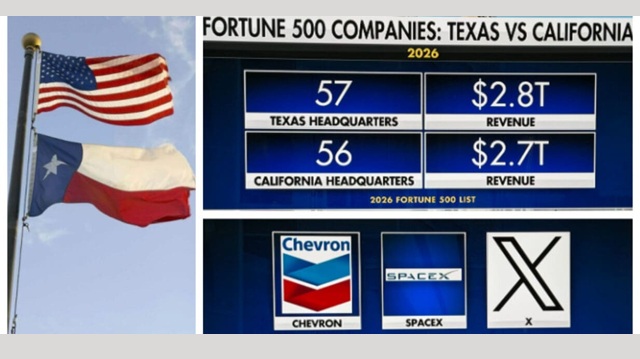
Texas Dethrones California As State With most Fortune 500 Companies
Elections and Democrat policies have consequences. And Gavin Newscum just lost his number one talking point.
Texas beats California to claim the top spot for Fortune 500 headquarters. Tied with Chicago at No. 2 nationally, Houston’s 27 corporate giants will soon become 28 when Oklahoma’s Expand Energy completes its relocation to Spring.
Here is a list of notable examples (focusing on major, high-profile cases with confirmed full HQ moves):
To Texas:
- Tesla — HQ from Palo Alto to Austin (2021).
- Chevron — HQ from San Ramon to Houston (announced 2024, migration ongoing).
- Oracle — HQ from Redwood City to Austin (2020; later some functions to Tennessee).
- Hewlett Packard Enterprise (HPE) — HQ from San Jose to Spring/Houston area (2020).
- Charles Schwab — HQ from San Francisco to Westlake (2019).
- McKesson — HQ from San Francisco to Irving/Las Colinas (2019).
- SpaceX — HQ from Hawthorne to Starbase (2024).
- X (formerly Twitter) — HQ from San Francisco to Bastrop (near Austin, 2024).
- CBRE Group — HQ relocation to Dallas.
- AECOM — HQ from Los Angeles to Dallas (2021).
- Public Storage — HQ from Glendale to Frisco (announced 2026).
To Other States:
- Palantir Technologies — Significant relocation/expansion from Palo Alto area to Denver, Colorado (with Texas operations).
- In-N-Out Burger — Shifting corporate functions/HQ elements from Irvine to Tennessee (e.g., eastern territory HQ in Franklin).
Broader context from sources:
Reports (e.g., Hoover Institution via WSJ/National Review) document hundreds of companies leaving California between 2018–2025, with Texas gaining the most (often 100+ relocations). High-profile energy, tech, and finance firms dominate the moves. Net losses are higher for larger or medium-sized HQs.
This is not exhaustive—hundreds of smaller firms have also left—but these represent major, verifiable corporate HQ departures emphasized in conservative-leaning coverage. Data evolves, and some companies retain California operations.
Analyze California corporate tax impact
GROK says:
California’s corporate tax structure features a flat 8.84% rate on net income for most C corporations (10.84% for banks and financials), plus an $800 minimum franchise tax.
This ranks among the highest state corporate income tax rates in the U.S. (behind a few like New Jersey and Illinois at 9%+ top rates), far above competitors like Texas (no corporate income tax, but a franchise/margin tax) or Florida (5.5%).
Overall:
California’s high corporate tax rate amplifies other cost disadvantages, accelerating the corporate exodus documented in prior discussions. While it generates revenue (especially from profitable giants), effective collection is uneven, and long-term impacts include lost jobs, reduced economic dynamism, and pressure on the state’s budget from a shrinking high-value tax base.
California loses Fortune 500 crown to Texas as billionaire tax threat looms
The 2026 Fortune 500 list shows Texas leading 57-56, reversing a gap from just two years prior
By:Fox Business, June 5, 2026:
In Texas, ‘people are coming and they’re not leaving,’ real estate expert says
A shifting economic landscape has culminated in Texas, dethroning California as the nation’s premier hub for Fortune 500 companies.
Data from the 2026 Fortune 500 list show Texas leading with 57 headquarters, compared with California’s 56, marking a reversal from two years ago, when California held the lead.
Additionally, corporations in Texas generated $2.8 trillion in revenue, while those in California reported $2.7 trillion in revenue.
“Texas is the undisputed headquarters of headquarters,” Texas Gov. Greg Abbott said in a press release reacting to the news. “The world’s leading businesses invest with confidence in Texas because of our welcoming business climate, predictable regulatory environment, and skilled and growing workforce. People and businesses are choosing Texas because Texas works.
In the past year alone, companies including ExxonMobil, Chevron, Samsung Electronics America, SpaceX and X have either moved their headquarters or their legal incorporation to Texas — mostly from California, with two moving from New Jersey.
Company relocations have also been accompanied by billionaires and public figures moving their homes and personal portfolios to the Lone Star State. Most recently, Uber co-founder Travis Kalanick revealed his move to Austin, while Elon Musk, Mark Cuban, Palantir co-founder Joe Lonsdale and David Sacks have made their mark on Texas in recent years.
“Americans are voting with their feet. They want places that are livable. They want places that are workable. They want places that are sustainable and affordable,” Texas REALTORS Chair Jennifer Wauhob previously told Fox News Digital. “And so I think this migration, as we call it, is really turning into a long-term shift.”
The migration of major corporations and prominent business figures comes amid mounting concern over California’s proposed tax policies, including a controversial one-time 5% wealth tax on the state’s wealthiest residents.
Samsung Electronics America Inc. relocates its headquarters from New Jersey to Texas, citing a business transformation for long-term growth.video
Samsung exits New Jersey for Texas, citing high regulatory costs
Samsung Electronics America Inc. relocates its headquarters from New Jersey to Texas, citing a business transformation for long-term growth.
The Service Employees International Union–United Healthcare Workers West (SEIU-UHW) said it has collected more than 1.55 million signatures, according to a press release, nearly double the 875,000-signature requirement — to place a one-time tax on billionaire assets on the California ballot.
The California Billionaire Tax Act would target the net worth of roughly 200 residents and impose a one-time 5% tax on the net worth of California residents with assets exceeding $1 billion. The tax would be due in 2027, and taxpayers could spread payments over five years, with interest, according to the Legislative Analyst’s Office.
If the measure is approved by voters in November, anyone who was a California resident on Jan. 1, 2026, would owe the tax, according to the proposal. In practical terms, a resident with $20 billion in net worth on that date would owe a one-time tax of $1 billion, payable over five years.
Supporters argue the billionaire tax is a direct response to “cuts to Medicaid and other federal health insurance programs by the Trump administration last year,” while opponents of the measure have warned the tax could kill an estimated 108,000 high-paying jobs over the next 20 years.
AUTHOR
Pamela Geller
POST ON X:
EDITORS NOTE: This Geller Report is republished with permission. ©All rights reserved.
Leave a Reply
Want to join the discussion?Feel free to contribute!