
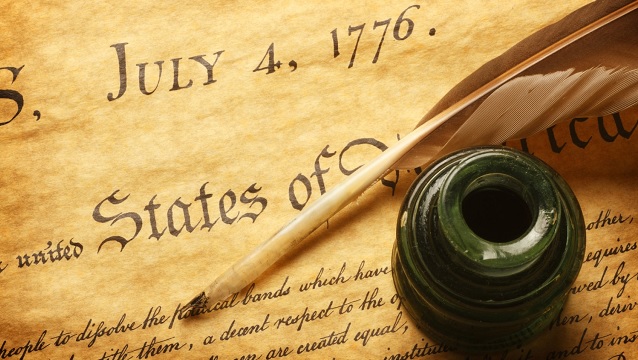
The 56 Signers of the Declaration of Independence
In a quick reading of my book “Our Forefathers Truly Appealed to Heaven,” I demonstrated how the founding, developing and the eventual birth of this exceptional nation was directed by God, not man.
The 56 who signed the Declaration of Independence each, when it was his time to step forward and append his signature, bowed his head in prayer at his desk. This simple yet profound act by each man was not some mere polite gesture to God, or nowadays photo-op to appear good and humble. This volunteer gesture was affirming a commitment to the principle that God ordained the establishment of this county, and it is He that must be the central plan for any government. How far we have slipped!
Each of the thirteen colonies sent their best men to Philadelphia, to the then called State House, we now know as Independence Hall. All 56 delegates to the Constitutional Convention were among the best and the brightest the colonies had to offer. All were financially successful, 24 were lawyers, 9 owned very large and productive plantations. On June 11th a committee was assigned to draw up the Declaration of Independence. The intent was clear — to tell the King of England the colonists had enough of his tyrannical rule, mandates and forced occupation of their houses by British Troops.
The 56 men of the convention did not participate in bigotry or demagoguery. All were committed to the cause of freedom, and all knew the very cost for the same. Thomas Jefferson wrote the Declaration for the small committee, and he finished it in 17 days from which the Continental Congress adopted it in July 1776.
King George was livid! He pronounced that ALL colonists who went along with this Declaration of Independence from England as traitors to the Crown, and punishment would be swift with public hanging. In part because of this threat, the names of all signers to the Declaration were kept silent for six months. Each of these men knew what was about to happen, but they pledged their sacred oath to uphold and preserve the words on the document they would sign. They further pledged prior to signing, their lives one for the other, their fortunes to keep this sacred document, and they pledged their personal honor. 56 men made this pledge openly in that room, one to another prior to taking the quill into their hand and placing ink to paper signing their full name. 56 men knew they were risking everything of value. They knew if they won their independence, they would still face years of struggle economically and socially. If they lost the war for independence, they knew they would face public hanging.
They each pledged their personal honor. They each pledged their fortune. They each pledged their sacred oath as gentlemen one to another. Think about that for a moment. What if today’s elected officials did likewise? What if today’s elected officials understood the privilege and the full personal cost to them individually to steer this nation in the right direction, not in the most politically prudent path but for the good of all in this nation? What if today’s elected officials pledged in writing and in speech openly to put aside self-interest in pursuit of national interest and gave permission to be held accountable if they altered? These 56 signers did just that. And what was the cost?
Carter Braxton of Virginia — a wealthy planter and farmer, also a merchant trader saw his ships at sea all sunk. To pay his debts, he lost his home and land and died in rags.
Thomas Lynch, Jr. — was a third-generation large rice plantation owner, socially respected. After signing the stress caused his health to fail, and he and his wife sailed to France so he could regain his health, but the ship sunk, and he and his wife were never heard from again.
Thomas McKean of Delaware — was so sought after by the British Army he had to leave his home and belongings, but then he had to move five times in five months staying ahead of being captured. He then served in the Continental Congress without pay while his family lived in poverty and in hiding.
Messrs. Ellery, Kilmer, Paul, Wynette, Walton, Hayward, Rutledge Middleton — each of these signers had their homes vandalized beyond repair, as well as their own lives and families.
Thomas Nelson, Jr. of Virginia — raised $2 million to pay the cost of our oldest ally, the French and their navy fleet so they could come to the colonies and help us. After the Revolution War, he paid ALL funds back which were given to him. His entire estate was depleted, and he was never reimbursed by our new government. This signer also pleaded with General Washington to fire upon his homestead to kill British General Cornwallis who had taken possession of his home. The home and property were destroyed.
Francis Hopkinson of New Jersey — had his home seized by the Hessians.
Francis Lewis — had his home and possessions destroyed. His wife was imprisoned where she died alone within a couple of months.
Richard Stockton — was captured and seriously beaten multiple times. His health was destroyed, and he died at 51. His estate was ransacked completely.
Thomas Hayward, Jr. — was captured when Charleston, Virginia fell to the British.
John Hart — barely escaped from his very ill and dying wife’s bedside. Their 13 children had to flee in all directions to keep from being captured. His farm and all his land were destroyed. He lived in caves and forests until after the Revolution War when he returned to his home only to find his wife dead, children gone, property and all possessions destroyed. He died only a few weeks later of exhaustion and a broken heart.
Lewis Morris — had a very similar experience as his friend and co-signer John Hart.
Phillip Livingston — died within a few months of the war due to the stress and hardships he experienced.
John Hancock — was one of the wealthiest men in all the colonies. He stood one night on the outskirts of Boston and pleaded to have Boston burn to destroy the British hold even though for this happen, Hancock said, “burning this beloved city to the ground will cause John Hancock to become a beggar, but it will serve the public good.”
Of the 56 signers, and besides what I have previously described, 5 were captured and tortured by the British, and several others were not long to survive. 12 had their homes from Rhode Island down to Charleston severely ransacked and burned; 2 signers lost their sons serving in the Continental Army. One signer had his son captured and beaten severely almost to death, and 9 other signers died in the war.
The 56 signers of the Declaration of Independence were successful men, not irresponsible, nor were they wild-eye fanatics or political tyrants, nor were they malcontents looking to gain power and position. These were men who found liberty far more important than political position or financial gain at the public’s expense. These were men who had flaws like all men and women. But these men placed service to their new nation just below their submission (cooperation) with God’s Word written in the Bible. In no other nation’s founding documents can we find so many declarations of allegiance to God. Where have men, and women, like these gone? They don’t seem to be around much anymore in public life. There are a few, to be sure, but they are greatly outnumbered by people with agendas our Forefathers would hardly recognize, and the 56 signers of the Declaration of Independence most sincerely would not recognize.
©2026 Lyle J. Rapacki, Ph.D. All rights reserved.
WEBSITE: arizonatoday.org
BOOK: Our Forefathers Truly Appealed to Heaven – Barnes N Noble, Amazon
Support joining me to distribute thoughtful commentary: https://arizonatoday.org/support-arizona-today/
Leave a Reply
Want to join the discussion?Feel free to contribute!