
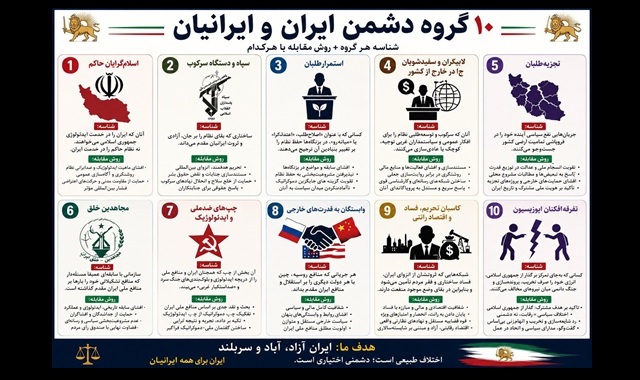
Who Are The 10 Enemies of Iran and the Iranian People
Rashto: Let’s get to know Iran’s 10 enemies. Who are Iran’s enemies?
It is clear that Iranians today, more than ever before in history, must distinguish between their friends and enemies. To answer the question “Who is Iran’s enemy,” we must first define “Iran” and “enemy.” “Iran’s enemy” is not necessarily a specific ethnicity, religion, or group; rather, it is any movement, structure, or activism that systematically undermines one of these four principles: — National sovereignty — Territorial integrity — Freedom and dignity of citizens — Development and public welfare.
Accordingly, the “enemies of Iran” can be classified into several groups: — Power structures that prioritize their own survival over national interests — Movements that substitute foreign dependence for national independence — Groups that resort to destruction, violence, or elimination of others instead of reform or political competition — Networks of corruption and rent-seeking that drain the country’s resources from within.
Simply put, an enemy of Iran is any force that prioritizes its own ideology, power, or organizational interests over “Iran.” Using this framework, specifically at the moment these lines are being written, the following ten movements are Iran’s greatest enemies.
The common denominator of these ten movements is one thing: prioritizing ideology, organization, power, or personal interest over Iran.
10 Enemies of Iran:
- The ruling Islamists — those who want Iran to serve the ideology of the Islamic Republic, not the ruling regime to serve Iran.
- The IRGC and the apparatus of repression — a structure that prioritizes the survival of the regime over the lives, freedom, and wealth of Iranians.
- Continuationists — those who, under the guise of “reformists,” “moderates,” or “moderates,” prefer to preserve the regime over its fundamental change at critical junctures.
- Lobbyists and whitewashers of the regime abroad — those who justify, minimize, or normalize the regime’s repression and expansionism to public opinion and Western politicians.
- Separatists — currents that seek their future political gain in the collapse of the country’s territorial integrity.
- The People’s Mojahedin (MEK) — an organization with a deeply problematic history that has repeatedly prioritized its organizational interests over Iran’s national interests.
- Anti-national and ideological leftists — The part of the left that still sees Iran and national interests through the lens of Cold War ideology and blocs and “Western anti-arrogance.”
- Affiliates of foreign powers — any movement that prioritizes the interests of Russia, China, or any other state over Iran’s independence and interests.
- Merchants of sanctions, corruption, and the rentier economy — networks whose wealth is secured by Iran’s isolation, structural corruption, and the poverty of the people and therefore have an interest in the survival of the status quo.
- Opposition divisives — those who, instead of focusing on the transition of the Islamic Republic, spend their energy on destruction, file-building, and constant war between opposing forces.
In this article, we will identify these 10 groups and explain in detail how to deal with each one.
We will spend most of our time on the tough and complex enemies, not the obvious ones.
Thank you very much for your support.
©2026 Amil Imani. All rights reserved.
Leave a Reply
Want to join the discussion?Feel free to contribute!