The president has a long track record of letting us know what he’s thinking.
Barak Ravid: President Trump told Axios Thursday that he’s approaching a critical juncture in the Iran war over whether to restart massive attacks in an effort to bring the conflict to a close. “I have a big decision coming up. Do I want to go in and annihilate them [the Iranian regime] or do I not? It’s a big decision. Anything could happen with me.” Though Trump has made similar threats before, his comments come ahead of a planned meeting Tuesday with leaders from six Gulf countries — Saudi Arabia, the UAE, Qatar, Bahrain, Kuwait and Oman — on the sidelines of the UN General Assembly in New York. The meeting could shape the next phase of the war, including whether to make another push for diplomacy or intensify military action. If Trump wants to resume major combat operations, he would need buy-in from his regional allies…. What he’s saying: Trump made clear in the interview that he wants to use the meeting at the UN to hear directly from regional allies about the war’s next steps. “I want to find out where they are and how they are doing. We have been very protective of them,” Trump said.
The Iranian people are waiting for that moment. They are dying for it.
By Ronny Reyes, NY Post, Sep. 17, 2026, 5:21 p.m. ET
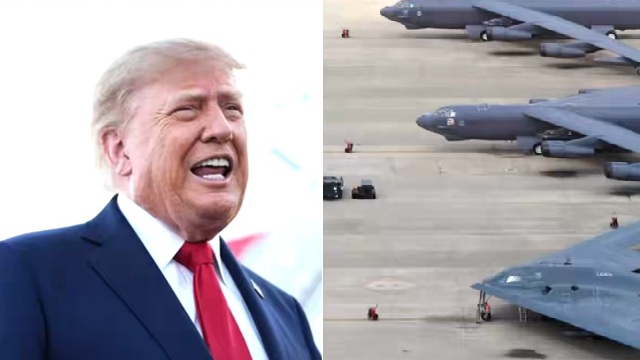
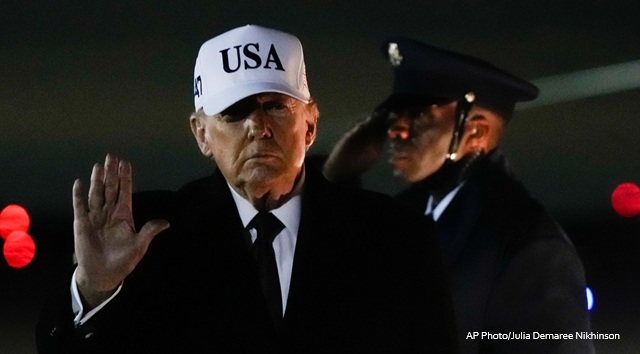
President Trump said Thursday that he was at a crossroads over whether to renew attacks in Iran to wipe out the regime and bring the war to an end.
“I have a big decision coming up. Do I want to go in and annihilate them or do I not?” he told Axios. “It’s a big decision. Anything could happen with me.”
Trump’s comments echo previous threats he’s levied against Tehran since the war began.
But this time, he said, his next move is likely to be influenced by his meetings with Gulf allies at next week’s United Nations General Assembly meeting.
“I want to find out where they are and how they are doing. We have been very protective of them,” Trump added.
The UN Security Council already saw a clash on Thursday after Russia and China vetoed a bid to extend an expert panel to monitor sanctions against Iran and the regime’s nuclear program.
Jennifer Locetta, an American ambassador to the United Nations, slammed the vetoes as a clear “act of obstructionism” that highlights Russia and China’s support of “rogue regimes.”
Meanwhile, Iran allegedly scored another hit on US aircraft this week, with two unmanned MQ-1 Predator drones shot out of the sky in recent days, CBS News reported.
The older-model UAVs — estimated at about $4 million each — have been used to protect the Strait of Hormuz under the US naval blockade, according to the outlet.
The US has lost at least 24 MQ-9 Reaper drones since the war began, which is a loss of about $720 million, according to the Congressional Budget Office report released this week.
Iran has repeatedly stated that its attacks on US military troops and equipment in the Middle East would not end until its control over the Strait of Hormuz is recognized.
With peace negotiations still in limbo, the regime issued its latest ultimatum that the strait would remain closed until Trump and Israeli Prime Minister Benjamin Netanyahu are ousted from power.
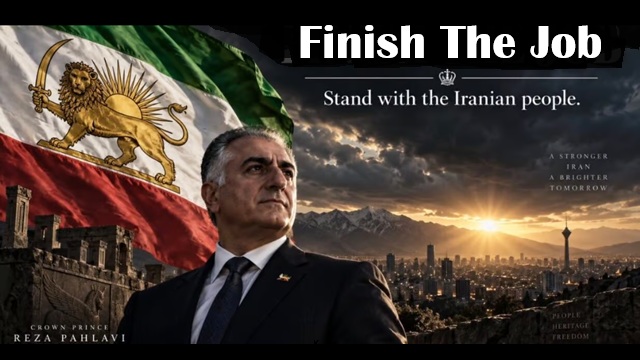
https://drrichswier.com/wp-content/uploads/finish-the-job-reza.jpg360640The Geller Reporthttp://drrich.wpengine.com/wp-content/uploads/logo_264x69.pngThe Geller Report2026-09-19 05:09:352026-09-19 05:19:14Trump at a Crossroads on Iran: ‘Do I Want To Go In and Annihilate Them or Do I Not?’
President Trump said this week he was contemplating taking “decisive action” against Iran, a move he said he would discuss with Arab Gulf allies when they visit New York next week for the UN General Assembly.
“Do I want to annihilate them or do I not?” he said, referring to the Iranian regime.
Sure, the President is responding to the growing unpopularity of the war. A FoxNews poll on Thursday showed that 71% of registered voters don’t think we don’t have a strategy to end the war.
Sure, I get it that Democrats would give that answer. The war, affordability, and scare me about AI are their national talking points. But 43% or Republicans? And 83% of Independents?
I don’t know how the pollsters chose their sample, but if you ask me, what it really shows is that 71% of Americans aren’t paying attention. Or that they are economically illiterate. Or that they have zero knowledge of history.
Let’s stick with not paying attention, which is easy to understand. As my good friend Morgan Murphy said on Newsmax this morning, “Americans are pretty simple. We want to be able to fill up our F-150 for less than $150. We want to be able to buy our wives and girlfriends pumpkin spice lattes.”
And so high prices, which are the daily reminders of the war, have overpowered any serious analysis of what is actually going on.
By every measurable metric, we are winning this war and the Iranian regime is losing. The fact that they can still fire off missiles, or get their proxies in Yemen to fire missiles, does not mean they are winning, as the Panicans claim. It just means they are alive.
Every day their economy is growing weaker. And every day what they thought was their trump card — the Strait of Hormuz — becomes increasingly irrelevant.
We are now getting on average ten million barrels of oil through the Strait every day, thanks to US Navy escorts. That is more than half the amount transmitting the Strait before the war.
When you add the seven million barrels the Saudis and Emiratis have diverted to the Red Sea, that is a net reduction of just three million b/d — and two million of that is the Iranian oil that we have prevented from reaching the market through our blockade.
Thousands of Iranian trucks are backed up at the Pakistani border, because the Pakistanis have joined the blockade, making the resupply of daily goods next to impossible.
The regime has even lost its rail line to China, thanks to Scott Bessent’s efforts to get the governments in Tajikistan and Kazakhstan to join our economic blockade.
The regime is panicking. They can no longer pay government salaries. They can no longer even pay the Revolutionary Guards and bassijis except with promissory notes.
Fearing imminent US strikes, this week they paraded new IRGC recruits through the streets of Tehran. The regime claimed they were all “volunteers” in their Janfaday-e Iran (“Sacrifice for Iran”) initiative.
If you watch the video, they are decidedly a very unwarlike lot. Most of them look like they have just been dragged out of their homes at gunpoint and put in uniforms. They don’t even know how to march. Maybe the regime goons promised them lunch.
President Trump is the one with options, not the Iranians. He could allow the economic pressure to continue to build until, as I believe, the regime collapses in on itself.
In the meantime, Centcom can continue its three for two rule: we sink three of your ships if you target two of ours.
Or the President could authorize devastating decapitation strikes against the regime and the Revolutionary Guards so locals can seize the armories and government buildings.
The only way the Iranians win this war is if enough Republicans join Democrats in voting to end funding it.
The Iranians had been banking that the Democrats and their media mouthpieces would make the war so unpopular that Trump would order our forces to withdraw before the November mid-terms.
That hasn’t happened. The President has shown he has a spine. Now Republicans need to show they have a spine as well.
President Trump is the first American leader to say enough is enough to an Iranian regime that has spread terror through the region — and the world — for the past forty-seven years.
Remember, this is a regime that began with an act of terror: seizing the US embassy in Tehran on Nov. 4, 1979 and keeping them hostage for 444 days. They blew up our Embassy in Beirut in April 1983, and murdered 241 Marines that October. (I tell those stories in And the Rest is History).
All during the 1980s, they took Americans hostage in Lebanon, which led President Reagan to secretly ransom them with arms shipments in what became the Iran/contra scandal.
In the early 1990s, they joined forces with al Qaeda in Khartoum, Sudan, and together attacked us in Saudi Arabia, Kenya, Tanzania, Yemen, and ultimately in New York, Washington, DC, and Shankesville, PA on 9/11.
During the Iraq war, they sent explosively formed penetrators (EFPs) as roadside bombs into Iraq, killing over 800 US servicemen. And on, and on.
President Trump campaigned on ending the endless wars in the Middle East. But that doesn’t happen by magic.
This is the war that ends them.
Republicans, grow a spine and explain to your constituents what this war is all about.
I discuss the latest developments in the Iran war, as well as the British turn away from Israel and the rumors of Chinese President’s Xi’s illness, on this week’s Prophecy Today Weekend.
As always, you can listen live at 1 PM on Saturday on 104.9 FM or 550 AM in the Jacksonville, Florida, area, or by using the Jacksonville Way Radio app.
Ken Timmerman’s 14th book of non-fiction, THE IRAN HOUSE: Tales of Revolution, Persecution, War, and Intrigue,can be ordered by clicking here or by viewing my author’s page, here.
Raising Olives in Provence, can be ordered by clicking here.
https://drrichswier.com/wp-content/uploads/Trump-And-The-War-that-Ends-the-Endless-Wars.jpg360640Kenneth R. Timmermanhttp://drrich.wpengine.com/wp-content/uploads/logo_264x69.pngKenneth R. Timmerman2026-09-18 14:42:472026-09-18 14:49:57The War that Ends the Endless Wars
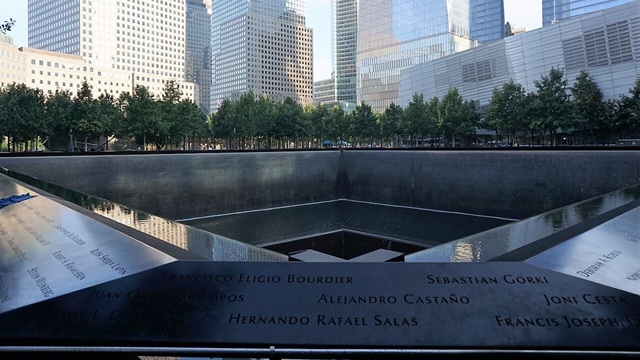
I have spent the past two days with 9/11 families in New York and at the Garden of Remembrance in Bucks County, Pennsylvania. I have known some of these families for nearly twenty years.
They were the first to pursue claims against the Islamic Republic of Iran for Tehran’s role in the attacks. (Below: Tara Bane, the widow of Michael Bane, who perished at the Twin Towers on 9/11).
I began to suspect an Iranian involvement in the al-Qaeda plot on noon of September 11, 2001.
No, I wasn’t looking into a crystal ball. I had gotten a startling phone call from Ahmad Rezai, the 26-year old son of former Revolutionary Guards Commander Maj. Gen. Mohsen Rezai.
For those of you who haven’t heard me tell this story or haven’t read it in my latest book, The Iran House,you need to know that Ahmad defected to the United States a few years earlier and was extensively debriefed by the CIA on his knowledge of Iran’s ballistic missile and nuclear weapons program.
He was told by a senior Agency official that he was the most valuable defector from Iran since the 1979 revolution.
I knew Ahmad because he had taken refuge with me and my family in Kensington, Maryland (the “Iran House”), and spent six months in our basement learning English from Jackie Chan movies. (Below: Here he is with me in 2008).
Ahmad called me that day, twenty-five years ago because his father had just called him. Dad was certain the United States was going to attack Iran and wanted Ahmad to get US visas for his mother, sister, and brother so he could send them to safety.
“Did we do this?” Ahmad asked his father.
“Everyone knows we don’t have the capabilities for such an attack,” the elder Rezai said for the benefit of the listeners.
Of course, his call and his request were already an admission. And today, Mohsen Rezai is the number two man in the Iranian regime, after he proved his loyalty by arranging the murder of his traitorous son in Dubai. (That chapter is called, “Death in Dubai.”)
After Ahmad’s call, I identified other defectors from Iranian intelligence organizations who claimed to have personal knowledge of Iran’s involvement in the plot and published their accounts in the Washington Times and elsewhere.
Tom Mellon Jr., an attorney representing a group of widows from Bucks County, PA, read those articles and asked to meet me to tell him more.
Within months, I took a group of his associates to Europe to meet with some of the defectors and with European counter-terrorism officials. (Here I am with lead plaintiff, Fiona Havlish, and the lead investigative attorney, Timothy B. Fleming, at the 9/11 memorial at Ground Zero on Thursday.)
As I recount in my latest article at American Greatness, Treasury Secretary Scott Bessent has aired the idea of conveying the ill-gotten assets of the Iranian regime either to the Iranian people or to victims of Iranian terrorism.
But so far, he has not mentioned the 9/11 victims, even though they account for the overwhelming majority of claimants to the US Victims of State Sponsored Terrorism Fund (USVSST).
THE 9/11Commission reluctantly recognized Iran’s complicity in the attacks on pages 240-241 of its final report, due to information it uncovered at the eleventh hour before publication. I tell that story in an earlier book, Countdown to Crisis: the Coming Nuclear Showdown with Iran, which you can get in an updated – and inexpensive – Kindle version by using this link.
The Commission authors concluded this section with an exhortation. “We believe this topic requires further investigation by the US government.” And yet, to this day, that investigation was never done.
In 2018, a top Iranian official, Mohammad-Javad Larijani, publicly acknowledged that Iran had facilitated the travels of the future 9/11 hijackers, and said they were “under the complete supervision of Iranian intelligence.” His admission was ignored by the national media.
Reporters who queried the CIA about the $7 billion judgment we ultimately won for the 9/11 families were systemically told that it was a conspiracy theory and they would ruin their reputations if they ran with it.
For years, I have heard two explanations for why the United States government has refused to recognize Iran’s complicity in the 9/11 attacks.
The first is purely parochial: the CIA was worried that its monumental pre-9/11 errors would come to light and the Agency would be punished by Congressional appropriators.
The second is that if the American public knew that Iran was co-responsible with al Qaeda for the 2,977 deaths that occurred on 9/11, they would demand US military action against Iran.
President Trump has burst that second bubble. The taboo over US military action against Iran has now passed.
It boggles the mind to think that a handful of former CIA officials could hold such sway over American public policy as to continue covering up the Iranian connection to 9/11. (Below: The 9/11-Iran attorneys and some of their clients at the Garden of Remembrance in Pennsylvania on Friday).
And yet, they continue down this path. Just yesterday, when American Greatness published my article detailing the Agency’s failings before 9/11, I was contacted by a former Agency analyst, who made clear his displeasure at my revelations.
As the French say, plus ca change, plus ca reste le meme. The more things change, the more they stay the same. We have a CIA that doesn’t have a single live asset inside Iran, and yet when confronted with real information from real defectors, they use all their influence to steer reporters away from it.
I discuss this, and the broader issues surrounding the 9/11 attacks, on this week’s Prophecy Today Weekend. As always, you can listen live at 1 PM on Saturday at 104.9 FM or 550 AM in the Jacksonville, Florida, area, or by using the Way Radio app.
Ken Timmerman’s 14th book of non-fiction, THE IRAN HOUSE: Tales of Revolution, Persecution, War, and Intrigue,can be ordered by clicking here or by viewing my author’s page, here.
Raising Olives in Provence, can be ordered by clicking here.
https://drrichswier.com/wp-content/uploads/911-memorial-3-1.jpg360640Kenneth R. Timmermanhttp://drrich.wpengine.com/wp-content/uploads/logo_264x69.pngKenneth R. Timmerman2026-09-12 14:43:292026-09-12 14:45:43It’s Time to Recognize Iran’s Complicity in the 9/11 Attacks
The U.S. military has “successfully destroyed 10 Iranian tankers in just the last week,” U.S. Central Command announced Wednesday, marking a steep escalation in President Trump’s declared strategy of “Economic Warfare and Isolation” of the Islamist regime. “These vessels were part of a multibillion-dollar shadow network that funds the IRGC, and Iran cannot defend them.”
The strikes came in response to Iran’s continued attack on American naval ships and bases throughout the region. “Iran continues to try to hit U.S. naval ships,” U.S. Secretary of State Marco Rubio explained Tuesday. “And for every time they do that or try to do that, they’re going to lose tankers.”
The U.S. military destroyed nearly all of Iran’s military capabilities through conventional warfare operations over February and March of this year. Since then, the adversaries have exchanged occasional fire, as the remnants of the Iranian regime — principally the Islamic Revolutionary Guard Corps (IRGC) — simply refuse to surrender. Iran increasingly relied on asymmetrical attacks, such as firing upon civilian shipping in the Persian Gulf, attacking civilian targets in neighboring countries, and launching cyber-attacks.
After months of unsuccessful negotiations, President Trump fell back on a strategy of economic blockade. Until that point, U.S. forces had allowed Iranian oil tankers to exit freely from the Strait of Hormuz, even though the Iranian regime was blockading the tankers of every other nation in the Persian Gulf. However, these oil profits funded the IRGC, thus enabling it to increase its hold on power as the rest of the nation languished.
The blockade strangled Iran’s oil exports for some time, although chasing blockade runners across the Indian Ocean soon demanded manpower. On August 24, the U.S. Treasury Department announced an expansion of that blockade, “Operation Economic Outcast: an unprecedented, whole-of-government, economic campaign against the Islamic Republic of Iran and its enablers.”
The economic measures against Iran continue to escalate, with new sanctions announced Wednesday on Iranian airlines.
Meanwhile, the move to sink Iranian oil tankers, as opposed to merely chasing down and capturing them, allows the U.S. military to more effectively restrict all Iranian exports of oil, thus increasing the economic pressure on the IRGC.
The move bears some resemblance to the Trump administration’s earlier actions against Venezuela, where assembled U.S. forces fired on and destroyed boats believed to be smuggling narcotics. However, the U.S. Navy never fired on oil tankers carrying sanctioned Venezuelan oil, choosing to chase them down and capture them instead.
Several factors may play a role in the escalation of strategy. Dark fleet oil tankers fleeing Venezuela across the North Atlantic had to flee a long way before finding a safe harbor from American pursuit, whereas tankers leaving Iran have more and closer options. Furthermore, the Maduro regime never fired on American vessels, whereas the Iranian regime is actively doing so. Finally, it could be a deliberate step of escalation to increase the economic pressure on Iran while decreasing the burden of the blockade on American personnel.
Overall, the move plays to American strengths. The U.S. has overwhelming kinetic power and naval superiority, especially after sinking Iran’s entire regular navy during Operation Epic Fury. The U.S. also has much greater economic strength. Thus, instead of allowing Iran to choose its battlefield, America is now taking initiative on its own preferred ground.
There is still the question of why it took so long for America to arrive at this outcome. If the U.S. was already engaged in kinetic military operations against the Iranian regime, and if it had declared a blockade, why was it holding its fire against Iranian tankers? If the action is acceptable now, surely it would have been acceptable sooner with greater success.
Furthermore, why not go ahead and sink all Iranian tankers, instead of just retaliating by sinking five tankers every time Iran attacks American ships? Why only escalate the war slowly, instead of striking as hard as possible, to bring a swift end?
The answer to these questions likely comes down to the fact that these actions are far less savory. America is paying back the Iranian regime in its own kind, but that was a very nasty kind of warfare. Iran responded to attacks on its military by firing upon civilian targets. Now, America is responding to attacks on its military by firing upon civilian targets. By striking at Iranian economic targets, the U.S. has further legitimized Iranian strikes on economic targets as well.
There is an argument to be made — and the administration will surely make it — that the oil tankers are legitimate targets because they economically prop up the Iranian regime. That case relies on the fact that the conflict has turned into a state of total war, at least for Iran. The Iranian regime has leveraged the nation’s entire economy to sustain the war effort, rather like the U.S., U.K., and Germany did during World War II. Thus, striking Iranian oil tankers is the equivalent of bombing German factories in World War II.
The twists and turns of the U.S.-Iran conflict this year have created an unusual situation where Iran has entered a state of total war, but America has not. The calculation is that the part of the U.S. economy devoted to military funding is stronger than the entire Iranian economy. Furthermore, the Trump administration is calculating that it can keep the American economy insulated from Iranian assaults while pummeling Iran to the point of submission.
The question then remains whether the Iranian regime can hit back at the U.S. economy in a meaningful way before its economic reserves expire. Already, Americans are facing the most expensive Labor Day gas prices on record, with the national average reaching $4.15 on Tuesday. Iran also issued warnings for oil tankers to evacuate areas around Kuwait and Bahrain, where the U.S. has military bases, a thinly veiled threat that it may strike trapped oil tankers in response to American strikes.
However, Iran’s most likely move is to rely yet again on asymmetrical warfare. It lost militarily. It is losing economically. But it might just be able to inflict such heavy political damage on President Trump that his party suffers midterm losses too profound to sustain the war any longer.
The Washington Stand is Family Research Council’s outlet for news and commentary from a biblical worldview. The Washington Stand is based in Washington, D.C. and is published by FRC, whose mission is to advance faith, family, and freedom in public policy and the culture from a biblical worldview. We invite you to stand with us by partnering with FRC.
https://drrichswier.com/wp-content/uploads/U.S.-War-Strategy-Pivots-to-Sinking-Iranian-Tankers.jpg336640Family Research Councilhttp://drrich.wpengine.com/wp-content/uploads/logo_264x69.pngFamily Research Council2026-09-10 15:24:102026-09-10 15:27:29U.S. War Strategy Pivots to Sinking Iranian Tankers
Hello, this is Victor Davis Hanson for the Daily Signal.
We are six months out now from the beginning of the Iran war, if that’s what it is. It’s not a formally declared war. It’s not even like any war we’ve seen in the past.
It began on Feb. 28 with a 38- to 39-day bombing that did enormous damage to Iran. And ever since then, it’s evened out to a tit-for-tat every couple of weeks, negotiations, a memorandum of understanding, but we should remember that it’s not like any war we’ve seen.
One of the reasons it isn’t is we can get no reliable information. There are no embedded reporters because there are no American or Western troops on the ground, and the Ministry of Information in Iran is less reliable than Saddam Hussein’s Baghdad Bob.
And to the degree there are foreigners within Iran that are trapped, they don’t risk their lives by trying to communicate with us.
And Iranians themselves know if they call relatives in Europe or the United States and disclose information, they can be killed or executed.
So, there’s a complete news blackout. In that vacuum, of course, it didn’t stop The Washington Post, but especially The New York Times, from telling the American people we’ve essentially lost the war.
And we’ve even had illustrious people like Robert Kagan, as I’ve mentioned in the past, or John Mearsheimer from Harvard saying that essentially the war is lost. I don’t know how they can draw that conclusion when we don’t have reliable information.
We do have information that comes from Israel, which did a lot of damage to Iran and has photo reconnaissance, and us, but of course they don’t trust the Trump administration.
The other thing to remember about this war is there are two laws, canons, protocols that we haven’t seen before. The first: Under no circumstances will there be American troops on the ground. No American troops on the ground, given the misadventures in Afghanistan and Iraq. So we are not invading, we’re not going to overthrow the government, we’re not going to arm the resistance for good or evil. That’s just not going to happen because it’s politically impossible.
The other sideline or parameter that we cannot violate, or that we have to respect, is we can’t do enough damage that would impair the Iranians’ ability to eat, sleep, get fuel, and exist.
If this was a true enemy, as was Germany in World War II, as was Japan, North Korea, or Vietnam, we would be taking out power plants as we did in Serbia with Bill Clinton, or we would be taking out dockworks like we did with Barack Obama in Libya, or bridges, all of them, as Bill Clinton did on the Danube.
But we’re not doing that. And I guess the rationale is the Iranian people are now short of food, they’re short of water, they’re short of fuel, and we count on them to rise up at some point in the fashion of Eastern Europeans or Russians during the period following the Cold War.
So, we do not want to do enough damage to Iran to hurt the viability of a successive free government, and we don’t want to put troops on the ground. So that means that it has to be air power.
There’s another consideration. The countries that would benefit just as much or more than we do—Japan, South Korea, most of Europe, which import oil either from North Africa or from the Gulf states, or themselves—are terrified of terrorism, specifically European countries that know that even Arab terrorists who seem to be Sunni terrorists are indirectly subsidized by Iran.
So, they know that if this government falls, there will be no interference with the Strait of Hormuz. But more importantly, you can criticize anybody you want. If you criticize the Iranian government now and you’re a European country, or you take sanctions against them, they will retaliate by closing the Strait, and that’s what they were afraid of.
It’s not quite true, as we are told by the Left, that the strait was always open until [President Donald] Trump got us in this war and then they closed it. It was open conditional on the attitude of the particular country using it.
So, where does this leave us? This leaves us with a new situation. And in that void, finally, as happens in war, we have a new comprehensive strategy.
We really didn’t have a strategy in the Civil War until 1863 or 1864 when Grant said, “I will go down and tie up the Army of Northern Virginia and bleed it white while Uncle Billy Sherman is going to go down to Atlanta, the transportation hub of the Confederacy, destroy it, and then humiliate the martial chivalry and chauvinism of the Southern soldier by marching right through Georgia and then through the Carolinas to meet Grant and end the war.”
That didn’t formulate until there’d been 250,000 Union dead.
So, what’s my point? We finally get a strategy that some of us might want to say, “Why didn’t we do this at the beginning?”
And what is that strategy? It’s the “anaconda strategy” that I mentioned.
So, we are doing a type of blockade, sanctions, freezing of bank accounts, targeting individual theocrats who live double lives, very austere, very religious, very sanctimonious in Iran, not so much in Europe, where they use their ill-gotten gains to buy penthouses, suites, properties, investments that get high interest for a theocracy that says interest itself is sacrilegious.
And if we squeeze them as we are, they will break.
The question is now a political one, and it has two corollaries.
At what point will the Iranian economy cease to function entirely, and that will force people to take great risk and go out and remove this regime in hopes that immediately there will be billions of dollars of Western aid, which there will be, and the country will be reopened?
Because mark my words, if we have a midterm landslide for the Democrats, as happened against [Barack] Obama in the case of a Republican landslide that neutered his last two years, this opposition isn’t like Republican oppositions.
When the Republicans took the House, they did not impeach Barack Obama. They did not impeach Joe Biden.
This bunch will immediately stop all House proceedings, try to cut off the war, deny funds to the military, and begin impeachment hearings against Donald Trump and most of his Cabinet.
At that point, the Iranian theocracy will be emboldened to take even more severe measures in hopes that the Left is a de facto ally.
Finally, one last perspective, because we are in a dispute with Canada right now as well.
One of the things that came up is President Javier Milei of Argentina said that the Falklands really, given their proximity, should go to Argentina.
He’s a big supporter of Donald Trump. The economics and government and new culture in Argentina are much more akin to a conservative government in the United States than is the hard-left government in the U.K.
The hard-left government of Mr. [Keir] Starmer and the present government, remember, had denied us airspace rights, had put Diego Garcia, a key island in the Indian Ocean, off-limits for our resupply.
And now what happens? The Falklands comes up, and the British media is paranoid.
Why are they paranoid?
Because they have broken a traditional close relationship with the United States.
Milei senses that, senses his affinity for free-market economics under Donald Trump and conservative governance, and all of a sudden thinks he might take a risk and the United States would not get into it as it did during the tenure of Margaret Thatcher when we saved them.
Bottom line: If the United States were not to help Great Britain logistically protect the Falklands, they would not have the ability to do that.
And that would be something that would be a reminder to all of our allies that alliances are not one-way.
And so this war, for all the criticism that it’s incurred in the United States and in Europe, does have historical importance.
It’s very crucial for Western civilization because it will change the entire Middle East and eliminate a 50-year existential threat.
And no president, given his advisers’ acumen, who said, “Do not go into that hornet’s nest, just rhetorically say it has to be done. Tell everybody it has to be done to stop this regime. You’ve got to stop their nuclear weapon, but pass it on to the next president.”
Donald Trump didn’t do that, and we’ll see what happens in November.
We publish a variety of perspectives. Nothing written here is to be construed as representing the views of the Daily Signal.
https://drrichswier.com/wp-content/uploads/When-Will-the-Iranian-People-Overthrow-the-Regime.jpg360640The Daily Signalhttp://drrich.wpengine.com/wp-content/uploads/logo_264x69.pngThe Daily Signal2026-09-09 12:55:542026-09-09 12:58:24Victor Davis Hanson: When Will the Iranian People Overthrow the Regime?
The Trump administration’s screw-turning on Iran’s economy is having a devastating effect. How long will the people of Iran, 85% of whom say in polls that they want the regime to fall, endure this state of affairs before they come out in protest again, as they did last January? More on the economic collapse in Iran can be found here: “Iran’s Rial in Free Fall: How US Sanctions Are Reshaping Daily Life, Public Opinion for the Iranian People,” by Maddie Ali, Algemeiner, September 3, 2026:
As the Trump administration continues to tighten the economic noose around Iran with US sanctions and a naval blockade, ordinary Iranians are bearing the most immediate cost — but largely blaming their own government for the country’s current financial crisis.
Many Iranian officials publicly insist that Washington’s latest pressure campaign to strangle the economy is ineffective and will fail. Yet in bazaars, pharmacies, and household budgets, the economic damage is no longer concealable.
The officials putting a brave face on the situation, denying that the American pressure on the economy is having a major effect, surely know that they cannot keep up this denial. Ordinary people can’t buy food, can’t pay for prescriptions, can’t pay for school and university tuition. Nor can the young find employment. Only 37% of the adult population actually have jobs.
The Iranian public is sinking into deep poverty. Ordinary Iranians — not the members of the ruling class and the Islamic Revolutionary Guard Corps — can’t pay for food, can’t pay for medicines, can’t pay their utilities bills, can’t find work, and they know that this is all the fault of their fanatical rulers, who insist on continuing to keep the Strait of Hormuz closed, which means that American sanctions will not be removed, nor the American blockade of Iranian ports be lifted. They know that their government has spent more than one hundred billion dollars on its nuclear program, with much of that program going up in smoke after the U.S. and Israeli bombing. They know, too, that the Iranian government has transferred billions of dollars’ worth of weapons to Hamas, to Hezbollah, to the Houthis, in addition to billions in cash, and that support continues as the regime chooses to prioritize support for its proxies over a decent life for its people. The Iranian public sees all this as a tremendous misallocation of resources.
There will soon come a point when millions of Iranians, at the end of their tether, will again take to the streets to demand an end to this wretched regime, and this time one hopes that, as happened with the shah’s military in 1978, there will be a revolt in the ranks of the Basiji and Islamic Revolutionary Guard Corps, and those sent out to crush the protesters will instead mutiny, and either put down their weapons, or aim them at those, their numbers fast diminishing, who still support the regime.
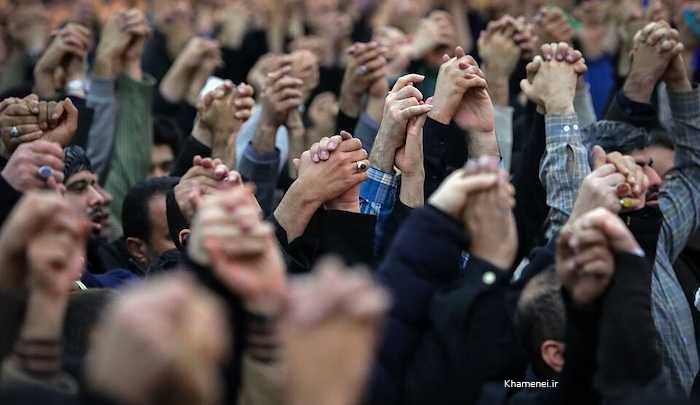
https://drrichswier.com/wp-content/uploads/Friday-Prayer-in-Tehran.jpg405700Jihad Watchhttp://drrich.wpengine.com/wp-content/uploads/logo_264x69.pngJihad Watch2026-09-07 07:25:412026-09-07 07:29:54Iranian Economy Now in Free Fall
In the streets of Tehran, the smell of cordite and the roar of a nation in revolt have rendered the “calculated” language of Washington and Brussels obsolete. But as the Islamic Republic’s house of cards teeters on the edge of a terminal collapse, a second, equally parasitic threat is circling the carcass: the Mujahedin-e-Khalq (MEK).
Make no mistake: Iran is currently fighting a war on two fronts. One is against a decrepit theocracy that hangs its youth from construction cranes; the other is against a cult-like mercenary outfit that has spent decades buying the souls of Western politicians to bypass its own bloody history. To save Iran, both must be purged.
The world watched in horror on January 11, 2026, as the theoretical threat of MEK violence on U.S. soil became a bloody reality. In the heart of Los Angeles’s Westwood neighbourhood, a U-Haul truck – acting as a literal battering ram – tore through a crowd of thousands supporting the Iranian people’s right to self-determination. This was not a random act of road rage; the truck was adorned with a banner declaring: “NO SHAH, NO MULAH. USA: DON’T REPEAT 1953. NO MULLAH.”
This specific slogan is the precise ideological brand of the MEK and its political wing, the NCRI. This incident follows a chilling pattern established by the June 2025 “U-Haul Massacre” in Los Angeles and the October 2025 “Alameda Charge,” where a vehicle was driven toward federal personnel during civil unrest. The strategy is classic MEK: operate in the shadows, leverage chaos, and use “activism” as a front for paramilitary tactics. You cannot “delist” the nature of a scorpion. Hillary Clinton’s 2012 decision to scrub them from the Foreign Terrorist Organization (FTO) list wasn’t an act of justice; it was a surrender to the most expensive lobbying campaign in Washington history.
The spectacle of Maryam Rajavi’s “Free Iran” conventions in 2025 was a masterclass in political prostitution. It is a sickening open secret: high-profile GOP hawks and a handful of Democrats are being paid “handsomely” – ranging from $25,000 to $50,000 per speech – to shill for a woman who runs her organization like a high-security cult. When Mike Pompeo or Rudy Giuliani stand on a stage and claim Rajavi represents the “will of the Iranian people,” they aren’t speaking for the protesters in Isfahan. They are reading a script purchased by an organization that mandates forced divorces, sleep deprivation, and absolute ideological submission among its members in Albania’s “Ashraf-3” camp. These politicians have sold the sovereignty of 85 million Iranians for the price of a luxury SUV.
The financial rot runs deeper than mere guest appearances; it is a systemic buy-out of American foreign policy. In 2025 alone, the MEK’s front organizations poured millions into “honorariums” and “travel expenses” for a roster of DC power players, effectively turning the tragedy of the Iranian people into a lucrative revenue stream for the Western elite. While the Iranian Rial collapses and families in Tehran starve under the weight of the regime’s corruption, Mike Pence – who reportedly pocketed $430,000 from the group – and a cadre of House and Senate “caucus” members continue to shill for Rajavi’s 10-point plan as if it were a holy text. These “freedom fighters” for hire aren’t just ignoring the MEK’s history of slaughtering Kurds and siding with Saddam; they are actively silencing the 2026 grassroots movement by crowning an unelected, cult-leading “President-elect” in a DC ballroom. This isn’t diplomacy – it’s a paid hit on the future of Iranian democracy.
The Islamic Republic and the MEK are not enemies; they are symmetrical opposites that feed off each other’s extremism to justify their own parasitic existence. This duality is anchored in a shared obsession with the cult of personality, where Khamenei demands absolute worship as the “Representative of God” while Rajavi commands fealty as the self-appointed “President-elect” of a non-existent government. Neither entity tolerates dissent, as both rely on the total erasure of the individual in favor of blind ideological submission.
Furthermore, both are drowning in a blood debt that the Iranian people will never forgive: while the Mullahs spent 2024 and 2025 executing thousands to maintain their grip on a shattered economy, the MEK remains stained by the ultimate betrayal of fighting alongside Saddam Hussein during the Iran-Iraq War. For the average Iranian, siding with the butcher who gassed their soldiers is a sin that no amount of Washington lobbying can wash away. This is why the 2026 uprising is leaderless by design; the youth in the Grand Bazaar and the students in Shiraz are not shouting for Rajavi, but for a secular, decentralized democracy. They recognize that the MEK is simply the “B-team” of the current regime – a mirror image of the same authoritarian rot that must be shoved off the stage of history alongside the theocracy it claims to oppose.
The MEK belongs back on the Terrorist List. Their involvement in domestic U.S. unrest and their continued use of “troll farms” and psychological warfare prove they have never abandoned the gun; they’ve just learned to hide it behind a suit. To the “Strike Force” of the Iranian resistance currently facing down IRGC bullets: do not let your revolution be hijacked by the ghosts of the 1970s. The path to a free Iran does not go through the MEK’s compound in Albania or the pockets of paid-off U.S. Senators. It ends with the total dismantling of the clerical system and the permanent exile of the Rajavi cult,
Iran does not need a “transitional government” designed in a DC boardroom. It needs the world to stop funding its oppressors – whether they wear robes in Tehran or tailored suits in Paris. The two-headed viper is dying; it is time for the Iranian people to cut off both heads once and for all.
https://drrichswier.com/wp-content/uploads/Iranian-Flag-Amani-2.jpg360640Amil Imanihttp://drrich.wpengine.com/wp-content/uploads/logo_264x69.pngAmil Imani2026-09-04 05:15:182026-09-06 06:22:24Iran Must Bury The Two-Headed Viper Of Mullahs And The MEK
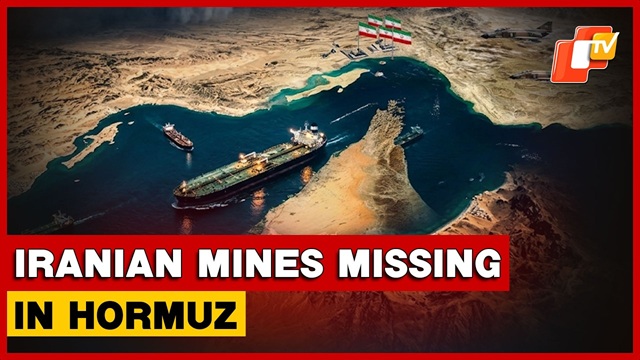
“The United States is, as we speak, striking Iranian Targets near the Strait of Hormuz. The strikes are large and powerful, and in retaliation for the Iranians’ failed attempt at adding sea mines to the Strait, which currently has no mines (They have been completely removed or detonated!)” – President Donald J. Trump 🇺🇸
CENTCOM UPDATE: “Today at 12 p.m. ET, U.S. forces began striking Islamic Revolutionary Guard Corps (IRGC) targets in Iran. The strikes follow recent attempted attacks by the IRGC against commercial shipping in the Strait of Hormuz and against American service members deployed to the region.”
Bessent vows to ‘asphyxiate’ Iran with sanctions, taking away IRGC’s offshore accounts, luxury homes.
“The strikes follow recent attempted attacks by the IRGC against commercial shipping in the Strait of Hormuz and against American service members deployed to the region,” CENTCOM said in a statement.
The US unleashed a fresh wave of strikes on Iran, its second in two days, in response to the regime’s attacks across the region, President Trump said.
“The strikes are large and powerful, and in retaliation for the Iranians’ failed attempt at adding sea mines to the Strait, which currently has no mines (They have been completely removed or detonated!), and the Iranians shooting eight missiles, all successfully knocked down, at our Military Base in Jordan,” Trump wrote on Truth Social.
“If the failed Nation of Iran retaliates for this very justified attack, they will be hit again at a much harder and higher level, but it will not be the biggest attack of them all, that is waiting in the wings and, when it is over, there will be very little left of the Islamic Republic of Iran!” he warned.
The strikes began at 12 p.m. EST, with US Central Command noting that the attacks are focused against the Islamic Revolutionary Guard Corps, which oversees the Strait of Hormuz.
The video player is currently playing an ad.
“The strikes follow recent attempted attacks by the IRGC against commercial shipping in the Strait of Hormuz and against American service members deployed to the region,” CENTCOM said in a statement.
The US renewed its airstrike campaign on Iran on Sunday as it targeted IRGC facilities attempting to place mines in the Strait.
The Islamic Republic followed up with attacks on two supertankers carrying 4 million barrels of Saudi oil on Tuesday, with the ships reporting strikes from multiple projectiles near Oman’s coast.
There have been at least nine attacks on ships in the Strait of Hormuz this month, with more than 72 recorded since March, according to the United Nations’ International Maritime Organization.
https://drrichswier.com/wp-content/uploads/TRUMP-UNLEASHES-HELL-ON-IRAN.jpg359640The Geller Reporthttp://drrich.wpengine.com/wp-content/uploads/logo_264x69.pngThe Geller Report2026-09-02 05:37:462026-09-02 05:40:04TRUMP UNLEASHES HELL ON IRAN: Massive U.S. Strikes Hammer IRGC—‘Very Little Will Be Left’
DUBAI (Reuters) — An Iranian official dismissed as “laughable” on Monday a post by Donald Trump of an AI-generated video clip that the U.S. president said showed Iran’s oil hub Kharg Island being “blown to smithereens.”
Hours after Sunday’s post, there was no evidence Kharg had been attacked. The White House and the U.S. Defense Department did not immediately respond to Reuters requests for comment outside regular business hours.
Trump’s post came shortly after the U.S. and Iran resumed hostilities for the first time since late July, further denting hopes for any early resolution of a conflict now in its sixth month and driving oil prices nearly 2% higher on Monday.
U.S. forces on Sunday struck two Iranian launchers on Iran’s Larak Island, some 660 km (410 miles) east of Kharg, a U.S. official said, prompting Iran to retaliate by attacking two U.S. bases in Jordan, according to Iranian media.
“Kharg Island being blown to smithereens!!! President DJT,” Trump had said on his Truth Social platform on Sunday, with no further details.
Reuters confirmed that an accompanying video clip showing dramatic explosions was most likely synthetically generated, using software that detects AI-manipulated imagery.
“Trump’s tweets are laughable and conditions in Kharg are calm and appropriate,” Hamid Bovard, chief executive of government-run National Iranian Oil Co, said on Monday.
Oil operations have not stopped and workers were busy repairing previous damage and modernizing facilities, he added in comments cited by Nournews, a semi-official outlet close to Iran’s top security body.
Iran Vows to Respond to Any Attacks
Kharg handled 90% of Iran’s oil exports before the war launched by U.S. and Israeli attacks on February 28, and attacking it would severely disrupt energy trade and put huge pressure on the economy.
Iranian President Masoud Pezeshkian said his country was not seeking war but would respond decisively to any aggression.
“We will never remain silent in the face of any aggression…,” state media quoted him as saying on Monday ahead of a visit to Kyrgyzstan.
It was not clear if he was speaking before or after Trump’s post on Kharg Island.
A U.S. official said forces had attacked the Iranian launchers on Larak Island on Sunday after “Islamic Revolutionary Guard Corps forces were observed preparing to launch rockets with sea mines into the Strait of Hormuz.”
Larak is a small island in the strait near the strategic Iranian port of Bandar Abbas. The strait, which normally handles a fifth of global crude oil and liquefied natural gas shipments, has been effectively blocked since the start of the war.
In a statement, the U.S. Central Command said it took “limited, precise” action against minelaying forces of Iran’s Revolutionary Guards that posed an “imminent threat” in the strait. It gave no details.
In retaliation, as well as attacking the U.S. bases in Jordan, Iran’s army said it had also struck the Al Minhad air base in the United Arab Emirates early on Monday. However, the UAE’s defence ministry dismissed that report as false.
The UAE defence ministry later said its air force engaged a drone that had come from Iran over its territorial waters. It provided no further details, including whether it was shot down.
The Jordan strikes targeted U.S. bases used to launch and support the attack on Larak, Iran’s foreign ministry said.
The Revolutionary Guards used air defence missiles to shoot down a U.S. drone that crashed in Gulf waters, the Mehr news agency said on Monday, citing a statement from the elite force.
A supertanker caught fire and was brought to a complete halt after being struck by two naval mines in the southern Strait of Hormuz, Iran state TV said, citing a Guards’ statement.
UAE presidential adviser Anwar Gargash said Iran’s policy of targeting Gulf Arab states and Jordan had failed.
“A state of neither war nor peace cannot be a sustainable solution,” Gargash said in a post on X, adding that realistic political solutions should begin with de-escalation and the restoration of normal shipping through the Strait of Hormuz.
Piling Economic Pressure on Iran
Trump has yet to achieve the objectives he set out at the start of the war: dismantling Iran’s nuclear programme, curbing its ability to attack regional rivals and creating conditions for Iranians to overthrow their clerical rulers.
Sunday’s return to hostilities followed weeks in which his administration has stepped up efforts to punish Tehran and its business partners with costly economic sanctions, shifting away from military options.
U.S. Treasury Secretary Scott Bessent told Reuters on Sunday new secondary sanctions were likely to be unveiled weekly in the effort to pressure Iran, with an initial focus on banks.
Amid threats to shipping, the number of visible commodity vessels transiting the Strait of Hormuz dropped to five a day over the weekend, shipping data showed.
The actual number could be higher as some vessels have switched off automatic identification systems to evade attacks.
The Guards said the supertanker on fire after being hit by mines had been attempting to pass through the waterway illegally, but gave no details of the vessel or crew, according to a statement cited by state television.
Last week, Trump said all mines had been detonated or removed from the international waters of the strait and Iran had been warned that any vessel placing new mines would be destroyed. Iran denied Trump’s assertion.
(Reporting by Eman Abouhassira in Dubai, David Lawder in Asheville, North Carolina, Phil Stewart and Kanishka Singh in Washington, Helen Coster in New York, and Yasmine Ghania and Hatem Maher in Cairo; Writing by Clarence Fernandez and Gareth Jones; Editing by Paul Thomasch, Raju Gopalakrishnan and Alex Richardson)
The Washington Stand is Family Research Council’s outlet for news and commentary from a biblical worldview. The Washington Stand is based in Washington, D.C. and is published by FRC, whose mission is to advance faith, family, and freedom in public policy and the culture from a biblical worldview. We invite you to stand with us by partnering with FRC.
https://drrichswier.com/wp-content/uploads/Trump-Threatens-Kharg-Energy-Hub.jpg336640Family Research Councilhttp://drrich.wpengine.com/wp-content/uploads/logo_264x69.pngFamily Research Council2026-08-31 11:31:012026-08-31 12:34:36As U.S. and Iran Resume Hostilities, Trump Threatens Kharg Energy Hub
Former U.S. Ambassador to the European Union Gordon Sondland says Europe can no longer continue trying to satisfy Washington while maintaining economic ties with Tehran.
“For years, they’ve been doing contortions in trying to appease us and continue to do business with Iran,” he said. “It’s really despicable when you think about it.”
Sondland said that during his tenure as ambassador from 2018 to 2020, the Trump administration provided European governments with intelligence about Iranian activity and repeatedly urged them to reduce business ties with Tehran.
“At the end of the day, it takes money to create mischief,” Sondland said.
He accused Europe of helping provide the Iranian regime with the financial resources it needed while still refusing to fully break ties.
Sondland argued that the current confrontation has eliminated the room for continued ambiguity.
“I think it’s time for the Europeans to be counted one way or the other,” he said. “Are you part of the coalition or are you not?”
He went further, warning that European governments that continue materially supporting economic ties with Iran are, in effect, acting against Washington.
“If you’re not part of the coalition, what you’re doing indirectly is you’re fighting the United States.”
https://drrichswier.com/wp-content/uploads/Europe-must-choose-between-America-and-Iran.jpg360640NEWSRAEL Telling the Israeli Storyhttp://drrich.wpengine.com/wp-content/uploads/logo_264x69.pngNEWSRAEL Telling the Israeli Story2026-08-30 05:42:582026-08-30 05:49:04Former U.S. Ambassador: Europe must choose between America and Iran
U.S. Central Command confirmswhat Democrats and the Fake News have spent months denying: the United States — not the Islamic Republic of Iran — controls the Strait of Hormuz. American forces are keeping energy moving to the world while denying Tehran the revenue it needs to threaten global commerce.
Here are the facts:
Iranian mines have been cleared from the Strait’s international shipping lanes.
Nearly 1,500 commercial vessels have moved through under U.S. protection, carrying 750 million barrels of crude to the world.
Iran has exported zero oil from its shores since the blockade resumed in July.
75 vessels that tried to break the blockade were turned around.
Gulf oil exports have recovered to two-thirds of pre–operation levels — and continue to rise.
President Trump was right — again:
August 10: “The only one that has control of the Strait of Hormuz right now is the United States Navy. We have a blockade that’s been infallible. It’s a steel wall… We control the Strait, 100%.”
August 11: “We totally control the Strait of Hormuz. We have control over it. Nobody else — only us.”
August 14: “In the true sense, we own the Hormuz Strait, and we only allow boats to come in if we want them to come in.”
August 17: “We have total control over the Strait… The Strait is open.”
August 19: “Right now, the Strait is open. A lot of boats are coming through. People aren’t reporting that… The naval blockade has been extremely effective.”
August 21: “We have total control of that entire region having to do with the Strait of Hormuz.”
August 26: “The Strait is open. We take a lot of ships through the Strait now… It’s a very functioning Strait. A lot of oil is pouring out.”
August 27: “The Strait of Hormuz is open. We have control, and we have the blockade. Iran is not getting anything; nothing is going through.”
Here’s what they’re saying:
Former Deputy National Security Advisor KT McFarland: “Iran overplayed its hand by closing Strait. Countries developed work-arounds w/ pipelines, US exports, and then reopened Strait. For 50 yrs Iran blackmailed world. No longer. That card is dead.”
West Point Chair of Urban Warfare Studies John Spencer: “Despite all the rhetoric coming out of Tehran, the reality is clear: the U.S. blockade of Iran is effective. Iran’s claims that it has closed the Strait of Hormuz are false. It has neither closed the strait nor effectively stopped maritime traffic.”
United Against Nuclear Iran Policy Director Jason Brodsky: “Tehran can hoot, holler, and threaten, but its hold over the Strait of Hormuz is being eroded, while its economy is deteriorating and its revenue streams are drying up.”
Hudson Institute Senior Fellow Rebeccah Heinrichs: “There is a demoralization campaign to make people think we’ve lost this war. But the evidence just doesn’t support that. USF have been clearing the Strait and are successfully getting oil through while degrading the IRGC’s weapons and cutting off its resources.”
Institute for National Security Studies Iran and Shiite Axis Program Director Raz Zimmt: “Significant statements from Tehran today point to a growing recognition among the Iranian leadership of the severity of the economic situation and the erosion of Iran’s ability to use the Strait of Hormuz as leverage in light of U.S. military gains in opening a corridor through the strait.”
Former Deputy National Security Advisor Victoria Coates: “By far Trump’s most devastating tool was the imposition of the U.S. blockade on Iranian exports through the Strait of Hormuz last April. Iran is now losing an additional $13 billion a month and is also cut off from critical imports. … The sanctions Bessent announced Monday are going to accelerate economic decline into a collapse.”
Analyst Adolfo Franco: “Six months into the conflict between the United States and Iran, the situation is not the humiliating quagmire that critics of the Trump administration insist upon. Instead, President Trump has charted a new and far more patient strategy that is making steady progress towards his objectives. The quick victory that some initially envisioned by destroying the regime’s military power has given way to a slow and consistent tightening of the noose aimed at denying the Iranian regime the economic oxygen it needs to survive. Although the conflict is far from over, the evidence is that this new focus is working and will continue. The reflexive opposition of critics at home and abroad has not dissuaded the Trump administration. Instead, what we are witnessing is a grinding contest of attrition in which the pressure is compounding over time, steadily narrowing the Iranian regime’s resources and options.”
FDD CEO Mark Dubowitz: “Those of us who stood firmly against the regime in Iran did so because we had supreme confidence in @CENTCOM leadership—and in the extraordinary courage, skill, and professionalism of the remarkable men and women of the U.S. military. That confidence has been more than justified. Profound gratitude to everyone who is making it possible.”
FDD Senior Advisor Richard Goldberg: “The blockade is working. Project Freedom is still going. We are getting 5mpbd out even with IRGC threats. Alternatives are accelerating. IRGC knows its financial sector is a house of cards.”
Commentator Scott Jennings: “Iran has exported no oil since resumption of US blockade in July. The US Navy has helped move 750 million barrels of oil out of the Gulf. Incredible.”
The economic pressure on the Iranian regime is only tightening. Operation Economic Outcast is now cutting off every remaining lifeline to the regime as a domestic fuel crisis, collapsing currency, and crushing inflation starves the regime of its ability to project power.
President Trump has been clear: he will keep the pressure on the Islamic Republic until it can no longer threaten the world.
https://drrichswier.com/wp-content/uploads/Trumps-Actions-on-Iran.jpg354640The White Househttp://drrich.wpengine.com/wp-content/uploads/logo_264x69.pngThe White House2026-08-29 13:33:482026-08-31 12:02:37President Trump Was Right: America Controls the Strait of Hormuz
I like to remind people that war is politics by other means. So is the economic warfare that Treasury Secretary Scott Bessent announced on Monday.
Operation Economic Outcast, Bessent’s term for what Trump called an Economic D-Day against Iran, goes way beyond any previous set of sanctions.
For starters, it explicitly targets the enablers of the Iranian regime. The sanctions evaders. The banks. The exchange houses. The shipping registries. Countries that allow ship to ship transfers.
Countries “that tether themselves [to Iran] can expect to share in the isolation of a withering regime,” Bessent said.
I loved the specificity of Scotty Bessent’s threats.
“Treasury has mapped every node, ever facilitator and every network that Iran has used to smuggle oil and evade sanctions… Beginning today… we are enforcing a zero leakage approach.”
If you thought you could sneak past the Treasury intelligence analysts, think again. The US was now targeting Iran’s “most vital lifelines,” namely digital assets, technology, gold, aviation, and shipping.
“These measures broaden secondary sanctions risk for anyone foolish enough to continue conducting business with this regime — and accelerate the speed with which we pursue them,” Bessent said.
World leaders faced a choice. “Between prosperity and isolation. Peace and terror. America and Iran.” The US campaign “will not end until this regime stands alone,” he said.
Strong words. And I believe they will be followed by strong — but sometimes quiet — actions.
For example, Russia. We learned on Tuesday that CIA Director John Ratcliff flew “secretly” to Moscow, reportedly to deliver a “warning” to Russia not to attack NATO. This, as usual with the national media, according to anonymous sources.
Still, it wasn’t much of a secret because his Ratcliff’s military jet was spotted leaving Latvia and arriving in Moscow on Tuesday, where it was greeted by a convoy of black Suburbans that whisked him to the Kremlin.
Trump acknowledged the Ratcliff mission on Wednesday in an interview with Glenn Beck, but denied Ratcliff delivered a warning to Putin not to test NATO’s resolve. Instead, he called the visit “semi-routine,” and hinted it might involve negotiations toward ending the Russian-Ukraine war.
I suspect — but this is just my gut speaking — that Ratcliff at the very least told his Russian counterpart (who acknowledged the meeting on Thursday) that Russia was also in Scotty Bessent’s cross-hairs if they didn’t cut off their military and intelligence support for Iran.
Perhaps he hinted that the US might lean on Zelensky to stop attacking Russian refineries if the Russians stopped aiding Iran?
Again, this is just me speculating. But Trump is a transactional guy. You give and you get.
But if Radcliff did issue a warning to Russia about NATO, as the media claims, it didn’t go over very well, because on Thursday a Russian foreign ministry spokesperson explicitly threatened the UK over its military support to Ukraine.
This came as Moscow accused Ukraine of firing British Storm Shadow air to surface missiles against a shopping center in the city of Donetsk in Russian-occupied eastern Ukraine.
Russian Foreign Ministry spokeswoman Maria Zakharova said the UK was “one step away” from becoming legally complicit in “terrorism” against Russian civilians.
“We have repeatedly warned that any British military installations and equipment in Ukraine and beyond its borders could be targeted in response to Ukrainian strikes on Russian territory carried out using British weapons,” she said.
Following that warning, Poland sent tanks to the Russian border and Sweden deployed Grippen fighter jets to Finland to reinforce its air defenses along the 800 mile border with Russia.
And for the past two days, Kiev has been under intense bombardment by missiles and drones, with air raid sirens going off almost constantly for fifteen hours at a stretch.
Putin’s message to the Ukrainians was clear: continue attacking our oil refineries and oil depots and we will continue attacking Kiev.
Perhaps Ratcliff really was on a mission to find the terms for a lasting ceasefire, and both sides are jockeying to get the best terms.
In both Iran and Russia, economic warfare is proving itself just as powerful as bombs and missiles, if not more so.
Russia is hurting badly from the hits on its oil infrastructure. Only 27% of gasoline stations now have gas. Russians haven’t experienced this type of economic pain since the economic collapse of 1998, which ultimately forced Yeltsin to resign and brought Putin to power.
In Iran, protesters are back on the streets demanding economic relief from the regime. I’d like to hear them chant, No No Nuclear.
It’s pretty clear you can’t force regime change through air power alone. But when that is coupled with a naval blockade and an economic noose cutting the regime off from its foreign sources of support, I am increasingly confident we will see change in Iran.
What a surprise it would be to Democrats if their biggest ally — the IRGC in Tehran — were to fall just before the midterms.
I discuss these subjects and Europe’s drift into irrelevance on this week’s Prophecy Today Weekend. As always, you can listen live at 1 PM on Saturday on 104.9 FM or 550 AM in the Jacksonville, Florida, area, or by using the Jacksonville Way Radio app.
Ken Timmerman’s 14th book of non-fiction, THE IRAN HOUSE: Tales of Revolution, Persecution, War, and Intrigue,can be ordered by clicking here or by viewing my author’s page, here.
Raising Olives in Provence, can be ordered by clicking here.
https://drrichswier.com/wp-content/uploads/Economic-Warfare.jpg369652Kenneth R. Timmermanhttp://drrich.wpengine.com/wp-content/uploads/logo_264x69.pngKenneth R. Timmerman2026-08-28 14:50:552026-08-28 14:58:09Economic Warfare and Regime Change
The Iranian regime is offering a $10 million bounty for the death of Barron Trump, according to a three-minute segment that aired this weekend on Iranian state television. The explicit threat is also a tacit admission. Apparently, the President of the United States is too secure a target for Iranian assassins. So, how about his college-enrolled son?
The monstrous offer shows in stark contrast the difference between Iran’s Islamist regime and the United States of America. In America, government officials only provide large monetary rewards for information leading to the capture of heinous criminals — terrorists, traffickers, serial killers, and the like. Iran, meanwhile, is offering a monetary reward for an innocent college student whose only imaginable offense is being related to his father. Oh, and the reward is not for his capture, but for his death. What monstrous barbarism!
But the Trump family are not the only ones who must worry about Iranian assassins. On Monday, Israeli Prime Minister Benjamin Netanyahu shared in a radio interview that “Iran tried to murder one of my sons.”
Why is Iran so fixated with the children of its enemies? Perhaps it knows that men like Trump deeply care about their families and will go to great lengths to protect them. By striking at Barron, Iran believes it can create another point of leverage to manipulate President Trump’s decisions.
More likely, however, Iran is simply treating the leaders of other nations as it treats its own. Technically speaking, the U.S., Israel, and Iran are all republics or democracies of one brand or another, not hereditary monarchies. But, when Iran’s Supreme Leader Ali Khamenei was killed at the outset of fighting on February 28, Iran’s remaining leaders selected his son, Mojtaba Khamenei to replace him.
Mojtaba was a strange pick to lead the battered regime through war, as he was already underqualified for the position and gravely wounded to boot. Thus, his appointment can only be described as a bit of dynastic loyalty bleeding through, even though the Islamic Republic of Iran technically has no dynasty.
Thus, by striking at the sons of President Trump and Prime Minister Netanyahu, the Iranian regime was simply treating the families of those leaders as it treated its own — as an elected dynasty of sorts.
Such elected dynasties were never the intention of America’s Founders. The authors of the Federalist Papers defended the Constitution’s sparse qualifications for federal elected office on the grounds that it would result in candidates being selected for their merit. Thus, the office of representative was “open to merit of every description, whether native or adoptive, whether young or old, and without regard to poverty or wealth, or to any particular profession of religious faith” (Federalist 52). Those would become senators “whose merits and talents may claim a share in the public confidence” (Federalist 62). And the office of president “will never fall to the lot of any man who is not in an eminent degree endowed with the requisite qualifications” (Federalist 68). Alas, even the Founders could guess wrong sometimes.
At first, the fledgling nation inched along the prescribed path. In his prize-winning biography, historian Ron Chernow suggests of George Washington that the general’s path to the presidency was helped by the fact that he had no biological children. In an age of kings, Washington could never become a king, at least not a hereditary kingdom. Thus, power was considered safe in his hands.
That changed quickly. The nation’s second president was John Adams; his son, John Quincy Adams, became the sixth president. Adams once wrote to his wife, “I must study Politics and War that my sons may have liberty to study Mathematics and Philosophy.” As it turned out, at least one son studied politics, too. Politics quickly turned into a family business.
Since then, America has seen other family “dynasties,” as it were, who remain politically powerful across generations. President Benjamin Harrison was the grandson of President William H. Harrison. Presidents Theodore and Franklin Roosevelt were cousins. Just in the past half-century, two generations of Bushes sat in the oval office (and another tried), Hillary Clinton nearly succeeded her husband Bill (16 years later), and people named “Kennedy” somehow keep popping up in positions of power.
The last two presidents were surrounded by a constellation of people named “Biden” or “Trump” who had murky official status but nevertheless sometimes played a role in policymaking (most significantly, Jared Kushner, husband of Ivanka Trump, negotiated the Abraham Accords).
That such family coincidences are merely the result of merit is too preposterous to believe. It turns out that politics, especially in a party system, is more about connections and popularity than merit. In fact, when individuals of true talent do rise to the top, it almost seems to be by accident.
So then, how should we understand this phenomenon? Is it merely a subconscious reversion to monarchy? Some zealous defenders of liberty might say so, but that seems too uncharitable. It overlooks the natural human instincts to make provision for one’s children, and to raise children in the footsteps of their parents. A business owner might hope that his son will one day take over the family business; when the “family business” is politics, it becomes a “dynasty” of sorts.
In a system of popular government like America, such passing of the governmental baton between relatives also requires cooperation from the voters. This week, South Carolina Republicans elected Darline Graham, younger sister of the late Senator Lindsey Graham to be their candidate in November’s election. Does Ms. Graham have the same foreign policy bona fides that characterized Lindsey’s tenure? In the senatorial debate, she admitted that she does not. But voters gave her the chance to succeed her brother anyways because they believe she wants to carry on her brother’s legacy.
It also seems to be the case that some voters simply like to keep the same name in office. South Carolinians replaced Graham with Graham. When Luke Letlow (R-La.) suddenly died after winning election to Congress, his wife Julia ran for the empty seat and won. Kentuckians have now been governed by two generations of Beshears. Alaska Democrats tried to sow confusion by recruiting a man named Dan Sullivan to run for the seat held by Senator Dan Sullivan.
Yet, although America has seen many well-connected families, it has not seen total family dominance. In a recent primary in New York City, voters rejected Jack Schlossberg, a grandson of President John F. Kennedy, because there weren’t really any reasons to vote for him, besides his family legacy.
Although cases of nepotism arise from time to time, America remains fundamentally a republic, not a hereditary system. Voters can choose candidates based on their name association with a beloved candidate. But they can also choose candidates for their merits and reject candidates who have none, despite a famous name. For now, America seems to be riding something of a wave of family connections in politics. But that will likely fade as the old guard must hand over the standard to a new generation. As always, in America, the people decide.
The Washington Stand is Family Research Council’s outlet for news and commentary from a biblical worldview. The Washington Stand is based in Washington, D.C. and is published by FRC, whose mission is to advance faith, family, and freedom in public policy and the culture from a biblical worldview. We invite you to stand with us by partnering with FRC.
https://drrichswier.com/wp-content/uploads/Trump-Family-Of-Democracies-and-Dynasties.jpg336640Family Research Councilhttp://drrich.wpengine.com/wp-content/uploads/logo_264x69.pngFamily Research Council2026-08-28 05:22:222026-08-28 05:25:57Of Democracies and Dynasties
Bessent: “Let me be clear: any entity that facilitates money laundering on behalf of Iran will be removed from the U.S. Dollar system. The clock just started ticking.”
Iran’s leadership is admitting what the world can now see: the pressure is working. President Masoud Pezeshkian acknowledged Iran’s economic shortages, saying, “The war must come to an end at some point.” Mohammad Bagher Ghalibaf, Iran’s parliamentary speaker, was even more direct: “No matter how much military power we have, if people are hungry and we don’t have financial circulation, economic growth and domestic production, we will not endure.” Under President Trump, Treasury will continue to sever every economic lifeline sustaining this regime until Tehran stands alone.
Daugherty: More from Bessent, once again reminding the Iranian how the Berlin Wall came down: To the ordinary soldiers supporting this regime, as more and more of your paychecks stop or supposedly just delayed, ask whether your commanders are leading your country to triumph or to ruin, and recall that the Berlin Wall fell when ordinary soldiers decided not to shoot at their own people.
Iran International: Reports of gasoline shortages spread across Tehran on Monday, with filling stations closing after running out of fuel and motorists describing long searches and queues for increasingly scarce supplies. Images, videos and accounts posted widely on Persian-language social media showed closed stations and lines of cars at others still operating, with shortages reported in several parts of the capital, including central and northern Tehran. The disruption was also acknowledged by state-affiliated media. “Some gas stations have closed without a clear explanation, creating considerable concern and questions for people,” SSN wrote, calling on the government to explain whether the closures were part of an attempt to curb fuel consumption and how long they would last. The shortages bring into the open a problem Iranian officials have been warning about for months: the country is consuming more gasoline than it can produce.
Treasury Secretary Scott Bessent declared Tuesday that Iran’s leadership is already “panicking” under President Donald Trump’s mounting economic offensive — pointing to stark warnings from Tehran’s own president and parliament speaker about the country’s deteriorating economy while vowing to continue severing the regime’s financial lifelines until it “stands alone.”
“Iran’s leadership is admitting what the world can now see: the pressure is working,” Bessent wrote on X, one day after the administration launched Operation Economic Outcast.
Bessent highlighted recent remarks made before Monday’s rollout from Iranian President Masoud Pezeshkian, who acknowledged the country’s mounting economic shortages while declaring that “the war must come to an end at some point.”
He also highlighted an even starker warning from Iranian Parliament Speaker and chief negotiator Mohammad Bagher Ghalibaf about whether Iran could sustain its military strength while its economy and living conditions continued to deteriorate.
“No matter how much military power we have, if people are hungry and we don’t have financial circulation, economic growth and domestic production, we will not endure,” Ghalibaf said.
Bessent pointed to the statements as evidence that Trump’s pressure campaign was already biting before Washington dramatically widened its economic offensive Monday with what officials have called an “Economic D-Day” designed to isolate Tehran and choke off the revenue streams sustaining the regime.
Operation Economic Outcast initially targeted more than 60 individuals, entities, and vessels tied to Iranian oil revenue, weapons and missile procurement, and cyber operations, while widening secondary-sanctions exposure across five sectors Tehran exploits abroad: digital assets, technology, gold, aviation, and shipping.
The administration has also put foreign governments, financial institutions, and businesses on notice that continued dealings with Tehran could see them cut off from the U.S. dollar-based financial system.
Bessent described the strategy Monday as the “economic asphyxiation” of the regime and said Washington would enforce a “zero-leakage approach” intended to leave Tehran with virtually no financial breathing room.
Trump reinforced that assessment Tuesday morning, asserting that the Islamic Republic is increasingly unable even to meet obligations to portions of its own armed forces.
“The failing Islamic Republic of Iran is not paying large segments of their military, while at the same time killing protesters, even when they are not protesting, at levels not seen before,” Trump wrote on Truth Social.
Calling the situation a “humanitarian crisis of epic proportions,” Trump demanded that it “must be stopped, NOW.”
The comments came amid mounting signs of strain inside Iran. The rial is trading at roughly 2 million to the U.S. dollar on the open market, while Iran’s prominent Donya-e-Eghtesad economic newspaper reported Monday that the currency had lost roughly 41 percent of its value since December. Long lines have also formed at gasoline stations in Tehran amid growing fuel constraints.
At the same time, Washington is moving to strip Tehran of another major source of leverage: its ability to disrupt commercial shipping and energy flows through the Strait of Hormuz.
Trump announced later Tuesday that the Navy had completed clearing mines from international waters in the strategic waterway — and warned that any Iranian vessel attempting to restore the threat would be destroyed.
“Iran has been notified that any ship or boat placing new mines will be immediately and systematically destroyed,” Trump warned.
Trump said Space Force was watching “every square inch of the Strait,” along with Pickaxe Mountain — the fortified underground nuclear complex near Natanz — and three other Iranian nuclear sites he says have already been destroyed.
“There is a Zero Tolerance policy on mine placement in full force and effect,” he declared.
Two U.S. officials with direct knowledge of the operation confirmed to Axios that the Navy had cleared the Traffic Separation Scheme (TSS), the central shipping lane between Iran and Oman that had remained heavily mined during the war.
U.S. Navy underwater drones spent months systematically scanning the area and located more than 100 objects suspected of being mines, after which private contractors were brought in to remove or detonate them, according to the report.
The development was separately confirmed by U.S. officials to Israeli media, with the Jerusalem Post reporting that CENTCOM had cleared both inbound and outbound shipping routes, opening an additional passage expected to increase maritime traffic through the chokepoint.
Washington had already been moving substantial maritime traffic through a southern channel closer to Oman, with more than 500 vessels passing through that route over the previous 30 days, according to U.S. officials. Clearing the central lane now allows protected vessels to move simultaneously in both directions, potentially expanding the volume of oil and commercial traffic moving through Hormuz.
That directly cuts into a pressure point Tehran has repeatedly sought to wield against Washington and the Gulf states.
In the run-up to Monday’s unveiling of Operation Economic Outcast, Iran’s Supreme National Security Council Secretary Mohsen Rezaei threatened any country that joined Washington’s economic offensive, warning that Tehran would regard such participation as an “act of war.”
“If the economic war continues, not a single drop of oil will be exported, neither through the Strait of Hormuz nor from anywhere in the Persian Gulf,” Rezaei declared Sunday.
The U.S. breakthrough comes as Iran and Oman pursue their own framework for restoring maritime traffic through the strait.
The two countries announced Tuesday that they had discussed a phased framework establishing a temporary joint navigation corridor and mine-clearing project, with technical negotiations continuing toward a permanent route and future arrangements for managing the strait.
Omani Foreign Minister Badr Albusaidi called his talks in Tehran with Iranian Foreign Minister Abbas Araghchi “constructive” and said he was hopeful that a temporary corridor and practical arrangements to restore safe navigation would soon be announced. Araghchi, meanwhile, pointed to the proposed corridor, joint mine-clearing and future management of Hormuz as a “case in point” of Iran’s “steadfast diplomacy with our neighbors.
The American mine-clearing operation, however, has already expanded the shipping routes available without a final agreement with Tehran, with U.S. officials reportedly viewing the combination of cleared mines and steadily increasing traffic through American-protected routes as a significant blow to Iran’s leverage over global energy markets and future negotiations over the strait.
The developments come as Pakistan continues trying to revive an indirect diplomatic track between Washington and Tehran. Army Chief Field Marshal Asim Munir met senior Iranian officials during a day-long visit to Tehran on Monday, with Islamabad subsequently saying the discussions produced “significant progress” toward preventing further escalation, reopening Hormuz, and ending the conflict.
Iranian officials said Munir carried a U.S. message aimed at reviving the stalled political process and that Tehran, in turn, provided its own conditions for returning to the June memorandum of understanding for Pakistan to relay to Washington.
A White House official stressed Tuesday, however, that there are currently “no talks or discussions” underway or scheduled directly with Iran and that the U.S. naval blockade remains firmly in force.
Tehran, meanwhile, has sought to project defiance in the face of Washington’s expanding economic offensive. Iranian Economy Minister Ali Madanizadeh insisted Tuesday that the government had anticipated additional sanctions for years, developed a two-year plan to withstand them, and possessed tools of its own to fight back.
“The enemies intend to launch an economic terrorist attack on us, but we also have our own tools and know how to play the game,” Madanizadeh said.
Ghalibaf predicted Tuesday that Washington would suffer another economic defeat, while Pezeshkian rejected any suggestion that worsening conditions would force Tehran to capitulate.
“Should we give in to problems and surrender? Of course not,” Pezeshkian said.
Bessent countered that those declarations of defiance do not erase the Iranian leaders’ own increasingly stark warnings about hunger, shortages, economic stagnation, and the need to end the war. Under Trump, he vowed, Treasury will continue severing the regime’s economic lifelines until Tehran stands alone.
“I have just been informed by the United States Navy that all mines have been removed and/or detonated from within the International Waters of the Strait of Hormuz. Iran has been notified that any ship or boat placing new mines will be immediately and systematically destroyed. Through Space Force, we are watching every square inch of the Strait, as we are, also, with Pickaxe Mountain and the already destroyed three other Nuclear sites. There is a Zero Tolerance policy on mine placement in full force and effect. Thank you for your attention to this matter! President DONALD J. TRUMP”
https://drrichswier.com/wp-content/uploads/ALL-IRANIAN-MINES-CLEARED-From-Strait-of-Hormuz.jpg360640The Geller Reporthttp://drrich.wpengine.com/wp-content/uploads/logo_264x69.pngThe Geller Report2026-08-26 06:47:132026-08-28 14:42:23TRUMP VICTORY: ALL IRANIAN MINES CLEARED From Strait of Hormuz—Lay Another and Your Ships Will Be Destroyed