
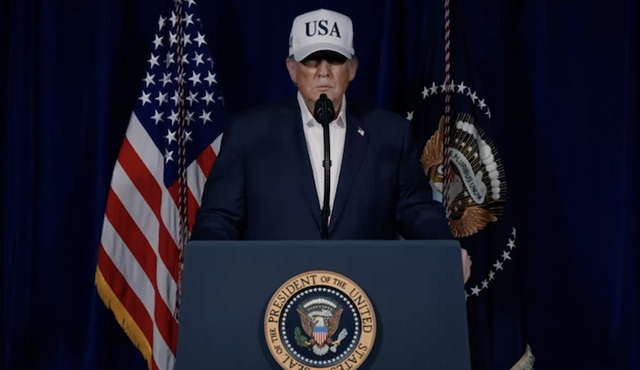
War With Iran Draws Closer
Trump has said that if he decides to attack Iran, in conjunction with Israel, that will happen only after the U.S. midterm elections. Those midterms take place on November 3. The nuclear-powered aircraft carrier USS Theodore Roosevelt (CVN-71) is now on its way to the Middle East as part of a third Carrier Strike Group deployment. A strike force of 10,000 Marines is also on its way to the Gulf. There can be only one reason for such a naval and Marine buildup in the Persian Gulf. Meanwhile, Iran has been hard at work on its nuclear program, enriching more uranium to just below weapons-grade at its facility built deep inside Pickaxe Mountain. And it continues to block the Strait of Hormuz. Tehran refuses any discussion of its nuclear program, insisting that can only take place after the U.S. ends its naval blockade and lifts all economic sanctions on the Islamic Republic.
More on the likelihood of such a strike can be found here: “After months of threats by Trump, resumption of Iran war now seems inevitable,” by Lazar Berman, Times of Israel, October 27, 2026:
Ever since US President Donald Trump’s memorandum of understanding with Iran predictably fell apart, there have been regular warnings about a potential US or even Israeli attack on the Islamic Republic.
Those predictions often follow the latest bombastic threat from Trump, which have proven to be a reliable indicator not of an impending strike, but rather that he has no intention of restarting intensive combat operations against Iran.
Now, however, a return to war in the coming weeks seems likely.
There are good reasons to believe that the chances of an American attack — or another joint operation with Israel — are rising, and the Iranians know it.
But that doesn’t mean they’re about to give in.
Israel seems to be champing at the bit to resume the fight against Iran.
According to multiple reports, Prime Minister Benjamin Netanyahu has been trying to convince Trump to launch a joint strike, or at least give his blessing for an Israeli operation.
Two weeks ago, US officials told Channel 12 news that they believe that Netanyahu wanted to launch an attack before the elections.
An American source said that Netanyahu “has discussed the issue” of a resumption of attacks “several times,” and that Trump told the premier he can “go ahead and prepare,” but made no official commitment to approving an attack.
Last week, sources told the Financial Times that Israel was ready to carry out strikes on the weekend of October 10 on Iranian nuclear facilities and energy plants, but was stopped by Trump.
And on Sunday, reports emerged of “unprecedented confrontation” in recent days between Netanyahu and IDF Chief of Staff Eyal Zamir over an unspecified military action that the prime minister has been pushing. Defense officials believed the operation could lead to a swift confrontation with Iran shortly before the election.
“This relates to an action that could lead to a flare-up with Iran, at a sensitive and dramatic moment, creating this [potential] miscalculation,” a security source told Channel 12.
Since Trump called a sudden halt to the US-Israeli campaign against in Iran in April, it has been evident that he had no inclination to go back to war before the November midterms….
Trump knows that the Iran war is unpopular with voters, and were he to have launched new strikes before the midterms, that would have harmed his party’s chances. Launching a “swift attack” on Iran at the end of November, after the American military presence has strengthened, will have no electoral consequences. And if the joint attack is successful, and Iran is pummeled so thoroughly that it will end its blockade of the Strait of Hormuz, swiftly bringing down the price of oil, Trump should regain much of the support he has been losing.
Earlier this month, Trump ordered the USS Theodore Roosevelt and its carrier strike group to the Middle East, along with around 10,000 Marines in the USS Makin Island Amphibious Ready Group. They are slated to arrive by the end of November, bringing the number of US aircraft carriers near Iran’s shores to three….
With that third carrier strike group, and those additional ten thousand Marines, in the Persian Gulf by the end of November, that is when most analysts now believe the Americans, along with the Israelis, will strike.
Though various US officials have expressed slightly different versions, Trump’s main demands are straightforward: Iran will have to give up uranium enrichment on its soil, ship out its enriched uranium, and cease any threats to the freedom of shipping through the Strait of Hormuz, and only then can it begin to receive significant economic relief….
That economic relief would come from ending the American blockade of Iranian ports, so that it can resume exporting oil, and from ending sanctions on the regime, including the freeing of possibly as much as an estimated $100 billion in broader Iranian oil revenues and reserves that remain frozen in foreign banks worldwide (such as in China, Iraq, Qatar, and South Korea) under U.S. and international sanctions.
AUTHOR
RELATED ARTICLES:
Roman Catholic bishop says Vatican complicit in ‘invasion’ and ‘dechristianization’ of Europe
NYC: Muslima who became Islamic State bride at age 18 found guilty of training with jihadis
UK Muslim Judge Rules for Somali Serial Rapist
A Muslim Says What He Really Thinks of the French
Did the French Government Fake an ‘Islamophobic’ Attack?
Islamic State Weekly Newsletter: ‘Media Warfare is Key Component to Our Campaign of Global Jihad’
RELATED VIDEOS:
WATCH: Iranians LOVE Benjamin Netanyahu!
Daniel Greenfield Video: Why the Left Tries to Blind Us to the Islamic Threat
EDITORS NOTE: This Jihad Watch column is republished with permission. ©All rights reserved.
Leave a Reply
Want to join the discussion?Feel free to contribute!