
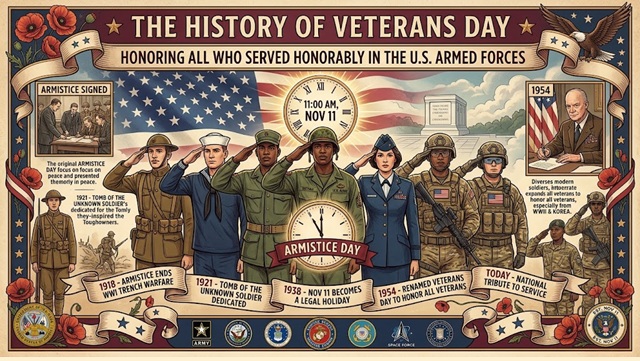
The History of Veterans Day
The Origin: Armistice Day (1918)
It starts with the end of “The Great War.” Fighting between the Allied nations and Germany ceased when an armistice went into effect at the eleventh hour of the eleventh day of the eleventh month — November 11, 1918. (Technically, the war didn’t officially end until the Treaty of Versailles in June 1919, but the guns fell silent that day.)
President Woodrow Wilson proclaimed the first commemoration in November 1919, calling it a day of “solemn pride in the heroism of those who died in the country’s service.”
The original vision: parades, public meetings, and a two-minute suspension of business at 11:00 a.m.
Formal Recognition (1926–1938)
- 1926 — Congress passed a concurrent resolution officially recognizing the end of WWI and requesting the flag be displayed on all government buildings on Nov 11.
- 1938 — Congress made Nov 11 a legal holiday called “Armistice Day,” dedicated to the cause of world peace and honoring WWI veterans.
The Shift to Veterans Day (1954)
After WWII and the Korean War, the scope had clearly outgrown “Armistice.” Two things happened:
- Alvin J. King of Emporia, Kansas, proposed renaming the holiday to “Veterans Day” to honor vets of all wars. Emporia celebrated it under that name as early as 1953.
- Congress struck the word “Armistice” and inserted “Veterans” (Public Law 380), signed June 1, 1954, and President Eisenhower issued the first Veterans Day Proclamation that October.
The Uniform Holiday Mess (1968–1978)
This is where it gets characteristically bureaucratic. In 1968, Congress passed the Uniform Holiday Bill to create three-day weekends for federal employees by moving Veterans Day (along with Washington’s Birthday, Memorial Day, and Columbus Day) to Mondays.
Result: The first “Monday” Veterans Day was observed on October 25, 1971 — and it was a confusing mess.
Many states refused to go along and kept celebrating on Nov 11. The disconnect was so unpopular that in 1975, President Gerald Ford signed Public Law 94-97, returning Veterans Day permanently to November 11, starting in 1978.
Key Distinction: Veterans Day vs. Memorial Day
People conflate these constantly, which is worth flagging:
| Veterans Day | Memorial Day | |
|---|---|---|
| Honors | All who served (living + dead) | Those who died in service |
| Date | Nov 11 (fixed) | Last Monday of May |
| Tone | Celebration | Remembrance |
The Bigger Picture
A few observations worth keeping in mind:
- The date is symbolic, not practical. Nov 11 marks the armistice — a pause, not a victory. The “war to end all wars” framing aged terribly, as every subsequent conflict proved.
- The holiday was politicized by convenience. The Uniform Holiday Bill was pushed through under the banner of “stimulating travel and commerce” — i.e., long weekends for retail and industry, not solemn reflection. It took a nationwide backlash to restore the actual date.
- It honors individuals, not the institution. Veterans Day celebrates the people who served — often the same people the state underfunds, overexposes to toxic burn pits, and under-treats for decades after. The parade is one day; the VA backlog is every day.
The holiday survives because the sentiment is genuine — most Americans want to honor the sacrifice, even when they’re rightly skeptical of the wars themselves. That tension is worth sitting with. You can oppose the wars and still respect the warriors. The day gives you room for both.
©2026 Dr. Richard M. Swier, LTC U.S. Army (Ret.). All rights reserved.
Leave a Reply
Want to join the discussion?Feel free to contribute!