Tag Archive for: Strait of Hormuz

Iran Shoots Down U.S. Apache Helicopter in Strait of Hormuz; Crew Members Rescued, U.S. Strikes Back

U.S. President Donald Trump announces that Washington will retaliate against Iran for shooting down a military helicopter last night over the Strait of Hormuz.

“I have just been informed by our great military that last night the Iranians shot down one of our highly sophisticated Apache Helicopters while patrolling over the Strait of Hormuz. There were two pilots involved, both are safe and uninjured,” Trump writes on Truth Social.

“Nevertheless, the United States must, of necessity, respond to this attack,” Trump adds, without elaborating on what a response might look like.

But Israel is prevented from retaliation (or minimized its retaliation) when it is attacked.

CENTCOM: The two crewmembers were rescued by a drone-boat. Central Command: At 7:33 p.m. ET on June 8, two crew members from a U.S. Army AH-64 Apache were rescued by American forces after their helicopter went down near the coast of Oman while patrolling regional waters. The Soldiers were safely rescued within approximately two hours and are in stable condition. The cause of the incident is under investigation. Rescue efforts were led by U.S. Naval Forces Central Command and the 82nd Airborne Division, with support from U.S. Air Force and Navy units including U.S. 5th Fleet’s Task Force 59.

Axios: More details on the rescue: The crew of a U.S. Apache attack helicopter shot down by Iran was rescued by a drone-boat known as Corsair. It was a first-of-its-kind operation, with incredibly high stakes…. Saronic advertises Corsair as autonomous. It was not immediately clear how it maneuvered during the rescue mission. It was operated by the Navy’s Task Force 59, which was established in 2021 to experiment with unmanned tech and artificial intelligence and fold them into naval operations. Navy leadership has for years advocated for a hybrid fleet, or a mix of manned and unmanned ships. The Corsair, unveiled in October 2024, is 24 feet long. It can travel 1,000 nautical miles, carry 1,000 pounds and hit speeds greater than 35 knots.

In response the USA just launched “self-defense strikes against Iran” in response to “yesterday’s downing of an Apache helicopter”

The explosions are reported from Qeshm island, Sirik, Bandar Abbas and 2 other locations near the Strait of Hormuz.

The United States launched a series of strikes against Iranian targets following the downing of an American Apache helicopter over the Strait of Hormuz, which President Donald Trump directly attributed to Tehran. According to the Pentagon, American forces targeted Iranian air defense systems, ground control stations, and radar installations. U.S. Central Command announced the completion of the operation three hours after it began. In response, Iran’s Islamic Revolutionary Guard Corps claimed to have attacked 21 targets on US military bases in the region, including sites in Bahrain and Jordan. Kuwait reported intercepting incoming attacks. American officials have not yet commented on reports of attacks on their bases, and it is unclear whether any damage was caused. However, according to local authorities, an air alert was declared in Bahrain, and the Iranian attacks were repelled.

That description comes straight from CENTCOM: U.S. Central Command (CENTCOM) forces began launching self-defense strikes against Iran at 5 p.m. ET today at the Commander in Chief’s direction, in response to yesterday’s downing of a U.S. Army Apache helicopter. The mission is a proportional response to unjustified Iranian aggression.

Ravid: Tuesday evening we heard of a second and third round of retaliatory strikes. Barak Ravid of Axios: Third round of strikes now, per U.S. official.

Jonathan Karl of ABC News: I was on the phone with Trump as CENTCOM announced US retaliatory strikes against Iran.  Here’s what he said: “I think it’s very important to respond. They shot down a helicopter, and we are responding as we speak.” He added: “This is a response to what they did they did with our helicopter last night, and I believe the response should be very strong, very powerful, and that’s what this one is” (Karl).

Dubowitz: Mark Dubowitz of the Foundation for Defense of Democracies: President Trump is right to respond. But the more effective strategy is to impose—and support Israel’s right to impose—overwhelming costs on the regime in Tehran and its terror network. The lesson: perceived weakness invites aggression. Strength restores deterrence. Escalate to de-escalate.

NY Post:

Consider: Trump told the press just hours before that attack, “We’re very close to having a very, very good, strong, powerful deal.”

Does it feel like an Iran deal is getting closer?

A country that’s “very close” to sealing a deal in good faith doesn’t escalate against its negotiating partner.

This leaves us wondering which presidential advisers are leading him down this garden path to likely humiliation.

By one count, he’s said “nearly there” 38 times since he announced that “almost all” of the points of contention “have been agreed to” and that a “two-week period” should allow the deal to be “consummated.”

We’re now 10 weeks into that “two-week period,” and everything’s going backward.

Back then, those final issues were: 1) setting verifiable procedures for the end of Iran’s nuke program, and 2) securing permanent free passage through the Strait of Hormuz — with any benefits to Iran (beyond the end of US-Israeli bombing) to come later.

Now, suddenly, getting to the deal somehow has Washington telling Jerusalem it can’t respond to Hezbollah’s missile attacks out of Lebanon.

Bare minimum, Trump’s public bragging about ordering Israel around sure makes it look like he’s appeasing Iran’s outrageous demands.

It’s what the Iranians do: Claim they could give us what we want, stall on actually delivering it (in this case, on any way to hold them to a no-nukes promise) by never giving an inch unless they take it back a day or three later — meanwhile ginning up side issues and manipulating the other side into delivering in advance on those demands in the foolish belief that a final deal will then be possible.

Trump’s negotiators are falling into the same old trap as Carter and Barack Obama.

Are they telling him the blockade will force the regime to bend? Sorry: Iran’s leaders are perfectly willing to let the people suffer. (Heck, they proved in January that they’ll slaughter civilians in the street!) The elites can keep on living the high life, just as they do in impoverished North Korea.

A sign Trump’s getting terrible advice is his assertion Monday night that if “we spend another two or three weeks bombing, they’ll have nothing left whatsoever,” but then “you won’t have the Strait open for months.”

How’s that? 

And why is just reopening the Strait not a legitimate military aim to take away the regime’s leverage?

AUTHOR

RELATED VIDEOS:

President Donald J. Trump: U.S. Military are taking “millions of barrels of oil” out of Iran

Senior Saudi Royal: “The only solution is to change the regime in Iran one by one. “

EDITORS NOTE: This Geller Report is republished with permission. ©All rights reserved.

Trump Administration Reads In Conservative Podcasters On State Of Iran Negotiations

The White House briefed multiple conservative media figures on negotiations with Iran over a potential peace deal which could end the nearly three-month-long armed conflict.

Multiple conservative media figures, including Salem Radio Network host Scott Jennings, Fox News host Kayleigh McEnany, Daily Caller Editorial Director Vince Coglianese, and Turning Point USA’s Andrew Kolvet took to X to defend President Donald Trump’s efforts following a briefing with a “senior administration official.” Coglianese outlined what the unidentified official told them about progress in the talks, saying there had been one marked shift in the Iranians’ tone, using the phrase “NO DUST, NO DOLLARS” as the “topline.”

The senior administration official told Coglianese and others the Iranians were “clearly talking details about getting rid of the enriched stockpile in a way they never have before” and had agreed to end further uranium enrichment.

“They have acknowledged that is something they’re going to have to give on,” the official added.

“Iran doesn’t get a dime unless they actually produce real results,” Coglianese posted, adding, “The Trump administration believes it is now just days away from a memorandum of understanding with the Iranian regime. It won’t be signed today or tomorrow, the official says, but that’s primarily because communication with Iranian leadership moves very slowly.”

“Relief is phased in when Iran actually delivers,” Coglianese posted later. “If they deliver their stockpile of enriched uranium, they’ll get some sanctions relief. If they deliver real long-term commitments to stop nuclear enrichment, they’ll get some sanctions relief.”

Trump took to Truth Social on Sunday to target critics of the agreement’s rumored provisions. Republican Texas Sen. Ted Cruz, former Trump Secretary of State Mike Pompeo, and other conservatives expressed concern over the potential deal on social media, even citing how the reported deal drew praise from former Biden administration official Robert Malley. Malley was the lead negotiator of former President Barack Obama’s 2015 Joint Comprehensive Plan of Action with Iran; Trump said any deal he accepted would be nothing like the that which Obama signed.

“If I make a deal with Iran, it will be a good and proper one, not like the one made by Obama, which gave Iran massive amounts of CASH, and a clear and open path to a Nuclear Weapon,” Trump posted on Truth Social. “Our deal is the exact opposite, but nobody has seen it, or knows what it is. It isn’t even fully negotiated yet.”

“So don’t listen to the losers, who are critical about something they know nothing about,” he continued. “Unlike those before me who should have solved this problem many years ago, I don’t make bad deals!”

Former Director of the National Counterterrorism Center Joe Kent, who resigned from the Trump administration March 17 over the conflict, warned in a Saturday post on X the United States would have to also address Israel after he expressed optimism about an end to the fighting.

“To make the deal effective we have to be realistic about Israel. We must recognize that a peace deal of any kind with the Iranian regime will be viewed by Israelis as an existential threat to their objectives, therefore they will seek to thwart the deal,” Kent said. “To stop the Israelis from thwarting a potential peace deal, we will have to take away the military support that we provide that allows them to go on the offensive against Iran, and make it clear more will be taken from them if they attack Lebanon.”

More than three out of four respondents to a CBS News poll released May 17 said they felt “concerned” about the economy, while two in three said they felt “stressed” as the war continues to affect the U.S. economy, such as stubbornly high inflation, particularly due to higher energy prices.

The average price of a gallon of gas in the U.S. on Sunday was $4.515, according to AAA, up over $1.50 from that of Feb. 26 — $2.98 per gallon — days before the start of U.S. and Israeli military operations against Iran. Diesel prices have also soared to an average of just over $5.62 a gallon at the time of writing, which affects multiple sectors of the economy.

The United States and Israel launched military strikes against Iran on Feb. 28 after talks over the Islamic regime’s nuclear weapons program broke down. Trump and other administration officials asserted the Iranian nuclear program was “obliterated” after the June 2025 strike against multiple Iranian nuclear sites, but maintained Iran posed a threat to the U.S. without providing specific details.

During a May 10 interview on “Meet the Press,” Energy Secretary Chris Wright told host Kristen Welker that Iran possessed sufficient material for ten nuclear devices and nearly 1,000 pounds of uranium enriched to 60%. Trump Middle East Envoy Steve Witkoff made comparable claims during a March 2 appearance on “Hannity.” The administration has not provided evidence to substantiate these assertions from either Witkoff or Wright.

The New York Times reported April 7 that, although there was skepticism among a number of administration officials, including Vice President JD Vance, Trump was persuaded to authorize the military campaign against Iran following a February meeting at the White House by Israeli Prime Minister Benjamin Netanyahu.

Editor’s note: This report and its headline were updated for clarity.

AUTHOR

Harold Hutchison

Second Amendment Reporter

RELATED ARTICLES:

Iran, US Peace Talks Still Stuck In Mud, Trump Says

EDITORS NOTE: This Daily Caller column is republished with permission. ©All rights reserved.


All content created by the Daily Caller News Foundation, an independent and nonpartisan newswire service, is available without charge to any legitimate news publisher that can provide a large audience. All republished articles must include our logo, our reporter’s byline and their DCNF affiliation. For any questions about our guidelines or partnering with us, please contact licensing@dailycallernewsfoundation.org.

Cutting Putin Down to Size

President Trump this week called Iran’s new leaders “lunatics,” because they just didn’t seem capable of making a deal.

As he told Fortune magazine, “[T]hey make a deal, and then they send you a paper that has no relationship to the deal you made. I say, ‘Are you people crazy?'”

The latest Iranian response to the US was “leaked” to the Saudi daily al Arabiya on Thursday, and it’s as much as non-starter as every other Iranian “plan” to end the war. The US makes all the concessions, and Iran gets all the goodies.

If you want to read the details, here is a link to the purported Iranian offer. It doesn’t even mention Iran’s nuclear weapons material, its enrichment capabilities, or its missiles. Talk about arrogant!

At the same time the Iranians were telling the Saudi media of their agreement to guarantee freedom of navigation in the Strait of Hormuz they published their own map, which showed them claiming the entire Strait — right up to the shoreline of the United Arab Emirates and Oman  — was in Iran’s territorial waters.

They are behaving like the Barbary Pirates. 

Remember them? They were the ones who prompted President Thomas Jefferson in 1802  to establish the US Marine Corps because they were raiding U.S. commercial ships plying the Mediterranean and taking U.S. sailors as slaves. So we landed “on the shores of Tripoli,” and the rest is history.

I say it’s time to treat the Iranian regime the same way. Let’s call it, the shores of Kharg and Lavan Island.

Leader Mojtaba Khamenei reportedly told his followers that there was no way he would agree to sending Iran’s stockpile of highly-enriched uranium (HEU) out of the country.

President Trump said that’s not what the negotiators told him. But alas, that’s all he knows.

The Iranians are clearly not negotiating in good faith and in my view — I know my Iranians — they never will. Why? Because they are terrorists.

The only good news this week have been reports from inside Iran of growing tensions between the IRGC and the artesh, Iran’s conventional army. How credible are those reports is, alas, anyone’s guess. But they are persistent.

So is the recent video of Hamid Resai, a cleric and member of parliament, who questioned the government decision-making process and even the legitimacy of the new Supreme Leader in a public address. Here’s the link.

I discussed these issues on Newsmax this morning with USMC Colonel (ret). Grant Newshom. Here’s the link.

Meanwhile, Putin traveled to Beijing to get the full debrief on last week’s Trump-Xi summit. The official communique made it sound like a typical China-Russia summit, with 40 trade agreements signed and the standard communist blah-blah-blah.

But this image said it all.

President Xi took Putin by the leash and paraded him like his pet poodle in front of a newly-unveiled portrait of the two leaders in the Great Hall. Xi looms over Putin and the message is clear: I am the King, you are the vassal.

Trump just treated Xi as his virtual equal. Xi just treated Putin like a second-tier leader. As I have been saying for some time, Russia has become Venezuela with nukes.

And one reason, of course, is that Russia — for the first time, really — now appears to be actually losing the war with Ukraine. It’s a stunning turnaround.

When Trump returned to the White House January 2025, he thought he could resolve the war through negotiations in 48 hours. Uh, not.

Once he realized that wasn’t going to happen, he cut U.S. military and economic aid to Ukraine, telling the Euros to pay up. But he also unleashed the Ukes to strike deep into Russian territory. Over the past three months, they have done massive damage to Russian refineries, oil fields, and export facilities. This has cut at least 500,000 b/d day of Russian oil exports — and thus, the money to fund the war.

I discuss these subjects, as well as a recent report from Center-Right parliamentarians in Europe about Muslim immigration and no-go zones, on this week’s Prophecy Today Weekend.
 
As always, you can listen live on 104.9 FM or 550 AM in the Jacksonville, Florida area, or by using the Jacksonville Way Radio app. If you miss us live, catch the podcast later, here.

Yours in freedom.

©2026 . All rights reserved.


Website: kentimmerman.com

Ken Timmerman’s 14th book of non-fiction, THE IRAN HOUSE: Tales of Revolution, Persecution, War, and Intrigue, can be ordered by clicking here or by viewing my author’s page, here. 

Raising Olives in Provence, can be ordered by clicking here.

President Trump Announces ‘Project Freedom’

President Trump on Sunday said an effort to escort ships from countries not involved in the war with Iran safely out of the Strait of Hormuz, dubbed Project Freedom, will begin Monday.

“For the good of Iran, the Middle East, and the United States, we have told these Countries that we will guide their Ships safely out of these restricted Waterways, so that they can freely and ably get on with their business,” Trump wrote on Truth Social.

The backlog of traffic in the region has become a humanitarian issue.

Wall Street Journal: The underlying reality that it highlights is that in order to continue to inflict serious economic pain on Iran, we need to successful movement for the rest of the world’s cargo on the Strait. Reuel Marc Gerecht: America’s primary objective, then, must be reopening the strait. Secretary of State Marco Rubio appears to understand Hormuz’s importance, saying: “Those are international waterways. They cannot normalize, nor can we tolerate them trying to normalize, a system in which the Iranians decide who gets to use an international waterway and how much you have to pay them to use it.” What Mr. Rubio may understand but left unstated is that this means that the U.S. is stuck in the Persian Gulf guaranteeing safe passage as long as the Iranian regime lasts. It also means we are on the hook to protect, at a minimum, Saudi Arabia and the United Arab Emirates from missile and drone attacks against energy and water infrastructure, which may come if the blockade begins to eviscerate the Iranian regime or Mr. Trump starts bombing Persia into darkness…. If the regime doesn’t crack, we could be in a long struggle that will require commitment, patience, and discipline across the U.S. government.

Truth Social: The president announced “Project Freedom” on Truth Social Sunday afternoon: For the good of Iran, the Middle East, and the United States, we have told these Countries that we will guide their Ships safely out of these restricted Waterways, so that they can freely and ably get on with their business. Again, these are Ships from areas of the World that are not in any way involved with that which is currently taking place in the Middle East. I have told my Representatives to inform them that we will use best efforts to get their Ships and Crews safely out of the Strait. In all cases, they said they will not be returning until the area becomes safe for navigation, and everything else. This process, Project Freedom, will begin Monday morning, Middle East time.

It’s a bold move with risk exposure as well. David Strom

Strom: This is an interesting strategy. It will enable hundreds of ships to leave the area, presumably laden with their cargo, stabilizing the oil market for a time,  without establishing full two-way traffic and normalization…. This is a really bold move, as it would entail, one would assume, US Naval vessels going into dangerous waters with a hostile enemy that has vowed to keep us out. With all the talk of mines, suicide dolphins, and presumably a significant supply of drones and perhaps ship-killer missiles, the risk he is assuming is high.

Just to be clear, the Straits of Hormuz is not Iran’s. It is an international waterway bordered to the north by Iran and to the south by Oman and the UAE. While Iran may claim significant influence over the region, international law defines it as a waterway with, in part, Omani territorial waters.

Jerusalem Post: This will be an interesting week. Jerusalem Post sums up the latest: US Navy ships reportedly crossed the Strait of Hormuz on Saturday afternoon as US-Iran ceasefire negotiations kicked off in Pakistan, though Iran denied the reports and threatened to attack any unauthorized ships in the strait. Axios, citing a US official, reported that several US Navy ships crossed the Strait of Hormuz. According to the report, the move was not coordinated with the Iranian Navy and was the first time US Navy ships made such a move since the start of the war. According to the Wall Street Journal, three US officials confirmed that two US Navy guided-missile destroyers passed through the strait without issue in what was described as a “freedom-of-navigation mission.” Minutes later, a senior Iranian military official denied the reported crossing of US vessels on Iranian government-owned state television. Iranian media additionally released a warning that any US Military ship will be attacked within 30 minutes if it attempts to cross the Strait. According to State TV, a US vessel in the strait turned back after receiving the warning.

AUTHOR

RELATED VIDEO: State Department Secretary Marco Rubio has revoked the visas of 80,000 foreign nationals since January

EDITORS NOTE: This Geller Report is republished with permission. ©All rights reserved.

Trump Gives Major Update on Strait of Hormuz

President Donald Trump announced Friday morning that the Strait of Hormuz is open.

“IRAN HAS JUST ANNOUNCED THAT THE STRAIT OF IRAN IS FULLY OPEN AND READY FOR FULL PASSAGE,” he wrote on TruthSocial. “THANK YOU!”

A few minutes later, Trump posted that the Strait was “COMPLETELY OPEN AND READY FOR BUSINESS AND FULL PASSAGE.”

The Iranian foreign minister, Seyed Abbas Araghchi, confirmed this on X, saying that yesterday’s ceasefire between Israel and Lebanon was connected to the strait’s reopening.

“In line with the ceasefire in Lebanon,” he said, “the passage for all commercial vessels through Strait of Hormuz is declared completely open for the remaining period of ceasefire, on the coordinated route as already announced by Ports and Maritime Organisation of the Islamic Rep. of Iran.”

Since Monday, the United States had maintained a blockade of ships connected to Iranian commerce. Trump added on Friday that “THE NAVAL BLOCKADE WILL REMAIN IN FULL FORCE AND EFFECT AS IT PERTAINS TO IRAN, ONLY, UNTIL SUCH TIME AS OUR TRANSACTION WITH IRAN IS 100% COMPLETE.”

“THIS PROCESS SHOULD GO VERY QUICKLY IN THAT MOST OF THE POINTS ARE ALREADY NEGOTIATED,” he wrote.

Addressing a sticking point in talks, Trump said Tehran had offered not to possess nuclear weapons for more than 20 years.

“We’re going to see what happens. But I think we’re very close to making a deal with Iran,” Trump told reporters outside the White House on Thursday.

The Strait of Hormuz is a key waterway for the global oil trade. About 25% of world seaborn oil trade transits the straight, according to the International Energy Agency, with 80% of it destined for Asia. About 19% of the world’s liquefied natural gas transits the strait as well.

Bangladesh, India, and Pakistan imported almost two-thirds of their liquefied natural gas supplies via the Strait of Hormuz in 2025, making them particularly vulnerable to Iran’s actions.

Oil prices fell sharply in late trading as Trump announced the ceasefire. West Texas Intermediate crude, the domestic benchmark, fell by more than 9% to around $102 per barrel, The New York Times reported.

Trump announced April 7 that Iran agreed to open the Strait of Hormuz, but the crucial waterway remained heavily disrupted by the conflict.

This story is developing and will be updated.

Reuters contributed to this report.

AUTHOR

Elizabeth Troutman Mitchell is the White House Correspondent for “The Daily Signal.” Send her an email. Elizabeth on X: .

RELATED POSTES:

U.S. Naval Blockade Seals Iranian Coast

Poll Reveals Popularity of Trump’s Iran Performance

Trump Slams Democrats for Shutting Down DHS Amid Terrorism Threats

Gas Prices Are Better Than They Might Seem

RELATED VIDEO: HANNITY MONOLOGUE: Iran is feeling the pressure of the US naval blockade

EDITORS NOTE: This Daily Signal column is republished with permission. ©All rights reserved.


The Daily Signal depends on the support of readers like you. Donate now

The Strait of Hormuz: The Story No One Is Explaining

The United States has just moved to blockade one of the most important waterways on Earth.

You’re reading about this everywhere now: The Strait of Hormuz. Oil shipments. Naval forces. Rising tensions with Iran.

But here’s the part no one is stopping to explain…

What exactly is the Strait of Hormuz?

Because if you don’t understand that, none of this makes sense.

It’s not what most people think

Most people hear the word “strait” and imagine a large stretch of water. Something wide. Something open.

That’s not what this is.

strait is a narrow passage of water that connects two larger bodies of water. Think of it like a doorway. Or better yet, a funnel.

And the Strait of Hormuz is one of the tightest, most important funnels in the world.

It connects the Persian Gulf to the Arabian Sea.

That means nearly all the oil from countries like Saudi Arabia, Kuwait, Iraq, and others must pass through this single narrow point to reach the global market.

Not around it. Not through an alternate route. But through it.

And what does “Hormuz” mean?

Simplified map of the Strait of Hormuz showing a narrow waterway connecting the Persian Gulf to the Arabian Sea, with an oil tanker and a container ship passing through the tight channel highlighted by a directional arrow.
A narrow passage with global consequences, nearly a fifth of the world’s oil must pass through this single chokepoint, making the Strait of Hormuz one of the most strategically vulnerable waterways on Earth.

“Hormuz” isn’t the name of a sea.

It comes from a historic region and a small island, Hormuz Island, which was part of the old Kingdom of Hormuz.

Centuries ago, this area controlled trade moving in and out of the Persian Gulf.

In other words, even back then, this was a choke point.

The name stuck because the geography never changed.

Now here’s where everything shifts

Once you understand that this is a narrow passage, not an open ocean, everything you’re seeing in the news suddenly looks different.

Because this is not a wide battlefield.

It’s a bottleneck.

In some places, the Strait is only about 20 miles across. The actual shipping lanes are even narrower.

Picture massive oil tankers, forced into tight lanes, moving slowly through a confined space…

…and just off the coast, a hostile country is watching every move.

“Why doesn’t the U.S. just keep it open?”

That’s the question people are asking.

After all, this is the most powerful navy in the world. So why is this even a problem?

Because this isn’t about strength.

It’s about position.

Iran doesn’t have to win

Iran doesn’t need to defeat the United States Navy.

It doesn’t need a fleet that matches America ship-for-ship.

All it has to do is make the Strait too dangerous to use.

That’s it.

And it can do that with:

  • Naval mines dropped into narrow lanes
  • Fast attack boats that swarm larger ships
  • Drones and missiles launched from the nearby coastline

These are relatively low-cost tactics. But in a place like this, they’re incredibly effective.

Because when ships are packed into a tight corridor, even a small attack has massive consequences.

Fear can shut the Strait down

Here’s something rarely said out loud.

You don’t have to physically block the Strait to close it.

You just have to make shipping companies afraid to use it.

  • Insurance rates spike
  • Tankers hesitate
  • Traffic slows or stops

All from a handful of well-placed attacks or even the threat of them.

That’s how a weaker force can control a critical global chokepoint.

And then there are the mines

Underwater scene showing multiple naval mines anchored by chains to the ocean floor, with one large mine in the foreground and others fading into the blue distance.
Naval mines, inexpensive and difficult to detect, can turn narrow waterways like the Strait of Hormuz into dangerous chokepoints, slowing or even halting global shipping.

Naval mines change everything.

They are cheap, easy to deploy, and extremely dangerous.

And clearing them is slow, methodical work. Especially in a narrow, high-risk environment where more mines could be laid at any moment.

Even the most advanced navy in the world cannot instantly make a mined strait safe again.

So what happens now?

The move to blockade the Strait, led by Donald Trump, is being presented as a decisive step.

And it is. But it’s not a simple solution.

Because enforcing a blockade in a place like this means:

  • Monitoring constant ship traffic
  • Identifying threats in real time
  • Operating within range of Iranian weapons
  • Responding to asymmetric attacks

This is not a quick operation.

It’s a high-stakes, ongoing confrontation in one of the most sensitive locations on Earth.

The part no one is saying clearly

This isn’t just a military story. It’s a geography story.

It’s about a narrow doorway that the world depends on… sitting right next to a country that doesn’t need to win a war to control it.

And that changes everything

Because once you see it for what it is, you understand the real tension:

The United States is trying to secure a passage it does not own…

In a place where the enemy only needs to create risk, not victory.

Final thought

The Strait of Hormuz isn’t a sea; it’s a choke point. And while the military stand-off makes the headlines, the real story is how easily the world’s lifeline can be turned into a noose.

And right now, the world’s energy supply is trying to pass through it while the two sides test just how dangerous that passage can become.

AUTHOR

Martin Mawyer

Martin Mawyer is the founder of the Digital Intelligence Project and the President of Christian Action Network. He is the host of the “Shout Out Patriots” podcast, and author of When Evil Stops Hiding. For more action alerts, cultural commentary, and real-world campaigns defending faith, family, and freedom, subscribe to Patriot Majority Report.

©2026 . All rights reserved.


Please visit the Patriot Majority Report substack.

Trump agrees to two-week suspension of attacks on Iran

President Trump agreed to hold off on his apocalyptic promise to order the death of “a whole civilization” on Tuesday after Iran agreed to open up the Strait of Hormuz as part of a Pakistan-brokered temporary ceasefire of the ongoing conflict between Washington and Tehran.

Mr. Trump said a two-week suspension of what he said would be a sweeping bombing campaign targeting Iran’s bridges, power plants, and utilities was based on conversations he had with Pakistani Prime Minister Shehbaz Sharif and Field Marshal Asim Munir, the country’s military chief.

“They requested that I hold off the destructive force being sent tonight to Iran and subject to the Islamic Republic of Iran agreeing to the complete, immediate, and safe opening of the Strait of Hormuz,” he said on Truth Social.

©2026 . All rights reserved.

RELATED VIDEO: BREAKING: Nonstop Iranian missiles raining down on Tel Aviv less than two hours into the ceasefire.

Why the Strait of Hormuz Remains Open for India While the World Is Shut Out

The year 2026 has turned the world’s most vital waterway into a silent, jagged canyon of steel and shadow. As the Strait of Hormuz constricts under the weight of modern war, the flags of a dozen nations have vanished from its surface. Yet, through the sulfurous haze of the Gulf, the Indian tricolor still moves – not as an intruder, but as a guest in a familiar house.

As of mid-March 2026, while nearly 500 tankers remain stranded and global oil prices carry a nearly $20 risk premium, India has successfully negotiated the exit of key energy carriers like the ShivalikNanda Devi, and Jag Laadki. The question echoing through global capitals is: Why does the Strait remain open for India when it is slammed shut for almost everyone else?

To truly understand why the Hormuz remains open for India, one must look past the oil barrels and the ballistic trajectories. One must look into the “Civilizational Trust” that predates the very concept of a border.

Before there was a New Delhi or a Tehran, there were two people who were one. In the dawn of time, the Indians called their home Aryavarta, while the Iranians spoke of Airyanem Vaejah. Both names were a vow of the “honorable,” a shared identity that has survived three millennia of shifting sands.

When an Indian tanker enters the Strait today, it sails through a linguistic mirror. The Sanskrit Sapta (seven) became the Avestan Hapta. The sacred Sindhu river of the Vedas flowed into the Persian tongue as the Hindu. Even the name Hindustan — the very identity of the subcontinent — is more Persian than Indian; this word is a gift of Persian recognition. More than a relationship of current leaders, it is a memory of the DNA.

The humanitarian window India enjoys in 2026 is guarded by the living presence of shared gods. While modern ideologies have swept the surface of the earth, the foundations remain unshaken. It is on this very foundation that the diplomatic capital, built over decades of cooperation on projects like the Chabahar Port, allows India to be viewed by Tehran not as an adversary, but as a “responsible stakeholder” and a historical friend.

ASpeaking of history, in the Iranian province of Lorestan, a 3,200-year-old plaque of Ganesha sits in the dust, a silent witness to a time when there was no “us” and “them.” In Bandar Abbas, the murals of Krishna still adorn the walls of a Vishnu temple. Even the most radical of modern regimes could not dare to erase these paintings; to do so would be to erase the very roots of the Persian soul.

Perhaps the deepest reason the Hormuz stays open for India is a debt of 1,300 years. When the Sassanian Empire collapsed in 651 CE, and the Zoroastrian fire temples were being razed to the ground, the “Arya” of Persia looked toward the East.

They sailed across the Arabian Sea and knocked on India’s door. India did not ask for their gold or their conversion; she offered them the soil of Gujarat. Today, the Iranshah Atash Behram – the oldest living sacred fire of Zoroastrianism — burns not in Shiraz, but in Udvada. India saved the Persian civilization when Persia could not save itself. Every time an Indian ship passes through the Strait in 2026, it is a silent, poetic return to that sanctuary.

In the history of the world, neighbors are defined by their wars. Yet, between these two great civilizations, there has not been a single war for over 3,000 years. They never invaded each other. Instead, they traded wisdom. The father of Darius the Great studied under Brahmins in Bharat, taking that light back to the Magi. Taxila, the world’s first great university, flourished under the care of Persian administrators.

In the 2026 crisis, while Western navies deploy carriers and threats, India deploys Operation Sankalp. Its warships do not act as an occupational force but as a familiar presence. The Iranian authorities see the Indian flag and recognize a partner that has never sought their destruction.

This civilizational trust manifests in 2026 through a seamless bridge between ancient bonds and modern reality. The linguistic transition from Sapta-Sindhu to Hapta-Hindu has evolved into a contemporary diplomatic ease, where shared nuances allow for a dialogue that transcends standard geopolitics. The profound historical memory of the Parsi Migration in 785 CE continues to command a deep-seated respect from Iran, honoring India’s role as a sanctuary for their ancestral flame. This foundation is fortified by a staggering legacy of zero wars in 3,000 years, a record of peace that translates today into a high level of naval and tactical coordination. Ultimately, the intellectual heritage of Brahmins teaching the Magi survives in the modern era as a robust partnership, ensuring that projects like the INSTC and Chabahar remain vital veins of cooperation even amidst global turmoil.

The Strait of Hormuz remains open for India because trust is the only currency that does not devalue during a war. When a call goes from New Delhi to Tehran, it is much more than a ring in a government office; it rings in a shared history.

Sanskrit may have been suppressed, and Taxila may be a ruin, but the connection was never truly lost. India passes through the Hormuz because she is the keeper of the flame, the sister of the Arya, and the only neighbor who never drew a sword. In the turbulence of 2026, the Strait is not just a maritime route for India — it is a homecoming.

©2026 . All rights reserved.

Oil Prices, Strategic Trade-offs, and the Strait of Hormuz

One unavoidable side-effect of gasoline prices being prominently posted in front of every roadside service station is that Americans remain constantly aware of the volatile fluctuations in gas prices. Since the start of President Trump’s military action against Iran, the national average price for a gallon of regular unleaded fuel has jumped from $2.98 on February 28 to $3.72 on March 16. World oil prices, which ended December under $60 per barrel, have now reached as high as $106 per barrel (as of this writing, they sat at $93 per barrel). With a jump like that, not only Americans but the entire world is taking notice.

The current spike in oil and gas prices is a direct result of the U.S. military’s combat against Iran. Instead of acting like a responsible state that follows the laws of war and spares non-combatants, the Islamist Iranian regime reacted by launching missiles indiscriminately at all its neighbors, including at civilian targets.

Iran’s indiscriminate attacks have not spared international commercial shipping, including oil tankers. Since the conflict began, U.K. Maritime Trade Operations has recorded at least 14 reported attacks on ships in the Persian Gulf or Strait of Hormuz. This has effectively closed the Strait of Hormuz to commercial shipping, as the owners and crews of those vessels naturally do not wish to become foolhardy casualties of war. (Notably, Iranian and Chinese ships continue to sail through unmolested.)

This closure affects global oil markets because the oil-rich countries of the Persian Gulf produce 20% of the world’s oil supply, and their crude oil must pass through the strait to reach global markets. (The Strait of Hormuz, which separates Iran from the Arabian Peninsula, is the Persian Gulf’s only outlet to the sea; at its narrowest point, it measures a mere 24 miles across, no wider than the Amazon River in the rainy season.)

Global oil markets, in turn, affect U.S. gas prices because of the basic principles of supply and demand. Under normal circumstances, the U.S. only imports a small amount of oil from the Persian Gulf, around 2%, while countries like China and India import a much larger quantity. However, when the oil supply from the Persian Gulf is cut off, all the countries that did buy its oil still have the same demand for oil, and they go looking for other suppliers to make up the difference. Thus, an impact on the oil supply in one area of the world will affect oil prices globally.

American strategists have long considered an oil price shock due to the closure of the Strait of Hormuz to be an expected — or at least likely — consequence of war with Iran. “Planning around preventing this exact scenario — impossible as it has long seemed — has been a bedrock principle of US national security policy for decades,” CNN quoted an anonymous former security official.

Yet, to hear CNN tell it, the Trump administration did not prepare for this likely scenario at all. “Top Trump officials acknowledged to lawmakers during recent classified briefings that they did not plan for the possibility of Iran closing the Strait of Hormuz in response to strikes,” the original version of the article claimed.

Such an outrageous claim was bound to be challenged. “Of course, for decades, Iran has threatened shipping in the Strait of Hormuz,” responded Department of War Secretary Pete Hegseth. “This is always what they do: hold the Strait hostage. CNN doesn’t think we thought of that. It’s a fundamentally unserious report.” The National Review editors note that Secretary of State Marco Rubio warned Iran against closing the Strait just last year, and that one of the Trump administration’s stated goals in the current conflict is to degrade Iran’s capability to do so.

CNN’s story now includes the following “CLARIFICATION: This story has been updated to reflect additional developments and clarify that top Trump administration officials briefed lawmakers on long-standing military plans to address a major disruption to the Strait, according to one official, but that multiple sources familiar with the session said there was no indication there were any near-term solutions.”

There’s a big difference between, “The Trump administration totally forgot to account for this glaring vulnerability,” and, “The Trump administration considered the vulnerability but doesn’t have a near-term solution for it.”

As in all of life, politics is about trade-offs, and particularly so in war strategy. The Wall Street Journal reports that Joint Chiefs of Staff Chairman General Dan Caine briefed President Donald Trump on Iran’s ability to close the Strait of Hormuz with mines, drones, and missiles. “Trump acknowledged the risk … but moved forward” anyway, they wrote. “He told his team that Tehran would likely capitulate before closing the strait — and even if Iran tried, the U.S. military could handle it.”

In hindsight, this assessment was clearly too optimistic, but every war strategy suffers from setbacks, accidents, and unknowns. On the other hand, allowing Iran the time to build more missiles and potentially a nuclear weapon could have resulted in even worse consequences.

The reason why the U.S. Constitution invests executive power in one individual is so that one seasoned leader can be responsible for weighing the various tradeoffs and reaching a final decision. In other words, the U.S. presidency exists to make hard decisions just like this one. And those who don’t like the decisions Trump makes had their opportunity to elect a different president.

While the heightened price of gas and oil is causing Americans undeniable pain at the pump, the National Review editors allow that “None of this is catastrophic. The price of Brent crude settled above $100 a barrel on Friday. That’s the highest in four years, not in, say, 60 years. But the clock is ticking.” Indeed, oil prices hit $113 per barrel in June 2022 and $128 per barrel in July 2008. In between, oil prices peaked in April 2011 ($108 per barrel), March 2012 ($105 per barrel), August 2013 ($102 per barrel), and June 2014 ($98 per barrel). So, administration critics do have legitimate grounds to hit Trump over high gas prices, but only as hard as they hit President Joe Biden for the historic inflation in 2021-2022.

That said, the Trump administration is not doing themselves any favors in public perception by appearing desperate and unprepared for this eventuality. The Trump administration has promised military escorts for oil tankers in the Strait of Hormuz, but they have yet to work out the logistics. Meanwhile, the U.S. issued a 30-day waiver for countries to buy sanctioned Russian oil — after President Trump slammed U.S. allies for doing just that — offering Russia’s tottering regime an invaluable financial lifeline.

Errors of strategy and judgment are inevitable in war, even when a superpower like the United States is dominantly pummeling a stubborn rogue regime like that of the Iranian mullahs. But just because the Trump administration has fumbled one snap does not mean that they failed to call the right play. A turnover can be costly, but the only thing that matters is the scoreboard when time expires.

AUTHOR

Joshua Arnold

Joshua Arnold is a senior writer at The Washington Stand.

EDITORS NOTE: This Washington Stand column is republished with permission. All rights reserved. ©2026 Family Research Council.


The Washington Stand is Family Research Council’s outlet for news and commentary from a biblical worldview. The Washington Stand is based in Washington, D.C. and is published by FRC, whose mission is to advance faith, family, and freedom in public policy and the culture from a biblical worldview. We invite you to stand with us by partnering with FRC.

Are Trump Haters and Liberal Media Conspiring to Stop Ship Movement in the Strait Of Hormuz

President Donald Trump warned Iran on Monday against blocking oil shipments in the Strait of Hormuz, a Middle Eastern passage through which a fifth of the world’s petroleum travels.

He said in a social media post that “Death, Fire, and Fury” would “reign upon” assets essential to the country. “If Iran does anything that stops the flow of Oil within the Strait of Hormuz, they will be hit by the United States of America TWENTY TIMES HARDER than they have been hit thus far,” Trump wrote on Truth Social. The National News Desk requested comment from Iran’s foreign ministry but hasn’t received a response. The country’s top national security official, Ali Larijani, said in an X post on Tuesday, though, that the passage “will either be a Strait of peace and prosperity for all or will be a Strait of defeat and suffering for warmongers.”

Tankers have stopped traveling through the channel since the beginning of the war, when the U.S. and Israel ignited a regional conflict with a fatal strike against Iranian Supreme Leader Ali Khamenei.

©2026 . All rights reserved.

U.S. Nuclear Submarine enters Persian Gulf after Pompeo blames Iran for Rocket Attack on U.S. Embassy in Baghdad
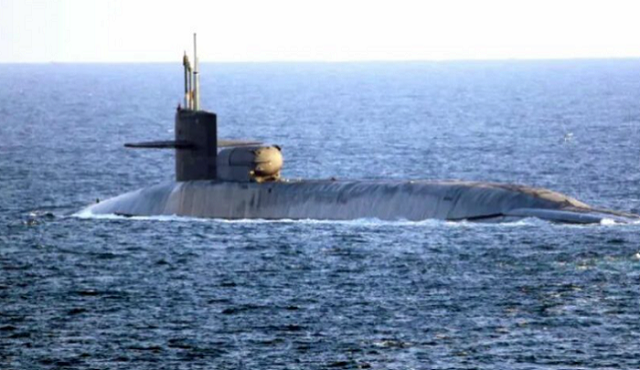
Tension is heating up in the Persian Gulf following a rocket attack on the American Embassy in Baghdad that left a civilian dead.

The nuclear sub sends a clear message to Iran, but clearly Iran has been emboldened by its expectation of a Biden administration that will enable billions to flow once again into its coffers, facilitate its nuclear arsenal build-up, expand its influence in the Middle East, and further enable it to terrorize its targets abroad, including Iranian dissidents who should be safe in the West.

“Israeli Submarine Reportedly Crossed Suez in ‘Message’ to Iran as US Warships Enter Persian Gulf,” by Svetlana Ekimenko, Sputnik News, December 22, 2020:

A US nuclear-powered submarine entered the Persian Gulf through the Strait of Hormuz on 21 December as part of Washington’s latest deterrence mission against Iran as tensions spiked after Secretary of State Mike Pompeo blamed Iranian-backed militias for a rocket attack on the American Embassy compound in Baghdad on Sunday.

An Israeli Navy submarine visibly crossed the Suez Canal above water last week in what is being seen as a show of force aimed at Iran, Kan News, a public broadcaster, reported on Monday night.

Arab intelligence officials had reportedly confirmed to Kan News that the IDF Navy submarine surfaced and faced the Persian Gulf, which lies on the other side of Saudi Arabia, in a deliberate act, approved by Egypt, and purportedly intended to ‘send a message’ to Iran’s supreme leader Ali Khamenei.

There has not been any official comment from the Israel Defence Forces, with the IDF saying it does not respond to “reports of this kind.”

Earlier, on 21 December IDF Chief of Staff Aviv Kohavi voiced a warning to Tehran against attacking Israel, vowing that the Jewish state would retaliate forcefully against any aggressive moves.

“Recently, we have heard increased threats from Iran against the State of Israel. If Iran and its partners, members of the radical axis [Iran, Syria, Hezbollah and Palestinian terror groups], whether in the first circle of states or the second, carry out actions against Israel, they will discover their partnership to be very costly,” Kohavi was quoted by The Times of Israel as saying at a military ceremony. He added:

“The IDF will forcefully attack anyone who takes part, from near or far, in activities against the State of Israel or Israeli targets. I am saying this plainly and am describing the situation as it is — the response and all the plans have been prepared and practised.”
‘Message to Iran’

The reported move by the IDF Navy comes as a similar manoeuvre was undertaken on Monday by a US submarine. The US Navy confirmed that the guided-missile submarine USS Georgia entered the Persian Gulf through the Strait of Hormuz on 21 December, accompanied by two American warships, the guided-missile cruisers USS Port Royal (CG 73) and USS Philippine Sea (CG 58), amid heightened tensions with Iran.

​A US Navy official confirmed to Fox News that the latest movements in the Persian Gulf had been “long planned” ahead of the approaching anniversary of the killing of top Iranian General Qasem Soleimani, the head of the Islamic Revolutionary Guard Corps’ (IRGC) Quds Force, in Iraq on 3 January 2020 by an American drone.

According to the American official, the manoeuvres were not in response to the rocket attack on the US Embassy compound in Baghdad on Sunday.

According to a statement from the US Navy, accompanied by photos of USS Georgia at the surface, the vessel can carry 154 Tomahawk cruise missiles and 66 special forces soldiers.

The Navy warned that the military move seeks to demonstrate “the United States’ commitment to regional partners and maritime security with a full spectrum of capabilities to remain ready to defend against any threat at any time.”

US military officials have been apprehensive of a possible attack by Iran to avenge the assassination of Soleimani in a US drone strike near Baghdad airport in Iraq in early January.

Iran’s Revolutionary Guards Chief Commander, Hossein Salami, said in September on the guard’s website that Tehran will avenge the US killing of its top commander General Qasem Soleimani by targeting those involved, in an “honourable” retaliation.

Spike in Iran Tensions
The show of force in the Persian Gulf comes amid heightened tensions with Iran after US Secretary of State Mike Pompeo laid the blame with Iranian-backed militias for a rocket attack on the US Embassy compound in Baghdad on 20 December.

The attack left at least one local civilian dead, while no embassy personnel were killed or injured, according to NPR, which cited US diplomatic sources….

COLUMN BY

RELATED ARTICLES:

EU ministers back return to Iran nuke deal under Biden

Mufti of Jerusalem: Temple Mount ‘is Islamic and Only for Muslims’

Sudan: Muslims burn temporary worship structure for fifth time, threaten to kill Christians if they put up another

UK: 37,000 migrants abscond, Home Office has no idea where they are

EDITORS NOTE: This Jihad Watch column is republished with permission. ©All rights reserved.
Iran fires upon, seizes U.S. commercial ship, U.S. “monitoring” the situation

“Even though the Strait of Hormuz is in Iranian territorial waters, ‘innocent passage’ is applied — ships are authorized to pass through the body of water assuming they abide by all the rules of the sea — because it is an internationally recognized shipping lane.” By firing upon the ship, then, the Iranians are clearly signaling that they hold Barack Obama in contempt, and know that there is no limit to how far they can push him. They took the measure of John Kerry at Lausanne, won their spectacular nuclear concessions from the Obama regime, and now they’re going to rub his face in their aggressiveness, knowing that he will do nothing in response.

Act of war, followed by spinelessness: “Iran seizes commercial ship, U.S. forces respond,” by Jim Sciutto and Jamie Crawford, CNN, April 28, 2015:

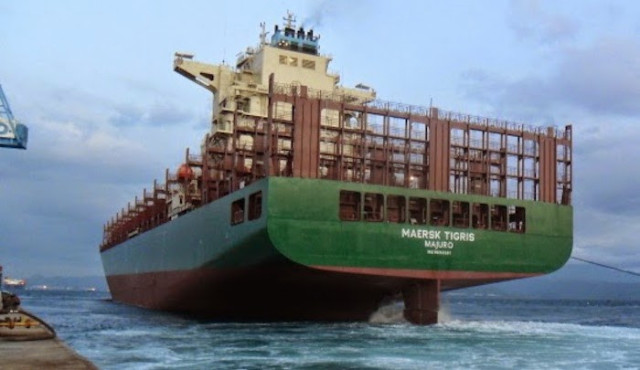
(CNN)Iran Revolutionary Guard patrol boats fired shots at a commercial cargo ship and then intercepted the vessel, the M/V Maersk Tigris, which was crossing the Strait of Hormuz Tuesday morning, according to a senior U.S. military official.

Despite reports in some media, there are no Americans on board, the official said.

Pentagon spokesman Col. Steve Warren said it was “inappropriate” for the Iranians to fire the warning shot. The U.S. Navy has dispatched one maritime patrol and reconnaissance aircraft to observe and monitor the situation, Warren told reporters.

The ship, a Marshall Islands-flagged vessel, was transiting the Strait into the Persian Gulf on an internationally recognized maritime route when the the Iranian military contacted the vessel and directed the ship master to “divert further into Iranian waters,” according to Warren.

“The master was contacted and directed to proceed further into Iranian territorial waters. He declined and one of the IRGCN craft fired shots across the bridge of the Maersk Tigris,” said Warren, referring to the Iranian Revolutionary Guard Corps Navy. “The master complied with the Iranian demand and proceeded into Iranian waters in the vicinity of Larak Island.”

After the shots were fired, the Tigris issued a distress call which was picked up by U.S. forces in the area and the USS Farragut was ordered to head towards the incident. The closest U.S. warship was 60 miles from the incident. The Pentagon thinks about 30 individuals are on board.

The U.S. Navy has also sent aircraft to monitor its status.

According to the shipping company, which is in contact with the U.S. military, the Iranian military has boarded the ship.

Even though the Strait of Hormuz is in Iranian territorial waters, “innocent passage” is applied — ships are authorized to pass through the body of water assuming they abide by all the rules of the sea — because it is an internationally recognized shipping lane.

Warren said it was “to be determined” what the USS Farragut will do when it reached the vicinity of the incident….

Probably apologize.

RELATED ARTICLES:

Muslim Congressmen want to block “Islamophobic” Geert Wilders from entering U.S.

Islamic State in Rome and Milan: “We are on your streets, we are locating targets”