
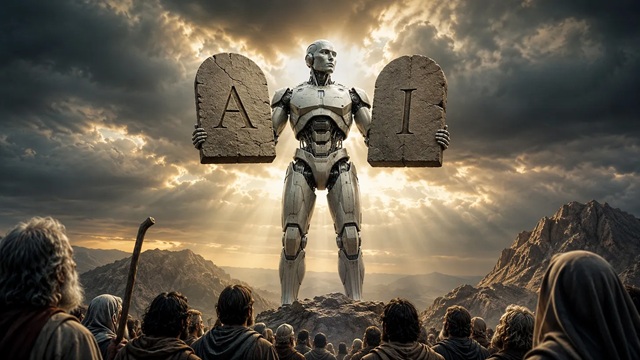
Over the Past Several Years, Here’s What We’ve Learned About AI And Why Christians Should Be Concerned
For a long time, artificial intelligence felt like a distant issue.
It sounded like something for Silicon Valley engineers, science fiction writers, or investors looking for the next big thing. Most Christians understandably viewed it as just another new technology — impressive, perhaps useful, maybe even overhyped, but not particularly spiritual in nature.
That assumption no longer holds.
Over the past several years, we have learned something important. AI is not just changing how people work. It is changing how people perceive truth, how institutions exercise power, how nations monitor populations, and how humanity increasingly imagines salvation without God.
What once looked like innovation is beginning to look like infrastructure.
And Christians need to understand what kind of infrastructure is being built.
This is not about claiming every new app is demonic. It is not about panicking over every chatbot, robot, or headline. It is about recognizing patterns.
It is about paying attention to the direction of the world. And it is about measuring technological developments against biblical warnings, rather than against the marketing language of corporations and politicians.
Technology itself is not the enemy. A hammer can build a church or break a window. Artificial intelligence is no different. In the hands of faithful believers, it can help pastors organize knowledge, preserve biblical teaching, strengthen communication, and serve the body of Christ.
But in the hands of fallen men, or systems divorced from truth, the same technology can become a force for deception, manipulation, and control.
The issue is not whether AI exists. The issue is who shapes it, what spirit guides it, and what authority it ultimately serves.
If the last few years have taught us anything, it is this:
The greatest danger of AI is not merely what it can do. It is the kind of world it is preparing people to accept.
The First Lesson: Deception Is Scaling
For most of history, deception had limits.
A liar could only speak to so many people. A propagandist could only print so many leaflets. A false teacher could only reach whatever room, church, city, or kingdom was within range.
AI changes that.
Now deception can be personalized, automated, multiplied, and distributed at a scale previous generations could not have imagined.
Machines can generate false images, voices, videos, articles, personas, and narratives in seconds. They can imitate familiarity, authority, emotion, and confidence. They can create the appearance of truth even when none exists.
This matters spiritually.
Scripture repeatedly warns that the final age will be marked by deception. Not only wickedness. Not only violence. But Deception. Counterfeit power. False signs. False confidence. Convincing lies.
That is what makes AI so dangerous.
Its greatest threat may not be that it becomes alive. Its greatest threat may be that it becomes believable.
A machine does not need a soul to deceive. It only needs a convincing imitation of intelligence. It only needs to sound wise. It only needs to appear informed. It only needs to answer quickly, confidently, and persuasively enough that people begin to trust the output more than they trust Scripture, conscience, or the voice of God.
That is not a minor cultural shift. That is a civilizational threat.
The Second Lesson: The World Is Building the Scaffolding for Control
When most people think about end-times control, they imagine some dramatic moment in the future when freedom suddenly disappears.
But systems of control do not arrive all at once. They are built gradually. They are normalized piece by piece. They are sold as convenience, safety, efficiency, and progress.
Over the past several years, we have watched the scaffolding go up all around us.
Digital identity systems.
AI-driven surveillance.
Facial recognition.
Predictive policing.
Behavioral monitoring.
Speech moderation systems.
Algorithmic control over what people see, hear, and believe.
Growing pressure to centralize information, finance, credentials, and access inside digital systems.
Each development is often presented as neutral. Sometimes even compassionate. But taken together, they reveal something much larger than a set of disconnected innovations.
They reveal a world being engineered for visibility, traceability, and compliance.
Christians should pay attention to that.
The Bible describes a future in which power over commerce, allegiance, and public life becomes centralized in unprecedented ways. For years, many people wondered how such a system could ever function on a global scale.
That question is becoming easier to answer.
AI is making it administratively possible.
AI is not the whole system by itself. But it may be the glue that binds the system together.
AUTHOR
Martin Mawyer
©2026 Majority Report. All rights reserved.
Please visit the Patriot Majority Report substack.
Leave a Reply
Want to join the discussion?Feel free to contribute!