
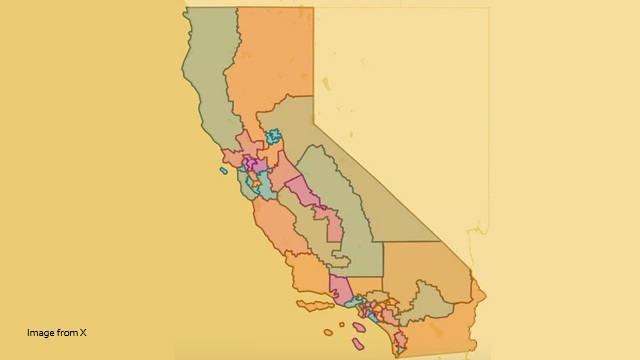
Justice Department Files Challenge to California Electoral Maps
Jesus A. Osete of the DOJ’s Civil Rights division: “Callais comes to California.” From the complaint: “[T]he Constitution almost never permits … a State to discriminate on the basis of race.” … California nevertheless discriminated on the basis of race “when it drew new congressional district lines using race as the predominant factor” in order to enhance Hispanic voting power. Specifically, the United States alleges that in violation of the Equal Protection Clause and Section 2 of the Voting Rights Act, “[r]ace was a predominant factor in drawing the boundaries of at least sixteen congressional districts,” all of which are Hispanic-majority. The Complaint alleges extensive direct evidence of race discrimination. The mapmaker Paul Mitchell made several “public statements confirm[ing] that he intentionally and directly used race and Hispanic demographics as criteria in designing the map.” Most notably, he publicly boasted that the “number one thing that [he] first started thinking about” was “drawing a replacement Latino majority/minority district in the middle of Los Angeles.” Several California legislators made similar public comments evincing their desire to empower Hispanic and black voters.
- The Ruling: Writing for the majority, Justice Samuel Alito determined that Louisiana’s mapmakers relied too heavily on race when drawing the districts to comply with the Voting Rights Act.
- Impact on the VRA: The decision makes it substantially harder to use Section 2 to challenge racially discriminatory voting maps. It allows states to use partisan goals or incumbent protection as a defense against allegations of racial gerrymandering.
Sen. Eric Schitt (R-MO): California’s mapmaker said his “number one thing” was increasing the Congressional representation of a particular racial group. I’m glad DOJ is taking California to court. This should be an easy case. Let’s get this map thrown out.
AUTHOR
Pamela Geller
RELATED ARTICLES:
SANTA MONICA: Violent Jew Hater Attacks Random Jewish Couple With a Bat, Then Sics His Dog On Them
New Jersey Poised to Elect AL QAEDA-Linked Muslim Candidate
EDITORS NOTE: This Geller Report is republished with permission. ©All rights reserved.
Leave a Reply
Want to join the discussion?Feel free to contribute!