
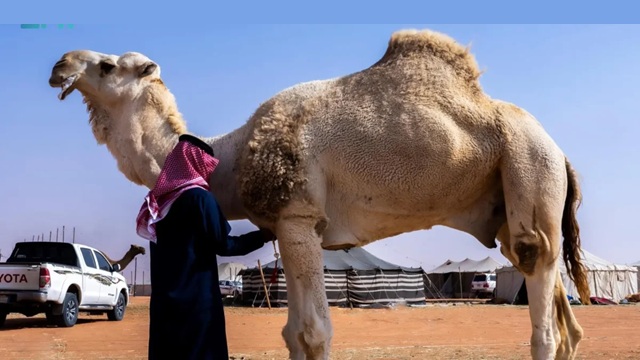
During COVID, some Muslims doctors recommended drinking camel urine, which actually caused MERS and other diseases
Because it’s in the Hadiths!
WATCH: Iranian Doctor recommends camel Urine for Corona
Muhammad’s Camel Urine ‘Medicine’ and the Deadly Virus It Helped Spread: A Decade of WHO Warnings
A hadith in which Muhammad prescribed camel urine as medicine continues to drive the practice in some Muslim communities, prompting more than a decade of WHO warnings against it as a transmission route for the deadly MERS-CoV virus that first emerged in 2012.
In 2012, a new coronavirus surfaced in Saudi Arabia and Jordan. Within a few years, epidemiologists working on the outbreak had identified the animal reservoir: dromedary camels. They had also identified one specific human behavior that spread it from camel to person. It wasn’t petting camels at a market. It was drinking their urine.
That is not a coincidence of modern hygiene habits. It is a direct continuation of a medical instruction attributed to Muhammad himself, recorded in the two most authenticated hadith collections in Sunni Islam, and still cited today, by name, as the reason people keep doing it.
What the World Health Organization Actually Said
In June 2015, as a MERS-CoV (Middle East Respiratory Syndrome coronavirus) outbreak in South Korea killed five people and infected dozens more, the World Health Organization issued a public warning. As reported by U.S. News & World Report at the time, WHO advised people to “avoid drinking raw camel milk or camel urine,” and to steer clear of close contact with camels generally, particularly in markets, farms, and barns where the virus was known to circulate.
The U.S. News piece noted, almost in passing, why this warning was necessary in the first place: “some people in Muslim countries believe drinking camel urine will cure ailments.”
This was not WHO inventing an eccentric new hygiene rule. It was public health investigators tracing a real transmission pathway back to its source, and finding that the source was a religious practice.
The warning did not expire when the 2015 outbreak faded from headlines. It is still there. WHO’s current MERS-CoV fact sheet, last updated in December 2025, a full decade after the South Korea outbreak, repeats the same instruction almost word for word: individuals at greater risk of severe disease should avoid “handling or drinking raw camel milk or camel urine, or eating meat that has not been properly cooked.” MERS-CoV has by now been reported to WHO from 27 countries, with a case fatality ratio of roughly 37 percent among confirmed cases.
The Instruction Behind the Practice
The belief that camel urine, especially mixed with camel milk, has curative properties is not folk superstition floating free of any religious source. It is anchored directly in an authenticated hadith, appearing in nearly identical form in Sahih al-Bukhari (widely regarded as the single most authoritative hadith collection in Sunni Islam) and in Sahih Muslim, the second most authoritative.
Sahih al-Bukhari 233 (Book of Ablutions), narrated by Anas ibn Malik:
“Some people of ‘Ukl or ‘Uraina tribe came to Medina and its climate did not suit them. So the Prophet ordered them to go to the herd of (Milch) camels and to drink their milk and urine (as a medicine). So they went as directed and after they became healthy, they killed the shepherd of the Prophet and drove away all the camels.”
Sahih al-Bukhari 5686, filed under a chapter heading that leaves no ambiguity about the subject, “To treat with the urine of camels”:
“The climate of Medina did not suit some people, so the Prophet ordered them to follow his shepherd, i.e. his camels, and drink their milk and urine (as a medicine). So they followed the shepherd that is the camels and drank their milk and urine till their bodies became healthy.”
Sahih Muslim 1671a confirms the same event, with Muhammad specifying the animals as the camels of the sadaqa (charity/alms herd):
“Allah’s Messenger said to them: ‘If you so like, you may go to the camels of Sadaqa and drink their milk and urine.’ They did so and were all right.”
All three narrations agree on the essential fact: Muhammad personally ordered a group of sick people to drink camel urine as medicine, and it is presented as having worked. What follows in the hadith, the group’s subsequent murder of the shepherd, theft of the herd, and brutal punishment, is a separate legal episode about apostasy and banditry. It has nothing to do with the medical instruction itself, and conflating the two would blur what is actually being documented here: an authenticated prophetic recommendation to drink animal urine as a remedy.
Scholars Disagree on the Ruling, Not on the Event
It’s worth noting, in fairness, that Islamic jurisprudence is split on what this hadith means for camel urine’s ritual status. The Maliki and Hanbali schools generally hold that the urine of animals whose meat is lawful to eat, including camels, is ritually pure and therefore permissible to consume. The Shafi’i and Hanafi schools take the opposite view, treating camel urine as impure, and read the hadith’s instruction as a case of necessity (darura), a specific emergency remedy given because no other treatment was available at the time, not a general religious prescription for all Muslims at all times. Either way, the drinking of camel urine is recommended. It just depends on the circumstance.
The Belief Is Still Active, and It Is Still Killing People
The clearest evidence that this isn’t a dead historical curiosity comes from WHO’s own published research. A 2023 study in the WHO’s Eastern Mediterranean Health Journal, titled “Use of camel urine is of no benefit to cancer patients,” followed 20 Saudi cancer patients (15 men, 5 women) between September 2020 and January 2022 who refused conventional chemotherapy in favor of drinking camel urine mixed with camel milk.
Below, a 2020 video of an Iranian doctor advising drinking camel urine for Covid, and leading by example:
The study’s authors state plainly what was driving the decision: “All of the patients believed that camel urine was a religious treatment and the advice came mainly from their community.” In their discussion section, the researchers explicitly trace the belief back to the same hadith cited above, citing Sahih al-Bukhari and Sahih Muslim by book and hadith number as the origin of the practice.
The results were not good. None of the 20 patients showed any clinical benefit. All had disease progression, documented by imaging and tumor markers. Two developed brucellosis, a bacterial infection contracted from animals. One of those two was treated and returned to chemotherapy; the other died of respiratory failure with clinical features the researchers say were consistent with MERS-CoV pneumonia, though no autopsy was performed to confirm it.
Eleven patients eventually changed their minds and returned to conventional treatment. Seven were too weak by then to receive further care, and died of the disease they had been trying to treat with camel urine.
The study’s conclusion does not hedge: “The promotion of camel urine as a traditional medicine should be stopped because there is no scientific evidence to support it.”
The Timeline
Put the three data points next to each other, and the pattern is hard to miss:
- 2012: MERS-CoV identified in Saudi Arabia and Jordan. Camels confirmed as the reservoir host.
- 2015: WHO issues a public warning during the South Korea outbreak, explicitly naming raw camel urine and milk as a risk to avoid, with contemporary reporting noting the religious belief behind the practice.
- 2020-2022: Saudi cancer patients, citing religious belief, choose camel urine over chemotherapy. Two develop brucellosis. Seven die after switching back to treatment too late.
- 2023: WHO publishes the clinical findings, tracing the belief directly to the hadith and calling for the practice to stop.
- 2025: WHO’s standing MERS-CoV fact sheet still carries the same warning against raw camel urine and milk, more than a decade after the original outbreak.
This is not a single overcautious health notice from a decade ago. It is a warning that has had to remain in force, unchanged, for more than ten years, because the underlying belief driving the exposure has never gone away. That belief has a specific, identifiable, textual source, and it is not ambiguous.
Camel urine as medicine is not a slur invented by critics of Islam. It is an authenticated instruction from Muhammad, preserved in Bukhari and Muslim. People still follow it today. Global health authorities are still investigating it. And according to the WHO’s own published research, it is still costing lives.
©2026 Vlad Tepes Blog. All rights reserved.
Leave a Reply
Want to join the discussion?Feel free to contribute!