
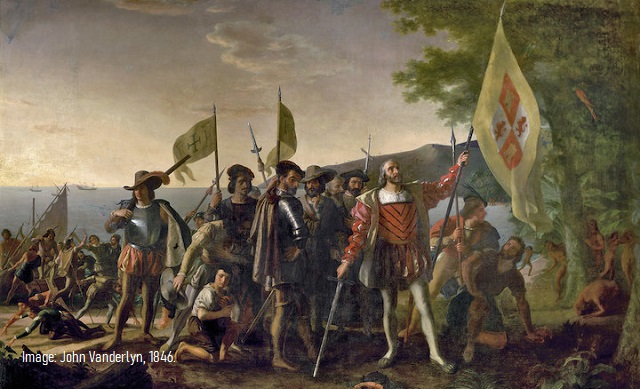
THE TRUTH: Christopher Columbus’s Views on Christian Struggles Against Muslim Powers
Recently a California Imam Amir Abdel Malik-Ali said: “Islam Is going to save America…there are major changes coming to this country…muslims were here before Christianity — Columbus said so in his diary.”
It’s all a lie, here’s the truth.
Here’s what is really in Christopher Columbus’s diary about Islam:
Christopher Columbus’s journal (and associated writings) reflects a worldview heavily influenced by the 15th-century Christian struggle against Muslim powers. Having witnessed the fall of Granada in 1492—the end of centuries of Muslim rule in Spain—Columbus framed his westward voyage largely through the lens of the Crusades and geopolitics with Islam.
In his diary and logbooks, Columbus refers to Islam and Muslims in three primary ways:
1. Framing the Mission as a Holy War against Islam
In the prologue of his journal addressed to King Ferdinand and Queen Isabella, Columbus explicitly references the defeat of Muslim rule in Spain and frames his journey as an extension of that Christian victory:
“After your Highnesses had ended the war of the Moors who reigned in Europe… you thought of sending me, Christopher Columbus, to the said regions of India, to see the said princes, and the people and the lands… and the manner which should be used to bring about their conversion to our holy faith.”
His goal was to reach the “Grand Khan” in the East to form a Christian-Mongol alliance, bypass Muslim-controlled Mediterranean trade routes, and secure gold to fund a new Crusade to retake Jerusalem from Muslim rule.
2. Describing Indigenous People with Moorish/Islamic Terminology
Because Columbus was trained to view “enemies” or foreign non-Christians through the template of Muslims (then called Moors in Spain), he frequently used Spanish-Islamic terminology in his journal to describe the Taíno people:
-
Weapons: He described Native weapons and cutlasses using the word alfanjes (scimitars, the curved blades used by Moorish armies).
-
Clothing: He described head coverings and sashes worn by Indigenous women as similar to Moorish sashes or garments.
3. Common Myths and Misinterpretations
A popular claim online asserts that Columbus wrote in his diary that he saw a mosque on a mountaintop in Cuba. However, primary text analysis shows this is a misinterpretation:
-
On October 29, 1492, Columbus wrote describing a mountain near Gibara, Cuba, noting it had a peak that looked like a “mezquita” (the Spanish word for mosque). He was describing a geographical mountain shape that resembled a dome or minaret, not an actual building or evidence of Muslims in the Americas.
-
Conquistadors who followed Columbus (such as Hernán Cortés) frequently used the word mezquita as shorthand for Native temples, further fueling later confusion.
Columbus’s diary does not record any actual encounters with Islam in the Americas; rather, it demonstrates how his entire mission and vocabulary were shaped by European rivalries with Muslim nations.
©2026 Dr. Richard M. Swier, LTC U.S. Army (Ret.). All rights reserved.
Leave a Reply
Want to join the discussion?Feel free to contribute!