
AI Frontier Leaders Say AI Cyberattacks Are Coming: What this warning means for you!
When more than 100 of the world’s leading technology, cybersecurity and financial companies agree on a major threat, we’d better pay attention.
OpenAI, Anthropic, Google, Microsoft, Amazon Web Services and dozens of other companies signed an open letter on August 27 warning that AI-powered cyberattacks are about to become far more widespread and sophisticated.
Their message is cold and blunt: “We have a limited window to strengthen cyber defenses.”
In addition, the letter called “on leaders across industry and government to bring the full weight of their technology, resources, and expertise to this effort.”
According to the letter, the danger is not confined to some distant technology company or government computer system.
It could reach the electric company that powers your home, the gas station where you fill your car and the local market where you buy groceries.
Hospitals, water-treatment plants and the infrastructure supporting the internet are all at risk. The companies warned that current security practices will not be enough as increasingly capable AI systems become available worldwide.
But what does all this mean for the average person?
I’d like to know, wouldn’t you?
The most immediate threat is that criminals, hostile governments and organized hacking groups will use AI to accelerate existing attacks, make them cheaper and more convincing, and carry them out more easily on a massive scale.
In practical terms, every criminal may soon have access to an automated team of researchers, programmers, impersonators and con artists that never sleeps.
Who better to ask what this threat could mean for families like yours than OpenAI itself?
Who better to ask what this threat could mean for families like yours than OpenAI itself?
So, I asked ChatGPT to translate the industry’s warning into plain language, explaining what it could mean for the average American and what families can do to protect themselves.
I hope you’ll find this plain-language explanation of OpenAI’s warning helpful.
Oh, and please do your family members and friends a favor by sharing this warning with the people you love:
The scam may know who you are
For years, most fraudulent emails and text messages were relatively easy to recognize. They contained misspellings, awkward language, strange greetings or requests that didn’t quite make sense.
AI can eliminate many of those warning signs.
Before contacting you, an AI system could search social media, public records, stolen databases and other online sources. It could learn the names of your relatives, where you work, which church you attend, where your children go to school and which companies you do business with.
It could then write a message specifically for you.
The fraudulent email may appear to come from your bank. The text message may mention your actual employer. The caller may know your child’s name. The request may arrive at exactly the moment when it seems most believable.
Instead of sending one poorly written message to a million people, criminals will be able to send a million individually tailored messages.
A familiar voice will no longer prove identity
One of the most frightening vulnerabilities is AI voice cloning.
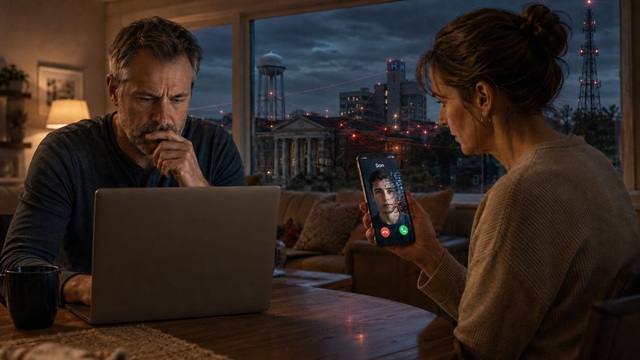
A criminal may need only a short recording from a social-media video, podcast, church livestream or voicemail to imitate someone’s voice. A parent or grandparent could receive a call that sounds exactly like a son, daughter or grandchild saying:
“I’ve been in an accident.”
“I’ve been arrested.”
“Please don’t tell Mom and Dad.”
“I need you to send money right now.”
The voice may sound frightened. It may use familiar expressions. An AI system may even be able to carry on a conversation and answer questions in real time.
The FBI has already warned that criminals are using AI-generated voices and videos to impersonate family members, coworkers, business partners and public officials. The technology does not need to be perfect. It only needs to sound convincing during a moment of fear and confusion.
A face on a screen is no longer proof of identity. Neither is a familiar voice.
Your email account may be the doorway to everything else
An email account is often the master key to a person’s digital life. Once criminals obtain access, they can search years of private correspondence, identify financial relationships and request password resets for other services.
AI can help an attacker examine stolen messages quickly, identify valuable information and imitate the account owner’s writing style. Friends and relatives may then receive believable requests for money from the victim’s real email address.
People who reuse the same password on several websites will face even greater danger. Once one service is breached, automated systems can try those credentials elsewhere almost instantly.
You can be harmed without being personally hacked
Good personal security cannot protect someone from every danger because other organizations already possess enormous quantities of information about them.
A hospital, pharmacy, school, insurance company, employer, church, retailer or government agency may hold names, addresses, medical records, Social Security numbers, financial information or private communications.
If one of those organizations is penetrated, its customers, patients, employees or members can become victims even though they did nothing wrong.
The consequences may include identity theft, fraudulent accounts, medical-information exposure, blackmail or years of attempts to misuse personal information. A stolen password can be changed. A stolen Social Security number, medical history or facial image cannot be replaced so easily.
Everyday services could be interrupted
The open letter specifically warns about attacks against hospitals, water systems and internet infrastructure.
That raises the possibility of people suffering physical and financial consequences from attacks occurring far away from their own homes. A successful cyberattack could leave:
- Hospitals postponing surgeries or struggling to retrieve patient records
- Pharmacies unable to process prescriptions
- Local governments unable to provide ordinary services
- Water utilities operating under emergency conditions
- Banks or payment systems temporarily unavailable
- Businesses unable to operate or issue payroll
- Internet or communications services interrupted
An attacker does not have to steal money from your personal bank account to disrupt your life. Striking the systems on which an entire community depends can harm thousands of people at once.
Churches and small organizations may become easier targets
Large corporations can employ teams of cybersecurity specialists. Most churches, ministries, medical practices, family businesses and local charities cannot.
These organizations often possess donor information, employee records, banking access and private communications while relying on a small number of employees or volunteers. That combination can make them attractive targets.
AI could help criminals impersonate a pastor, board member, ministry president, bookkeeper or vendor. A convincing message might request an urgent wire transfer, a change in payroll information, the purchase of gift cards or access to a shared document.
Ransomware criminals could also attack smaller organizations in far greater numbers. What was once too time-consuming for a skilled hacking group may become profitable when AI agents can automate much of the search, intrusion and extortion process.
The elderly will face a particularly cruel threat
Older Americans are already targeted by grandchild scams, romance scams, government impersonation, fake technical support and fraudulent investment offers.
AI can make every one of these schemes more believable.
A scammer may appear in a live video call wearing the face of a trusted person. A fake investment presentation may feature a well-known public figure. A supposed government agent may know enough personal information to sound legitimate. A romance scammer may generate photographs, voice messages and video conversations for a person who does not exist.
The criminal’s chief weapon will remain the same: emotional pressure. Fear, affection, embarrassment and urgency are used to prevent the victim from stopping long enough to verify the story.
What families should do now
The warning is serious, but individuals are not helpless. Several precautions can make a family much harder to deceive or penetrate.
Create a private family verification word. Choose a word or short phrase that family members can use to establish their identity during an emergency. Do not publish it or use something that can be discovered through social media.
Verify urgent requests through a second channel. If someone calls asking for money or sensitive information, hang up and call that person using a number you already know. Do not use the telephone number, link or contact information supplied in the suspicious message.
Use a different password for every important account. A reputable password manager can create and store strong, unique passwords so that the theft of one password does not expose everything else.
Turn on multifactor authentication. Whenever possible, use an authenticator application, passkey or physical security key. Never give an authentication code to someone who contacts you.
Protect your email account first. Because email can be used to reset other passwords, give it the strongest password and authentication protection available.
Install security updates promptly. Turn on automatic updates for computers, phones, tablets, internet routers and connected household devices. Many successful attacks exploit vulnerabilities for which a security update already exists.
Maintain protected backups. Important family photographs, financial records and business files should be backed up somewhere that ransomware cannot easily reach.
Limit what strangers can learn online. Public posts about relatives, birthdays, schools, workplaces, vacations and daily routines give scammers material for more believable impersonations.
Slow down. Urgency is often the clearest warning sign. Banks, police officers, government agencies and legitimate businesses do not demand immediate payment through gift cards or cryptocurrency.
The nature of cybercrime is changing
AI does not need to invent an entirely new crime to create a national danger. It only needs to make familiar crimes nearly free to produce, personally tailored, continuously operating and available to people who previously lacked the technical ability to carry them out.
That is the central meaning of this industry warning.
The technology companies are not merely predicting an increase in annoying spam. They are warning that AI may fundamentally change the economics of cybercrime, allowing attackers to pursue more victims, exploit weaknesses more rapidly and produce deceptions that are increasingly difficult to distinguish from reality.
Americans should not panic, but they should adjust one deeply rooted assumption: seeing is no longer necessarily believing, and neither is hearing.
Before sending money, revealing private information or granting access to an account, stop and verify the request independently. In the emerging age of AI-enabled cybercrime, a few minutes of caution may be one of the strongest defenses an ordinary person possesses.
AUTHOR
Martin Mawyer
Martin Mawyer is the founder of the Digital Intelligence Project and the President of Christian Action Network. He is the host of the “Shout Out Patriots” podcast, and author of When Evil Stops Hiding. For more action alerts, cultural commentary, and real-world campaigns defending faith, family, and freedom, subscribe to Patriot Majority Report.
©2026 Majority Report. All rights reserved.
Please visit the Patriot Majority Report substack.
Leave a Reply
Want to join the discussion?Feel free to contribute!