
From Dearborn to McKinney: The Growing Power of America’s Muslim Population Centers
Whether planned or not, concentration creates institutional and political power.
Until recently, few Americans would have included McKinney, Texas, on a map of the nation’s significant Muslim population centers.
That may be changing.
On August 4, the McKinney City Council unanimously approved a site plan for a new facility operated by the McKinney Islamic Association. The proposed development would occupy approximately five acres near residential neighborhoods and a high school.
But this would not be merely a neighborhood mosque.
The plans call for a 37,000-square-foot complex containing a mosque, educational facilities, meeting rooms, and a gymnasium. It would be designed to accommodate up to 3,000 people.
The approval proved controversial. Residents subsequently launched an effort to recall the mayor and three City Council members. Supporters of the recall now allege they have encountered intimidation and organized attempts to discourage residents from signing their petition.
Whatever ultimately happens with the recall, the controversy raises a larger question:
Why is a rapidly growing Texas suburb preparing for an Islamic institution capable of serving thousands of people?
And how many other American communities are undergoing similar changes?
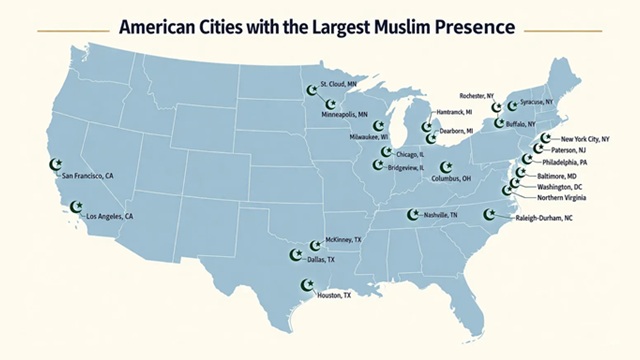
What This Map Actually Shows
This map is not a strict ranking of America’s Muslim populations.
Such a ranking would be difficult to produce with certainty because the United States Census does not ask Americans about their religion. Available estimates generally come from religious organizations, surveys, mosque membership studies, and independent research. The 2020 U.S. Religion Census provides helpful estimates, but much of its information is organized by counties and metropolitan areas rather than individual cities.
Instead, this map identifies places with one or more of the following characteristics:
- A substantial Muslim population
- A densely concentrated Muslim community
- Large or influential Islamic institutions
- Rapid population or institutional growth
- Increasing civic or political significance
Some locations, such as Dearborn, Hamtramck, Paterson, and Minneapolis, have long-established Muslim communities.
Others, including McKinney and Raleigh-Durham, may represent a different stage of development. Their Muslim populations may be less concentrated or less nationally recognized, but the institutional infrastructure is growing.
That distinction is important.
Population tells us how many people live in an area. Institutions tell us how firmly a community has established itself and how effectively it can preserve its identity, educate the next generation, organize its members, and participate in civic affairs.
Is There a Coordinated Strategy?
There is no evidence that all these communities were established as part of one centrally directed national plan.
The original explanations are generally more ordinary.
Some Muslim immigrants followed employment opportunities. Others settled near relatives or existing ethnic communities. Refugees were placed in particular cities by government agencies and charitable organizations. Professionals were attracted to universities, hospitals, technology companies, and government employment. Growing families moved from expensive urban neighborhoods into more affordable suburbs.
But the absence of centralized coordination does not make the eventual result insignificant.
Communities that begin through employment, refugee resettlement, affordable housing, or family migration can still develop considerable institutional and political strength.
Whether the concentration was planned or accidental, it is real.
That is the larger story behind this map.
The Patterns Behind the Map
Several strategic patterns stand out.
1. Gateway cities provide population and international connections
New York City, Paterson, Philadelphia, Los Angeles, San Francisco, Chicago, and Detroit have long served as gateways for immigrants.
New arrivals frequently settle near relatives, people from their countries of origin, familiar businesses, cultural organizations, and houses of worship. Each successive wave strengthens the community already in place.
Over time, the neighborhood can develop mosques, Islamic schools, halal markets, charities, legal organizations, media outlets, and political organizations.
Paterson, New Jersey, demonstrates this pattern particularly well. South Paterson is known as both “Little Istanbul” and “Little Ramallah.” The area contains substantial Turkish, Palestinian, Syrian, Jordanian, Bangladeshi, and other Muslim communities.
A settlement that begins as an immigrant neighborhood can eventually become a permanent religious and political center.
2. Declining industrial cities offer affordable places to establish concentrated communities
Buffalo, Rochester, Syracuse, Hamtramck, and portions of metropolitan Detroit have experienced industrial decline, population loss, or periods of inexpensive housing.
Those conditions created opportunities for immigrants and refugees to establish new communities at a cost that would have been impossible in New York, Washington, or coastal California.
Refugee resettlement has been particularly important in upstate New York. Buffalo, Syracuse, and Rochester have all ranked among prominent refugee-resettlement metropolitan areas. New arrivals helped stabilize neighborhoods and replace portions of the population lost during previous decades.
Affordable housing does more than give individual families somewhere to live. It allows extended families and people from the same cultural or religious background to settle near one another.
That proximity makes institution-building easier.
3. Fast-growing suburbs provide room for large institutions
McKinney illustrates another pattern.
The Dallas-Fort Worth region is experiencing rapid suburban growth. Communities such as McKinney offer more land than dense urban neighborhoods, making it possible to construct large religious and educational complexes.
A 37,000-square-foot facility with room for 3,000 people would provide more than prayer space. It could support religious education, youth activities, conferences, recreation, community meetings, leadership development, and charitable programs.
The same basic pattern appears in parts of metropolitan Houston, Dallas, Northern Virginia, and other expanding suburban regions.
The institution often becomes the center around which the community organizes itself.
4. Government and university centers provide access to influential institutions
Northern Virginia, Washington, Raleigh-Durham, Minneapolis, Los Angeles, and the San Francisco Bay Area contain major universities, government agencies, hospitals, technology companies, legal organizations, and media institutions.
These regions attract educated immigrants and professionals.
Northern Virginia is especially noteworthy because of its proximity to Congress, federal agencies, foreign embassies, government contractors, lobbying organizations, and national media.
The Raleigh-Durham area contains major universities, medical institutions, and the Research Triangle’s technology economy. The Islamic Association of Raleigh describes itself not only as a mosque, but also as a school and gathering place serving the Triangle’s Muslim community.
The San Francisco Bay Area combines immigration with technology, professional employment, wealth, and philanthropic networks. A major regional study estimated that nearly 250,000 Muslims lived in the six-county Bay Area, making it one of America’s largest Muslim population centers.
These communities possess more than numbers. They include people with access to institutions that can shape public policy, education, technology, law, medicine, and public opinion.
5. Refugee resettlement can create lasting population centers
Minneapolis and St. Cloud became important centers of Somali settlement after refugees began arriving in Minnesota during the 1990s.
The original movement was driven by war, refugee policy, resettlement organizations, employment, and family connections. Once a substantial Somali community became established, relatives and other Somali families had additional reasons to settle in the same region.
Minnesota now contains one of the country’s most prominent Somali populations.
That population has also become increasingly involved in public affairs. Somali Americans have sought local office, served in the Minnesota Legislature, and won representation in Congress. In St. Cloud, community members have openly discussed increasing their participation in municipal government, although reporting also demonstrates that Somali voters do not necessarily share identical political views.
That is an important qualification.
Political influence does not require every community member to think or vote alike. It requires sufficient population, organization, leadership, voter participation, and institutional durability to make the community politically consequential.
6. Concentration multiplies influence
A community’s political importance is not determined solely by its nationwide population.
A relatively small population spread evenly across the country may exercise limited local influence. The same number of people concentrated in a city, county, or legislative district can become an important electoral constituency.
Dearborn and Hamtramck demonstrate the difference.
Hamtramck became the first American city to elect an entirely Muslim mayor and City Council. Dearborn elected its first Muslim mayor and recognizes Islamic holidays for municipal employees. Muslim and Arab-American voters in metropolitan Detroit have also demonstrated that they cannot automatically be claimed by either political party.
These voters may disagree among themselves. Their political preferences may change from one election to another. But elected officials must nevertheless take their concerns seriously because they are numerous, concentrated, organized, and capable of affecting election outcomes.
That is inherent political power.
It exists regardless of whether anyone deliberately planned the original settlement pattern.
From Population to Institutional Stronghold
The word “stronghold” must be used carefully.
It does not mean that every resident of a city is Muslim. It does not mean every Muslim belongs to the same organization, supports the same candidates, or shares the same political priorities.
It means that a community has acquired sufficient population and infrastructure to maintain itself across generations.
A durable community generally contains more than houses of worship. It may include:
- Religious and private schools
- Youth and family programs
- Charitable organizations
- Businesses and professional networks
- Legal and political advocacy groups
- Candidate-recruitment and voter-engagement organizations
- Community media
- Social-service providers
- Meeting and recreational facilities
Each institution performs its own function. Together, however, they form an ecosystem.
That ecosystem can educate children, train leaders, raise money, mobilize voters, provide social services, influence public discussions, and preserve a common religious or cultural identity.
The individual institutions do not have to be controlled by one central authority for their combined influence to be significant.
Their cumulative effect produces the stronghold.
Why McKinney Belongs on the Map
McKinney does not yet have the national reputation of Dearborn, Hamtramck, Paterson, or Minneapolis.
Its significance comes from what is being constructed.
The proposed McKinney Islamic Association complex would combine worship, education, recreation, and community organization within a facility capable of accommodating thousands.
That represents long-term institutional capacity.
A small congregation may serve the immediate spiritual needs of its members. A multifaceted complex of this size can help anchor a regional community for generations.
McKinney therefore illustrates why Americans should look beyond today’s population rankings.
By the time a city becomes nationally recognized as a Muslim population center, the institutions supporting that population may have been developing for decades.
How the Locations Break Down

The Power Exists Either Way
These locations did not all develop for the same reasons.
Some emerged from industrial employment. Others grew through refugee resettlement, family migration, universities, government work, professional opportunities, or affordable suburban land.
There may have been no single architect drawing this national map.
But the absence of a central architect does not diminish what has been built.
Political influence does not become less real because no one originally planned the population concentration. Institutional strength does not become less consequential because employment or refugee policy produced the first settlement. A stronghold created by happenstance still functions as a stronghold once its population and institutions are firmly established.
Taken together, the locations on this map show that Muslim influence in America is no longer confined to a few familiar urban enclaves.
It now extends through historic gateways, industrial cities, growing suburbs, refugee destinations, government centers, university regions, and technology corridors.
The map therefore does not simply show where Muslim Americans live.
It is showing where population, institutions, organization, and civic influence have begun reinforcing one another.
McKinney may never become another Dearborn.
But the proposed construction of a 37,000-square-foot Islamic complex demonstrates why looking only at the best-known Muslim population centers can cause Americans to overlook where the next durable centers are already developing.
The question is no longer only, “Where are America’s largest Muslim populations?”
The more important question is this:
Where have those populations acquired the institutions and concentration necessary to shape the future of their communities?
That is what this map begins to reveal.
AUTHOR
Martin Mawyer
Martin Mawyer is the founder of the Digital Intelligence Project and the President of Christian Action Network. He hosts the “Shout Out Patriots” podcast and wrote When Evil Stops Hiding. For more action alerts, cultural commentary, and real-world campaigns defending faith, family, and freedom, subscribe to Patriot Majority Report.
©2026 Majority Report. All rights reserved.
RELATED ARTICLE: Bronx Latino Residents Protest Muslim Takeover
Please visite the Patriot Majority Report substack.
Leave a Reply
Want to join the discussion?Feel free to contribute!