
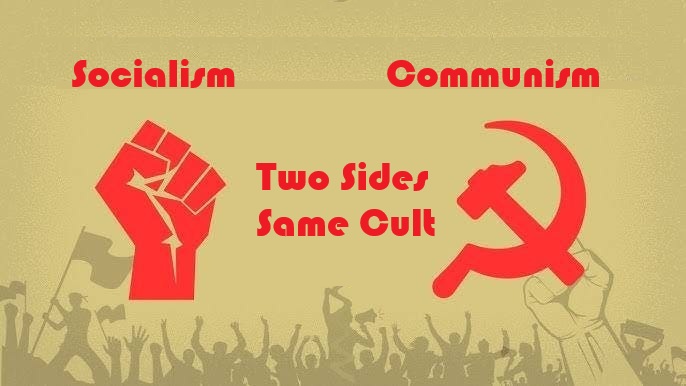
Socialism and Communism Are Two Sides of the Same Cult
“The goal of socialism is communism.” — Vladimir Lenin
“How do you tell a Communist? Well, it’s someone who reads Marx and Lenin. And how do you tell an anti-Communist? It’s someone who understands Marx and Lenin.” — Ronald Reagan, Remarks in Arlington, Virginia (1988)
“Socialism is a philosophy of failure, the creed of ignorance, and the gospel of envy, its inherent virtue is the equal sharing of misery.” — Sir Winston Churchill, Speech at the Conservative Party Conference (1948)
“Political power grows out of the barrel of a gun.” — Mao Zedong, Problems of War and Strategy (1938)
“The theory of the Communists may be summed up in the single sentence: Abolition of private property.” — Karl Marx & Friedrich Engels, The Communist Manifesto (1848)
“Socialism means a classless society, or it means nothing at all.” — George Orwell,The Lion and the Unicorn (1941)
“The problem with socialism is that you eventually run out of other people’s money.” — Margaret Thatcher, Interview for TV-am (1976)
While socialism and communism are distinct political and economic ideologies, they share foundational origins and core theoretical principles. Both emerged as critiques of capitalism during the Industrial Revolution, primarily through the work of Karl Marx and Friedrich Engels.
- Shared Critique of Capitalism: Both systems view capitalism as inherently exploitative, arguing that it creates class divisions, inequality, and the concentration of wealth and power in the hands of private capital owners (the bourgeoisie) at the expense of the working class (the proletariat).
- Public Ownership of Means of Production: Both frameworks advocate for collective or public control over key industries, resources, and the means of production (such as factories, land, and infrastructure), rather than leaving them under private ownership for profit.
- Focus on Social Equality: A primary objective of both ideologies is to reduce or eliminate socio-economic inequality, ensuring that societal resources and wealth are distributed to benefit the public interest rather than private profit.
- Centralized Planning: Both models place a strong emphasis on economic planning and regulation—whether through state authority, public councils, or community organizations—to direct production, set prices, and distribute goods based on societal needs rather than free-market forces.
- Theoretical Continuum: In classical Marxist theory, socialism is conceived as a transitional stage between capitalism and communism. Under this view, a socialist society gradually restructures the economy and social relations until it eventually evolves into communism.
Key Distinction While both aim for public control, socialism typically allows for state governance, mixed economic structures, and varying degrees of private property. In contrast, ultimate communism envision a stateless, classless, and moneyless society where all property and goods are held entirely in common.
America under the Democrat Socialists is at the state governence level, once Democrat Socialists, like Mandami, are elected they quickly move to a stateless, classless, and moneyless society.
Remember this when you vote in the 2026 Mid-Term Elections and the 2028 Presidential Election.
©2026 Dr. Richard M. Swier, LTC U.S. Army (Ret.). All rights reserved.
Leave a Reply
Want to join the discussion?Feel free to contribute!