
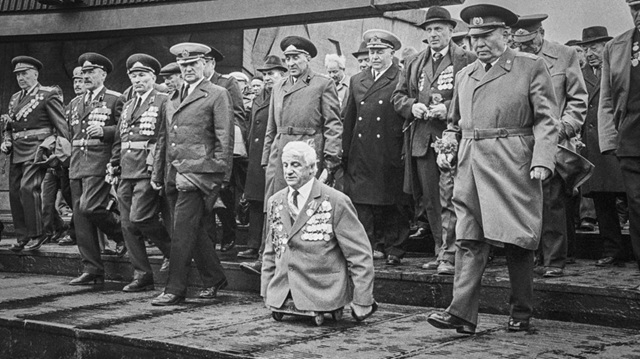
How Stalin Dealt with Red Army Amputees — Feel the ‘Warmth of Collectivism’
After the guns of World War II fell silent, the Soviet Union’s city squares filled up – not so much with monuments — but with war amputees — so many in fact that they crowded out private citizens on Sunday strolls. Virtually uncared for, uncompensated and unmarriable, the young, crippled men — among them double and even triple amputees — took to hobbling to the dusty public squares to find companionship at least with fellow amputees. The State largely ignored them. So, eventually they had to beg and became a public nuisance. With time, the public gave them unflattering nicknames. Legless veterans in due course became “scooters,” and quadruple amputees — “tea pots.” Eventually they all became “parasites.”
The statistics on military amputations beggar belief. Back in the US Civil War, one soldier in fifty came home without an arm or a leg – to heartfelt laments as Johnny came hobbling — rather than marching — home again. During World War Two, with advanced American medical care, that number fell to only one in a thousand. Just 1 in 1,000 Americans returned an amputee! How did the Soviet Union fare in this horrifying statistic in the same war? How did the Red Army do? One out of four! Of the 35 million Soviet citizens who served in the Red Army, nearly 5.5 million returned amputees. And the Americans? — only fifteen thousand. How could such a human catastrophe befall the Soviet Union?
An account of a typical day at the Soviet-German front helps open our eyes. [This excerpt comes from a soon-to-be-published book, “Orphans of War”]:
“Half drunk on compulsory vodka rations, Slota’s unit marched down the access road for their turn at the Germans as the thunder of artillery began to drown out the patter of heavy rain. Along the muddy ditches on both sides of the road, endless lines of wounded soldiers were already trudging back — many horribly maimed, some helping each other limp along, and a few poor devils holding in their bluish intestines spilling out over their hands — heading toward overburdened medical stations. With the lines of wounded backing up, treatment increasingly emphasized speed, and, as everyone knew, amputation the panacea — less costly and time-consuming to amputate and send the chumps back home — while the well-oiled recruitment machine steadily rolled out new recruits!
“As the Soviet dead and wounded continued to pile up, some German soldiers confided in their journals that they never dreamed they’d see anything like it – trained soldiers blowing themselves up crossing live minefields — wave after wave, while German machine guns finished off the rest. What army treated their soldiers that way? Did the Russians keep hidden manpower reserves somewhere no one suspected? Such reckless self-annihilation, the soldier wrote, in a way terrified him, disoriented him — something beyond comprehension.”
How did Stalin view these legions of recklessly sacrificed men? — possibly like he viewed the “New Soviet Man” of Communist ideology, the mass-produced, interchangeable Homo Sovieticus. What was the common man good for, after all, if not as expendable ammunition for the ultimate victory of the Revolution, the new Shining Future for All Mankind? Could the welfare of the common man compete at all with this lofty vision?
In fact, earlier in the war, as the Reds retreated in the face of the Blitzkrieg, Stalin ordered whole Soviet factories dynamited, together with the workers still inside, and mines flooded with the miners underground — to keep these prizes out of German hands. Americans, by contrast, practiced an entirely different policy — one of not a soldier nor civilian left behind, a policy of even stopping whole battlefield initiatives to retrieve and rescue any of their own trapped people.
With the defeat of Nazi Germany — a joint US-Soviet effort — Stalin celebrated his Victory Parade in Red Square on June 14, 1945. America’s top military leader, General Dwight Eisenhower joined his Soviet counterpart, Marshall Zhukov on the reviewing stand. As Red Army tanks clanked by in the overcast day, Eisenhower asked Zhukov how he had dealt with the enemy’s minefields — always a big problem for the Americans. Zhukov, surprised at the question, said he simply ran his own soldiers through the minefields to clear them. No problem. Alright, but the wounded?
So how did Stalin finally deal with these millions of amputees clogging every major Soviet city square? Grateful for their sacrifice? Hardly. To preserve the unblemished image of Soviet victory, of a glorious Soviet future, he ordered them rounded up in waves and shipped to distant sanitoria and especially to a faraway island deep in the Valaam Archipelago — out of sight, out of mind.
AUTHOR
Darian Diachok
©2026 SPIDER & THE FLY The False Allure of Communism. All rights reserved.
Leave a Reply
Want to join the discussion?Feel free to contribute!