
What is the true meaning of Thanksgiving?
The true meaning of Thanksgiving is two things stacked on top of each other: a genuine, ancient human practice of gratitude, and a manufactured civic ritual built in the 19th century to hold a fracturing country together.
Most people only ever get taught the second one and mistake it for the first.
Who Commercialized Thankgiving
Nobody did it in one stroke. Thanksgiving was commercialized in layers, by four different groups of people over about 80 years — and the version you grew up with is closer to a 19th-century magazine’s marketing department than to Plymouth Rock.
The Magazine Publisher Who Invented the Holiday
Sarah Josepha Hale, editor of Godey’s Lady’s Book — the most widely read women’s magazine of the era, and essentially a fashion catalog with essays stapled in — campaigned for a national Thanksgiving for decades. She lobbied governors, wrote endless editorials, and personally petitioned Lincoln, who finally issued the proclamation in October 1863, in the wake of Gettysburg. A domestic holiday of family, home, and table was good for circulation and good for wartime morale. Both got what they wanted.
Her 1827 novel Northwood contained an idealized Thanksgiving dinner scene that did more to fix the menu in the public imagination than 1621 ever did.
The Department Stores
This is where the money showed up.
- 1920: Ellis Gimbel of Gimbels in Philadelphia staged the first formal Thanksgiving parade — a route from City Hall to his store, ending with Santa Claus climbing a ladder to greet children and collect wish lists. Not a civic celebration. A customer acquisition funnel.
- 1924: Macy’s copied it in New York, originally calling it a “Christmas Parade.” It ran on Thanksgiving specifically to plant Christmas in November and tie department-store Santa to the holiday.
- 1939: FDR moved Thanksgiving up a week at the behest of retailers — Fred Lazarus Jr. of Federated Department Stores is the name attached to the lobbying — to add shopping days to the Christmas season. The result was “Franksgiving,” half the country celebrating on one Thursday and half on another, until Congress fixed it to the fourth Thursday in 1941.
Black Friday Was a Police Term, Then a Marketing Campaign
Philadelphia cops coined “Black Friday” in the 1950s–60s for the traffic, crowds, and shoplifting chaos of the day after Thanksgiving — merchants tried and failed to rebrand it “Big Friday.” Retailers later retrofitted the “red to black” accounting story, which is a PR invention, not history. It only went national in the 1980s and global in the ’90s.
The Point
The holiday’s imagery — the buckle hats, the shared table, the turkey — was manufactured in the 1840s–1860s by magazine writers and illustrators building a usable national myth. Its economic function was bolted on in the 1920s–1940s by department stores, then formalized into a discount stampede in the 1980s. A holiday sold to the public as timeless tradition is a fairly recent product, and the people who built it had circulation figures and quarterly earnings in mind.
The part that’s myth
The story you got in elementary school — Pilgrims and Indians, buckled hats, a harmonious multicultural potluck — is essentially a 19th-century stage production. What actually happened in 1621 was a three-day harvest feast at Plymouth after a brutal first year, attended by Wampanoag men from the surrounding area. It wasn’t called Thanksgiving, it wasn’t annual, and it wasn’t a symbol of anything. It was one meal in a tense diplomatic relationship that later collapsed into war.
The Pilgrims’ actual “thanksgivings” were something else entirely: days of fasting and prayer, sober religious observance, not turkey and football.
The part that’s real history — and revealing
The holiday you celebrate is a political artifact, and the record is clear on this:
- Sarah Josepha Hale — editor of Godey’s Lady’s Book, author of “Mary Had a Little Lamb” — campaigned for a national Thanksgiving for 36 years, starting with essays in 1827 and a letter-writing campaign from 1846. Her motive was explicitly political: a single shared day, she believed, could ease the growing sectional split between North and South.
- Lincoln’s proclamation of October 3, 1863 — three months after Gettysburg — made it official. He didn’t write it; Secretary of State William Seward did. It was one of nine such proclamations Lincoln issued during the war.
- Read the actual text. It’s not a celebration. It asks Americans to give thanks “with humble penitence for our national perverseness and disobedience” and to commend to God “all those who have become widows, orphans, mourners or sufferers in the lamentable civil strife.” It’s a wartime document designed to bind a bleeding nation together and sanctify the Union cause.
- FDR moved it in 1939 to extend the Christmas shopping season — a naked commercial calculation — and Congress fixed it to the fourth Thursday in 1941.
- The parade and the game arrived on schedule with mass commercial culture: Macy’s in 1924, the NFL in 1934.
So: a magazine editor’s unification project, a Secretary of State’s wartime prose, a president’s political need, and a retailer’s calendar. That’s the institutional layer. It exists to make a population feel like one people — which is exactly what national rituals are for, and exactly why they get dressed up as ancient tradition.
The part that’s actually true
Strip the costume off and you’re left with something older and better than the myth: a designated day to stop, look at what you have, and say so out loud, in front of the people you love.
Gratitude is not a sentiment; it’s a discipline. It’s the antidote to the two things that corrode a life — resentment about what you lack and entitlement about what you’re owed. A person who can’t be grateful can’t be satisfied, no matter how much arrives. That’s not folklore; it’s the oldest observation in every serious tradition.
And the setting matters. Thanksgiving is one of the last remaining American holidays built around the table and the family rather than the individual — no gifts to buy, no costume to wear, no identity to perform. You sit with people you didn’t choose, some of whom you’d rather not, and you eat. In a country that has spent decades dissolving the household into a collection of separate consumers, that’s a genuinely countercultural act, and it’s why the holiday survives even as its origin story rots.
The short answer
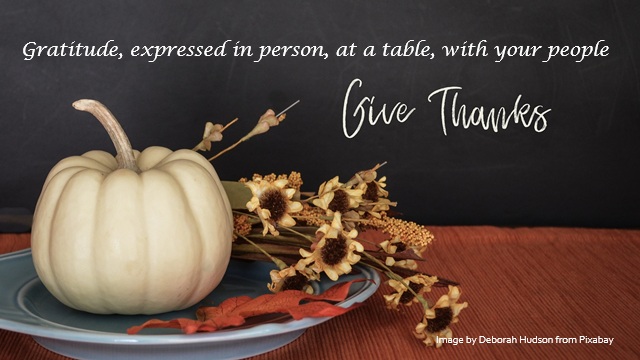
The true meaning is gratitude, expressed in person, at a table, with your people — and the machinery around it — the myth, the parade, the shopping calendar — is scaffolding built by people who understood that a nation needs shared ritual and were happy to invent one.
Keep the gratitude. Keep the table. Be skeptical of anyone selling you the costume.
©2026 Dr. Richard M. Swier, LTC U.S. Army (Ret.). All rights reserved.
Leave a Reply
Want to join the discussion?Feel free to contribute!