
What is Hanukkah and why is Celebrating it so Important Given the Growth of Anti-Semitism
Hanukkah (also spelled Chanukah) is a major Jewish holiday celebrated for eight nights and days, traditionally known as the Festival of Lights. Its name comes from the Hebrew word ḥănukkāh (חֲנֻכָּה), which means “dedication” or “consecration.”
At its core, Hanukkah commemorates both a historical victory for religious freedom and a miracle of light that preserved the Jewish temple.
The Historical Meaning: Rededication & Religious Freedom
The Context (2nd Century BCE): Judea was under the rule of the Seleucid Empire, led by King Antiochus IV Epiphanes, who sought to force Hellenistic (Greek) culture and practices onto the Jewish people and outlawed core Jewish observances.
The Maccabean Revolt: Led by Mattathias and his son Judah Maccabee, a group of Jewish rebels—the Maccabees—fought back against oppression and reclaimed Jerusalem.
Rededicating the Temple: After retaking the Second Temple in Jerusalem (around 164 BCE), the Maccabees cleansed it of pagan idols and rededicated it to the worship of God—the exact event for which the holiday is named.
The Miraculous Meaning: The Oil That Lasted Eight Days
According to rabbinic tradition, when the Maccabees sought to light the temple’s menorah (candelabrum), they found only a single cruse of pure, uncontaminated olive oil bearing the high priest’s seal.
That small supply should have lasted for just one day, yet it miraculously burned for eight days—long enough for fresh oil to be pressed and prepared. This is why Hanukkah lasts eight days.
Key Traditions & Symbolism
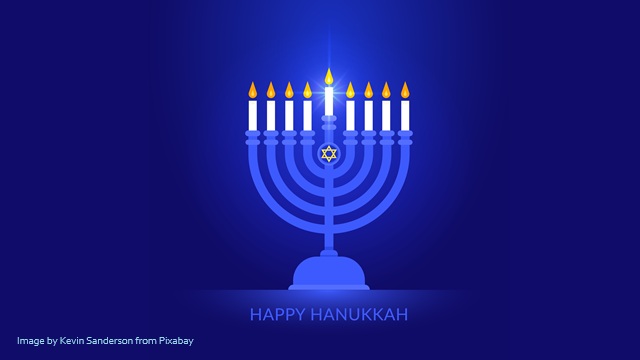
The Hanukkiah: Unlike a traditional seven-branched temple menorah, a Hanukkah menorah (often called a hanukkiah) holds nine branches—eight for the nights of the holiday and one elevated or set-apart branch (the shamash, or “helper” candle) used to light the others.
Lighting Candles Each Night: One candle is added each evening (starting with one on the first night plus the shamash), placed prominently in a window or doorway to publicize the miracle (pirsumei nisa).
Foods Fried in Oil: Traditional foods like latkes (potato pancakes) and sufganiyot (jelly-filled donuts) are fried in oil to honor the miracle of the oil.
Dreidel & Gelt: Children often spin a four-sided top called a dreidel and receive Hanukkah gelt (traditionally money, now often chocolate coins), customs that carry ties to teaching Torah, sharing generosity, and celebrating resilience.
Timing on the Calendar
Hanukkah begins on the 25th day of Kislev in the Hebrew calendar, which usually falls in late November or December on the Gregorian calendar. Because the Hebrew calendar is lunisolar, the exact dates shift from year to year.
Celebrating Hanukkah in 2026 matters for the same reason any minority’s public religious practice matters: it keeps a community’s identity in its own hands instead of letting outsiders define it, and it’s a visible assertion that people don’t need permission to worship.
Continuity — ritual is how a tradition survives generations; a menorah lit publicly does more for that than any statement about tolerance.
Religious liberty as a principle, not a favor — the right to practice openly belongs to everyone, and it’s strongest when exercised rather than begged for.
Pushback against intimidation — visible celebration denies anyone the satisfaction of driving a community into hiding, which is the actual goal of harassment.
One distinction worth holding: real hostility toward Jews deserves plain condemnation, and so does the habit of stretching “antisemitism” into a catch-all that swallows legitimate criticism of organized institutions and power. Confusing the two corrupts the first and weaponizes the second.
Every state has documented antisemitic incidents — the ADL’s 2025 audit logged 6,274 incidents across all 50 states and D.C., up about five-fold from a decade ago. The concentration, though, follows Jewish population, not some national distribution.
States that have Documented Anti-Semitic Attacks
Top 10 States by Documented Incidents (2025)
- New York — 1,160 (also 90 assaults, 44% of the national total)
- California — 817 (398 in LA County alone)
- New Jersey — 687 (139 in Bergen County)
- Florida — 319 (record vandalism and assault for the decade)
- Pennsylvania — 281
- Massachusetts — 279
- Illinois — 202 (79% in Cook County)
- Texas — 188
- Maryland — 181
- Colorado — 167 (including the Boulder attack that killed one and injured twelve)
Worth noting: reported totals fell 33% from 2024’s record 9,354, but that drop is mostly accounting — bomb threats collapsed (California went from 192 to 5) and campus incidents fell sharply after institutional “engagement.”
Remove the Israel/Zionism-tagged incidents and New Jersey actually rose 8%. Assaults hit an all-time high nationally. Also keep in mind these are reported numbers filtered through an organization with its own definitional and funding interests — the real baseline is almost certainly higher, and the state rankings mostly measure where Jews live.
©2026 Dr. Richard M. Swier, LTC U.S. Army (Ret.). All rights reserved.
Leave a Reply
Want to join the discussion?Feel free to contribute!